



- The most profitable gaming platforms combine multiple revenue streams, including in-app purchases, subscriptions, ads, and battle passes.
- Development costs typically range from $50,000 for an MVP to $500,000+ for enterprise-grade gaming platforms.
- Scalable infrastructure, real-time multiplayer architecture, and cloud hosting are critical for long-term growth.
- Player retention features such as rewards, challenges, and social communities directly impact platform profitability.
- Security, fraud prevention, and payment compliance protect revenue and ensure a reliable player experience.
- Partnering with an experienced game development company like TekRevol can accelerate launch timelines and maximize ROI.
You want to build a gaming platform. You want it to make money. To build a profitable gaming platform, combine a scalable technology foundation with effective monetization models such as in-app purchases, subscriptions, ads, or battle passes.
Most gaming platforms fail not because the games are bad, but because the business model was an afterthought. Developers focus on gameplay, skip the monetization strategy, and wonder why users play but don’t pay. The solution is to treat revenue design as a core product decision from day one, not a layer you add later.
That’s where TekRevol comes in. As a mobile game development company, TekRevol has helped startups and enterprises build gaming platforms that are engineered to retain users and generate revenue. This guide breaks down everything you need to know, from choosing a business model to estimating your development cost.
What Is a Gaming Platform and How Does It Generate Revenue?
A gaming platform is a digital ecosystem where users discover, play, and interact with games, and revenue comes from how those users engage with content, features, and each other.
Understanding the Gaming Platform Business Model
A gaming platform isn’t just a game. It’s a system. It combines content, community, and commerce into one experience. Revenue flows from multiple channels, subscriptions, purchases, ads, and tournaments, and the most successful platforms tap more than one.
Types of Gaming Platforms in the Market
- Casual gaming platforms – Mobile-first, easy to pick up, monetized through ads and small purchases (Think Miniclip, Poki)
- Social gaming platforms – Community-driven with in-app purchases and gifting mechanics
- Fantasy sports platforms – Entry fees and prize pools drive revenue (DraftKings, FanDuel)
- Casino and betting platforms – House edge, rake, and subscription tiers
- Cloud gaming platforms – Subscription access to a game library (Xbox Cloud Gaming, NVIDIA GeForce Now)
- Esports platforms – Ticket sales, sponsorships, battle passes, media rights
Key Factors That Make a Gaming Platform Profitable
- Low user acquisition cost relative to lifetime value
- Multiple monetization layers working together
- High session frequency and retention
- Viral or community-driven growth loops
- Scalable infrastructure that doesn’t bleed money under load
Ready to Turn Your Idea into a Revenue-Generating Gaming Platform?
TekRevol builds gaming platforms with proven monetization models, secure infrastructure, and seamless user experiences designed for long-term growth.
Schedule a Free Consultation TodayWhich Gaming Platform Business Model Is the Most Profitable?
The hybrid monetization model, combining free-to-play access with in-app purchases, seasonal content, and ads, consistently generates the highest revenue across platform types.
Free-to-Play (F2P) Model
Free entry removes the barrier. Revenue comes from a small percentage of players (often 2–5%) who spend heavily. Fortnite built a billion-dollar business on this model without charging a single dollar for access.
Subscription-Based Gaming Platforms
Monthly or annual fees create predictable, recurring revenue. Xbox Game Pass and Apple Arcade use this well. It works best when your content library is deep enough to justify the ongoing cost.
In-App Purchases and Virtual Goods
Skins, power-ups, characters, boosts, digital goods have near-zero delivery cost and high margins. The key is making purchases feel meaningful, not mandatory.
Advertising-Based Revenue Model
Best for casual platforms with high daily active users. Rewarded video ads work particularly well; users opt in, watch a 30-second ad, and get in-game currency or a life. Less intrusive, higher completion rates.
Battle Pass and Seasonal Content Monetization
Popularized by Fortnite and adopted by dozens of titles. Users pay $5–$10 for a season pass and unlock rewards through play. It drives both purchases and daily engagement simultaneously.
Tournament and Entry Fee Revenue
Platforms take a percentage of entry fees as the house cut. The prize pool incentivizes participation, creating opportunities for players to make money from playing games while generating a steady revenue stream for the platform. This model scales as your player base grows.
NFT and Blockchain Gaming Models
Play-to-earn models allow players to own in-game assets and trade them. Revenue comes from transaction fees, primary sales, and platform cuts. This model is volatile and heavily regulatory-dependent; approach with caution.
Hybrid Monetization Strategies Used by Top Platforms
The most profitable platforms don’t pick one model. They stack them. A free-to-play game with a battle pass, cosmetic store, rewarded ads, and a premium subscription tier can generate revenue from every type of player: the spender, the grinder, and the casual user, which is exactly how to monetize a game effectively.
What Features Should a Profitable Gaming Platform Include?
A profitable gaming platform must include user authentication, a scalable game library, real-time multiplayer, payment integration, and a robust analytics dashboard; these are non-negotiable.
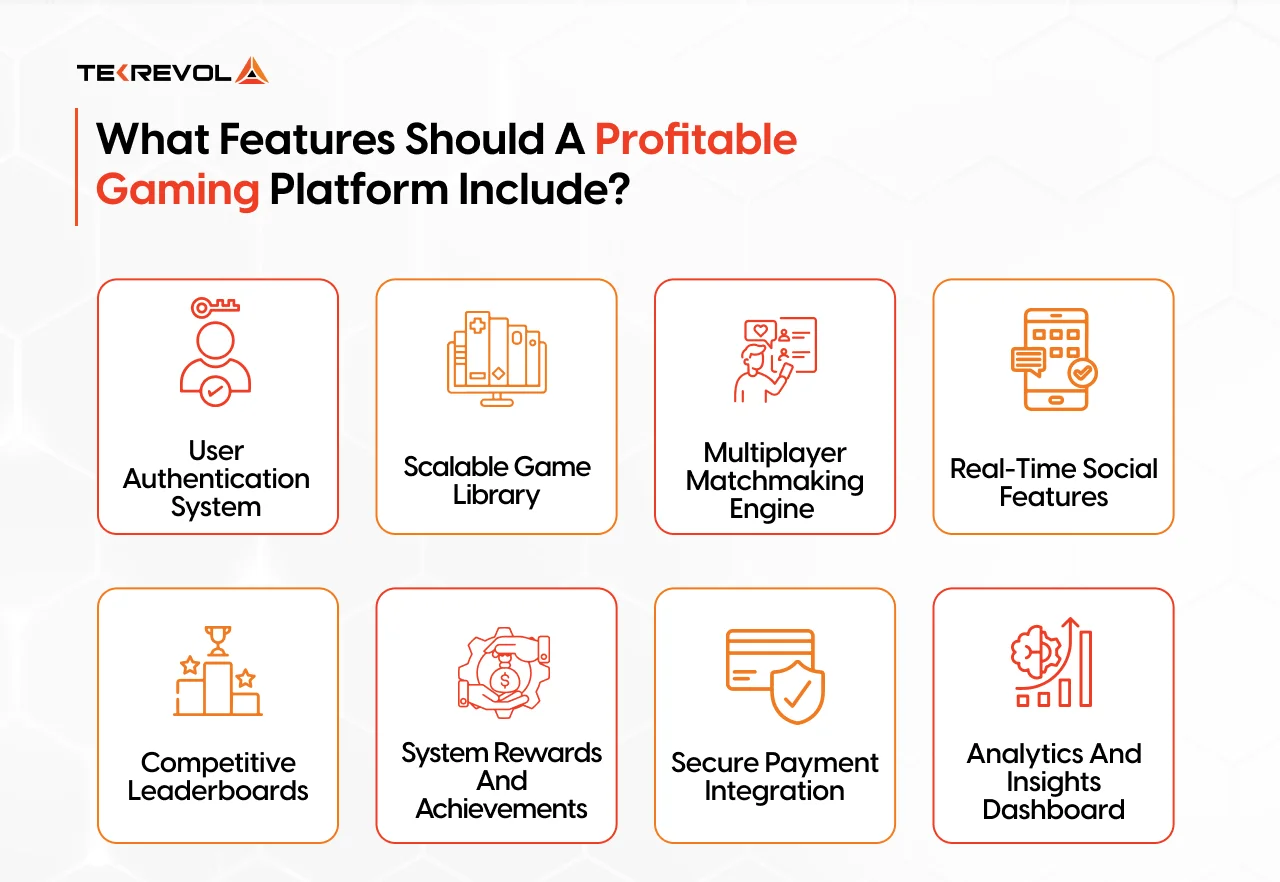
User Registration and Profile Management
Simple onboarding. Social login (Google, Apple, Facebook). User profiles with achievement history, stats, and customizable avatars. The easier it is to get in, the lower your drop-off.
Game Library and Content Management
A content management system that lets you add, update, or retire games without redeployment. Support for multiple game formats, categories, and age ratings.
Multiplayer and Matchmaking Systems
Skill-based matchmaking (SBMM) pairs players of similar ability. Reduces frustration, increases retention. Real-time infrastructure must handle concurrent sessions at scale.
Real-Time Chat and Social Features
In-game chat, friend lists, party systems, and direct messaging. Social features are not optional, they’re retention tools. Players who have friends on a platform are significantly less likely to leave.
Leaderboards and Ranking Systems
Global, regional, and friend-based leaderboards. Weekly resets keep competition fresh. Rankings create motivation loops that drive daily return visits.
Rewards, Loyalty, and Achievement Programs
Daily login bonuses, streak rewards, badge systems. Small, frequent rewards trigger dopamine responses and build habits. Achievement unlocks create a sense of progress even outside of active play.
Secure Payment Gateway Integration
Support for credit cards, PayPal, Apple Pay, Google Pay, and regional wallets. PCI DSS compliance is required. Localized payment options increase conversion in non-US markets.
Push Notifications and Re-Engagement Features
Trigger-based notifications for tournament starts, friend activity, and reward availability. Smart timing matters — poorly timed pushes increase uninstall rates.
Admin Dashboard and Analytics Panel
Real-time data on DAU, revenue, churn, session length, and conversion rates. Your team needs visibility to make informed product decisions fast.
Thinking About Developing a Multiplayer Gaming Platform?
TekRevol delivers high-performance matchmaking systems, leaderboards, real-time communication, and seamless gameplay experiences built to scale.
Let's Discuss Your ProjectHow Do Successful Gaming Platforms Keep Players Engaged?
Successful gaming platforms retain players through gamification, personalized experiences, community features, and consistent live events that give users a reason to return every day.
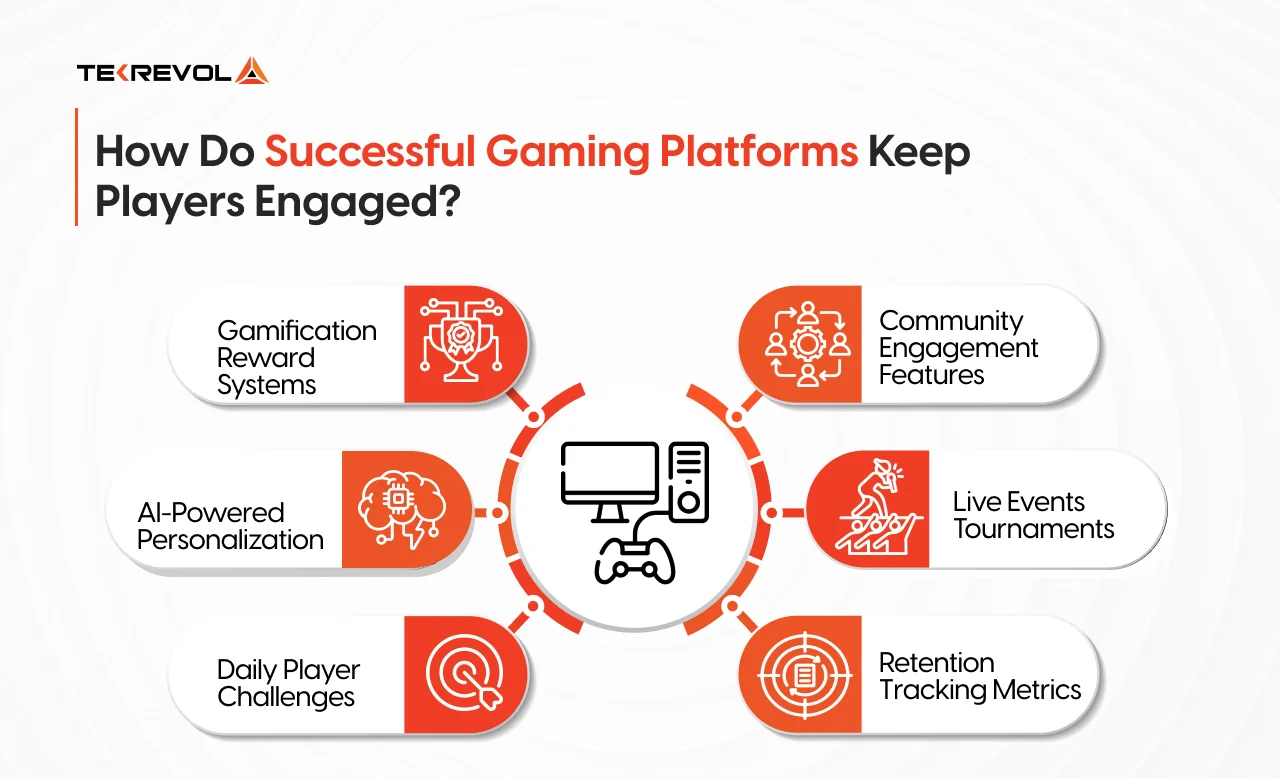
Gamification Techniques That Increase Retention
Progress bars, XP systems, tiered badges, daily streaks, and level-up ceremonies each create a small reward cycle that pulls users back.
Personalized Recommendations Using AI
ML models analyze play history to surface the right game, challenge, or event for each user. Personalization reduces time-to-engagement and increases session depth.
Daily Challenges and Reward Systems
Fresh challenges every 24 hours create a pull factor. Users return not just to play, but to complete the daily objective.
Community Building Features
Forums, guilds, and team gameplay build belonging. Users in a community have significantly higher LTV than solo players.
Live Events, Tournaments, and Competitions
Scheduled events spike engagement and give lapsed users a reason to return. Limited-time tournaments and holiday events create urgency.
Retention Metrics Every Gaming Business Should Track
- Day 1, Day 7, Day 30 retention rates — industry benchmarks: 40%, 20%, 10%
- Session frequency — how often users open the app per week
- Churn rate — percentage of monthly actives who don’t return the following month
- Feature engagement rate — which retention features actually drive return visits
What Is the Ideal Tech Stack for Gaming Platform Development?
The ideal tech stack for a gaming platform uses React or Unity for the frontend, Node.js or Go for the backend, WebSockets for real-time play, and AWS or GCP for scalable cloud hosting.
Frontend Technologies
- Web: React.js, Next.js
- Mobile: React Native, Flutter (cross-platform); Swift/Kotlin for native
- Game UI: Unity (for in-game interfaces), Phaser.js (browser-based 2D)
Backend Technologies
- Node.js – Fast, event-driven, ideal for real-time features
- Go (Golang) – High concurrency, low latency, great for game servers
- Python – Best for AI/ML services and data pipelines
Database Selection
- PostgreSQL – Relational data (user accounts, transactions)
- MongoDB – Flexible document storage (game state, user profiles)
- Redis – In-memory caching for leaderboards, session data, matchmaking queues
Cloud Infrastructure and Hosting
- AWS – EC2, Lambda, GameLift (dedicated multiplayer server hosting)
- Google Cloud – Kubernetes, Agones (open-source game server scaling)
- Azure PlayFab – Turnkey backend-as-a-service for gaming
Real-Time Communication Technologies
- WebSockets – Bidirectional, low-latency communication
- WebRTC – Peer-to-peer for voice/video chat
- Socket.io – Abstraction layer over WebSockets with fallback support
Game Engines and Development Frameworks
- Unity – Dominant for 2D/3D mobile and cross-platform games
- Unreal Engine – High-fidelity graphics, better for PC/console
- Phaser.js – Lightweight browser-based game engine
- Godot – Open-source, growing community
AI and Machine Learning Integration
- TensorFlow or PyTorch for custom models
- AWS Rekognition or Google Vision for image moderation
- Recommendation engines built on collaborative filtering
Third-Party APIs and Services
- Payments: Stripe, Braintree, PayPal
- Analytics: Amplitude, Mixpanel, Firebase
- Push notifications: Firebase Cloud Messaging, OneSignal
- Anti-cheat: Easy Anti-Cheat, BattlEye (for PC titles)
How Does AI Improve Modern Gaming Platforms?
AI improves gaming platforms by powering smarter matchmaking, personalizing user experiences, detecting fraud, and automating content moderation, all of which directly impact revenue and retention.
AI-Powered Matchmaking
Traditional Elo rating systems are being replaced by ML models that factor in playstyle, ping, device performance, and behavioral patterns. Better matches mean more fun, more sessions, and less churn.
Personalized Gameplay Experiences
AI recommends the right game, challenge, or event to each user based on their history. It’s the difference between a generic lobby and an experience that feels tailored.
Predictive Analytics for Player Retention
Churn prediction models flag at-risk users before they leave. When the model fires, the platform triggers a personalized offer, a bonus, a reward, a nudge, at exactly the right moment.
AI-Based Fraud Detection
Transaction fraud, account takeovers, and bonus abuse cost platforms millions annually. By leveraging AI development services, gaming platforms can use ML models to detect anomalous behavior in real time and prevent losses before they escalate.
Automated Moderation and Community Management
Natural language processing detects toxic chat, hate speech, and harassment. Image classifiers flag inappropriate uploads. Automation handles the scale that human moderators cannot.
Dynamic Content Generation
AI generates procedural levels, NPC dialogue variations, and adaptive difficulty adjustments. This extends content life without the overhead of full content production cycles.
What Security and Compliance Requirements Should You Consider?
Every gaming platform must address data privacy laws, payment security standards, anti-cheat measures, and regional gaming regulations; non-compliance can shut your platform down.
User Data Protection and Privacy
GDPR (EU), CCPA (California), and COPPA (users under 13) are the three you cannot ignore. Data minimization and explicit consent flows are required.
Anti-Cheat Mechanisms
Always validate game state server-side, never trust the client. Use behavioral analysis to detect aimbots and speedhacks, and run regular third-party penetration tests.
Payment Security Standards
PCI DSS compliance is mandatory. Tokenize stored payment methods and use 3D Secure for high-value transactions.
Regional Gaming Regulations
Real-money gaming requires licenses in most jurisdictions. Loot box legality varies by country. Fantasy sports legality varies by US state. Know your market before you launch.
Age Verification and Responsible Gaming Measures
Real-money platforms need ID verification. Built-in spending limits, session reminders, and self-exclusion tools.
Platform Scalability and Disaster Recovery Planning
Multi-region deployment, automated backups, and pre-event load testing are not optional; they’re what keep you alive when it matters most.
How Much Does It Cost to Build a Gaming Platform?
Building a gaming platform costs between $50,000 for a basic MVP and $500,000+ for an enterprise-grade platform. Much like estimating game app development cost, the final number depends on features, tech stack, and your development team’s location.
Cost Breakdown by Development Stage
| Stage | Estimated Cost |
| Discovery & Planning | $5,000 – $15,000 |
| UI/UX Design | $10,000 – $30,000 |
| MVP Development | $30,000 – $80,000 |
| Full Platform Development | $150,000 – $500,000+ |
| QA & Testing | $10,000 – $40,000 |
| Launch & Post-Launch Support | $5,000 – $20,000/month |
MVP Gaming Platform Development Cost: $50,000 – $100,000
Includes: user auth, basic game library (2–5 games), leaderboards, in-app purchases, and basic admin panel. Single platform (iOS, Android, or Web).
Mid-Level Gaming Platform Development Cost: $100,000 – $250,000
Includes: multiplayer support, real-time matchmaking, chat, multiple monetization models, cross-platform (iOS + Android + Web), and analytics dashboard.
Enterprise Gaming Platform Development Cost: $250,000 – $500,000+
Includes: AI-powered matchmaking and recommendations, tournament engine, battle pass system, custom anti-cheat, full analytics suite, multi-region deployment, and dedicated game server infrastructure.
Factors That Influence Development Costs
- Features: Every real-time feature adds significant backend complexity
- Platform complexity: Cross-platform adds 30–50% to frontend development time
- Real-time infrastructure: WebSocket servers and game servers require specialized architecture
- Security requirements: Enterprise-grade compliance adds $20,000–$50,000+
- Geographic location of dev team: US-based teams run $100–$200/hr; Eastern European teams $40–$80/hr; South Asian teams $25–$50/hr
How Long Does It Take to Develop a Gaming Platform?
A basic gaming platform MVP takes 4–6 months. A full-featured platform takes 10–18 months, depending on complexity, team size, and how well the requirements are defined upfront.
Discovery and Planning Phase
2–4 weeks. Define business model, core features, architecture, and monetization. Skipping this is the single most expensive mistake you can make.
UI/UX Design Timeline
4–8 weeks. Wireframes, prototypes, usability testing, and final visuals. Design determines whether users stay past the first session.
Development Timeline
- MVP: 8–16 weeks
- Full platform: 20–40 weeks
- Enterprise: 40–60+ weeks
Testing and Quality Assurance
3–6 weeks for MVP; 8–12 weeks for full platforms. Load, security, device compatibility, and gameplay QA run in parallel with final sprints.
Launch and Post-Launch Support
Budget for 3–6 months of post-launch sprints. Player feedback will reshape priorities faster than any pre-launch plan predicts.
What Mistakes Should You Avoid When Building a Gaming Platform?
The most common and costly mistakes are skipping monetization planning, ignoring scalability, building too many features at once, and launching without analytics in place. These pitfalls often occur when businesses try to make a game app from scratch without a clear product roadmap and long-term growth strategy.
Ignoring Monetization Planning
If the revenue model isn’t designed into the product from day one, it will feel tacked on. Conversion rates will suffer.
Overlooking Scalability Requirements
A successful launch can kill an unprepared platform. Design for 10x your expected peak load. Auto-scale from the start.
Underestimating Security Risks
Gaming platforms are high-value fraud targets. Security is an ongoing operational commitment, not a launch checkbox.
Building Too Many Features in the First Version
Scope creep kills launches. Ship the core loop. Expand based on real user data.
Neglecting User Retention Strategies
Acquisition is loud and expensive. Retention is quiet and cheap. Build the retention mechanics first.
Skipping Analytics and Performance Tracking
You can’t fix what you can’t measure. Instrument everything before launch.
What KPIs Measure the Success of a Gaming Platform?
The most critical KPIs for a gaming platform are DAU/MAU ratio, ARPU, Day 30 retention rate, and LTV, these four numbers tell you whether your platform is healthy or slowly dying.
Daily Active Users (DAU)
The raw count of users who open the platform each day. DAU growth is a leading indicator of platform health.
Monthly Active Users (MAU)
DAU/MAU ratio measures stickiness. Above 20% is healthy. Above 50% is exceptional.
Average Revenue Per User (ARPU)
Total monthly revenue divided by MAU. The clearest signal of whether your monetization model is working.
Customer Lifetime Value (LTV)
The total revenue a user generates over their time on the platform. Target LTV:CAC of 3:1 or better.
Retention Rate
Industry benchmarks: D1 at 40%, D7 at 20%, D30 at 10%. If you’re below these, fix retention before you scale acquisition.
Churn Rate
Monthly churn above 10–15% is a red flag. Find the drop-off point in the user journey and fix it.
Session Length and Engagement Metrics
Average session length and sessions per user per week tell you whether users are genuinely engaged, or just logging in and leaving.
How Can TekRevol Help You Build a Scalable and Profitable Gaming Platform?
TekRevol, a mobile app development company, builds end-to-end gaming platforms, from revenue model design to launch and post-launch optimization, with a team that has shipped platforms across casual, fantasy sports, and esports categories.
- End-to-End Gaming Platform Development: TekRevol handles the full build: product strategy, UX design, frontend, backend, real-time infrastructure, and QA. One team, one coherent product.
- Custom Revenue Model Implementation: TekRevol architects monetization into the platform from day one, battle pass systems, in-app purchase flows, tournament entry mechanics, or subscription tiers. Revenue is a first-class feature.
- AI-Powered Gaming Solutions: From matchmaking to churn prediction, TekRevol integrates ML where it moves the needle.
- Secure and Scalable Architecture: Auto-scaling infrastructure, multi-region deployment, and load-tested game servers are standard on every TekRevol build.
- Ongoing Support, Optimization, and Growth Services: Post-launch is where platforms win or lose. TekRevol iterates on retention mechanics, optimizes conversion funnels, and expands features based on real user data.
Need Expert Guidance on a Revenue-Generating Gaming Platform?
TekRevol provides end-to-end development services, from product validation and monetization planning to launch and post-launch growth.
Book Your Free Session


![Rockstar GTA 6 Development Cost [1B+ Budget Breakdown]](https://d3r5yd0374231.cloudfront.net/images-tek/uploads/2025/10/Featured-Image-Rockstar-GTA-6-Development-Cost-400x226.webp)
![How to Build a Mobile Strategy Game in 2026 [Development Process, Cost & Monetization]](https://d3r5yd0374231.cloudfront.net/images-tek/uploads/2026/01/Tek-Feature2-400x160.jpg)


