


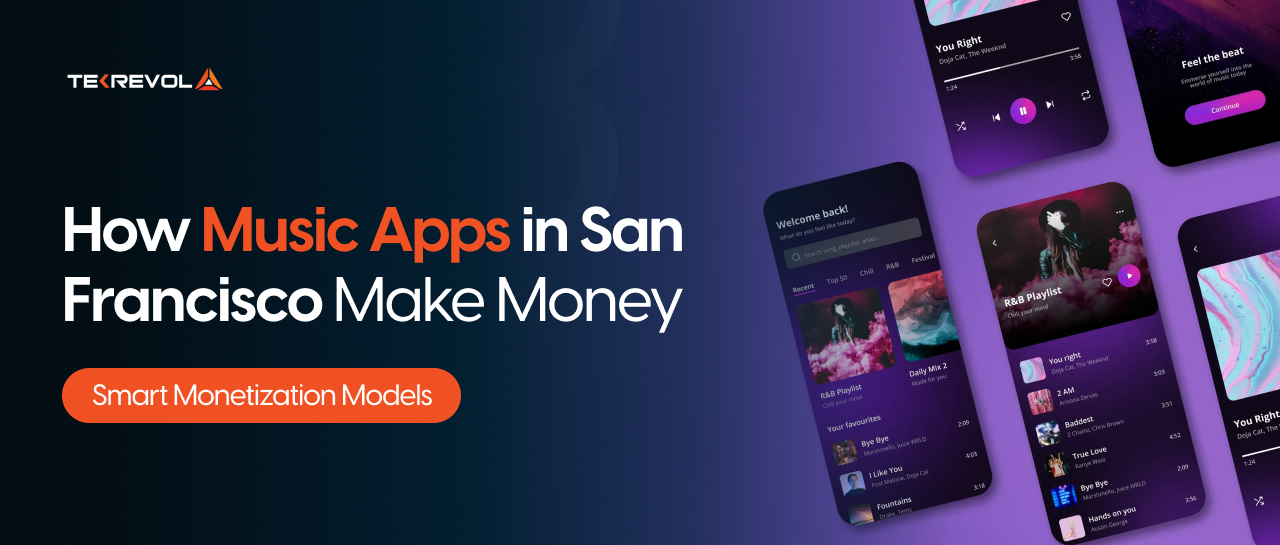
San Francisco isn’t just a hub for tech startups but a place where music, technology, and business collide. From indie developers experimenting in shared workspaces to large teams testing AI-powered features, music apps in this city are redefining how artists and listeners interact. At the heart of this ecosystem is music app monetization: the ways platforms turn attention into revenue without alienating users or creators.
Understanding music app monetization strategies is crucial not just for startups in San Francisco but for anyone looking to build a music platform that actually makes money. Whether you’re working with experienced app developers in San Francisco or figuring things out on your own, knowing how these apps earn revenue and keeping an eye on the tools and trends shaping 2026 can save a lot of trial and error.
To make it even easier, we’ve put together a list of the top 10 platforms that artists and creators are using today to distribute their music and maximize earnings.
Why San Francisco Is a Hub for Music App Monetization?
San Francisco thrives on innovation. It attracts developers, designers, and entrepreneurs who are willing to test bold ideaswhether they’re building a full web platform or a mobile-first experience.
Understanding the differences between a website and a web application is key for music apps, since the choice affects both user engagement and monetization potential.
Likewise, working with the right mobile app developers in San Francisco can make the difference between an app that just exists and one that actually generates revenue.
Data That Drives Decisions
According to the Sensor Tower report Q2 2025, Music app downloads increased by 18% year over year during the second quarter of 2025, while Music apps that were integrated into YouTube have seen the greatest rates of growth.
These insights inform music app monetization strategies, emphasizing the need for flexible models that can handle large numbers of free users while gradually converting them to paying customers.
Need Help Planning Your Monetization Model?
We’ll map out the smartest revenue paths for your music app idea.
Schedule Your Monetization ReviewCore Music App Monetization Strategies
There isn’t a single approach to monetization. Successful apps often combine multiple strategies to maximize revenue while maintaining a strong user experience.
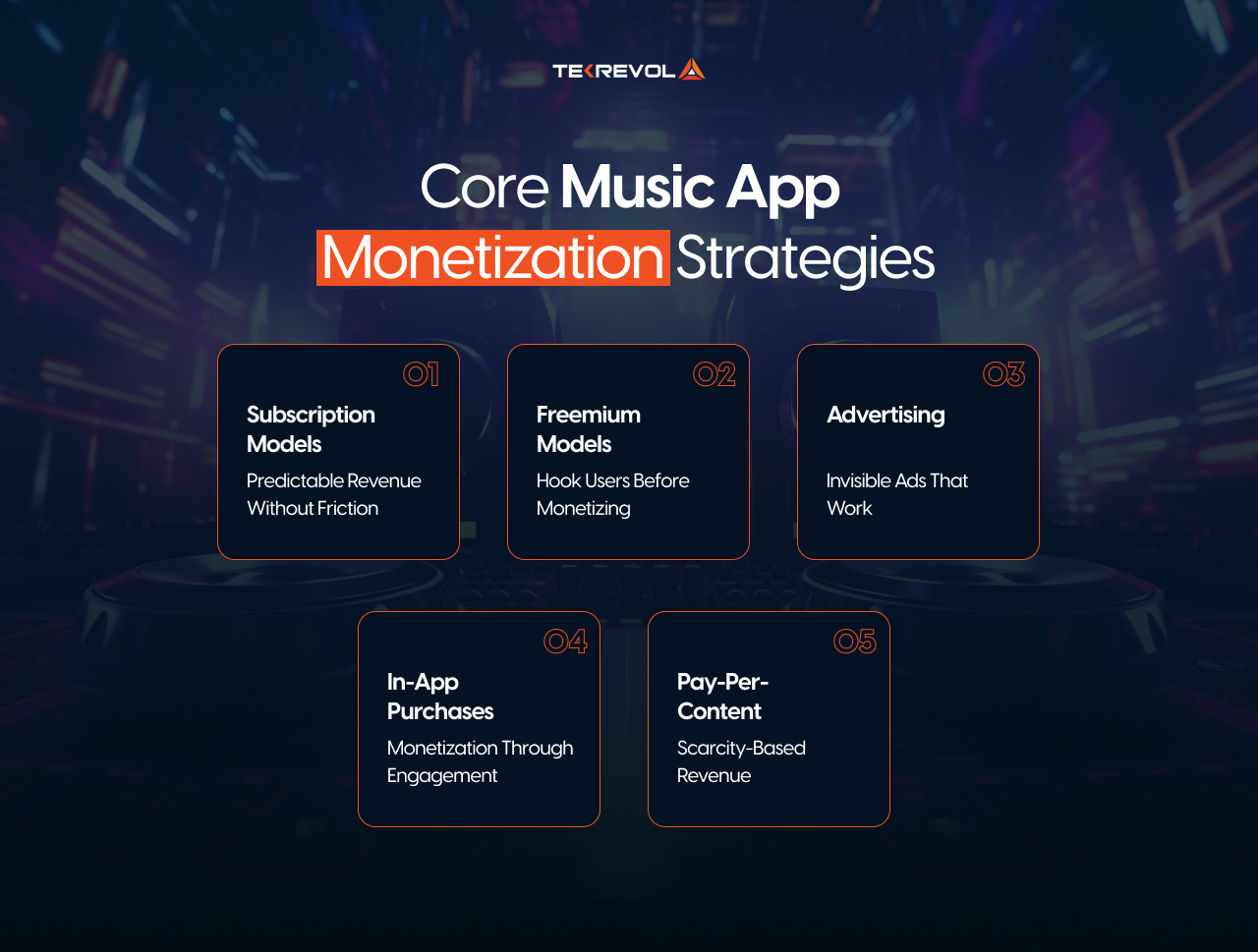
Subscription Models: Predictable Revenue Without Friction
Subscriptions remain one of the most reliable music app monetization models. They provide predictable, recurring income and are less intrusive than other revenue streams.
- Tiered subscriptions allow different levels of access: free, premium, and creator-focused plans.
- Premium tiers often include ad-free listening, offline access, or advanced analytics for artists.
- These tiers ensure that while free users continue enjoying the app, paying users are incentivized to upgrade.
Subscription-based monetization strategies are widely discussed in professional communities, where developers explore monetization through labels, promoters, or other business entities rather than individual listeners.
Freemium Models: Hook Users Before Monetizing
Freemium models allow users to experience a platform’s core features at no cost, creating a funnel for eventual upgrades.
- Free tiers often include ads and limited features.
- Paid tiers remove ads and unlock premium content.
- Freemium is particularly effective in Android markets, which, according to mobile app download statistics, dominate free music app adoption.
This model is considered one of the best app monetization strategy choices for early growth. By attracting a large base of free users first, apps can experiment with conversions and retention before asking for payment.
Advertising: Invisible Ads That Work
Advertising is a traditional revenue stream, but modern San Francisco apps approach it strategically:
- Sponsored playlists or branded content integrate seamlessly into the user experience.
- Short audio ads play between tracks without breaking immersion.
- Contextual advertising leverages listening habits and user preferences.
Community discussions like Reddit about how to start monetizing my music from zero highlight that ads only work when they are non-intrusive and aligned with user behavior.
In-App Purchases: Monetization Through Engagement
Beyond subscriptions and ads, in-app purchases (IAPs) allow apps to monetize fan engagement.
- Users can buy digital collectibles, artist merchandise, or concert tickets.
- Apps can offer exclusive content or VIP experiences for superfans.
- These microtransactions add up without forcing every user to pay, maintaining broad accessibility.
Many successful apps consult experienced music app developers to implement these flows seamlessly.
Pay-Per-Content: Scarcity-Based Revenue
Pay-per-content is a niche but growing monetization model:
- Exclusive tracks or limited-time releases encourage users to pay for unique content.
- Indie-focused apps in San Francisco often experiment with this model to support smaller communities.
Reddit discussions like It’s finally done, a new kind of music app show real-world examples where apps successfully generate revenue by selling time-sensitive content, creating scarcity that drives purchases.
Top 10 Music Monetization Platforms Artists Should Use in 2026
Most people don’t realize how massive the streaming industry has become. Recent reports show that hundreds of millions of listeners stream music every single day, yet only a small portion pays for premium features, forcing apps to adopt smarter music app monetization models just to stay profitable.
With market revenue expected to skyrocket in the coming years, creators, developers, and app founders need to lean into modern music app monetization strategies, evolve app monetization trends, and choose the best app monetization strategy that balances user experience with long-term income.
Know more about the role of Android app development or iOS app development in monetization.
Or discover how offline streaming shapes user retention in this guide on free offline music apps.
If you’re curious for deeper insight, check this one about how AI is reshaping the music landscape through AI-powered music apps.
1. DistroKid
Website: https://distrokid.com/
Android: https://play.google.com/store/apps/details?id=com.distrokid
iOS: https://apps.apple.com/us/app/distrokid/id1563720617
DistroKid is one of the easiest ways to distribute music globally without worrying about individual release fees. It’s ideal for artists who drop new singles regularly because one annual subscription covers unlimited uploads. They also offer smart features like automatic revenue splits for collaborators and quick delivery to major streaming platforms.
Pros:
· Unlimited uploads with one subscription
· Quick distribution + artist tools
· Supports revenue splits for collaborators
Cons:
· Some features require paid add-ons
· Fewer promotional tools compared to competitors
2. TuneCore
Website: https://www.tunecore.com/
Android: https://play.google.com/store/apps/details?id=com.tunecore
iOS: https://apps.apple.com/us/app/tunecore-artist-services/id1110020934
TuneCore is built for artists who want complete financial control. Along with distribution, it offers publishing, sync licensing, and YouTube monetization. It’s especially valuable for musicians who like digging deep into data and want a platform that expands with their catalog.
Pros:
· Artists keep 100% of royalties
· Publishing + sync administration
· Detailed analytics dashboard
Cons:
· Annual fee per release
· Costly for artists with many tracks
3. SoundCloud (Repost)
Website: https://soundcloud.com/
Android: https://play.google.com/store/apps/details?id=com.soundcloud.android
iOS: https://apps.apple.com/us/app/soundcloud/id336353151
SoundCloud’s Repost system helps artists earn from both SoundCloud streams and external platforms. It’s one of the best places to build a loyal community, especially in niche genres. Their monetization tools and fan subscription features give independent musicians a unique revenue path.
Pros:
· Great for fan-building
· Monetization inside and outside SoundCloud
· Built-in promotion tools
Cons:
· Payout varies
· Best for artists with existing SC audiences
4. Audiomack AMP
Website: https://audiomack.com/
Android: https://play.google.com/store/apps/details?id=com.audiomack
iOS: https://apps.apple.com/us/app/audiomack/id921765888
Audiomack stands out for its artist-first approach. Their AMP program shares ad revenue, and the platform’s strong presence in Afrobeats, hip-hop, and global genres helps emerging artists find real listeners fast. For many, it’s a gateway to building international audiences.
Pros:
· Free uploads
· Earn through AMP revenue
· Fast-growing global listener base
Cons:
· Not as large as Spotify or Apple Music
· Limited advanced analytics
5. Spotify for Artists + Discovery Tools
Website: https://artists.spotify.com/
Android: https://play.google.com/store/apps/details?id=com.spotify.music
iOS: https://apps.apple.com/us/app/spotify-music/id324684580
Spotify offers some of the most powerful discovery features in music. With editorial playlists, algorithmic boosts, and tools like Discovery Mode, artists can build long-term listener growth. The real value comes from consistent releases and understanding how Spotify’s ecosystem works.
Pros:
· Massive listener base
· Strong analytics
· Playlist + algorithm opportunities
Cons:
· Low per-stream payouts
· Highly competitive
I Tried 6 FREE Apps That CLAIM They Pay You To Listen To Music (My Results Revealed)
6. Bandcamp
Website: https://bandcamp.com/
Android: https://play.google.com/store/apps/details?id=com.bandcamp.android
iOS: https://apps.apple.com/us/app/bandcamp/id706408639
Bandcamp is ideal for musicians who want to sell directly to fans. You can offer albums, singles, merch, vinyl, exclusive fan subscriptions, and more. Fans on Bandcamp are often more supportive and willing to pay higher rates than on streaming platforms.
Pros:
· High revenue per sale
· Supports merch + digital bundles
· Fan-first model
Cons:
· Smaller mainstream exposure
· Requires a dedicated fanbase willing to pay
7. YouTube Content ID + YouTube Music
Website: https://www.youtube.com/
Android: https://play.google.com/store/apps/details?id=com.google.android.youtube
iOS: https://apps.apple.com/us/app/youtube/id544007664
YouTube monetization is one of the most powerful tools for artists because earnings come not only from your channel but also from any video using your music. With Content ID, every time your track appears anywhere on the platform, you get paid, even if someone else uploaded it.
Pros:
· Earn from global reuploads
· Huge audience reach
· Combines video + music discovery
Cons:
· Requires a distributor or network
· RPM varies widely
8. CD Baby
Website: https://cdbaby.com/
CD Baby is a long-standing favorite for indie artists who want stability without annual renewal fees. They provide global distribution, sync opportunities, and even physical distribution for those selling CDs or vinyl. Once you pay for a release, they’re your partner for life.
Pros:
· One-time release fee
· Sync licensing and publishing options
· Physical distribution available
Cons:
· Commission on earnings
· Slower processing for new releases
9. Patreon
Website: https://www.patreon.com/
Android: https://play.google.com/store/apps/details?id=com.patreon.android
iOS: https://apps.apple.com/us/app/patreon/id949402037
Patreon turns your fans into supporters with monthly memberships. Artists can offer early access, unreleased tracks, behind-the-scenes content, livestreams, and private community access. For many musicians, this becomes their most stable income stream.
Pros:
· Predictable monthly income
· High fan engagement
· Flexible content tiers
Cons:
· Requires active content creation
· Slow to grow without a strong fanbase
10. TikTok Music + Creator Monetization
Website: https://www.tiktok.com/
Android: https://play.google.com/store/apps/details?id=com.zhiliaoapp.musically
iOS: https://apps.apple.com/us/app/tiktok/id835599320
TikTok has become one of the biggest discovery engines in modern music. Their music distribution partners and creator reward programs let artists earn from sound usage, UGC trends, and official integrations. Even a small clip can generate massive exposure and real payouts when tied to the right music app monetization setup.
Pros:
· Unmatched viral potential
· Earnings from sound usage
· Rapid fanbase growth
Cons:
· Viral success isn’t guaranteed
· Short videos may limit full-song exposure
Want a Music App That Actually Makes Money?
Avoiding common pitfalls is only half the game; success depends on having the right game development team by your side.
Get in TouchAdvanced Monetization Strategies for B2B and Non-End Users
Some music apps earn revenue not directly from listeners but from business entities:
- Labels pay for analytics or promotional tools.
- Promoters pay for targeted campaign access.
- Other brands partner for sponsored content.
This approach is particularly highlighted in the Spotify Developer Forum, where non-end-user monetization strategies are explored. These B2B approaches diversify revenue and reduce reliance on consumer payments alone.
Platform Choice and Technology Stack
How a music app is built dramatically impacts monetization potential.
Web, Mobile, or PWA? How Platform Choice Affects Monetization
- Progressive Web Apps: Quick to deploy and ideal for testing ideas.
- Native apps: Offer robust features and smoother monetization flows.
- Cross-platform apps: Balance cost and reach.
Understanding native vs cross-platform development costs helps startups decide where to invest first, ensuring that revenue-generating features are supported by the tech stack.
The Platform Switch Every Serious Artist Needs to Make
AI-Powered Monetization Insights
AI helps optimize music app monetization strategies:
- Predicting churn to reduce lost subscriptions.
- Personalizing content to increase engagement.
- Offering dynamic pricing or targeted promotions.
Many San Francisco startups collaborate with artificial intelligence development teams to leverage AI in their monetization models. Case studies are available in AI-powered app development at Tekrevol.
Community Signals That Shape Monetization Trends
San Francisco founders don’t rely only on dashboards; they watch what real creators discuss online:
- Reddit: How to start monetizing my music from zero, Creators share freemium, ad, and subscription strategies.
- Spotify: Talks about monetization through labels and promoters.
- Facebook Group Post: Discusses merch, exclusive content, and fan loyalty.
- Reddit: A new kind of music app, Pay-per-content and niche monetization experiments.
Monitoring these conversations allows us to adapt app monetization trends in real-time, beyond what analytics can tell us.
How to Make Money with Music in 2026
Additional Technical and Design Considerations
- UX and responsive design significantly influence conversions.
- Converting web platforms to mobile apps can increase revenue reach.
- Choosing the right development stack is critical.
Every technology and design decision directly impacts music app monetization strategies.
How Tekrevol Builds Revenue-Smart Music Apps in San Francisco?
When we create music apps for the San Francisco market, we don’t just focus on the code. We study how people discover, stream, and connect with music across devices, and we shape the experience around real user behavior.
That’s the foundation of strong music app monetization. As a local team, we understand what San Francisco innovators look for, and you can learn more about our approach here: app developers in San Francisco.
Every music app begins with an idea, but turning that idea into a stable, scalable product takes careful planning. From design to engineering to long-term maintenance, we consider how each feature impacts revenue.
Today’s music app monetization strategies move beyond basic ads. Users want free access, but they also expect personalization, premium add-ons, intelligent recommendations, and content that feels unique to them.
That’s why we combine subscriptions, exclusive drops, AI-driven experiences, and even blockchain-backed features to build revenue models that actually work. We also integrate smart technologies that elevate user engagement.
If you’re curious about how AI improves discovery and retention in modern music apps, you can explore our insights here: music AI app development.
In the end, our goal is simple: build music apps that feel smooth, perform fast, and generate dependable income without compromising the user experience. San Francisco’s music-tech space moves fast, and we build with that momentum in mind, blending innovation with real, sustainable monetization.
Ready to Build a San Francisco–Focused Music App?
Avoiding common pitfalls is only half the game; success depends on having the right game development team by your side.
Get in Touch


![How Much Does it Cost to Develop a Food Ordering Website? [2026 Analysis]](https://d3r5yd0374231.cloudfront.net/images-tek/uploads/2026/03/Tek-Feature-7-1.jpg)


