
Today, ordering food using an online ordering website has transitioned from being a trend to being a standard way for customers to order food. As such, customers now expect speed and convenience when they’re using websites to place their orders online. If you have an older or slower website, likely that the customer will not order again after they leave and won’t return.
This is why finding the right development team to help build your company’s food ordering website is more important than it ever has been. You need to find a reliable web development company that can provide a strong focus on building scalable and high-performing food ordering websites that use established web development platforms and methodologies.
- But what does this actually mean when you engage to have your website built by a development team?
- What is it that you will expect to receive?
- And how do you ensure that you do not overpay for the development of your online ordering website?
Let’s take a closer look at the answers.
Understanding What You’re Actually Hiring
Businesses often think that web development is simply a matter of developing code; however, in order to build a complex food delivery system, you have to have an ecosystem working behind the scenes to get it done.
According to a 2024 McKinsey report issued by McKinsey, over 70% of digital projects fail because of poor planning, inadequate user experience, or lack of cross-functional roles, rather than bad code. For this reason, companies that succeed prefer to build complete, well-structured development teams versus hiring just developers.
A full-scale development team for a food delivery application includes:
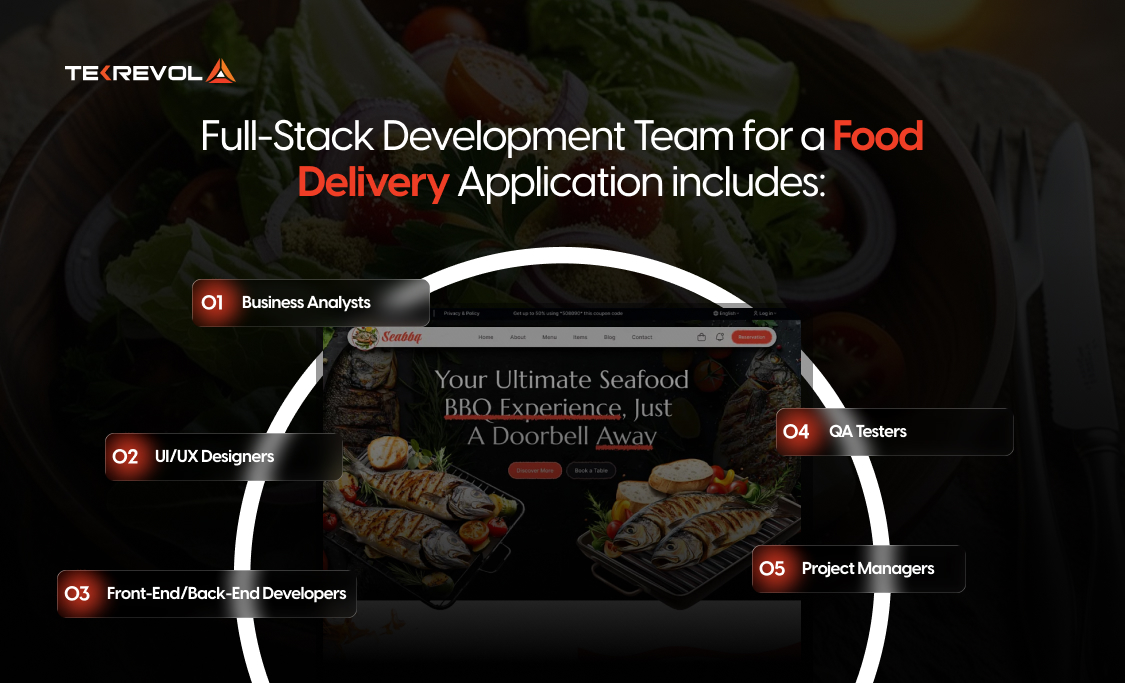
- Business Analysts – work with the company to take an idea and develop it into a successful business plan based on research of the business model, target audience, and goals.
- UI/UX Designers – create user friendly, conversion based designs for customers, restaurants, riders, and administrators.
- Front-End/Back-End Developers – build everything the customer can see and everything they cannot see, while ensuring the application operates quickly, well, and securely between front-end and back-end.
- QA Testers – test applications to identify & repair problems in the product before the product is released to customers.
- Project Managers – manage the delivery of the project, ensuring everything stays on schedule, communication is consistently maintained with all parties involved in the project and the overall project is completed as planned.
When all of these roles work together, the platform will operate as a scalable, reliable, and future-proven product.
For a deeper look into how modern development teams work, you can explore these detailed guides:
Transform Your Online Food Delivery Experience
Hire a dedicated food delivery app development team to build a smooth, scalable platform with powerful features, seamless ordering, and reliable performance.
Get Your Free Project ConsultationStep 1: Discovery & Business Planning
Discovery and business planning are often the first phase of the development process when working with a custom application. The purpose of this phase is to determine if your food-delivery concept is viable, in terms of economics, technology, and marketability to the market you wish to target.
Working with an experienced team of developers, you will be asked many questions regarding your food delivery application.
Here are a few examples:
– Will your service be geo-targeted to a specific city, or have a broader reach?
– Are you creating a service for a single restaurant and/or building a multi-vendor marketplace like UberEATS or Foodpanda?
– Would you like to incorporate artificial intelligence within your food delivery service to recommend meals based on individual customer preferences?
– How far do you want to deliver, and how many delivery personnel will you need?
While these questions appear simple, they will determine your overall budget, technical architecture, development timeframes, server requirements, and even overall design flows for your food delivering application.
A solid project development team will answer these questions before beginning the development of your custom application, reducing the possibility of surprise issues during your project’s completion.
If you want ideas or inspiration on how successful food-delivery platforms are built, you can explore insights from this guide on modern coding tools that are shaping app development, or review top apps like Instacart and best alternatives for grocery delivery to understand how industry leaders structure their services.
For inspiration on starting a food delivery business, see this step-by-step guide on how to start a food delivery business.
Step 2: UX That Converts
When it comes to food ordering, your user experience (UX) can make or break the entire business. Customers decide in seconds whether they’ll stay on your website or bounce to a competitor. That’s why your platform must be fast, responsive, and incredibly easy to use.
A high-converting food-delivery website should allow customers to:
- Browse menus effortlessly without slow loading or confusing layouts
- Customize orders easily, whether it’s spice levels, add-ons, or special instructions
- Checkout in under 30 seconds, with as few steps as possible
A dedicated development team ensures every screen, button, and flow is designed to reduce friction, leading to higher order completion rates and fewer abandoned carts.
Step 3: Choosing the Right Technology Stack
Choosing the right technology stack is one of the most important decisions in building a food-delivery platform. It affects everything, be it speed, security, scalability, or even how enjoyable the experience feels for your customers.
A modern food-ordering system usually relies on:
- Real-time GPS tracking – So customers know exactly when their rider will arrive.
- Secure payment gateways – To protect customer data and maintain trust during checkout.
- AI-driven recommendations – Helping increase upsells and encourage repeat orders.
- Cloud-based scalability – Allowing your platform to handle sudden order spikes without crashing.
A strong tech stack isn’t “optional.” According to Google, 53% of users abandon a site if it takes longer than 3 seconds to load, which shows how crucial fast, well-built technology is for conversions and customer retention.
If you want to understand the technologies powering modern web platforms, you can explore insights on e-commerce website development strategies used in modern platforms or dive deeper into complete web portal development insights.
For an even broader understanding of today’s web app ecosystems, you can also look into a detailed overview of everything you need to know about web app development to see how different technologies work together to create a seamless user experience.
Learn more about the latest technologies for web platforms.
Build a Food Platform Customers Love
Work with a dedicated food delivery app development team to integrate AI, GPS tracking, and secure payments into a seamless, high-performing platform.
Request a Free Development PlanStep 4: AI & Automation in Food Ordering
AI has shifted from a “nice addition” to an absolute must-have for modern food-ordering platforms. It doesn’t just enhance user experience but also actively helps businesses operate faster, smarter, and more profitably.
Here’s what AI can do inside your food-delivery system:
- Recommend meals based on past orders, increasing average order value
- Predict peak delivery times, helping restaurants and riders prepare ahead
- Optimize delivery routes, reducing delays and improving customer satisfaction
AI is now so essential that, according to PwC, AI could contribute up to $15.7 trillion to the global economy by 2030, with automation and personalization being major growth drivers. This explains why leading food platforms are adopting AI at every level, from order recommendations to backend logistics.
If you want to explore how modern businesses are implementing AI today, you can check out insights on AI development services and capabilities or learn more about top modern web development tools used by leading teams.
Dedicated Team vs. Freelancers
While freelancers can help you launch a small MVP or a simple single-vendor setup, scaling into a full multi-vendor food-delivery ecosystem requires much more than individual contributors.
A dedicated development team for food delivery offers:
- Scalability – Add specialists like DevOps engineers, data analysts, or AI engineers as your platform grows
- Long-term support – Continuous updates, maintenance, and new feature releases
- Expertise in logistics, payments, and multi-vendor architecture – The complex backbone that freelance teams often struggle with
In simple words: freelancers build features; a dedicated team builds an entire thriving platform.
Step 5: Estimating Food Delivery Website Costs
Estimating the cost of a food-delivery website isn’t always straightforward because every platform has different needs. The final price depends on several factors, including:
- Number of user types (customer, vendor, driver, admin)
- Payment integration complexity (local gateways, multi-currency, wallet features)
- Real-time order tracking and GPS-based delivery systems
- Hosting and cloud infrastructure to handle order surges
- Third-party integrations like SMS providers, mapping APIs, loyalty tools, or POS systems
As your platform grows in features and scale, so does the investment. Enterprise-level systems naturally cost more because they’re designed for high traffic, multi-vendor management, stronger security, and long-term scalability.
A useful benchmark: According to Clutch, the average cost of building a feature-rich web application ranges from $70,000 to $250,000, depending on complexity and required integrations, showing how much variation there can be based on business needs and technical scope.
In short, simple single-vendor websites cost less, while full marketplace platforms with logistics, AI, and multi-role dashboards require a larger but more future-proof investment.
How Tekrevol Helps Build Cost-Effective Food Ordering Websites
Building a successful platform requires more than just development. Tekrevol focuses on delivering scalable and efficient solutions that match business goals while controlling development expenses. Our experts help businesses plan realistic budgets and reduce unnecessary spending.
Tekrevol provides complete web app development services, including planning, design, development, and launch. Our team builds platforms that balance performance and affordability while ensuring long-term scalability.
We help businesses estimate the real food ordering website development cost based on their goals and features. Instead of generic estimates, Tekrevol provides customized planning that delivers accurate projections and avoids unexpected expenses.
With Tekrevol, businesses receive a transparent food delivery website price estimate and a clear development roadmap. This approach ensures that restaurants and startups launch reliable platforms that support long-term growth.
Launch Your Food Ordering Website with Confidence
TekRevol’s dedicated food delivery development team builds scalable, cost-effective platforms tailored to your business goals, ensuring seamless performance and long-term growth.
Book Your Free Consultation Today

![How Much Would It Truly Cost to Develop a Food Ordering Website? [2026 Analysis]](https://d3r5yd0374231.cloudfront.net/images-tek/uploads/2026/03/Tek-Feature-7-1.jpg)