

- ASO localization means adapting keywords, visuals, and copy per market, not translating your English listing word for word.
- Optimizing for global app stores starts with independent local keyword research, not a translated version of your home-market keywords.
- Apple’s cross-localization can quietly limit your reach in secondary markets if you never review which locales are inherited.
- Title, keyword field, and screenshots carry the most ASO weight and should be localized first.
- Measure ranking, conversion, and retention separately per locale; a global average hides underperforming markets.
- TekRevol builds and maintains localized app store listings with native-language research and ongoing post-launch performance tracking.
ASO localization means adapting your app’s title, keywords, screenshots, and description for each language and country, not just translating the English version word for word. Do this right, and your app ranks for local search terms and converts local visitors into installs. Skip it, and your app stays invisible in every market outside your home country, no matter how good the product is.
Most teams either ignore localization entirely or hand their English listing to a translator and call it done. Both approaches leave downloads on the table. A literal translation misses how people actually search in that language, and an English-only listing never shows up in local search results at all. The result is the same either way: an app that could be ranking in dozens of countries stays stuck in one.
This guide covers what to localize first, how keyword research changes by market, how Apple’s cross-localization system works, and how to measure whether your localization is actually paying off. If you’d rather have a specialist run this process for you, TekRevol’s app store optimization company handles ASO localization for apps launching across multiple regions at once.
What Is ASO Localization?
ASO localization is the process of adapting your app store listing: title, keywords, description, screenshots, and video to match the language, search behavior, and culture of a specific country.
It’s broader than translation. Translation converts words. Localization changes the words, the visuals, and sometimes the entire pitch to match what that market actually cares about.
Apple and Google treat this differently at a technical level; for multiple platforms needs to plan for both systems from the start:
- Apple’s App Store indexes metadata separately per locale, meaning your keyword field, title, and subtitle can be entirely different in each market, and each one ranks independently.
- Google Play supports even more languages per listing and lets you localize screenshots, short descriptions, and long descriptions by country, with slightly different indexing behavior for untranslated fields.
Understanding this difference matters before you write a single localized word, because it changes how many locales are worth prioritizing and how much duplicate work you actually need to do.
Not Ranking Outside Your Home Market?
Get a free ASO audit and see exactly which locales are costing you downloads right now.
Request Your Free ASO Audit →Why Does App Store Optimization Localization Matter for Global Growth?
App store optimization localization matters because users in different markets search, compare, and evaluate apps in different languages and cultural contexts. An English-only listing can limit an app’s ability to connect with audiences who search and browse in other languages.
Greenbook reports that 75% of the world’s internet users do not speak English as their first language, highlighting the scale of multilingual audiences available to businesses expanding internationally.
The size of the global app market makes that opportunity difficult to ignore. Statista projects 528.48 billion app downloads worldwide in 2026, spread across markets and app stores around the world.
Localization doesn’t guarantee downloads, but it gives apps a better opportunity to match local search behavior, communicate value clearly, and compete for users beyond their original market.
According to a Forbes Business Council analysis on international expansion, businesses that adapt their local presence with consistent, market-specific signals see stronger visibility and reduced trust friction with local audiences. The same principle applies directly to an app store listing: a user who sees a listing in their own language, with local context built in, trusts it faster than one that’s obviously translated or left in English.
How Is ASO Localization Different Between the App Store and Google Play?
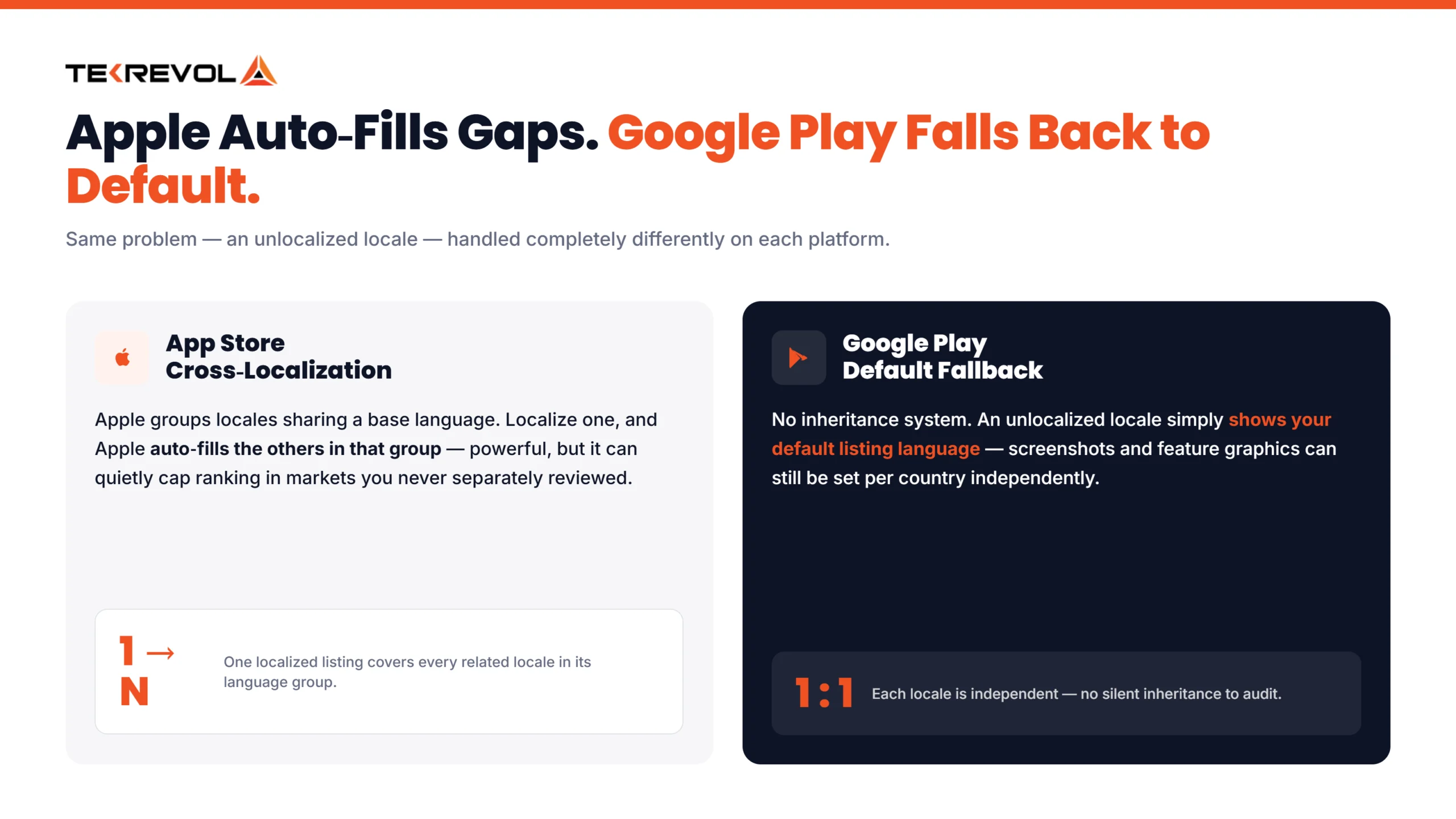
ASO localization differs between the two stores mainly in how missing locales get handled and how many languages each platform supports per listing. Apple auto-fills gaps using a system called cross-localization, while Google Play generally shows your default listing language when a specific locale isn’t localized.
Apple’s Locale-Based System
Apple groups certain locales together. If you localize for one locale in a language family, Apple can automatically apply that metadata to related locales that share the same base language. This is powerful, but it also means an unedited assumption can quietly limit your reach in secondary markets.
Google Play’s Broader Language Support
Google Play supports localization across a wider list of languages and lets you customize more assets per locale, including screenshots and feature graphics. Untranslated locales typically fall back to your default listing language rather than inheriting from a related locale.
What This Means for Prioritization
Because of these mechanics, teams should decide upfront how many locales are worth full custom localization versus how many can rely on inherited or default metadata. Trying to fully customize every locale from day one usually isn’t realistic. Start with high-value markets and expand from there.
Which App Store Elements Should You Localize First?
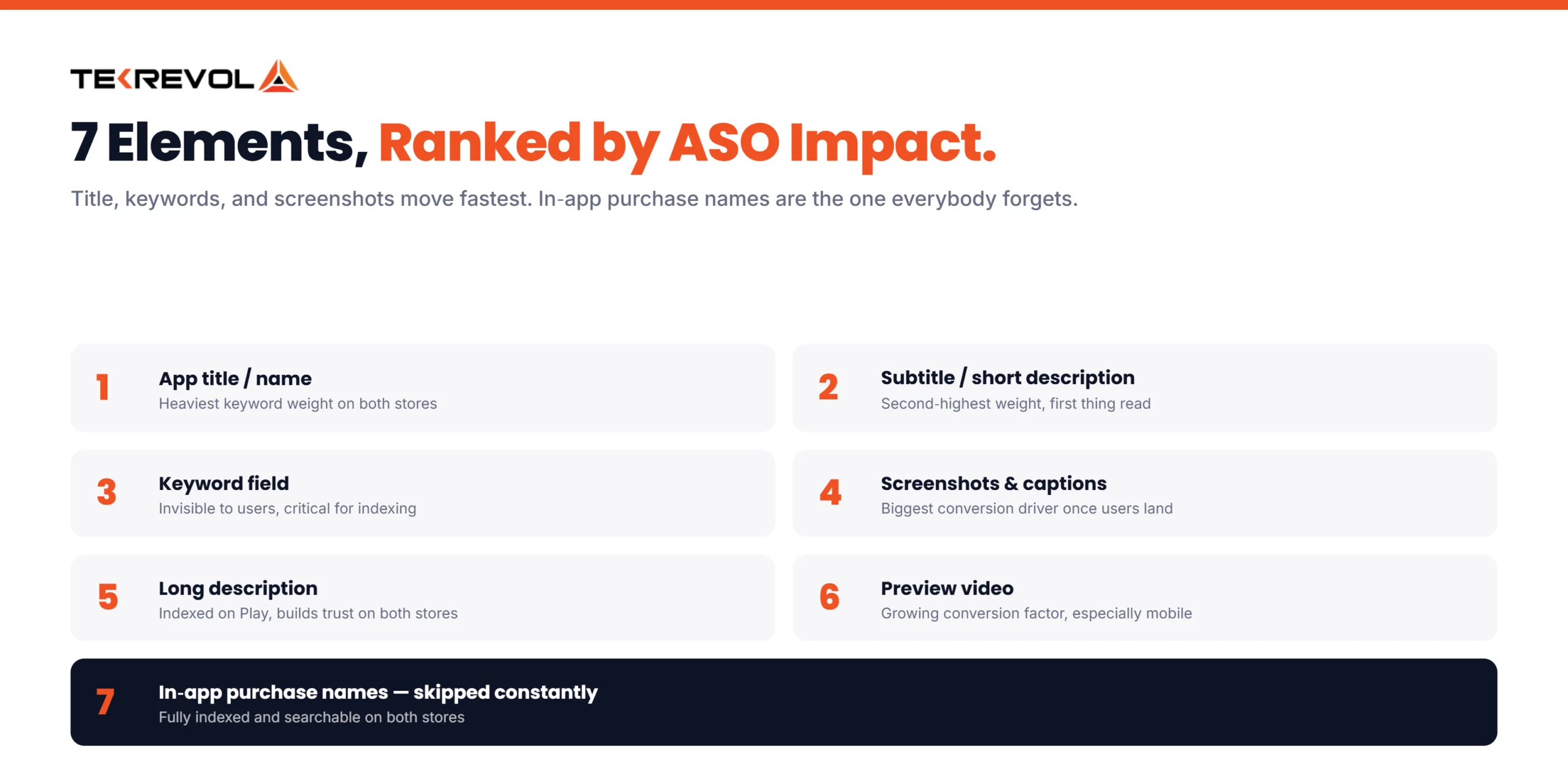
The app title, keyword field, and screenshots should be localized first, because they carry the most weight in both search ranking and conversion. Everything else matters, but these three move the needle fastest.
Priority order, based on ASO impact:
- App title/name: carries the heaviest keyword weight on both stores
- Subtitle (iOS) / short description (Google Play): second-highest ranking weight, first thing users read
- Keyword field (iOS) or embedded keywords in description (Google Play): invisible to users, critical for search indexing
- Screenshots and captions: the biggest driver of conversion once a user lands on the listing
- Long description: supports keyword indexing on Google Play and builds trust on both stores
- Preview video / App Preview: increasingly important for conversion, especially on mobile
- In-app purchase names: often skipped, but indexed and searchable in some markets
That last one gets missed constantly. If your in-app purchases stay in English while everything else is localized, you create a jarring mismatch that hurts both trust and conversion at the exact moment a user is deciding whether to pay.
Trying to localize all seven elements perfectly across every market on day one isn’t realistic for most teams. A better approach is a “minimum viable localization” pass on all top markets first, hitting title, keywords, and screenshots, then circling back to deepen the remaining elements once early results confirm which markets are worth the extra investment.
How Do You Localize App Store Keywords for International Markets?
You localize app store keywords by researching how people actually search in that language and market, not by translating your English keyword list. Literal translation is the single most common ASO localization mistake, because search behavior doesn’t map word-for-word across languages.
Why Literal Translation Fails
A keyword that converts well in English might be a term nobody actually types in German, Japanese, or Portuguese. Local users often use different phrasing, slang, or even English loanwords mixed into local-language searches. Independent research per locale, not translation, is the only way to catch this.
Handling Character Limits Per Language
Apple’s keyword field caps at 100 characters, and that limit behaves very differently across languages:
- German, Russian, and other languages with longer average word length eat through that limit fast
- CJK languages (Chinese, Japanese, Korean) pack more meaning into fewer characters, leaving room for more terms
- Plan character budget per locale rather than assuming a uniform approach across all markets
Research Process
- Pull local search suggestions directly from the App Store and Google Play search bars in that locale
- Check top-ranking competitor apps in that specific country’s store, not your home market’s store
- Validate keyword relevance with a native speaker before finalizing, since automated translation tools miss slang and regional variation
For teams building out this process from scratch, this guide on the best app store keyword research tools covers platforms that support locale-specific keyword data, not just English-market volume.
What Is Cross-Localization in ASO and How Does It Work?
Cross-localization is Apple’s system for automatically filling in metadata for a locale you haven’t specifically localized, pulling from a related “base” locale within the same language group. It’s built to save work, but it can also quietly waste ranking opportunity if left unchecked.
How Locale Groups Work
Apple groups certain locales by shared language. An English (U.S.) listing, for example, can populate other English locales that haven’t been separately localized. The same inheritance pattern applies to other shared-language locale groups.
When to Override It
Cross-localization makes sense as a starting point for smaller or lower-priority markets. But if a secondary market in that language group has real download volume or distinct search behavior, relying on inherited metadata leaves ranking potential on the table. Those markets deserve their own keyword research and their own custom listing, even if the base language is technically the same.
The Cost of Ignoring It
Teams that never touch cross-localization settings often don’t realize which locales are running on inherited metadata versus custom-built listings. That’s a quiet ranking leak. A quarterly audit of which locales are inherited versus custom is worth the hour it takes.
Wondering Which of Your Markets Are Running on Inherited Metadata?
Our ASO team maps every locale in your listing and flags where you're leaving rank on the table.
Get a Locale-by-Locale ASO Review →How Do You Localize App Store Visuals and Screenshots for Different Markets?
You localize screenshots and visuals by translating text overlays, adjusting imagery for cultural fit, and rebuilding layouts for right-to-left languages where needed. Visuals do more conversion work than any other element on the listing, so getting this wrong costs more than a bad keyword choice.
- Text overlay translation: every callout, headline, and caption on the screenshot needs translating, not just the app’s UI
- Cultural fit: colors, gestures, and imagery carry different meanings by region; something neutral in the US can read differently elsewhere
- Right-to-left layout: Arabic and Hebrew markets need screenshots rebuilt for RTL reading order, not just mirrored text
- Local social proof: region-specific awards, press mentions, or rating badges build more trust than generic global ones
How Do You Choose Which Markets to Localize For First?
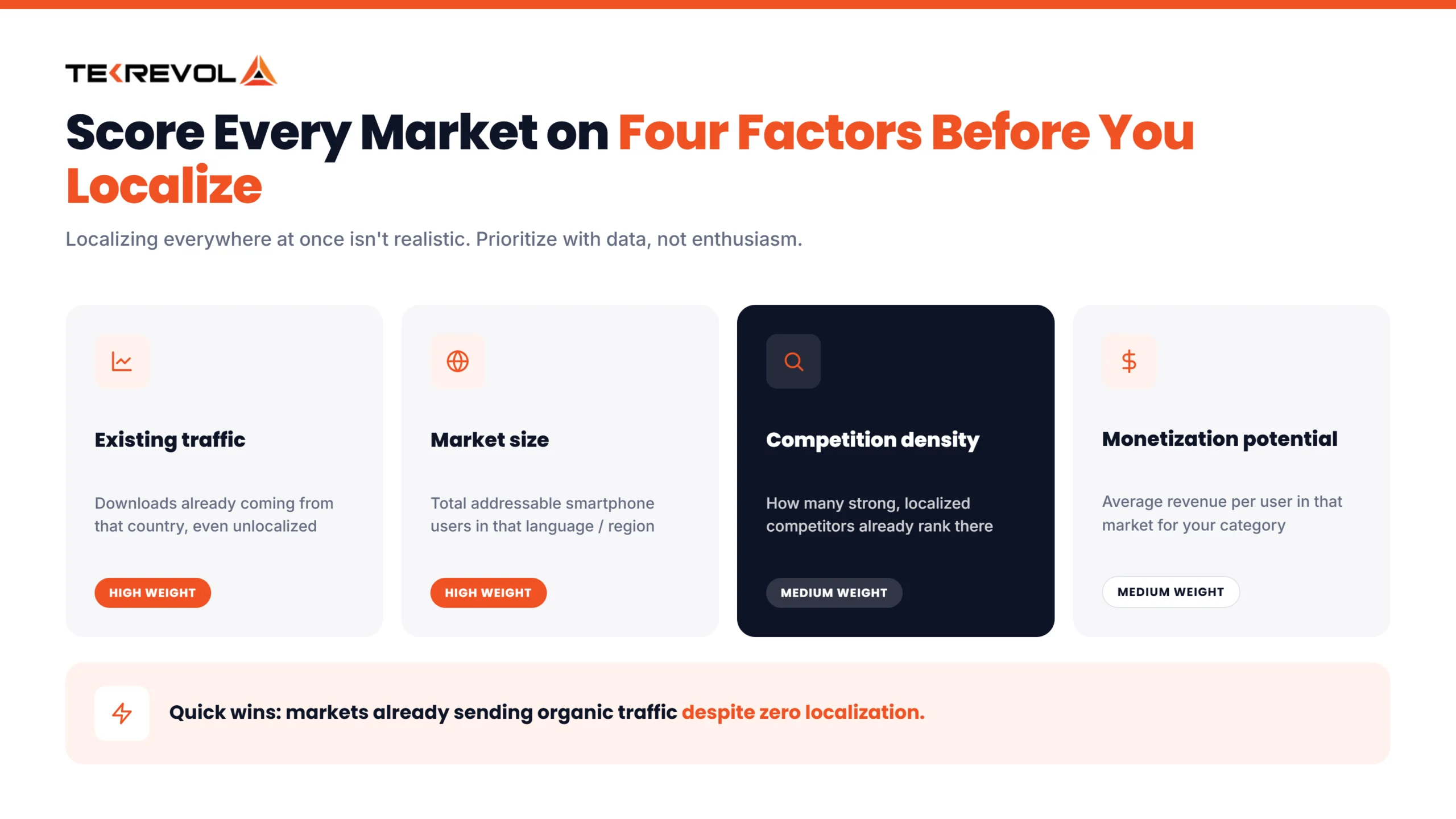
Choose your first localization markets based on existing traffic data, market size, competition density, and monetization potential, in that order. Localizing every market at once is rarely realistic, so prioritization decides where the early return comes from.
A simple scoring approach:
| Factor | What to Check | Weight |
| Existing traffic | Downloads/impressions already coming from that country, even unlocalized | High |
| Market size | Total addressable smartphone users in that language/region | High |
| Competition density | How many strong, localized competitors already rank there | Medium |
| Monetization potential | Average revenue per user in that market for your category | Medium |
Quick-win markets are usually ones already sending you organic traffic despite no localization. That’s a signal of real demand you haven’t captured yet. Long-term investment markets are large but competitive, and they’ll take longer to see payoff.
What Are ASO Localization Best Practices?
The most important ASO localization best practice is using native, in-market linguists instead of relying on machine translation alone. Machine translation is fine for a first draft, but it consistently misses slang, tone, and search intent that a native speaker catches immediately.
- Use native speakers for final review, even if a translation tool does the first pass
- Localize the in-app experience alongside the listing: a localized store page that leads to an English-only app tanks ratings and retention fast
- Test one locale at a time before scaling: validate the approach works before committing budget to ten more markets
- Update localized keywords on a cadence: search behavior shifts, and a keyword set localized once every two years is stale
- Monitor conversion rate separately per locale: a global average hides which markets are actually underperforming
Localization also shouldn’t run in isolation from the rest of your growth plan. Paid campaigns, social content, and influencer partnerships in a new market all perform better when the store listing they point to is already localized. This roundup of top app marketing strategies covers how store optimization and user acquisition work together rather than as separate workstreams.
How Do You Measure the Success of App Store Localization?
You measure ASO localization success by tracking keyword ranking, conversion rate, and download growth separately for each localized market, not as a blended global average. A global average can hide a market that’s quietly underperforming while others carry the numbers.
Key metrics to track per locale:
- Localized keyword ranking: Are you actually appearing for the terms local users search?
- Store listing conversion rate by locale: impressions-to-install rate specific to that country
- Download growth by region: month-over-month trend after the localized listing goes live
- Retention and rating by locale: a mismatch between the listing promise and the in-app experience shows up here first
A/B testing localized metadata is possible on both platforms in supported regions, and it’s worth running before scaling a change across every market at once.
Red flags worth watching for
Deep impressions with low conversion in a specific locale usually mean the visuals or messaging aren’t landing, even if the keywords are ranking well. That’s a signal to revisit screenshots before touching keywords again.
Understanding what actually drives ranking in the first place makes this measurement work more useful. This breakdown of the app store ranking algorithm explains which signals each platform weighs most heavily.
What Are Common Mistakes in Multilingual ASO?
The most common multilingual ASO mistake is relying on literal or machine-only translation instead of local keyword research and native review. This single mistake undermines nearly every other localization effort, because it means your metadata never matches how people in that market actually search.
Other frequent mistakes:
- Ignoring cross-localization inheritance: not knowing which locales run on default metadata versus custom listings
- Reusing the same screenshots across every market: missing the conversion lift that culturally adapted visuals provide
- Localizing the store listing but not the app itself: leads to uninstalls once users open an app that doesn’t match what they saw
- Treating localization as a one-time project: search behavior and competition shift, and stale keywords lose rank over time
- Skipping smaller elements, like in-app purchase names: small oversights that quietly hurt conversion at the payment moment
Many of these mistakes stem from treating ASO localization as a translation task handed to a vendor instead of an ongoing marketing function. Comparing it to how ranking works on the web is a useful mental model. The comparison of ASO vs SEO breaks down why app store ranking needs the same ongoing attention as organic search does.
How TekRevol Helps Brands Localize and Optimize Their App Store Presence
TekRevol helps brands build localized app store strategies based on how users search, compare, and choose apps in different markets. Rather than treating localization as simple translation, the approach combines market research, localized keyword strategy, culturally relevant creative assets, and ongoing performance tracking.
What this includes:
- Market prioritization based on traffic potential, competition, and growth opportunity
- Native-language keyword research and copywriting instead of direct machine translation
- Culturally adapted screenshots and visuals that reflect local expectations, including RTL layouts where needed
- Locale-level performance tracking for rankings, conversions, and other key ASO metrics
The focus is on making each listing feel native while still supporting a consistent global brand. Every market gets messaging and creative choices that reflect how its users actually search and evaluate apps.
ASO localization doesn’t end when the listing goes live. TekRevol uses ongoing performance data to identify what needs refinement as search behavior, competition, and user expectations change, helping brands build a stronger and more sustainable presence across global app stores.
Ready to Rank in Markets You Haven't Touched Yet?
Get a free localization roadmap for your top three target markets, no obligation.
Start Your ASO Localization Plan →