



- Most web apps cost between $25,000 and $180,000, with mid-market builds landing near $60,000 to $150,000.
- The huge price spread comes mostly from your team’s hourly rate, not your app’s features.
- Plan 15% to 25% of your build cost every year for maintenance, hosting, and security work.
- AI speeds up boilerplate but adds review time, so budget for rework instead of assuming savings.
- App type matters more than feature count: marketplaces cost roughly triple what internal tools cost.
- Fixed-price discovery followed by a time-and-materials build protects you from the two worst budget outcomes.
A web app can look deceptively simple from the outside. A login screen, dashboard, payment button, or booking flow may seem straightforward, until you start adding integrations, user roles, security, real-time features, and the backend infrastructure that keeps everything running. That’s where a seemingly affordable $20,000 project can quickly turn into a six-figure build.
In 2026, web app development cost ranges from $25,000 to $180,000, while more complex business and enterprise applications can push well beyond that range. The final price depends less on the idea itself and more on what you expect the app to do, how many users it needs to support, where your development team is located, and how much customization your product requires.
In this guide, we’ll break down the real cost by complexity, app type, development region, pricing model, and hidden expenses that often get left out of initial quotes. If you want to move from a rough estimate to a properly scoped budget, our custom web app development services team can help you map the features, technology, timeline, and expected investment before development begins.
How Much Does Web App Development Cost in 2026?
Web app development costs $25,000 to $180,000 for most projects in 2026. Simple MVPs start near $18,000, mid-complexity apps run $40,000 to $215,000, and enterprise platforms exceed $400,000. Your final number depends on build hours multiplied by your team’s blended hourly rate.
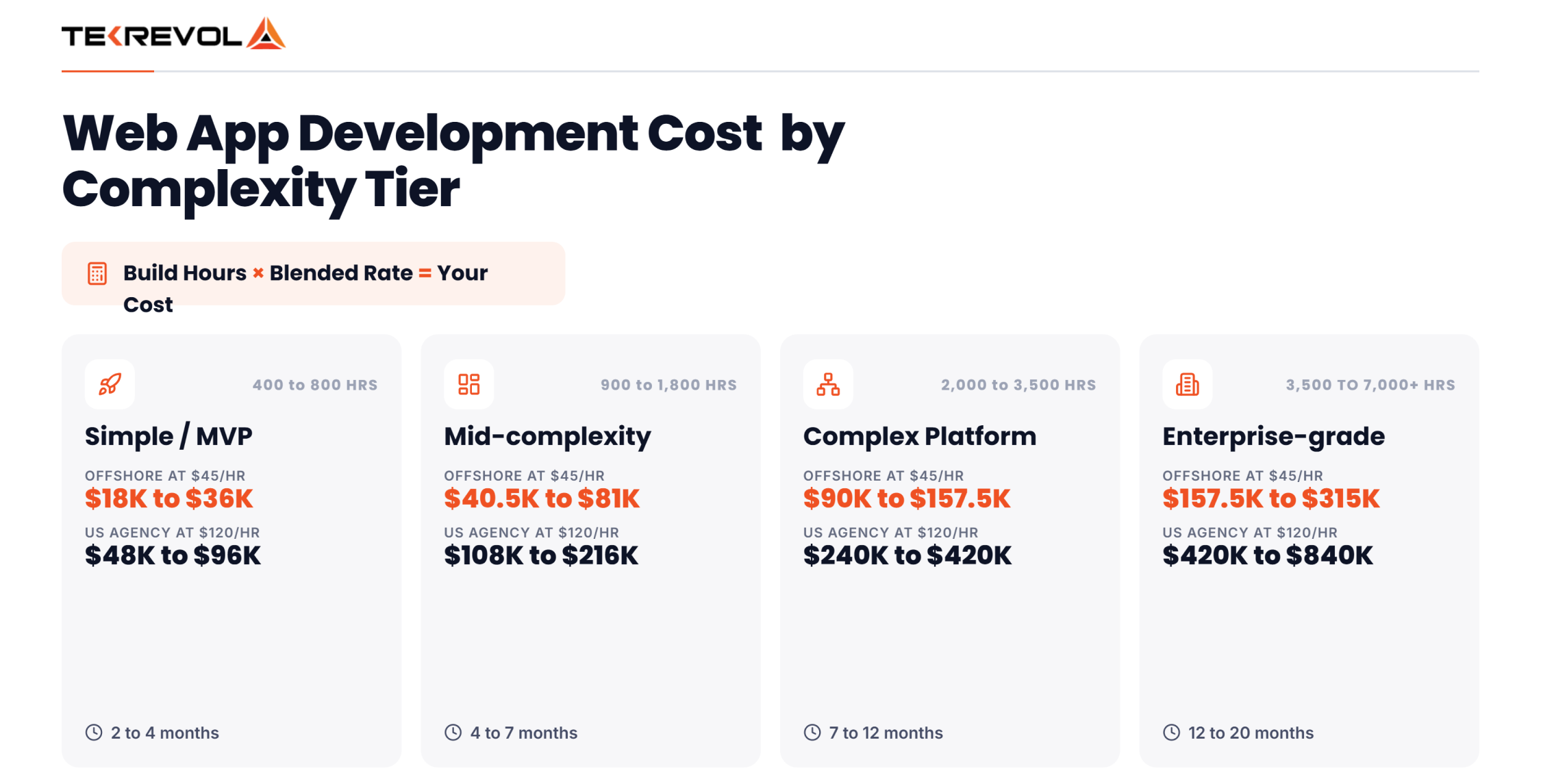
Here’s the part almost nobody explains. Cost is two numbers multiplied: hours × blended rate. That’s it.
Below, each tier is priced at two rate anchors: a $45 per hour offshore blended rate and a $120 per hour US agency blended rate. Same app, same scope, different team location.
| Complexity tier | Typical hours | At $45/hr blended | At $120/hr blended | Timeline |
| Simple / MVP | 400–800 | $18,000–$36,000 | $48,000–$96,000 | 2–4 months |
| Mid-complexity | 900–1,800 | $40,500–$81,000 | $108,000–$216,000 | 4–7 months |
| Complex platform | 2,000–3,500 | $90,000–$157,500 | $240,000–$420,000 | 7–12 months |
| Enterprise-grade | 3,500–7,000+ | $157,500–$315,000+ | $420,000–$840,000+ | 12–20 months |
What sits in each tier? A simple app has one user role, a few screens, and maybe one integration. Mid-complexity adds multiple roles, payments, a real data model, and an admin panel, which is where most funded startup products live.
A complex platform brings real-time features, heavy integrations, and performance targets that force architectural decisions. Enterprise-grade means compliance, legacy migration, single sign-on, audit trails, and a stakeholder list that needs its own spreadsheet.
Still not sure which tier your idea falls into?
Send us your feature list, and we'll map it to a tier, an hour range, and a realistic timeline. No sales pitch, no obligation.
Get Your Free Web App Cost Estimate →What Do the Numbers Say About Web App Spending Right Now?
The market numbers vary depending on what gets counted, but they point to the same reality: software demand is strong, and development remains a significant investment. Here are the numbers worth keeping in mind:
- IT spending is surging: Gartner forecasts global IT spending to reach $6.37 trillion in 2026, up 14.2%, with software spending hitting $1.468 trillion, up 15.5%.
- Software growth looks more moderate: Statista projects $779.07 billion in worldwide software revenue in 2026, representing 5.53% growth.
- Developer salaries set the baseline: The U.S. Bureau of Labor Statistics reports a $90,930 median annual wage for web developers as of May 2024, with employment projected to grow 7% from 2024–2034.
Why it matters: Strong software demand and rising development costs help explain why professional web app projects can quickly reach five or six figures.
What Factors Influence the Cost of Web App Development?
Factors that influence web app development cost include feature scope, number of user roles, third-party integrations, design depth, security and compliance requirements, performance targets, tech stack choices, and team seniority. Integrations and compliance usually surprise clients most, adding 20% to 40% to a build.
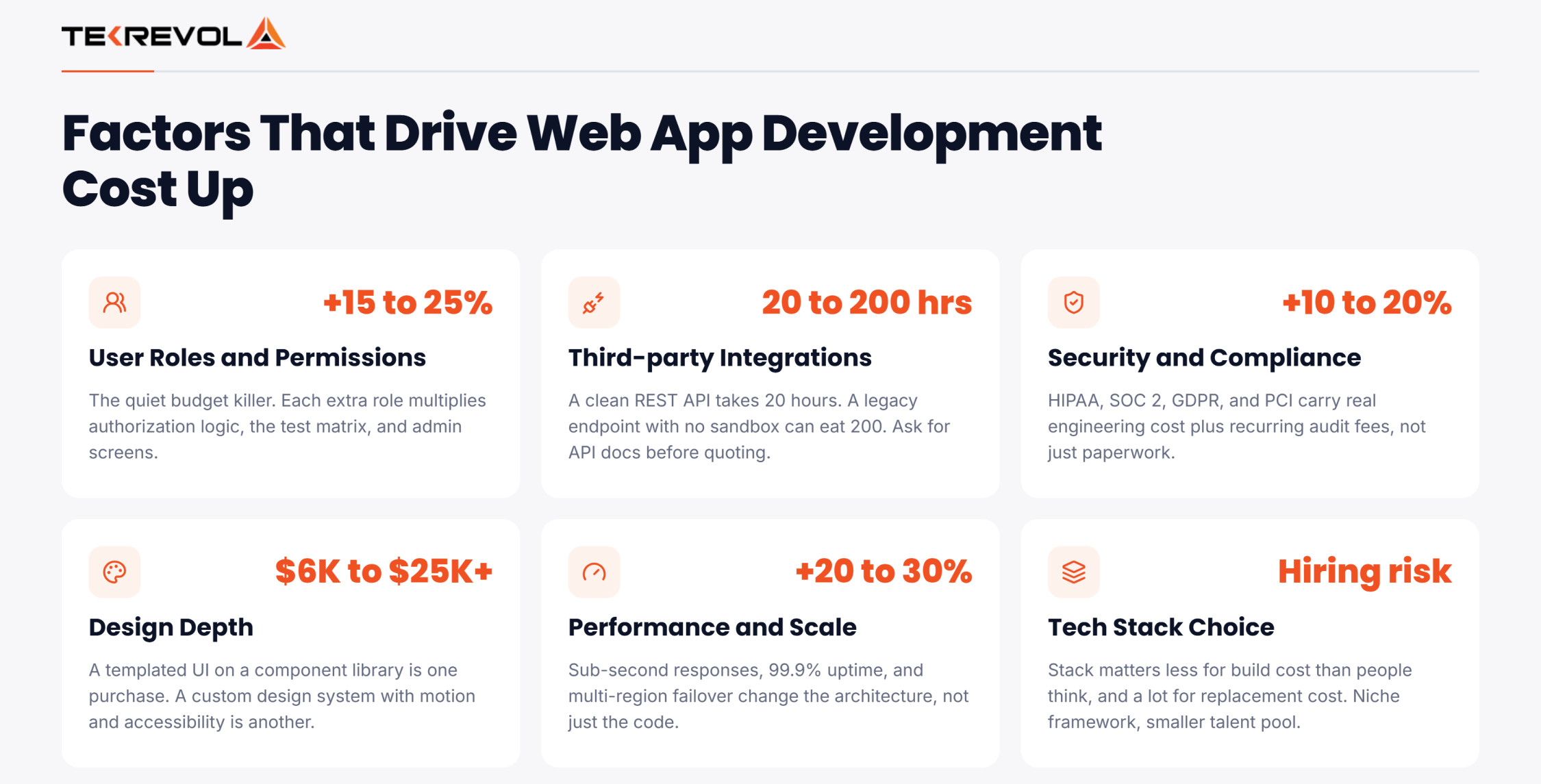
Here’s what actually moves your number, ranked by how often we see it blow past the original estimate.
User Roles and Permissions
The quiet budget killer. One user type might take 500 hours. Add an admin, a manager, and a read-only auditor, and you’ve tripled your authorization logic, your test matrix, and your admin screens. Each extra role typically adds 15% to 25% to build hours.
Third-party Integrations
Every integration is a mini-project. A clean REST API might take 20 hours. A legacy SOAP endpoint at a bank with no sandbox can eat 200 hours. Make your vendor ask for API documentation before quoting.
Security and Compliance
HIPAA, SOC 2, GDPR, and PCI carry real engineering cost, not just paperwork. Expect 10% to 20% added to your build, plus recurring audit fees. Any vendor who calls this cheap is telling you something useful about themselves.
Design Depth
A templated UI on an existing component library runs about $6,000. A custom design system with motion, illustration, and a full accessibility pass runs $25,000 or more. Both are legitimate. They’re just not the same purchase.
Performance and Scale
Building for 500 users is a different job from building for 500,000. Requirements like sub-second response times, 99.9% uptime, and multi-region failover add roughly 20% to 30% to build hours. Our guide to web application development covers how those architectural calls get made.
Tech Stack
Stack matters less for build cost than people think, but a lot for hiring cost later. A niche framework means a smaller, pricier talent pool when you need to replace someone.
How Much Does a Web App Cost by App Type?
Web app cost by type ranges from $25,000 for internal business tools to over $1 million for enterprise platforms. Customer portals run $55,000 to $140,000, SaaS products $90,000 to $250,000, and two-sided marketplaces $110,000 to $300,000 because they require two complete user experiences.
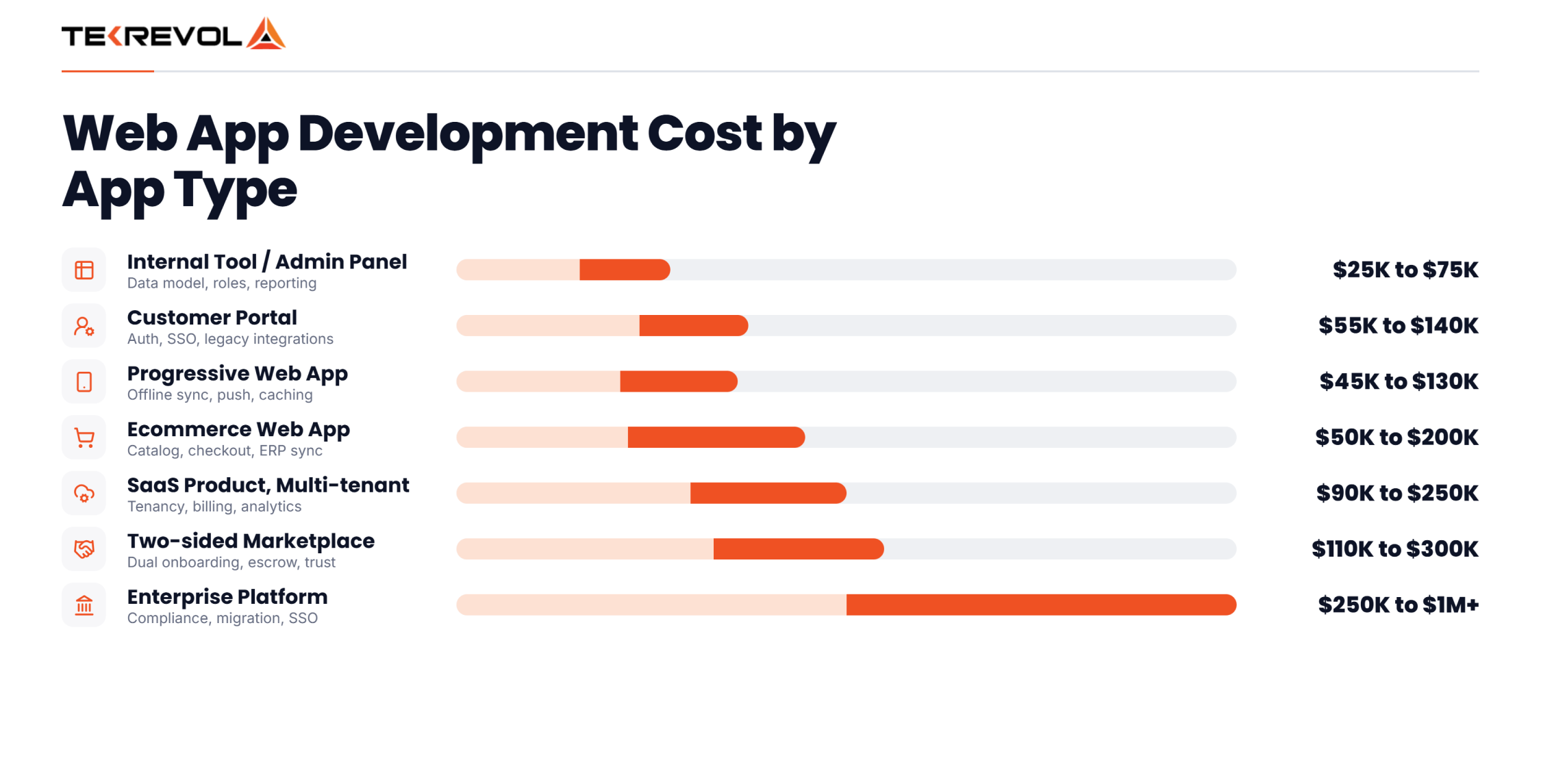
App type is a better cost predictor than feature count, because each type carries a set of problems you can’t avoid. Marketplaces need trust and safety. SaaS needs billing and tenancy. Internal tools need almost none of that.
| App type | Typical range | Hours | What drives the cost |
| Internal business tool / admin panel | $25,000–$75,000 | 400–900 | Data model, roles, reporting |
| Customer portal / self-service | $55,000–$140,000 | 800–1,600 | Auth, SSO, legacy integrations |
| Progressive web app (PWA) | $45,000–$130,000 | 700–1,500 | Offline sync, push, caching |
| Ecommerce web app | $50,000–$200,000 | 800–2,500 | Catalog, checkout, ERP sync |
| SaaS product (multi-tenant) | $90,000–$250,000 | 1,500–3,000 | Tenancy, billing, roles, analytics |
| Two-sided marketplace | $110,000–$300,000 | 1,800–3,500 | Dual onboarding, payments, trust & safety |
| Enterprise platform | $250,000–$1M+ | 3,500+ | Compliance, migration, integrations |
Marketplaces cost roughly four times what internal tools cost, and it isn’t because they have four times the screens. You’re building two products for two audiences, plus a payment layer that holds money in escrow, plus dispute handling nobody remembers to scope.
Weighing a web app against a native mobile build? The economics diverge fast once you need offline capability or device hardware. Our mobile app development service team runs that comparison often, and the honest answer is usually “start with the web app.”
How Much Does a Web App Cost by Development Method?
Web app cost by development method ranges from near zero for no-code tools to $400,000 or more for a full custom build. No-code runs $30 to $500 monthly, low-code costs $8,000 to $60,000 upfront plus seat fees, and custom development starts around $25,000.
The method you pick determines your ceiling as much as your cost. Cheap methods aren’t wrong; they just run out of room at a predictable point.
| Method | Upfront cost | Ongoing cost | Best for | Where it breaks |
| No-code (Bubble, Glide, Softr) | $0–$8,000 | $30–$500/mo | Validation, simple internal tools | Custom logic, scale, data ownership |
| Low-code (Retool, OutSystems) | $8,000–$60,000 | $200–$3,000/mo + per-seat | Internal ops, dashboards, admin panels | Per-seat costs compound; vendor lock-in |
| Hybrid (no-code front, custom back) | $15,000–$90,000 | Varies | Fast validation with an upgrade path | Integration seams, dual maintenance |
| AI-assisted custom build | $20,000–$150,000 | 15–20% of build/yr | Most funded products | Review overhead (see next section) |
| Traditional custom build | $30,000–$400,000+ | 15–25% of build/yr | Regulated, complex, IP-critical work | Slowest path to first release |
The no-code trap is real but overstated. No-code is great for testing whether anyone wants your product. It gets expensive when per-seat pricing scales with your success or when you need a feature the platform simply can’t handle.
We’ve helped businesses move from no-code prototypes to a web development service when they needed more flexibility, scalability, or control. In many cases, starting with no-code was still the right move: validate cheaply first, then invest in custom development once the product proves itself.
What Do Developers Charge by Region in 2026?
Developer rates by region run from $18 per hour in South Asia to $220 for senior North American engineers. Eastern Europe averages $45 to $85 blended, Latin America $40 to $80, North America $100 to $180. Location is your single biggest cost variable.
Here’s the table that explains most of your quote confusion.
| Region | Junior | Mid-level | Senior | Blended agency rate |
| North America | $60–$100 | $95–$150 | $130–$220 | $100–$180 |
| Western Europe | $45–$75 | $70–$115 | $95–$165 | $70–$130 |
| Eastern Europe | $25–$45 | $45–$80 | $65–$115 | $45–$85 |
| Latin America | $22–$42 | $42–$75 | $55–$105 | $40–$80 |
| Middle East (UAE, KSA) | $35–$60 | $55–$95 | $80–$140 | $50–$100 |
| South & Southeast Asia | $18–$40 | $35–$70 | $55–$110 | $25–$55 |
Rate is not the same as cost. This is where buyers get burned. A $30 per hour developer who needs 1,600 hours costs more than a $70 per hour developer who needs 600. We’ve inherited plenty of cheap builds that cost more to fix than to have built right.
What we’d recommend. Blended teams beat single-region teams more often than not. Keep architecture, product, and QA leadership in your timezone, and put implementation capacity where rates are efficient. That structure is why our IT staff augmentation engagements tend to outperform pure-offshore setups on delivered value. Timezone overlap is its own cost multiplier: a team with four overlapping hours ships faster than one with zero, at the same rate.
How is AI Changing Web Application Development in 2026?
AI can reduce development time, but it doesn’t automatically make web apps cheaper. It handles repetitive work well, while complex logic, debugging, and quality checks still need experienced developers.
- The productivity picture is mixed: A 2025 METR trial found experienced developers took 19% longer with AI on real-world coding tasks, showing why AI-assisted development still needs human oversight.
- AI adoption is high, but trust remains limited: Stack Overflow’s 2025 survey found 84% of developers use or plan to use AI tools, while only 33% trust their output. 66% cited “almost right” solutions as a major frustration, and 45% said debugging AI-generated code takes longer.
What this means for your budget: AI can deliver meaningful savings on simple, repetitive builds, but those savings shrink as integrations, security, and custom functionality increase. Treat AI as a productivity tool, not a reason to accept an unrealistically low quote.
If your web app includes AI features, also budget for recurring inference and infrastructure costs. That’s a core part of how our artificial intelligence development service practice scopes AI-powered products.
Which Engagement Model Costs Less: In-house, Outsourcing, or Staff Augmentation?
Staff augmentation costs the least for teams that already have technical leadership, at $25 to $90 per hour per specialist. Outsourcing suits defined scopes at $45 to $180 blended. In-house costs most upfront, roughly $115,000 to $180,000 per senior US developer yearly, but wins long roadmaps.
There’s no universally cheapest model, only the cheapest one for your situation. What decides it is whether you already have someone who can run a build.
| Model | Typical cost shape | Time to start | Your control | Best when |
| In-house team | $115,000–$180,000/yr per senior US dev, loaded | 8–14 weeks to hire | Highest | Permanent product, multi-year roadmap |
| Full outsourcing/agency | $45–$180/hr blended, fixed-price or T&M | 1–3 weeks | Medium | Defined scope, no internal engineering |
| Staff augmentation | $25–$90/hr per specialist | 1–2 weeks | High | You have a lead or PM, need capacity |
| Hybrid (core in-house + augmented) | Mixed | 2–4 weeks | High | Scaling an existing team fast |
The in-house number is derived. BLS puts the US median web developer wage at $90,930. Add benefits, payroll taxes, equipment, software, and recruiting, and loaded cost runs 25% to 40% higher. That’s $114,000 to $127,000 for a median developer, more for genuine seniors.
The fixed-price trap. Fixed price feels safe, but it bakes your vendor’s risk into the number, usually 20% to 30% of padding, and it turns every change into a negotiation. It works beautifully for discovery and well-defined scopes. It works badly for products that will learn something during development, which is most products.
Why staff augmentation keeps winning for mid-market teams. You pay for capacity instead of a vendor’s project management layer, and you keep architectural control. The catch: it only works if someone internal can direct the work. Without that, you’re paying for hands with no head.
Our recommendation: fixed-price discovery, then time-and-materials for the build. Discovery de-risks the estimate. Time-and-materials stops you from paying a risk premium on work that turns out simpler than feared.
What Hidden Costs Blow Up Web App Budgets?
Hidden web app costs include cloud bills that scale with traffic, third-party licence creep, security audits, data migration, payment processing fees, accessibility compliance, and post-launch rework. Together, these commonly add 25% to 40% beyond the quoted build price in year one.
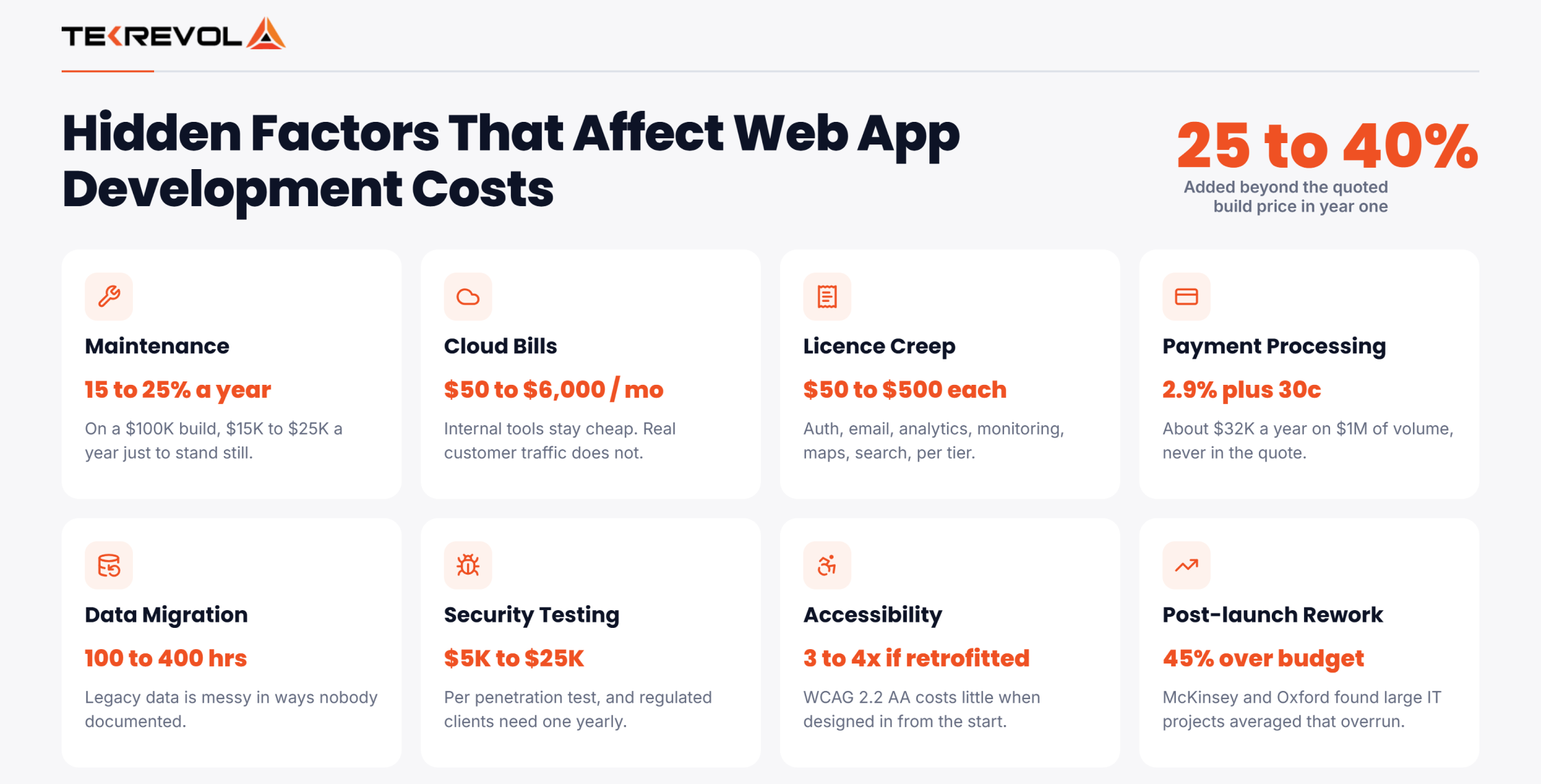
The build quote is the part everyone talks about. These are the parts that show up later.
- Maintenance, at 15% to 25% of build cost annually. Not optional. Dependencies need updating, browsers change, security patches land, small fixes pile up. On a $100,000 build, budget $15,000 to $25,000 a year just to stand still.
- Cloud costs that scale with success. A cloud-native internal tool runs $50 to $200 a month. A mid-size customer-facing app with real traffic runs $1,500 to $6,000. Spend alerts and right-sizing are exactly what our cloud services sets up before launch, not after the invoice.
- Third-party licence creep. Auth, email, analytics, error monitoring, maps, search. Each one costs $50 a month until you cross a tier, then it’s $500.
- Payment processing. Roughly 2.9% plus 30 cents per transaction. On $1 million in annual volume that’s about $32,000 a year, and it never appears in a development quote.
- Data migration. Legacy data is messy in ways nobody documented. We routinely see migration eat 100 to 400 hours on projects where the estimate said “we’ll import the CSV.”
- Security testing. A penetration test runs $5,000 to $25,000 depending on scope, and most regulated clients need one every year.
- Accessibility. WCAG 2.2 AA conformance costs little when designed in and three to four times more when retrofitted.
- Post-launch rework. McKinsey’s research with Oxford University on large-scale IT projects found they ran 45% over budget on average and delivered 56% less value than predicted. Your project is smaller and less exposed, but the direction of the error is consistent.
How Can You Cut Web App Development Cost Without Wrecking Quality?
Cut web app costs by scoping a ruthless MVP, buying commodity features instead of building them, running fixed-price discovery before a time-and-materials build, using blended onshore-offshore teams, and choosing cloud-native architecture. These five moves typically save 25% to 40% without sacrificing product quality.
We’d rather you spend less and come back than spend everything once. Here’s what works.
Scope a genuinely ruthless MVP
Not “MVP with a few extras.” Ask of every feature: if we launched without this, is the product still usable? If yes, it’s version two. Your biggest available saving is the features you don’t build in round one.
Buy the commodity, build the differentiator
Auth, payments, email, search, and analytics are solved problems. Paying $200 a month for Auth0 beats spending $18,000 on auth you’ll then have to secure forever. Build only what your competitors can’t buy off a shelf.
Run discovery as its own paid phase
Two to four weeks of fixed-price discovery produces a scoped backlog, an architecture, and an estimate with a defensible basis. It costs 5% to 10% of the build and routinely prevents the 30% overrun. Skipping it is the most expensive way to save money we know.
Build a blended team
Leadership close, implementation where rates are efficient. Still the highest-leverage structural decision you’ll make.
Go serverless where load is spiky
Uneven traffic favours serverless functions and managed databases by a wide margin. Steady heavy load favours reserved instances. Match architecture to traffic pattern, not to fashion.
Invest in automated testing early
It feels like a cost in month two and pays for itself by month six. Every bug a test catches is a bug that didn’t need a developer, a QA cycle, and a redeploy.
Design system before screens
Building a component library first feels slow until roughly screen fifteen. By screen forty it’s saved you weeks. We cover that sequencing in our guide to web app development.
Phase your compliance
Need SOC 2 eventually but not at launch? Build to the standard and certify later. Building compliant costs little extra. Retrofitting costs a lot.
Why Choose TekRevol for Web App Development?
The right development partner should give you more than developers; it should give you clear estimates, experienced technical guidance, and confidence that your budget is being spent wisely. TekRevol combines all three with 50+ web app experts, 60+ delivered web application projects, and a 95% project success rate.
- Proven expertise: 50+ dedicated web app specialists with experience across 60+ delivered projects.
- Transparent estimates: Costs are broken down by workstream, estimated hours, and blended rates instead of vague lump-sum quotes.
- Business-first guidance: If low-code or an existing platform can solve your problem more efficiently, we’ll tell you rather than push an unnecessary custom build.
- Cost-efficient delivery: Senior architecture and product leadership are combined with implementation resources to balance quality and development costs.
- Client trust: TekRevol holds a 4.8/5 rating across 75+ Clutch reviews, adding independent validation to its track record.
The goal is simple: build the right web app, at a defensible cost, without cutting corners that create bigger expenses later.
Getting quotes that don't agree with each other?
Send us the scope you've already been quoted on and we'll give you a free line-by-line breakdown showing exactly where the hours go.
Request Your Free Quote Review →


