



- ERP software runs finance, inventory, procurement, and manufacturing from one shared database instead of separate systems.
- Cloud, on-premises, and hybrid are the three deployment types, and cloud now dominates new sales.
- Microsoft Dynamics and SAP S/4HANA represent two of the world’s most widely adopted enterprise platforms.
- Custom ERP software eliminates recurring seat licensing fees and gives your enterprise complete data ownership control.
- The right ERP software examples depend far more on your industry and size than on brand recognition.
No single vendor owns the ERP market. Oracle leads it with 6.5%, and the ten biggest vendors together hold barely a quarter of the $135.9 billion businesses spent on ERP software in 2024, according to Apps Run The World. Three-quarters of that money goes somewhere else entirely.
That fragmentation is why shortlisting the best ERP software examples is so much harder than shortlisting a CRM. There is no safe default. A mid-market manufacturer, a government contractor, and a nonprofit will each end up with a completely different system, and all three will be right.
So we pulled together 25 systems grouped by who they’re built for, and checked every product price and status. This guide covers what ERP software is, the features to expect, 25 ERP software examples by category, the three types of ERP, and the migration deadlines already running.
What Is ERP Software?
ERP software, short for Enterprise Resource Planning software, is a centralized digital system that connects and automates core business operations. Finance, procurement, inventory, manufacturing, HR, and order management all read and write to the same records, so a sale updates stock, revenue, and the general ledger at once.
When a customer places an online order, the ERP instantly updates warehouse inventory records, notifies shipping logistics, generates an invoice in accounting, and updates sales revenue reports. This real-time automation keeps your business running smoothly, cuts down manual errors, and gives leadership full visibility over operational costs.
That’s the whole promise, and it’s also why custom ERP software development is hard. The ERP software examples differ enormously in scope and price, but they all ask the same thing: agree on one version of how the business works. The software part is usually the easier half.
Need an ERP Scoped Before You Commit Budget?
Tell us your industry, headcount, and what you're running now. We'll map the options.
Book a Free Strategy Call NowWhat are the Key Modules of ERP Software?
Every ERP ships the same core: a general ledger, buying, stock, order handling, and reports, all from one database, which is what separates it from the other enterprise software categories running alongside it.
While individual platforms offer specialized capabilities, most comprehensive ERPs rely on these core functional modules:
- Financial Management & Accounting: Tracks general ledgers, manages accounts payable and receivable, handles tax compliance, and generates balance sheets.
- Supply Chain & Logistics: Automates order fulfillment, tracks vendor shipments, manages warehouse stock levels, and optimizes distribution routes.
- Human Capital Management (HCM): Handles employee records, payroll processing, benefits administration, performance reviews, and time tracking.
- Procurement & Purchasing: Streamlines purchase orders, manages vendor bids, tracks supplier invoices, and controls corporate spend.
- Manufacturing & Production: Schedules shop-floor production runs, plans material requirements (MRP), and monitors equipment usage.
If your company relies on unique internal workflows, our custom software development services help you build specialized operational logic directly into your software platform.
What Are the Types of ERP Software?
ERP is usually sorted three ways: by deployment (cloud, on-premises, hybrid), by company size (small business, mid-market, enterprise), and by industry specificity. Dedicated ERP developers can map your operation onto the right combination.
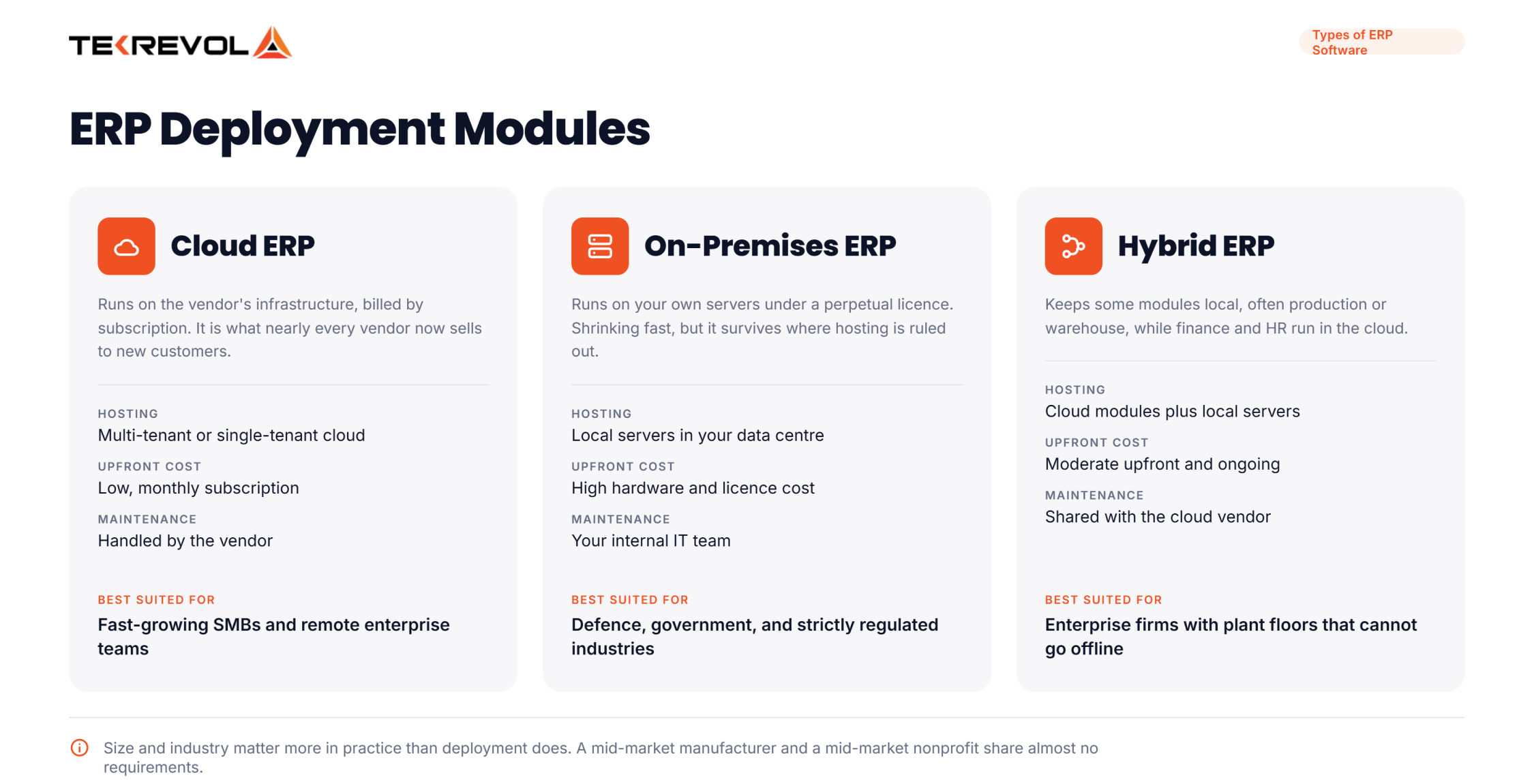
Choosing the right deployment model depends on your operational infrastructure, security standards, and IT budget:
| Deployment Type | Infrastructure & Hosting | Upfront Cost | Maintenance | Best Suited For |
| Cloud-Based ERP | Multi-tenant or single-tenant cloud servers | Low initial investment; monthly subscription | Managed by ERP cloud vendor | Fast-growing SMBs & remote enterprise teams |
| On-Premise ERP | Local physical servers inside company data centers | High initial hardware & software license cost | Managed entirely by internal IT staff | Defense, government, & strictly regulated industries |
| Hybrid ERP | Combined cloud modules and local physical servers | Moderate upfront and ongoing hosting costs | Shared between internal IT and cloud vendor | Enterprise firms |
Cloud ERP
Cloud ERP runs on the vendor’s infrastructure, which you subscribe to, in the same delivery model as the subscription-based SaaS platforms your teams already use.
Public cloud means multi-tenant, everyone on the same version and upgrade schedule. Private cloud means a dedicated instance you control more of. Nearly every ERP software examples list is now dominated by cloud products, and most vendors have stopped selling anything else to new customers.
On-premises ERP
On-premises ERP runs on your servers, under your control, usually on a perpetual licence. It survives in regulated industries, in defence, and anywhere latency or data residency rules out hosting. It is shrinking fast, and the Epicor announcement below is a good illustration of why.
Hybrid ERP
Hybrid ERP keeps some modules on-premises and moves others to the cloud, usually because a manufacturing plant floor can’t tolerate an internet outage while finance can.
What Are the Main ERP Software Examples?
The most widely deployed ERP software examples are SAP Cloud ERP, Oracle Fusion Cloud ERP, Microsoft Dynamics 365 Finance, Oracle NetSuite, and Infor CloudSuite at the top end, with Acumatica, Sage Intacct, Epicor Kinetic, and Odoo covering mid-market and smaller businesses.
Here are 25 ERP software examples, grouped by who they’re actually built for. Every product name, price, and status below was checked against the vendor’s own page in August 2026.
Tier-1 & Large Enterprise ERP Examples
- SAP Cloud ERP: This was SAP S/4HANA Cloud until the 2025 rename, and the private-cloud version is now SAP Cloud ERP Private. It is built for large firms running many entities in many countries. Pricing is not published.
- Oracle Fusion Cloud ERP. Oracle’s finance-led enterprise suite, which Oracle also shortens to Oracle Cloud ERP. “Oracle ERP Cloud” is the superseded word order. Pricing is not published.
- Microsoft Dynamics 365 Finance. The natural pick if your business already runs on Microsoft. It is one of the few big ERPs with public pricing: $210 per user per month billed yearly, or $300 for Premium.
- Infor CloudSuite. Not one product but a family of industry suites running on AWS. There are separate ones for aerospace, cars, distribution, fashion, food and drink, health, and the public sector. Pricing is not published.
- Workday Financial Management. Built for large firms that sell time rather than goods, such as consultancies and law firms. Workday brands the wider suite “next-generation ERP for the AI era.” Pricing is not published.
- IFS Cloud ERP. Aimed at firms with a lot of heavy kit to look after: energy, aerospace, building, and utilities. It is built around service and asset work as much as finance. Pricing is not published.
Mid-Market & Cloud-Native ERP Examples
- Oracle NetSuite. The default answer for fast-growing companies wanting one cloud suite. NetSuite states more than 44,000 customers. Pricing is not published; expect an annual licence plus a one-time implementation fee.
- Acumatica Cloud ERP. Strong in construction, distribution, and manufacturing. Licensed by resources consumed rather than per seat, so users are unlimited — which changes the maths for larger teams. Vista Equity Partners agreed to acquire it in May 2025.
- Sage Intacct. Sage aims it at firms above roughly $4 million in revenue or 20 staff. Worth noting that Sage sells it as accounting and finance software rather than a full ERP. Pricing is not published.
- Sage X3. Sage’s product for manufacturers and distributors. Briefly renamed Sage Business Cloud Enterprise Management, then reverted to Sage X3, so both names circulate. Pricing is not published.
- Epicor Kinetic. Discrete manufacturing ERP, renamed from Epicor ERP. On-premises development is being wound down, which matters if that’s your deployment. Pricing is not published.
- SYSPRO. Built for mid-sized firms that make or move physical goods. It is moving off perpetual licences to a named-user subscription, so older cost comparisons no longer hold. Pricing is not published.
- Unit4 ERP. Built for places where people are the main cost: government, colleges, charities, and consulting firms. Also branded Unit4 ERPx. Pricing is not published.
Manufacturing & Supply Chain ERP Software Examples
- QAD Adaptive. Strong in cars, drugs, food and drink, and heavy industry. QAD dropped “ERP” from the name in 2025, so the old name is now wrong. Pricing is not published.
- Epicor Prophet 21. Purpose-built for wholesale distributors, with deep inventory and pricing logic. Current release is Prophet 21 2026.1. Pricing is not published.
- Rootstock Cloud ERP. Built right on top of the Salesforce Platform, so it suits makers who already run Salesforce and want one set of data. Pricing is not published.
- Microsoft Dynamics 365 Supply Chain Management. Supply chain and production planning, split out of the old Finance & Operations product in 2019. Published pricing: $210 per user per month billed yearly, $300 for Premium.
Small business ERP software examples
- Microsoft Dynamics 365 Business Central. Microsoft’s SMB ERP, sold separately from the Finance line. Published pricing: Essentials $80 per user per month paid yearly, Premium $110, Team Members $8.
- Odoo. Modular apps you switch on gradually, which suits companies that want to start narrow. Standard is $24.90 per user per month, discounted from $31.10 for the first 12 months; Custom is $49. The One App Free tier gives unlimited users on a single app.
- Intuit Enterprise Suite. Launched in 2024 for firms with several entities that have outgrown QuickBooks. Intuit brands it “the AI-native ERP” and aims at messy finances rather than a staff-count band. Pricing is not published.
- TallyPrime. Very widely used by small firms, mainly in India but with editions for other markets. The current release is TallyPrime 7.1, and “Tally. ERP 9” is the old one. Pricing is published in rupees.
Open-source ERP software examples
- ERPNext. Maintained by Frappe, with version 16 as the current line under GPLv3. It is free if you host it yourself, and Frappe Cloud has published tiers if you would rather not. Best for teams happy to run their own stack.
- Dolibarr. PHP-based and GPL-licensed, latest stable 23.0.3. A genuinely free self-hosted suite for small businesses, with paid cloud hosting available.
Industry-Specific & Niche ERP Software Examples
- Deltek Costpoint. Built for firms that sell to government, where the audit rules rule out a general suite. Deltek runs five ERPs in total across project-based work, including one for builders and one for architects. Pricing is not published.
- Blackbaud Financial Edge NXT. Nonprofits and foundations. Worth flagging that Blackbaud calls it fund accounting software rather than ERP, even though nonprofits run it as their back office. Pricing is not published.
Shortlisting ERPs and drowning in vendor decks?
Send us your industry and headcount, and we'll tell you which of these actually fit.
Schedule Your Free ConsultationWhich ERP Software Are Out of Date?
Several ERP software examples still in circulation are renamed or gone: SAP S/4HANA Cloud is now SAP Cloud ERP, Dynamics 365 Finance & Operations was split in 2019, QAD Adaptive ERP dropped the “ERP,” Kronos became UKG, and Skubana was absorbed into Extensiv.
SAP S/4HANA Cloud
SAP’s own ERP page now lists one product name: SAP Cloud ERP, sitting under a relaunched SAP Business Suite umbrella brand. Confusingly, SAP hasn’t finished the transition; the RISE with SAP page still says S/4HANA Cloud Private Edition, so use both names together when you search.
Dynamics 365 Finance & Operations
Not a product. Microsoft split it in October 2019 into Dynamics 365 Finance and Dynamics 365 Supply Chain Management. “Finance and operations apps” survives only as a documentation umbrella term, never as something you can buy.
QAD Adaptive ERP
Now just QAD Adaptive. The old product page has been archived.
Kronos
Merged with Ultimate Software to form UKG in 2020, and it was workforce management rather than ERP in the first place. It still appears on a high-authority ERP list.
Skubana
Acquired by 3PL Central in 2021, which then rebranded itself as Extensiv. The product is now Extensiv Order Management, and the Skubana name is gone.
Tally ERP
The current product is TallyPrime. Tally.ERP 9 is legacy, with a free upgrade path off it.
Three more get miscategorised entirely, and in two cases the vendor says so itself:
- Xero’s own ERP explainer states that “modern cloud accounting platforms like Xero sit between traditional accounting software and full ERP.”
- Procore publishes an article titled “Why Your ERP Is Not A Construction Management Solution” and sells an ERP integration product, which rather settles it.
- Oracle Health, formerly Cerner, is an electronic health record, not an ERP. Hospitals typically run it alongside a real ERP for the back office.
Which ERP Deadlines Should You Be Planning Around?
Two matter right now. SAP ends mainstream maintenance for Business Suite 7 and ECC on 31 December 2027, with paid extended maintenance to the end of 2030, so software maintenance planning belongs in this year’s budget, not the migration year’s. Epicor announced in January 2026 that on-premises development for Kinetic, Prophet 21, and BisTrack will end.
If you’re running either, the decision has a date on it, and that changes how you should read any vendor list you find.
| Deadline | What it covers | Key dates |
| SAP mainstream maintenance ends | SAP Business Suite 7 core applications, including ECC | Ends 31 December 2027 |
| SAP extended maintenance | Optional paid extension, at a two-percentage-point premium on the maintenance basis | 1 January 2028 to 31 December 2030 |
| Epicor Kinetic on-premises | Final on-premises release 2028.1 | Active support ends 31 December 2029 |
| Epicor Prophet 21 on-premises | Final on-premises release 2028.1 | Active support ends 30 June 2029 |
| Epicor BisTrack (desktop) | Final on-premises release 2026.2 | Active support ends 31 December 2028 |
| Epicor BisTrack (web and API) | Final on-premises release 2028.1 | Active support ends 30 June 2029 |
SAP has also committed to keeping at least one S/4HANA release in maintenance until 2040, so the destination is stable even if the journey has a deadline. SAP packages the move two ways:
- RISE with SAP for existing customers heading to private cloud, and
- GROW with SAP for new and midsize customers going to public cloud.
The Epicor announcement is less widely known and arguably more disruptive, because on-premises manufacturers chose on-premises for a reason. If that’s you, the planning window is now rather than 2028.
Facing a maintenance deadline on your current ERP?
Tell us what you're running, and we'll map what moving actually involves.
Consult Our ExpertsWhich ERP Software Is the Most Used?
Oracle leads, but narrowly. Apps Run The World put the worldwide ERP software market at $135.9 billion in 2024 and ranked Oracle first with a 6.5% share. The top ten vendors combined hold only 26.5 percent, which makes ERP one of the most fragmented enterprise categories.
Apps Run The World’s top ten for 2024, in order, were Oracle, SAP, Intuit, Constellation Software, Microsoft, FIS Global, IQVIA, Roper Technologies, Sage, and Infor. Constellation and Roper are acquisition holding companies rather than single products, which tells you how much of the market lives in industry-specific niches.
Gartner splits the category into three separate Magic Quadrants, which is itself a useful signal. Its 2025 Magic Quadrant for Cloud ERP for Product-Centric Enterprises named seven Leaders: Oracle Fusion Cloud ERP, Microsoft, SAP, IFS, Oracle NetSuite, Epicor, and Infor. Unusually, that edition had no Challengers and no Visionaries at all.
Commercial Off-the-Shelf vs Custom Enterprise ERP Solutions
Commercial off-the-shelf ERPs offer quick initial deployment with recurring monthly user fees. Whereas custom enterprise ERP software delivers tailored business workflows, total data security, seamless proprietary database integrations, and zero per-seat licensing costs, you can weigh those savings against custom ERP build costs upfront.
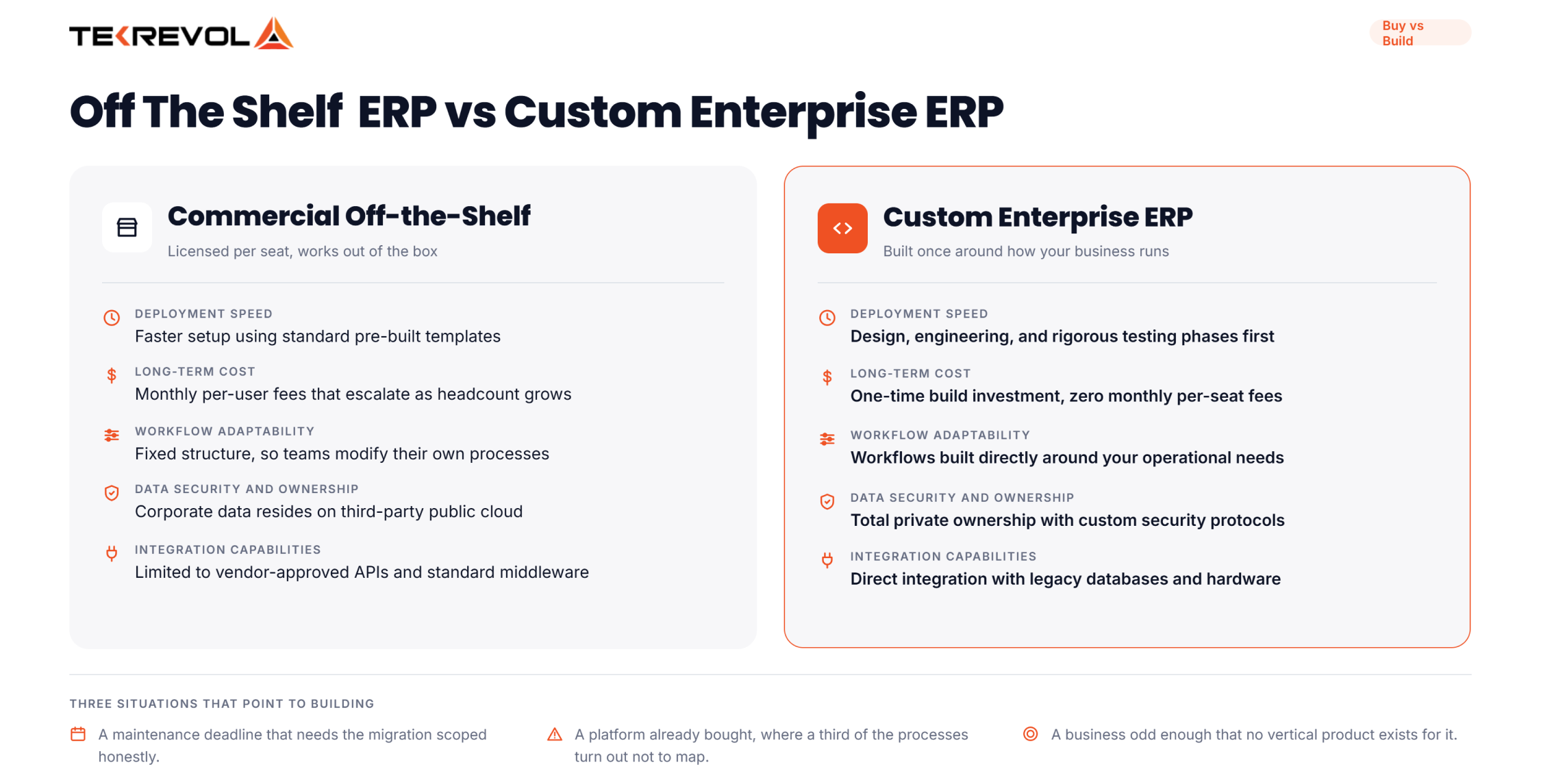
While commercial tools like SAP or Microsoft Dynamics work well out of the box, growing enterprise companies frequently run into operational friction. Off-the-shelf software forces your staff to adapt unique business processes to fit generic system fields.
To compare how both options perform, here is a direct breakdown:
| Evaluation Metric | Commercial Off-the-Shelf ERP | Custom Enterprise ERP Solution |
| Initial Deployment Speed | Faster setup time using standard pre-built templates | Requires design, custom software engineering, and rigorous testing phases |
| Long-Term Cost Structure | Monthly per-user licensing fees that escalate as your headcount grows | Initial custom development investment with zero monthly per-seat fees |
| Workflow Adaptability | Fixed software structure; forces teams to modify internal processes | 100% custom workflows built directly around your operational needs |
| Data Security & Ownership | Corporate data resides on third-party public cloud environments | Total private data ownership with custom security protocols |
| Integration Capabilities | Limited to vendor-approved APIs and standardized middleware tools | Direct, seamless integration with your legacy databases and hardware |
As your enterprise scales to hundreds of active employees, recurring per-seat monthly fees for commercial tools can accumulate into hundreds of thousands of dollars annually. Building custom software gives you absolute data ownership, tailored workflows, and zero monthly licensing charges.
For field teams needing portable operational access, our mobile app development company specialists build custom mobile interfaces that give staff real-time access to ERP data anywhere.
Why Choose TekRevol for Custom ERP Software Development?
At TekRevol, we build custom software platforms engineered specifically around your operational goals. Instead of paying recurring monthly subscription fees for rigid commercial packages, we develop scalable ERP platforms built around your unique business workflows.
Three situations bring people to us.
- A maintenance deadline that needs the migration scoped honestly.
- A platform already bought, where a third of the processes turn out not to map.
- A business odd enough that no vertical product exists and you need ERP developers rather than implementation consultants.
That work is custom ERP software plus the layer around whatever you’ve chosen: integrations, customer and supplier portals, and the modules a generic suite leaves out.
Ready to Build a Custom ERP Platform Tailored to Your Enterprise?
Stop paying high subscription fees for platforms. Partner with TekRevol to build fully custom ERP platforms tailored to your operational goals.
Book a Strategy Consultation Today


