



- Healthcare app development in Houston is driven by the Texas Medical Center, fueling high demand for custom digital health solutions.
- HIPAA compliance in Houston healthcare app development is mandatory, with non-compliance fines reaching up to $2 million.
- Telemedicine app development in Houston is surging, backed by a 30% annual increase in U.S. telehealth consultations.
- mHealth app development in Houston covers patient portals, remote patient monitoring, mental health apps, and chronic disease platforms.
- A basic HIPAA-compliant healthcare app MVP costs $60,000–$100,000, while complex EHR-integrated platforms exceed $250,000.
- Clinical-grade medical apps require EHR/EMR integration, HL7/FHIR compatibility, end-to-end encryption, and role-based access control.
Healthcare app development in Houston combines one of the world’s most concentrated medical ecosystems, the Texas Medical Center, with strict federal compliance requirements and a rapidly growing demand for digital health tools. In 2026, a HIPAA-compliant healthcare app costs between $60,000 and $300,000+, depending on complexity, integrations, and feature depth.
In the heart of the Bayou City, a digital revolution is unfolding. Houston isn’t just an energy titan; it’s the home of the Texas Medical Center, the largest medical complex on earth. Here, healthcare app development company isn’t just about code; it’s about scaling innovation within a high-stakes ecosystem of 10 million annual patient encounters.
Whether you’re launching a sleek telemedicine platform to meet the 30% annual surge in virtual care or a complex AI-native diagnostic tool, the path to success is paved with precision. From navigating the million-dollar stakes of HIPAA compliance to integrating seamless HL7/FHIR protocols, building in Houston requires a blend of clinical rigor and cutting-edge tech.
Explore our comprehensive guide on the features, costs, and compliance architecture needed to turn your vision into a clinical-grade reality in 2026.
The Houston Healthcare Tech Landscape in 2026
Why Does the Texas Medical Center Change Everything?
The TMC isn’t just a hospital cluster; it’s the world’s largest medical complex and one of the most active innovation ecosystems in healthcare globally.
In 2026, TMC Innovation actively funds and incubates digital health startups, giving founders direct access to clinical validation partners, real patient populations, and procurement decision-makers who are actively looking for technology solutions.
This matters enormously for the healthcare app developers Houston teams serve. Unlike founders in other cities who need to cold-pitch hospital IT departments, Houston-based health tech companies can move from prototype to pilot within the same zip code.
Key Sectors Driving mHealth Demand in Houston
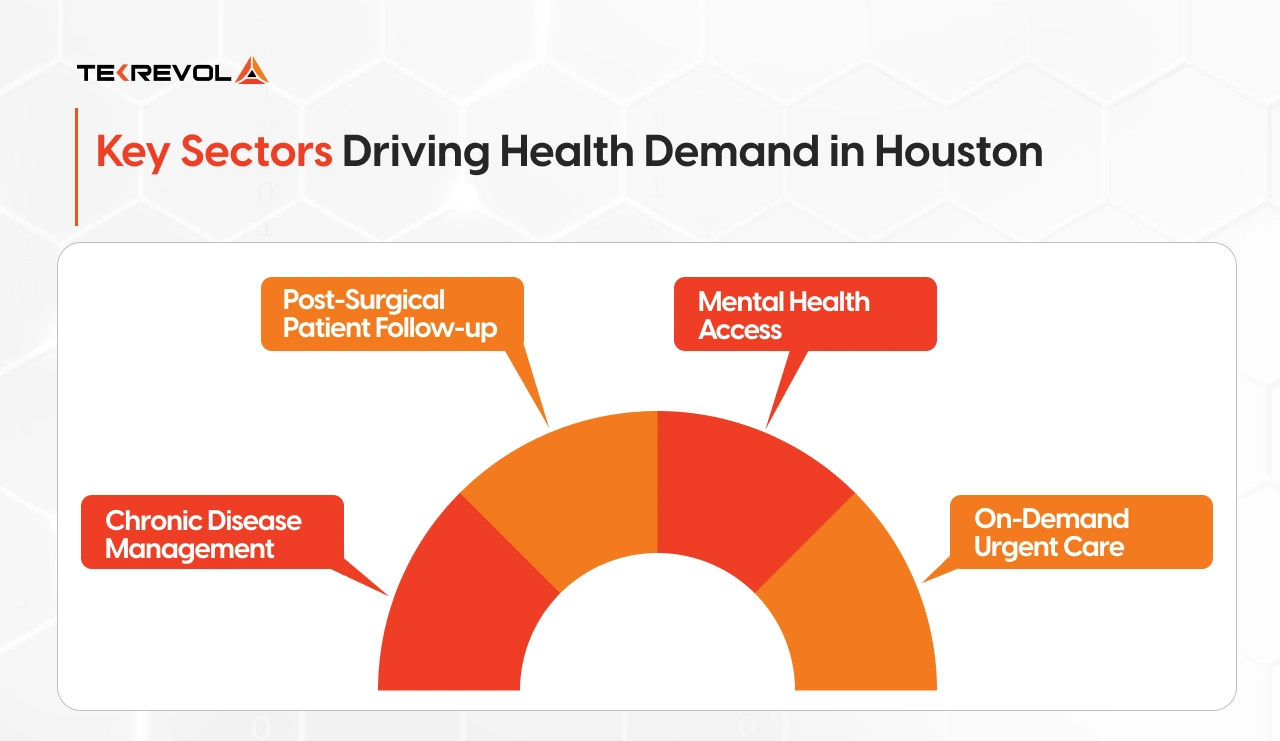
mHealth app development Houston is being driven by four dominant clinical and operational needs:
- Chronic disease management: Houston has some of the highest rates of diabetes, obesity, and hypertension in the U.S. Remote patient monitoring apps that track vitals, medication adherence, and lifestyle data are in acute demand.
- Post-surgical patient follow-up: With hundreds of major surgeries performed daily across TMC institutions, automated follow-up tools and telehealth check-in platforms are replacing inefficient phone-call workflows.
- Mental health access: Texas ranks near the bottom nationally for mental health resource availability. Digital mental health platforms that deliver therapy, coaching, and crisis support are filling a significant gap.
- On-demand urgent care: Consumer demand for same-day virtual consults is accelerating, particularly among Houston’s sprawling suburban populations who face long commutes to clinical facilities.
Claim Your $450 Healthcare App Strategy Blueprint, Free
Get a feature-prioritized scope, a realistic timeline, and a transparent cost estimate built specifically for your Houston healthcare product.
Secure Your Free Blueprint Now
Types of Healthcare Apps Being Built in Houston
Telemedicine app development Houston is the dominant category in 2026, but it sits within a broader ecosystem of digital health product types that healthcare app developers Houston are actively building.
| App Type | Primary Use Case | Compliance Level |
| Telemedicine Platform | Virtual consultations, remote diagnosis | HIPAA mandatory |
| Patient Portal | Medical records, scheduling, and billing | HIPAA mandatory |
| Remote Patient Monitoring | Chronic disease management via wearables | HIPAA mandatory |
| Mental Health App | Therapy, coaching, crisis support | HIPAA if clinically integrated |
| Hospital Operations Tool | Staff scheduling, bed management, internal comms | HIPAA if PHI is accessed |
| Wellness & Fitness App | Nutrition, exercise, and sleep tracking | HIPAA, if not clinically integrated |
| EHR/EMR System | Clinical data management for providers | HIPAA mandatory |
| Medical Education App | Training tools for TMC students and residents | HIPAA if real patient data is used |
HIPAA Compliance: The Non-Negotiable Foundation
Before a single feature is designed, every healthcare app development in Houston project must address HIPAA compliance at the architecture level.
The Health Insurance Portability and Accountability Act governs how Protected Health Information (PHI) is stored, transmitted, accessed, and deleted. In 2026, the Office for Civil Rights (OCR) significantly increased audit frequency, and fines range from $141 to over $2 million per violation.
Understanding the full cost of adding HIPAA compliance to a mobile app is essential before budgeting. Retroactively bolting compliance onto a finished product costs 3–5x more than building it correctly from the start.
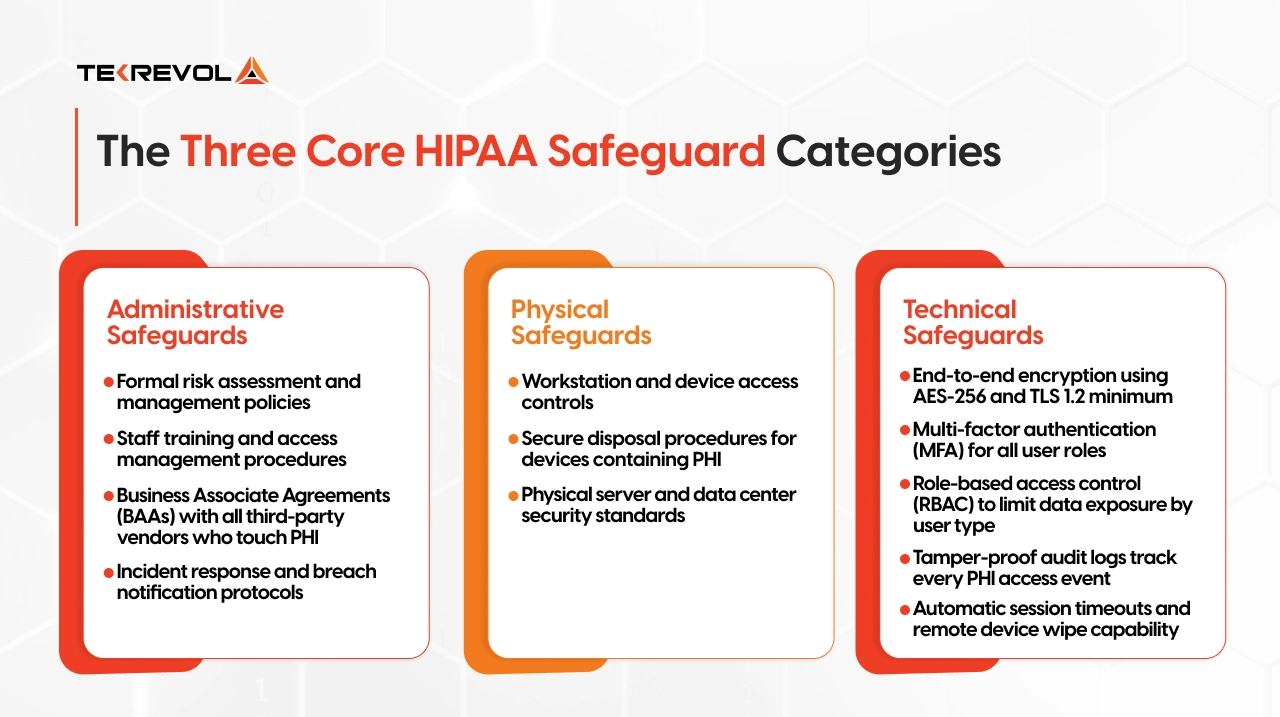
The Three Core HIPAA Safeguard Categories
1. Administrative Safeguards
- Formal risk assessment and management policies
- Staff training and access management procedures
- Business Associate Agreements (BAAs) with all third-party vendors who touch PHI
- Incident response and breach notification protocols
2. Physical Safeguards
- Workstation and device access controls
- Secure disposal procedures for devices containing PHI
- Physical server and data center security standards
3. Technical Safeguards
- End-to-end encryption using AES-256 and TLS 1.2 minimum
- Multi-factor authentication (MFA) for all user roles
- Role-based access control (RBAC) to limit data exposure by user type
- Tamper-proof audit logs track every PHI access event
- Automatic session timeouts and remote device wipe capability
Texas-Specific Compliance Considerations
Beyond federal HIPAA requirements, Houston-based products must also navigate:
- Texas Medical Privacy Act: Texas imposes additional restrictions on the use and disclosure of health information that go beyond federal minimums.
- Telemedicine regulations in Texas: The Texas Medical Board has specific licensure and prescribing requirements for virtual care platforms. Telemedicine app development Houston projects must account for these in their feature design, particularly around prescription workflows and out-of-state provider licensing.
- FDA classification: Apps that analyze clinical data to assist in diagnosis may be classified as Software as a Medical Device (SaMD), triggering an additional regulatory layer.
Stop Guessing on Compliance, Get a Free HIPAA Architecture Review
Stop risking $2M HIPAA fines. Get a free, expert-written PHI risk audit and bulletproof your app.
Book Your Free HIPAA ReviewCore Features of a Houston Healthcare App
-
Patient-Facing Features
A strong mHealth app development Houston product meets patients where they are, on their phones, between appointments, managing chronic conditions, or navigating the aftermath of a procedure.
- Secure patient portal: Access to medical history, lab results, prescriptions, and provider notes, all encrypted and permission-controlled.
- Appointment scheduling & reminders: Real-time booking with automated SMS/push reminders that reduce no-show rates, a chronic problem for Houston’s high-volume clinic environments.
- Telemedicine/video consultations: HIPAA-compliant video calls with waiting room functionality, session recording controls, and encrypted chat. This is the cornerstone of any telemedicine app development company engagement.
- Medication tracking & reminders: Adherence tools that send push notifications for scheduled doses and flag missed medications to care coordinators.
- Symptom checker & triage: AI-assisted intake tools that help patients self-assess before choosing between urgent care, ER, or virtual consultation.
- Wearable device integration: Syncing with Apple Health, Google Fit, and medical-grade IoMT devices for continuous vital sign monitoring.
-
Provider-Facing Features
A healthcare app that only serves patients is half a product. Clinical staff workflows must be digitized just as thoughtfully.
- EHR/EMR integration: Compatibility with Epic, Cerner, and Meditech via HL7 and FHIR standards is required for most Houston hospital partnerships. This is technically one of the most complex and costly features in any healthcare app development project in Houston.
- Clinical dashboard & patient queue: Providers need a clean, fast interface for reviewing incoming consults, patient histories, and test results without leaving the app.
- e-Prescribing: HIPAA-compliant electronic prescription generation, DEA number verification, and pharmacy routing, especially important for telemedicine platforms where physical prescription pads aren’t possible.
- Secure provider-to-provider messaging: Internal communication tools that keep clinical conversations inside a compliant infrastructure, replacing unsecured SMS among staff.
- Billing & insurance verification: Real-time eligibility checks, automated claim submission, and CoPay collection integrated into the patient flow.
-
Advanced Features for Competitive Differentiation
By 2026, standard features are the baseline. Houston health tech products competing for enterprise hospital contracts need:
- AI-powered diagnostics support Machine learning models that flag abnormal lab trends, identify early-stage chronic disease markers, or surface high-risk patients for proactive outreach.
- Remote Patient Monitoring (RPM), Continuous data streams from home devices, blood pressure cuffs, glucometers, pulse oximeters, feeding into a provider dashboard with configurable alert thresholds.
- Multilingual support, Houston is one of the most linguistically diverse cities in the U.S. Apps that serve patients in Spanish, Vietnamese, and other prevalent languages see measurably higher adoption and retention.
- Mental health modules, Mood tracking, guided therapy sessions, crisis escalation pathways, and secure therapist messaging are embedded directly into the care flow.
For a comprehensive breakdown of which features to prioritize at each stage, TekRevol’s guide on the benefits of custom healthcare app development walks through the clinical and operational impact of each capability.
The Tech Stack for a HIPAA-Compliant Healthcare App in 2026
Choosing the right technology is not just a performance decision; it’s a compliance decision. Every component of your stack must support the security and interoperability standards required by HIPAA and by Houston’s hospital integration requirements.
| Layer | Technology Options | Why It Matters |
| Frontend (iOS) | Swift, SwiftUI | Full access to Face ID, HealthKit, and Apple’s on-device encryption |
| Frontend (Android) | Kotlin, Jetpack Compose | Deep integration with Android health APIs and biometric authentication |
| Cross-Platform | Flutter, React Native | Cost-efficient for dual-platform launches; suitable for most mHealth apps |
| Backend | Node.js, Python (Django/FastAPI) | Scalable API architecture for real-time data and clinical integrations |
| Database | PostgreSQL, MongoDB Atlas | HIPAA-eligible with proper configuration; supports encrypted at-rest storage |
| Cloud Infrastructure | AWS (HIPAA BAA), Google Cloud Healthcare API, Azure for Health | All three offer signed BAAs; AWS is the most widely used in U.S. healthcare |
| Real-Time Communication | Twilio (HIPAA-eligible), Daily.co | Encrypted video/audio for telemedicine consultations |
| EHR Integration | HL7 FHIR APIs, Epic App Orchard, Cerner Open Platform | Required for any app integrating with Houston hospital systems |
| Authentication | OAuth 2.0, Auth0, AWS Cognito | MFA and session management to meet HIPAA technical safeguard requirements |
The Healthcare App Development Process in Houston
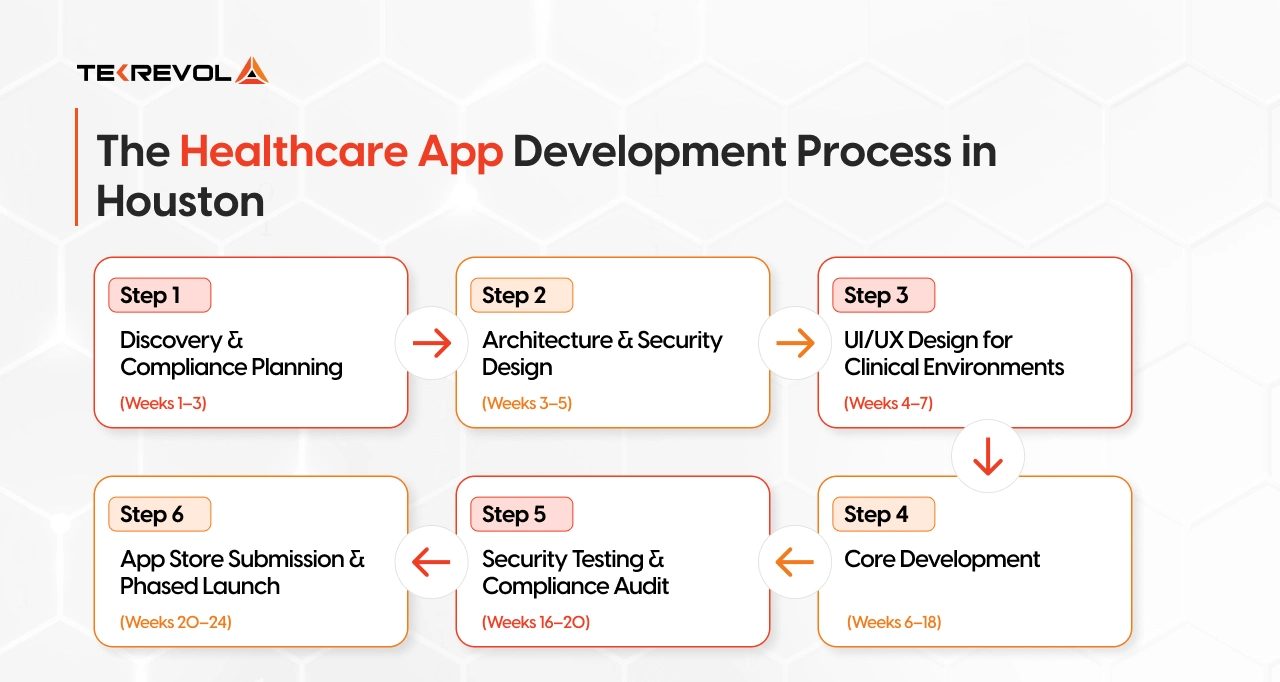
Experienced healthcare app developers, Houston founders, should be working with a disciplined, compliance-first process. Cutting any of these stages increases the risk of failed audits, data breaches, and costly post-launch rebuilds.
Stage 1: Discovery & Compliance Planning (Weeks 1–3)
Map user journeys, define clinical workflows, identify PHI touchpoints, classify the app under FDA and HIPAA frameworks, and produce a signed Business Associate Agreement with all vendors. This stage is where most cost surprises are eliminated.
Stage 2: Architecture & Security Design (Weeks 3–5)
Define the database schema, encryption strategy, access control logic, and cloud infrastructure configuration before any production code is written. Every subsequent decision flows from the security architecture established here.
Stage 3: UI/UX Design for Clinical Environments (Weeks 4–7)
Healthcare UX is not consumer UX. People use these apps in stressful, low-light, time-pressured clinical situations. Designs must be validated with real clinical staff before development begins. Wireframes and high-fidelity prototypes should be tested by actual nurses, physicians, or patients where possible.
Stage 4: Core Development (Weeks 6–18)
Backend APIs, frontend interfaces, EHR integrations, telemedicine infrastructure, and all compliance-layer components are built using agile sprints. Weekly stakeholder reviews ensure clinical accuracy is maintained throughout.
Stage 5: Security Testing & Compliance Audit (Weeks 16–20)
Penetration testing, vulnerability scanning, HIPAA technical safeguard verification, and third-party security audit before any real PHI is introduced to the system. This is not optional; it is the difference between a compliant app and a liability.
Stage 6: App Store Submission & Phased Launch (Weeks 20–24)
Submission to the App Store and Google Play, soft launch with a controlled user group, performance monitoring, and rapid iteration based on real clinical feedback before broader rollout.
If you’re still at the concept validation stage, TekRevol’s guide to PoC vs. MVP development clarifies exactly where to start depending on your current technical certainty and funding stage.
Healthcare App Development Cost in Houston [2026]
Investment Tiers
The cost of healthcare app development in Houston varies more widely than almost any other app category, primarily because compliance depth, clinical integration requirements, and AI complexity create an enormous spread between a basic MVP and a full enterprise platform.
| Tier | Budget Range | Timeline | What’s Included |
| HIPAA-Compliant MVP | $60,000 – $100,000 | 4–6 Months | Core patient portal, basic telemedicine, appointment scheduling, HIPAA architecture |
| Mid-Market Clinical App | $100,000 – $200,000 | 6–9 Months | EHR integration, RPM, provider dashboard, billing, multilingual support |
| Enterprise Health Platform | $250,000 – $500,000+ | 9–18 Months | AI diagnostics, full EHR interoperability, IoMT, multi-facility deployment, SOC 2 |
For a detailed breakdown of what each cost driver represents, TekRevol’s dedicated guide on healthcare app development cost provides feature-by-feature estimates that make budgeting more predictable.
Feature-Level Cost Breakdown
| Feature | Development Hours | Estimated Cost (2026) |
| HIPAA Compliance Architecture | 150–250 hrs | $12,000 – $25,000 |
| Telemedicine / Video Consultation | 200–350 hrs | $18,000 – $45,000 |
| EHR/EMR Integration (FHIR) | 250–400 hrs | $22,000 – $55,000 |
| Patient Portal & Medical Records | 120–200 hrs | $10,000 – $22,000 |
| Appointment Scheduling | 80–120 hrs | $7,000 – $14,000 |
| Remote Patient Monitoring | 200–300 hrs | $18,000 – $38,000 |
| AI Symptom Checker | 300–500 hrs | $28,000 – $60,000 |
| UI/UX Design (Clinical Grade) | 150–250 hrs | $12,000 – $28,000 |
Key Cost Drivers Specific to Houston
Several factors make healthcare app development in Houston distinctly priced compared to general mobile app development:
- HIPAA compliance overhead adds 15–25% to the base development budget, covering security architecture, BAA setup, penetration testing, and audit trail infrastructure.
- EHR integration complexity varies significantly by hospital system. Epic integration alone typically adds $20,000–$55,000 in specialized engineering hours.
- Texas Medical Board compliance for telemedicine features requires legal review and feature adjustments that generic national platforms don’t require.
- Post-launch compliance maintenance, HIPAA is not a one-time checkbox. Security patches, annual risk assessments, and infrastructure updates add $8,000–$20,000 per year to ongoing operational costs.
For context, the full guide to telemedicine app development costs in the USA explains how each technical decision compounds into the final price.
Why Telemedicine App Development in Houston Deserves Its Own Strategy?
Telemedicine app development in Houston is not simply “video calls with doctors.” In 2026, it is a multi-modal care delivery system that must account for asynchronous store-and-forward communication, remote vital sign transmission, AI-assisted triage, and cross-state prescribing compliance, all within a HIPAA-compliant architecture.
For Houston-based products, there are three distinct telemedicine models worth considering:
- Synchronous telemedicine, Real-time video or audio consultations. The most familiar model and the fastest to build, but it requires active scheduling infrastructure and provider availability management.
- Asynchronous (store-and-forward), Patients submit clinical data, images, or structured intake forms; providers review and respond on their own schedule. Highly effective for dermatology, radiology, and specialist referral workflows within the TMC network.
- Remote patient monitoring, Continuous passive data collection from wearables or home medical devices, feeding into a provider dashboard with configurable alert thresholds. This is the fastest-growing model for Houston’s chronic disease patient populations.
To understand how these models work technically before committing to a development approach, TekRevol’s breakdown of how telemedicine apps work is the right starting point.
How TekRevol Can Help?
In the world’s largest medical hub, generic software isn’t enough; you need clinical-grade precision. Developing in Houston requires a partner who speaks the language of Epic integrations, HL7 FHIR standards, and Texas Medical Board regulations.
With over 60 HIPAA-compliant products shipped and a flawless regulatory record, TekRevol bridges the gap between ambitious digital vision and rigorous healthcare reality. As a leading Healthcare app development company, we don’t just build apps; we engineer secure, scalable ecosystems that thrive in the city’s complex hospital networks. From initial risk assessments to post-launch maintenance, our specialized teams ensure your innovation is audit-ready and patient-approved from day one.
Ready to lead the next wave of digital health? Partner with TekRevol to build a high-impact, compliant solution tailored for the Houston medical landscape.
Your 48-Hour Consultation Window Is Open.
Houston's digital health opportunity won't wait. Lock in your discovery session within the next 48 hours and skip the 4-week development queue.
Claim Your Priority Slot Today


