

- AI-powered applications help UAE businesses automate operations, improve customer experiences, and generate data-driven insights.
- AI software development cost in Dubai ranges from AED 80,000 for basic AI applications to over AED 1,200,000 for enterprise-grade systems.
- Simple MVPs take 2 to 4 months; enterprise platforms need 12 to 18 months minimum.
- Agentic AI apps act autonomously end-to-end; the UAE government is mandating private sector adoption within two years.
- Build PDPL compliance from day one; retrofitting it after launch costs three times more.
- Most UAE businesses recover their AI investment within 12 to 24 months through automation savings.
The difference between businesses using AI and those relying on traditional software is becoming increasingly visible. Companies adopting AI are delivering faster customer experiences, automating operational tasks, improving decision-making, and scaling more efficiently. In many industries, AI-powered applications have shifted from being an innovation advantage to a business necessity.
Few business leaders in Dubai are still asking whether AI should be part of their strategy. The conversation has moved beyond adoption and toward execution. The real challenge is building AI solutions that generate measurable business value while avoiding costly development mistakes, budget overruns, and compliance risks.
The UAE government has made that easier: a dedicated Minister of AI, the Dubai AI Seal, and a national strategy through 2031 mean real infrastructure and regulation that businesses can actually build on.
But a strong ecosystem doesn’t guarantee a strong app. Costs range from AED 80,000 for a basic build to AED 1,200,000+ for enterprise platforms. The app development timeline runs from 2 months to over a year. AI development company that know this upfront make better decisions than those who find out mid-build.
This guide covers the build process, real costs, and the mistakes worth avoiding before you start.
What Is Artificial Intelligence App Development and Why Dubai Is All-In On It
AI app development is building mobile or web applications that learn from data, adapt to behavior, and make decisions automatically. Unlike regular apps that follow fixed rules, AI apps improve every time they’re used.
And every reliable mobile app development company in Dubai is embracing this shift to make apps more intuitive and valuable. The five technologies that power them:
- Machine Learning (ML): The app learns from data and improves its predictions over time. The longer it runs, the more precise it becomes.
- Natural Language Processing (NLP): The app recognizes and works with human language, whether a customer is typing in English, speaking in Arabic, or switching between the two languages mid-conversation. NLP does that naturally.
- Computer Vision: It can scan documents, identify products, and perform facial recognition.
- Predictive Analytics: The app predicts outcomes, sales trends, health risks, and equipment failures, before they actually occur.
- Generative AI: The app produces original content, reports, code, designs, and customer responses powered by generative AI, a technology that becomes more refined and intelligent with every use.
What Gives Dubai the Edge in AI?
Dubai doesn’t just have good infrastructure. It has structural advantages that most cities can’t match.
- In 2017, the UAE became the first country to designate its first-ever Minister of State for Artificial Intelligence.
- The UAE is fast becoming one of the top global destinations for AI talent and adoption.
- The combination of Dubai Internet City, DIFC Innovation Hub, Hub71, and the Mohamed bin Zayed University of Artificial Intelligence (MBZUAI) creates one of the world’s most concentrated AI ecosystems.
- Microsoft has spent $1.5 billion in Dubai’s G42. The $500 billion Stargate Project is a collaboration between OpenAI and UAE businesses. The world’s tech giants are voting with their dollars.
- Dubai isn’t the only place that global tech giants are watching; it’s also the place they are investing. The UAE is home to world-class AI capabilities, and IBM, Microsoft, and Google are all working to bring them to the region for UAE enterprises.
- GITEX Global is the world’s biggest technology event that takes place in Dubai in October. It is where the UAE AI procurement decisions are made, announced, and influenced.
- Expo City Dubai still uses its Expo 2020 AI infrastructure to test and scale smart city solutions.
Not Sure Where AI Fits in Your Business?
Our AI experts cut through the hype and identify the solutions that deliver real value for your market, helping you prioritize the right opportunities and avoid costly missteps.
Book a Free 30-Minute Strategy CallHow the UAE AI Strategy 2031 Creates Opportunity for Your Business
The UAE AI Strategy 2031 mandates AI adoption in the country. The government has legislated it, funded it, and built regulatory frameworks around it. Every business investing in AI app development in Dubai operates inside this structure, whether they know it or not.
Here’s what’s actually in place right now that directly affects any business building an AI app in Dubai.
UAE Government Moved AI from Vision to Reality
- UAE National AI Strategy 2031 targets an AI adoption landscape that will contribute to AED 335 billion in economic growth.
- AI is being integrated into Dubai’s smart city projects, such as transport, government services, and digital infrastructure.
- The UAE PDPL requires AI products handling personal data to prioritize compliance from day one.
- Dubai’s data regulations are shaping how AI platforms manage cloud infrastructure and user data.
Grants, Incentives, and Free Zone Advantages
Most founders come to Dubai for the market. They stay for the financial structure.
- R&D tax credits via Mubadala and ADQ reduce the upfront cost of AI development significantly.
- Dubai Silicon Oasis and Dubai Internet City offer technology licenses at competitive rates, ideal for machine learning companies building custom models.
- DIFC’s regulatory sandbox lets fintech AI products test and validate before full market launch.
- The UAE AI market is projected to contribute 14% of national GDP, the highest proportion in the GCC.
Top AI Mobile App Types Transforming Dubai Industries
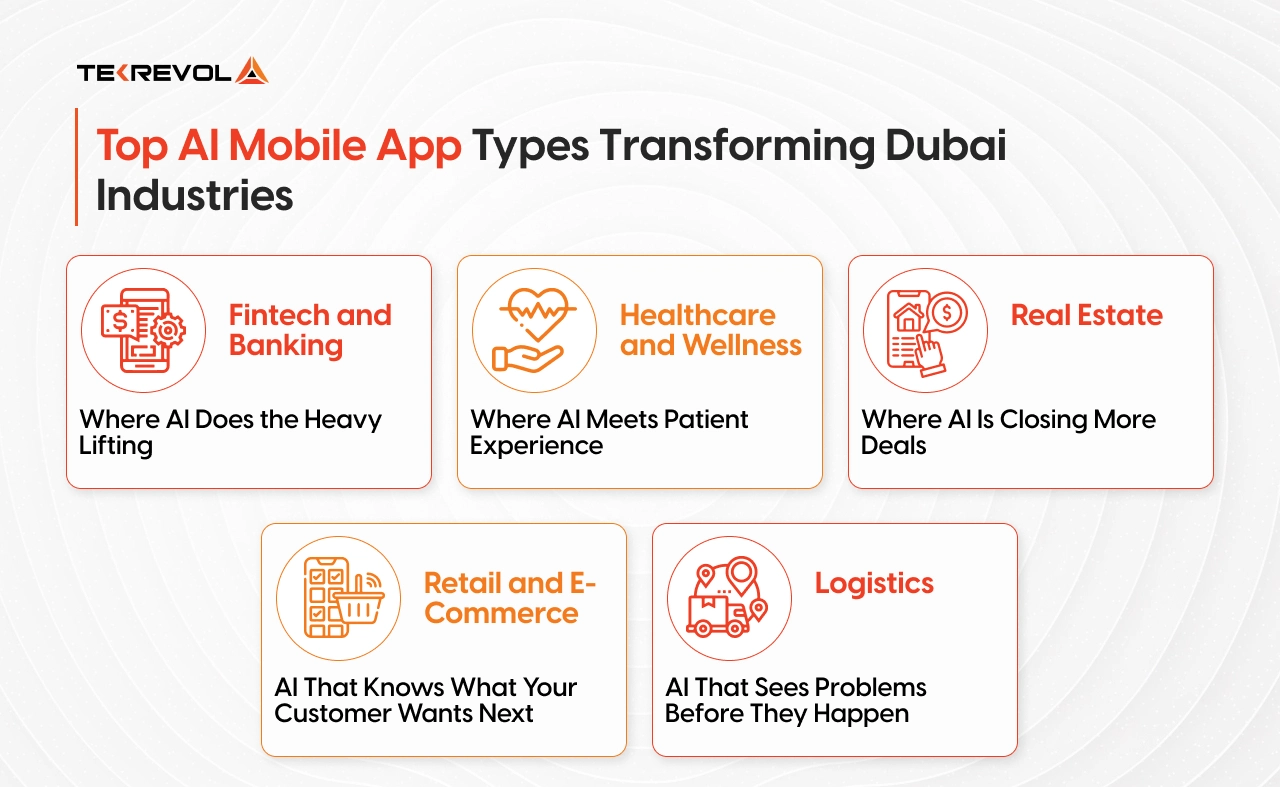
Currently, the UAE’s most popular industries for machine learning applications are fintech, healthcare, real estate, retail, and logistics. Here’s what’s really being constructed and what’s really up and running.
| Industry | AI Use Case | Business Impact |
| Fintech | Fraud detection, KYC automation | Near-zero false positives, faster onboarding |
| Healthcare | Predictive diagnostics, patient monitoring | Earlier intervention reduces clinical workload |
| Real Estate | AI valuations, investment signals | Faster deals, data-driven pricing |
| Retail | Hyper-personalization, BNPL timing | Higher conversion, increased basket size |
| Logistics | Supply chain visibility, predictive maintenance | Fewer delays, lower operational cost |
Fintech and Banking: Where AI Does the Heavy Lifting
- Fraud detection systems catch transaction anomalies in milliseconds, before a payment is declined.
- Neobanks use AI to deliver instant spending insights and automatic savings tips to users.
- Automated wealth management tools build and manage investment portfolios without a human advisor.
- Computer vision scans and validates identity documents during KYC (Know Your Customer) onboarding in seconds.
Healthcare and Wellness: Where AI Meets Patient Experience
- Predictive diagnostic tools that detect health risks from patient information before symptoms arise.
- AI patient-monitoring systems that trigger alerts to clinical teams.
- AI health assistants are available around the clock to answer patient questions, schedule appointments, and remind patients about their medications.
- The use of Arabic NLP tools, which allow patients to communicate in their native language, is crucial for UAE adoption rates.
Building in the Healthcare Space? We Already Know the Infrastructure
Discuss your healthcare project with our team and receive a detailed roadmap covering architecture, compliance, features, and development planning—completely free of charge.
Book Your Free Session NowReal Estate: Where AI Is Closing More Deals
- AI valuation tools that use market trends, comparable sales, and location data to provide real-time, accurate property valuations.
- The technology of virtual property sightseeing using computer vision and AI to shorten the time gap between enquiry and viewing.
- Machine learning apps that surface new investment opportunities before the wider market prices them in.
Retail and E-Commerce: AI That Knows What Your Customer Wants Next
- Smart AI recommendation systems that go beyond basic “people also bought” by analyzing live user behavior and context.
- Intelligent shopping assistants that handle complex queries, comparisons, and upsells in natural language.
- BNPL integration intelligence, AI that predicts which customers are likely to use Tamara or Tabby and surfaces the option at the optimal moment.
Logistics: AI That Sees Problems Before They Happen
- AI-powered supply chain visibility tools that track inventory, predict delays, and automatically reroute shipments.
- Predictive maintenance systems for fleets and industrial equipment, catching failures before they happen.
- Demand forecasting apps that tell warehouse managers what to stock three weeks from now, not three days ago. Note that on-demand apps in Dubai are among the fastest adopters of AI dispatch and routing features.
Top AI App Development Trends in Dubai for 2026
The AI mobile apps transforming Dubai businesses in 2026 share four architectural characteristics: Agentic AI, Edge AI, Arabic LLMs, and Super App integration. Each one represents a shift in what users expect, and what businesses must deliver to stay competitive.
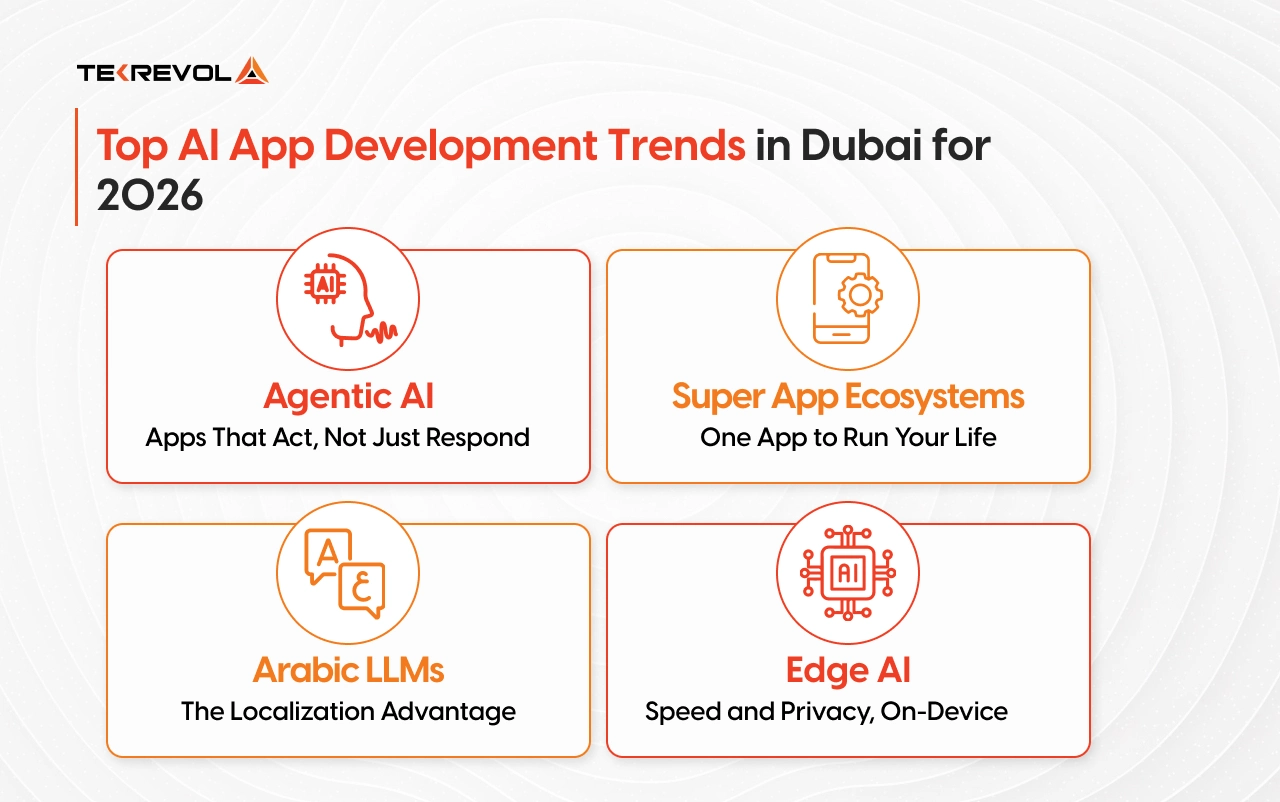
Agentic AI: Apps That Act, Not Just Respond
Agentic AI is an AI system that can perform multiple steps without needing human input in between.
When the standard AI apps respond, they respond. Agentic AI apps go to work. The system books the meeting, follows up on the e-mail, updates the CRM, and escalates the ticket, based on the outcome it has been given, and not on the steps that it has been told.
- A full-service hotel concierge app that handles room upgrades, dining reservations, and checkout autonomously.
- The corporate procurement agent automatically detects anomalies, compares supplier quotes, and raises purchase orders.
- A patient intake system gathers patient history, schedules the appropriate specialist, sends reminders, and follows up after appointments
Super App Ecosystems: One App to Run Your Life
A super app is a single platform that handles finance, transport, shopping, government services, and communication, with AI connecting the experience across all of them.
Dubai users want fewer apps doing more. WeChat proved the model. Careem is the closest UAE example of the region’s leading ride-hailing and multi-service super app.
- AI that recognizes your journey, pay cycle, and spending patterns to suggest the best financial products at the best time.
- Smart notifications surface relevant services before the user searches for them based on location, time, and past behaviour.An
- AI-driven platform context provides one tap for government services, utilities, and bookings.
Arabic LLMs: The Localization Advantage
Arabic LLMs are large language models specifically trained on the Arabic language. This enables AI apps to grasp the sentiments, context, and dialect when they’re not using English as the primary language.
The Technology Innovation Institute (TII) has developed one of the world’s most powerful open-source AI models, the Falcon family of large language models, which are also very proficient in Arabic. This is a UAE advantage that can’t be easily replicated by international competitors.
- Arabic NLP enables natural conversation in dialect, not just formal Modern Standard Arabic.
- Bilingual Arabic-English apps serve both populations without code-switching friction.
- Government services built on Arabic LLMs are achieving significantly higher user adoption rates than English-first equivalents.
Building AI features that feel natural to Arabic speakers requires more than plugging in a model. It requires RTL interface design, Arabic-first content architecture, and dialect-aware training data. The full scope of Arabic mobile app development in Dubai covers exactly what that involves technically.
Edge AI: Speed and Privacy, On-Device
Edge AI means the AI processing happens on the user’s device, not on a remote server. The data never leaves the phone.
For fintech app inDubai, this is a major advantage. It enables local processing of biometrics, transaction verification, and fraud signals while meeting UAE data residency requirements.
- Facial recognition for app login that works offline and doesn’t send biometric data to the cloud.
- Real-time transaction analysis that flags anomalies at the point of payment, not after.
The platform choice matters here: on-device AI performs differently across native and cross-platform builds.
AI App Development Process in Dubai
Most AI projects in Dubai don’t fail because of bad technology. They fail because of a broken process.
At TekRevol, we fix that.
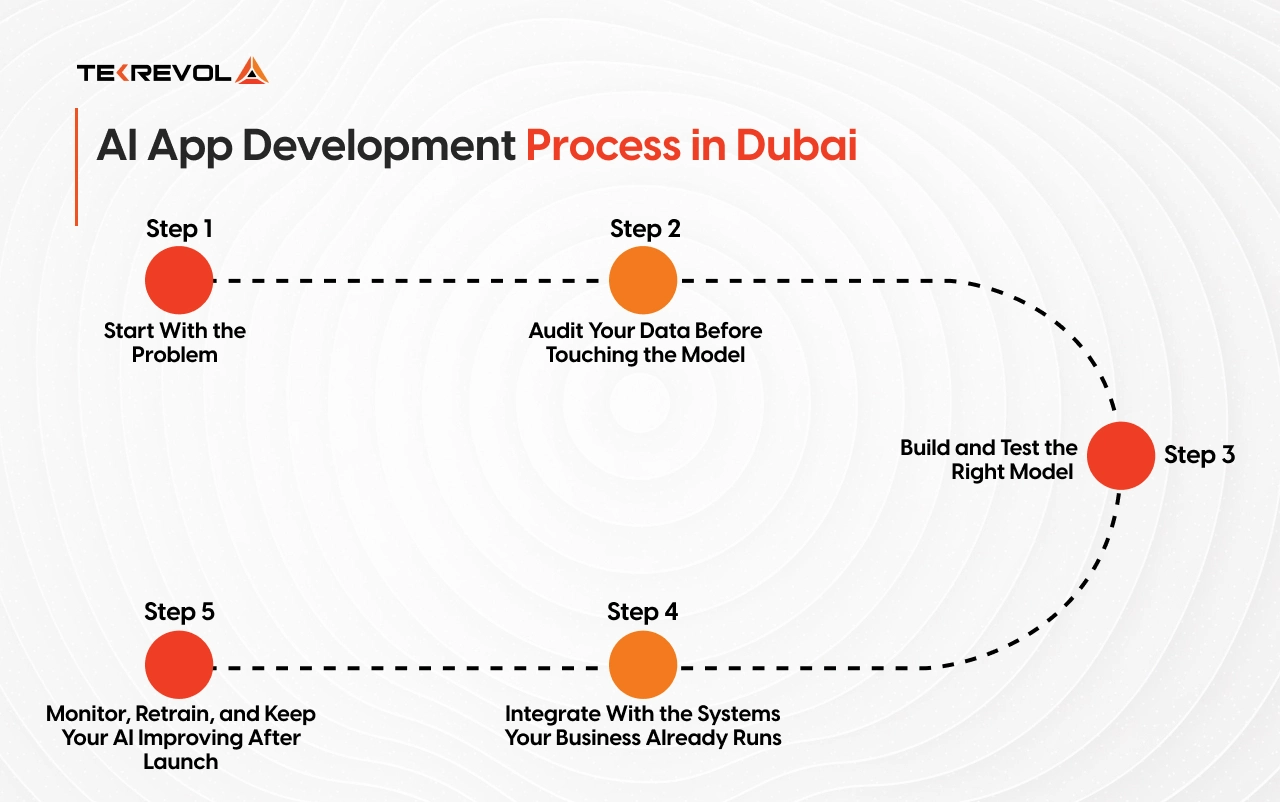
Step 1: Start With the Problem
Every AI project starts with a conversation. We ask the questions your team hasn’t thought to answer yet. Who is this for? What decision does it need to make? What does success actually look like in six months? That clarity is what separates an AI product that delivers from one that just demos well.
Step 2: Audit Your Data Before Touching the Model
Bad data produces bad AI. It’s that simple.
Before we write a single line of model code, we look at what data you actually have, how clean it is, where the gaps are, and what needs fixing. We also make your architecture decisions here. Under the UAE’s PDPL regulations, sensitive data often needs to stay within approved local infrastructure. That’s a day-one decision, not a last-minute fix.
Step 3: Build and Test the Right Model
The best AI model balances accuracy, performance, scalability, and cost—not just raw accuracy.
Our engineers test multiple approaches, tune the parameters, and benchmark accuracy against real cost. A model that works beautifully in a test environment but breaks your compute budget isn’t a solution. We build what actually works at scale.
Step 4: Integrate With the Systems Your Business Already Runs
AI doesn’t operate in isolation. It needs to talk to your existing systems, and that conversation has to be planned before the build begins.
- We map every system your AI needs to connect to before a single integration is attempted.
- CRM, ERP, UAE payment gateways, logistics platforms, government APIs, all scoped upfront.
- If existing APIs weren’t built for real-time AI exchange, we identify that early and plan around it.
- Data flow between systems is assessed and cleaned before it reaches the model.
The goal is an AI product that fits into how your business already runs, and makes it work better without creating a parallel system to manage.
Step 5: Monitor, Retrain, and Keep Your AI Improving After Launch
Launching is not the end. It’s where the real work begins.
AI models can drift over time as user behaviour and data patterns evolve. TekRevol builds MLOps infrastructure into every product we ship. So your AI keeps learning, keeps improving, and keeps delivering value long after go-live.
How Much Does AI App Development Cost in Dubai? (2026 Breakdown)
The AI app development cost in Dubai ranges from AED 80,000 for basic builds to AED 1,200,000+ for enterprise-grade platforms. Basic AI features built on pre-existing APIs sit at the lower end. Enterprise platforms with proprietary models, system integration, PDPL compliance architecture, and MLOps support sit well above AED 800,000.
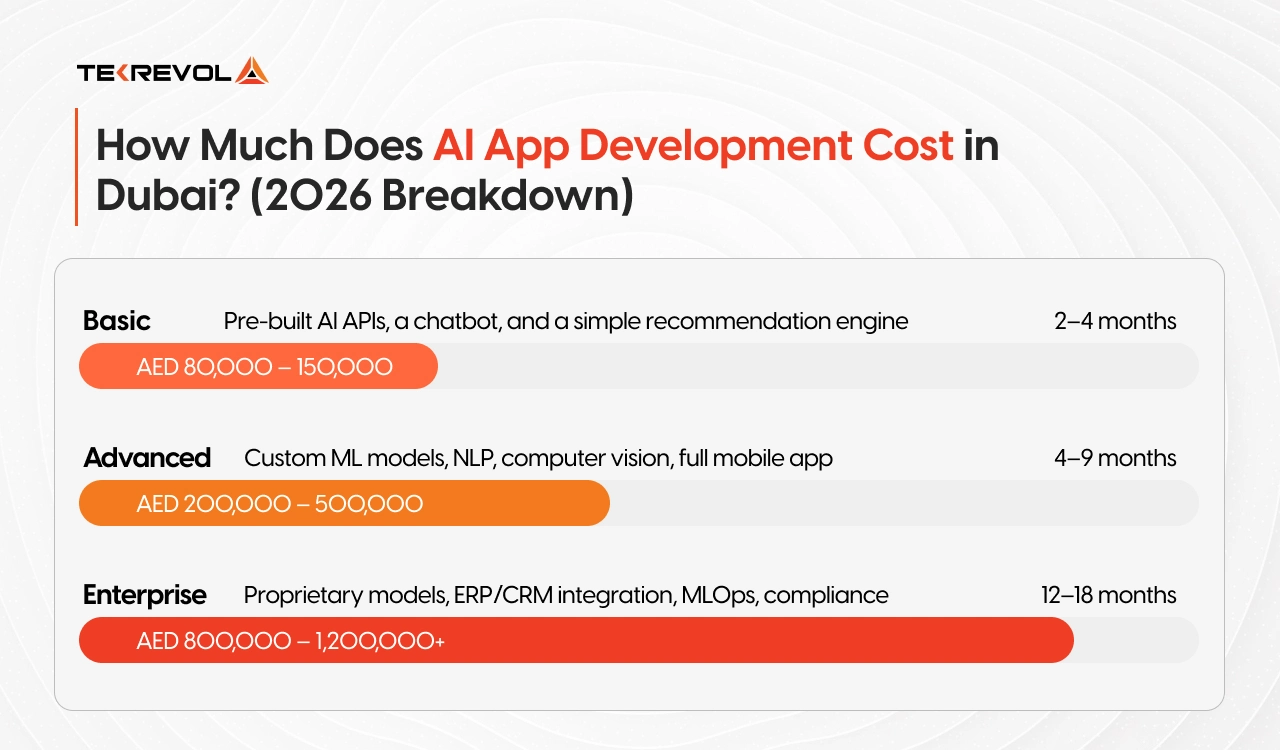
Cost by Complexity Tier
| Tier | What You Get | Cost Range (AED) | Timeline |
|---|---|---|---|
| Basic | Pre-built AI APIs, a chatbot, and a simple recommendation engine | 80,000 – 150,000 | 2–4 months |
| Advanced | Custom ML models, NLP, computer vision, full mobile app | 200,000 – 500,000 | 4–9 months |
| Enterprise | Proprietary models, ERP/CRM integration, MLOps, compliance | 800,000 – 1,200,000+ | 12–18 months |
What Drives the Price Up
- Data complexity: Messy, unstructured, or multilingual data, Arabic and English together, takes significantly more work to prepare.
- System integration: Connecting AI to legacy ERPs and CRMs is often the most expensive part of the entire project.
- PDPL compliance: Building data residency and privacy controls from scratch adds cost, but retrofitting them later adds more.
- MLOps and maintenance: Plan for 15 to 25% of the initial build cost annually for ongoing model monitoring and retraining.
- Arabic language models: Bilingual NLP and custom Arabic training data add complexity and real competitive value.
ROI reality: Most businesses running machine learning apps in the UAE recover their investment within 12 to 24 months through automation savings and improved customer retention
Challenges in AI App Development in the UAE, And How to Navigate Them
Most AI app development in Dubai projects fail because of business and compliance readiness issues, not technical ones. Technology is rarely the problem. Here’s what actually is.
Data Fragmentation in UAE Enterprises
Most UAE enterprises have data spread across multiple systems, an ERP customized five years ago, a CRM that was never properly cleaned, and internal tools that don’t talk to each other. AI models trained on fragmented data produce fragmented results.
Solution: Do a data audit before you start. Understand what you have, where it lives, and how clean it is. This isn’t glamorous, but it determines everything that comes after. At TekRevol, this is one of the first conversations we have with every client, because what we find in that audit shapes the entire build.
PDPL Compliance: Build It In From Day One
Any AI system handling personal data in the UAE must comply with PDPL, and that means building it in from the start. Ensuring data residency, consent management, and explainability upfront is crucial. Retrofitting PDPL compliance post-launch often triples costs and significantly delays deployment.
Three things that trip up UAE AI projects on compliance:
- Storing personal data on international cloud servers without UAE-approved data residency arrangements
- AI systems that make decisions affecting individuals without explainable reasoning
- Biometric data processed without explicit user consent frameworks
Integration Complexity: The Real Reason AI Projects Fail
Most AI projects fail not because the model is wrong, but because it can’t integrate with legacy systems. That integration layer is where time and budget are usually overrun.
- Map every system your AI will need to connect to before a contract is signed.
- Treat integration as a first-class project deliverable, not something figured out mid-build.
- APIs that weren’t designed for AI, mid-stream data cleaning, and version conflicts need to be scoped upfront, not discovered later.
The UAE AI Ethics Board and Explainability Requirements
AI systems that affect access to services, financial decisions, or healthcare outcomes in the UAE fall under review by the UAE AI Ethics Board. The core requirement is explainability; the system has to be able to show why it made a decision, not just what it decided.
First, for regulated industries, model choice isn’t just technical. Black-box AI adds compliance risk, so explainability should guide decisions from day one.
Second, audit trail functionality isn’t optional. It needs to be built in from day one, not added when a regulator asks for it.
Why Businesses Choose TekRevol for AI App Development in Dubai
TekRevol is the most trusted app development company in the UAE operating from Sheikh Rashid Tower in DIFC, Dubai. With 500+ apps delivered globally and 120+ industry awards, the track record speaks for itself.
Our approach to artificial intelligence app development in Dubai starts with compliance and ends with a model that keeps improving after launch.
What We Bring to Every Project
- Deep UAE Market Knowledge We understand the regulatory landscape, the PDPL requirements, and the infrastructure realities of building AI in Dubai.
- End-to-End AI Development: From translating your business problem into a technical use case, all the way through to MLOps and continuous retraining, one team, full ownership.
- Legacy System Integration: Most enterprises in Dubai run on complex, customised infrastructure. We map every integration requirement upfront and build connections that actually hold.
- Compliance-First Architecture Data residency, privacy regulations, and security requirements are built into the foundation, not bolted on before launch.
Get Your Free AI Strategy Session
Tell us your business challenge and our Dubai-based AI experts will map out exactly how artificial intelligence can solve it, complete with a clear implementation plan and realistic delivery timeline.
Claim Your Free Session Today