



Imagine the scenario when you enter your bank branch holding your smartphone in the air. You do not have to wait in line, instead, you receive greetings from the digital overlays showing your account summary, recent spending trends, and a holographic adviser guiding your next move. This is the augmented reality (AR) power in finance, which is changing the way of an ordinary banking into an immersive experience.
The use of AR in banking is transforming the way customers interact with their banks. Much like the interactive experiences created by a professional mobile app development company, AR applications in finance help with data visualization, service delivery, and engaging customers in ways traditional banking cannot. Banks that strategically implement AR will be able to cut down on operating costs, attract and engage their customers, and increase loyalty.
We, at this blog, dive into how banks and financial institutions are employing AR, its use-cases, benefits, and challenges, and the future of immersive finance. If you are a banking executive, a fintech professional, or simply a tech-savvy person interested in or curious about technology in finance, these insights will help you understand better what is possible.
What Does Banking Augmented Reality Mean?
In finance, augmented reality superimposes digital data, charts, and guidance on top of the actual environment. This can include utilizing augmented reality (AR) to navigate an ATM or viewing account balances on your phone.
Recent trends show significant growth in AR applications in financial services:
- The global AR market is estimated at USD 35.8 billion in 2024.
- Expected to grow to USD 233.3 billion by 2030 at a CAGR of 36.7%.
- The AR in BFSI market is projected to grow from USD 994 million in 2023 to USD 4.63 billion by 2030.
These statistics demonstrate that augmented reality banking is becoming a major part of the financial technology landscape. It enables banks to make complex data and services intuitive and interactive.
Ready to Redefine Your Digital Banking Experience?
Bring innovation to finance with AR-powered solutions.
Connect with TekRevol’s Fintech Experts TodayUse Cases for Augmented Reality in Finance
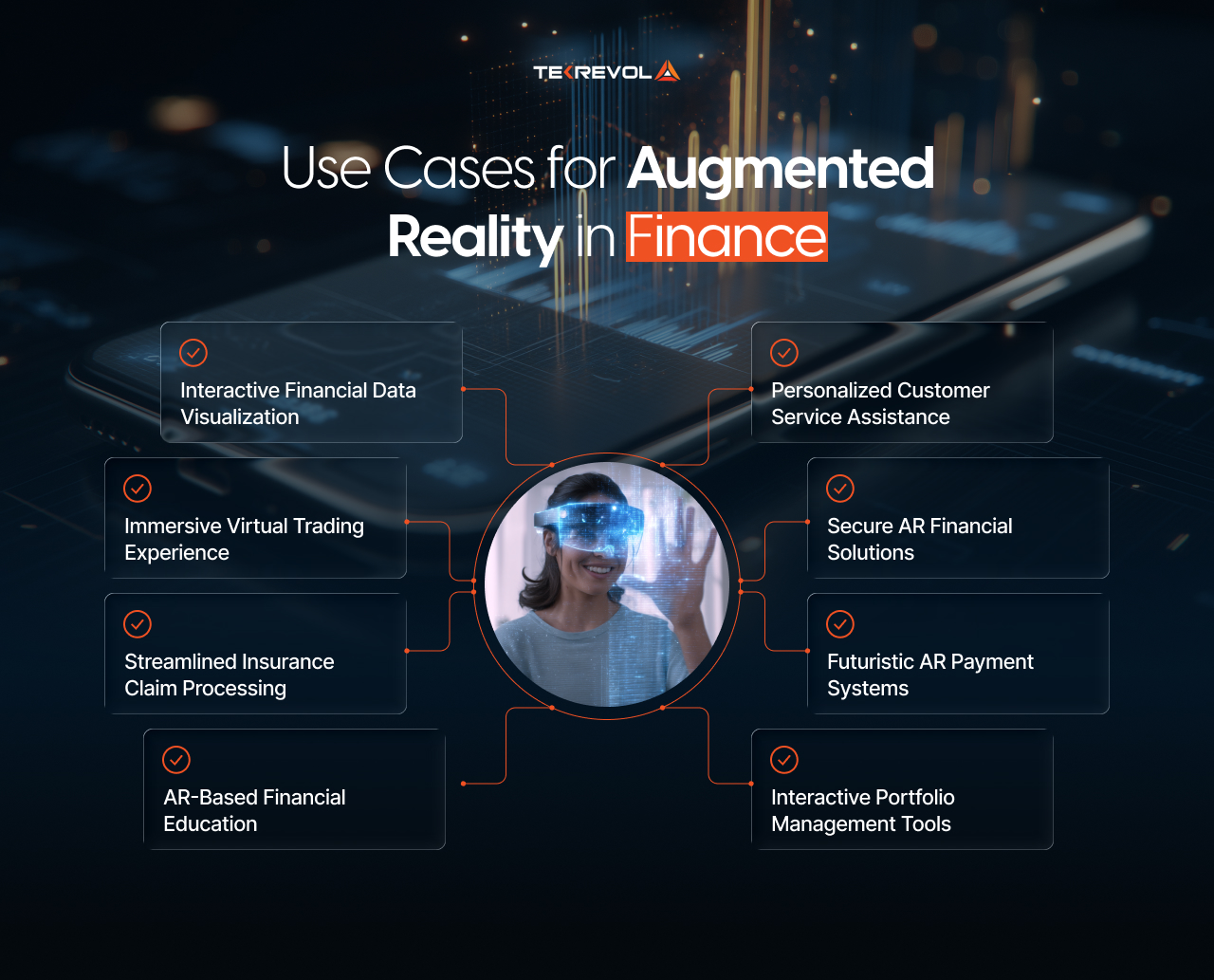
AR in banking is transforming how customers, advisors, and financial institutions interact with data and services. Below are the key applications driving innovation in financial services.
1. Data Visualization in Financial Services
Augmented reality in finance allows complex financial information to be displayed in interactive 3D formats. Portfolios, spending trends, and investment flows become spatial objects that customers can explore.
This approach simplifies comprehension and decision-making. Financial advisors can leverage these visualizations to explain strategies clearly, bridging gaps in understanding and making augmented reality banking a practical tool for real-time insights.
2. AR-Powered Virtual Trading
Traders and investors are increasingly using AR in banking platforms for immersive virtual trading. 3D projections of stocks, indices, and risk metrics provide a realistic, hands-on experience beyond traditional screens.
This improves reaction time and clarity when analyzing market movements. By incorporating AR VR use cases in banking, institutions can create sophisticated trading simulations that boost efficiency and decision confidence.
3. Augmented Reality in Improved Insurance Claims
AR applications in financial services are revolutionizing insurance claims processing. Customers can use their devices to capture damage, while AR overlays highlight affected areas, simplifying assessment for insurers.
The combination of augmented reality financial services and secure processing reduces errors and fraud. It also improves customer satisfaction by making claims faster, transparent, and more interactive.
4. Financial Education, Planning, and Investment with AR
Augmented reality in banking makes financial concepts tangible for customers. AR can visualize savings goals, investment plans, and risk simulations in a real-world context, making abstract ideas easier to grasp.
Gamified experiences and immersive AR financial education modules can be built with the support of AI development services, making learning interactive and personalized.
5. Enhanced Customer Service and Communication with AR
Virtual advisers using AR in banking offer interactive guidance through account setup, loan processes, and product exploration. Customers can see overlays showing step-by-step instructions, reducing confusion.
This improves efficiency while creating personalized experiences. Financial institutions adopting augmented reality banking gain stronger engagement and higher satisfaction rates among clients.
6. Data Privacy and Security in AR Financial Applications
AR in financial services involves sensitive data, making security paramount. Encryption, secure integration, and authentication are essential for maintaining customer trust.
By combining augmented reality in finance with strict security protocols, banks ensure that users benefit from immersive features without compromising their personal data. AR in banking theme analysis emphasizes balancing innovation with compliance.
7. AR in Online Payments
Augmented reality banking enables customers to complete payments through interactive AR overlays. Many banks implement this functionality with support from an on demand app development company, allowing real-time transactions and personalized financial interactions.
This streamlines the payment process and adds a futuristic touch to transactions. Incorporating AR in financial services for payments increases convenience, reduces friction, and drives adoption of digital wallets.
8. Virtual Product Demos for Financial Services
AR transforms product demos for loans, insurance, and investment plans. Customers can visualize repayment schedules, expected returns, and risk scenarios in an engaging, interactive way.
By leveraging augmented reality financial services, banks can simplify complex offerings and improve customer understanding. This approach reduces hesitation and builds confidence in purchasing financial products.
9. Simulating Customer Interactions in Virtual Banking
Banks can train staff using AR simulations to replicate real-world branch or call center interactions. This prepares employees to handle customer queries, complaints, or onboarding scenarios more effectively.
Applying AR VR technology in banking ensures that staff learn in a low-risk environment. These simulations improve service quality and consistency, which enhances trust and professional reliability.
10. Interactive Portfolio Management with AR
Clients can explore investments through immersive AR dashboards that visualize portfolios in 3D. Adjusting asset allocations instantly shows projected risk, returns, and diversification.
This integration of augmented reality in finance and augmented reality banking makes portfolio management engaging and intuitive. Clients gain a better understanding of their financial standing and collaborate more effectively with advisors.
Looking to Bring AR to Your Financial Services Platform?
Empower users with real-time visualization and smarter experiences.
Collaborate with TekRevol’s AR Development TeamKey Benefits of AR in Banking and Finance
Implementing augmented reality in financial services is more than futuristic, there are concrete benefits to banks, insurers, and fintechs apps alike. Let’s explore several major ones.
Virtual Banking Experiences
AR allows banks to offer branches that are less about physical space and more about flexible, immersive experiences. Customers can engage with financial services in their home, on mobile or with AR glasses—reducing dependency on brick‑and‑mortar locations. Virtual branches, AR kiosks, and mobile overlays create new distribution channels, increase reach and improve accessibility.
Enhanced Data Visualization
Reports suggest that immersive visuals improve recall, decision-making speed, and customer satisfaction. Backed by cloud application development services, these AR solutions ensure data is rendered securely and scalable across devices, reducing misunderstandings and building stronger client trust.
Improved Customer Interaction
When customers engage with banks via AR, the experience feels dynamic and personalized. Visual overlays, interactive tutorials, and real‑time guidance—these shift customer service from reactive to proactive. A satisfied user is more likely to stick with the bank, recommend it and engage with additional services.
Branch & ATM Navigation
AR can streamline physical banking by overlaying navigation cues in branch lobbies, showing ATM locations, self‑service kiosks, and queue wait times via mobile apps. For customers, this means a smoother in‑branch experience; for banks, lower staff load and more efficient operations. This benefit is often underestimated but adds to the overall “smart banking” experience.
Financial Product Exploration
Traditional brochures and website pages are static. With augmented reality banking, product exploration becomes immersive. Customers can visualize how a mortgage product impacts their future house, how savings goals build up, or how an investment timeline evolves. This richer interaction drives conversion, reduces friction, and instils confidence in complex financial decisions.
Enhanced Security & Fraud Detection
Inherent in many AR tools are biometric sensors, spatial tracking, and overlay verification that add layers of security. For instance, an AR session might require facial recognition, environment mapping, and secure handshake protocols between device and bank systems. For banks, that means stronger fraud prevention, better authentication and improved regulatory compliance. When done correctly, AR strengthens trust in both customers and regulators.
Challenges and Considerations of Implementing AR in Financial Services
While the advantages of augmented reality in banking are compelling, deployment is not without its hurdles. Let’s examine key challenges.
Ensuring Data Privacy and Security
As mentioned previously, AR interfaces handle sensitive information—account data, transaction history, biometrics, and location tracking. Ensuring that these overlays, devices and apps are secure is paramount. Banks must adopt end‑to‑end encryption, device management policies, secure session handling, and clear permissions. Failure to protect can erode trust faster than any other tech misstep.
Big Cost of Implementation
Developing and rolling out an AR app in financial services requires investment: hardware (AR glasses, devices), software (3D models, SDKs), integration with legacy systems, and training. Early adopters may bear higher AR app development costs. As the market evolves, costs may come down—but initial budgets and ROI calculations must be realistic. Given that the “AR in BFSI” market is projected to grow from under USD 1 billion in 2023 to over USD 4.6 billion by 2030 (CAGR 24.6 %).
Lack of Proper Regulation
As immersive technologies proliferate in finance alternatives, regulatory frameworks may lag. Questions around digital identity, biometric authentication in AR, liability for immersive advice, data sovereignty, and cross‑border sessions remain partially settled. Financial institutions must engage proactively with regulators and build pilot programs that emphasise compliance and audit‑trail readiness.
Beyond these three headings, banks must also watch for user adoption barriers (are customers ready for AR experiences?), device fragmentation (which smartphone/AR headset users have), and UX design maturity (immersive interfaces must remain intuitive, not gimmicky).
The Future of AR Application in Finance
As we look ahead, augmented reality in finance is evolving beyond simple overlays and mobile AR apps into richer ecosystems. Imagine AI‑driven virtual financial advisers appearing in AR, or entire banking branches accessible via mixed‑reality headsets. The convergence of AR VR development company and spatial computing—together with data analytics and blockchain—will create “phygital” banking experiences (where physical and digital worlds merge seamlessly).
Forecasts show the broader AR/VR market may reach USD 96.3 billion by 2029 at a CAGR of 34.2 % from 2024 to 2029. As hardware becomes cheaper, adoption becomes more widespread, and enterprise platforms become more mature, the threshold for mainstream AR in banking lowers. We may soon see banks offering AR‑first onboarding, remote financial‑planning sessions in virtual lounges, and immersive “walkthroughs” of investment portfolios like digital games.
For financial services firms willing to innovate, the opportunity is to reimagine customer journeys—not just digitize old flows but design new ones that are spatial, interactive, and anticipatory. The winners will be those who blend advisory, technology, empathy, and security into one seamless service. In that sense, “smart banking” with AR isn’t optional—it may become essential.
How Tekrevol Helps Digital Innovation with its Custom AR App Development
At this point, you may wonder how to turn these ideas into reality, which is where specialised partners come in. Companies like Tekrevol bring expertise in building custom AR applications tailored for financial institutions. With a track‑record of working on immersive mobile apps, AR overlays, financial dashboards, and secure integrations, Tekrevol helps banks apply augmented reality in banking and augmented reality financial services in a structured and compliant way.
Here’s how Tekrevol adds value:
- Strategy & visioning: We work with your leadership to map where AR fits in your customer journey, internal workflows, and market positioning.
- Prototyping & user experience: Using rapid AR prototypes, we test assumptions with real users and refine interfaces for both advisors and customers.
- Secure integration: We integrate AR modules with your core banking, CRM, risk, analytics, and data‑governance systems, ensuring the AR in banking solution meets compliance, audit and privacy standards.
- Launch & scale‑up: We facilitate the expansion of the AR application across devices, areas, and user segments, after a successful pilot, thereby optimizing for performance and analytics.
- Continuous innovation: The AR trek is not just about the launch. Tekrevol supports the iterative updates, A/B testing of the immersion features, and use of user‑ behaviour data to develop the AR ecosystem.
If your company is seriously considering a move from traditional digital banking to the immersive, spatial era of finance, a partner like Tekrevol can be instrumental in turning augmented reality banking into your strategic advantage rather than merely a proof‑of‑concept.
Ready to Lead the Digital Finance Revolution?
Integrate immersive AR features that redefine user experience.
Partner with TekRevol to Shape the Future of Smart Banking


