



- AI chatbot development typically costs $8,000 to $400,000 in 2026, with most mid-complexity projects landing near $150,000.
- RAG chatbots cost 30–50% less than fine-tuned LLMs by directly retrieving answers instead of retraining model weights.
- AI chatbot maintenance typically costs 15–25% of your original build cost, billed every single year going forward.
- Most businesses recover their AI chatbot investment within 6 to 18 months through automation and reduced costs.
- A focused AI chatbot MVP typically costs $30,000 to $60,000 and launches within 8 to 14 weeks.
- Enterprise AI chatbots cost $150,000 to $400,000+, driven mainly by compliance, governance, and integration, not smarter AI.
Most business owners come to us with the same question, and it’s rarely “Should we build an AI chatbot?” It’s “Why does one cost $20,000 at one agency and $200,000 at another?” Both quotes can be honest. They’re just pricing different things. It depends on your use case, your data, your integrations, and how much intelligence you actually need baked in.
On average, AI chatbot app development costs range from $8,000 for a simple, rule-based bot to $400,000+ for an enterprise-grade assistant with generative AI, voice, and deep system integrations. Most mid-complexity projects, production-ready bots with real integrations, land between $60,000 and $150,000, while custom AI builds with real data training typically fall between $80,000 and $300,000.
That’s a wide range to plan around, and narrowing it down is exactly what the right AI chatbot development company helps you do by breaking your project into clear phases and giving you a price you can actually budget for.
This guide covers both the upfront and ongoing costs to build a chatbot, breaking down pricing by chatbot type, features, development phase, and maintenance, so you can plan a realistic budget for your own project.
How Much Does It Cost to Develop a Chatbot?
AI chatbot development costs range from roughly $8,000 for a simple rule-based bot to $400,000+ for a custom enterprise assistant with generative AI, voice, and deep system integrations. Most mid-complexity projects land between $40,000 and $150,000.
That’s a wide range; we know. So let’s break it down by what you’re actually building, because “chatbot” is really an umbrella term at this point.
| Tier | Cost Range | Timeline | What you actually get |
| Rule-based bot | $8,000 to $25,000 | 3 to 8 weeks | Decision-tree flows, FAQ handling, one channel, no real language understanding |
| AI chatbot MVP | $30,000 to $60,000 | 8 to 14 weeks | LLM-powered conversation, one channel, basic knowledge retrieval, simple handoff |
| Production AI chatbot | $60,000 to $150,000 | 3 to 6 months | RAG over your content, 2 to 4 integrations, analytics, human handoff, evaluation suite |
| Enterprise AI chatbot | $150,000 to $400,000+ | 6 to 12 months | Multi-system actions, SSO, governance and audit, multilingual, voice, agentic orchestration |
Thinking About Building an AI Chatbot for Your Business?
See what it takes to build a chatbot that fits your business needs, from core features to integrations and scalability.
Request A Quote!What Factors Affect AI Chatbot Development Cost?
AI chatbot cost factors include the AI model you choose, how many systems it integrates with, feature depth, compliance needs, platform coverage, and where your development team is based. Each one can shift your final number by tens of thousands of dollars.
Let’s go through them one at a time, since knowing which levers actually move your budget is half the battle.
1. Chatbot Type and Intelligence Level
AI chatbot development costs vary sharply by type: rule-based bots run $8,000 to $25,000 and NLP assistants $35,000 to $90,000, while generative AI chatbot development costs land at $70,000 to $200,000 and RAG enterprise assistants reach $350,000
| Chatbot Type | Cost range | Timeline | The line item people miss |
| Rule-based / decision tree | $8,000 to $25,000 | 3 to 8 weeks | Flow maintenance grows forever as your business changes |
| NLP intent-based chatbot | $35,000 to $90,000 | 2 to 4 months | Intent training data has to be written, labelled, and maintained by humans |
| Generative AI chatbot (LLM) | $70,000 to $200,000 | 3 to 6 months | Evaluation and guardrails, which are engineering, not prompt writing |
| RAG-powered knowledge assistant | $120,000 to $350,000 | 4 to 8 months | Content pipeline and retrieval tuning, not the model |
| Multilingual chatbot | $50,000 to $140,000 | 3 to 6 months | Every language needs its own evaluation set, not just translation |
| Voice AI assistant | $90,000 to $250,000 | 4 to 9 months | Speech latency budget forces architecture choices that cost money |
| Transactional / action-taking bot | $100,000 to $280,000 | 4 to 9 months | Every action needs a rollback path and an approval boundary |
| Agentic orchestration chatbot | $180,000 to $450,000+ | 6 to 14 months | Multi-step failure handling, which is most of the work |
| Custom fine-tuned model chatbot | $150,000 to $400,000 | 6 to 12 months | Retraining every time your data or tone changes |
2. AI Model Selection & Token Architecture
Here’s the factor every competing guide files under “hidden costs” instead of treating it as a cost driver, which we think is backwards. Your model choice sets a permanent monthly bill that scales with usage, not with features.
Build-side work runs from $5,000 to $20,000 for prompt architecture, streaming, fallbacks, and usage metering. The running cost is where it gets serious.
- Budget tier model: roughly $0.01 per conversation, so about $960 a month at 100,000 conversations.
- Mid-tier model: roughly $0.09 per conversation, or about $9,000 a month at the same volume.
- Frontier tier model: roughly $0.24 per conversation, or about $24,000 a month.
Development cost is only part of the equation. Long conversations, large prompts, and detailed responses can significantly increase ongoing AI costs. By using caching, model routing, and response optimization, we help businesses keep AI usage costs predictable and build chatbots that remain cost-effective as they scale.
3. Knowledge and retrieval (RAG)
Retrieval cost depends on how scattered your content is, not how much of it you have. Budget $15,000 to $50,000.
RAG stands for retrieval-augmented generation. In plain terms, the chatbot looks up your documents before it answers, so it can give current information without anyone retraining a model. If your bot needs to know things that change, you need it.
The build covers four things:
- Pulling your documents in and splitting them sensibly
- Turning them into a searchable format and storing them
- Tuning the search so the right document comes back
- A refresh process, so answers don’t go stale
Content in one clean, maintained source keeps this cheap. Content spread across wikis, PDFs, and shared drives makes it expensive. We compare RAG against fine-tuning properly later in this guide.
4. Integrations with your systems
What the chatbot is allowed to do in each system matters far more than how many systems it touches. Reading data is straightforward. Changing data is not.
Every integration is a small project of its own, with setup, security, error handling, and ongoing upkeep. The three levels price out like this:
- Read-only (order status, account balance): $4,000 to $12,000 each, e.g., Zendesk, Google Sheets, a support ticketing system
- Two-way sync (creating or updating records): $10,000 to $30,000 each, e.g., Salesforce, HubSpot, Zoho CRM
- Actions with approval (refunds, bookings, cancellations): $18,000 to $50,000 each, e.g., Stripe, Amazon Pay, a booking/reservation system
Older systems can make chatbot integrations more expensive, particularly when they lack modern APIs or have a higher risk of data conflicts. One cost-effective approach is to launch with read-only access first, then add write permissions once the bot has demonstrated that it can handle tasks reliably.
Already know which systems you need to integrate? Let’s price them out.
Send us your integration list and expected volume. We'll cost those two factors first, since they usually decide the budget.
Book a Free Scoping Call5. Features and functional scope
Features cost more in a chatbot than in a normal app. Each one needs prompt design, a plan for what happens when it fails, and its own tests on top of the code.
| Feature Group | Cost Range | What’s included |
| Core chat, history, and sessions | $7,000–$19,000 | Chat interface, message history, user sessions, basic conversation management |
| Memory across multiple sessions | $10,000–$30,000 | Persistent user context, memory storage, retrieval, and personalization |
| Sentiment and escalation detection | $8,000–$20,000 | Sentiment analysis, intent detection, confidence thresholds, and human handoff |
| Multiple languages | $10,000–$35,000 | Multilingual responses, language detection, localization, and language-specific testing |
| Voice input and output | $20,000–$60,000 | Speech-to-text, text-to-speech, voice processing, and real-time interaction |
| Analytics dashboard | $8,000–$25,000 | Conversation metrics, usage tracking, response performance, and reporting |
| AI-powered recommendations | $12,000–$35,000 | User profiling, recommendation logic, personalization, and AI-driven suggestions |
Voice is the expensive one because response speed turns into an architecture decision rather than a preference. Shipping one channel and one language first is the simplest way to keep this tier down. Our walkthrough on how to make a chatbot covers what belongs in a first release.
6. Testing, evaluation, and guardrails
This is what separates a working product from a demo. Budget 10% to 15% of your build, or $10,000 to $30,000 on a typical project.
Testing an AI chatbot isn’t like testing normal software. There’s no single correct answer to check against, so you need a way to measure whether the bot is getting better or worse over time. That work includes:
- A test set built from questions that real users actually ask
- A way to measure whether the right information is being found
- Rules covering what the bot refuses to answer
- Protection against people trying to manipulate it
- A repeat test suite, so a small prompt change doesn’t quietly break something else
Regulated use cases and actionable customer responses add to the cost. There’s little room to reduce this part because testing after launch requires revisiting and validating what you’ve already shipped.
7. Action Permissions and Approvals
Costs roughly double on any task where the chatbot acts instead of just answering. Expect $18,000 to $50,000, depending on how many actions you allow.
The moment a bot can issue a refund or cancel a booking, it needs a permission model, a spending limit, an approval route above that limit, an audit trail, and a way to undo mistakes. None of that is visible to the user, and all of it takes engineering time.
Money movement and anything touching a system of record are the expensive cases. Keeping the bot advisory in version one, then adding actions once you trust its accuracy, is usually the sensible path. Our overview of AI agents and workflow automation explains how these permission layers fit together.
8. Conversation design
Design cost grows with the number of ways a conversation can go wrong. Expect $6,000 to $25,000.
Conversation design isn’t writing chat copy, and treating it that way is the most common scoping mistake we see. It’s the work of deciding what the bot refuses to do, when it hands over to a person, how it recovers when it misunderstands someone, and what it says when your systems are down. The failure paths take longer to design than the successful ones.
Multiple user types and regulated language increase the cost. A single audience with one clear purpose keeps it lower.
9. Human Handoff and Escalation
Every chatbot fails at something, so the handover is a requirement rather than an extra. Budget $10,000 to $28,000.
A good handoff passes the full conversation to your agent, so the customer never repeats themselves. It also needs to know when your team is available, how to queue people fairly, and when the bot should stop trying and simply pass the conversation on.
Several support tiers and older helpdesk software make this harder. A single support queue with a simple rule makes it easy.
10. Data Preparation and Content Cleanup
This cost depends entirely on the state of your documentation today. Budget $5,000 to $30,000.
Almost everyone assumes their content is ready to use. In our experience, it rarely is. Before a chatbot can answer well, someone has to clean, structure, and de-duplicate what you already have.
The classic problem is contradiction. Two policy documents say different things, and the chatbot picks one at random with complete confidence. Content locked in PDFs, scanned files, or people’s heads makes this worse. A maintained knowledge base with a clear owner makes it cheap.
11. Security and Compliance
Compliance shapes the architecture rather than sitting on top of it. That’s exactly why adding it later costs more. Expect it to add 10% to 35% to your build.
- GDPR and data location rules: add 10% to 15%
- Stripping personal data before it reaches the model: $8,000 to $20,000
- Healthcare (HIPAA): adds 25% to 35%
- Financial services controls: add 25% to 35%
- Enterprise governance and audit logs: $25,000 to $70,000
Regulated data and enterprise buyers with security review teams push this up. Good architecture that keeps sensitive data out of the model’s path entirely can bring it down more than people expect. For a sector view, our piece on chatbots in healthcare shows where the compliance premium actually goes.
12. Number of channels
Each channel beyond your first adds $4,000 to $15,000. The connection itself isn’t what you’re paying for.
Your website widget is the baseline. Adding WhatsApp, Slack, Teams, or SMS brings different message formats, different sign-in methods, and a full testing pass for each one. Business messaging platforms also charge per conversation, separately from your model bill.
Every channel with unique formatting or approval requirements adds complexity. Launching on one channel first lets you prove the use case without taking on those extra costs.
13. Monitoring and analytics
Chatbot quality drops quietly rather than breaking loudly. Budget $8,000 to $25,000 to build, plus $200 to $2,000 a month.
Normal software fails in an obvious way. A chatbot can give worse answers steadily for weeks before anyone notices, which is why monitoring belongs in your budget rather than on a wishlist. You’ll want conversation logs, alerts when quality drifts, tracking of how often the bot refuses or escalates, and a clear view of what each conversation costs in tokens.
High-volume workloads and audit-heavy environments cost more to support. Relying on managed tools instead of building your own systems can make the setup more affordable.
14. Team Composition, Location, and Delivery Speed
The development team you choose can significantly affect your chatbot budget. Rates vary by region, while the mix of AI engineers, backend developers, and other specialists also influences the overall cost and delivery timeline.
| Region | Chatbot development hourly rate |
| United States and Canada | $90 to $180 |
| Western Europe | $70 to $140 |
| Australia and New Zealand | $80 to $150 |
| Eastern Europe | $40 to $85 |
| Latin America | $35 to $75 |
| South Asia | $25 to $60 |
Location is only part of the equation. A lower hourly rate may not mean a lower total project cost if the team lacks AI expertise or requires more time and rework.
If you already have an internal engineering team but need specialized AI expertise, IT staff augmentation can help you add the right specialists without the cost and delay of a full hiring process.
Platform Choice Affects Chatbot Development Pricing
Platform choice shifts your cost by $10,000–$60,000, depending on how much you build versus configure. No-code platforms like Dialogflow are the cheapest but limit customization; open-source frameworks like Rasa or a custom LangChain/LLM stack cost more upfront but remove the ceiling on what your bot can do.
The platform question rarely gets asked early enough, and it should. It decides your entire cost curve, not just your starting price.
| Platform | Setup Cost | Best For | The Catch |
| Google Dialogflow | $5,000–$20,000 | Simple, structured conversations on a budget | Limited reasoning; hits a wall fast for complex use cases |
| Microsoft Bot Framework | $8,000–$30,000 | Teams already in the Microsoft/Azure ecosystem | Steeper learning curve, more DevOps overhead |
| IBM Watson Assistant | $10,000–$35,000 | Enterprise buyers wanting a vendor-backed SLA | Licensing costs stack on top of dev cost, scales expensive |
| Rasa (open-source) | $15,000–$50,000 | Teams wanting full control without per-message platform fees | You own the hosting, security, and scaling — no vendor safety net |
| Custom LLM stack (LangChain, direct API) | $20,000–$80,000+ | Generative AI chatbots, RAG, anything needing real reasoning | Highest upfront cost, but no per-conversation platform tax at scale |
What Does Each AI Chatbot Development Phase Cost?
AI chatbot development is usually split into several phases, from initial discovery to deployment and ongoing maintenance. The exact budget varies by chatbot complexity, but breaking the project into phases makes it easier to understand where your money goes and how long each stage takes.
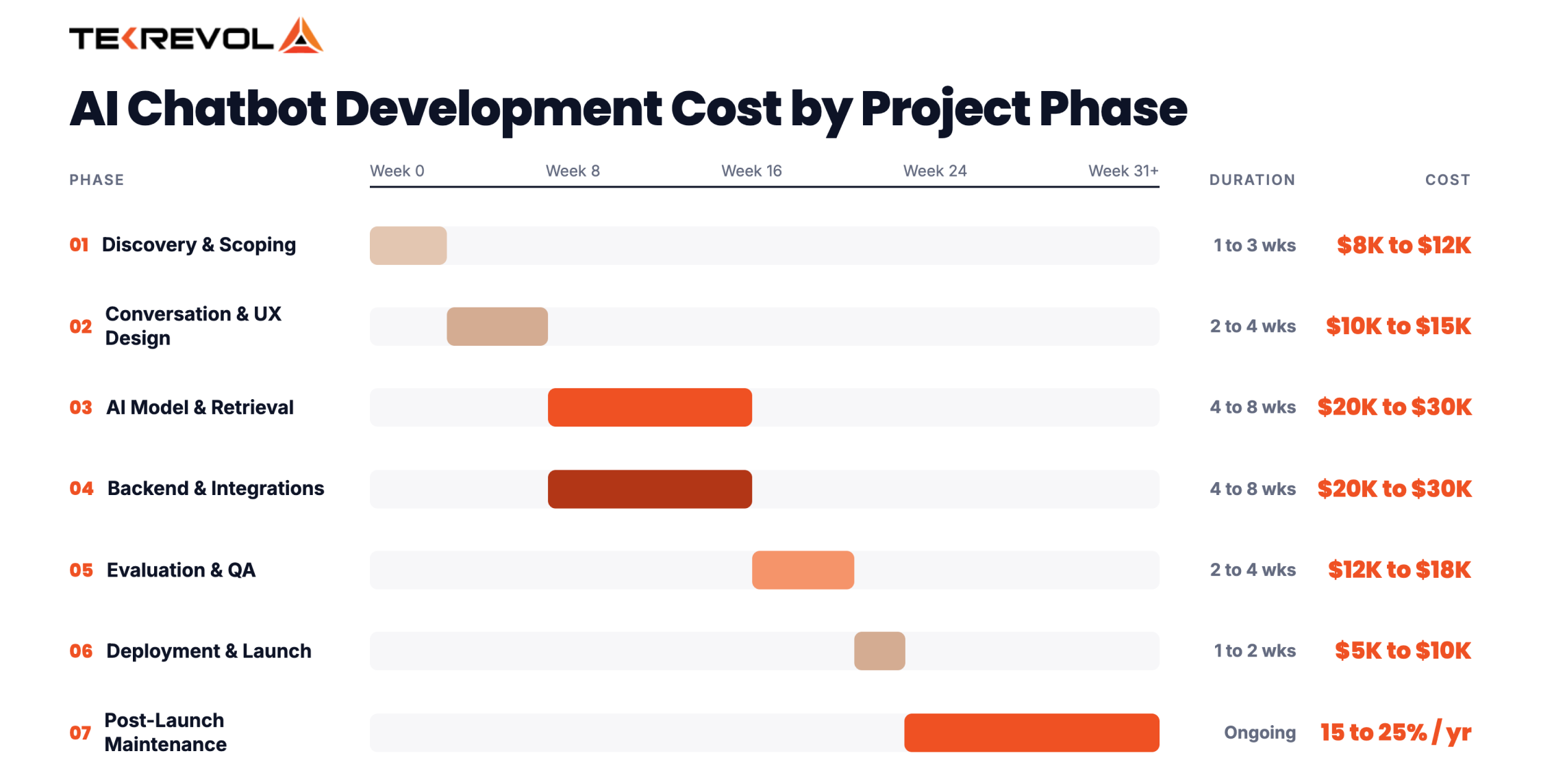
1. Discovery and Scoping
Estimated cost: $8,000–$12,000 | Timeline: 1–3 weeks
This phase defines what the chatbot needs to accomplish before development begins. The team validates the use case, reviews available data, identifies technical requirements, and establishes measurable success criteria.
Key activities:
- Define chatbot goals and target users
- Audit available business data
- Identify required integrations
- Map technical architecture
- Establish project scope and success metrics
2. Conversation and UX Design
Estimated cost: $10,000–$15,000 | Timeline: 2–4 weeks
Conversation design determines how the chatbot communicates and handles different user situations. The focus is not just on writing responses but on creating reliable flows for normal requests, unclear questions, refusals, and human escalation.
Key activities:
- Design conversation flows
- Define tone and response guidelines
- Map escalation and fallback scenarios
- Create prompts and interaction patterns
- Design the chatbot interface where required
3. AI Model and Retrieval Development
Estimated cost: $20,000–$30,000 | Timeline: 4–8 weeks
This is where the AI capabilities are built and connected to the information the chatbot needs. Depending on the project, this may involve prompt engineering, model configuration, RAG implementation, embeddings, and retrieval optimization.
Key activities:
- Select and configure the AI model
- Build prompt and response logic
- Develop RAG pipelines where required
- Connect knowledge sources
- Test retrieval accuracy and response quality
4. Backend and System Integrations
Estimated cost: $20,000–$30,000 | Timeline: 4–8 weeks
The backend connects the chatbot to the systems that allow it to access data or perform actions. Complexity depends largely on the number of integrations and how much information the chatbot needs to exchange with each system.
Key activities:
- Develop backend APIs
- Connect CRM, ERP, payment, or support systems
- Implement authentication and permissions
- Build action and workflow logic
- Handle third-party API requirements
5. Evaluation and Quality Assurance
Estimated cost: $12,000–$18,000 | Timeline: 2–4 weeks
AI testing requires more than checking whether buttons and APIs work. The chatbot needs to be evaluated against realistic conversations to identify inaccurate answers, unsafe responses, broken workflows, and unexpected edge cases.
Key activities:
- Create representative test scenarios
- Measure response accuracy
- Test edge cases and failure scenarios
- Validate security and safety controls
- Run regression testing before launch
6. Deployment and Launch
Estimated cost: $5,000–$10,000 | Timeline: 1–2 weeks
Once the chatbot passes testing, it needs to be moved into a production environment. This stage covers infrastructure setup, monitoring, final configuration, and a controlled rollout.
Key activities:
- Configure production infrastructure
- Set up monitoring and analytics
- Complete final security checks
- Deploy the chatbot
- Monitor initial user interactions
7. Post-Launch Maintenance
Estimated cost: 15%–25% of the initial development cost annually | Timeline: Ongoing
An AI chatbot requires continuous maintenance after launch. Business information changes, models are updated, integrations evolve, and new user questions reveal gaps that need to be addressed.
Ongoing work includes:
- Updating prompts and knowledge sources
- Monitoring chatbot performance
- Fixing integration issues
- Optimizing model usage and costs
- Adding improvements based on user feedback
Is RAG Cheaper Than Fine-Tuning for an AI Chatbot?
RAG is cheaper than fine-tuning for most chatbots. RAG costs $15,000 to $50,000 to build and $350 to $2,850 monthly to run. Fine-tuning costs $2,400 to $18,000 per training run, plus retraining forever. RAG wins below roughly 10,000 daily queries.
Retrieval-augmented generation (RAG) looks up relevant content from your documents at query time and hands it to the model. Your knowledge lives outside the model, so updating it means editing a document.
Fine-tuning adjusts the model’s own weights on your examples. Your knowledge becomes part of the model, so updating means training again.
| RAG | Fine-tuning | |
| Build cost | $15,000 to $50,000 | $2,400 to $18,000 per training run |
| Build time | 2 to 4 weeks, longer with messy content | 4 to 8 weeks, including data preparation |
| Monthly running cost | $350 to $2,850 | $200 to $3,000 if self-hosting |
| Ongoing engineering | 5 to 10 hours a month | 20 to 40 hours a month, plus $500 to $5,000 per update |
| Updating knowledge | Edit a document, done | Retrain, re-evaluate, redeploy |
| Token cost per query | Higher, since retrieved context inflates input | Lower, no retrieved context to send |
| Best for | Knowledge that changes | Behavior, format, or tone that must stay consistent |
Below 10,000 daily queries, RAG is usually cheaper. Above 100,000, fine-tuning a smaller model can cost less by avoiding retrieved context on every query.
What We Recommend: Start with RAG. It’s faster, cheaper, and easier to update. Use fine-tuning later for specific tone, formatting, or classification needs. Mature systems often use both.
AI Chatbot Development Cost by Use Case
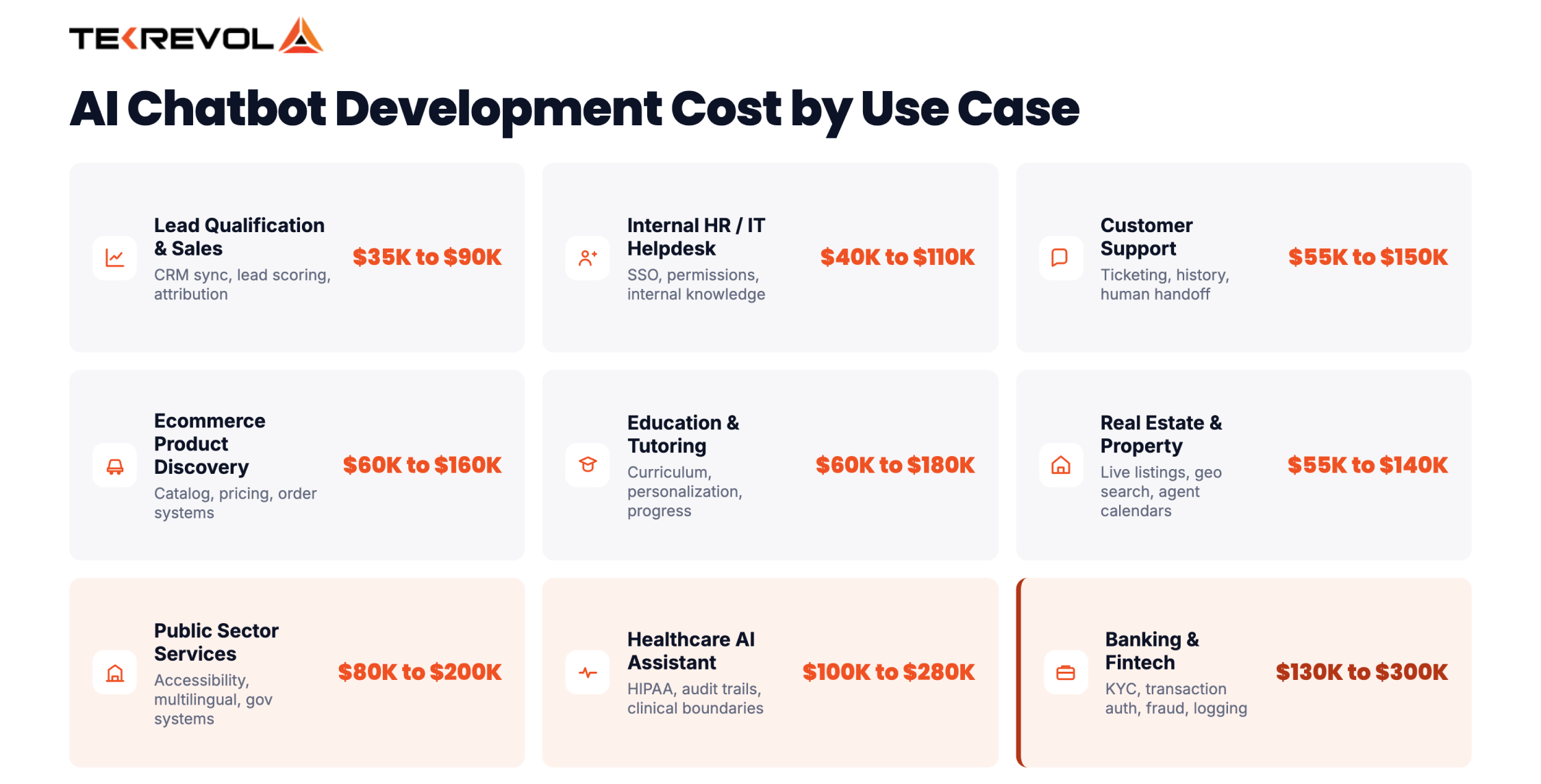
The cost of an AI chatbot changes significantly depending on what the system is expected to do. A lead-generation bot may only need CRM integration and qualification logic, while healthcare and fintech assistants require stronger security, compliance, and operational controls.
1. Lead Qualification and Sales Chatbot
Estimated cost: $35,000–$90,000
Sales chatbots are designed to capture leads, qualify prospects, answer product questions, and route high-value opportunities to the right sales representative. The main development work usually centers around CRM integration, lead scoring, and marketing attribution.
2. Internal HR or IT Helpdesk Chatbot
Estimated cost: $40,000–$110,000
An internal chatbot can help employees find policies, troubleshoot common IT issues, submit requests, and access company information. Although the use case is generally lower risk, secure employee authentication, SSO, permissions, and access to internal knowledge bases add to development costs.
3. Customer Support Chatbot
Estimated cost: $55,000–$150,000
Customer support assistants handle common questions, troubleshoot issues, check account information, and escalate complex cases to human agents. Taco Bell’s ordering and support bot is a well-known example. Ticketing system integration, conversation history, and reliable human handoff are typically the biggest cost drivers.
4. Ecommerce Product Discovery Chatbot
Estimated cost: $60,000–$160,000
E-commerce chatbots help customers discover products, compare options, and sometimes complete purchases. H&M’s shopping assistant is a widely cited example, with costs rising as catalog, pricing, and order-system integrations are added.
5. Education and Tutoring Assistant
Estimated cost: $60,000–$180,000
An AI tutoring assistant can answer questions, explain concepts, generate practice exercises, and track student progress. Development becomes more complex when the chatbot must follow a structured curriculum, personalize learning paths, and maintain student performance data.
6. Real Estate and Property Chatbot
Estimated cost: $55,000–$140,000
Real estate chatbots can help users search for properties, answer listing questions, qualify buyers or renters, and schedule viewings. Live property data synchronization, listing availability, location-based search, and integration with agent calendars can significantly affect the final cost.
7. Public Sector Services Chatbot
Estimated cost: $80,000–$200,000
Public-sector chatbots typically help residents access government information, complete service requests, or find relevant programs. Accessibility requirements, multilingual support, data security, and integration with government systems can make these projects more complex than standard customer-service bots.
8. Healthcare AI Assistant
Estimated cost: $100,000–$280,000
Healthcare assistants require stronger safeguards because they may handle sensitive patient information and operate in regulated environments. Costs can increase substantially with HIPAA requirements, secure integrations, audit trails, identity controls, and clearly defined boundaries around clinical information
9. Banking and Fintech Assistant
Estimated cost: $130,000–$300,000
Financial chatbots often need to handle sensitive account information, explain financial products, support transactions, or assist with customer onboarding, similar to how PayPal uses conversational support for account and payment help. Secure authentication, KYC workflows, transaction authorization, fraud controls, regulatory logging, and banking-system integrations make these among the most expensive chatbot implementations.
How Much Does It Cost to Build an Enterprise AI Chatbot?
Enterprise AI chatbot costs run from $150,000 to $400,000 for a first deployment and pass $1 million for multi-business-unit programmes. The premium comes from SSO, governance, audit logging, procurement security review, and phased rollout rather than from smarter AI.
Enterprise buyers aren’t paying for a better model. They’re paying for everything wrapped around it.
- Identity and access: SSO, role-based permissions, and department-level data access can add $20,000–$60,000.
- Governance and audit: Conversation logs, action tracking, and data-retention policies typically add $25,000–$70,000.
- Security review: Supporting your buyer’s InfoSec assessment can require additional engineering and documentation, adding $10,000–$40,000.
- Multi-system integration: Connecting the chatbot to multiple enterprise systems can add $40,000–$150,000, depending on the number and complexity of integrations.
- Phased rollout: Launching with one team and expanding to others can cost $10,000–$30,000 per additional business unit.
- Change management and training: Employee training, onboarding, and adoption support can add $15,000–$50,000.
Timelines stretch too. A technically finished enterprise chatbot commonly waits two to four months for security review and internal approvals before a single user touches it. Plan for that rather than discovering it.
Should You Build a Custom AI Chatbot or Buy a Platform?
Buy a platform if your use case is standard support and volume stays under roughly 5,000 conversations a month. Build custom if you need your own data, systems, or rules. At high volume, per-resolution platform pricing can cost 10x the raw token cost.
This is the most consequential decision in the whole exercise, and it’s where custom AI chatbot development cost has to be weighed against a subscription you’ll pay forever.
| Platform subscription | Custom AI chatbot build | |
| Upfront cost | $0 to $5,000 setup | $40,000 to $250,000 |
| Ongoing cost | $50 to $5,000/month, or $1 to $6 per resolution | Token spend plus 15% to 25% maintenance |
| Time to live | Days to weeks | 2 to 6 months |
| Data ownership | Vendor’s terms | Yours |
| Integration depth | What the vendor supports | Whatever you need |
| Customization | Configuration only | Complete |
| Cost at scale | Rises linearly with volume, forever | Flattens, since only tokens scale |
See our guide to build vs. buy vs. customize for the full comparison.
What Does AI Chatbot Maintenance Cost Each Year?
AI chatbot maintenance costs 15% to 25% of build cost annually, so $15,000 to $25,000 on a $100,000 build, plus token spend on top. Chatbots need more upkeep than standard software because models change, content drifts, and answer quality degrades silently.
- Content and knowledge refresh: $4,000 to $15,000. Your documents change, so retrieval quality decays if nobody maintains them.
- Prompt and behavior tuning: $3,000 to $12,000, ongoing, based on real conversation review.
- Model version migrations: $5,000 to $20,000 per major change. Behavior shifts when you move.
- Integration maintenance: $3,000 to $15,000. Third-party APIs change without asking you.
- Quality monitoring: $4,000 to $18,000. The thing that catches silent degradation.
- Infrastructure and vector hosting: $840 to $6,000 a year at typical scale.
Add token spend to all of that. On a $100,000 build handling 50,000 conversations a month at mid-tier rates, you’re looking at roughly $20,000 in maintenance plus $54,000 in tokens. Budget three years, not one.
Hidden AI Chatbot Costs to Budget For
The initial development quote rarely covers every expense involved in running and improving an AI chatbot. Beyond development, you may need to budget for data preparation, AI usage, infrastructure, security, monitoring, and ongoing optimization.
Vector Database and Infrastructure
Estimated cost: $70–$500+ per month
RAG-based chatbots often require vector databases and cloud infrastructure to store and retrieve knowledge. Costs increase as your document volume, query traffic, and storage requirements grow.
Messaging and Channel Fees
Your AI model bill is not necessarily your complete usage cost. Channels such as WhatsApp and other messaging platforms may charge separate fees for conversations, messages, or business-initiated interactions.
Model Updates and Migration
AI providers regularly introduce new models and retire older ones. Moving to a replacement model can require prompt adjustments, testing, performance comparisons, and production updates, creating an ongoing maintenance cost.
Legal and Policy Requirements
Estimated cost: $3,000–$15,000
Depending on your industry and the data your chatbot handles, you may need legal review for privacy policies, terms of use, disclaimers, data-processing agreements, and other documentation.
Human Review and Optimization
One of the most overlooked costs is the time required to review real conversations after launch. Teams often need to analyze transcripts, identify recurring failures, update knowledge, refine prompts, and improve workflows, especially during the first few months.
The 5 Most Expensive AI Chatbot Budgeting Mistakes
The most expensive mistakes are ignoring ongoing token costs, skipping evaluation to save on the initial quote, and underestimating what a “simple” integration actually requires; all three show up as unplanned spend within the first three months of launch.
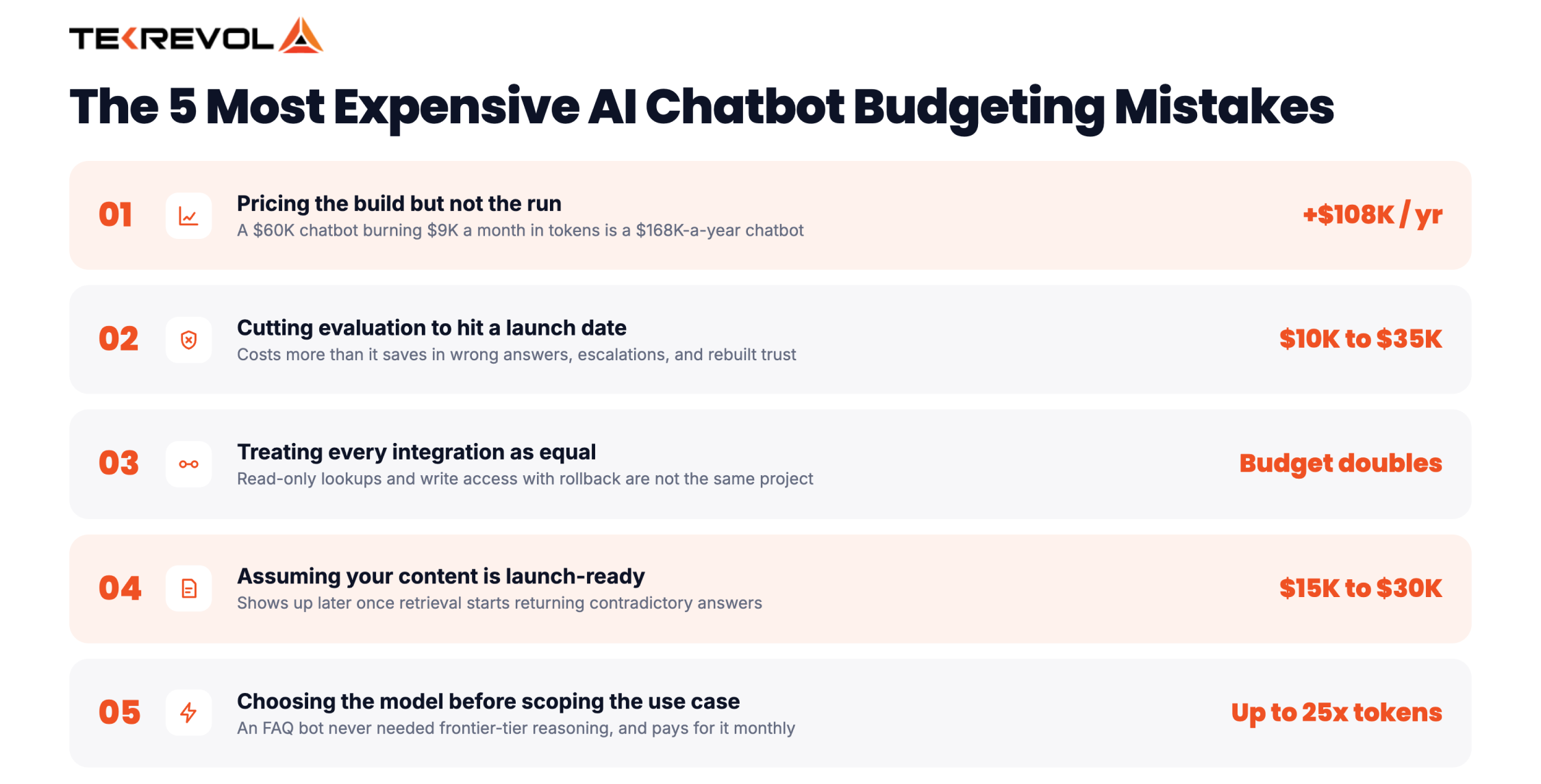
These aren’t edge cases. We see some version of all five on nearly every project that comes to us after a first build went over budget elsewhere.
- Pricing the build but not the run: A $60,000 chatbot that costs $9,000/month in tokens isn’t a $60,000 chatbot; it’s a $168,000-a-year one. Budget token spend from day one, not after the first invoice, surprises you.
- Cutting evaluation to hit a launch date: Skipping the test suite saves $10,000–$35,000 upfront and costs more than that in wrong answers, escalations, and rebuilt trust once the bot is live and unmonitored.
- Treating every integration as equal: “We need it to talk to Salesforce” sounds like one line item. Read-only lookups and write-access actions with rollback logic are not the same project; quoting them the same way is how budgets double mid-build.
- Assuming your content is launch-ready, almost no business’s knowledge base is actually clean. Data prep gets treated as a footnote and shows up later as a $15,000–$30,000 surprise once retrieval starts returning contradictory answers.
- Choosing the model before scoping the use case: Defaulting to the most powerful (and most expensive) model available, then discovering an FAQ bot never needed that level of reasoning, is one of the fastest ways to inflate a monthly bill for no accuracy gain.
How Can You Reduce AI Chatbot Development Costs Without Cutting Corners?
Reducing AI chatbot development costs does not mean removing the features that matter. The better approach is to control scope, use the right technology for the job, and invest first in capabilities that deliver measurable business value.
Start With a Focused MVP
Launch with the core capabilities your users actually need instead of building every feature at once. A focused MVP reduces upfront development costs and gives you real usage data to guide future improvements.
Start with:
- One or two high-value use cases
- Essential integrations
- Core conversation capabilities
- Basic analytics and monitoring
Choose RAG Before Fine-Tuning
If your chatbot needs to answer questions using business-specific information, RAG is often more practical than fine-tuning. It lets the AI retrieve relevant information from your knowledge base without the cost and maintenance involved in repeatedly training a custom model.
Fine-tuning makes more sense when you need consistent behavior, specialized output formats, or domain-specific model behavior that prompting and retrieval cannot achieve.
Prioritize High-Value Integrations
Every integration adds development and testing work. Instead of connecting your chatbot to every business system at launch, identify the integrations that directly support your primary use cases and add the rest in later phases. This keeps the initial build smaller without limiting the chatbot’s long-term potential.
Use the Right AI Model for Each Task
Not every chatbot needs the most powerful model available. A simple FAQ or classification task may work well with a smaller, lower-cost model, while complex reasoning can be routed to a more capable model when necessary.
Model routing can help you:
- Reduce API costs
- Improve response speed
- Reserve advanced models for complex requests
- Scale usage more efficiently
Budget for Maintenance From Day One
AI chatbot costs continue after launch. Model updates, knowledge-base changes, monitoring, security improvements, and integration maintenance all require ongoing investment.
Partner With TekRevol for AI Chatbot Development
Building an AI chatbot that delivers real business value takes more than connecting an LLM to a chat interface. As an experienced AI development company, TekRevol helps businesses design, develop, integrate, and scale AI chatbots around their workflows, data, users, and business goals.
From RAG-powered knowledge assistants and generative AI chatbots to voice and agentic systems, our team manages the full development journey, from strategy and architecture to deployment and optimization. TekRevol is ranked among the top AI development companies, reflecting our experience delivering AI solutions for businesses across industries.
If a $300-a-month platform can genuinely solve your problem, we’ll tell you that instead of pushing you toward a custom build. And if you need something more advanced, our AI chatbot development services cover everything from initial scoping to production.
Ready to find out what your AI chatbot will cost to build and to run?
Book a 30-minute session with a senior conversational AI engineer. We’ll review the build, model your expected AI spend, and give you a clear cost range backed by your actual usage.
Schedule Your Free Consultation!


