



- Mobile app development in Saudi Arabia costs SAR 30,000 to SAR 1,000,000+, depending on complexity and compliance scope.
- Backend development and third-party integrations absorb 25% to 35% of your budget, more than design and frontend combined.
- Arabic localization and RTL support is engineering work, not translation, and it touches every screen you build.
- ZATCA e-invoicing, Mada, and Nafath are Saudi-only integrations that global app development cost guides rarely price.
- Nearly every quote you receive excludes the 15% VAT that ZATCA applies to app development services.
- Budget 15% to 25% of your build cost each year for app maintenance, hosting, and platform updates.
Saudi businesses are no longer asking whether they need a mobile app. They’re asking a more practical question: How much will it cost to build one properly, and how quickly can it launch?
That answer depends on what you’re building. Mobile app development cost in Saudi Arabia can range from around SAR 30,000 for a basic MVP to SAR 1,000,000+ for enterprise-grade or highly regulated platforms. The country’s digital transformation and Vision 2030 initiatives are also driving demand for more sophisticated, secure, and scalable digital products.
This guide breaks down the real cost of mobile app development in Saudi Arabia, including pricing by development stage, team structure, city, and industry. We’ll also cover the often-overlooked costs that can push a project beyond its initial quote, so you can budget with confidence before development begins.
How Much Does Mobile App Development Cost in Saudi Arabia in 2026?
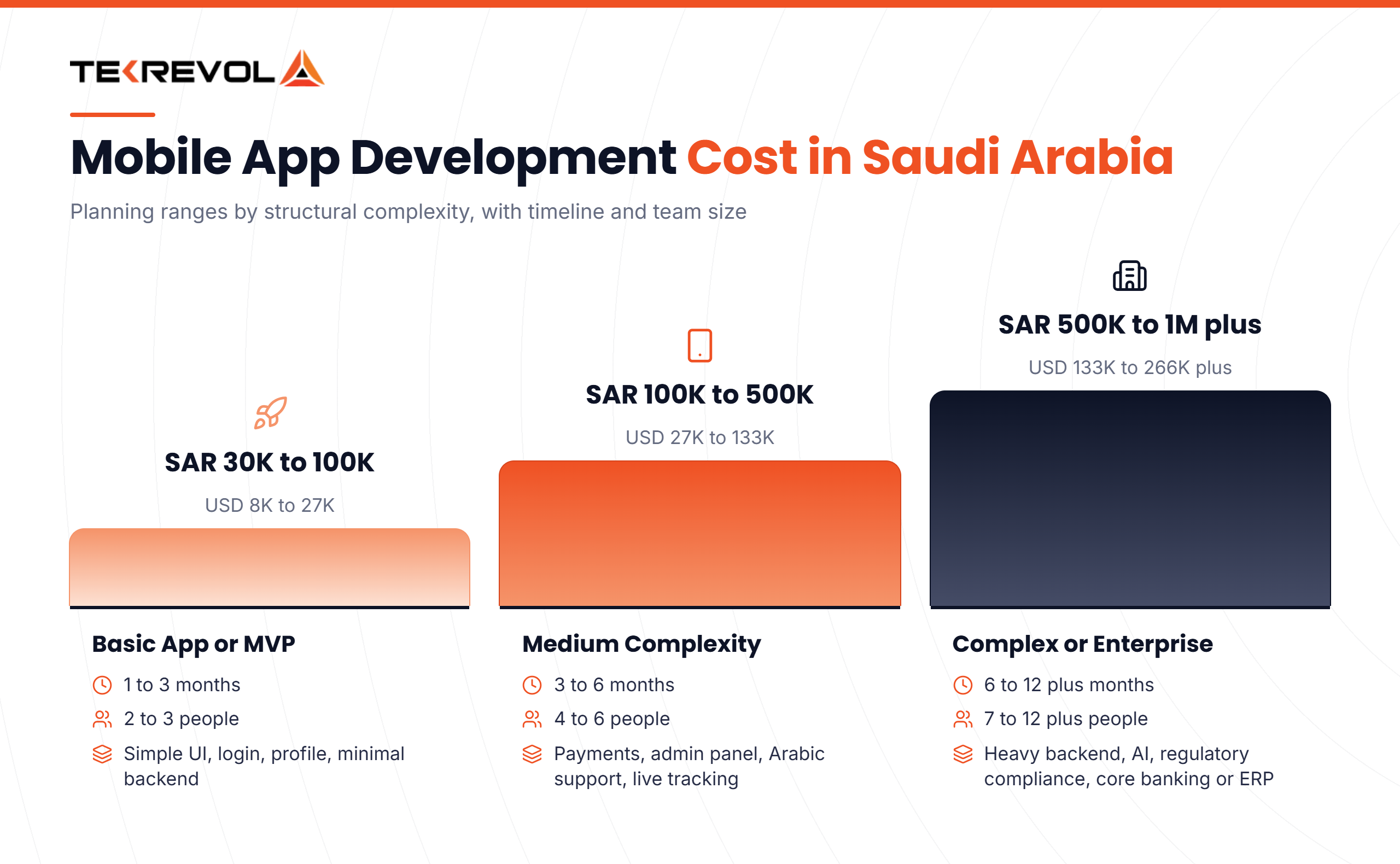
The best Mobile app development cost in Saudi Arabia quotes sit between SAR 30,000 and SAR 1,000,000 or more in 2026. When evaluating app development pricing in Saudi Arabia, categorizing your application by structural complexity provides the clearest budgeting benchmark
Basic App / MVP: SAR 30,000 to SAR 100,000 ($8,000 to $27,000)
- Timeframe: 1 to 3 months
- Features: Simple UI/UX, user login, profile management, and minimal backend setup
- Best for: Validating an idea, an internal tool, or a single-workflow product before you commit real budget
Medium Complexity App: SAR 100,000 to SAR 500,000 ($27,000 to $133,000)
- Timeframe: 3 to 6 months
- Features: Custom design, multi-user roles, real-time tracking, and third-party APIs
- Best for: Most commercial launches. Payments, an admin dashboard, and Arabic support usually land you here
Complex / Enterprise App: SAR 500,000 to SAR 1,000,000+ ($133,000 to $266,000+)
- Timeframe: 6 to 12+ months
- Features: Advanced architecture, heavy backend data, AI integration, and regulatory compliance
- Best for: Fintech, healthcare, government, and anything integrating with core banking or ERP systems
Note: Ranges reflect TekRevol’s own scoping across Saudi and GCC engagements. They’re planning ranges, not a market survey.
If you’d rather have a number than a band, our mobile app development services in Saudi Arabia page walks through platform, project type, and feature set.
Why Does App Development Cost More in Saudi Arabia Than in Other Markets?
App development costs more in Saudi Arabia because of a compliance and integration layer that doesn’t exist in global markets. Local regulations and market infrastructure introduce distinct compliance and engineering requirements worth SAR 30,000 to SAR 300,000.
Let’s go through it properly.
PDPL Compliance: SAR 25,000 – 120,000
The Personal Data Protection Law (PDPL) enforced by SDAIA requires robust consent management, data encryption, and local audit logging. It also applies to you even if your company sits outside the Kingdom.
Penalties reach SAR 5 million for general violations, and up to SAR 3 million plus imprisonment for intentional disclosure of sensitive data.
Data Residency and In-Kingdom Hosting: SAR 12,000 – 90,000 setup
Saudi regulations mandate that sensitive financial, personal, or public sector data stay hosted within local cloud regions like AWS Middle East or Azure KSA.
For the private sector, that policy is “highly recommended,” not required. Enterprise cloud configuration and sovereignty protocols cost SAR 12,000 to SAR 90,000.
Arabic Localization and RTL Support: SAR 30,000 – 90,000
Building a native bilingual (Arabic/English) app requires more than text translation. Right-to-Left (RTL) mirror-layout design, custom Arabic typography, Hijri calendar support, and dual-language QA increase UI/UX engineering budgets by 15% to 25%.
Then there’s testing. You’re now running two full QA passes on every release instead of one. Retrofitting RTL support later usually costs more than building it in from the start, because you revisit every screen you already signed off.
ZATCA E-Invoicing Integration: SAR 45,000 – 130,000
If your app sells anything to Saudi customers, ZATCA e-invoicing is in scope. Wave 25, announced by ZATCA in July 2026, pulls in businesses with VAT-subject revenue above SAR 187,500 by 1 February 2027. That’s the voluntary VAT registration threshold, so in practice it reaches everyone.
Local Payment Rail Integrations: SAR 20,000 – 85,000
Card payments in Saudi Arabia run through Mada, the national payment system owned by SAMA. Electronic payments reached 85% of total retail payments in 2025, per SAMA data reported by SPA.
Buy-now-pay-later is mainstream alongside it. SAMA licensed Tamara Finance in March 2025 and Tabby Finance in November 2025. STC Pay is also no longer a wallet: SAMA authorised STC Bank to begin banking operations in January 2025.
Integrating native payment rails like MADA, STC Pay, and BNPL leaders Tabby and Tamara demands rigorous testing against local banking sandbox environments. Setting up these native payment channels typically ranges from SAR 20,000 to SAR 85,000.
Nafath Identity Verification: SAR 25,000 – 65,000
Nafath is Saudi Arabia’s national digital ID and sign-on service run by the National Information Center. You won’t need it for a coffee loyalty app. You will need it the moment you onboard customers into anything regulated or connect to a government service.
Not sure which of these actually apply to your app?
We'll map your compliance scope in one session and tell you which line items you can safely drop.
Book a Free Compliance Scoping Call→What Factors Affect Mobile App Development Cost in Saudi Arabia?
Several core technical variables drive the baseline cost to build an app in KSA. Feature complexity, target platforms, and backend architecture dictate how many engineering hours your team requires.
If you’re planning to develop an app in Saudi Arabia, understanding these factors is essential. Each range below shows the swing that factor alone creates on a medium-complexity build.
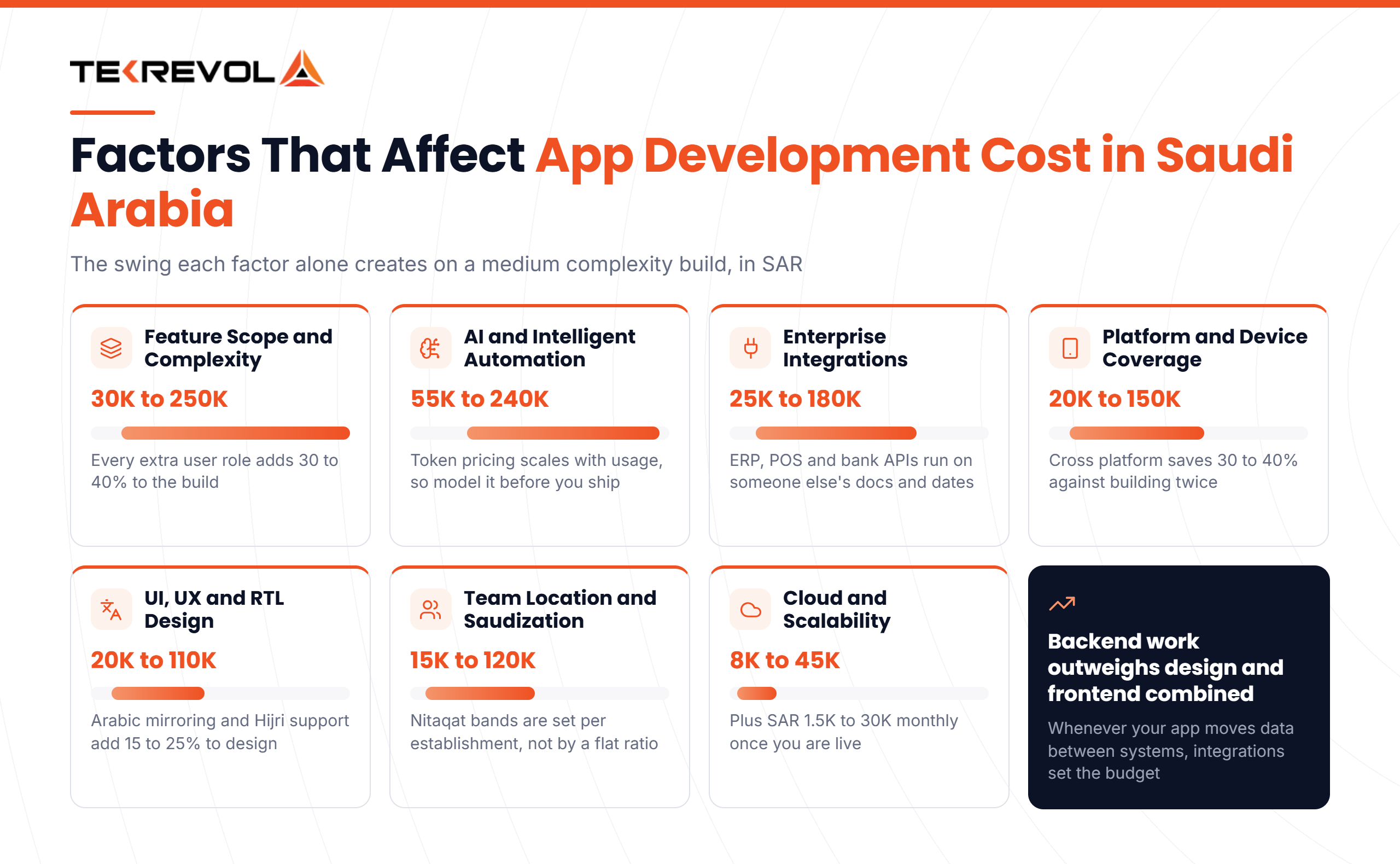
Feature Scope and Technical Complexity: SAR 30,000 – 250,000
Feature scope drives more of your budget than any other single factor. A booking flow with one user type is easy to build. However, adding a vendor panel, a driver app, and a dispatch engine increases the surface area and the cost.
Real-time features are the other multiplier. Live tracking, in-app chat, and instant order updates need persistent connections, conflict handling, and a scalable backend that stays consistent under load.
Enterprise Integrations and Backend Systems: SAR 25,000 – 180,000
Third-party integration is the line item most people underestimate, because you don’t control the other side of it. Linking to an ERP, a POS system, or a bank API means working to someone else’s docs, someone else’s release dates, and someone else’s uptime.
Common Saudi integration targets include:
- ERP and accounting platforms such as SAP, Oracle, or Odoo
- Retail POS and inventory systems
- Logistics and fleet telematics providers
- Bank and payment service provider APIs
- Government service endpoints
Each one adds discovery time, data mapping, error handling, and a sandbox testing cycle. Two integrations rarely cost twice as much as one integration. They usually cost more because they have to agree with each other.
Platform Choice and Device Coverage: SAR 20,000 – 150,000
Platform strategy changes both build and maintenance costs. Native app development cost for iOS and Android means two codebases, two test cycles, and two release processes forever. cross-platform app development services shares most of that work across one codebase.
| Approach | Build cost | Maintenance cost | When it fits |
| Native (Swift / Kotlin) | Highest | Highest | Heavy graphics, deep hardware access, platform-specific UX |
| Cross-platform (Flutter / React Native) | Moderate | Lower | Most commercial apps, especially with a shared feature set |
| Progressive web app | Lowest | Lowest | Content-led products with light device requirements |
Most Saudi launches we scope end up on Flutter or React Native, which typically saves 30% to 40% compared to building twice. We cover the trade-offs in detail in our guide to app development frameworks used in Saudi Arabia.
UI/UX Design Standards & RTL Customization: SAR 20,000 – 110,000
Saudi users demand sleek, highly intuitive digital experiences. Delivering a bilingual application with a full Right-to-Left (RTL) Arabic interface mirroring involves significant design architecture. Reconfiguring layouts, navigation flows, custom typography, and Hijri calendar support adds 15% to 25% to the initial UI/UX design budget.
Cloud Infrastructure and Scalability: SAR 8,000 – 45,000 build, plus SAR 1,500 – 30,000 monthly
Cloud infrastructure choices show up in your monthly bill, not your build quote. A simple managed backend costs little. A setup that scales across regions and hosts inside the Kingdom costs far more.
Ask three questions early: how many concurrent users at peak, how much data you’re storing, and whether a Saudi client will require data residency inside the Kingdom. The third one changes your provider options entirely. Our cloud consulting team sizes this during discovery, not after launch.
AI Integration and Intelligent Automation: SAR 55,000 – 240,000
AI integration is the newest cost driver and the least predictable. Wiring up a commercial API for recommendations or a support assistant is moderate work. Training or fine-tuning a model on your own data is a different project with its own budget. Recurring cost matters here too. Token-based pricing scales with usage, so an AI feature that’s cheap at launch gets expensive at scale. Model that before you ship it.
Team Location, Seniority and Saudization: SAR 15,000 – 120,000
Team location changes your hourly rate more than almost anything else. Hiring a local workforce in Saudi Arabia may be costly, but it provides greater alignment with the local demands. Costs can be cut through outsourcing; however, there are drawbacks like time zone disparities and communication obstacles.
Saudization is the factor nobody prices. Under the Nitaqat programme, run by the Ministry of Human Resources and Social Development, every firm with one or more employees carries a Saudization band. Fall into the red band, and you can’t renew expatriate work permits, let alone issue new ones.
How Much Does AI App Development Cost in Saudi Arabia
AI app development cost in Saudi Arabia runs SAR 150,000 to SAR 1,000,000 or more, depending on whether AI is a feature inside your app or the product itself. That’s $40,000 to $266,000+ at the fixed peg.
The split we use when scoping breaks down like this:
- AI-enhanced app: SAR 150,000 – 450,000. A normal app with one or two AI features bolted on, such as a support assistant or product recommendations.
- AI-native app: SAR 400,000 – 1,000,000+. The AI is the product. Think document processing, diagnostics, or an agent that does the work a person used to do.
- Enterprise AI platform: SAR 750,000 – 1,000,000+. Multiple models, internal data pipelines, governance, and integration into systems you already run.
Vision 2030 puts AI at the centre of the Kingdom’s digital economy, and SDAIA exists precisely because data and AI are treated as national infrastructure. So the buyers approaching us for AI development services now are banks, retailers, and government suppliers, not just startups.
AI Feature Costs in Saudi Arabia
| AI feature | Cost (SAR) | Cost (USD) |
| Chatbot on a commercial LLM API | 45,000 – 120,000 | $12,000 – $32,000 |
| Arabic and English conversational assistant | 75,000 – 190,000 | $20,000 – $50,700 |
| Recommendation engine | 60,000 – 170,000 | $16,000 – $45,300 |
| RAG assistant over your own documents | 90,000 – 260,000 | $24,000 – $69,300 |
| OCR and document processing (Arabic script) | 55,000 – 150,000 | $14,700 – $40,000 |
| Computer vision and image recognition | 80,000 – 240,000 | $21,300 – $64,000 |
| Predictive analytics and forecasting | 70,000 – 200,000 | $18,700 – $53,300 |
| Fraud and anomaly detection | 95,000 – 280,000 | $25,300 – $74,700 |
| Voice and Arabic speech-to-text | 65,000 – 180,000 | $17,300 – $48,000 |
| Fine-tuning a model on your own data | 120,000 – 375,000 | $32,000 – $100,000 |
TekRevol scoping ranges, converted at the fixed SAR 3.75 peg. Build cost only; running costs are separate.
Weighing an AI feature and unsure what it costs to run?
We'll size the build, model the monthly token spend, and flag the PDPL transfer question before you commit budget.
Book a Free AI Scoping Session→How Much Does It Cost to Hire an App Developer in Saudi Arabia?
Hourly rates for app developers in KSA vary by role and seniority far more than by city. Here’s the band each role commands on Saudi and GCC engagements, converted at the fixed SAR 3.75 peg.
| Role | SAR / hour | USD / hour | What you’re paying for |
| Junior mobile developer | 150 – 220 | $40 – $59 | Supervised feature work, bug fixes, UI build-out |
| Mid-level mobile developer | 220 – 300 | $59 – $80 | Independent feature delivery, API integration |
| Senior mobile developer | 300 – 400 | $80 – $107 | Architecture calls, performance, mentoring |
| Backend engineer | 230 – 370 | $61 – $99 | Data models, APIs, third-party integrations |
| UI/UX designer | 190 – 320 | $51 – $85 | Design system, prototypes, bilingual variants |
| QA engineer | 150 – 260 | $40 – $69 | Test plans, regression, bilingual QA passes |
| DevOps engineer | 260 – 400 | $69 – $107 | CI/CD, cloud setup, monitoring, releases |
| Product manager | 260 – 410 | $69 – $109 | Scope control, roadmap, stakeholder management |
| Solution architect | 340 – 480 | $91 – $128 | System design, compliance architecture, scale |
| Blended project rate | 188 – 371 | $50 – $99 | The number that actually lands on your invoice |
TekRevol’s published staff augmentation range and our own role bands for Saudi and GCC delivery. Not a market salary survey.
Two things worth flagging. First, the blended rate is what matters, not the senior rate. Second, a Saudi PDPL or ZATCA specialist bills at architect level, so compliance-heavy builds carry a higher blend than the same app without them.
Hourly Rates by Sourcing Model
Where you buy those hours changes the rate more than which role you buy.
| Sourcing model | SAR / hour | USD / hour | The trade-off |
| Freelancer | 90 – 210 | $24 – $56 | Cheapest per hour. You carry PM, QA, and the risk |
| Offshore development agency | 130 – 260 | $35 – $69 | Lower rate, more hours on Arabic, ZATCA and Nafath |
| Regional GCC agency | 188 – 371 | $50 – $99 | Local context built in at a mid-market rate |
| Saudi in-house team | 240 – 450 | $64 – $120 | Full control, plus Saudization and overheads |
| Global consultancy | 450 – 900+ | $120 – $240+ | Enterprise governance, highest rate by far |
The cheapest hourly rate rarely wins on total cost. An offshore team at SAR 130 per hour that needs 40% more hours to get RTL layouts and ZATCA clearance right pushes your mobile app development cost in Saudi Arabia above a regional team billing SAR 250. Compare quoted hours alongside the rate, or the comparison means nothing.
You can also hire app developers in Saudi Arabia on a dedicated-team basis, which usually makes sense once you’re past your second release.
Why Does the Cost to Build An App in KSA Vary by Industry?
Different industries demand specialized feature sets that impact overall mobile app development cost in Saudi Arabia. For example, fintech applications require strict regulatory compliance, while e-commerce platforms need multi-vendor marketplace engines.
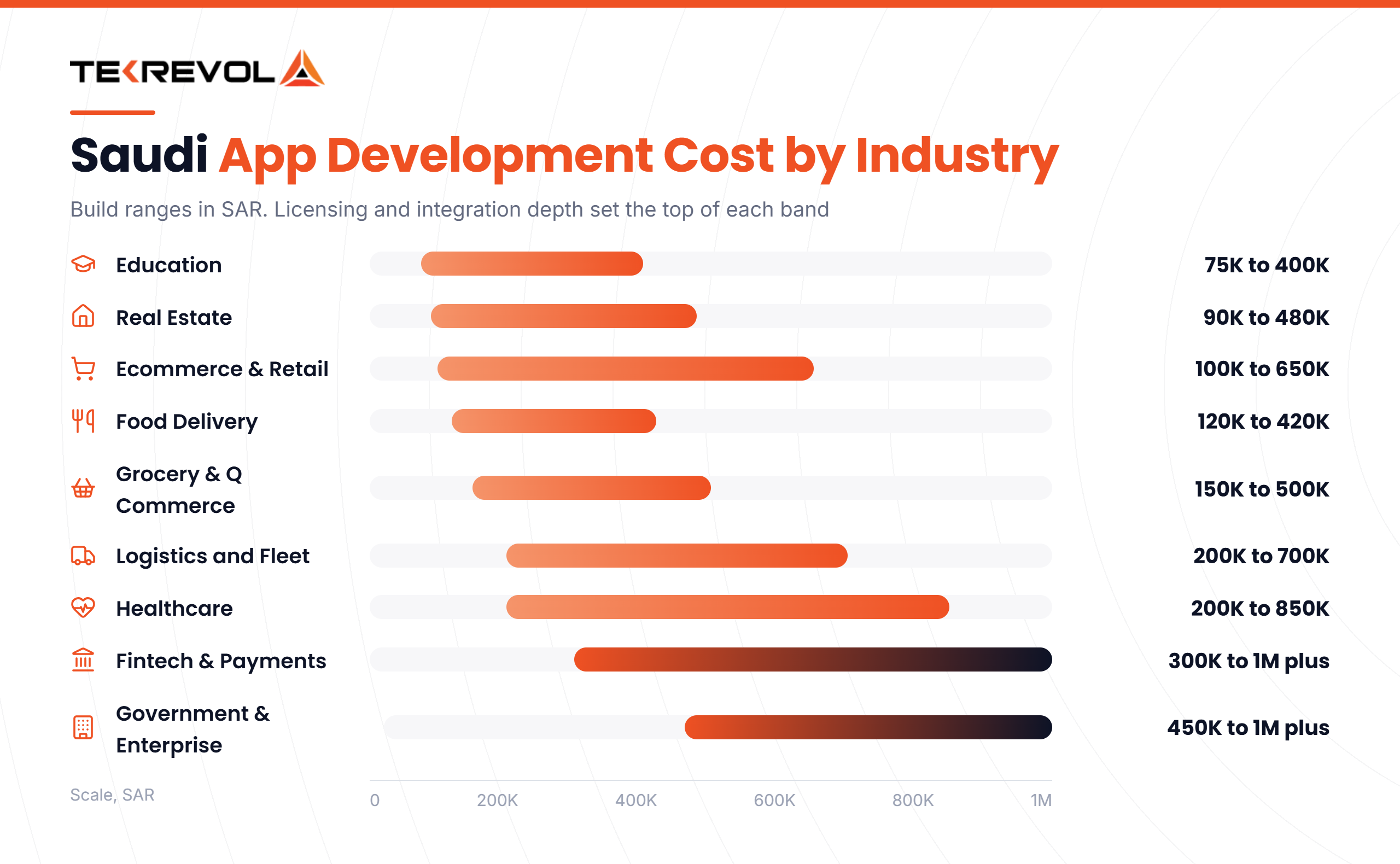
Education and E-Learning Platform: SAR 75,000 – 400,000
Education apps cost SAR 75,000 to SAR 400,000, making this the most accessible category on the list. Content delivery and video streaming are well-solved problems now.
Cost climbs when you add assessments, progress tracking, live classes, and Arabic curriculum content. Bilingual delivery matters more here than almost anywhere else, since the content itself is the product.
Real Estate App: SAR 90,000 – 480,000
Real estate apps cost SAR 90,000 to SAR 480,000. A listings app with search and filters sits at the low end. Add virtual tours, mortgage calculators, agent CRM, and developer inventory sync, and you move up quickly.
Saudi Arabia’s giga-project pipeline, from NEOM to Diriyah, has made this a busy category. Our real estate app development services page covers the feature set in more depth.
Ecommerce and Retail App Cost: SAR 100,000 – 650,000
Ecommerce apps cost SAR 100,000 to SAR 650,000, with the range driven almost entirely by what sits behind the storefront. A standalone catalogue is cheap. Syncing with an ERP, a POS, and a warehouse system is not.
ZATCA e-invoicing is mandatory here, and BNPL through Tabby or Tamara is close to expected. Our ecommerce app development solutions consider both; along with checkout optimisation, it decides whether any of it converts.
Food Delivery and On-Demand App: SAR 120,000 – 420,000
Food delivery apps cost SAR 120,000 to SAR 420,000. The cost covers a customer panel, a driver app, and a merchant dashboard, plus the dispatch engine that keeps all three honest.
Live tracking and real-time order status are the expensive parts. So is surge handling during Ramadan, when order volumes spike sharply, and your infrastructure has to hold. Our on-demand app development services cover that three-panel architecture.
Grocery and Quick Commerce App: SAR 150,000 – 500,000
Grocery apps cost SAR 150,000 to SAR 500,000, and inventory is what pushes them up. You need live stock sync across stores, substitution logic when an item runs out, and delivery slot management that doesn’t oversell capacity.
Cold-chain categories add another layer. So does basket size: a grocery order with 40 line items behaves very differently from a restaurant order with four. We looked at the market landscape in our roundup of grocery delivery apps in Saudi Arabia.
Logistics and Fleet App Cost: SAR 200,000 – 700,000
Logistics apps cost SAR 200,000 to SAR 700,000. Route optimisation is the most expensive component in logistics software development services, followed closely by driver apps that have to work offline in low-coverage areas. Telematics, proof of delivery, and warehouse links also contribute to scope.
Healthcare and Telemedicine App Cost: SAR 200,000 – 850,000
The cost to build a healthcare app in KSA ranges from SAR 200,000 to SAR 850,000. Here, patient data raises the bar on everything. Encryption, access control, audit logs, and consent flows stop being optional extras.
Video consultation adds real cost too, especially when it has to work reliably on mobile networks. Integration with clinic systems or national health platforms adds more. We cover the architecture in our comprehensive digital healthcare solutions.
Fintech and Payments App Cost: SAR 300,000 – 1,000,000+
Fintech apps cost SAR 300,000 to SAR 1,000,000 or more, and they carry the widest range on this list. The reason is licensing. An app that uses a licensed payment provider is a normal build. An app that stores value or initiates payments needs SAMA authorisation, which changes the project entirely.
KYC through Nafath, transaction monitoring, and audit trails all add scope. Budget for a security review as a named line item, not an afterthought. Our fintech app developers scope these separately for exactly that reason.
Government and Enterprise App Cost: SAR 450,000 – 1,000,000+
Government and enterprise apps cost SAR 450,000 to SAR 1,000,000 or more, and they run long. Nafath sign-on, in-Kingdom hosting, accessibility rules, and a formal security review are usually all in scope.
Procurement adds calendar time that has nothing to do with engineering. Plan for it, and price the waiting. Consult our custom software development company in Saudi Arabia to handle these enterprise builds.
How Does the App Development Lifecycle Impact App Cost in Saudi Arabia
The cost to build an app in Saudi Arabia follows a structured lifecycle where every phase contributes a defined percentage to the total budget. Planning investments across development phases prevents mid-project budget overruns.
To offer a more comprehensive understanding, let us dissect the cost of app development in Saudi Arabia into various components:
Discovery and Planning: 5% to 10% (SAR 15,000 – 30,000)
The discovery phase is where you decide what you’re building and, more usefully, what you’re not. Requirements workshops, user flows, technical architecture, and a locked scope document all happen here.
This is also the cheapest stage to change your mind in. A week of proper scoping regularly removes a month of rework later, which is why we push back hard when clients want to skip it.
For Saudi projects, discovery should also produce a compliance map. Knowing on day three that you need ZATCA clearance rather than reporting will save you a rebuild in month five.
UI/UX Design: 10% to 15% (SAR 30,000 – 45,000)
UI/UX design covers wireframes, interactive prototypes, a design system, and the visual polish that makes an app feel finished. On bilingual products, it also covers Arabic variants of every component.
Two things push UI/UX design cost up. Custom illustration and motion work is one. The other is stakeholder rounds: every extra review cycle costs real design hours, so agree on how many you get.
Frontend and Mobile Development: 20% to 30% (SAR 60,000 – 90,000)
Frontend work builds the screens, navigation, state handling, and offline behaviour your users actually touch. On cross-platform builds, this is one workstream. On native builds, it’s two, which is where the cost gap opens up.
Device testing sits here too. Saudi Arabia skews heavily toward both flagship iPhones and mid-range Android handsets, so your test matrix has to cover both ends properly.
Backend and API Development: 25% to 35% (SAR 75,000 – 105,000)
Backend development is the single largest line on most Saudi projects. Database design, business logic, authentication, admin APIs, and every third-party API connection are done here. If your app moves data between systems, expect backend and integration work to outweigh design and frontend combined.
Scalability decisions happen at this stage too. Building for 10,000 users when you’ll have 500,000 is expensive to fix later.
Testing and QA: 10% to 15% (SAR 30,000 – 45,000)
QA testing covers functional, regression, performance, and security passes. On a bilingual Saudi app, it also means running the whole suite twice, once in English and once in Arabic with RTL layouts.
Automated test coverage costs more upfront and less every release after. On anything you plan to maintain for years, it pays for itself somewhere around release four.
Compliance and Localisation: 5% to 12% (SAR 15,000 – 36,000)
This is the stage most mobile app development cost breakdowns in Saudi Arabia skip entirely. Arabic localization, RTL layout work, PDPL consent flows, audit logging, and ZATCA document handling all sit here.
Folding this into testing hides real work and creates real overruns. Giving it a named budget line is the single easiest way to stop that from happening.
Deployment and Launch: 5% to 10% (SAR 15,000 – 30,000)
Deployment covers environment setup, App Store and Google Play submission, monitoring, crash reporting, and handover documentation. Store review cycles add calendar time you don’t control, so build in a buffer. Post-launch hypercare, usually the first two to four weeks, belongs in this stage too. Something always surfaces once real users arrive.
How Do KSA App Development Costs Compare Across Riyadh, Jeddah, and Dammam?
The mobile app development cost in Saudi Arabia shifts by roughly 30% across Riyadh, Jeddah, and Dammam, mostly because of what each city’s buyers demand rather than what talent costs there.
| City | Relative cost | What drives it |
| Riyadh | Highest | Enterprise and government buyers, heavier compliance scope, larger agencies |
| Jeddah | Moderate | Retail, trading, and consumer platforms; competitive mid-market pricing |
| Dammam / Khobar | Most competitive | Industrial and operational apps; smaller vendor pool, lower overheads |
| Other cities | Lowest | Limited local supply; most work is outsourced to Riyadh or Jeddah teams |
Most Saudi delivery is remote-first now, so the city on the invoice matters less than the seniority of the people doing the work. Our own mobile app development company in Riyadh works this way.
Should You Build a Custom App or Buy White-Label in Saudi Arabia?
Build custom when your workflow is your advantage. Buy white-label when speed matters more than differentiation. Both are legitimate, and the cost gap is wide enough that the decision deserves real thought.
| Custom build | White-label | |
| Upfront cost | SAR 30,000+ | SAR 15,000 – 30,000 setup |
| Time to launch | 1 – 6 months | 2 – 4 weeks |
| Arabic and RTL | Built into your design system | Depends on the vendor |
| ZATCA and MADA | Built to your exact flow | Only if the vendor supports it |
| Ownership | You own the code | You license it |
| Best for | Funded startups, enterprises, regulated sectors | Small businesses, validation, pilots |
The trap is the middle. Teams pick white-label to save money, spend six months customising it, then rebuild anyway. If you already know you’ll need Nafath or ZATCA clearance, custom is usually cheaper by month eighteen. We’ve laid out the full comparison in our guide to custom versus white-label app development in Saudi Arabia.
How Long Does It Take to Develop an App in Saudi Arabia?
Building an app in Saudi Arabia takes 1 to 3 months for a basic app, 3 to 6 months for a medium-complexity product, and 6 to 12 months or more for complex and enterprise builds. Timeline and cost move together, since most of your budget is people multiplied by months.
| Tier | Cost (SAR) | Timeline | Typical team size |
| Basic / MVP | 30,000 – 100,000 | 1 – 3 months | 2 – 3 people |
| Medium complexity | 100,000 – 500,000 | 3 – 6 months | 4 – 6 people |
| Complex / Enterprise | 500,000 – 1,000,000+ | 6 – 12+ months | 7 – 12+ people |
Ranges reflect TekRevol’s own scoping across Saudi and GCC engagements. They’re planning ranges, not a market survey.
Three things stretch Saudi timelines specifically:
- Compliance validation. PDPL reviews and ZATCA integration testing add weeks that pure development doesn’t.
- Bilingual QA. Two language passes on every release, every time.
- Partner dependencies. Bank APIs, ERP vendors, and government integrations move at their own pace.
How Much Does It Cost to Maintain a Mobile App in Saudi Arabia?
Maintaining a mobile app in Saudi Arabia costs 15% to 25% of your original build cost every year. On a SAR 300,000 app, that’s SAR 45,000 to SAR 75,000 annually, starting the month you launch.
Here are the six drivers behind that number. They overlap and rarely all peak in the same year, which is why the blended figure lands where it does.
Hosting and Cloud Infrastructure: SAR 8,000 – 22,000 per year
Hosting is your most predictable recurring cost until it isn’t. Traffic growth, media storage, and database size all push it up, usually in steps rather than smoothly. In-Kingdom hosting costs more than a shared global region. If a Saudi enterprise client requires it, that’s a permanent uplift, not a one-off.
OS and Platform Updates: SAR 7,000 – 14,000 per year
Apple and Google both ship major OS releases every year, and both deprecate APIs on their own schedule. Skipping a cycle is cheap once and expensive twice.
Cross-platform apps carry a third layer here, since Flutter and React Native have their own upgrade paths. Budget for framework upgrades, not just OS ones.
Security Patching and PDPL Upkeep: SAR 6,000 – 12,000 per year
Dependency vulnerabilities appear constantly, and patching them is routine work you can’t defer. PDPL obligations add consent-record upkeep, access-request handling, and periodic reviews of what you’re storing and why.
If you process sensitive data, add a yearly security assessment on top. It’s cheaper than a breach and far cheaper than a SAR 5 million penalty.
Third-Party Services and API Renewals: SAR 5,000 – 13,000 per year
Map APIs, SMS and OTP delivery, push infrastructure, analytics, and crash reporting all bill monthly, and all scale with your user base. Payment gateway percentages sit outside this figure since they scale with revenue instead.
Vendors also change pricing. A map API repricing mid-year is a real thing that has caught real teams out.
Bug Fixes and User Support: SAR 12,000 – 20,000 per year
Every app encounters defects after launch, and Saudi apps produce two streams of them, since Arabic and English builds fail in different ways. Bilingual support handling adds cost that most quotes forget.
Expect the first 90 days to be heaviest, then a lower steady state. Agree on a response-time commitment in writing rather than assuming one.
Regulatory and Compliance Changes: SAR 4,000 – 9,000 per year
ZATCA has run e-invoicing waves continuously since 2023, SDAIA updated its cross-border transfer regulation in September 2024, and SAMA licenses new payment categories regularly.
None of these individually costs much. Together they’re a standing line item, and pretending otherwise just moves the surprise later.
Our app maintenance cost breakdown goes deeper into what pushes that annual percentage up or down.
Proven Techniques to Minimize Mobile App Development Cost in Saudi Arabia
You don’t have to break the bank to create a mobile app. Proper planning and savvy decisions can help you minimize app and web development costs in Saudi Arabia significantly without compromising performance and quality. Below are proven techniques that will allow you to stay within your budget while not compromising your app’s potential:
- Define Your Key Features: Focus on developing a Minimum Viable Product (MVP)—an initial release of your app that includes just the essential features. This conserves early development time and cost, yet allows you to gather knowledge from user feedback and iterate based on real-world demands. Our MVP development cost guide shows how the tiers work.
- Choose the Suitable Development Approach: Go for cross-platform development unless you have a reason not to. One codebase for iOS and Android cuts both build and maintenance effort. Heavy graphics and deep hardware access are the real exceptions.
- Design Arabic (RTL) Layouts Early: Plan Right-to-Left (RTL) screen flows during the initial wireframing phase. Retrofitting an English-only app later often leads to broken layouts and adds up to 25% in design rework.
- Leverage Existing APIs: Re-use ready-made third-party services for standard features like SMS OTP, map navigation, and push notifications to save hundreds of custom coding hours.
- Plan the ZATCA architecture before you build the checkout: Clearance versus reporting changes your data model, and deciding late is expensive.
How Do You Choose an App Development Company in Saudi Arabia?
Choosing an app development company in Saudi Arabia comes down to whether they’ve actually shipped in this market, not whether they say they can. Ask for evidence, and be specific about what you want to see.
- A named Saudi or GCC client, not a regional claim. Ask which project, which year, and what shipped.
- A ZATCA integration they’ve built, and whether it used clearance or reporting.
- Arabic and RTL work you can open on your phone, not a screenshot in a deck.
- A written PDPL position: where data lives, how consent is logged, how deletion works.
- A quote that separates build, VAT, and first-year maintenance into three numbers.
- The actual team, with names, roles, and person-month allocations.
If a vendor can’t answer the ZATCA question in a first call, that’s useful information about how well they understand the mobile app development cost in Saudi Arabia they just quoted you. It’s the fastest way we know to tell real local delivery experience and a translated global template.
Why Partner With TekRevol for Mobile App Development in KSA
Vision 2030 has turned the Kingdom into a construction site for digital products. NEOM, Qiddiya, Diriyah, and Red Sea Global all need booking platforms, workforce apps, and visitor tools. None of that gets built on spreadsheets.
The audience is already there, too. So the bar has moved. Saudi users judge your app against government services that work properly and giga-project platforms with real budgets behind them. That’s why the mobile app development cost in Saudi Arabia looks higher than a global template suggests. Underspending here usually costs more in the end than overspending.
That’s where we come in. Partnering with TekRevol for app development in KSA means working with a team that has already shipped into this market and its compliance layer across 11 industries, and holds a 4.8 out of 5 rating on Clutch.
We scope your feature list properly. Then we split the mobile app development cost into three numbers instead of one: build, VAT, and first-year maintenance. We’ll also flag which compliance items genuinely apply to you and which ones you can drop. After that, you decide.
Ready to turn your app concept into a high-performing digital asset?
Book a 30-minute session with our senior product engineer. You'll leave with a feature-level estimate in SAR, a realistic timeline, and a compliance checklist scoped to your app.
Schedule Your Free App Consultation→


