



- Personal finance app development costs range from $30K for a basic MVP to $115K+ for a compliance-heavy enterprise platform.
- Feature scope drives your total build cost more than any other single variable.
- Build a budgeting MVP first. Add cash advance and lending features in Phase 2 after validating core user retention.
- Adding credit features triggers CFPB oversight, state lending licenses, and KYC/AML workflows before your first user.
- Subscription-based monetization outperforms ad-supported models. YNAB’s retention data proves the case.
- Plan compliance architecture in Phase 1. Retrofitting it after launch costs significantly more in time and money.
The personal finance app market reached $165.9 billion in 2025 and is projected to hit $207 billion in 2026, according to CoinLaw’s Personal Finance App Industry Statistics 2026. That 25% year-over-year increase has held across multiple analyst projections through 2030.
Users want better tools for budgeting, saving, and managing their money. The data above on fintech adoption shows that they pay for products that meet their requirements.
Building a personal finance app takes more than a solid idea. You’re dealing with bank API integrations, compliance requirements, and a security architecture that needs to hold up from day one. Each of those is a decision point, and each one has cost and timeline implications.
This guide gives you a complete personal finance app development roadmap. You’ll find feature tiers matched to build budgets, a compliance decision map, tech stack recommendations, and cost ranges based on real projects.
Whether you’re a founder with a Mint alternative in mind, a product lead scoping a fintech build, a developer evaluating a fintech app development company, or a non-technical buyer working through your first build, this covers what you need to move forward.
What is a Personal Finance App?
A personal finance app is a mobile or web application that helps users track spending, set budgets, monitor investments, manage debt, or access short-term credit.
These apps sit within the broader category of financial wellness apps. They range from simple budgeting tools to full-featured platforms built by fintech software developers, covering bank aggregation, credit monitoring, and embedded cash advance features.
Personal Finance App Market Growth and Opportunity
The global personal finance software market is on a strong upward trajectory, driven by rising consumer demand for financial literacy tools and the normalization of open banking.
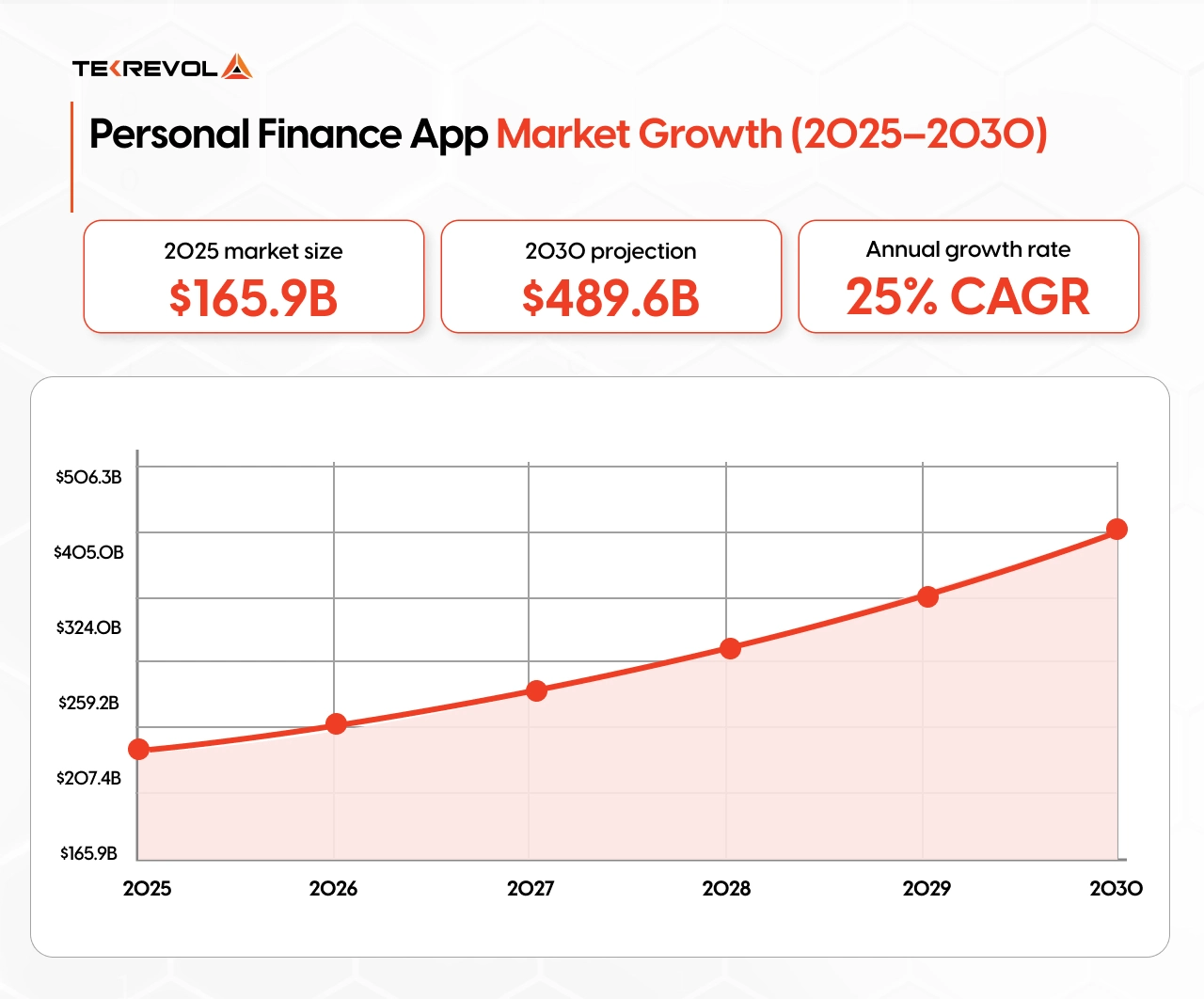
According to CoinLaw’s Personal Finance App Industry Statistics 2026, the market reached $165.9 billion in 2025 and is forecast to grow to $207 billion in 2026, a 25% year-over-year increase sustained through 2030. That growth is driven by demand for financial literacy tools and app-based banking, becoming the default for most consumer segments.
When Intuit shut down Mint in January 2024, millions of active users needed a replacement tool. Many moved to Monarch Money, YNAB, or Rocket Money. The market stayed fragmented. That gap creates a real opportunity. A focused use case, expense tracking for gig workers, debt payoff planning for younger borrowers, or a dedicated money management tool for families, can still carve out a defensible niche in 2026.
Personal Finance Is a $207 Billion Market with a Visible Gap and No Winner Yet
Map your product category, compliance tier, and build cost before you scope a single feature.
Book a Free Scoping Call with TekRevolTypes of Personal Finance Apps
Personal finance app development falls into four categories: budgeting and expense tracking, investment and portfolio tracking, credit and lending platforms, and financial aggregators.
Each type serves a different buyer need, requires a different compliance footprint, and carries a different build cost.
For most first-time builders, a budgeting app is the right MVP entry point over a lending platform. Because the compliance timeline alone adds 6 to 18 months before you can ship.
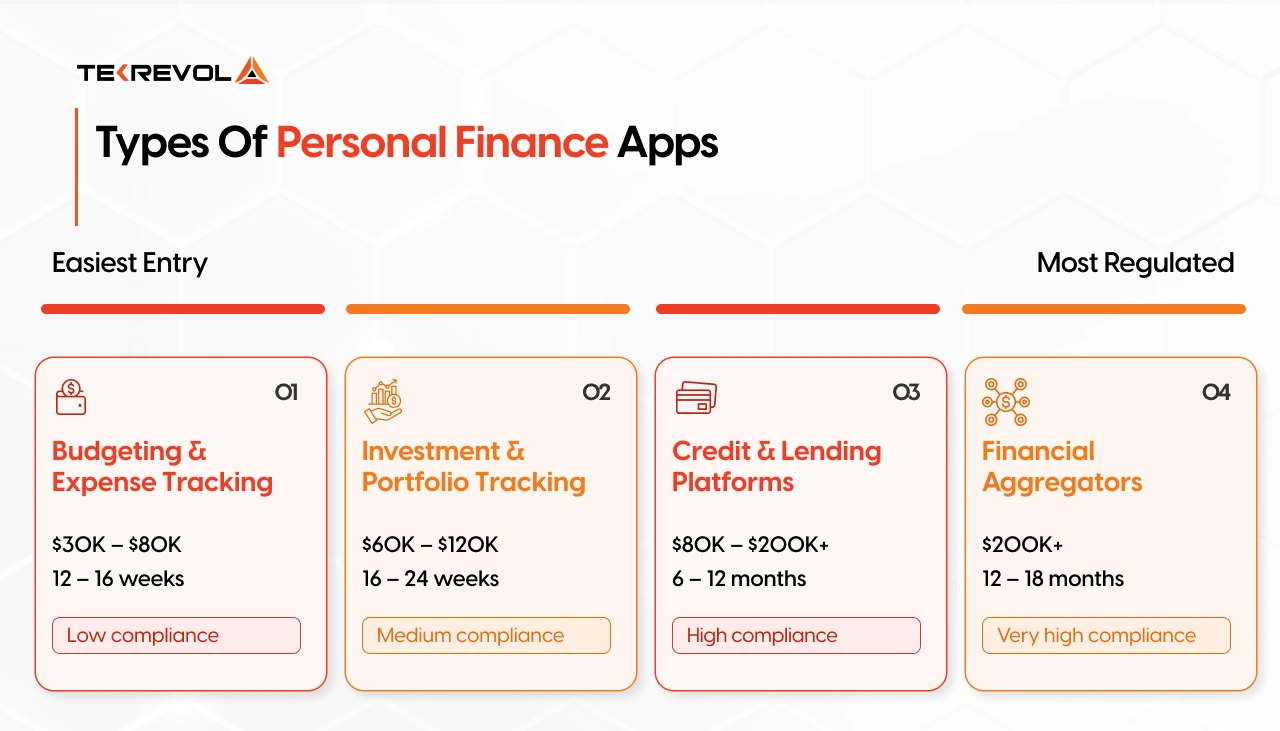
1. Budgeting & Expense Tracking
This model helps users track spending, set savings goals, and categorize transactions. It is the lowest-complexity entry point in budgeting app development. Secure Plaid integration handles automatic bank syncing while keeping your system clear of complex money-handling liabilities.
- MVP Cost: $30K – $80K
- Timeline: 12 – 16 weeks
- Compliance: Low (No lending licenses required)
2. Investment & Portfolio Tracking
This architecture connects to brokerage accounts and displays portfolio performance, dividend history, and tax-loss harvesting data. The best investment apps give users a consolidated view of their wealth across different asset classes.
- MVP Cost: $60K – $120K
- Timeline: 16 – 24 weeks
- Compliance: Medium (Requires read-only API access via Plaid or Yodlee)
3. Credit & Lending Platforms
These apps offer cash advances, credit building, or installment loans. They require custom automated underwriting engines to evaluate risk before providing users with short-term liquidity.
- MVP Cost: $80K – $200K+
- Timeline: 6 – 12 months
- Compliance: High (state-by-state lending licenses, KYC/AML workflows, and bank sponsors)
4. Financial Aggregators (Most Complex)
This framework combines budgeting, investment tracking, bill pay, and credit monitoring into a single interface. It serves as an all-in-one hub for a user’s entire financial life and is best suited for Phase 3 builds.
- MVP Cost: $200K+
- Timeline: 12 – 18 months
- Compliance: Very High (multiple API integrations and compliance layers)
How Much Does Personal Finance App Development Cost?
A custom personal finance app development project costs between $30,000 and $115,000. Feature complexity drives that range more than any other single variable, including team location, timeline, and compliance requirements.
The three build tiers and what each one gets you:
| Development Tier | Avg Cost Range | Production Timeline | Target Product Strategy |
| MVP Tracker | $30,000 – $50,000 | 12 – 16 Weeks | Manual entries, core analytics, no live bank sync |
| Market-Ready Platform | $50,000 – $80,000 | 16 – 24 Weeks | Automated data feeds, live bank link, custom notifications |
| Enterprise Fintech Suite | $80,000 – $115,000+ | 6 – 12 Months | Cash advances, automated underwriting, and full KYC workflows |
MVP Tracker Tier
This level focuses on launching a foundational product with minimal regulatory overhead. The system relies on manual transaction entry, custom category tagging, spending dashboards, and secure user profile authentication.
It functions as a secure, read-only analytical tool to test user acquisition before pursuing deeper financial integrations. A structured MVP development process maps these decisions before a single line of code is written.
Market-Ready Platform Tier
This tier introduces real-time automation through a Plaid API integration. The system pulls consumer transaction records, assigns algorithmic category tracking, sends proactive spending alerts, and calculates multi-account net worth metrics.
Engineering this tier requires building secure backend databases to process raw webhook payloads, alongside compliance documentation to satisfy data privacy requirements.
Enterprise Wellness Suite Tier
This tier covers cash advance eligibility logic, automated installment payback workflows, and state-by-state compliance configurations. Building it requires constructing a security environment that isolates personally identifiable information (PII) from underlying ledger data.
The cost difference between a $40K tracker and a $100K enterprise app development build lies in the depth of the security architecture and the compliance infrastructure required to operate legally.
When calculating your fintech app cost, map every regulated connection point and data layer required to launch legally in your target states.
What Drives Development Cost?
- Integration Complexity: Read-only bank aggregators like Plaid carry predictable integration costs. Adding micro-lending capabilities, payroll APIs, or direct credit bureau data streams increases developer hours and testing cycles.
- Compliance Frameworks: High-liability platforms require bank-grade security protocols, automated KYC/AML identity verification flows, and multi-state legal validation.
- Team Location & Engineering Model: Teams with deep fintech experience reduce the risk of costly code rewrites, structural data leaks, or rejected app store deployments.
Must-Have Features for a Personal Finance App (MVP vs Advanced vs Enterprise)
A personal finance app needs seven core features at launch: user authentication, account linking, transaction categorization, budget creation, spending summaries, push notifications, and basic settings.
Prioritize financial app features based on your product’s maturity. Launching a complex feature set all at once creates regulatory friction and risks stalling your rollout.
Structuring your product roadmap across clear engineering tiers lets you launch faster, validate user engagement, and scale compliance operations incrementally.
A. Core Features (Every App Needs These for MVP)
Your Phase 1 minimum viable product focuses on delivering high-fidelity data visibility and a secure user experience. These form the baseline of modern budgeting app development:
Bank Account Linking
Integrates secure data aggregators like the Plaid API. This establishes read-only bank pipelines, avoiding expensive in-house banking connections. Budget between $500 and $2,000 per month in third-party API fees as your active user base grows toward 1,000 users.
Transaction Categorization
Automatically parses incoming bank webhook payloads and sorts expenditures into searchable categories like groceries, transit, and utilities. Pre-built vendor categorization maps accelerate deployment.
Budget Creation & Progress Tracking
Allows users to set spending ceilings by category or time frame. Frontend accessibility built into this component turns a read-only dashboard into an active money management tool.
Push Notification System
Alerts users when they approach spending caps, when recurring deposits hit, or when balances drop below safety margins. These are also a prerequisite if you plan to add cash advance repayment options later.
Secure Authentication Stack
Deploys OAuth 2.0, two-factor authentication (2FA), and biometric login (FaceID/TouchID) to satisfy state regulations and pass financial compliance reviews.
B. Advanced Features (The Market-Ready Tier)
Once your core MVP has consistent user validation, Phase 2 introduces smart data capabilities and deeper personalization:
AI-Powered Budgeting & Insights
Uses machine learning to evaluate historical transaction trends and forecast cash-flow patterns. This requires months of live user data to train models effectively.
Subscription Detection & Bill Reminders
Scans incoming transaction logs for recurring merchant identifiers, maps active subscriptions, and displays an automated calendar of upcoming bill payments.
Live Credit Score Monitoring
Integrating direct APIs from major credit bureaus lets your platform display real-time credit score shifts and actionable tips on lowering debt utilization ratios.
Expert Tip
Building a lean Phase 1 architecture keeps core usability tight. Direct bill pay can add $30,000 to $60,000 in multi-state licensing and legal setup fees. Holding that for Phase 2 lets you launch on schedule and within budget.
C. Enterprise-Grade Features (High-Scale Financial Infrastructure)
For large corporate entities, business operators, or established platforms rolling out regional employee benefits:
Earned Wage Access (EWA) & Payroll APIs
Connects platforms to employer payroll networks like ADP via dedicated payroll APIs. This lets users access accumulated wages before their formal payday.
White-Label Infrastructure & Multi-Tenancy
Backend database models that securely isolate corporate client records, allowing the interface to be white-labeled and rebranded for different enterprise clients.
SOC 2 Type II Compliance Layer
Implements end-to-end payload encryption and database isolation to eliminate data leaks and clear institutional due diligence.
Client Case: Kinder Morgan
TekRevol has built compliance-heavy platforms for enterprise clients, including Kinder Morgan. These engagements required SOC 2 compliance, data governance, and phased delivery aligned with annual IT budget cycles. The same compliance layer that financial aggregators require from day one.
How to Build a Personal Finance App: Step-by-Step Process
Building a personal finance application with credit features is a phased process that starts with compliance architecture, not wireframes. Skipping that order often results in costly mid-build rewrites when a chosen financial API doesn’t support your underwriting rules or legal permissions.
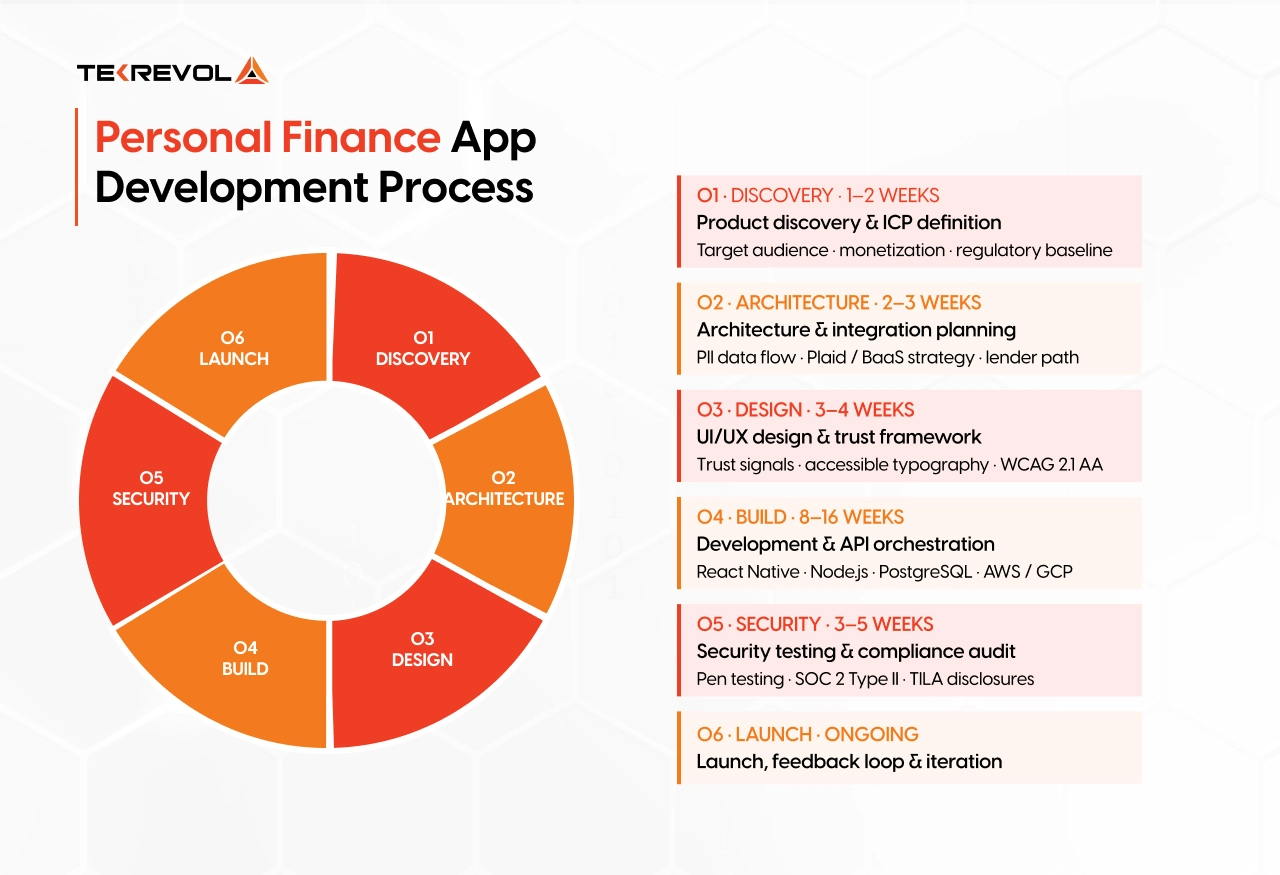
Step 1: Product Discovery & ICP Definition
- Define your exact target audience (e.g., gig workers needing instant liquidity vs. families managing joint expense trackers).
- Establish the monetization structure (subscriptions, transaction fees, or interest margins) to ensure backend data fields support your revenue logic.
- Map the regulatory baseline before scoping features to avoid compliance delays during app store reviews.
Step 2: Architecture & Integration Planning
- Map the complete end-to-end data flow to safely isolate personally identifiable information (PII) from underlying financial ledger records.
- Execute a bank API integration strategy, selecting a read-only financial data aggregator like Plaid.
- Finalize your Banking-as-a-Service (BaaS) or lender-of-record integration paths early. Third-party onboarding typically spans 30 to 90 days.
Step 3: UI/UX Design & Trust Framework
- Design interfaces with explicit trust signals, including clear privacy badge placements and visible security messaging.
- Apply accessible typography to reduce user anxiety during the bank-credential authentication process.
- Build WCAG 2.1 AA accessibility compliance into your component stylesheets from day one.
Step 4: Development & API Orchestration
- Deploy React Native or Flutter for cross-platform efficiency, backed by a Node.js or Python API engine and a PostgreSQL database layer hosted within AWS or Google Cloud.
- Build core financial features in phases, starting with read-only transaction feeds before adding fund routing.
- Implement strict data-logging systems to maintain immutable audit trails for every API request and system state change.
Step 5: Security Testing & Compliance Audit
- Retain an independent, certified third-party cybersecurity firm to perform vulnerability scanning and penetration testing across your API endpoints.
- Verify that your server configurations and data-handling structures align with SOC 2 Type II data safety baselines.
- Validate all consumer disclosures against federal TILA guidelines before activating credit-access features.
Step 6: Launch, Feedback Loop & Iteration
- Deploy your MVP to a controlled initial cohort of 50 to 200 users to monitor onboarding behavior and isolate dropout bottlenecks.
- Integrate product analytics (Mixpanel or Amplitude) to measure daily feature usage and track retention.
- Build a modular product roadmap so Phase 2 enhancements expand on the existing backend rather than requiring structural rewrites.
Executing these fintech app development steps positions you to clear regulatory scrutiny and scale without surprises. Verifying compliance baselines during discovery keeps your budget predictable and protects your system from critical vulnerabilities.
The Compliance Stack: Which Regulations Actually Apply to Your App?
The regulations that apply depend on one thing: what your app does with money. A budgeting app that stores PII has different obligations than a cash advance platform that moves money. The table below maps each app type to the regulations that apply.
| App Category | Primary Data Ingested | Applicable Legal & Security Regulations | Required Verification Layers |
| Read-Only Budgeting | Transactional payloads, linked balances, and user emails. | GLBA, CCPA, SOC 2 Type II data frameworks | Basic Auth, OAuth 2.0 bank link |
| Credit Monitoring | SSNs, credit bureau lines, and credit utilization histories | FCRA, GLBA, and data privacy guidelines | Multi-factor verification (2FA) |
| Cash Advance / EWA | Banking rails, payroll data, routing, and account numbers. | CFPB rules, TILA, State Usury laws, USA PATRIOT Act | Full KYC/AML identity screening |
PCI DSS Compliance for a Budgeting App
A read-only budgeting app does not require full backend PCI DSS Level 1 infrastructure compliance if it uses a secure data aggregator like Plaid to sync accounts. Because the platform processes read-only data and never ingests, transmits, or stores raw credit card numbers or banking passwords, it remains outside the scope of a cardholder data environment (CDE) audit.
Implementing a PCI DSS-compliant mobile app design standard is still best practice. Access tokens should be encrypted, PII should be kept isolated from transaction tables, and all data should move over HTTPS with TLS 1.3 encryption.
CFPB, State Lending Laws, and Cash Advance Apps
Moving from reading data to managing active credit triggers, CFPB fintech regulations. Under federal guidelines, any platform offering short-term liquidity, cash advances, or Buy Now Pay Later (BNPL) features must comply with the Truth in Lending Act (TILA) by displaying APR percentages and payback intervals on every offer screen.
The USA PATRIOT Act mandates Know Your Customer (KYC) and Anti-Money Laundering (AML) identity validation via FinCEN. Implementing automated KYC screening with verification APIs typically costs between $3,000 and $8,000 annually in software fees.
GDPR, CCPA, and Data Security for Global Apps
The Gramm-Leach-Bliley Act (GLBA) requires all financial applications operating in the United States to secure PII through technical safeguards, including AES-256 data encryption at rest and strict tokenization profiles.
- CCPA (California Consumer Privacy Act): Grants US users the right to opt out of data sharing, review collected data, and request permanent deletion of their account history.
- GDPR (General Data Protection Regulation): Applies if your platform allows downloads by EU residents, regardless of where your company is based. GDPR mandates explicit data consent, immediate data portability, and 72-hour breach notification protocols.
Building these data security layers typically requires 60 to 100 hours of specialized backend development.
Cash Advance vs Lending Features: What Changes When You Add Credit
The moment you introduce a cash advance feature, you cross from building a read-only consumer tracking tool to operating a regulated financial product. That single architectural decision changes your compliance obligations, feature footprint, vendor relationships, and development costs.
Regulatory Compliance
Cash advance features trigger federal consumer credit regulations enforced by the CFPB:
- TILA (Truth in Lending Act): Requires upfront APR disclosures and repayment terms on every offer screen.
- ECOA (Equal Credit Opportunity Act): Mandates non-discriminatory algorithmic underwriting and automated adverse action notices for rejections.
- FCRA (Fair Credit Reporting Act): Controls how user credit profiles are pulled, processed, and secured.
- State Usury Laws: Mandates adherence to regional interest caps, which range from 36% APR caps to higher payday-style allowances.
The Sponsor-Bank Model
Operating as the direct lender of record requires individual state lending licenses. Costs range from $50,000 to $200,000 or more, with a 6 to 18-month clearing window per the Conference of State Bank Supervisors (CSBS) 50-State Survey.
To bypass this, most fintechs use a sponsor-bank model. Your application acts as the technology service provider, while a chartered bank partner acts as the lender of record. The sponsor-bank choice is one of several structural decisions covered in depth when comparing fintech app development models.
Architectural Infrastructure
Transitioning to a lending model requires engineering three advanced automated infrastructures:
- Underwriting Engines: Backend scripts that ingest real-time banking data to evaluate income stability and cash burn.
- Alternative Scoring APIs: Integrations with aggregators like Plaid to assess thin-file borrowers.
- Multi-Rail Fund Movement: Real-Time Payment (RTP) or Same-Day ACH to disburse funds and automate scheduled repayments.
Accounting for this credit architecture during Phase 1 avoids expensive backend rewrites later.
Fintech App Monetization Models That Work (The Post-Mint Playbook)
Mint’s shutdown confirmed that the freemium-plus-ads model doesn’t hold in fintech. To build a sustainable platform, your monetization structure needs to be built into the core architecture from day one.
| Monetization Model | Targeted ICP / Strategy | Margin Potential | Structural & Compliance Dependency |
| Subscription Tiers | Consumer-facing products | High | Requires high-engagement core utility; low legal overhead |
| Premium Feature Unlocks | Founders validating product-market fit | Medium to High | Requires separate integration layers (e.g., cash advance tools, credit APIs) |
| B2B2C / Employer Wellness | Enterprise platforms selling to corporate HR departments. | Very High | Demands enterprise-grade sales cycles and SOC 2 Type II data isolation |
| Anonymized Data Licensing | High-scale platforms with large data networks. | High (At Scale) | Requires explicit user consent mechanisms and state data broker licenses |
1. Subscription Tiers (Highest Retention)
Charging a monthly or annual fee (YNAB charges $14.99/month) filters out low-engagement users and creates predictable revenue. Paid users demonstrate higher app engagement because they have a direct financial stake in using the product. This model keeps your platform clear of ad networks and aligns your revenue directly with helping users manage their money.
2. Premium Feature Unlocks
Keep your foundational budgeting and balance dashboard free, but place high-liability features behind a premium tier (e.g., $4.99/month). Users pay when they choose to access capabilities like immediate cash advances, live brokerage syncing, or real-time credit monitoring.
3. B2B2C / Employer-Sponsored Wellness
Market your application directly to corporations as an employee financial wellness benefit. Companies pay a recurring $3 to $8 per employee per month (PEPM) fee. This involves longer 6-to-12-month corporate sales cycles, but delivers high contract values and low user-acquisition costs.
4. Data Licensing
This involves aggregating and selling fully anonymized consumer transaction data to market research firms, institutional investors, or retail brands. Data licensing requires significant scale (500K+ active users) and a strong compliance framework, including explicit user opt-in workflows and state-level data broker registrations.
Most modern platforms deploy a hybrid approach: a free onboarding experience paired with a mandatory subscription trial, alongside premium add-ons for credit or wealth tools. Designing a clear personal finance app monetization structure before writing code ensures your revenue model is built into the product architecture, not bolted on afterward.
Post-Launch Operations: Monitoring, Compliance, and Expansion
Operating a personal finance app requires continuous adaptation after deployment.
Regulators like the CFPB modify consumer lending guidelines on a rolling basis, while state-level usury rules adjust alongside local legislative cycles. Your terms of service, backend data schemas, and loan disclosure layouts must track these updates immediately. Staying updated is part of what structured post-launch app support covers for fintech products.
Post-Launch Support Layers
Fintech maintenance requires a three-tiered operational framework:
- Regulatory Monitoring: Quarterly technical reviews of federal credit directives, state interest caps, and app store updates.
- Technical Maintenance: Continuous server patch deployment, third-party banking aggregator API migrations (e.g., Plaid endpoint updates), and iOS/Android compatibility tracking.
- User Feedback Loops: Systems that capture user input to populate your product backlog for Phase 2 feature prioritization.
Phase 2 Expansion & SLAs
Phase 2 maximizes user retention and lifetime value by introducing high-engagement utilities. Because your core authentication, database routing, and primary banking APIs are already active, adding advanced features is an expansion, not a rebuild. Common Phase 2 additions include bill negotiation protocols, credit profile monitoring, and custom expense tagging.
To prioritize these features, use a frequency-weighted impact formula:
Enterprise SLAs typically mandate 99.5% core API uptime, 4-hour remediation windows for critical security incidents, and quarterly infrastructure reviews.
App marketplaces remove non-compliant apps without advance notice. Budgeting fixed annual reserves for policy-driven technical patches keeps your production code on store shelves.
Partner with TekRevol For Personal Finance App Development
Finance products have a different failure mode than standard SaaS. A bug in expense tracking frustrates users. A bug in cash advance logic triggers CFPB scrutiny. The engineering decisions are categorically different, and so is the cost of getting them wrong.
As an experienced mobile app development company, TekRevol has built consumer finance platforms, business lending tools, and payment infrastructure. Our fintech builds span underwriting integration, compliance-ready architecture, and cash advance logic for both consumer and B2B use cases.
We structure every engagement to lower operational risk and keep your budget predictable. A free 30-minute fintech scoping session maps your product against what it actually needs to ship. You leave with:
- A phased technical delivery roadmap aligned with your business milestones.
- A compliance checklist tailored to your target states and feature set.
- A cost breakdown that factors in third-party API vendor fees, not just development hours.
Ready to Scope Your Personal Finance App?
We map your features, compliance footprint, and development costs in a single session.
Book Your Free Project Scoping Session


![SaaS App Development Company in Austin: Cost, Vetting & Build Strategy [2026]](https://d3r5yd0374231.cloudfront.net/images-tek/uploads/2026/07/SaaS-app-development-in-Austin-featured-image-400x211.webp)


