The mobile gaming industry has reached a point where building a great game is only half the battle. As 500,000 apps fight for a tiny slice of the share, mobile game marketing strategies become the primary bottleneck for game growth rather than technical development.
Organic luck or viral magic donot gurantee mobile game success anymore. You need a plan that balances focusing on player acquisition and retention simultaneously for aggressive growth with steady monetization.
This guide moves beyond basic tactics to break down the most effective mobile game marketing strategies to help you scale your title sustainably. Drawing insights commonly used by a successful mobile game development company, we’ll also explore the key metrics and emerging trends that will shape the mobile gaming market in 2026. So, let’s hop on!
What Is Mobile Game Marketing?
Mobile game marketing is the process of attracting new users and keeping them engaged through targeted digital strategies. It covers the entire player journey from the first ad impression to long-term monetization.
Unlike static products, mobile gamers require a constant flow of new content and social validation to survive. Thats why, where an expert digital marketing agency might prioritize functionality, a game marketer prioritizes the “fun” factor.
The mobile gaming industry is built on rapid loops of action and reward. Therefore, mobile game promotion is not just about getting a download. It is about player acquisition that targets users who are likely to spend time and money. The success of game marketing strategies is measured by how well you convert a stranger into a loyal fan who plays every day.
How Mobile Game Marketing Differ from General Mobile App Marketing
There is a significant gap between general mobile app marketing and game-specific growth. Standard apps usually solve a specific problem or provide a utility. Users download a banking app to manage money or a fitness app to track runs. The goal is efficiency and speed.
Whereas mobile game marketing focuses on the sale of an experience. As gamers have different motivations than users of productivity or finance apps. Marketing for games relies heavily on emotional triggers like competition and curiosity.
The technical requirements also differ greatly. Games require massive asset testing to see which characters or colors drive clicks. You also deal with much higher churn rates in the gaming sector. So, your game marketing strategy must prioritize player acquisition and retention more aggressively than a typical utility app.
Fear of losing potential players?
Scale your mobile game marketing ROI with Tekrevol’s growth experts.
Get Your Custom PlanHow Does Mobile Game Marketing Work?
Mobile game marketing strategies work as an integrated system that tests player interest before a full global release. It relies on a feedback loop between creative assets and performance data to lower costs. It begins with identifying the core audience and ends with long-term retention through growth loops. This system ensures that every dollar spent on mobile game user acquisition eventually returns a profit.
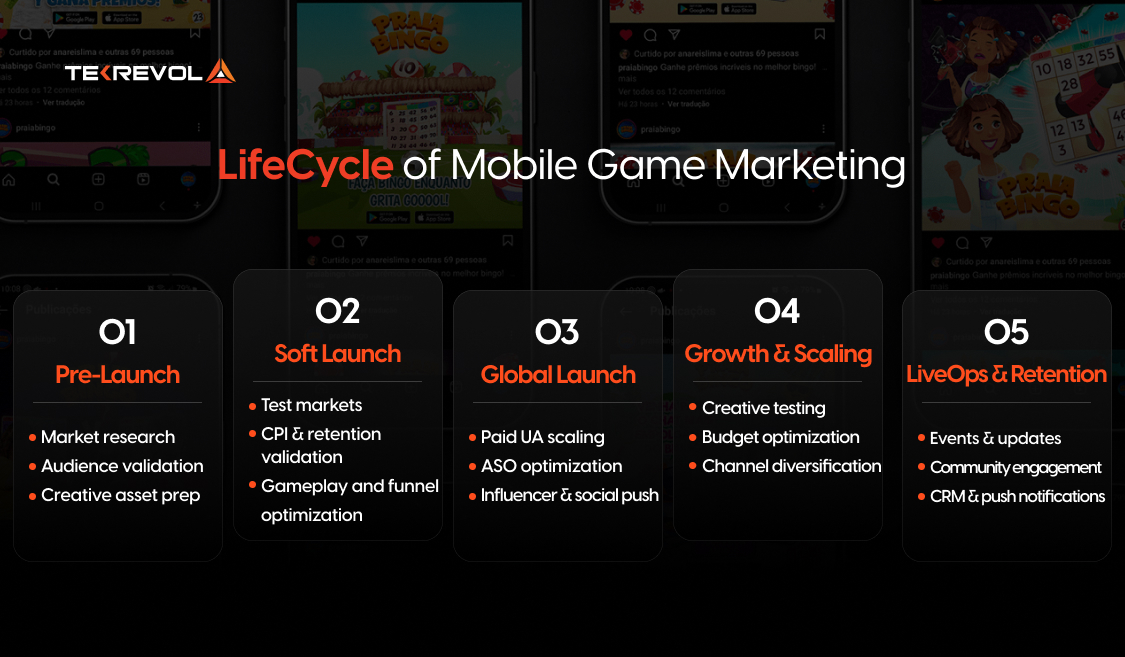
Pre-launch marketing
A successful go-to-market strategy begins months before the code is actually finalized. You coordinate with social media marketing services to build a presence on social platforms and landing pages.
The primary goal here is to secure pre-registrations on the App Store and Google Play. These sign-ups act as massive signals to store algorithms that your game has high demand.
Soft launch testing
The soft launch mobile games phase is where you validate your core business assumptions. You release the game in specific, smaller markets like Canada or the Philippines to gather real-world data at a lower cost.
During this stage, you focus on technical stability and Day-1 retention. If players leave the game immediately, you fix the tutorial or the first ten minutes of gameplay. You also test different mobile game marketing plans to find your baseline cost per install. This prevents you from wasting a massive budget on a game that is not yet ready to scale.
Global launch
Once your metrics are stable, you execute a coordinated game launch strategy across all major regions. Here, you increase your budget for mobile game advertising strategies to flood the charts and gain organic momentum. You coordinate paid ads, influencer partnerships, and PR pushes to hit at the same moment. The objective is to achieve high download velocity.
High velocity pushes your game into the “Top Free” charts, which generates thousands of free organic installs. This is the most volatile part of the process and requires constant monitoring of ad spend.
Live operations & scaling
Marketing does not stop once the game is live. The live operations phase is about managing the game as a service. You use growth loops and in-game events to keep the community active. This includes launching seasonal updates and limited-time offers that provide fresh reasons for players to return.
Scaling occurs when your return on ad spend is consistently positive. You reinvest profits back into player acquisition to reach wider audiences. This phase is where the most successful games find their long-term stability and profitability.
A Quick Glance at the US Mobile Gaming Market
The USA mobile gaming market is one of the most competitive and lucrative regions in the world. Sensor Tower reports that in 2024, the US led the world in consumer spending on mobile games, reaching a staggering $52 billion in IAP revenue alone. This stat alone justifies why the US is a primary target for any mobile game marketing campaign.
Player behavior
US mobile gamers prefer high-quality graphics and deep social integration. They also exhibit significant player spending behavior, with the average gamer in North America investing approximately $325 annually in 2025, according to NewZoo. They value games that respect their time and offer clear progression.
Genre performance
Casual and mid-core titles currently dominate the revenue charts in the United States. Hyper casual games still drive high volumes but face challenges with rising costs. Whereas, high-fidelity gaming sees a surge on high-end devices. Check our latest mobile game revenue statistics to see which genres are growing fastest this year.
Ad saturation & CPI realities
The average CPI USA is significantly higher than in any other territory due to intense saturation. Market fragmentation makes it harder to reach everyone through a single channel. You are competing for attention against Netflix and TikTok as much as other games.
Effective regional game marketing requires creative testing to avoid creative fatigue. With the US seeing the highest rewarded ad eCPM, roughly $13.18 on iOS as per Statista, marketers must focus on high-quality player acquisition that prioritizes lifetime value (LTV) over simple download counts.
Only those who master data-driven attribution can successfully navigate the market fragmentation seen in the US today.
6 Best Mobile Game Marketing Strategies
The best mobile game marketing strategies combine technical optimization with creative storytelling to drive growth. You must balance paid vs organic acquisition to maintain a healthy profit margin.
Learning how to promote mobile games effectively involves mastering several different channels at once. A comprehensive growth strategy for mobile games integrates the following 6 pillars.
1. Paid User Acquisition
Mobile game user acquisition is the process of buying installs through ad networks like Meta and Google. In the mobile game marketing strategies, it acts as the primary engine for scaling a game quickly in a crowded market. You need a data-driven mobile game marketing plan to manage these costs effectively.
Paid user acquisition is no longer about just picking keywords; it is about feeding the algorithm the right creative data.
- Ad networks & platforms: Spread your budget across TikTok and Google AC to reach different demographics.
- Creative testing frameworks: Run multiple versions of mobile game ads to see which ones get the lowest cost.
- Budget scaling logic: Use CPI optimization to ensure you do not overspend on low-value players.
Using Facebook game ads often yields the highest engagement rates. You should constantly rotate new videos and playable ads to see which versions drive the lowest costs. Also, look at how your players generate ad revenue in mobile games to balance your acquisition cost and ensure profitability.
2. App Store Optimization (ASO)
App store optimization for games involves improving your store page to rank higher in search results. It is the foundation of the best mobile strategy games because it drives free organic traffic generated by social media ads. Weak ASO means significantly expensive paid ads. Let’s look at what ASO includes:
- Keyword optimization is the foundation of ASO. Research the terms your players use and include them in your title and description. This directly affects your app store ranking and visibility.
- Visual assets like high-contrast screenshots and a compelling icon can improve your app store ranking. These elements immediately communicate the “fun” and quality of the game.
- Conversion rate optimization: Test different video trailers to see which one converts visitors into players. A high CRO on your store page means you get more value from every person who clicks your ad.
- Ratings & reviews: Google and Apple prioritize games that maintain high player satisfaction scores. Encourage happy players to leave reviews at key moments of joy in the game to boost your social proof and organic reach.
Just as SEO services help websites rank on Google, ASO ensures your game is discoverable on mobile marketplaces.
3. Influencer Marketing
Influencer marketing for games builds trust and excitement by showing real people enjoying your title.
When a Twitch creator features your title, they aren’t just “showing gameplay”; they’re validating your game to a live community that hates traditional ads. Meanwhile, YouTube gameplay videos provide long-term search traffic as players look for tips and walkthroughs. When players get stuck, they search for walkthroughs. If a trusted creator is the one showing them the ropes, your conversion rate skyrockets.
Pro-tips for actual results:
- Target “Micro” Experts: Don’t chase the biggest names. Find micro-influencers who live in your specific niche (like “deck-building roguelikes”). Their audience is smaller, but they actually listen to recommendations.
- Build a Discord Homebase: Don’t let that traffic vanish. Create a dedicated Discord where influencers can hang out with your “hardcore” fans. It turns a one-time video into a self-sustaining community.
4. Advanced Ad Creatives
Quality ad creatives for mobile games are the most important lever in performance marketing today. Try these mobile game marketing tips to combat creative fatigue and refresh your assets easily every few weeks.
Capitalize UGC (User Generated Content) featuring real people playing your game for a more authentic feel. You can also create fast-paced clips that show the core fun loop to capture attention in crowded feeds. Both UGC game ads and high-quality video ads perform better than polished cinematic trailers because they sound more authentic to the user.
Testing playable ad formats is essential for interactive genres. These allow potential players to try a snippet of the gameplay before they ever hit the download button. Your creatives should always highlight the most fun parts for successful mobile game monetization because they attract players who are more likely to engage with in-game purchases.
5. Events and Live-Ops Marketing
If you launch a game and walk away, you’re already dead in the water. A modern live ops strategy is the only thing standing between a “one-hit wonder” and a multi-year revenue stream. Treat your game as a service that requires a constant pulse of fresh content to keep the audience from drifting toward a competitor.
- The Retention Reality Check: Forget total downloads for a second. Your Day-1 and Day-7 retention metrics are the real truth-tellers. If your D7 is sliding, your player retention strategy is failing, and no amount of paid ads will save you.
- Events as Adrenaline Shots: Don’t just do “holiday themes.” Use in-game events and limited-time tournaments to create a “fear of missing out” (FOMO).
- The War on Churn: Effective churn reduction is a feedback loop. Use your marketing to find out exactly where players hit a wall, then deploy a live event or a content drop to break that barrier.
By keeping the experience “always-on,” you turn casual players into a hardcore community that feels invested in the game’s evolution.
6. Community and Social Media Marketing
Social media marketing builds a loyal fanbase that promotes your game for you. Platforms like Discord communities allow for direct communication with your most loyal players.
You can use these channels to advertise your mobile games and gather feedback. Many digital marketing agencies use social media marketing to manage their presence across multiple platforms. This approach expands your reach beyond paid user acquisition and fosters long-term loyalty.
The Strategy for 2026:
- Ditch the Script: When you advertise your mobile games on social, talk with the community, not at them. Admit when a bug exists and show the fix. That transparency builds more “brand equity” than a million-dollar trailer.
- Creator Synergy: Don’t just pay gaming content creators for a post. Invite them into your Discord. Let them leak a teaser. When a creator feels like an insider, their audience follows suit, and your “installs” turn into “loyalists.”
Generic strategies stall growth
Execute data-backed mobile game marketing with Tekrevol to dominate the charts.
Book Free ConsultationMobile Game Marketing KPIs For Performance Measurement
High-level marketing is just data science with a budget. Before you plan to monetize a game, it’s imperative to define marketing KPIs against which you can measure the success of your campaigns and make data-driven decisions. You can also use mobile game analytics to track how players interact with your game.
Common Performance Metrics
Below are the essential metrics that determine whether a game is a hobby or a scalable business.
- CPI (Cost Per Install): The entry fee you pay to acquire one new user.
- LTV (Lifetime Value): The total projected revenue a single player generates through in-app purchases and ad revenue in mobile games.
- ROAS (Return on Ad Spend): Your profitability pulse. It measures revenue earned for Retention: The percentage of players who return to the game after a specific period. This is the ultimate indicator of “fun” and product-market fit.
- ARPU (Average Revenue Per User): The total revenue divided by the number of active users, helping you understand the monetization efficiency of your player base.
Advanced Measurement Models
Don’t just look at players as a single mass; use cohort analysis to track users based on their “birth date” in the game. If your Day-30 retention for a specific group is tanking, you don’t have a marketing problem but a content gap or a technical bug that’s killing your momentum.
In the post-IDFA world, attribution models have become the ultimate puzzle. Since you can’t track every individual move with 100% certainty anymore, rely on “Last-Touch” or “Time-Decay” models to understand which creative actually triggered the intent. This isn’t just about counting clicks; it’s about ensuring your performance marketing spend is tied to high-value actions, from that first impression to the final in-app purchase.
Mobile Game Marketing Mistakes To Avoid
Many failed game launches happen because developers ignore the data or scale too quickly. Avoid these common online game marketing mistakes to protect your budget. Even a great game cannot survive a poorly managed budget.
- User acquisition pitfalls: Spending your entire budget on one channel without testing others first. Once the audience stops clicking, your CPI will spike, and your campaign will fail.
- Scaling too early: If you increase your daily spend before your Day-7 retention is stable, you are essentially pouring water into a leaky bucket.
- Ignoring ASO: Paying for traffic while having a store page that looks unprofessional or confusing.
- Creative fatigue: Failing to refresh your ad assets, leading to a steady decline in performance.
- Ignoring the data is the final error. Many marketers make decisions based on gut feelings instead of mobile game analytics.
Successful online game marketing requires the humility to pivot when the numbers don’t match your expectations. Avoid these errors to give your game a real chance at long-term survival.
Mobile Game Marketing Trends for 2026
The future of mobile gaming is being shaped by artificial intelligence and stricter data regulations. Staying ahead of these mobile gaming trends will give you a significant advantage.
AI in Game Marketing
AI-generated creatives will allow for hyper-personalized ads at a massive scale. This will help marketers combat market fragmentation and rising production costs. By the end of 2026, experts predict that over 50% of ad creatives will be either AI-assisted or fully AI-generated.
Privacy-first Advertising
With the decline of third-party cookies and increased restrictions on IDFA, privacy-first advertising is the new standard. Game marketing strategies must align with promoting game apps that pay real money to the audience without relying on individual user data.
Community-led Growth
As organic discovery becomes harder, top game development studios are now incentivizing their communities on Reddit and Discord to drive demand. This “human-in-the-loop” approach ensures that marketing feels like an organic recommendation rather than an interruption.
Hybrid Discovery
Hybrid discovery will combine traditional store search with programmatic buying across a DSP (Demand Side Platform) and non-gaming apps. Marketers can find high-intent players in news or social apps and bring them into the game ecosystem. This reduces dependence on a single platform’s algorithm and spreads risk across the entire app economy.
Final Thoughts
A holistic mobile game marketing balance creative intuition with rigorous data analysis. You must treat your marketing as a product that needs constant updates and optimizations. As the app economy evolves, the victory belongs to those who prioritize player acquisition and retention through a privacy-first marketing lens.
As a professional game app development company, TekRevol ensures your unique game vision drives the results through better mobile game advertising strategies. By integrating mobile game ASO with an advanced live ops strategy, we create a sustainable engine for growth.
Don’t leave growth to chance
Scale your mobile game marketing with Tekrevol and turn players into profit.
Schedule Your Call