In 2026, hyper-personalization and real-time connectivity are making traditional apps feel like ancient history. At the same time, local startups and established giants in Houston now demand mobile innovation that integrates AI apps with emerging tech like spatial computing. As a result, app development trends here do not just follow the West Coast; they set the standard for high-stakes, data-heavy industries.
Houston is no longer just a city of oil and medicine. Today, it is a global engine for industrial and clinical software. Driven by the rapid growth at The Ion, the expansion of the Texas Medical Center (TMC) Innovation Factory, and the ongoing digital overhaul of the Port of Houston, the city has created a truly unique innovation environment.
As a result, successful apps this year require mobile app developers in Houston to move beyond basic 5G-powered utility. Instead, you are building solutions for a workforce that operates in the Energy Corridor and for logistics coordinators working along Hobby Airport flight paths.
With this mind shift, this guide details the latest app development trends and high-performance strategies you need to win the Houston market in 2026.
Core App Development Trends Shaping Houston Tech in 2026
App development trends 2026 center on AI-native architectures and 5G-optimized connectivity to serve Houston’s heavy industries. They enable businesses to move from reactive services to predictive, real-time experiences. Infact predictive analytics is now the standard for any data-heavy application in Houston.
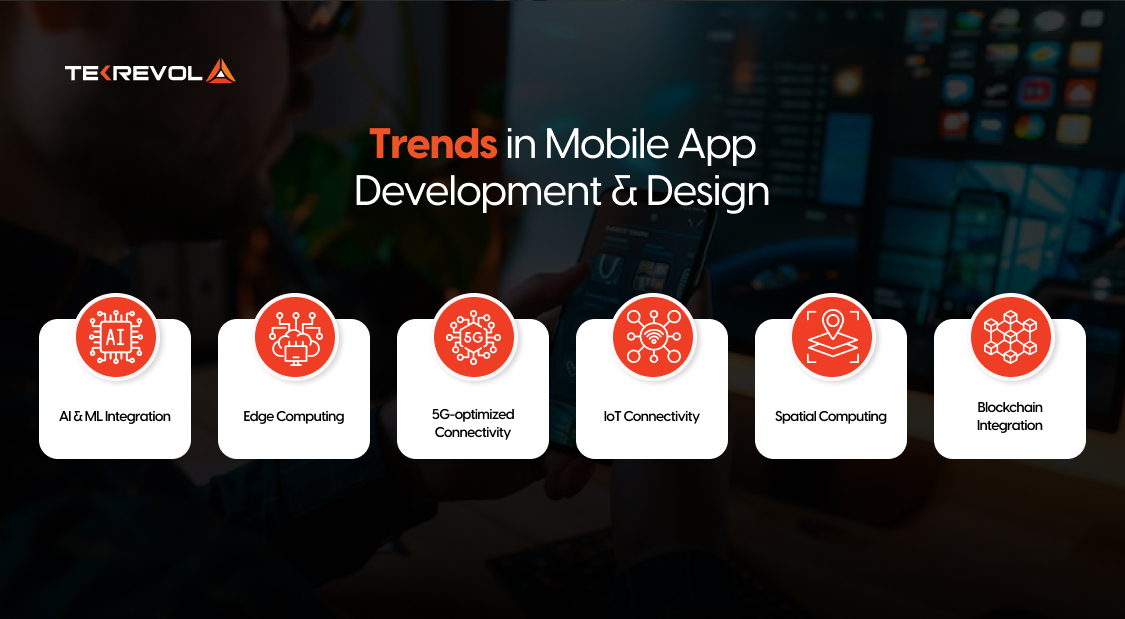
AI & Machine Learning Integration
The biggest change this year is that AI has moved from the ‘nice-to-have’ feature list directly into the app’s core infrastructure. Instead of being an afterthought, it now serves as the engine for everything from real-time data predictions to hyper-personalized user experiences.
A logistics app does not use AI just to show a map. It recalculates routes based on real-time vessel traffic at the Port of Houston. Local AI development services now focus on multi-AI agents that talk to each other.
For an energy firm, one agent might monitor sensor data while another automatically schedules a repair crew. This multi-AI agent system removes the “middleman” lag that usually slows down industrial operations.
IoT Connectivity
According to IoT Analytics, cellular IoT subscriptions are forecast to reach 5 billion globally by 2030. IoT and connected apps link mobile interfaces directly to physical assets like healthcare monitoring wearables and smart home systems. The tech reduces latency so that critical alerts reach users instantly.
On the other hand, Edge computing ensures your app responds instantly even when the cloud is congested. Developers prioritize secure APIs to handle the influx of data from industrial IoT sensors. See how cloud app development company strategies help you shift toward these “thin-client” models where the app is just a window into a vast, connected physical world.
Augmented & Virtual Reality (AR/VR)
By 2026, AR/VR app development trends have moved beyond gaming. Instead, they now revolve around spatial computing and immersive apps that bridge digital and physical worlds for modern technical training and complex assembly in manufacturing plants.
AR & VR tech support businesses by improving efficiency. Technicians at NASA now use spatial computing to see digital overlays on physical machinery, which reduces human error during complex repairs. We also see AR/VR apps used for virtual retail try-ons in the Galleria.
5G-Optimized Applications
5G becomes the backbone of real-time mobile experiences because it offers the ultra-low latency required for high-stakes tasks. Such ultra-fast app connectivity powers cloud gaming and complex IoT data syncing without a hitch.
Local logistics firms rely on 5G mobile apps to coordinate autonomous delivery fleets across the metro area. Without the high throughput of 5G, many of these real-time innovations would simply stall under the weight of massive data.
Blockchain Integration
Blockchain app development trends are attentive for secure transactions and managing decentralized apps in the growing Downtown fintech scene. By using distributed ledgers, the blockchain app development company ensures that sensitive data in supply chains remains tamper-proof and transparent.
This technology is no longer just for crypto but serves as a foundational layer for trust in enterprise software. It provides an unchangeable audit trail that is vital for Houston’s heavily regulated industries and financial services.
Cross-Platform Development
Native-only development is becoming a rarity. Most businesses now prefer cross-platform app development services to launch on iOS and Android simultaneously. By leveraging Flutter or React Native, businesses can sync their iOS and Android launches and still offer a top-tier feel for the latest foldable tech. These hybrid apps are the ultimate equalizer for startups. They provide that ‘big tech’ consistency and quality across all devices, but at a fraction of the traditional price tag.”
Don't let your business fall behind
TekRevol aligns your business with 2026 app development trends for maximum impact.
Claim Your Free Strategy2026 Trends in App Development & Design
Modern app development trends prioritize how users feel about their data secrecy in every interaction. As a result, we are moving away from “pretty” interfaces toward functional, accessible, and ultra-secure experiences. Consequently, developers now focus on zero-trust security and inclusive designs for secure and better performance.
Data Privacy & Security
App security in Houston now demands end-to-end encryption and a zero-trust security model to protect user information. Biometric authentication and multi-factor layers are now basic expectations for any professional mobile app development company.
Similarly, for medical platforms, HIPAA-compliant apps are mandatory to ensure patient privacy. Many local firms also follow GDPR Houston standards to remain compatible with global regulations.
Every line of code now undergoes rigorous automated testing to prevent data leaks. This focus on privacy builds trust and protects businesses from data breaches.
Low-Code / No-Code Platforms
Low-code tools are democratizing software creation, as LMS developers can easily build functional prototypes in days using AI. This rapid app development approach helps small businesses automate internal workflows without needing a massive engineering team. It bridges the gap between a business idea and a working product while keeping costs manageable for early-stage ventures. These platforms have matured enough to handle enterprise-grade logic and complex database integrations.
Composable Architectures
Flexible app systems replace rigid monoliths with a microservices architecture that supports modular updates and scaling. It is one of the huge app development trends for Houston enterprises because they can swap out features without breaking the entire system. Such app support services provide the agility needed to stay competitive in an era where technology changes every few months.
Smart & Inclusive UX/UI
Inclusive design makes mobile apps accessible to everyone through gesture-based UX and touchless interfaces. Immersive UI now adapts to foldable screens and spatial environments, providing a seamless experience regardless of the hardware.
Motion design is no longer just for flair but guides the user through complex tasks with intuitive visual cues. Inclusive practices also mean optimizing for screen readers and varied motor abilities to reach the diverse demographic effectively.
Trending App Features for Houston’s Key Industries
Houston’s primary sectors are adopting specific app development trends to solve unique local challenges. The energy sector needs Edge AI, whereas healthcare works on Telehealth 2.0, and Retail needs Visual Search. These specialized features help local businesses maintain their leadership in global markets.
Add Image
Energy
Energy and industrial app development trends in Houston 2026 centre edge AI and industrial IoT to monitor remote assets.
StartUs Insights highlights that AI in the energy sector is growing at an annual rate of 16.86%, as companies shift from pilots to “execution at scale.” Smart rigs now utilize edge AI to process data on-site, which enables predictive maintenance in remote locations.
Field workers use AR field apps to access 3D blueprints and live support while standing in the middle of a refinery. These industrial IoT solutions keep the energy infrastructure running safely and profitably around the clock.
Healthcare
Healthcare app development 2026 focuses on telemedicine and wearable apps that sync with hospital systems. As per Fortune Business, the global digital health market is valued at $491.62 billion in 2026, with the US accounting for $179.78 billion of that total.
Surgeons even use AR for surgical planning for real-time vitals and AI-driven diagnostic suggestions. Patients also benefit from remote monitoring via IoT. Professional healthcare app development services are mainly concerned with HIPAA compliance for maintaining data security. This connectivity ensures that secure healthcare extends far beyond the hospital walls.
Logistics & Supply Chain
Logistics app development trends 2026 rely on satellite connectivity and real-time tracking via IoT for global fleet management. Warehouses use AI route optimization and edge computing, which saves fuel and time across our massive highway networks. Satellite connectivity now ensures that assets are never lost, even when moving through dead zones.
Mobile Commerce & Retail
Ecommerce app development now focuses on personalized offers and m-commerce experiences. Merchants use retail apps AR to let customers see how furniture looks in their living room before hitting the buy button. Businesses also approach a tech-savvy ecommerce app development company to build enhanced payment systems. They integrate loyalty programs and one-tap payments, which make shopping faster and more rewarding for the modern consumer.
Secure your industry’s top spot
We turn global app development trends into custom features for Houston businesses.
Get Your Custom PlanStrategic Recommendations for Houston Developers
To turn these app development trends into a profitable reality, adopt a strategy that reflects the specific economic demands of the City. Given that Houston’s metro area experienced a 92% surge in startup activity according to Houston Innovation Map reports, success in 2026 requires a shift from chasing every novelty to delivering consistent user value.
Avoid generic roadmaps and focus on the following high-impact local execution.
Converge Technologies for Maximum Impact
To become one of the most successful Houston tech startups, do not view AI, IoT, AR, or 5G as separate buckets. Instead, converge them into a single, seamless workflow. Do not just provide a dashboard. Use 5G to stream sensor data, process it with AI to predict a valve failure. In the end, augmented reality application development shows how to fix the issue. This convergence transforms a simple app into an indispensable industrial tool.
Prioritize User Value Over Novelty
Houston users value efficiency over flash. Whether your audience is a busy logistics manager or a surgeon, your app must solve a high-stakes problem. Every feature should pass a simple test: Does this save time or lower costs?
High-end predictive UX simplifies the user’s journey. It surfaces the most important data before they even ask for it, removing friction from complex tasks.
Adopt Agile Workflow
The pace of innovation means your product roadmap must remain flexible. Use agile app development practices to release small, functional updates rather than waiting months for a “perfect” version. By maintaining a tight feedback loop with local stakeholders, you can pivot quickly. This agility ensures your software stays relevant in a city that never stops moving.
Integrate Hardware-Software Loops
Your software must feel like a natural extension of the hardware. In practice, this means focusing on Edge AI to ensure that critical alerts, like a gas leak at a refinery or a heart arrhythmia in a patient, are processed on the device instantly. Over time, reliability in the field is what builds long-term trust in Houston’s industrial sectors.
Focus on Security via Zero-Trust
Houston is the nation’s energy capital and a major target for sophisticated digital threats. You must implement zero-trust protocols from day one to protect your users and your reputation. This means your app never assumes a device or connection is safe by default, regardless of whether the user is on a secure office network or a public signal. Strict identity verification and micro-segmentation of data are now non-negotiable standards.
Partner Locally for Compliance
The regulatory environment in Texas, especially within healthcare and energy, is rigorous. You should partner locally with an established firm like TekRevol to ensure your project meets specific regional performance standards and legal frameworks. A partner who understands the local landscape can help you navigate these hurdles faster than an outsider, ensuring your launch is both smooth and legally sound.
Future Outlook & Key Takeaways
Houston is no longer just following the lead of other tech hubs; it is defining how critical infrastructure and high-performance software work together. To win in 2026, your app must be as resilient as the city itself.
You are building for a market that demands precision, security, and speed. Focus on AI-native features that solve real problems, leverage 5G for reliability in the field, and never compromise on Zero-Trust security. By doing so, by optimizing emerging mobile app development trends, your business can truly stand out in a crowded digital marketplace.
Scale your operations with confidence.
We leverage app development trends to deliver high-performance, measurable results.
Book Your Free Call

![How Much Would It Truly Cost to Develop a Food Ordering Website? [2026 Analysis]](https://d3r5yd0374231.cloudfront.net/images-tek/uploads/2026/03/Tek-Feature-7-1.jpg)