



- Building a streaming app like MangaOwl goes beyond simply hosting content; it demands speed, scalability, and a seamless, user-first experience.
- Reader UX is your product. Panel zoom, offline reading, dark mode, and smooth scroll determine whether users stay or delete.
- Monetization architecture must be chosen before development begins — subscription, pay-per-chapter, and freemium all require different backend builds.
- Content licensing is the #1 reason platforms like MangaOwl get shut down. Build legally from day one or build nothing at all.
- TekRevol builds end-to-end content streaming platforms — from reader UX to subscription billing — with the technical depth to scale from launch day.
Building a content streaming app in 2026 is one of the smartest moves in the media and entertainment space. MangaOwl proved the demand. Its shutdown proved the gap.
30 million monthly users lost their platform overnight. Not because the product was bad. It was built on unlicensed content with no sustainable business model behind it.
This guide is the complete roadmap for how to build a content streaming app, from market opportunity to tech stack to full cost breakdown. With the right mobile app development company, ready to build for media companies, independent publishers, entertainment startups, and IP holders who want to build the right way.
Let’s get into it.
The Digital Content App Market: What Is the Real Opportunity for Builders?
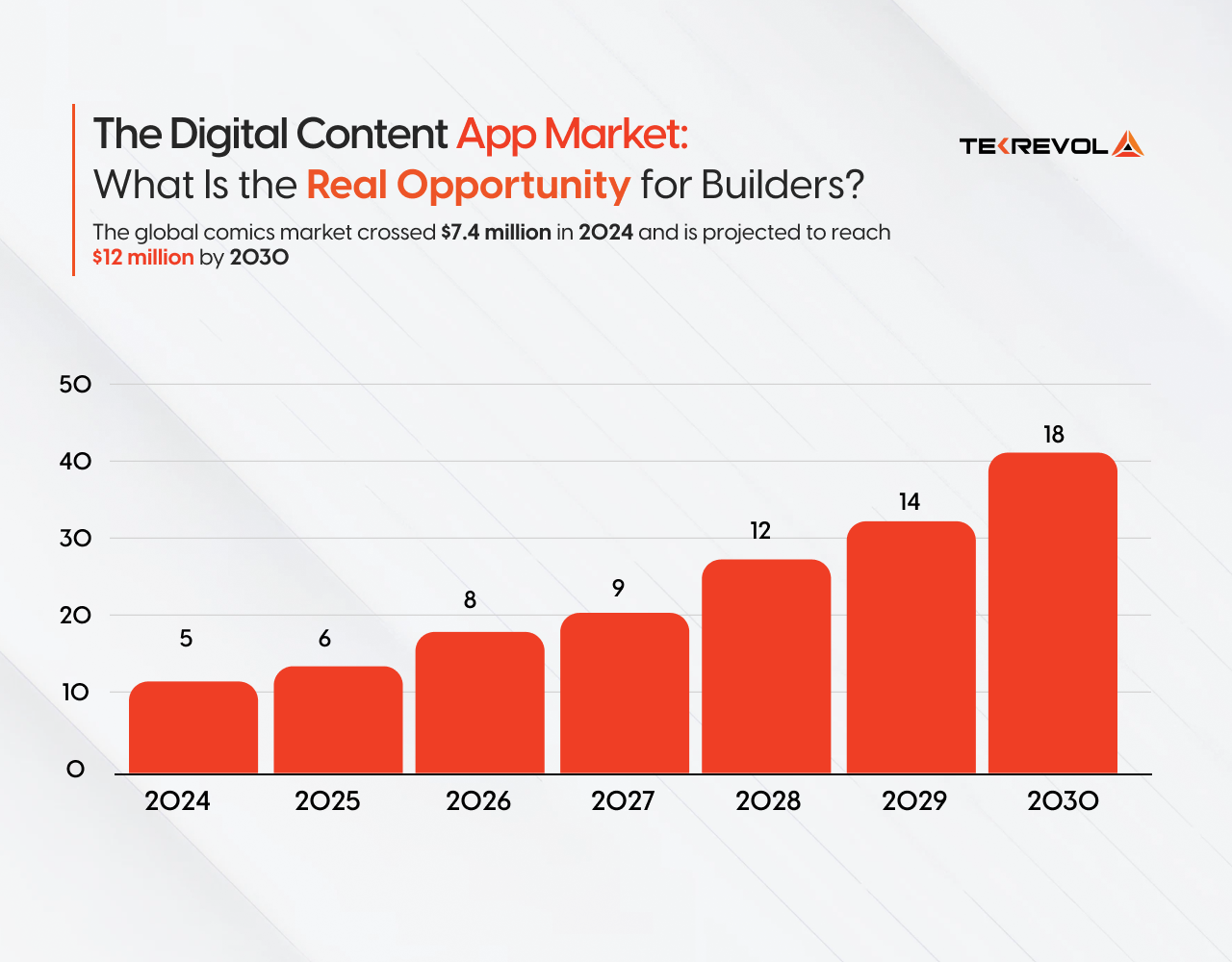
The global webcomics and digital comics market crossed $7.4 million in 2024 and is projected to reach $12 million by 2030, growing at a 5.2% CAGR, making this one of the most underpenetrated media categories for new platform builders.
The numbers that matter for builders:
- 1.2 billion global digital manga downloads in 2024
- 82 million combined active users on Webtoon and Tapas in 2023
- 30 million monthly users on MangaOwl before it shut down, all of them looking for a replacement
The dominant platforms are either piracy-adjacent and vulnerable to shutdown or massive corporate properties with user bases underserved in specific genres, languages, and regions.
The real builder opportunities in 2026:
- Niche genre platforms — Horror and regional language content are ignored by global platforms
- Creator-owned platforms — Direct-to-reader publishing with subscription revenue shared back to creators
- Regional platforms — Southeast Asia, Latin America, and the Middle East have growing audiences with no strong local platform
- Enterprise content platforms — Publishers who want direct reader relationships without giving 30% to Apple or Amazon
The window is open. But only for platforms built on legal content, sustainable monetization, and a reader experience that keeps users coming back.
Turn Content Into a Revenue-Driven App
Connect with TekRevol for strategy, tech, and launch planning
Get Free Consultation!MangaOwl Alternatives: A Competitive Landscape for Builders
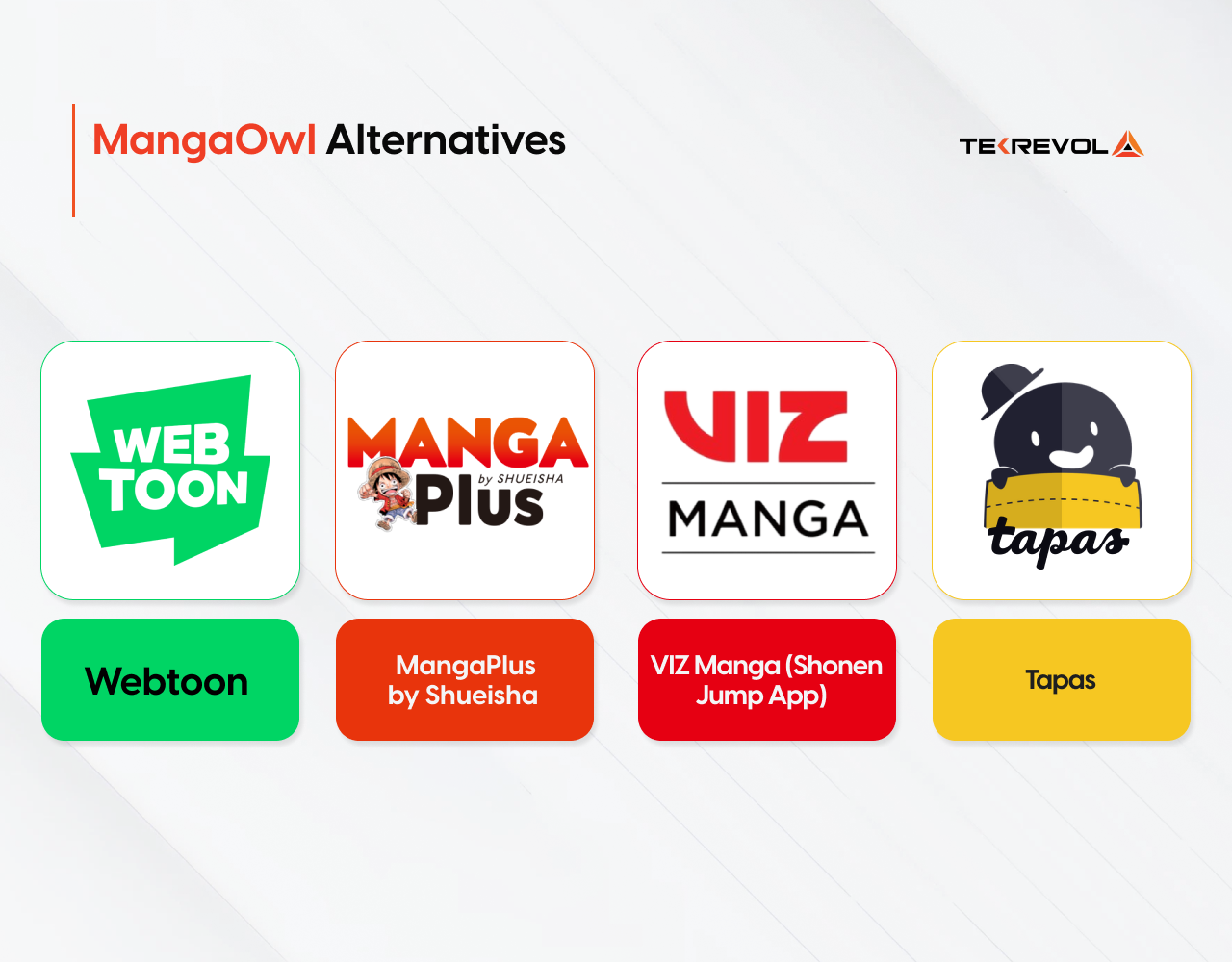
The competitive landscape for manga and content live streaming apps development is split into five distinct business models, and understanding each one is more valuable than copying any single platform’s features.
Analyzing these platforms as a builder, not a consumer, reveals what actually drives retention, revenue, and defensibility:
1. Webtoon
Webtoon built its dominance on one insight: mobile readers scroll, they do not flip. It ditched the traditional page-turn format entirely, went full vertical scroll, and never looked back. The result is the largest digital comics platform in the world with over 82 million active users, not because it had the most titles, but because it built the right reading mechanic for the right device.
The lesson for builders: format is strategy. How users read matters as much as what they read. This is digital reading app development at platform scale, one format decision that changed an entire industry.
Key Features:
- Vertical scroll reader optimized for mobile
- Original and creator-submitted series
- Daily episode unlock system
- Personalized recommendations engine
- Offline reading with downloaded episodes
2. MangaPlus by Shueisha
MangaPlus did not compete on features; it competed on source. As Shueisha’s official platform, it offers the same chapter, on the same day, as the Japanese print release. No fan translations. No delays. No licensing grey area.
It scaled by owning the supply chain entirely and giving it away for free. The lesson: if you can control the source, you do not need to compete on anything else. This is a subscription content platform development built on the most defensible position in the market, publisher ownership of the IP itself.
Key Features:
- Simulpub releases (same day as Japan)
- Official Shonen Jump and Shueisha catalog
- Free access with a clean, ad-light experience
- Bookmarking and reading history
- iOS, Android, and web support
3. VIZ Manga (Shonen Jump App)
VIZ Manga turned a $2.99 monthly subscription into a 10,000-chapter library and built one of the most loyal reader bases in the market. It did not need a complicated model. It needed iconic IP, a frictionless reader, and a price point low enough that cancellation never felt worth it.
The lesson: depth of catalog at the right price beats breadth of features every time. This is manga app development as a subscription business, priced for habit, designed for retention.
Key Features:
- 10,000+ chapters under one subscription
- Simulpub with Japan for select titles
- Offline reading with cross-device sync
- Panel zoom and clean reader UI
- iOS, Android, and web support
4. Tapas
Tapas built its entire monetization model around one human behavior: impatience. Read for free, but wait 24 hours for the next episode. Or pay to skip the wait. That single mechanic generates consistent revenue without a hard paywall, without subscriptions, and without ever turning away a new user at the door.
The lesson: friction, engineered correctly, becomes revenue. This is on-demand content app monetization at its most psychologically precise, patience as the product, speed as the purchase.
Key Features:
- Wait-or-pay episodic unlock system
- Free access with daily chapter drops
- Original webcomics, indie manga, and light novels
- Creator monetization and tipping tools
- iOS, Android, and web support
How to Build a Manga App Like MangaOwl?
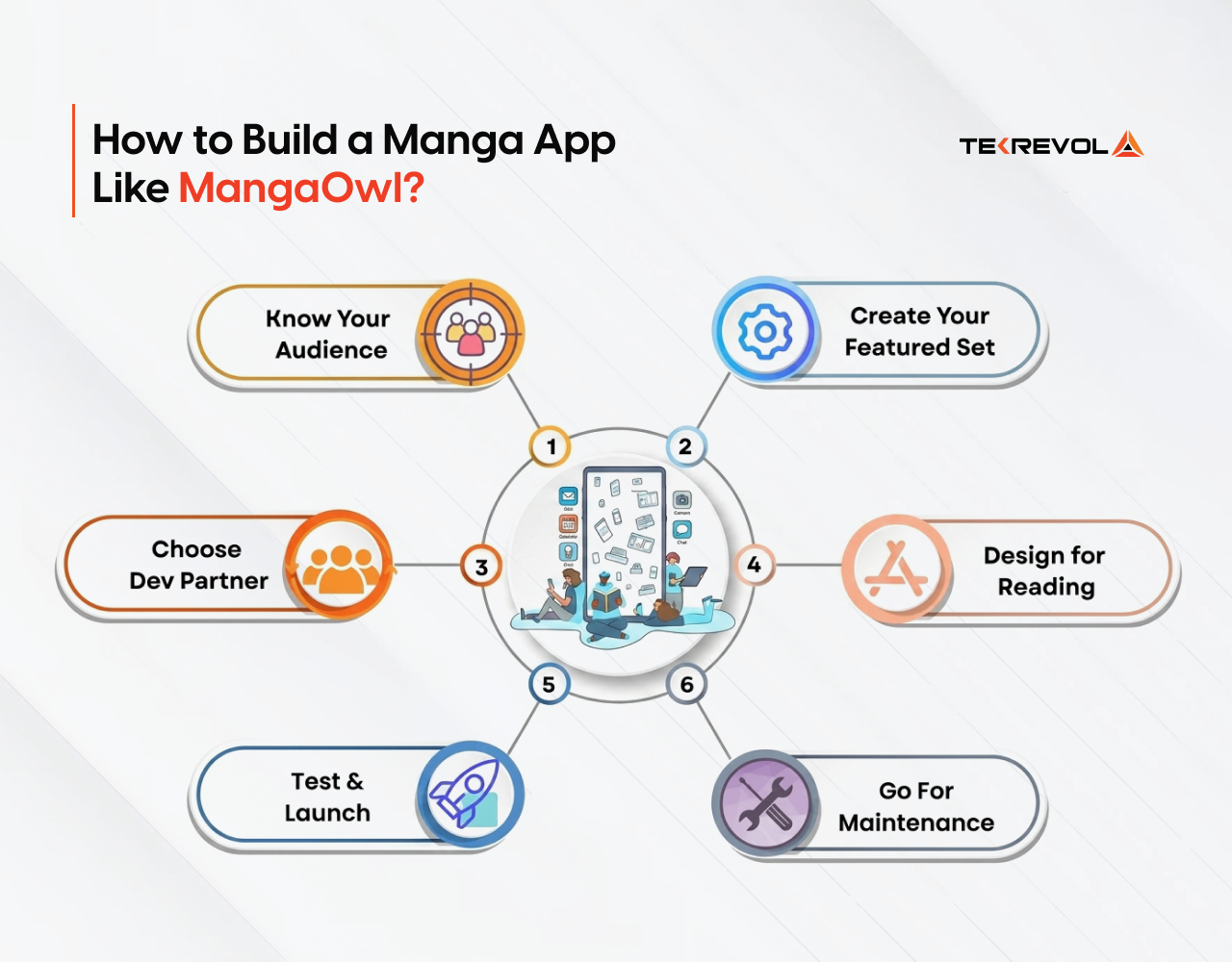
Developing a manga reader app like MangaOwl involves precision and structured methodology. It starts with clarification of the idea. The next step is to consider must-have features, then work on the app design, and finally, evaluate the cost and timeframe to enter the market.
Here is a detailed rundown of how to build a manga app like MangaOwl on iPhone and Android:
1. Know Your Audience’s Mindset
People don’t read like they used to. Today’s generation prefers fast, scrollable manga on mobile. That’s why apps like Webtoon and Tapas grew to 82 million active users in 2023 (Statista).
Before the practical execution, you need to know how to develop an app idea. Research why people loved MangaOwl in the first place, what a similar app like MangaOwl offers, and what readers expect now.
2. Create Your Own Featured Set
You don’t need to reinvent anything. Features like offline downloads, reading history, library filters, and push alerts are prerequisites for any manga website.
Start with these essentials, then expand based on what users do inside the app. A simple MVP can be built in 4 to 6 months if your scope is focused and realistic.
3. Choose the Right Development Partner
Manga apps are data-heavy. Each chapter includes dozens of images, and traffic spikes when new releases go live. That’s where the backend matters.
Your app needs reliable cloud storage, image compression, a content delivery network (CDN), and real-time syncing. If that’s outside your expertise, the smarter option is to work with a proven app development company that’s done this before.
4. Design for How People Read
A well-designed app not only looks good. It also helps in smooth and fast navigation from one page or tab to the next chapter. The best apps are the ones people barely think about while using.
To speed up early builds, test your layouts using powerful no-code AI tools. Once your flow works, refine it using standard UI libraries like Bootstrap. But always build for real user behavior, not your developer instinct.
5. Test & Launch
Don’t just launch your app hurriedly. You’ll miss things. First, test it with a small group of people. Watch how they use it, the issues they face, and fix the rough edges.
Once it runs clean, prep your Play Store and App Store listings. Add screenshots, short descriptions, and privacy details. That stuff matters more than people think.
6. Go For Maintenance
The majority of apps die after launch because no one sticks around. Readers leave when there are bugs, slow updates, or nothing new to read.
Keep security patches, bug fixes, and updates on a rolling schedule. You’ll also have to monitor performance and track user feedback for what’s crashing, what’s not loading, and where users drop off. Maintenance isn’t optional if you want to measure app user retention.
Launch a Content Streaming Platform That Scales
Get a custom roadmap from TekRevol’s development team
Start Free Consultation!Core Features for a Content Streaming App
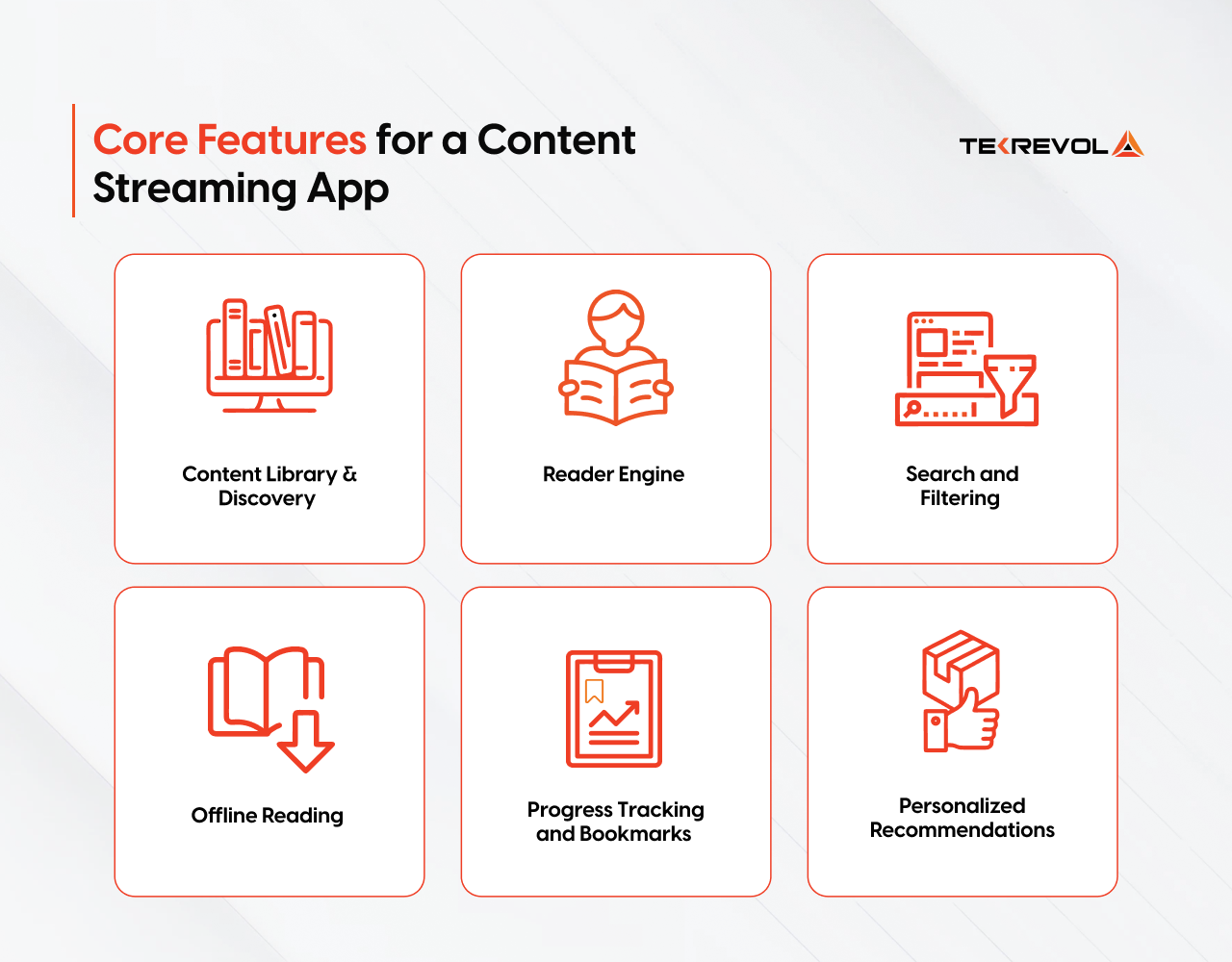
A competitive content streaming app in 2026 requires six core feature sets: a content library with discovery, a high-performance reader engine, search and filtering, offline reading, progress tracking, and personalized recommendations.
Content Library and Discovery
- Catalog management with metadata tagging, genre, author, publisher, language, and status
- Featured and curated collections, editorial picks outperform pure algorithm for new users
- New release feed with follow functionality for publishers and creators
- Regional and language filtering for multilingual platforms
Reader Engine — The Most Critical Feature
The reader is where users spend 95% of their time. It determines whether they return.
- Horizontal and vertical scroll modes — manga reads left-to-right; webtoons scroll vertically; both are required
- Panel zoom — tap-to-zoom is a standard expectation, not a premium feature
- Dark mode — non-negotiable for evening reading
- Reading direction toggle — Japanese manga reads right-to-left; Western comics left-to-right
- Image preloading — the next 3–5 pages must load before the user reaches them
- Double-page spread handling — essential for full-spread manga panels
Search and Filtering
- Full-text search across titles, authors, genres, and tags
- Filter by completion status — ongoing, completed, hiatus
- Sort by popularity, update date, rating, and new releases
Offline Reading
- Chapter download queue with progress indicator
- Storage management with visibility into downloaded content
- Offline sync — reading progress updates to the server on connectivity restore
- Download quality settings for storage-limited devices
Progress Tracking and Bookmarks
- Reading history with the last-read position saved per title
- In-chapter bookmarks — not just between chapters
- Reading lists — reading, plan-to-read, completed, dropped
- Push notifications for new chapter releases on followed titles
Personalized Recommendations
- Collaborative filtering — users who read X also read Y
- Genre and tag affinity modeling
- AI-powered content discovery — now a baseline expectation on new platforms in 2026
Building this kind of on-demand app development experience requires infrastructure thinking from day one, not just UI work.
Monetization Models for Content Apps
The four monetization models for content streaming apps are subscription, pay-per-chapter, freemium with ads, and hybrid, and the right choice depends on your content depth, audience acquisition strategy, and long-term LTV goals.
| Model | Revenue Potential | User Friction | Best For |
| Subscription (flat monthly) | High — predictable MRR | Low | Large catalogs with strong depth |
| Pay-Per-Chapter | Medium — high per-transaction | High | Exclusive titles, premium releases |
| Freemium + Ads | Low-to-medium — scales with MAU | Very Low | Audience building, new platforms |
| Hybrid (Freemium + IAP + Sub) | Highest — multiple streams | Medium | Mature platforms with large user bases |
| Creator Revenue Share | Variable — platform takes % | Low for users | Creator marketplaces, indie platforms |
Which Model Should You Build?
- Launching a new platform: Start freemium with ads to drive acquisition. Introduce subscription once you have 10,000+ MAU and enough catalog to justify the recurring fee.
- Launching with licensed IP: Subscription or pay-per-chapter from day one. The content is the value proposition — do not dilute it.
- Building for a publisher: Subscription library model. One monthly fee, everything included.
- Building for creators: Revenue share with creator monetization tools — tipping, exclusive content, fan subscriptions.
In-App Purchase Architecture Requirements
Regardless of the primary model, your IAP build needs:
- Virtual currency system for pay-per-chapter unlocks
- Subscription management with iOS and Android native billing
- Server-side receipt validation — client-side validation is trivially bypassable
- Free trial mechanics for subscription conversion
- Restore purchases functionality — Apple and Google require it
This is where an on-demand app development company matters most. Subscription billing errors are the leading cause of App Store rejections and post-launch revenue leakage.
Content Licensing and Legal Considerations
Content licensing is the most underestimated requirement in digital content app development, and the reason platforms like MangaOwl get shut down within months of reaching significant traffic.
MangaOwl had 30 million monthly users. Zero licensed content. One wave of DMCA takedowns. Gone in 2022. This is not an edge case. It is the standard outcome for unlicensed platforms that scale.
Types of Content Rights You Need
- Distribution rights — The right to make content available to users in specific territories. Rights are often territory-specific — a US license does not cover Europe or Asia.
- Digital rights — Separate from print rights. Publishers negotiate digital and print rights independently. You need digital distribution rights specifically.
- Translation rights — If serving non-original-language audiences, translation rights are required in addition to distribution rights. Fan translations are not a legal workaround.
- Exclusivity terms — Non-exclusive deals allow the publisher to license to multiple platforms. Exclusive deals cost more but create competitive defensibility.
How to Structure Content Licensing Deals
- Direct publisher deals — Negotiate with Kodansha, Shueisha, VIZ Media, or Dark Horse directly. Requires audience scale or guaranteed minimums
- Aggregator licensing — Companies like Comikey sublicense rights to new platforms. Lower barrier to entry
- Creator-direct licensing — Revenue share agreements (70/30 in favor of creator) for indie content platforms
- Public domain content — Free to license, limited catalog, zero legal risk
Rights Management Technical Requirements
Your platform technically needs:
- DRM — prevents screenshots, screen recording, and content extraction
- Watermarking — visible or invisible marks tracing content to specific accounts
- Geographic access controls — serve content only in licensed territories
- DMCA response workflow — a documented takedown process is legally required
- Server-side image serving — images should never be directly accessible via URL
A custom software development company is essential here. DRM and rights management systems are not off-the-shelf — they need to be built to your specific licensing agreements and content architecture.
Tech Stack for a Content Streaming App
The recommended tech stack for a manga app development or digital reading app development project in 2026 uses Flutter or React Native for mobile, Node.js for backend API, PostgreSQL and Redis for data, AWS S3 with CloudFront CDN for content delivery, and RevenueCat for cross-platform subscription management.
Mobile Layer
| Decision | Recommended | Alternative |
| Cross-platform | Flutter | React Native |
| Native iOS | Swift (SwiftUI) | — |
| Native Android | Kotlin | — |
Flutter is the recommended choice for most content streaming apps. Its rendering engine gives superior control over reader UI — custom scroll behavior, panel zoom animations, and page transitions all perform better in Flutter’s architecture.
Backend API
- Node.js (Fastify or Express) — Excellent for high-concurrency read operations typical in content streaming
- Python (FastAPI) — Strong choice when integrating AI recommendation engines
- GraphQL — Consider for complex content queries with multiple relationship types
Database Architecture
- PostgreSQL — Primary database for user data, subscriptions, reading progress, and content metadata
- Redis — Caching layer for content metadata, session tokens, and reading position sync
- Elasticsearch — Full-text search across titles, authors, and tags at scale
Content Delivery Infrastructure
- AWS S3 — Primary content storage for images and assets
- CloudFront CDN — Global edge delivery for low-latency image loading
- Image compression pipeline — WebP format with quality tuning by connection speed
- Adaptive image serving — Different resolution assets for mobile data vs. WiFi
Subscription and Payment Infrastructure
- RevenueCat — Cross-platform subscription management (handles iOS, Android, and web in one SDK)
- Stripe — Web subscription billing
- App Store Connect and Google Play Billing — Native IAP for mobile
The same infrastructure patterns TekRevol uses for music app developers, media streaming, offline caching, and user library management apply directly to manga and comics platforms.
View Full Case Study→
Development Cost for a Content Streaming App
Building a content streaming app costs between $25,000 for a focused MVP and $120,000+ for a full-featured platform with subscription billing, DRM, offline reading, and AI recommendations, with a timeline ranging from 3 to 9 months.
| Tier | Feature Set | Estimated Cost | Timeline |
| Basic Reader MVP | Content library, reader engine, search, user accounts, basic offline | $25,000–$40,000 | 3–4 months |
| Standard Platform | MVP + subscription billing, push notifications, bookmarks, reading history, IAP | $40,000–$75,000 | 4–6 months |
| Full Content Platform | Standard + DRM, AI recommendations, CDN infrastructure, publisher CMS, analytics | $75,000–$120,000 | 6–9 months |
| Enterprise Publishing Platform | Full + multi-publisher dashboard, revenue share reporting, advanced DRM, third-party API | $120,000–$200,000+ | 9–12+ months |
Cost Breakdown by Component
Here’s the cost breakdown by component:
| Component | Estimated Cost |
| UI/UX Design (Reader + Library + Onboarding) | $8,000–$20,000 |
| Mobile Development (iOS + Android) | $20,000–$60,000 |
| Backend API and Database | $12,000–$30,000 |
| CDN and Content Infrastructure | $5,000–$15,000 |
| Subscription and IAP Integration | $5,000–$12,000 |
| DRM and Rights Management | $8,000–$20,000 |
| Admin CMS for Content Management | $6,000–$15,000 |
| QA and Testing | $5,000–$12,000 |
| Annual Maintenance | 15–20% of build cost/year |
What Moves the Cost Up
- Multi-platform launch (iOS + Android + Web simultaneously): +30–40%
- AI recommendation engine: +$10,000–$25,000
- Multi-language and RTL support: +$8,000–$15,000
- Multi-tenant publisher architecture: +$15,000–$40,000
For ecommerce app development projects, TekRevol uses the same subscription infrastructure patterns. The cost and architecture benchmarks above are based on real delivery data, not estimates from spec sheets.
How TekRevol Builds On-Demand Content Platforms
TekRevol builds content streaming apps as end-to-end product engagements, covering product strategy, reader UX design, subscription infrastructure, CDN architecture, content licensing integration, and post-launch optimization, for media companies, publishers, and entertainment startups.
Building a subscription content platform development project is not standard mobile development. It requires:
- A reader engine performing smoothly at 60fps with large image assets on low-end devices
- CDN architecture serving thousands of concurrent readers without latency spikes when new chapters drop
- Subscription billing that handles iOS, Android, and web billing across geographies without revenue leakage
- A content management system that publishers and creators can use without developer assistance
- DRM that satisfies publisher licensing requirements
- A recommendation engine improving with every reading session
TekRevol maps on-demand app development directly to content streaming, the same real-time delivery architecture, the same user engagement mechanics, and the same subscription monetization patterns.
Our music app development experience adds deep expertise in media streaming infrastructure, content CDN, offline caching, and user library management, which applies directly to manga and digital reading platforms.
What a TekRevol engagement looks like:
- Discovery — Business model validation, content licensing strategy, monetization architecture, technical scoping
- Design — Reader UX prototyping and user testing before development begins
- Development — Agile sprints with milestone-based delivery, cross-platform from day one
- Infrastructure — CDN setup, image compression pipeline, subscription billing built to handle scale at launch
- Post-launch — Performance monitoring, recommendation engine tuning, subscription conversion optimization
Launch Your Content Platform with TekRevol
From UX to subscriptions, TekRevol builds end-to-end streaming apps for media and entertainment businesses.
Get a Free Project Estimate


