You can easily make predictions on a company’s future by analyzing how well it is handling its data. Those businesses that know their way to turn simple information into an insight, and that insight into a mandatory action, are truly the only ones making their way to lead the industry. There is one technology that is turning this transformation into a reality, and that technology is a digital twin app.
Not just another app, a digital twin cloud allows companies to produce digital models of their real products, assets, or systems. They use real data to analyze performance, predict possible tweaks, and precisely and confidently support decisions. To be honest, you cannot deny that this isn’t a smarter and sustainable way that one can use to manage all the operations.
With that being said, building a digital twin app can fill the gap between physical and digital assets by turning data into an engine for regular improvement, one that grows with your business—a task best handled by a professional mobile app development company. A real win-win situation for teams that focus on innovation and scalability.
Now, we know how this technology can really bring revolutionary changes, that’s why we are presenting you this guide that shows how to make a digital twin app, its core components, technologies, and practical insights from the industries adapting this approach.
What Is a Digital Twin App? A Quick Overview
A digital twin app is basically a virtual avatar of any real model or system that updates in real time by providing insights on how the physical product is behaving, reacting, and performing with the help of different sensors, IoT devices, and other software connected to it.
It runs with the help of a secure system known as the digital twin cloud, which connects physical and digital spaces. The digital twin cloud helps in storing, processing, and updating real data so that even a minor change in the real product directly pops up in the virtual one accurately.
In simple terms, think of it like a digital mirror, a smart one. The only difference between a regular mirror and this digital mirror is that it show’s whats happening in real-time and then predicts the possibility of what can happen next by analyzing the current situation.
Also, the numbers defined by Forbes indicate the importance of creating a digital twin cloud. According to them, there is a high potential for the digital twin app market to grow more than 60% per year for the next 5 years, making it $73.5 billion by 2027. This prediction proves that it has become important for businesses to create a digital twin to stay competitive in the market.
Predict Problems Before They Even Appear
Unlock live data insights and predict the future with a custom digital twin.
Build My Digital Twin AppWhy Are Businesses Creating a Digital Twin? Key Benefits and Industry Uses
Many businesses are stepping up to use the digital twin app for smart and fast decision-making. These digital assets help them to easily understand everything that’s happening across their operations and what might happen in the future.
In this case, McKinsey states that 70% of the C-suite leaders in reputable enterprises are investing in digital twin apps for improved performance and results.
This clearly shows that these virtual models have already become an important part of businesses today.
Key Benefits of Creating a Digital Twin
- Real-Time Performance Tracking: A digital twin cloud regularly tracks the performance of systems and equipment. It helps teams to get real-time updates with the help of sensors, quickly analyse problems, and then make immediate adjustments using the data without disrupting current operations.
- Predictive Maintenance: Building a digital twin cloud allows for making advanced predictions when parts or equipment might fail by analyzing data patterns. This helps in planning advanced maintenance, saving money and time, and avoiding unexpected breakdowns.
- Operational Simulation: Companies can test new ideas or make changes in the virtual model before applying them to the physical asset. This approach helps find effective solutions and reduces the chances of risks.
- Cost Efficiency: Once the performance data is clear, the digital twin cloud helps teams in reducing waste and energy use to get the most out of their systems, helping companies to stay within the budget.
Industries Using Digital Twins Today
- Manufacturing: They are the first in the industry to use digital twin apps for monitoring the performance of their equipment and reducing downtime. Teams can easily detect early problems, machinery failures, and optimize production schedules with the help of real-time data gained through sensors and IoT systems.
- Construction: Digital twin apps are used to plan, design, and track projects with accuracy in the construction field. They help engineers and project managers in visualizing structures properly, mark out the critical safety issues, and test different designs virtually before building anything.
- Healthcare: The healthcare industry is a great example to show the worth of creating a digital twin cloud. They are literally using the digital twin app for everything, from medical devices to even the data of their patients—a solution often developed by a professional healthcare app development company.
- Energy: They are using digital twins to track power grids, pipelines, and renewable assets like wind turbines and solar farms. With the help of a digital twin cloud, they can easily identify potential system failures and support sustainability goals.
How to Build a Digital Twin App: A Step-by-Step Process
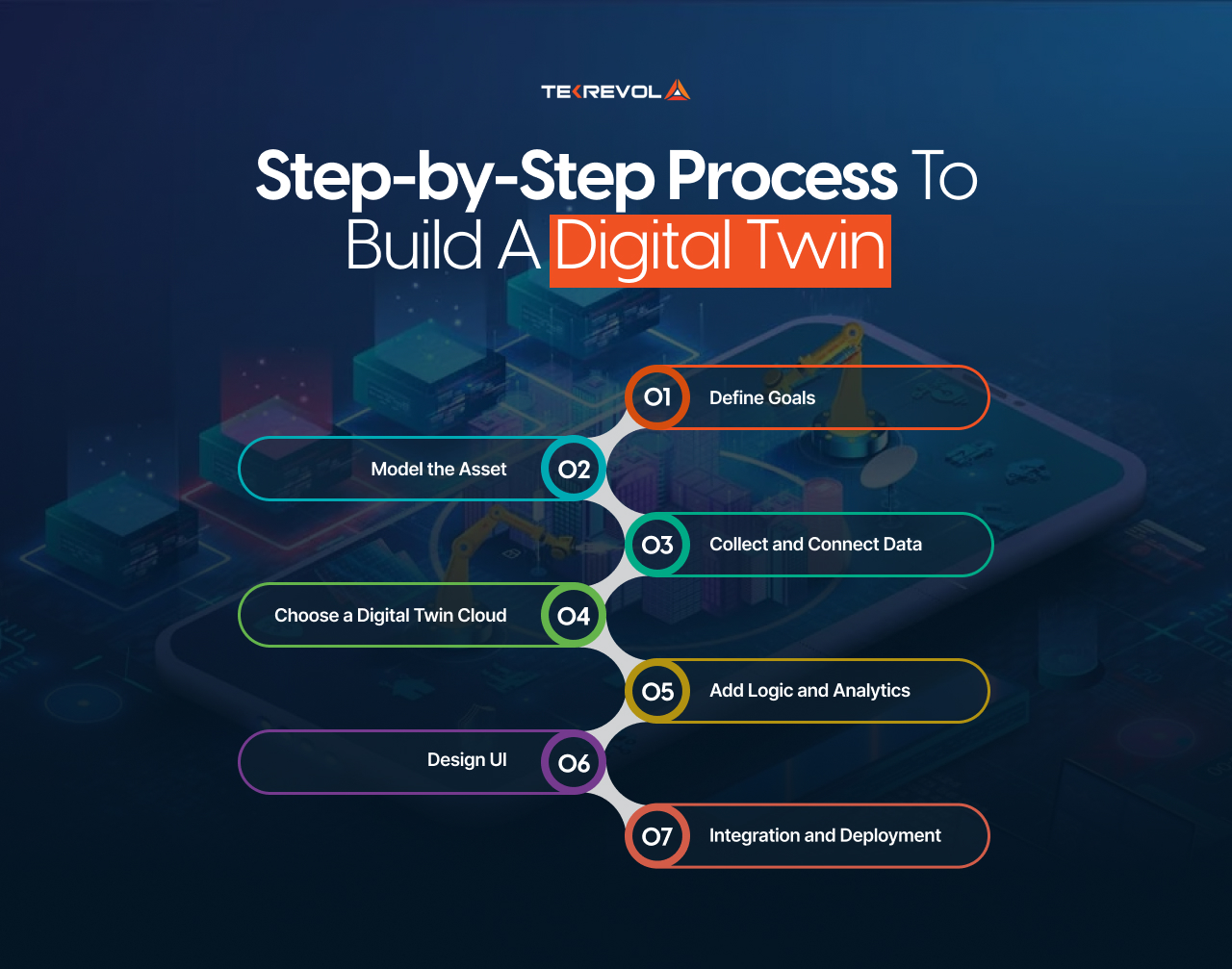
Creating a digital twin cloud may seem a bit difficult, but once you properly understand the structure and clear your concepts on how to implement a digital twin app, everything becomes practical and simple. With a cloud application framework and professional cloud application development services, you can proceed through each connected stage, starting from identifying your goals to testing the final product using correct tools and authentic data.
And this is the right time to invest in this space. A study reveals that the global digital twin app market will hit a whopping $149.81 billion by 2030. The timing could not get more perfect to show how businesses are running to adopt this technology.
Here is a step-by-step guide to make things even simpler for you.
Define Your Goal and Scope
The foundation of every remarkable project always begins with defined goals. In this step, you will define your needs and check mark the list of things you expect your digital twin app to achieve. It can be reducing downtime, performance optimization, or making predictions.
- Choose your area of focus by starting small. Begin with a single process instead of creating a twin of your entire massive system.
- Then set your KPIs and decide the metrics that matter a lot.
- Test on a small scale and then decide whether you want it to expand across your system.
Model the Asset
Once you have defined your clear objectives and scope, move on to modeling the asset. Make sure that your model represents the physical system in structure and functionality. It can be a dynamic dashboard or a 3D simulation. It all relies on your goals and resources.
- Map out the structure of your asset with the help of compatible modeling tools like DTDL (Azure), AWS IoT, or rely on professional custom software development services to implement and integrate these tools effectively.
- Add CAD/PLM data to mirror a real digital behavior and correct geometry.
Collect and Connect Real Data
A digital twin app only works well when it is fed with authentic and clean data. Connecting it with IoT devices and sensors guarantees that your digital asset is updating you in real-time.
- Install or connect reliable sensors to collect real-time data from machines or environments.
- Use protocols like MQTT or OPC UA for secure data communication.
- Align the data to avoid mistakes and lags in your system.
Choose a Digital Twin Cloud Platform
The digital twin cloud is like a home for your app. It helps the model to run in real time, manages data flow from sensors, and supports uninterrupted analysis. The correct cloud platform turns scaling simpler as your data and operations increase.
- Choose a preferred platform or any flexible cloud application development that fits the best with your system.
- Always check that the selected platform supports real-time processing for regular updates and accurate insights.
- Set up secure data access and permissions to protect all critical and sensitive information of your company.
Add Logic and Analytics
Add automation, logic, and analytics in your digital twin app so that it can really understand what and why is certain process is happening and what can possibly happen next.
- Create logical workflows that automatically react to sensor data.
- Use AI tools like Generative AI or Natural Language Processing to turn your digital twin cloud smarter and intuitive.
- Apply machine learning and predictive analytics to keep a record of maintenance and improvement.
Design the User Interface
Design a simple and clean UI to make your digital twin app accessible for everyone. This is the part where users directly get into content with the twin and make quick decisions.
- Create a visual dashboard for monitoring key insights in real-time.
- Use 3D visualization or AR support for operational support.
- Test it with real users to make sure that the design fits right with the daily workflow of your team.
Integration and Deployment
Connect your digital twin app with your physical systems and cloud environment. This is the step where it becomes a part of your operational flow by exchanging data and supporting daily decisions.
- Connect it with ERP or CRM software for data visibility.
- Run integration tests to check that all information is in perfect sync.
- Create deployment pipelines to receive updates and support scaling via a digital twin cloud.
Test, Launch, and Improve
This is the final phase where you validate your digital twin app by running multiple tests to check accuracy. Once you check all the boxes, launch it, collect feedback, and tweak it as new data flows in.
- Run pilot tests before deployment.
- Collect user feedback and adjust your dashboards or analytics models.
- Regularly monitor and update it with the growth of your business and assets.
Digital Twins Are Scaling Fast
Let our experts guide you in every step of building a scalable and accurate digital twin.
Get a Digital Twin GuideEssential Tools and Platforms to Create a Digital Twin App
Building a strong and accurate digital twin app requires the right set of tools and technologies. It is a combination of multiple data systems, modeling engines, cloud platforms, and analytical tools that work in harmony to keep everything aligned. Selecting the right tools, technologies, and platforms is crucial as it highly affects the performance, authenticity, growth, and flexibility of the digital twin cloud.
The numbers also define the importance of adopting digital twin apps among businesses. A study clearly reveals that the global digital twin market had already crossed $24.97 billion in 2024, and is expected to hit $155.84 billion in 2030 with a CAGR of 34.2% from 2025 to 2030.
This proves that creating a digital twin app is already becoming a necessity in the industry. So, below is a clear breakdown of the essential tools and platforms that one needs to create a digital twin.
| Category | Tools / Platforms | Purpose / Use Case |
| Data and Connectivity | MQTT, Apache Kafka, Azure IoT Edge. | Send live data into your systems through sensors and devices. |
| Storage and Data Architecture | Time-series DBs, Data Lakes (AWS S3, Azure Data Lake). | Save and organize a large volume of present and past data for analysis. |
| Modeling and Simulation Engines | ANSYS, Siemens Simcenter, MATLAB/Simulink, Unity/Unreal Engine. | Create digital asset models, realistic simulations, and 3D visualization. |
| Digital Twin Cloud | Azure Digital Twins, AWS IoT TwinMaker, Kubernetes, and Docker for custom stacks. | Host, manage, and grow your digital twin app in the cloud for flexibility and scaling. |
| Analytics and Intelligence | ML frameworks (LSTM, RNN), Prescriptive, and Predictive analytics tools. | Analyse data, spot errors, predict outcomes, and improve operations. |
| Visualization and UI Tools | Power BI, Tableau, Grafana, Cesium, and AR/VR engines. | Present the digital twin’s data and results in dashboards or clear visual views. |
| Security and Integration Middleware | Zero-Trust IAM, API-Management (OpenAPI Spec) | Protect the data and connect the twin with ERP, MES, or CRM systems. |
As the studies mentioned above underscore the growth of the global digital twin market, it is also clear that North America is currently leading this growth. With that being said, mobile app development company NYC are now actively focusing on creating stronger and more capable digital twin apps for the industry.
Common Challenges and Best Practices
As we have been through the step-by-step guide on creating and how to implement a digital twin app, there is one major aspect that many might seem to ignore. Even with the correct strategy, creating a digital twin app comes with potential technical and operational challenges, and most of them pop out when teams start to connect real devices, handle live data, and scale the digital twin cloud for the future.
Let’s check these common challenges and how to overcome them.
Data Quality and Sensor Accuracy
A digital twin app only works well when the data fed into it is clean and correct. When sensors deliver false and delayed information, the twin will not mirror the real conditions accurately. This negatively affects the tracking, predictions, and overall performance.
The best method to avoid this challenge is by using stable, well-calibrated sensors and automated filters that remove inaccurate data.
Integration Complexity
Connecting a digital twin app with ERP, CRM, and IoT systems can be complicated. Every system follows different data formats and communication rules, leading to delays, inconsistency, and additional time for development.
Leveraging standard APIs and adopting middleware systems helps everything work smoothly.
Security and Privacy
Digital twin apps heavily depend on live data, which makes security an important part of this whole network. Weak configurations, limited access, and missing encryption can expose sensitive and private information of the company, resulting in a disrupted workflow.
Strong access controls, encrypted data, and daily checking of your digital twin cloud help in keeping the system safe and secure.
Ongoing Updates and Maintenance
The real world keeps on changing every so often. And we know that your digital twin is the mirror of that physical world. Sensors age, workflows change, and performance keeps shifting as time goes by. If the digital twin app is not continuously updated, it becomes less helpful and hallucinatory.
Regular checks, updated rules, and model adjustments on the basis of new data help keep the twin in sync with your operations.
Estimated Cost Breakdown of The Digital Twin App
The estimated cost to create a digital twin app depends on different aspects like the type of your app, the systems and sensors used in it, and the size and region of the team. Below is a quick estimated breakdown of a digital twin app cost:
| Project Size | What You Get | Estimated Cost | Typical Timeline | Project Complexity |
| Small-scale twin | A basic digital twin for one machine or process. Simple dashboard, limited analytics, light integrations. | $50,000 – $100,000 | 8–12 weeks | Low: focuses on monitoring and simple data connections. |
| Medium-scale twin | Covers multiple machines or a full workflow. Better analytics, stronger integrations, and a more detailed model. | $100,000 – $300,000 | 3–6 months | Medium: includes deeper modeling, automation, and real-time insights. |
| Large Enterprise twin | Complete digital twin for multiple assets with advanced analytics, AI, 3D/AR views, and full ERP/CRM integration. | $300,000+ | 6–12+ months | High: requires custom cloud software, AI models, and advanced integrations. |
Create a Digital Twin App with TekRevol
It might seem a bit complicated at first when you learn about how to make a digital twin app, but things get clear and simple when you follow the correct steps and choose the right tools. From collecting authentic data for the digital twin cloud to adding real-time intelligence, each aspect plays a significant role in the performance of the system.
And to make things even simpler for businesses, TekRevol takes the lead and helps companies in building a digital twin that aligns with the real needs of your business. We bring together skills in cloud development, IoT, and AI integration to make sure that the final product acts as a helpful tool that provides desirable outcomes.
Your digital twin deserves an expert execution. So, join hands with TekRevol and watch our team turn complex technology into a real business impact.
Avoid Costly Mistakes and Let Experts Handle Everything
Partner with TekRevol and get a cloud-powered system that delivers real impact.
Get a FREE Consultation Today!

![How Much Would It Truly Cost to Develop a Food Ordering Website? [2026 Analysis]](https://d3r5yd0374231.cloudfront.net/images-tek/uploads/2026/03/Tek-Feature-7-1.jpg)