



- Most metaverse apps land between $30,000 and $500,000, and concurrency drives that spread more than features.
- Build tier decides your budget: layer-on worlds start near $25,000, custom platforms pass $150,000 quickly.
- Engine licences are real money now, with Unity Pro at $2,310 per seat annually since January 2026.
- Running a live metaverse costs 20% to 35% of build cost every year after launch.
- Building on Roblox or UEFN cuts first-year spend by roughly 60% versus a custom platform.
- Meta lost about $88 billion on Reality Labs, so budget for utility rather than land speculation.
Metaverse app development cost can look impossible to pin down because a branded 3D showroom and a persistent multiplayer world are both called “metaverse apps,” even though they require very different teams, infrastructure, and budgets.
In 2026, the cost to develop a metaverse ranges from $ 30,000 to $500,000, with most funded business projects landing between $90,000 and $260,000. A branded 3D space on an existing platform sits at the bottom. A custom, persistent world with its own economy sits at the top.
The reason quotes vary so much is rarely the feature list. It is concurrency, persistence, and who owns the platform underneath you. Those three choices move a budget by six figures before anyone designs an avatar.
This guide breaks down metaverse app development cost by project size, app types, features, and industry. Then it covers what you pay every month after launch, what game engines really charge in 2026, and whether building your own world beats renting space in someone else’s.
The goal here is to help you get your budget right so you can build the Metaverse platform without overspending.
How Much Does Metaverse App Development Cost in 2026? [Project Scope]
Metaverse development costs fall into four build tiers. A basic app costs $25,000 to $80,000. Branded 3D spaces cost $60,000 to $150,000. Custom metaverse apps cost $150,000 to $350,000. Enterprise platforms with economies start at $350,000 and can exceed $1 million.
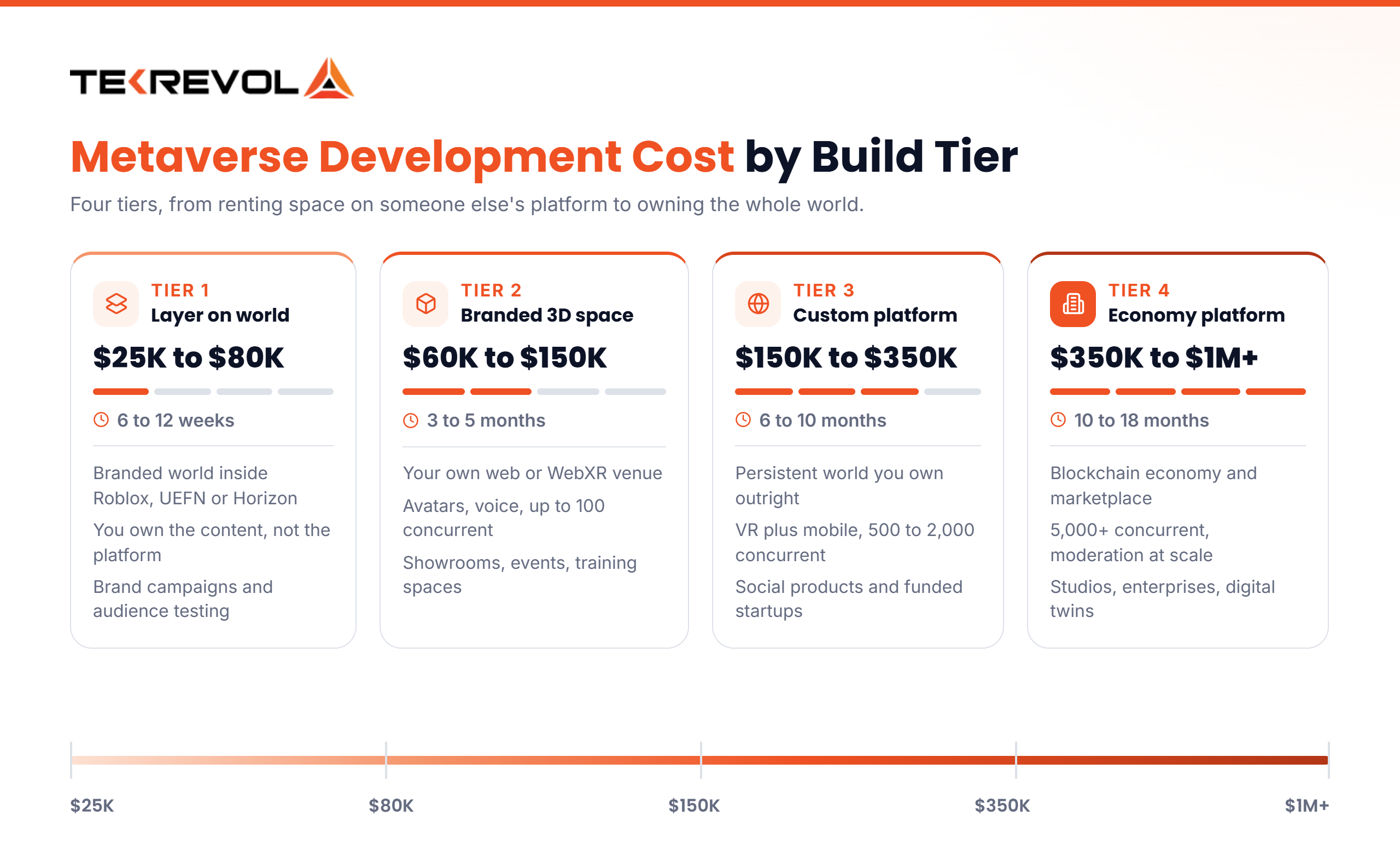
That range is deliberately wider than a standard mobile application estimate. A metaverse product can combine game development, custom software, 3D production, cloud infrastructure, real-time networking, AI, blockchain, and XR work inside the same product.
For planning purposes, this breakdown is more useful:
| Tier | Commonly called | What you get | Build cost | Timeline | Best for |
| Tier 1: Layer-on experience | “Basic” | A branded world inside Roblox, Fortnite UEFN, or Horizon. You own the content, not the platform. | $25,000 to $80,000 | 6 to 12 weeks | Brand campaigns, audience testing, retail activations |
| Tier 2: Branded 3D space | “Mid-level” | Your own web or WebXR venue. Avatars, voice, up to ~100 concurrent users. | $60,000 to $150,000 | 3 to 5 months | Showrooms, virtual events, training environments |
| Tier 3: Custom metaverse app | “Advanced” | Own platform, persistent world, VR plus mobile clients, 500 to 2,000 concurrent. | $150,000 to $350,000 | 6 to 10 months | Social products, education platforms, funded startups |
| Tier 4: Enterprise or economy platform | (rarely priced) | Blockchain economy, marketplace, cross-device, 5,000+ concurrent, moderation at scale. | $350,000 to $1M+ | 10 to 18 months | Gaming studios, enterprises, digital twin programmes |
These are planning ranges, not fixed quotes. The cost to develop a metaverse per month is high for big projects because there’s so much work involved. You really have to pick your project type before moving on. For example, a visually simple environment with complex real-time networking may cost more than a beautiful showroom with limited interaction.
Not sure how to scope your metaverse idea?
A 30-minute scoping call turns a vague metaverse idea into a costed feature list, a build tier, and a realistic timeline you can take to your board.
Book a Free Metaverse Scoping SessionWhat Counts As a Metaverse App in 2026?
A metaverse app combines a 3D environment with user identity, interaction, real-time systems, content, and backend infrastructure. Depending on the concept, it may also include avatars, multiplayer networking, AR/VR access, AI, payments, blockchain ownership, marketplaces, analytics, moderation, and content tools.
A metaverse is therefore better understood as a product architecture than a single technology.
At the experience layer, users may enter virtual spaces, customize avatars, interact with objects, communicate, play, learn, shop, attend events, or collaborate. Behind that experience, however, the platform may need authentication, databases, asset management, matchmaking, messaging, payments, analytics, moderation, and infrastructure capable of synchronizing users in real time.
Some applications also include decentralized ownership. In that case, wallets, tokens, smart contracts, NFTs, marketplaces, or blockchain transaction management become another architectural layer.
Also worth clearing up: the metaverse is not the multiverse, and it does not require blockchain. Plenty of 2026 metaverse projects ship with no tokens at all, which removes a large cost centre. TekRevol’s metaverse development services cover all three product types, but the scoping conversation always starts with which one you actually need.
How Much Did the Metaverse Cost Meta and Other Big Investors?
When people search “how much did the metaverse cost,” they’re usually asking about Meta and the other big public bets, not pricing their own project. Here’s the honest picture and what it should actually tell you about your own budget.
The Meta Number
Meta has lost roughly $88 billion on Reality Labs, the division behind Horizon Worlds and its Quest headsets. That single figure dwarfs almost every private metaverse build in the market. Keep this in mind during your own budget conversations, it shapes both platform choices and investor expectations, since anyone comparing your project to “the metaverse” is really comparing it to this number.
The Virtual Land Correction
The story on virtual real estate looks very different from the 2021 headlines. According to CoinGecko research:
- Decentraland parcel floors are down roughly 89% from their 2022 average
- The Sandbox is down about 95% from its peak
Early buyers paid six and seven figures for parcels during the 2021 boom. Today, that same land trades at a fraction of the price — which is exactly why smart brands now treat virtual land as a marketing expense, not an investment.
What This Means for Your Budget
Two takeaways carry over directly into your own planning:
- Budget for utility, not speculation: Don’t price your project the way early land buyers did. Price the platform build itself like any other multiplayer product, hosting, netcode, art, and live-ops are your real cost drivers, not virtual land.
- Corporate write-downs are a warning about scope, not a reason to skip the space: Meta’s losses came from trying to build hardware, an OS, content, and an audience all at once. A focused branded world or event build can still ship for a small fraction of the numbers making headlines.
Which Features Increase Metaverse App Development Cost the Most?
Individual metaverse features range from $6,000 for spatial voice chat to $90,000 for a full VR client. Avatar systems, multiplayer networking, and blockchain wallets sit in the middle. Feature costs compound because each one adds testing and backend load.
The most expensive metaverse features are usually custom 3D assets, real-time multiplayer, advanced avatars, blockchain systems, AR/VR support, and scalable cloud infrastructure.
| Feature | Cost range | Notes |
| 3D world and environment design | $12,000 to $90,000 | Scales with world size and asset uniqueness |
| Avatar system and customisation | $8,000 to $45,000 | Full-body IK and clothing layers raise this fast |
| Real-time multiplayer networking | $20,000 to $80,000 | The single biggest driver of scale cost |
| Spatial voice chat | $6,000 to $20,000 | Third-party SDKs cut this significantly |
| VR or XR client build | $25,000 to $90,000 | Quest optimisation is its own workstream |
| Mobile client | $20,000 to $60,000 | Often higher ROI than the VR client |
| Backend, auth, and persistence | $20,000 to $70,000 | Required for anything that saves state |
| Blockchain wallet and smart contracts | $20,000 to $75,000 | Audits are mandatory and priced separately |
| NFT marketplace | $25,000 to $70,000 | Listings, escrow, royalties, and fiat on-ramp |
| AI-driven NPCs or agents | $15,000 to $60,000 | Inference cost then becomes a monthly line |
| Admin, analytics, and moderation tools | $10,000 to $35,000 | Skipped often, regretted always |
| Cross-device QA | $12,000 to $40,000 | Grows with every device family you support |
The important word here is planning. These components do not simply add together. Integration between them can increase effort further.
How Does Concurrency Drive Metaverse Development Cost?
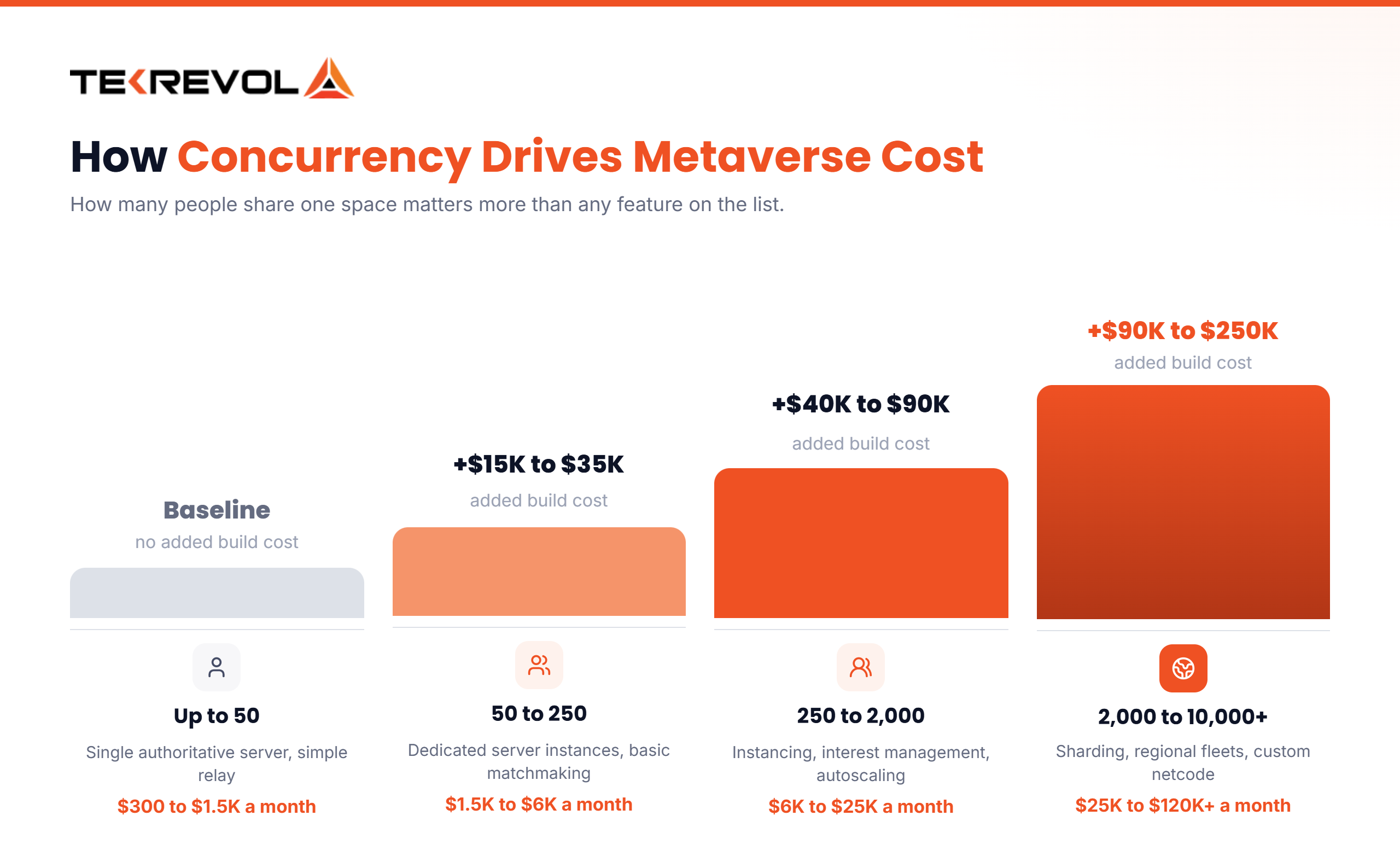
Concurrency drives metaverse cost more than any feature. Supporting 50 users in one shared space is simple engineering. Supporting 5,000 in the same space requires sharding, interest management, and dedicated servers, which can triple both build and hosting costs.
Here is roughly how concurrency changes the engineering picture.
| Peak concurrent users in one space | Architecture needed | Added build cost | Monthly hosting |
| Up to 50 | Single authoritative server, simple relay | Baseline | $300 to $1,500 |
| 50 to 250 | Dedicated server instances, basic matchmaking | +$15,000 to $35,000 | $1,500 to $6,000 |
| 250 to 2,000 | Instancing, interest management, autoscaling | +$40,000 to $90,000 | $6,000 to $25,000 |
| 2,000 to 10,000+ | Sharding, regional fleets, custom netcode | +$90,000 to $250,000 | $25,000 to $120,000+ |
How Much Does Metaverse Development Cost By Type
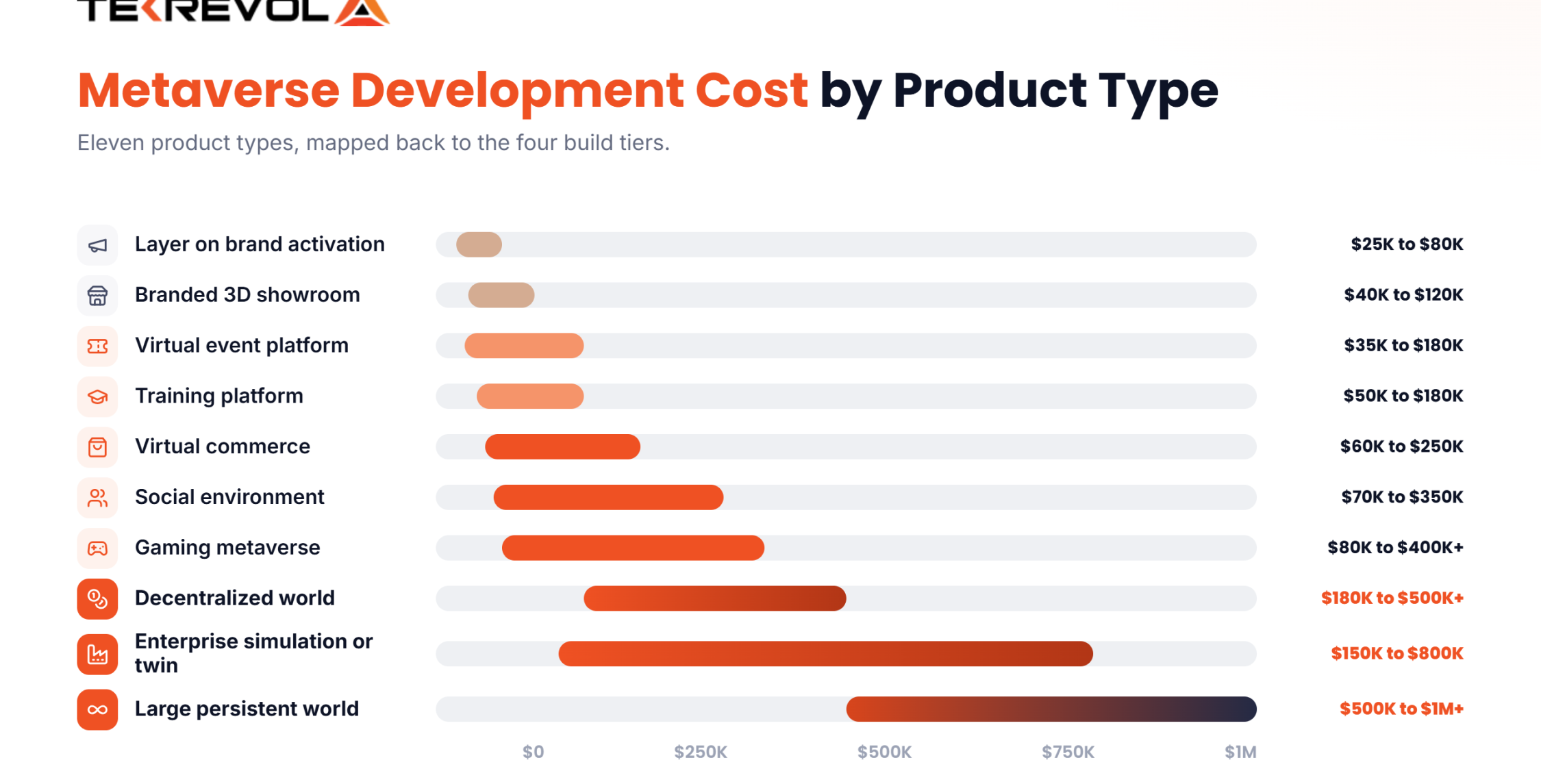
Metaverse cost changes significantly by product type. A branded virtual space is cheaper than a social world, blockchain marketplace, or persistent multiplayer game. Enterprise simulations and decentralized ecosystems also need infrastructure, security, integrations, governance, and operational support budgets.
The table below maps each product type back to the build tiers above, so the numbers stay consistent.
| Metaverse type | Typical requirement | Planning range | Maps to |
| Layer-on brand activation | A branded world inside Roblox, UEFN, or Horizon | $25,000 to $80,000 | Tier 1 |
| Virtual event platform | Streaming, ticketing, large short-lived audiences | $35,000 to $180,000 | Tier 2 to 3 |
| Branded 3D showroom | Guided spaces, products, media, simple interactions | $40,000 to $120,000 | Tier 2 |
| Training platform | Scenarios, assessments, analytics, user management | $50,000 to $180,000 | Tier 2 to 3 |
| Virtual commerce | 3D catalogue, checkout, personalisation, analytics | $60,000 to $250,000 | Tier 3 |
| Social environment | Profiles, avatars, chat, presence, moderation | $70,000 to $350,000 | Tier 3 |
| Gaming metaverse | Game mechanics, multiplayer, economies, content | $80,000 to $400,000+ | Tier 3 to 4 |
| Enterprise simulation or digital twin | Live data, CAD conversion, IoT sync, governance | $150,000 to $800,000 | Tier 4 |
| Decentralized world | Wallets, assets, smart contracts, marketplaces | $180,000 to $500,000+ | Tier 4 |
| Enterprise ecosystem | Multiple roles, integrations, security, analytics | $200,000 to $500,000+ | Tier 4 |
| Large persistent world | High concurrency, UGC, economies, live operations | $500,000 to $1M+ | Tier 4 |
A training platform and an enterprise simulation sound similar but price very differently, because a training platform delivers fixed scenarios while a digital twin ingests live data and runs continuously.
Likewise, a decentralized world starts near $180,000 rather than lower. Wallets, smart contracts, and a marketplace all stack on top of a Tier 3 base before you add a single audit.
How Does Metaverse Development Cost Change by Industry?
Industry changes metaverse app development cost mainly through compliance, asset fidelity, and integration depth. Gaming and healthcare sit at the top because of visual fidelity and regulation. Events and retail sit lower because sessions are short and worlds are small.
The industry you’re in has a huge impact on your total cost to develop a metaverse. Product type tells you what you are building. Industry tells you what your sector adds on top of it, which is usually regulation and integration rather than pixels.
| Industry | Typical cost range | What pushes the price up |
| Gaming and entertainment | $80,000 to $400,000 | High asset fidelity, physics, anti-cheat, live-ops |
| Social and community | $70,000 to $350,000 | Moderation tooling, UGC pipelines, scale |
| Real estate | $50,000 to $300,000 | Photorealistic interiors, CRM and MLS integrations |
| Retail and ecommerce | $45,000 to $220,000 | Product catalogue sync, payments, 3D product scans |
| Education and training | $40,000 to $250,000 | LMS integration, assessment logic, accessibility |
| Virtual events and conferences | $35,000 to $180,000 | Streaming, ticketing, large short-lived audiences |
| Healthcare simulation | $90,000 to $400,000 | HIPAA compliance, clinical accuracy, haptics |
| Industrial digital twins | $150,000 to $800,000 | IoT data ingestion, CAD conversion, real-time sync |
Real estate, for example, shows why integration depth matters more than world size. A virtual property tour is visually simple, but the moment it needs live listing data, lead routing, and investor documents, the backend work outgrows the 3D work.
Need to justify a metaverse budget to a sceptical board?
We will build a costed business case with build cost, three-year run cost, and the specific metric your project has to move. You get the model whether or not you build with us.
Request a Free Metaverse Business CaseShould You Build Your Own Metaverse or Build on Roblox, Fortnite, or Horizon?
Building a metaverse app on an existing platform costs roughly 60% less in year one and reaches users faster. Building your own platform costs more but gives you data ownership, monetisation control, and no risk of a platform policy change deleting your product overnight.
| Factor | Build on Roblox / UEFN / Horizon | Build your own platform |
| Year-one cost | $30,000 to $110,000 | $180,000 to $420,000 |
| Time to first users | 6 to 12 weeks | 6 to 12 months |
| Audience | Platform’s existing users | You acquire every user yourself |
| Revenue share | Platform takes a significant cut | You keep the margin, minus store fees |
| Data ownership | Limited, platform-controlled | Full |
| Platform risk | High. Rules and economics can change | Low |
| Brand control | Constrained by platform norms | Complete |
Meta’s 2026 Horizon Worlds reversal shows the risk clearly. After announcing an end to VR support, Meta reversed course within days following user backlash. For teams building VR-only experiences, it was a sharp reminder that platform decisions can change overnight.
For most brands, therefore, the honest recommendation is to start on someone else’s platform and graduate. Ship a Tier 1 experience, measure whether your audience actually shows up, and only then commit to a custom build. TekRevol’s Web3 and metaverse game development services cover both paths, and we will tell you when the platform route is the smarter spend.
How Long Does Metaverse App Development Take, and What Are the Stages?
Metaverse app development takes 6 weeks to 18 months depending on tier. Layer-on experiences ship in 6 to 12 weeks. Custom platforms take 6 to 10 months. Enterprise worlds with economies take 10 to 18 months, including audits and compliance work.
Metaverse development cost and timeline move together, since most of your spend is people-months. Compressing a schedule usually raises cost rather than lowering it.
The stages below reflect how a Tier 3 build actually runs.
- Discovery and technical strategy (2 to 4 weeks): Concurrency targets, device list, persistence model, and whether blockchain is genuinely needed. This stage decides most of your budget.
- Experience design and world blocking (3 to 6 weeks). Grey-box the world before art begins. Changing layout after art is expensive.
- Core engineering (8 to 16 weeks). Networking, backend, avatars, and the interaction layer, built in parallel with art.
- Art production (10 to 20 weeks). Environments, characters, and optimisation passes. Runs alongside engineering, not after it.
- Integration and live-ops tooling (3 to 6 weeks). Analytics, moderation, admin, and content pipelines.
- QA and device certification (4 to 8 weeks). Store submission for Quest or mobile adds its own review cycles.
- Launch and stabilisation (2 to 4 weeks). Load testing under real concurrency, then hotfixes.
Notice that art production and engineering overlap. Sequencing them creates dead time and inflates the cost of the metaverse by 15% to 25%, which is one of the most common budget mistakes in first metaverse projects.
Confused about building your metaverse?
We walk you through planning, design, and launch while keeping the cost under control.
Request your tailored plan todayMetaverse Engines and Licences Cost in 2026
Engine licences are a real budget line in 2026, not a rounding error. Unity Pro costs $2,310 per seat yearly. Unreal Engine charges a 5% royalty above $1 million in lifetime product revenue, or $1,850 per seat for non-game commercial use.
Here is what the two dominant engines actually charge, per their own published licensing terms.
| Engine | Free tier | Paid tier | Revenue-based fees |
| Unity | Personal, free up to $200,000 in revenue and funding | Pro at $2,310 per seat per year, or $210 monthly | None. Unity cancelled the Runtime Fee entirely |
| Unreal Engine | Free under $1 million in annual gross revenue | $1,850 per seat per year for non-game commercial use | 5% royalty on lifetime gross product revenue above $1 million |
Sources: Unity pricing documentation and Epic Games’ Unreal Engine licensing terms. Unity has also confirmed a 5% price increase on Pro and Enterprise from January 12, 2026.
TekRevol’s Unreal Engine development team handles licence planning as part of scoping, because the choice between Unity and Unreal has a cost tail far beyond the build.
Hardware Costs You Should Include in Metaverse Total Cost
Hardware is a smaller line than most buyers expect. Standalone VR headsets for a development and QA team typically cost $4,000 to $15,000 total. High-end workstations for 3D artists cost more, usually $3,000 to $6,000 each, and are the real hardware expense.
You do not buy hardware for users, which is the most common budgeting mistake. Above all, your users bring their own phones, laptops, or headsets. Your job is supporting them, and support cost shows up in QA time rather than procurement.
- Standalone headsets, QA set of 3 to 5: $1,200 to $3,500 total
- Premium spatial headset, 1 unit: $2,500 to $4,000 (Only if you commit to supporting the high-end tier)
- PC VR rig, headset plus GPU tower: $3,500 to $6,500 (Tethered and PC VR testing, plus performance profiling)
- Artist workstations, high-VRAM GPU: $3,000 to $6,000 each (Real-time 3D production. Usually 2 to 5 units)
- Mobile QA handsets, 6 to 10 devices: $2,500 to $6,000 total (Spread across Android tiers and two iOS generations)
- Cloud build agents or local build farm: $200 to $1,500 per month (Nightly builds. Cloud wins below roughly 10 engineers)
- Motion capture or scanning rig: $2,000 to $25,000 (Optional; only for mocap-driven avatars or scanned products)
- Enterprise deployment kit, per seat: $450 to $900 per seat (Headset, case, charging, and device management licence
The enterprise deployment kit scales dangerously. Everything above it is a fixed team cost that does not grow with your audience. Deployment kits multiply by headcount, so a 500-seat internal training rollout adds $225,000 to $450,000 in hardware alone, which can exceed the software build itself. Our AR and VR development services usually recommend launching on two device families and expanding after you have retention data.
How Much Metaverse Cost to Run After Launch
Running a metaverse app costs 20% to 35% of the original build cost every year. A $200,000 build typically costs $40,000 to $70,000 annually to keep live. Hosting, content updates, moderation, and licences make up most of that recurring spend.
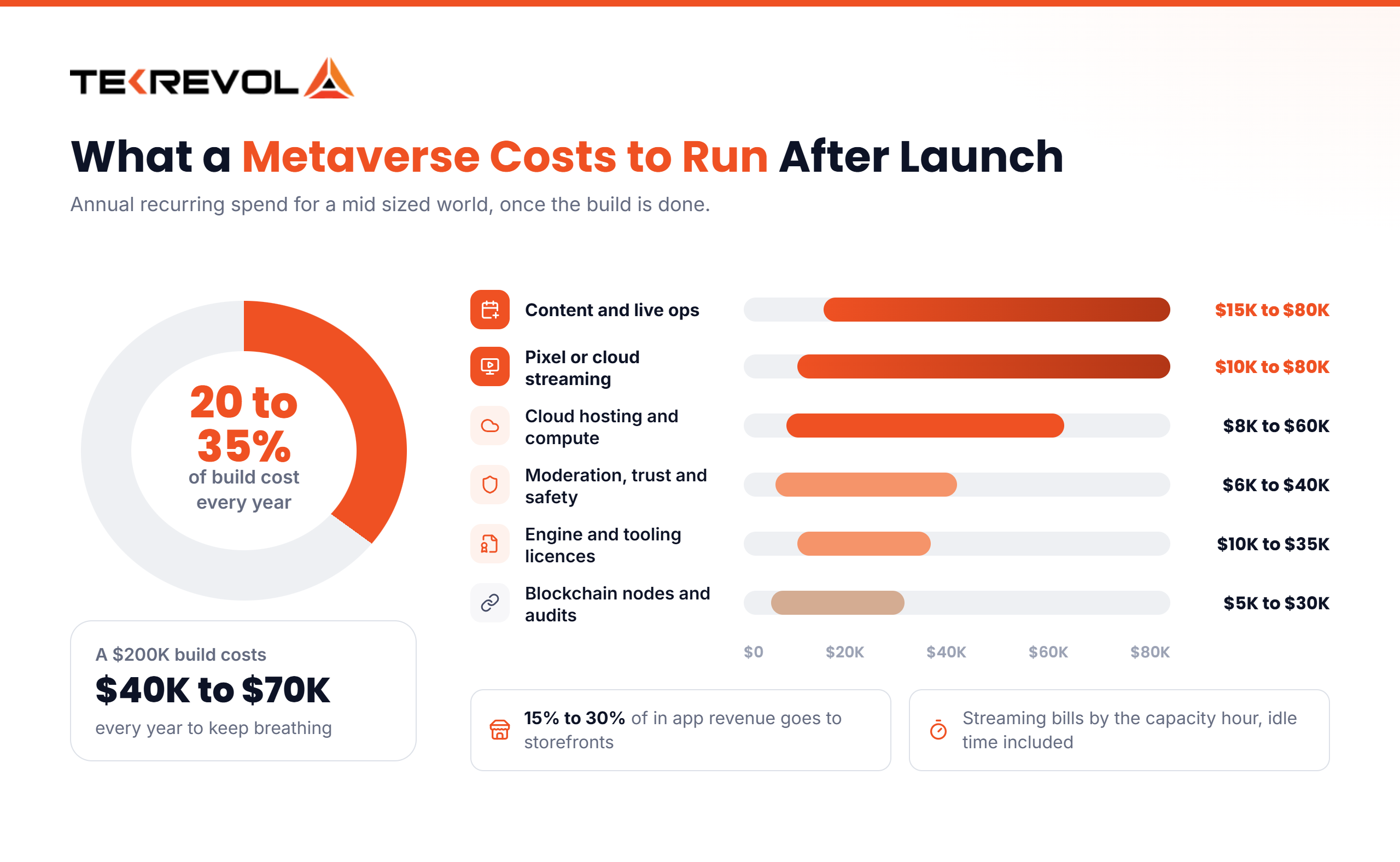
This is, in fact, where metaverse projects quietly die. Teams fund the build, launch, then discover the world costs real money to keep breathing while user numbers are still small.
| Recurring cost | Annual range for a mid-sized world | What drives it |
| Cloud hosting and compute | $8,000 to $60,000 | Concurrency, session length, region count |
| Pixel or cloud streaming (if used) | $10,000 to $80,000 | Billed per capacity-hour, idle time included |
| Engine and tooling licences | $10,000 to $35,000 | Team size and engine choice |
| Content updates and live-ops | $15,000 to $80,000 | How often you add new spaces or events |
| Moderation and trust and safety | $6,000 to $40,000 | User-generated content volume |
| Blockchain node, gas, and audits | $5,000 to $30,000 | Only if you ship an on-chain economy |
| App store and platform fees | 15% to 30% of in-app revenue | Meta, Apple, and Google storefront cuts |
Streaming, in particular, deserves a specific warning. If you stream a high-fidelity world to browsers rather than running it on-device, you pay by the capacity-hour whether anyone is connected or not.
Amazon’s GameLift Streams pricing, for example, lists $0.4982 per capacity-hour for its gen4n_high class in Oregon, and $1.82 per capacity-hour for a Windows gen6n_ultra class. Keep a modest always-on pool running around the clock, and the annual bill reaches five figures fast.
So model your run costs before you approve the build. If year-one operating cost exceeds your realistic year-one revenue by more than you can absorb for 24 months, drop a build tier. Our cloud engineering services usually find 30% to 40% of hosting spend in autoscaling policies and region consolidation alone.
Metaverse Development Cost by Team Size
In 2026, a team of eight to twelve people costs $18,000 to $60,000 per month depending on region. Metaverse work needs a rarer skill mix than standard app development, and thin markets carry premiums regardless of geography.
Here is the team that build actually needs, with rates attached.
| Role | Peak headcount | Share of build hours | Blended rate range |
| Product manager | 1 | 8% | $45 to $110 |
| Solution architect | 0.5 | 5% | $70 to $160 |
| Unity or Unreal engineers | 2 to 4 | 30% | $40 to $120 |
| 3D and technical artists | 2 to 5 | 30% | $30 to $95 |
| Backend and DevOps engineers | 1 to 2 | 12% | $45 to $130 |
| XR interaction designer | 1 | 7% | $40 to $110 |
| QA engineers | 1 to 2 | 8% | $25 to $70 |
| Blockchain engineer | 0 to 2 | +0% to 8% | $60 to $150 |
Note that peak headcount is not average headcount. A team of ten at peak usually averages four to five full-time equivalents across the project, because art and engineering ramp at different times. Quotes built on headcount times duration almost always overstate the cost.
If you would rather scale a team than hire one, TekRevol offers dedicated development teams for XR and real-time 3D work, which keeps fixed costs off your balance sheet.
Cost to Build Metaverse by Location
Developer location can change costs by 3X. US and Canadian teams bill $80 to $150 per hour. Eastern European teams bill $40 to $75. South Asian teams bill $25 to $55.
That total barely changes by region. What changes is the rate you pay for each hour, which is why identical scopes produce wildly different quotes.
| Region | Typical hourly rate | Blended team rate | Tier 3 build at 3,500 hours |
| United States and Canada | $80 to $150 | ~$110 | ~$385,000 |
| Western Europe | $70 to $130 | ~$95 | ~$333,000 |
| Eastern Europe | $40 to $75 | ~$55 | ~$193,000 |
| Latin America | $35 to $70 | ~$50 | ~$175,000 |
| Southeast Asia | $30 to $60 | ~$43 | ~$151,000 |
| South Asia | $25 to $55 | ~$38 | ~$133,000 |
Hidden Costs in Metaverse App Development You Should Watch Out
The upfront cost to develop a metaverse isn’t the whole story. There are hidden factors that can mess up your metaverse project cost breakdown.
The most common hidden costs are smart contract audits, content moderation, store compliance, localisation, and post-launch optimisation. Together, they typically add 15% to 30% to a first metaverse budget, because they rarely appear in the initial feature list.
Smart contract audits ($8,000 to $40,000 per round)
A reputable auditor reviews your contracts before mainnet. The trap is that any contract change after the audit needs a re-audit, so most projects pay for two rounds, not one. Skipping it makes user-held assets uninsurable.
Human moderation staffing ($3,000 to $15,000 per month)
Moderation tooling is a build cost you can plan for. Actual humans reviewing reports are not, and shared 3D spaces generate incident reports from week one. Voice moderation is harder and pricier than text.
Store compliance and resubmission ($5,000 to $20,000 per platform)
Meta, Apple, and Google each apply separate review standards to immersive apps, covering comfort warnings, age gating, and content ratings. A rejection costs 2 to 6 weeks of calendar time, which is usually worse than the fee.
Standalone headset performance work ($15,000 to $50,000)
Holding 72 or 90 frames per second on mobile-class headset silicon is a dedicated workstream, not a polish pass. Miss it, and users get motion sick, which shows up as a refund rate rather than a bug report.
Localisation ($4,000 to $12,000 per language)
Text in a 3D world lives baked into textures, signage, and spatial UI panels rather than a string file. Each language may need re-rendered assets and re-recorded voice, plus a fresh QA pass in-world.
Accessibility conformance ($8,000 to $30,000)
Seated modes, comfort locomotion, subtitles, colour-blind safe UI, and controller remapping. Increasingly a hard procurement requirement for enterprise and public sector buyers, so retrofitting it can cost you the deal.
Legal, IP, and virtual asset terms ($5,000 to $25,000)
Avatar likeness rights, ownership of user-generated content, virtual asset terms, and refund policy. Anything with a tradeable asset also needs a securities review in some jurisdictions.
Load testing at real concurrency ($6,000 to $20,000)
Simulating 2,000 concurrent users costs real compute and real engineering time. Teams that skip it discover their netcode ceiling on launch day, in public.
Rebuild after a wrong platform bet (40% to 70% of original build)
Tier 1 content does not port to Tier 3, because the platform owns the runtime. Choosing the platform layer carefully at discovery is the cheapest insurance in this entire guide.
User acquisition ($20,000 to $150,000+)
The highest hidden cost of all. An empty world is worse than no world, because shared spaces need a population to function. Budget acquisition alongside the build, never after it.
Is the Metaverse Still Worth Investing in 2026?
Yes, but the winning use cases have changed. Metaverse development makes sense in 2026 when immersive interaction solves a business problem. Gaming, training, simulation, commerce, events, and digital ownership remain defensible.
A business should assess value against the use case, not against the category. Below is what the immersive layer actually buys you in each one, and how the return shows up.
Gaming and Social Worlds
Value comes from retention, social interaction, player-created economies, and persistent progression. Players return to worlds where their friends, their progress, and their items still exist. That persistence is the product, which is why Tier 3 and Tier 4 builds dominate this category.
Potential return: day-30 retention, session length, and average revenue per daily active user. A social world that lifts day-30 retention from 8% to 14% roughly doubles the lifetime value of every user. That is the fastest way a $200,000 build pays for itself. Measure it against your existing 2D product, not against zero. TekRevol’s game development services build retention instrumentation into the first release for exactly this reason.
Training
Immersive simulation provides controlled environments for tasks that are costly, dangerous, or difficult to reproduce physically. Safety procedures, equipment handling, and difficult conversations all rehearse better in a headset than in a slide deck.
This is the one use case with genuinely strong published evidence. PwC’s VR soft skills training study found learners trained up to four times faster than in a classroom and were up to 275% more confident applying what they learned.
Potential return: cost per trained employee, time to competency, and incident or error rates. The payback maths is unusually clean. Divide your build cost by the per-learner saving versus your current method, and you get a headcount threshold rather than a vague promise.
Simulation and Digital Twins
Digital twins mirror a real facility, machine, or process using live data. Unlike training worlds, they run continuously. They also consume IoT feeds, CAD conversions, and real-time sync. That is why they sit at the top of the cost table, at $150,000 to $800,000.
Potential return: unplanned downtime hours, maintenance cost per asset, and commissioning time. One avoided day of downtime on a mid-sized line often exceeds the annual run cost of the twin. So the business case turns on a single number your operations team already tracks.
Retail and Commerce
3D and AR experiences help customers explore products that are hard to understand from static images. Furniture, footwear, machinery, and configurable goods benefit most, because the buyer’s hesitation is spatial rather than informational. Shopify’s own documentation reports on Rebecca Minkoff. Shoppers viewing products as 3D models were 44% more likely to add to cart, and AR viewers were 65% more likely to buy.
Potential return: conversion rate on 3D-enabled products, average order value, and return rate. Returns are the underrated one. In categories where sizing or fit drives returns, cutting the return rate by even two percentage points often outweighs the conversion lift entirely, and it is easier to attribute.
Virtual Events
Virtual environments extend participation beyond a physical venue. The cost sits low, at $35,000 to $180,000, because sessions are short and worlds are small. The catch is that value concentrates into a few days a year while hosting bills run continuously unless you scale capacity down between events.
Potential return: registrations beyond your venue capacity, cost per attendee against physical event cost, and post-event pipeline. Compare against your real alternative, which is usually a video platform rather than a physical conference. If a webinar achieves the same result, build the webinar.
Digital Ownership and Decentralized Systems
Decentralized systems make sense where verifiable ownership or transferability is central to the product. A tradeable item, a transferable credential, or an asset a user genuinely expects to resell all justify the contract layer and its audit cost.
Potential return: secondary market volume, royalty revenue on resales, and the share of active users who actually trade. If fewer than roughly 5% of your users ever transfer an asset, the economy is decoration and the honest move is to ship off-chain items instead.
How Does TekRevol Scope and Price Metaverse Projects?
TekRevol follows a meta-friendly approach to pricing metaverse projects from a scoping session that fixes four variables first: build tier, concurrency target, device list, and whether an on-chain economy is genuinely required.
Those four decisions set roughly 80% of the final metaverse development cost before feature-level estimating begins.
Furthermore, we give you a three-year cost model rather than just a build quote, because a build price without a run price is not a budget.
A few things worth knowing about our background in this space. TekRevol is a member of the Metaverse Standards Forum, the industry body founded in 2021 that now includes over 1,500 organisations working on metaverse interoperability.
TekRevol also earned a Bronze Stevie Award in the Blockchain Solutions category at the 18th Annual International Business Awards, and our metaverse practice reports 50+ full-stack developers and 150+ digital projects delivered, with a 4.8 rating on Clutch.
Our engagement models run in one of three ways:
- Fixed-scope builds work for Tier 1 and Tier 2 projects where requirements are clear.
- Time-and-materials works for Tier 3 and Tier 4, where discovery genuinely changes the plan.
- Dedicated teams work when you want to own the roadmap and rent the capability.
Whichever model fits, the first conversation is the same: what is this world for, how many people need to be in it at once, and what does it have to be worth to you in year two?
Ready to turn a metaverse idea into a number you can defend?
Get a costed build tier, a concurrency-based architecture plan, and a three-year run-cost model from a Metaverse Standards Forum member team.
Schedule Your Free Metaverse Consultation


