



- Food delivery app development cost sits between $35,000 and $300,000 in 2026, depending on scope.
- A four-module marketplace with customer, driver, restaurant, and admin panels typically starts near $100,000 today.
- Your business model drives price more than your feature list does, so decide the model first.
- Running the app costs roughly $1.44 to $1.94 per order once payment processing is counted.
- Annual maintenance lands at 15% to 22% of your original build cost, every single year.
Cross-platform builds trim 30% to 40% off native pricing without hurting the customer ordering experience.
A food delivery app isn’t expensive to build because it has a lot of screens. The actual cost goes to everything happening behind the order button: restaurant availability, driver assignment, live tracking, payments, refunds, commissions, and delivery logistics. Add multiple restaurants, cities, or your own delivery fleet, and the backend complexity changes dramatically.
In 2026, food delivery app development cost ranges from $35,000 to $300,000+. A single-restaurant ordering app can stay near the lower end, while a multi-vendor marketplace with driver management, real-time dispatch, and advanced automation can push well beyond $150,000.
This guide breaks down the cost to build a food delivery app by module, feature, business model, development stage, and ongoing operations. If you’re comparing food delivery with other marketplace models, our on-demand app development services can also help you scope the right platform structure before development begins.
How Much Does Food Delivery App Development Cost in 2026?
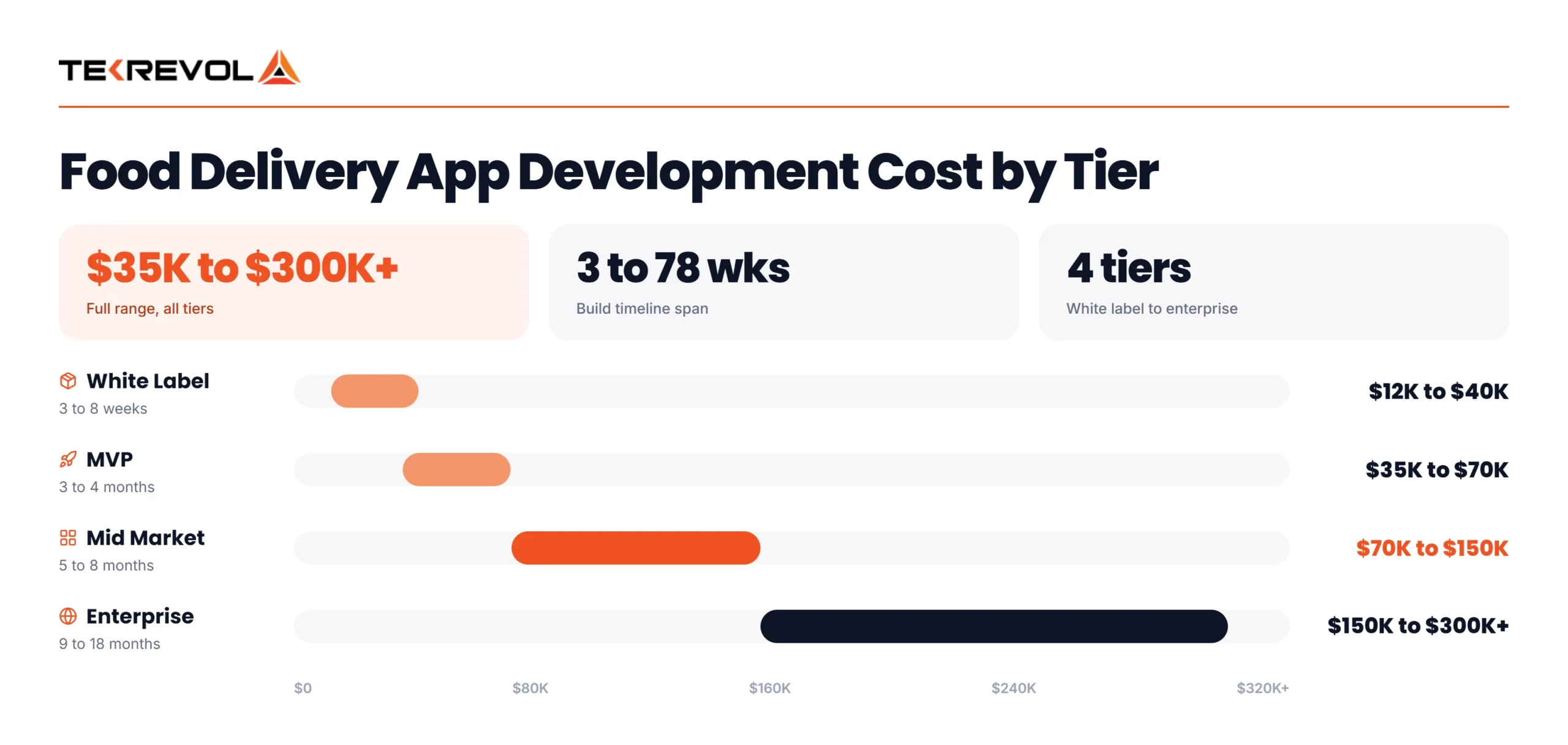
Food delivery app development cost ranges from $35,000 for a single-restaurant MVP to $300,000 or more for a multi-city marketplace with its own delivery fleet. Most launches land between $70,000 and $150,000 for a four-module build with real-time tracking and payments.
| Build tier | What you get | Cost | Timeline |
| White-label/clone | Licensed platform, your branding, limited customization | $12,000 – $40,000 | 3 – 8 weeks |
| MVP | Customer app, basic admin, one city, one platform | $35,000 – $70,000 | 3 – 4 months |
| Mid-market | Four modules, live tracking, multi-zone, both platforms | $70,000 – $150,000 | 5 – 8 months |
| Enterprise | Multi-country, own fleet, AI routing, custom logistics | $150,000 – $300,000+ | 9 – 18 months |
The market backdrop shapes what investors expect you to build. Statista projects worldwide Online Food Delivery revenue will reach US$1.51 trillion in 2026, up 9.5% year over year. That growth is why the feature bar keeps rising, and why a 2022 feature set no longer clears it.
Sitting on a Range Instead of a Number?
Send us your feature list and launch cities. We'll come back with a line-item estimate within three working days, with no sales call required.
Get Your Free Cost Estimate →What Types of Food Delivery Apps Are There and What Does Each Cost?
Food delivery apps split into six types, and each carries its own price band. Single-restaurant apps start near $35,000. Marketplace aggregators run $80,000 to $200,000. Full-stack platforms with owned delivery fleets push past $280,000 because logistics software costs more than ordering software.
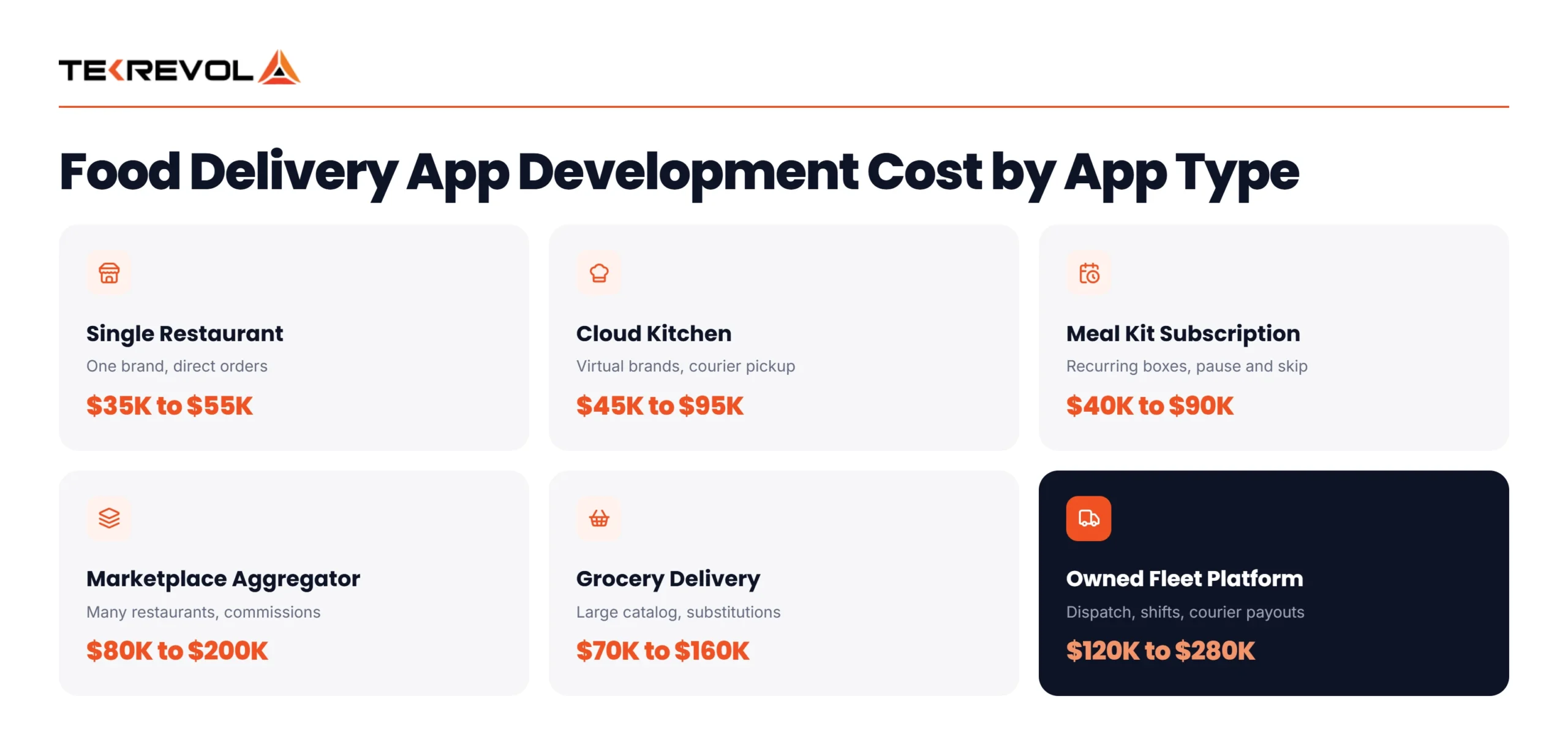
Picking your type is the first budget decision you’ll make, and it locks in most of the others.
| App type | What it does | Development cost |
| Single-restaurant / branded app | One brand, own kitchen, direct orders | $35,000 – $55,000 |
| Cloud kitchen app | Virtual brands, no storefront, pickup by courier | $45,000 – $95,000 |
| Meal-kit subscription | Recurring boxes, plan management, pause and skip | $40,000 – $90,000 |
| Marketplace aggregator | Many restaurants, third-party couriers, commissions | $80,000 – $200,000 |
| Grocery and convenience delivery | Huge catalog, substitutions, weight-based pricing | $70,000 – $160,000 |
| Full-stack with owned fleet | Own couriers, dispatch engine, shift scheduling | $120,000 – $280,000 |
Notice the jump between an aggregator and a full-stack platform. Owning your fleet means dispatch logic, courier onboarding, shift management, earnings calculations, and payout rails. That’s a second product living inside your first.
Restaurant groups often assume they need the marketplace version. They usually don’t. Running three locations under one brand, a branded ordering app plus a solid loyalty layer beats a marketplace build at a third of the price. We walk through this in our guide to the top food delivery app ideas that are trending right now.
How Does the Food Delivery Business Model Affect Development Costs?
Food delivery business models change development costs by shifting where the complexity sits. Commission marketplaces need multi-vendor payment splitting and payout engines. Owned-fleet models need dispatch and routing software. Hybrid models need both, which is why they price highest.
The model isn’t a marketing decision. It decides which systems you’re on the hook to build, so settle it first.
| Business model | Where the cost hides | Typical build |
| Commission marketplace | Multi-vendor payouts, split payments, tax handling per vendor | $80,000 – $200,000 |
| Delivery-fee only | Simpler money flow, heavier pricing and zone logic | $60,000 – $130,000 |
| Owned fleet | Dispatch engine, routing, courier shifts, earnings, payouts | $120,000 – $280,000 |
| Hybrid (own fleet plus partners) | Everything above, running in parallel | $150,000 – $300,000+ |
| Subscription membership | Billing cycles, entitlement checks, churn tooling | $55,000 – $120,000 |
| White-label licensing | Configuration and branding only | $12,000 – $40,000 |
Commission marketplaces feel cheap on paper and get expensive in the payout layer. Every restaurant is a separate payee with its own tax situation, settlement schedule, and dispute history. That’s weeks of engineering nobody quotes for.
Owned-fleet models flip it. Payments get simpler because the money flows to you, but now you’re building dispatch. Assigning the right courier to the right order in under two seconds, while accounting for traffic, prep time, and batching, is genuinely difficult software. Before you pick, read our step-by-step guide to starting a food delivery business, because the operational model and the software model need to match.
What Features Affect Food Delivery App Development Cost?
Features affect food delivery app development cost unevenly. Login, menus, and checkout are cheap and predictable. Live GPS tracking, dispatch automation, and multi-vendor payment splitting are where budgets break, because each one touches several systems at once.
Here’s how we split it during scoping. MVP features ship in version one. Everything else waits.
MVP features you can’t launch without:
| Feature | Cost |
| Sign-up, login, profiles | $2,500 – $5,000 |
| Restaurant and menu browsing with filters | $4,000 – $9,000 |
| Cart and checkout | $4,000 – $8,000 |
| Payment gateway integration | $4,000 – $10,000 |
| Order placement and status updates | $5,000 – $11,000 |
| Basic live order tracking | $6,000 – $14,000 |
| Push notifications | $2,000 – $4,500 |
| Ratings and reviews | $2,500 – $5,500 |
Version-two features worth waiting for:
| Feature | Cost |
| Loyalty and rewards program | $7,000 – $18,000 |
| Scheduled and recurring orders | $5,000 – $12,000 |
| Group ordering and bill splitting | $8,000 – $17,000 |
| Multi-language and multi-currency | $6,000 – $15,000 |
| In-app chat between customer, courier, and support | $7,000 – $16,000 |
| Advanced analytics dashboards | $9,000 – $22,000 |
Live tracking is the one people underestimate most. It isn’t a map with a pin. It’s a location pipeline, socket infrastructure, battery-aware polling on the courier device, ETA prediction, and a fallback for when GPS drops in a parking garage. Our complete roadmap to food delivery app development covers the feature sequencing in depth.
How Much Does Each Food Delivery App Module Cost?
Each food delivery app module carries its own budget. The customer app runs $28,000 to $55,000, the driver app $16,000 to $30,000, the restaurant panel $18,000 to $34,000, the admin dashboard $12,000 to $24,000, and the backend $26,000 to $48,000.
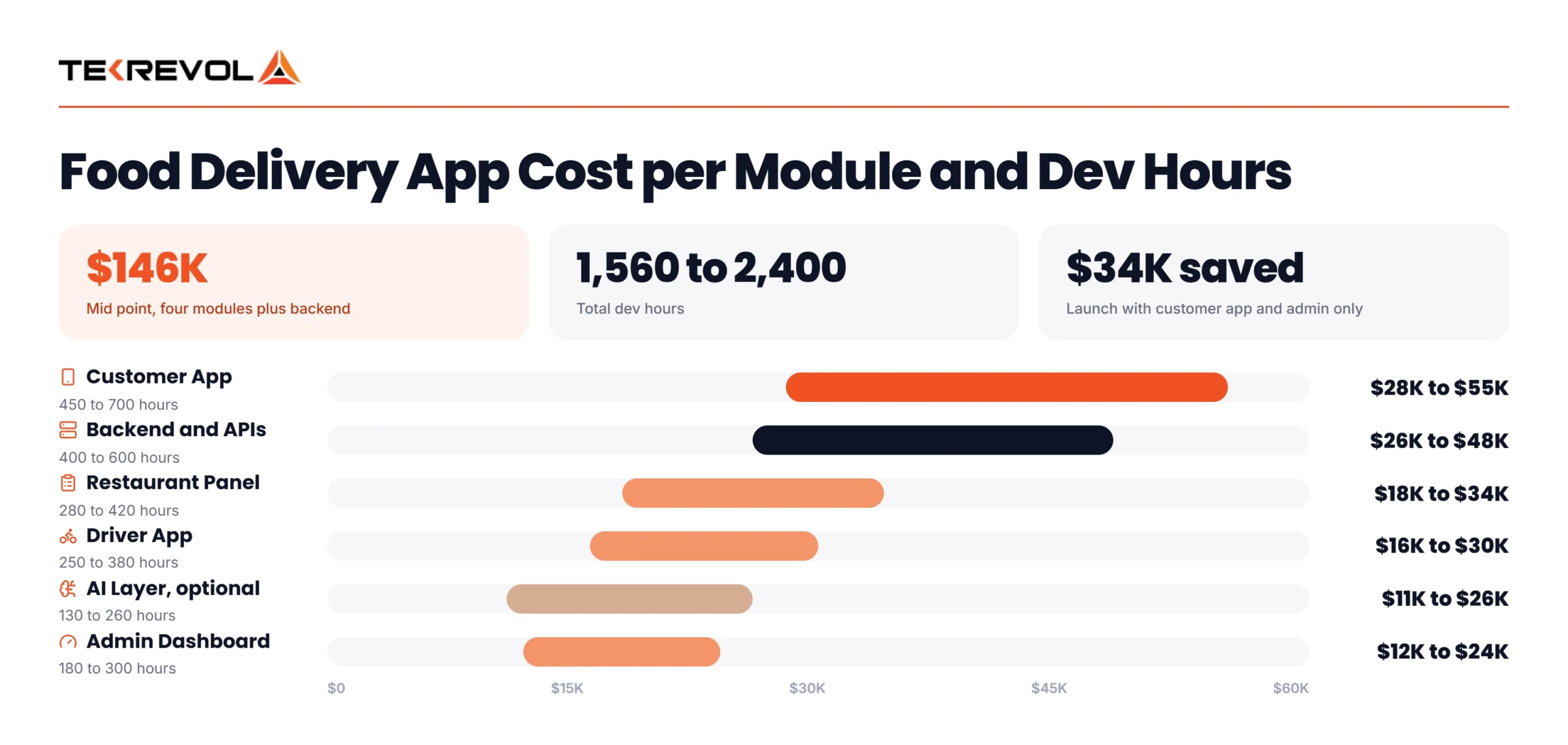
Most quotes hide this breakdown, which is why projects go sideways. Here’s a mid-market build opened up.
| Module | Dev hours | Cost | What’s inside |
| Customer app (iOS + Android) | 450 – 700 | $28,000 – $55,000 | Browse, order, pay, track, rate, reorder |
| Driver app | 250 – 380 | $16,000 – $30,000 | Job acceptance, navigation, proof of delivery, earnings |
| Restaurant/vendor panel | 280 – 420 | $18,000 – $34,000 | Menu control, order queue, prep times, promos, payouts |
| Admin dashboard | 180 – 300 | $12,000 – $24,000 | Users, disputes, commissions, zones, reporting |
| Backend, APIs, infrastructure | 400 – 600 | $26,000 – $48,000 | Auth, order engine, notifications, integrations, scaling |
| AI / ML layer (optional) | 130 – 260 | $11,000 – $26,000 | Recommendations, ETA prediction, routing |
Add the middle of each range, and you’re at roughly $146,000 for a four-module platform with a dedicated backend that won’t fall over. That’s the honest mid-market number.
You can launch with fewer modules. Plenty of clients start with the customer app and admin panel only, handling restaurants over WhatsApp and couriers through a third-party fleet API. It saves around $34,000 in year one.
What Factors Affect the Final Food Delivery App Development Cost?
Factors affecting the final food delivery app development cost include your team’s location, design complexity, compliance requirements, third-party integrations, and how often the scope changes. Team location alone can swing the same project by a factor of four.
Team’s location
Where your engineers sit is the biggest multiplier. Same specification, same quality bar, wildly different invoice.
| Region | Blended hourly rate | Mid-market build total |
| United States and Canada | $110 – $180 | $180,000 – $320,000 |
| Western Europe and UK | $85 – $140 | $140,000 – $260,000 |
| Eastern Europe | $45 – $75 | $80,000 – $150,000 |
| Latin America | $40 – $70 | $75,000 – $140,000 |
| South Asia | $25 – $50 | $55,000 – $110,000 |
Beyond geography, four things move the needle:
Design complexity
A template-driven interface costs $6,000 to $14,000. Custom motion, illustrated states, and a full design system run $25,000 to $60,000.
Compliance
PCI-DSS for card handling, GDPR or CPRA for user data, plus food-safety record keeping in some markets. Expect $8,000 to $30,000 by jurisdiction.
Third-party integrations
POS systems are the quiet budget killer. Square and Toast have clean APIs. Legacy restaurant systems often don’t, and each custom connector runs $4,000 to $15,000.
Scope drift
A mid-build feature request costs two to three times what the same feature costs planned upfront, because it means reopening finished work. This line damages more budgets than any other.
Native vs Cross-Platform vs White-Label: Which Costs Less?
Native builds cost the most, cross-platform saves 30% to 40% on the same feature set, and white-label is cheapest upfront but carries recurring licensing fees. For most food delivery launches in 2026, cross-platform is the right call on both cost and speed.
| Approach | Upfront cost | Time to launch | Year-two cost | Best fit |
| Native iOS + Android | $90,000 – $220,000 | 6 – 12 months | Highest, two codebases | Heavy device features, long-term scale |
| Cross-platform (Flutter, React Native) | $60,000 – $140,000 | 4 – 8 months | Moderate, one codebase | Most launches, most budgets |
| White-label/clone | $12,000 – $40,000 | 3 – 8 weeks | Licensing fee, limited control | Validating a market fast |
Cross-platform used to mean compromise. In 2026 it doesn’t. Flutter and React Native both handle live maps, background location, and payment SDKs at a quality diners can’t tell apart from native.
White-label is useful for validation. License a platform, run one city for six months, learn what your market wants, then build custom with real data. The trap is staying on it too long, because you can’t ship a differentiating feature on someone else’s roadmap. Teams weighing this usually benefit from talking it through with a cross-platform app development company first.
How Much AI Integration Add to Food Delivery App Development Cost?
AI features add $11,000 to $45,000 per capability to food delivery app development costs, plus ongoing inference bills. A recommendation engine runs $12,000 to $30,000 to build and $200 to $1,500 monthly. Route optimization costs more on both counts.
| AI feature | Build cost | Monthly running cost |
| Personalized recommendations | $12,000 – $30,000 | $200 – $1,500 |
| Demand forecasting and ETA prediction | $15,000 – $35,000 | $300 – $2,000 |
| Route optimization and batching | $18,000 – $40,000 | $400 – $3,000 |
| AI customer support agent | $8,000 – $22,000 | $250 – $2,500 |
| Voice and conversational ordering | $20,000 – $45,000 | $500 – $4,000 |
The monthly column is the part nobody plans for, and it’s getting worse. Gartner predicted in August 2026 that AI inference costs per agentic workflow will increase more than fivefold through 2028. Our artificial intelligence development service starts with a discovery sprint rather than bolting models on later.
How Long Does It Take to Develop a Food Delivery App?
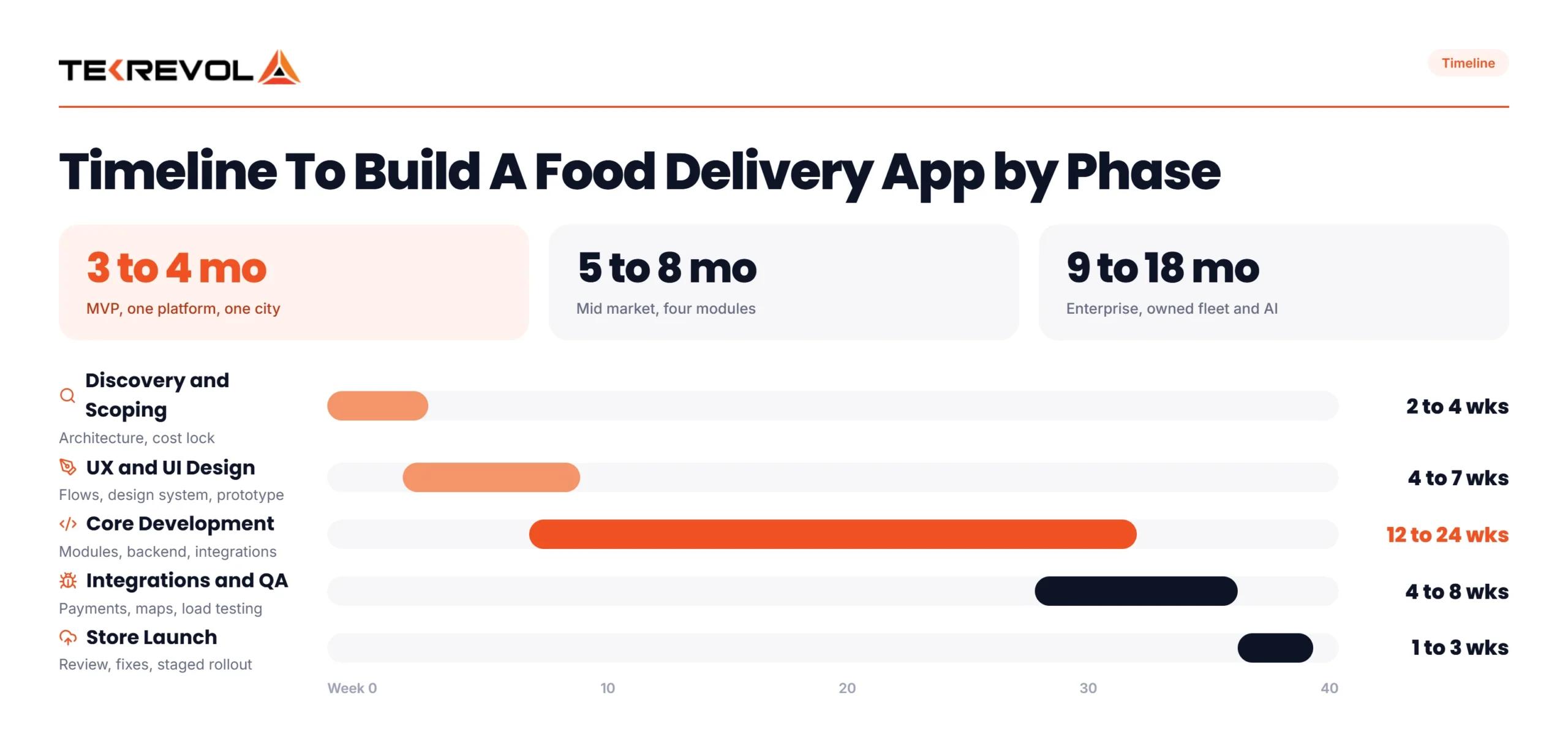
Developing a food delivery app takes 3 to 4 months for an MVP, 5 to 8 months for a mid-market four-module platform, and 9 to 18 months for an enterprise build with owned-fleet logistics and AI. Discovery and design consume the first 6 to 11 weeks.
| Phase | Duration | What happens |
| Discovery and scoping | 2 – 4 weeks | Requirements, architecture, cost lock |
| UX and UI design | 4 – 7 weeks | Flows, wireframes, design system, prototypes |
| Core development | 12 – 24 weeks | All modules, backend, integrations |
| Integrations and QA | 4 – 8 weeks | Payments, maps, POS, load testing |
| Store submission and launch | 1 – 3 weeks | Review, fixes, staged rollout |
These phases often overlap, so the total project timeline is shorter than the sum of each individual phase.
Timeline and cost are the same conversation. Compressing a six-month build into four means adding engineers, which raises cost per feature rather than lowering it. We’d rather ship a smaller version on the original date.
Worth planning around too: Apple’s review is fast now, but delivery apps with background location and payment features get looked at harder than average, so leave a week of slack.
What Hidden Costs Should You Expect After Launch?
Hidden costs after launching a food delivery app include cloud hosting, mapping API calls, SMS and push delivery, payment processing fees, app store charges, and legal work. Together they typically run $1,000 to $8,000 monthly before you spend a cent on marketing.
| Cost item | Typical amount |
| Apple Developer Program | $99 per year |
| Google Play Console | $25 one-time |
| Payment processing | 2.9% + $0.30 per transaction (Stripe’s published US rate) |
| Cloud hosting and CDN | $400 – $3,000 per month |
| Maps, geocoding, routing APIs | $200 – $2,500 per month |
| SMS and push infrastructure | $150 – $1,200 per month |
| Support desk software | $100 – $800 per month |
| Legal, terms, courier contracts | $3,000 – $12,000 one-time |
| App store optimization and launch marketing | $2,000 – $15,000 per month |
Mapping APIs surprise people the most. Every route calculation, address lookup, and ETA refresh is a billed call. An app doing 5,000 orders a month can easily make 80,000 mapping requests, because tracking screens refresh constantly.
The fix is architectural, not commercial. Cache aggressively, batch geocoding, throttle tracking refresh by distance remaining, and route non-critical lookups through a cheaper provider. We’ve cut mapping bills by more than half on live apps doing exactly this.
How Can You Reduce Food Delivery App Development Costs?
Reducing food delivery app development cost comes down to cutting scope before you cut quality. Launching one platform, building cross-platform, using proven third-party services instead of custom builds, and freezing scope during development typically save 30% to 45%.
Seven things that reliably work:
- Launch on one platform first. Check where your customers actually are. Shipping iOS-only or Android-only for six months saves 30% to 40% and halves your QA surface.
- Build cross-platform. One codebase, one team, one release cycle. The savings compound every year you maintain it.
- Rent instead of building. Payments, maps, notifications, chat, and analytics all have mature providers. Custom versions cost five figures and rarely perform better.
- Freeze the scope. Agree a feature list, sign it, park everything else in a version-two document. This habit saves more than every other item here combined.
- Start with two modules. Customer app and admin panel. Manage restaurants manually until manual hurts.
- Use a third-party fleet at first. An existing courier network delays building dispatch software by a year and lets you test demand cheaply.
- Design with a system, not screen by screen. A component library costs more upfront and pays back by your fourth screen. If a website is part of the plan, our breakdown of what it costs to develop a food ordering website shows where the two budgets overlap.
Why Choose TekRevol for Food Delivery App Development?
TekRevol builds food delivery and on-demand platforms end-to-end, covering customer apps, driver apps, restaurant panels, dispatch backends, and the AI layer on top.
Food delivery is an on-demand logistics problem wearing a restaurant menu, and the hard parts: dispatch under load, location accuracy when signal drops, payouts that reconcile, and an order state machine that never leaves a customer guessing.
Our mobile app development services shipped that architecture repeatedly. Multi-Restaurant Food Delivery gave us video-first discovery inside a live ordering flow. Reck’N proved the restaurant side, lifting bookings 25%.
The commercial side is straightforward too. We scope in line items, not lump sums, so you can see which feature carries which cost and decide what stays. If something isn’t earning its place, we’ll say so before you pay for it. That’s how we approach broader engagements as well.
Ready to Turn Your Range Into a Real Number?
Tell us your model, launch city, and must-have features. We'll send back a line-item estimate with timelines and a version-two roadmap.
Schedule a Free Food Delivery App Consultation →


