



- The six main mobile app monetization strategies are freemium, subscription, in-app purchases, paid apps, ads, and enterprise licensing.
- Freemium suits viral consumer apps, while subscriptions work best for high-engagement utility and productivity apps.
- Your monetization model should be planned before development because it impacts app architecture, onboarding, and UX.
- ARPU, LTV, churn rate, and free-to-paid conversion rate are the key metrics that measure monetization success.
- Rewarded video ads generate higher revenue and better user experience than traditional banner ads.
- TekRevol helps businesses choose the right monetization strategy early to build apps optimized for revenue from day one.
Most apps do not fail because of bad features. They fail because of wrong monetization.
The #1 mistake founders make is picking a pricing model after the app is built. By then, the onboarding flow is designed for the wrong conversion goal. The feature set is structured around the wrong value exchange. The backend is missing the infrastructure that the right model requires. Fixing it means rebuilding, at full cost.
Mobile app monetization strategies are not a post-launch decision. They are an architectural decision. The model you choose determines which features get built first, how users experience the product in the first 60 seconds, and whether your retention curve goes up or down after week one.
There are six viable app pricing models in 2026, and each one works for specific app categories, audience types, and business goals. Choosing the wrong one does not just cost revenue. It actively destroys the product-market fit you worked to build.
This guide gives you the full decision framework. Model by model. Use case by use case. With the metrics to know if it is working. Partnering with an experienced mobile app development company that understands monetization architecture before development begins is the fastest path to a product built for sustainable revenue.
Why Must Monetization Strategy Come Before Development?
Monetization strategy must be decided before development because it directly shapes your app’s onboarding flow, feature architecture, backend systems, and long-term retention strategy. Changing the monetization model after launch is not a simple pricing update; it often requires rebuilding major parts of the product.
This is the most consistently underestimated decision for any Android app development company. Founders often treat monetization as a marketing decision when, in reality, it is a product and engineering decision from day one.
Why the sequence matters:
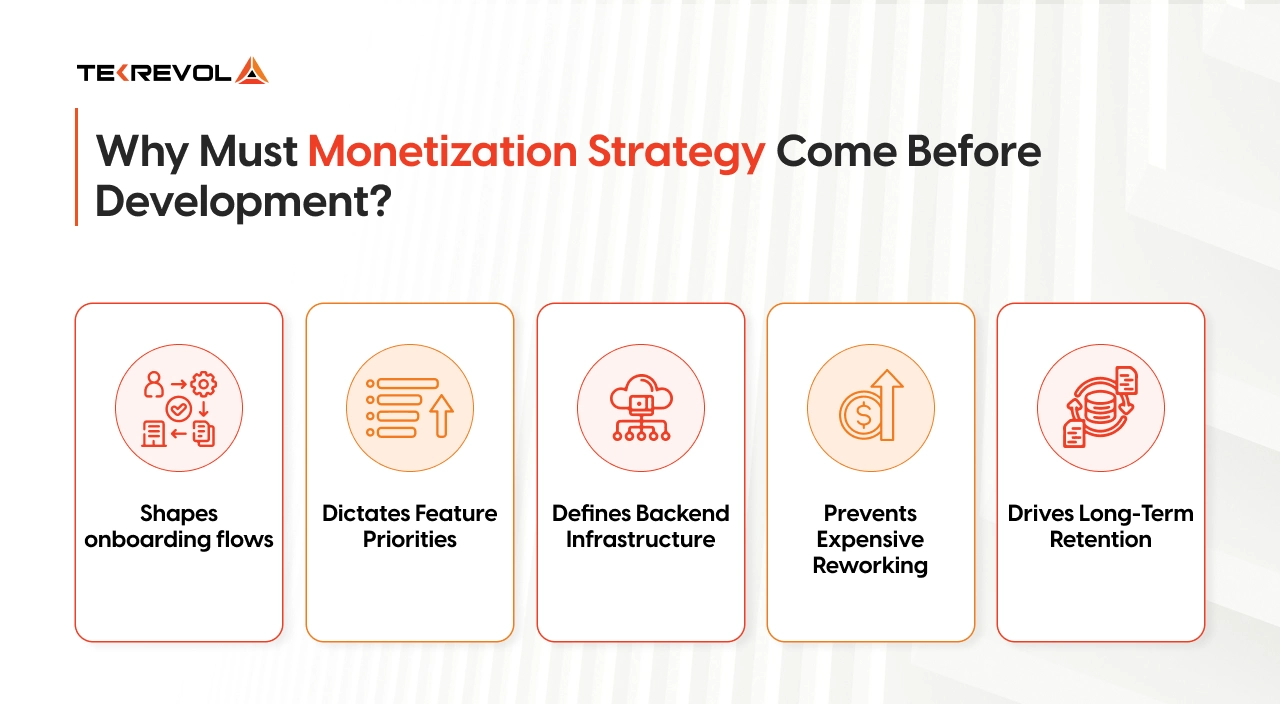
Onboarding flow changes based on the model
A subscription app must prove value within the first 7–14 days before the paywall appears. A freemium app needs to balance free value with premium incentives. An IAP-based app must make purchases feel natural instead of forced.
Feature priorities become completely different
Subscription apps invest heavily in daily-use and habit-forming features to reduce churn. Freemium apps focus on viral adoption while reserving advanced functionality for premium users. Both models require different product strategies.
Backend infrastructure depends on monetization
Subscriptions require billing integrations, receipt validation, trial management, and renewal handling. IAP models need consumable purchase management and server-side verification. Ad-based apps require SDK integrations, GDPR consent systems, and ad mediation layers.
Switching later becomes expensive
Retrofitting monetization systems after launch adds technical debt, increases instability, and delays growth. Even On-demand app development companies spent years refining their monetization architecture.
The smarter approach is simple: decide the revenue model first, then build the product around it. To align your revenue expectations with your actual production budget, must know your mobile app development cost before entering the design phase.
Not Sure Which Monetization Model Fits Your App Idea?
TekRevol helps founders identify the right pricing, revenue, and product strategy before development begins—ensuring your app is built for sustainable growth and profitability.
Book a Free Strategy Session →What Are the 6 Main Mobile App Monetization Strategies?
The six main mobile app monetization strategies are free with in-app purchases, freemium with premium upgrade, subscription, paid upfront, in-app advertising, and B2B enterprise licensing. Each is suited to different app categories, audience sizes, and revenue goals.
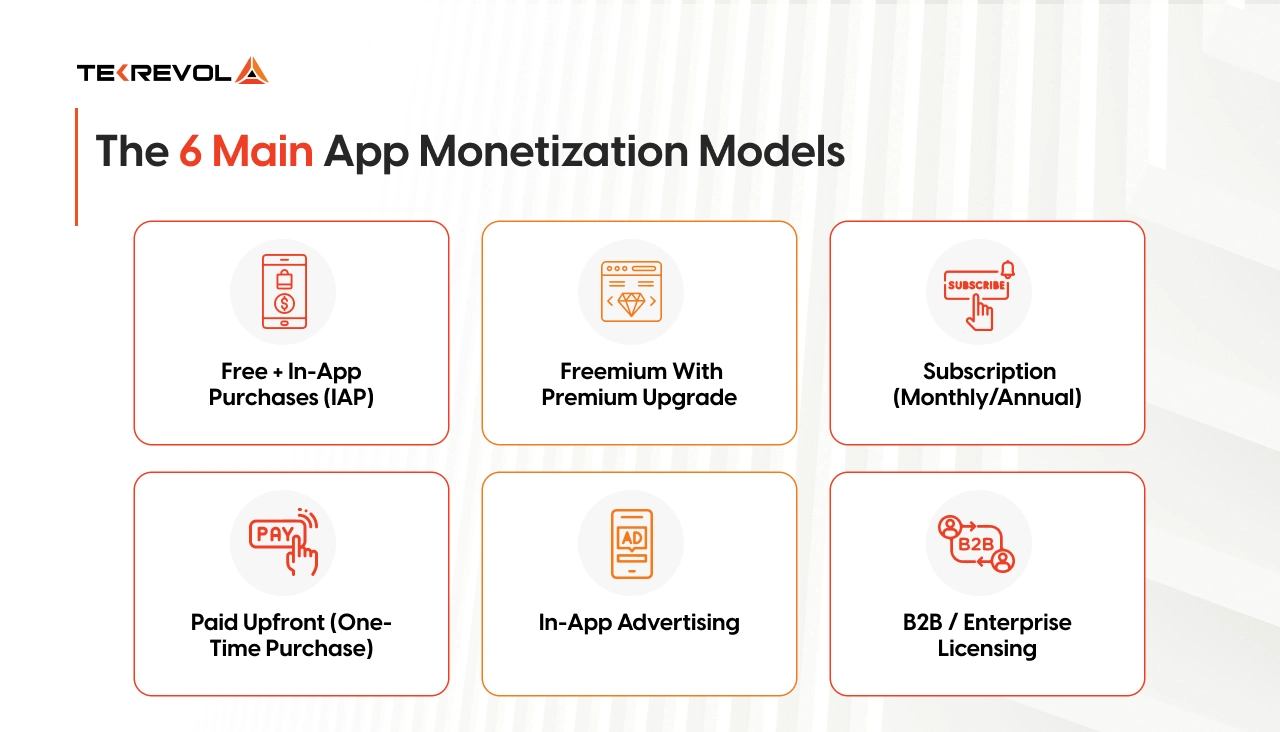
Here is the comparison overview before each model is examined in depth:
| Model | Best For | Revenue Potential | User Friction | App Store Cut |
| Free + IAP | Gaming, utilities, tools | High at scale | Low entry, variable | 15–30% per transaction |
| Freemium + Upgrade | Consumer apps, social | Medium-High | Low entry | 15–30% on upgrade |
| Subscription | Productivity, media, fitness | Highest LTV | Medium (trial needed) | 15–30% (15% after year 1) |
| Paid Upfront | Professional tools, niche | Low volume, high margin | High (pay before use) | 15–30% per sale |
| In-App Advertising | High-volume consumer apps | Low-Medium | Low | None |
| B2B/Enterprise | SaaS, internal tools | Highest per account | Low (procurement) | Direct billing |
Free + In-App Purchases (IAP)
The dominant model in mobile gaming is increasingly common in consumer utility apps. The app is free to download. Revenue comes from purchases made inside the app.
- Consumable IAP: items that are used up and can be repurchased — coins, credits, energy, boost items. The core of most gaming monetization.
- Non-consumable IAP: one-time permanent unlocks — a filter pack, a feature module, and removing ads. Purchased once, owned permanently.
- Subscriptions via IAP: App Store and Google Play both process subscriptions through the same IAP infrastructure, though they are managed separately from one-time purchases.
Apple and Google both take 15–30% of IAP revenue. Apple’s Small Business Program reduces this to 15% for developers earning under $1 million per year annually. Google Play matches this structure.
This approach is highly effective for on-demand app development services, where users frequently pay for immediate transactions, premium delivery slots, or micro-services within a free interface.
Freemium with Premium Upgrade
The app is free with a limited feature set. Users upgrade to a paid tier for full access. The free tier serves as the acquisition funnel; the premium tier is the revenue engine.
LinkedIn is the clearest large-scale example, free for basic networking, premium for recruiter tools, job applicants, and sales intelligence. Spotify uses freemium with shuffle-only, ad-supported listening as the free tier and on-demand listening as the paid tier.
The critical design challenge: the free tier must be good enough to acquire and retain users with premium quality mobile app maintenance and support, but limited enough that premium feels genuinely worth paying for. Getting this balance wrong in either direction kills conversion.
Subscription (Monthly/Annual)
Users pay a recurring fee, monthly, annual, or both, for ongoing access. The highest LTV model is when churn is managed well. The model that Apple and Google most actively support through platform features (promotional offers, offer codes, family sharing).
Duolingo, Headspace, and most fitness apps use subscription as their primary model. The recurring revenue predictability makes it the most investor-friendly model and the most sustainable for products with high content or operational costs.
Annual subscriptions are typically priced at a 30–50% discount vs. monthly equivalents. The conversion from monthly to annual is one of the highest-leverage revenue moves available post-launch; it locks in LTV and dramatically reduces churn.
Paid Upfront (One-Time Purchase)
Users pay once to download. No ongoing subscription, no IAP. Common in professional tools, creative software, and niche utility apps, where the user base is small but highly motivated.
Facetune launched as a paid app at $3.99 and became one of the top-grossing apps in the App Store before transitioning to a subscription. The paid model works when the use case is clear, the audience has high intent, and the App Store category is not dominated by free alternatives.
The challenge: discoverability. Free apps consistently outperform paid apps in App Store search because a significant portion of users filter by free. Paid upfront requires strong word-of-mouth or paid acquisition to reach critical mass.
In-App Advertising
The app is free. Revenue comes from ads displayed to users. Formats include banner ads (low CPM, low friction), interstitial ads (higher CPM, high friction), rewarded video (highest CPM, user-initiated), and native ads (integrated into content feed).
This model works at scale. It requires large monthly active user counts to generate meaningful revenue at typical mobile CPM rates ($1–$10 CPM for most categories, $5–$30 for rewarded video). For apps with fewer than 100,000 MAU, advertising rarely generates enough revenue to justify the UX cost.
B2B / Enterprise Licensing
Enterprise apps are priced entirely differently from consumer apps. Direct contracts, seat-based pricing, annual licensing, and custom enterprise agreements are the standard, not App Store transactions.
Pricing is typically $15–$200 per user per month, depending on the category, feature depth, and enterprise contract size. Security, compliance documentation, SSO integration, and SLA commitments are the features enterprise buyers pay for, not UI polish.
Freemium vs. Subscription: Which Is Right for Your App?
Freemium is right for consumer apps with viral growth potential and large total addressable markets. Subscription is right for utility and productivity apps with high daily active use, where users build a habit that makes cancellation painful.
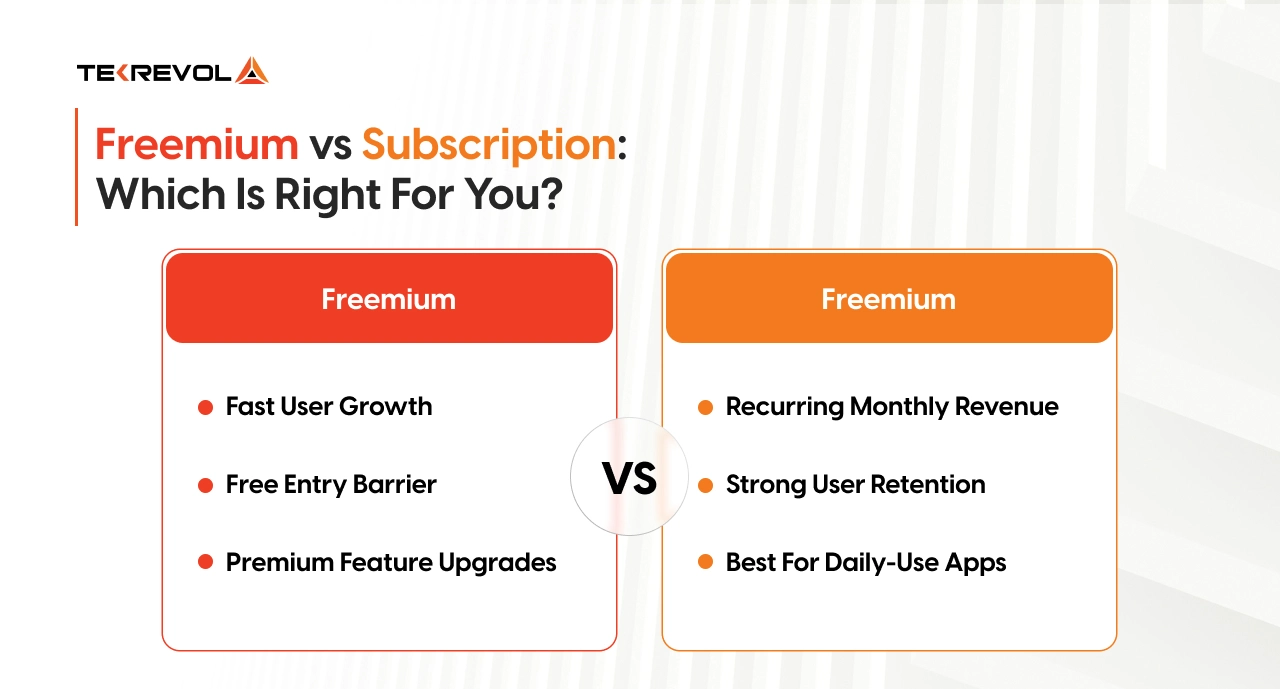
This is the most common decision founders face, and the most commonly made incorrectly. Here is the decision framework:
Choose Freemium When:
- Your app has genuine viral mechanics, users invite other users, share content, or the product improves with more users
- The total addressable market is large, and the funnel economics work at 2–5% conversion (you need scale to make 2–5% conversion meaningful)
- The free experience genuinely stands alone; users get real value without ever paying
- Discovery is your primary growth challenge; you need the frictionless entry point that free provides
- Your app category is dominated by free competitors; entering paid in a free-dominated market limits acquisition severely
Best examples: Spotify (freemium with subscription upgrade), LinkedIn (freemium with premium tiers), Dropbox (freemium with storage-based upgrade).
Choose Subscription When:
- Your app solves a recurring problem users encounter daily or weekly
- Users build a workflow dependency on the product — cancellation would disrupt their daily routine
- You have ongoing content, data, or service costs that require recurring revenue to sustain
- Your category benchmarks suggest users expect and accept subscription (fitness, meditation, language learning, productivity)
- You need predictable MRR to model growth and fundraise
Best examples: Headspace ($12.99/month), Duolingo ($6.99/month), Calm ($14.99/month), Notion ($8/month per user).
The Hybrid Model
Most mature consumer apps use freemium as acquisition + subscription as revenue. Duolingo is free with a subscription that removes ads and adds streak repair.
Spotify is freemium with a subscription that removes ads and adds on-demand listening. The hybrid model is often the right answer, but it requires more complex product architecture to execute well.
The Decision Framework
| App Category | Recommended Model | Reason |
| Social / Community | Freemium | Viral growth requires free entry |
| Productivity / Utility | Subscription | Daily use builds cancellation pain |
| Fitness / Wellness | Subscription | Habit formation justifies recurring |
| Gaming | Free + IAP | Consumable mechanics drive repeat purchase |
| Media / Content | Freemium + Subscription | Sample content drives conversion |
| B2B Tools | Subscription / Enterprise | Per-seat scales with customer growth |
| Professional Tools | Paid Upfront or Subscription | High intent, willing to pay |
How Do You Design In-App Purchases That Actually Convert?
In-app purchases convert best when the value is immediately tangible, the purchase fits naturally into the user’s action at that moment, and the price ladder offers multiple entry points rather than one all-or-nothing decision.
Paywall Placement
The paywall should appear at the moment of highest intent, when the user has just experienced the core value of the product and wants more of it. Showing the paywall during onboarding, before the user understands what they are buying, consistently produces poor conversion.
Contextual paywall placement:
- After a user completes a task and encounters the next step locked
- After a user engages with a feature preview and wants the full version
- After a user hits a usage limit (5 free exports, 3 free projects)
Timing data from the App Store: users who experience the product for 3+ minutes before seeing a paywall convert at 2–4x the rate of users who see the paywall within the first minute.
The Value Ladder
Offer multiple price points rather than one. The value ladder gives users an entry point that matches their willingness to pay.
A well-structured IAP value ladder looks like:
- Small consumable: $0.99–$1.99 (low commitment, tests willingness to pay)
- Mid-tier bundle: $4.99–$9.99 (the volume driver)
- Premium bundle: $19.99–$29.99 (anchors the mid-tier as the obvious choice)
The premium option exists partly to make the mid-tier feel like a bargain. This is price anchoring, a standard conversion technique.
Consumable vs. Non-Consumable Design
Here is the difference between consumable and non-consumable design:
Consumable IAP: (coins, credits, energy)
It works in apps where spending is a frequent behavior, such as gaming, social features with currency mechanics. The design challenge: the consumption cycle must feel rewarding, not punishing. Users who feel coerced into consumable purchases churn and leave negative reviews.
Non-consumable IAP: (permanent unlocks, feature modules)
It works when the feature is genuinely valuable standalone. The design challenge: the unlock must feel like a meaningful upgrade, not just access to what should have been included.
What Are the Subscription Pricing Best Practices for 2026?
The best subscription pricing practices for 2026 are offering both monthly and annual tiers, using a 7-day free trial as the standard entry point. Also, pricing the annual plan at a 30–50% discount vs. the monthly, and implementing win-back offers for churned subscribers before accepting cancellation.
Monthly vs. Annual Pricing
The standard in 2026:
- Monthly: $5.99–$14.99 for most consumer subscription apps
- Annual: $39.99–$79.99 — equivalent to a 30–50% discount on the monthly
- Annual conversion rate target: 40–60% of subscribers by month 12
Annual subscribers churn at dramatically lower rates than monthly subscribers, typically 3–5% annual churn vs. 10–15% monthly churn for the same product. Moving subscribers from monthly to annual is one of the highest-leverage post-launch growth actions available.
Free Trial Design
The industry standard is a 7-day free trial for most consumer apps. 14-day trials are used for apps with a longer learning curve (project management, creative tools). 30-day trials are common in B2B.
Key free trial design principles:
- Do not require a credit card for trial start if possible — removes the highest friction point in trial conversion
- Send a push notification or email 2 days before the trial ends — the most converting action a subscription app can take
- The last day of the trial is the highest-converting moment — UI should reinforce the value delivered during the trial period
Reducing Churn
Churn rate is the silent killer of subscription revenue. Even a 5% monthly churn means losing 46% of subscribers annually.
Churn reduction tactics:
- Pause option instead of cancellation — users who pause are 3x more likely to return than users who cancel
- Win-back offer at cancellation — a one-time discount offer shown at the cancel confirmation screen converts 15–25% of at-risk subscribers
- Annual upgrade prompt at 3-month mark — users who have been monthly subscribers for 3 months are the highest-converting annual upgrade segment
- Engagement-based retention — users with high feature usage churn at dramatically lower rates; onboarding investment that drives feature adoption is churn prevention
App Store Subscription Guidelines
Apple’s App Store guidelines require: a free trial must provide full access to the subscription content; subscription price increases require explicit user consent; family sharing must be implemented for applicable subscriptions. Google Play’s requirements mirror most of these, with slight variations in consent flow requirements.
Apple reduces its subscription commission from 30% to 15% after a subscriber has been active for more than 12 months. This is a meaningful revenue event; plan for it in your financial model.
Ready to Build an App That Actually Makes Money?
TekRevol designs subscription systems, in-app purchase architecture, and freemium conversion strategies that are built into your product from day one—maximizing revenue and long-term user value.
Get a Free Revenue Strategy Session →When Does In-App Advertising Work — and When Does It Destroy UX?
In-app advertising works for high-volume consumer apps with 100,000+ MAU, where the user session frequency justifies ad exposure. It destroys UX and accelerates churn when applied to apps where users are in a focused or private context or when ad frequency outpaces value delivery.
Ad Format Economics (2026 Benchmarks)
| Format | Average CPM | User Friction | Best Use Case |
| Banner ads | $0.50–$2.00 | Low | Passive browsing apps |
| Interstitial ads | $3.00–$8.00 | High | Break points between actions |
| Rewarded video | $10.00–$30.00 | None (user-initiated) | Gaming, utility apps |
| Native ads | $2.00–$6.00 | Low | Content feed apps |
Rewarded video is the gold standard for app advertising monetization. Users choose to watch a 15–30 second video in exchange for in-app currency, extra lives, or feature access. CPM is 3–5x higher than interstitial ads, and user satisfaction is measurably higher. If advertising is part of your model, rewarded video should be the primary format.
When Advertising Is Appropriate
- High-frequency consumer apps where the session count generates sufficient impressions (news apps, weather apps, casual games)
- Apps where a free tier with ads serves as the acquisition funnel for a premium subscription upgrade
- Casual games are where a mobile game development company can integrate rewarded video ads naturally into the gameplay loop.
When Advertising Destroys Retention
- Healthcare and wellness apps — ads break the therapeutic context and signal that user data is monetized
- Finance and productivity apps — ads create a distraction in focused-work contexts and undermine premium positioning
- Apps with low session frequency — an app used twice per week cannot generate enough impressions to justify the retention cost of advertising
- Any app where the primary competitor is subscription-only — advertising signals a lower quality tier that makes premium conversion harder
How Does B2B App Pricing Work Differently?
B2B app pricing operates through direct contracts, seat-based or usage-based models, and annual licensing agreements rather than App Store transactions. Pricing typically ranges from $15–$200 per user per month, depending on feature depth and enterprise requirements.
Seat-Based Pricing
The most common B2B model. Price is per user per month. The incentive structure aligns well with customer growth, as the customer’s team expands, revenue scales automatically.
Typical seat-based price bands:
- SME tier: $15–$40/user/month
- Growth tier: $40–$80/user/month
- Enterprise tier: $80–$200/user/month (custom contract, includes SLA, SSO, compliance)
Usage-Based Pricing
Price is based on consumption — API calls, data volume, transactions processed. Common in developer tools, data platforms, and infrastructure products. Revenue scales directly with customer value delivery, which aligns incentives well. The challenge: revenue unpredictability makes financial modeling harder.
Flat Fee / Annual License
A fixed annual fee for unlimited seats or usage within a defined scope. Preferred by enterprise procurement teams because it simplifies budgeting. Typical range: $10,000–$150,000/year, depending on category and customer size.
What Enterprise Buyers Actually Pay For
Enterprise pricing is not primarily about features. It is about:
- Security documentation — SOC 2 Type II, ISO 27001, penetration test reports
- Compliance — GDPR, HIPAA, CCPA alignment with documented evidence
- SSO integration — Okta, Azure AD, Google Workspace
- SLA — uptime guarantees with financial penalties for breach
- Dedicated support — named account manager, defined response times
A product that lacks these capabilities cannot close enterprise deals, regardless of how good the features are. If your target customer is an enterprise, budget for compliance infrastructure from the start; it is not optional.
How Do You Choose the Right Monetization Model?
Choose your monetization model based on four factors: app category, expected daily active use frequency, audience size, willingness to pay, and whether your distribution is primarily organic or paid. These four variables predict which model maximizes LTV for your specific product.
Step 1: What is your app category?
- Gaming → Free + IAP (consumable)
- Productivity / Utility → Subscription
- Social / Community → Freemium + Subscription
- Professional Tool → Paid Upfront or Subscription
- B2B / Enterprise → Seat-based Subscription or Annual License
- Content / Media → Freemium + Subscription
Step 2: How often will users open the app?
- Daily → Subscription (habit creates cancellation pain)
- Weekly → Freemium or IAP (lower urgency to subscribe)
- Occasional → Paid Upfront or one-time IAP (no ongoing value delivery to justify subscription)
Step 3: What is your total addressable market?
- Large (millions of potential users) → Freemium to maximize top of funnel
- Niche (tens of thousands) → Paid or Premium subscription to maximize revenue per user
Step 4: What is your distribution model?
- Organic/viral → Freemium (free removes the barrier to sharing)
- Paid acquisition → Subscription (LTV must justify CAC)
- B2B sales → Enterprise licensing (sales cycle requires direct pricing)
Monetization Model Selection Matrix
| Daily Use | Large Market | Recommended Model |
| Yes | Yes | Subscription + Freemium |
| Yes | No | Subscription (premium) |
| No | Yes | Freemium + IAP |
| No | No | Paid Upfront |
What Metrics Tell You If Your Monetization Model Is Working?
The four metrics that tell you if your monetization model is working are ARPU (average revenue per user), LTV (lifetime value), churn rate, and free-to-paid conversion rate. Track all four from launch day, not after problems are already visible in revenue.
ARPU — Average Revenue Per User
ARPU = Total Revenue ÷ Total Active Users
ARPU benchmarks by category (2026):
- Casual gaming: $0.50–$2.00/month
- Subscription productivity apps: $5–$15/month
- Subscription fitness apps: $8–$15/month
- B2B SaaS: $30–$150/month per user
If your ARPU is significantly below category benchmarks, either your pricing is too low or your conversion rate from free to paid is underperforming.
LTV — Lifetime Value
LTV = ARPU × Average Subscription Duration (or purchase frequency × average order value for IAP)
LTV is the number that determines how much you can spend to acquire a user (CAC) and remain profitable. The standard benchmark: LTV should be at least 3x CAC for a sustainable business.
For subscription apps, LTV is directly tied to churn rate. Reducing monthly churn from 8% to 4% roughly doubles LTV. No single action has more revenue impact than churn reduction.
Churn Rate
Churn rate = subscribers lost in a period ÷ total subscribers at start of period
Healthy benchmarks:
- Consumer subscription apps: 3–7% monthly churn
- B2B SaaS: 1–3% monthly churn
- Fitness/wellness apps: 5–10% monthly (seasonal patterns affect this category significantly)
Monthly churn above 10% indicates a product-market fit or onboarding problem — not a pricing problem. Changing prices rarely fixes high churn.
Free-to-Paid Conversion Rate
For freemium and subscription apps, the conversion rate from free user to paying customer is the most important early indicator of monetization health.
Benchmark conversion rates:
- Consumer freemium apps: 2–5% is typical; above 5% is strong
- Productivity subscription apps: 5–15% from free trial to paid subscription
- B2B free trials: 15–30% from trial to paid is typical for well-qualified leads
Conversion rate below benchmark indicates one of three problems: the free tier provides too much value, the premium offer does not communicate clear value, or the paywall appears at the wrong moment in the user journey.
Why Do Businesses Choose TekRevol for Revenue-Driven App Development?
Businesses choose TekRevol for revenue-driven app development because TekRevol integrates a monetization strategy into the product discovery phase. It ensures that pricing model, onboarding architecture, paywall design, and subscription infrastructure are built into the product from day one, not retrofitted after launch.
Mobile app monetization strategies are not afterthoughts in a TekRevol engagement. They are discovery-phase decisions that shape every subsequent design and development choice.
Here is what that looks like in practice:
- Monetization discovery before wireframes: TekRevol’s discovery process includes a dedicated monetization workshop, mapping app category, audience profile, usage frequency, and competitive benchmarks to the optimal pricing model before any design work begins
- Subscription infrastructure built in: App Store Connect and Google Play Billing integration, receipt validation, trial state management, grace period handling, and offer code support, all architected from the first development sprint
- Paywall design that converts: TekRevol’s design team applies contextual paywall placement, value ladder structuring, and A/B testable paywall variants that are ready to optimize from launch
- IAP architecture for scale: consumable and non-consumable item management with server-side validation, preventing the receipt manipulation that costs poorly-architected IAP systems significant revenue
- B2B pricing implementation: seat-based billing, enterprise SSO integration, compliance documentation support, and usage-based metering for B2B and enterprise clients
- Post-launch metrics tracking: ARPU, LTV, churn rate, and conversion rate dashboards are built into the analytics layer, so monetization health is visible from the first week after launch
Whether you are building a consumer subscription app, a freemium social platform, or a B2B enterprise tool, the monetization model that is right for your product is one of the most consequential decisions you will make. Getting it right before development saves months of rework and hundreds of thousands of dollars in lost revenue.
The Right Monetization Model Changes Everything
Higher lifetime value, lower churn, and stronger recurring revenue start with the right strategy. TekRevol helps founders choose the best monetization model using real data, market insights, and proven growth frameworks.
Book Your Free Discovery Call →


![Hire a Dedicated App Development Team in Austin: Cost, Models & How to Choose [2026]](https://d3r5yd0374231.cloudfront.net/images-tek/uploads/2026/07/TekRevol-Dedicated-Team-Feature-Image-selection-1-400x208.jpg)


