


We’ve all been there, stuck in traffic, worried about a strange noise from the engine, or nearly missing that car in our blind spot. These daily driving headaches are exactly what AI is starting to fix.
AI in the automotive industry isn’t some distant future anymore. It is already present and has made our lives easier. With the support of professional AI development services, your vehicle can now give you a warning before you crash, inform you when it requires some service, and even park itself while you go and have a cup of coffee.
This is only the new beginning. The future of the automotive industry is quickly advancing to the point of cars becoming self-driving, accidents being an infrequent occurrence, and traffic congestion being a thing of the past.
This blog will explore the major advantages of AI in the automotive industry and how the future of AI as a technology will impact households, companies, and the industry generally.
So, let’s get started!
The Rising Impact of AI in the Automotive Industry: Market Insights
Artificial intelligence is changing every aspect of the automotive sector and turning vehicles smarter and dealerships more efficient. The effect is objective, quantifiable, and increasing at an alarming rate:
- Swift zarket Growth: The global market of AI in the automobile industry is projected to grow up to 7 billion dollars by 2027, which means that the world is switching to intelligent technology on a huge scale.
- Dealership Efficiency & Satisfaction: Approximately 68% of dealerships say that AI has enhanced customer service, streamlined workflow, and financial performance.
- Autonomous Driving Revenue: Autonomous driving could become a $300-$400 billion industry by 2035. This massive growth highlights AI’s incredible potential to reshape how we travel.
- Safety and Maintenance Experience: AI sensors and predictive maintenance software are reducing the number of accidents and car downtimes, making the roads safer for all.
These are important statistics that point to an alarming fact: AI technology in the automotive industry is not a technological upgrade; it is a solution to actual issues, whether production bottlenecks or road safety, and new avenues of revenue.
Ready to Drive Your Automotive Business Forward with AI?
Let our AI specialists accelerate your digital transformation with proven solutions.
Schedule a Consultation!How AI is Transforming the Automotive Industry at Every Level
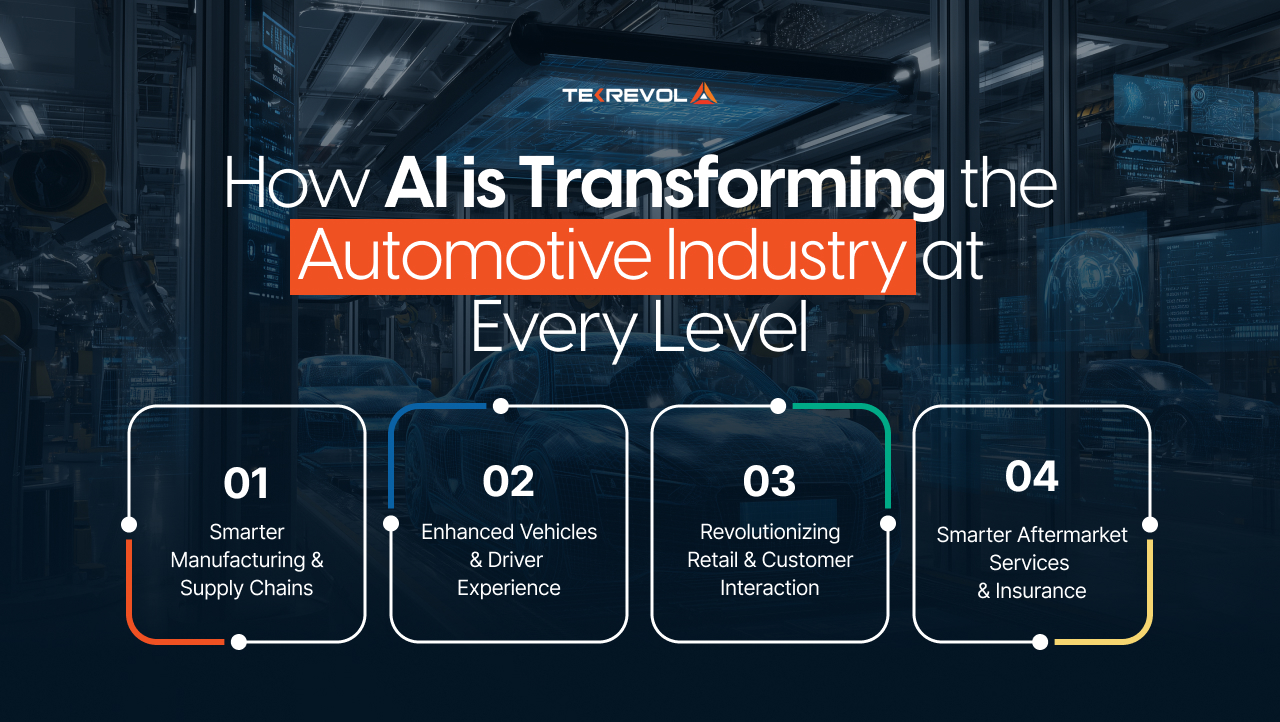
AI is transforming the way vehicles are manufactured, sold, and driven. Let’s discuss what is going on in the industry.
1. Smarter Manufacturing & Supply Chains
The AI is revolutionizing the processes of manufacturing and the supply chain of automotive products in the following manner:
- Real-Time Quality Control: AI-based robotics and computer vision will detect defects when they arise with minimal error that can rarely be detected by human inspection. This guarantees better cars and the reduction of recalls.
- Predictive Supply Chain Management: AI will make sure that the right parts are in place when needed, minimize wastage of time, and maximize storage to prevent slows in production.
- Massive Adoption: According to the industry research, 75 percent of original equipment manufacturers (OEMs) have already installed AI on their production lines to boost their efficiency and reduce downtimes.
2. Enhanced Vehicles & Driver Experience
The vehicles themselves are getting smarter, safer, and easier to operate:
- Advanced Driver Assistance Systems (ADAS): Artificial Intelligence is on the verge of leading technology that makes the functions of the lane-keeping assistance, adaptive cruise control, emergency braking, and driver supervision possible. The use of this system not only leads to a major safety enhancement but also adds to the overall comfort of the driver.
- Personalization: AI also learns driving patterns and preferences of individuals, adjusting the position of the seats, mirrors, climate control system, and in-car infotainment. Other vehicles can also react to voice recognition and movements so that the user experience is flawless.
- Connected and Autonomous Mobility: Cars and roads will gain the ability to communicate, and AI will turn into a tool that informs about real-time traffic conditions, potential threats, and even give a chance to take the first steps towards full autonomous driving.
3. Revolutionizing Retail & Customer Interaction
AI is completely transforming the process of car sales, service, and advertising:
- Virtual Showroom and Chatbots: future buyers can go online and browse cars, speak with AI chatbots, and be guided to purchase a car in real time, depending on their preferences and the history of their browsing.
- AI Funding and personalized Advice: AI will give recommendations of cars, financing, and options that will guarantee the client’s livelihood and budget compatibility. This minimizes buyer fatigue and quickens the purchasing process.
- Better Sales Metrics: Dealerships that use AI tools will have higher appointment booking, lead-to-sale conversion, and customer retention because of enhanced engagement.
4. Smarter Aftermarket Services & Insurance
AI’s benefits continue well beyond the showroom floor:
- Predictive Maintenance: AI will be applied to assist in monitoring the condition of a vehicle in real time, recognizing any early wear or breakages. Predictive alerts decrease the effects of sudden failures and minimize maintenance expenses.
- Automation in insurance and claims: AI-based image recognition handles claims faster. It assists the insurers in determining damage better and identifying fraudulent cases before they are paid.
- Better Customer Service: AI in the automobile industry may help the service centers make predictions about the parts demand in advance and offer vehicle owners with individual recommendations.
AI in the Automotive Industry: Benefits for Businesses and Consumers
The automotive industry is experiencing a faster rate of change than ever before through Artificial Intelligence. The whole automotive ecosystem is brought real value by this technology revolution. Here we’ve listed the benefits of AI in the automotive industry:
Benefits for Automotive Businesses
- In-House Product Development.
AI in the automobile industry drastically decreases the development times and expenses. With AI, simulation cycles are completed in minutes instead of days, allowing faster design improvements and better vehicle performance. Predictive modeling is also applied to battery development platforms to predict battery life, unlike the months of testing in the past.
- Manufacturing Excellence
The implementation of AI has brought quality control to new levels. The AI-based predictive maintenance system at Toyota resulted in a decrease of unplanned downtime by 30 percent and the improvement of the total equipment effectiveness by 25 percent.
- New Revenue Streams
The AI will enable the automobile manufacturers to transition to the software-as-a-service model instead of a hardware sale as a one-off. With the assistance of AI-powered functions and software, makers can sell subscription-based services, such as the advanced driving mode, advanced driver assistance, and high-quality in-car entertainment, which create new sources of income and sustained contact with customers.
- Better Retail Performance.
AI is changing the manner in which dealerships function. According to the analysis of customer behavior and preferences, AI allows the sales team to be more engaged, make appointments more efficiently, and offer a personalized experience, which results in better conversion and customer loyalty.
Benefits for Consumers
- Enhanced Safety
The ADAS driven by AI greatly minimizes the chances of accidents. The adaptive cruise control, the lane-keeping assistance, the automatic emergency braking, and the pedestrian detection are some of the features that assist a driver to remain safe. Fleet operators and regular drivers will have systems that are able to detect distracted or unsafe driving and take measures ahead of time.
- Predictive Maintenance & Cost Saving.
AI has the ability to discover possible problems even before they occur as minor ones, including defective sensors, tired brakes, or engine problems. Such a proactive strategy helps to reduce the downtime of the vehicles, maintain the smooth operation of the fleets, and minimize the unexpected expenses on maintenance.
- Individualized Driving Experience.
The modern cars are able to learn what the driver likes and change. AI personalizes the surroundings, works out the best routes, and gives real-time traffic information. I-powered voice assistants offer hands-free control of navigation systems, vehicle operations, and local search features, enhancing comfort and convenience throughout your drive.
- Environmental Impact
AI in automotive industry can also be used to optimize performance and maintenance of the vehicle, which results in fewer emissions, better energy efficiency, and waste. In the case of electric cars, AI also improves battery control, improving battery life and aiding in sustainability.
Key Strategies for Implementing AI in the Automotive Industry
AI in the automotive industry can transform the industry and develop superior experiences for customers. To be successful, companies need a properly structured plan, so here’s how you can implement AI in the automotive industry:
1. Set Clear Goals
Determine the business problems AI needs to address, be it the safety of the vehicles, the optimization of the production process, or the augmentation of the customer experiences. Focused goals help AI initiatives produce measurable results and align teams throughout the organization.
2. Build Scalable Infrastructure
Adoption of cloud-based solutions, edge computing, and IoT accessible systems would assist in dealing with massive data. Expansive infrastructure enables real-time analytics, smooth AI integration, and sustained expansion.
3. Create Cross-Functional Teams
Assemble engineers, data professionals, and business executives to develop functional AI. Professional teams are necessary to make sure that the projects are coordinated with the business goals and can be put into practice.
4. Leverage Technology Partners
Partner with an AI development company to access industry expertise, customized solutions, and faster deployment. Expert guidance reduces risks and keeps businesses competitive.
5. Start with Pilot Programs
Test AI solutions at a smaller scale to determine the performance, scale, and adoption by users. Pilots assist in system refinement, implementation risk mitigation, and maximization of the ROI.
6. Prioritize Cybersecurity
Protect sensitive data with encryption and regular audits. Strong cybersecurity ensures trust, compliance, and safe AI operations.
Power Your Automotive Company with AI That Delivers Results
Partner with TekRevol and turn AI's potential into your competitive advantage.
Connect With UsAI in Cars: Challenges, Ethics, and Best Practices
The revolution in the automotive industry influenced by Artificial Intelligence is significant, yet with the innovation, there are some significant challenges. The following are the major concerns and strategies to be used:
1. Cybersecurity Threats
Autonomous cars are based on inter-relationship and real-time information that can be victims to cyberattacks when it comes to driving them. Car controls can be manipulated by hackers, or sensitive information can be stolen.
To overcome these threats, automaker firms should introduce effective cybersecurity measures, which will entail encryption, secure communication systems, and constant monitoring of the system.
2. Ethical Considerations
Semi-autonomous and autonomous cars have complex ethical concerns. Who is operating the AI-driven decision in case of critical circumstances, the manufacturer, the software developer, or the owner of the vehicle? Ethical standards are transparent, and they will contribute to the achievement of accountable and responsible, and safe AI decisions.
3. Data Privacy
AI systems gather huge volumes of sensor, camera, and user feedback data. It is important to protect this data. The automotive companies should ensure that they only collect the information that they need, have a strict privacy policy, and give users control and transparency about the information that they have.
4. Transparency
Trust is key to AI adoption. The consumers should know the functioning of AI systems, the way of make decisions, and what information is used. Transparency brings about trust and encourages the use of autonomous technologies.
5. Testing and Regulation
AI systems are supposed to be tested in frequent conditions prior to deployment to ensure that they are reliable and safe. Government regulations and industry standards make the implementation ethical, responsible, and compliant.
6. Collaboration Across Stakeholders
Automakers, technology providers and regulators, and other stakeholders must collaborate in order to address AI issues. Sharing experience and finding a compromise on standards will ensure that AI solutions are safer and help innovate faster in the automotive sector.
The Future of AI in the Automotive Industry
The automotive sector is speeding into a new era, and at the heart of it is artificial intelligence (AI). With the global automotive‑AI market projected to grow from roughly USD 22 billion in 2025 to over USD 1788.4 billion by 2035, the transformation is both bold and inevitable. Below are the major trends reshaping the road ahead.
1. Smart Hardware & On‑board AI Chips
Car manufacturers are now specifically integrating dedicated AI processors into cars, not only to provide infotainment, but also to make real-time decisions, to control sophisticated lighting, as well as autonomous systems. This is a trend of the brain in the car and is becoming fundamental.
2. Software‑Defined Vehicles
Automobiles are changing into intelligent devices instead of being mechanical. Software is becoming just as significant as hardware, with such features as over-the-air updates and systems connected to the car itself..
3. Autonomous & Advanced driver‑assistance systems (ADAS)
AI is at the core of autonomy. From Level‑2 ADAS to full self‑driving, the industry is gearing up. The share of vehicles with autonomous features is set to rise sharply, driven by safety regulations and consumer demand.
4. Manufacturing, Supply Chain & Experience Optimization
In addition to the car, AI is also redefining the manufacturing, distribution, and maintenance of cars. Predictive maintenance, quality-control vision systems, and optimisation of the supply chain are providing benefits of efficiency and cost reduction. As one analysis found, AI could add over USD 215 billion of value for OEMs by 2025.
5. Generative AI & New Mobility Paradigms
Generative AI use cases in automotive industry are revolutionizing the sector. AI-driven models are now being used to design vehicles, personalize user experiences, and enhance service offerings. This advancement is opening up new opportunities for smarter, more adaptive vehicles and a more engaging experience for consumers.
The AI-Powered Road Ahead: Pioneering Automakers and Their Innovations
Modern vehicles are no longer just machines; they are becoming intelligent systems. Top automakers are leveraging AI to enhance safety and push the boundaries of autonomous technology.
| Automaker | AI Area of Focus | Notable Achievements |
| Tesla | Autonomous Driving & Vehicle Intelligence | Autopilot and Full Self-Driving features that improve through fleet learning. |
| BMW | Smart In-Car Systems & Safety | AI-driven personal assistant, predictive maintenance, and adaptive infotainment. |
| Nvidia | AI Computing & Autonomous Platforms | DRIVE platform powering autonomous vehicle operations and advanced AI processing. |
| Waymo | Autonomous Mobility & Ride-Hailing | Fully driverless fleets using AI for perception, navigation, and traffic decision-making. |
| Audi | Connected Vehicles & AI Assistance | AI-based traffic prediction, voice-activated systems, and automated driving support. |
| Mercedes-Benz | Intelligent Safety & Automation | AI for accident prevention, driver assistance, and enhanced comfort features. |
Boost Your Automotive Business with Tekrveol AI Solutions
The automotive industry is changing fast, and AI is at the center of this transformation. At Tekrveol, we help automotive companies use AI to stay competitive and innovate.
AI is revolutionizing every aspect of the automotive sector, from designing smarter vehicles to improving manufacturing efficiency, enhancing driver safety, and enabling predictive maintenance. Our custom AI solutions help you reduce costs, increase operational efficiency, and deliver exceptional customer experiences.
As a leading automotive app development company, we understand the challenges automotive businesses face. Our team combines technical expertise with industry knowledge to create AI platforms that deliver real results. We’ve helped companies reduce downtime and open up new revenue opportunities through innovative AI applications.
Future-proof your automotive business with TekRevol
Our team blends deep expertise with industry insights to deliver AI solutions that drive real, measurable results.
Book A FREE Consultation Now!




![How Does Hybrid App Monetization Work For Houston [Strategies, Models & Trends]](https://d3r5yd0374231.cloudfront.net/images-tek/uploads/2026/02/Hybrid-App-Monetization.jpg)


