- Enterprise app development costs $45,000 to $800,000+ in 2026, based on integrations and compliance load.
- Old legacy systems, not features or design, are usually the single biggest line item in your budget.
- Rules like HIPAA, SOC 2, or PCI DSS usually add 15% to 25% on top of your build.
- Three-year cost of ownership usually lands 55% to 90% above the number on your build quote.
- Offshore and hybrid teams cut enterprise build costs by 40% to 65% with no drop in code quality.
Planning an enterprise app often starts with one question: “How much will it cost?” The answer depends on far more than features or screen count. Integrations, sensitive data, approval workflows, security requirements, and user scale can all significantly change the budget.
To give you an estimate, enterprise app development costs range from $45,000 to $800,000+. A relatively focused internal application may require a modest budget, while a business-critical platform connected to legacy infrastructure, multiple third-party systems, and thousands of users can quickly move into six-figure territory.
This guide breaks down exactly where that budget goes. We’ll cover pricing tiers, the factors that push costs up, hidden expenses that often appear after launch, industry-specific benchmarks, and a practical calculator to help you estimate your project. And if you’re evaluating an enterprise app development company, these insights will help you understand whether the proposed scope and price actually make sense.
How Much Does Enterprise App Development Cost in 2026?
Enterprise app development costs $45,000 to $800,000+ in 2026. Simple internal tools run $45,000 to $110,000. Mid-tier workflow platforms with several integrations land at $110,000 to $300,000. Company-wide, compliance-heavy systems start at $300,000 and climb past $800,000.
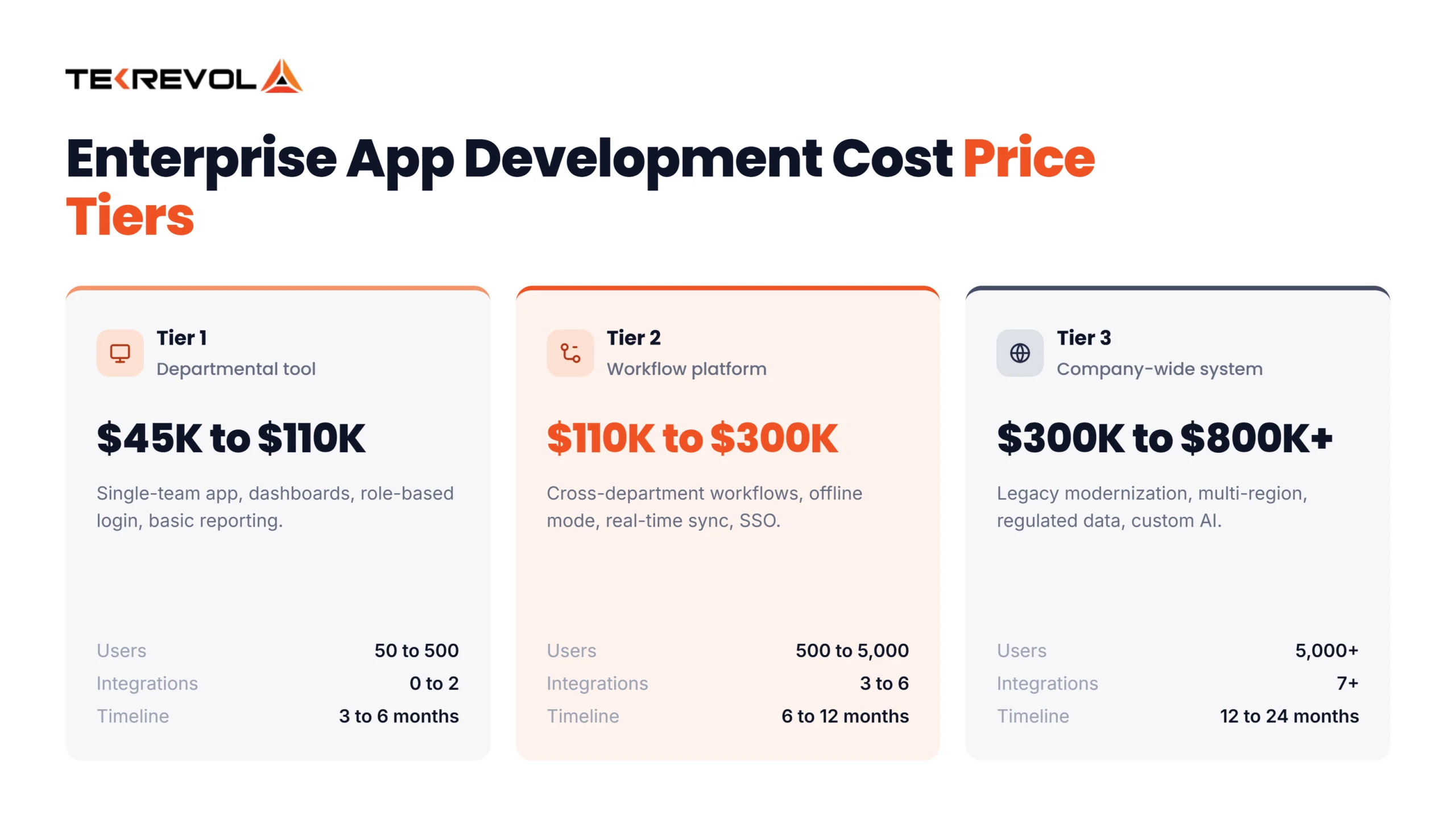
Those three bands aren’t random. They map to how deep the app has to sit inside your business. A tier one app touches one system and one department. A tier three app becomes the system your whole company runs on. The work between those two isn’t double. It’s often eight times.
| Tier | Cost range (2026) | What it covers | Users | Integrations | Timeline |
| Tier 1: Departmental tool | $45,000 – $110,000 | Single-team app, dashboards, role-based login, basic reporting | 50 – 500 | 0 – 2 | 3 – 6 months |
| Tier 2: Workflow platform | $110,000 – $300,000 | Cross-department workflows, offline mode, real-time sync, SSO | 500 – 5,000 | 3 – 6 | 6 – 12 months |
| Tier 3: Company-wide system | $300,000 – $800,000+ | Legacy modernization, multi-region, regulated data, custom AI | 5,000+ | 7+ | 12 – 24 months |
Most mid-market firms who come to us thinking they need tier three really need tier two. And most who budget for tier one find out during discovery that they’re tier two. That gap, not inflation, is where budget shock comes from.
Ready to Turn More Searches Into Downloads?
Let's build an ASO strategy designed to improve visibility, increase installs, and deliver lasting organic growth.
Get Your Free ASO ConsultationWhy Do Enterprise App Cost Estimates Disagree So Much?
Enterprise app cost estimates disagree because they price completely different products under one label. Some quote $20,000 for a “basic enterprise app.” Others start at $150,000. Both are accurate. One describes a small team tool. The other describes a company-wide platform.
| Range you’ll see | What’s actually being priced | Who it’s right for |
| $20,000 – $40,000 | A single-screen internal app, no real integrations, no compliance | Small teams replacing a spreadsheet |
| $30,000 – $150,000 | A mobile front end on an existing backend | Companies with clean, modern APIs already in place |
| $150,000 – $400,000 | A genuine workflow platform with ERP or CRM integration | Mid-market operations teams |
| $400,000 – $1M+ | Legacy modernization or a regulated, multi-region system | Large enterprises with technical debt |
When a vendor quotes you $35,000, and another quotes $280,000, they’re rarely bidding on the same scope. One is building you a screen. The other is rewiring your operation.
The fix is simple. Before you compare quotes, write down two numbers: how many existing systems the app must read from or write to, and whether your data is regulated. Those two numbers predict your final cost better than your whole feature list does.
Enterprise App Development Statistics 2026
Enterprise app budgets in 2026 are being shaped by more than developer rates. Software spending, AI adoption, security risks, and legacy modernization are all influencing what companies need to spend—and where that money goes.
- Software spending is growing fast: Gartner forecasts $1.468 trillion in global software spending in 2026, up 15.5%, outpacing overall IT spending growth of 14.2%.
- AI is changing enterprise software budgets: Gartner estimates $234 billion of enterprise application software spending could be disrupted by agentic AI by 2030—around 20% of enterprise application SaaS spending.
- Security is a major budget driver: IBM’s 2026 report puts the average global data breach cost at $4.99 million, rising to $6.3 million in financial services.
- Legacy modernization can quickly become a seven-figure project: Forbes Technology Council cites traditional modernization projects costing $1 million–$3 million over 12–18 months, while AI-assisted approaches may reduce timelines.
The takeaway: Enterprise app costs aren’t simply rising across the board. AI can reduce development effort while increasing architecture and integration costs, whereas security and compliance are becoming harder-to-cut budget lines.
What Factors Influence the Cost of Enterprise App Development?
Factors that influence enterprise app development cost, ranked by budget impact: system integration depth, compliance requirements, user scale and concurrency, platform choice, offline capability, and post-launch support. Integration alone often eats 30% to 50% of an enterprise build.
Let’s go through them in the order they actually hit your invoice.
1. Integration with existing systems ($8,000 – $150,000)
This is the big one. Connecting to a modern REST API costs a fraction of connecting to a fifteen-year-old ERP with no documentation. Every extra system adds testing work, not just build hours. Firms routinely guess low on this by half.
2. Security and compliance ($10,000 – $60,000)
HIPAA, SOC 2, PCI DSS, and GDPR each add design work, audit trails, encryption, and formal testing. Expect compliance to add 15% to 25% to a build in a regulated sector.
3. User scale and concurrency ($5,000 – $40,000)
An app for 200 warehouse staff and an app for 50,000 field agents need different backends. Load testing, caching, and database design all scale with that number.
4. Platform strategy ($0 – $80,000 delta)
Cross-platform frameworks like Flutter and React Native typically save 30% to 40% versus building two native apps. Native still wins if you need deep hardware access or heavy offline sync.
5. Offline-first architecture ($8,000 – $25,000)
If your users work in warehouses, on rigs, or in basements, the app has to work without a signal. Sync logic is hard to get right, and it’s rarely in the first quote you get.
6. Custom UI/UX design ($10,000 – $45,000)
Enterprise design isn’t decoration. A bad workflow in an app 3,000 people use daily costs more in lost time than the design budget ever would.
7. Post-launch support ($2,000 – $10,000/month)
Enterprise apps need SLAs, monitoring, and someone on call. This is a standing monthly cost, not a project cost.
8. AI and analytics features ($15,000 – $70,000)
More clients now ask for predictive maintenance, document scanning, and chat interfaces. Adding them later costs far more than planning for them upfront.
What Does Enterprise App Development Cost by Industry?
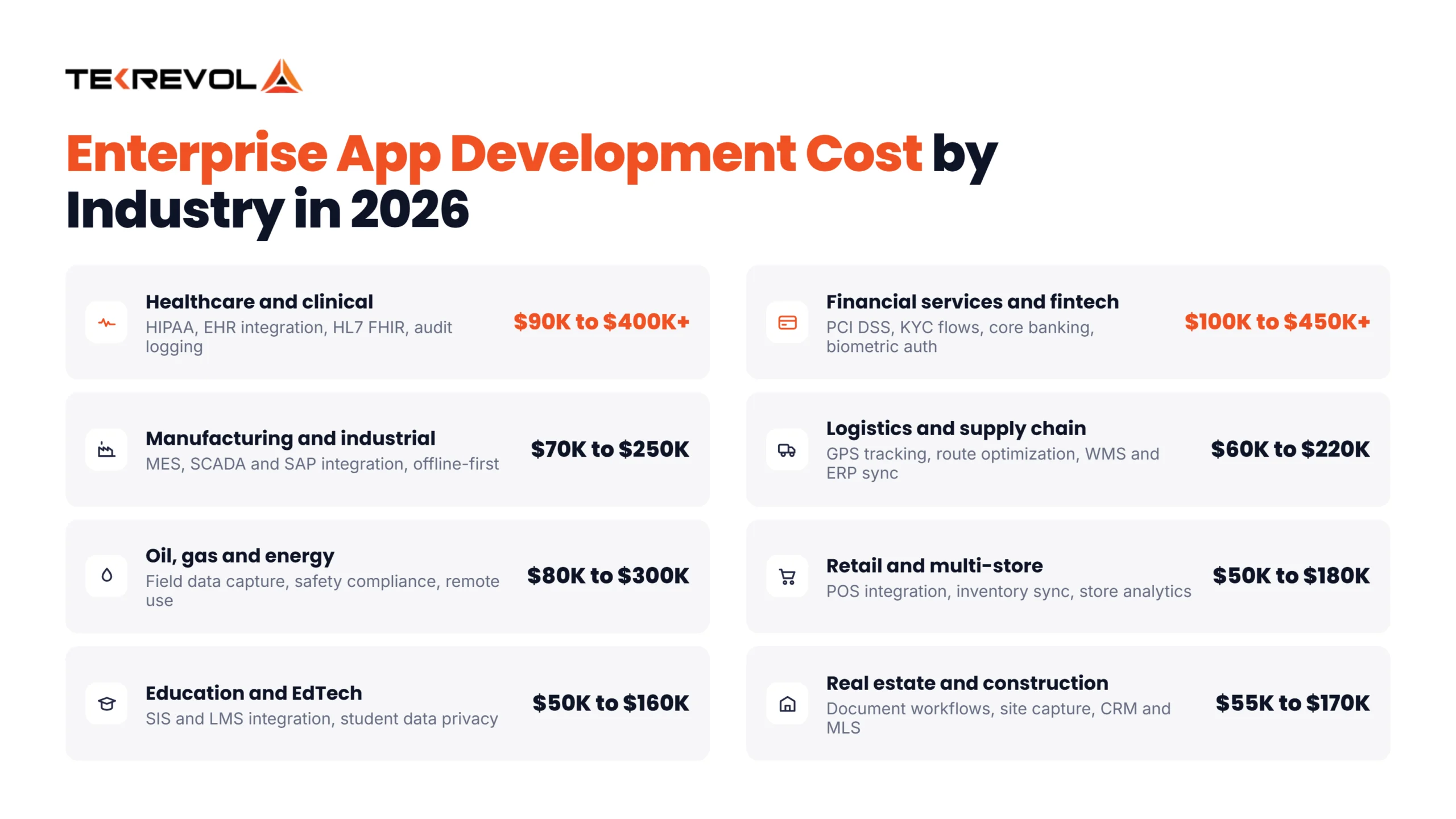
Enterprise app development cost by industry ranges from $50,000 in retail operations to $400,000+ in healthcare and financial services. What drives it is red tape and integration depth, not industry glamour. Sectors with strict rules and old core systems always cost more.
| Industry | Typical cost range | What drives the cost |
| Healthcare & clinical | $90,000 – $400,000+ | HIPAA, EHR integration (Epic, Cerner), HL7 FHIR, audit logging |
| Financial services & fintech | $100,000 – $450,000+ | PCI DSS, KYC flows, core banking integration, biometric auth |
| Manufacturing & industrial | $70,000 – $250,000 | MES/SCADA and SAP integration, offline-first, device connectivity |
| Logistics & supply chain | $60,000 – $220,000 | GPS tracking, route optimization, WMS/ERP sync, poor-connectivity handling |
| Oil, gas & energy | $80,000 – $300,000 | Field data capture, safety compliance, remote/offline operation |
| Retail & multi-store | $50,000 – $180,000 | POS integration, inventory sync, real-time store analytics |
| Education & EdTech | $50,000 – $160,000 | SIS/LMS integration, student data privacy, high seasonal load |
| Real estate & construction | $55,000 – $170,000 | Document workflows, site data capture, CRM and MLS integration |
In-House vs Agency vs Offshore: Which Enterprise App Model Costs Less?
In-house vs agency vs offshore is a real tradeoff, not a price war. In-house costs the most ($400,000 to $700,000 a year fully loaded) but keeps knowledge inside. Western agencies bill $100 to $250 an hour. Offshore and hybrid teams deliver the same quality for 40% to 65% less.
| Model | Hourly rate | Mid-tier app cost | Speed to start | Best for |
| In-house team | N/A (salaried) | $400,000 – $700,000/year | 3 – 6 months to hire | Core product IP you’ll build on for a decade |
| US/UK agency | $100 – $250 | $180,000 – $450,000 | 2 – 4 weeks | Heavily regulated builds needing local presence |
| Eastern Europe | $55 – $100 | $110,000 – $260,000 | 3 – 5 weeks | Complex engineering, overlapping EU hours |
| Offshore (Asia) | $25 – $60 | $60,000 – $160,000 | 2 – 3 weeks | Well-specified builds with strong internal PM |
| Hybrid (onshore lead + offshore build) | $45 – $90 blended | $90,000 – $220,000 | 2 – 4 weeks | Most mid-market enterprise projects |
Here’s what the rate tables never tell you. A cheap hourly rate on a badly specified project is the most expensive thing you can buy. We’ve been called in to rescue builds where the offshore rate was $22 an hour, and the rework bill beat the original contract.
The hybrid model wins for most mid-market firms. It puts a senior architect and product lead in your timezone while the build team works at offshore rates. If you’re weighing whether to staff up internally instead, our IT staff augmentation model sits between the two and often costs less than either.
What Is the Step-by-Step Process of Enterprise App Development, With Costs?
The step-by-step enterprise app development process runs through seven phases: discovery, architecture, design, development, integration and testing, deployment, and support. Discovery and integration are where budgets are won or lost. Both are underfunded in cheap quotes.
| Phase | Share of budget | Cost on a $250,000 build | What happens |
| 1. Discovery & scoping | 8 – 12% | $20,000 – $30,000 | Stakeholder interviews, system audit, integration mapping, risk register |
| 2. Architecture & tech strategy | 6 – 10% | $15,000 – $25,000 | Data model, security architecture, scalability plan, stack decisions |
| 3. UX/UI design | 10 – 15% | $25,000 – $37,500 | Workflow mapping, prototypes, design system, usability testing |
| 4. Core development | 40 – 50% | $100,000 – $125,000 | Frontend, backend, APIs, business logic, role-based access |
| 5. Integration & QA | 15 – 20% | $37,500 – $50,000 | Legacy connections, automated tests, load testing, security audit |
| 6. Deployment & rollout | 5 – 8% | $12,500 – $20,000 | Environment setup, data migration, phased release, user training |
| 7. Support & iteration | 15 – 25%/year | $37,500 – $62,500/year | SLA support, monitoring, OS updates, feature releases |
Notice that phases one and two together are up to 22% of the budget before anyone writes production code. Vendors who skip straight to coding to look cheaper aren’t saving you money. They’re pushing the cost into phase five, where fixing a design mistake costs about ten times more.
Enterprise Mobile App Development Cost by Platform
Enterprise mobile app development cost comparison shows platform choice moving your budget by up to 45%. A single native app is cheapest per platform. Cross-platform gets you both platforms for about 60% of dual-native cost. Web apps are cheapest but limited.
| Approach | Cost vs single native | Mid-tier enterprise cost | Trade-off |
| Progressive web app | 60 – 75% | $50,000 – $130,000 | No deep hardware access, weaker offline |
| Single native (iOS or Android) | 100% (baseline) | $80,000 – $200,000 | One platform only |
| Cross-platform (Flutter / React Native) | 115 – 135% | $95,000 – $260,000 | Both platforms, minor native trade-offs |
| Dual native (separate iOS + Android) | 180 – 200% | $150,000 – $400,000 | Best performance, highest cost and maintenance |
For most enterprise use cases, cross-platform is the right answer. Your field team doesn’t need 120fps animation. It needs the app to work in a warehouse with one bar of signal. We’d only pick dual native for heavy live video, AR, or deep device-level work.
Region matters just as much. The same cross-platform build costs roughly three times more with a US-only team than with a hybrid team, and the output is often the same when the lead architect is senior. Our mobile app development service team runs this hybrid structure by default for exactly that reason.
What Hidden Factors Affect Enterprise App Development Cost?
Hidden factors affecting enterprise app development cost include data migration, third-party licensing, change management, compliance re-certification, and infrastructure scaling. Together, they add 55% to 90% on top of your build quote over three years.
Here’s the three-year picture on a $250,000 build.
| Hidden cost | Typical amount | When it hits |
| Data migration & cleansing | $20,000 – $60,000 | Pre-launch |
| Third-party licenses & API fees | $500 – $5,000/month | Ongoing from launch |
| Cloud infrastructure | $800 – $8,000/month | Scales with usage |
| Change management & training | $8,000 – $35,000 | Launch + 6 months |
| Compliance audits & re-certification | $15,000 – $50,000/year | Annually |
| Monitoring, DevOps & incident response | $400 – $3,000/month | Ongoing |
| Scope changes during build | 10 – 20% of build | Months 3 to 9 |
| Three-year total cost of ownership | $390,000 – $475,000 | On a $250,000 build |
One more hidden cost worth naming: your own team’s time. Reviews, testing, and data prep pull real hours from people who already have jobs. We budget client-side effort explicitly in our cloud and infrastructure planning because pretending it’s free is how timelines slip.
How Do You Optimize Enterprise App Development Cost Without Cutting Quality?
Optimize enterprise app development cost by reducing unnecessary scope, not quality. Phase the rollout, lock integrations early, reuse existing systems, choose cross-platform where practical, and invest in discovery.
- Phase by department: Launch with one business unit, learn from real usage, then expand based on data.
- Lock integrations early: Finalize the integration list during discovery and price new additions as change orders.
- Reuse existing systems: Extend your current login, cloud, and data infrastructure instead of rebuilding them.
- Choose cross-platform: For internal and field apps, one codebase can reduce upfront and maintenance costs.
- Invest in discovery: A focused discovery phase can prevent expensive architecture and data-model mistakes.
- Use AI where it fits: Automate routine coding, testing, and documentation, but keep complex integrations and security under expert oversight with TekRevol’s AI development team.
Why Choose TekRevol for Enterprise App Development?
TekRevol is a US-headquartered enterprise app development company that has completed 800+ projects across 11+ industries.
Our approach to cost is straightforward: we scope integrations, compliance, and complexity upfront so you know what you’re paying for before development begins.
- Transparent integration pricing: We quote integrations separately, making complex costs easier to evaluate and phase.
- Hybrid delivery model: Senior architects and product leads work in your timezone, while distributed development keeps enterprise builds cost-efficient.
- Experience with complex industries: From Kinder Morgan in energy to MiloCare in healthcare and Stock n Ship in logistics, we’ve handled compliance, integrations, and offline requirements.
- Proven track record: TekRevol holds a 4.8/5 Clutch rating across 83 verified reviews and was ranked No. 165 on Forbes’ America’s Best Startup Employers 2023.
The goal isn’t simply to build for less. It’s to make every dollar of your enterprise app budget accountable.
Got an Enterprise App Quote? Let's See What's Behind the Number.
Send us your scope or estimate, and we'll help you identify what's included, what's missing, and whether the budget actually matches the complexity of your build.
Get Your Enterprise App Cost Assessment →