



- Video streaming app development cost typically lands between $40,000 and $500,000 depending on complexity and scale.
- A basic video-on-demand MVP runs $40,000 to $80,000 and ships in roughly three to four months.
- Live streaming costs two to three times more than on-demand because of real-time infrastructure and latency work.
- Content delivery bills scale with viewer-hours, so your monthly run cost can eventually exceed your build cost.
- Features like DRM, adaptive bitrate, and AI recommendations each add $10,000 to $50,000 to the total.
- Building an MVP first and negotiating CDN rates early are the two biggest cost savers available.
A video streaming app may look simple to users, but behind every play button sits video hosting, encoding, content delivery, storage, user management, and infrastructure built to handle simultaneous viewers. That’s why it is important to learn what is the actual cost of a video streaming app.
Video streaming app development cost sits between $40,000 and $500,000 in 2026. A lean video-on-demand MVP starts around $40,000. A mid-market subscription platform with monetization runs $90,000 to $200,000. A full OTT product with live streaming, DRM, and smart TV apps pushes past $300,000.
But the build price is only half your bill, and that’s the half most guides skip entirely.
This guide breaks down every number: cost by complexity, what each feature actually adds, tech stack pricing, the delivery costs that show up in month four, and how to cut the total without gutting the product. We’ve built video-heavy products as an on-demand app development company, so the math here comes from real projects, not a pricing page.
How Much Does It Cost to Build a Video Streaming App by Complexity?
Building a video streaming app costs $40,000 to $80,000 for a basic MVP, $90,000 to $200,000 for a mid-market platform with monetization, and $250,000 to $500,000+ for a full OTT product with live streaming, DRM, and smart TV support.
Complexity is the single biggest lever on your budget, and it’s not really about how many screens you have. It’s about how much real-time infrastructure you need running behind them. A catalog of pre-recorded videos is a solved problem. A million people watching a boxing match at the same second is not.
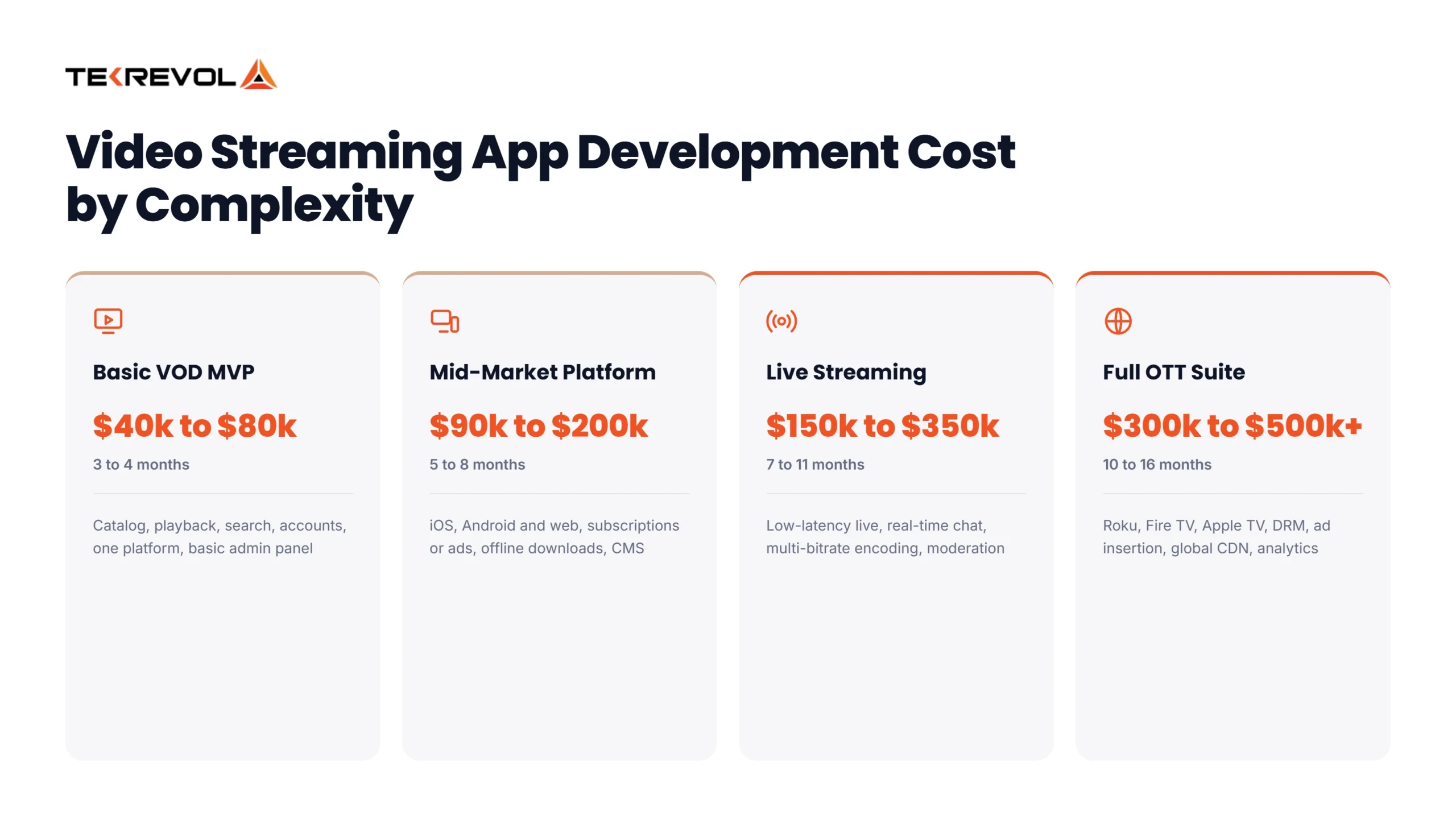
Here’s how the tiers break down in practice:
| Tier | What You Get | Cost Range | Timeline |
| Basic VOD MVP | Video catalog, playback, search, user accounts, single platform, basic admin panel | $40,000 – $80,000 | 3 – 4 months |
| Mid-Market Platform | iOS + Android + web, subscriptions or ads, watchlists, offline downloads, recommendations, CMS | $90,000 – $200,000 | 5 – 8 months |
| Live Streaming Platform | Everything above plus low-latency live, real-time chat, multi-bitrate encoding, moderation tooling | $150,000 – $350,000 | 7 – 11 months |
| Full OTT Suite | Multi-platform including Roku, Fire TV, Apple TV, DRM, SSAI, entitlements, global CDN, analytics | $300,000 – $500,000+ | 10 – 16 months |
Notice the jump between mid-market and live. Adding live streaming isn’t a feature, it’s a second product. You’re now running ingest servers, transcoding pipelines, and latency budgets that on-demand platforms never touch. If live is central to your idea, our breakdown of live streaming app development costs goes deeper on that specific path.
One thing we’d flag: those timelines assume a team that’s built streaming before. First-timers routinely add 30% because the encoding pipeline eats a sprint nobody planned for.
Still Guessing What Your Streaming App Will Actually Cost?
Send us your feature list and we'll come back with a costed scope, a realistic timeline, and the infrastructure bill nobody warns you about.
Get Your Free Streaming App Cost Estimate →Video Streaming Market Demand in 2026
The video streaming market is expanding rapidly, but the opportunity goes beyond mainstream entertainment. As streaming takes a larger share of viewing and niche platforms gain traction, businesses in areas such as fitness, education, sports, faith, and enterprise video can target specialized audiences instead of competing directly with major entertainment platforms.
- Global video streaming market: Estimated at $191.1 billion in 2026, up from $129.3 billion in 2024, and projected to reach $416.8 billion by 2030 at a 21.5% CAGR.
- Live video streaming: Held approximately 62.5% of the global video streaming market in 2024, making it the largest type segment.
- Global OTT video: Projected to generate approximately $352.96 billion in 2026. Statista reports 9.3% revenue growth in 2026 and an 8.14% CAGR for 2026–2030.
- US TV viewing: Streaming accounted for 48.6% of total US TV watch-time in May 2026, compared with 20.4% for cable and 19.2% for broadcast.
These numbers show that streaming is no longer limited to traditional entertainment. The strongest opportunity for new platforms may be in focused verticals where specialized content and community can matter more than having the biggest content library.
That makes niches such as fitness, education, sports, faith, and enterprise video particularly relevant for businesses considering a streaming platform.
Why Do Video Streaming App Cost Quotes Range From $8,000 to $1 Million?
Video streaming app costs can range from $8,000 to $1 million or more because “streaming app” can mean anything from a basic video platform to a full-scale service with live streaming, multiple apps, DRM, subscriptions, analytics, and custom infrastructure.
Three factors usually drive the difference:
- Features: Live streaming, subscriptions, pay-per-view, DRM, recommendations, offline viewing, and advanced analytics all add development effort.
- Platforms: Supporting iOS, Android, web, Roku, Fire TV, or Apple TV increases development and testing requirements.
- Infrastructure: Hosting, CDN, storage, transcoding, security, and monitoring add both development and ongoing operational costs, especially as viewership grows.
When reviewing a quote, check which platforms, features, infrastructure, and post-launch services are included. Two estimates can look very different simply because their scope is different.
The key is to define your streaming model and technical requirements first. Once the scope is clear, your video streaming app development cost becomes much easier to estimate accurately.
What Factors Affect Video Streaming App Development Cost?
Factors affecting video streaming app development cost include platform count, streaming type (live vs on-demand), design depth, team location, DRM and security requirements, third-party integrations, and post-launch maintenance commitments.
Some of these move your budget by 10%. Others double it. Here’s the honest weighting from projects we’ve delivered:
| Factor | Budget Impact | What Drives It |
| Streaming type (live vs VOD) | Very High (2x – 3x) | Live needs ingest, real-time transcoding, latency engineering, and chat moderation |
| Platform count | High (+40% – 120%) | Each smart TV platform is a separate codebase, not a port |
| DRM and content protection | High | Studio-grade DRM adds licensing fees plus integration work |
| UI/UX design depth | Medium (10% – 20%) | Custom motion, personalized layouts, and multi-device design systems |
| Team location | High (2x – 4x on rates) | Hourly rates vary from roughly $25 in South Asia to $100+ in the US |
| Third-party integrations | Medium | Payments, ad servers, analytics, CMS, identity providers |
| Content moderation | Medium to High | Mandatory for user-generated content, minimal for curated libraries |
| Maintenance | 15% – 20% of build, annually | Bug fixes, OS updates, security patches, scaling work |
Team location deserves a note, because it’s the factor people over-optimize. Cutting your hourly rate in half saves real money right up until you need someone who has actually shipped a WebRTC pipeline. Streaming has a small pool of genuinely experienced engineers, and rate shopping past a certain point buys you a rewrite.
Which Key Features Drive Video Streaming App Development Cost the Most?
Key features that drive streaming app cost are adaptive bitrate streaming, DRM, AI recommendations, offline downloads, live chat, and multi-profile support. Together these six typically account for 50% to 60% of total feature development spend.
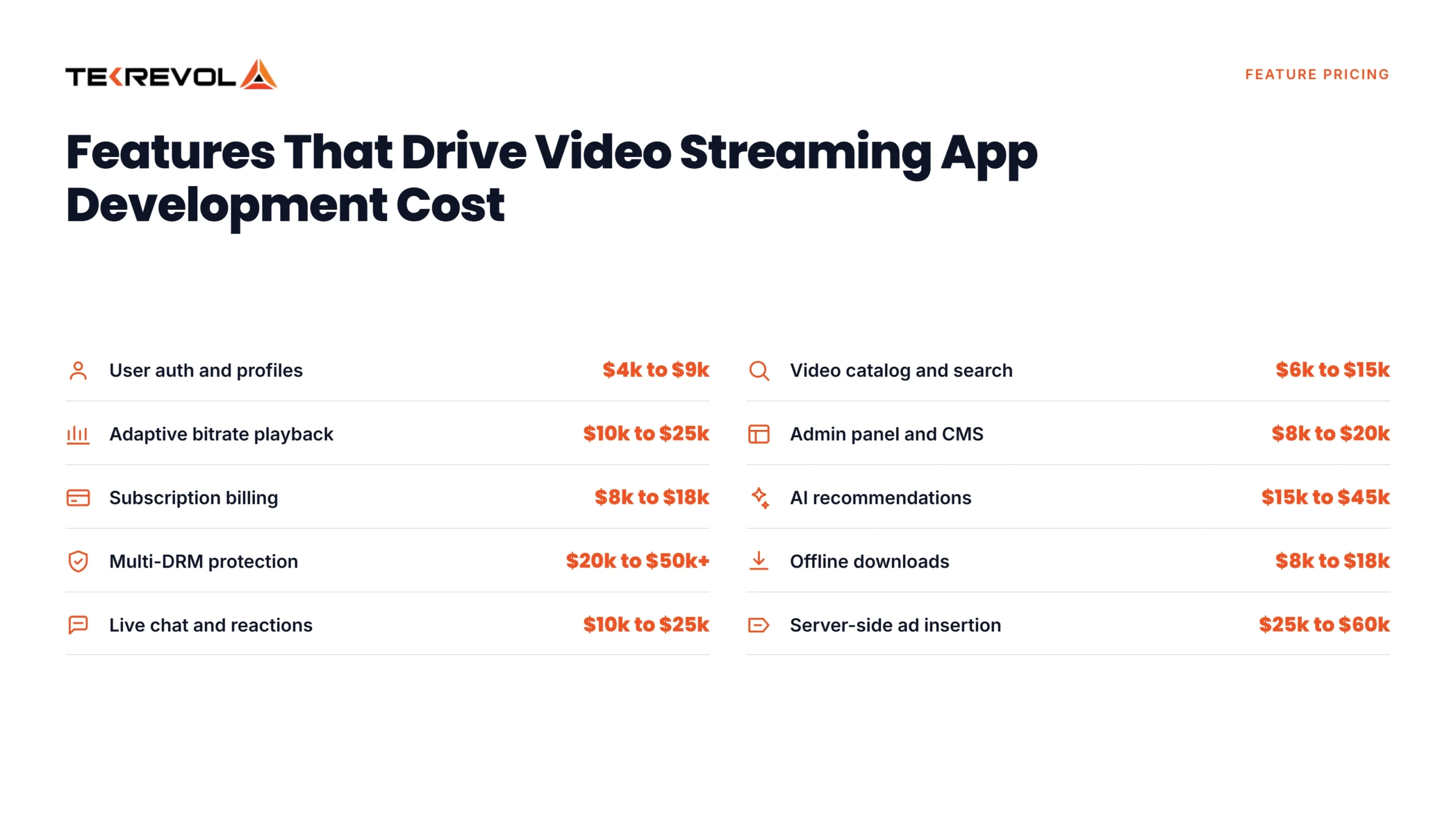
Every streaming app needs a baseline. What separates a $60,000 build from a $250,000 build is which features sit on top of it.
| Feature | Typical Cost | Why It Costs That |
| User auth and profiles | $4,000 – $9,000 | Standard, but multi-profile with per-profile history adds work |
| Video catalog and search | $6,000 – $15,000 | Metadata modeling and search relevance tuning |
| Adaptive bitrate playback | $10,000 – $25,000 | Multi-rendition encoding plus player logic across devices |
| Admin panel and CMS | $8,000 – $20,000 | Content ingest, scheduling, rights windows |
| Subscription billing | $8,000 – $18,000 | Plans, trials, proration, dunning, store billing rules |
| AI recommendations | $15,000 – $45,000 | Data pipeline, model training, cold-start handling |
| DRM (Widevine, FairPlay, PlayReady) | $20,000 – $50,000+ | Three DRM systems, license server, plus annual licensing |
| Offline downloads | $8,000 – $18,000 | Encrypted local storage and license persistence per platform |
| Live chat and reactions | $10,000 – $25,000 | Real-time messaging at scale plus moderation |
| Server-side ad insertion | $25,000 – $60,000 | Ad stitching, tracking, and playback continuity |
The pattern here is that anything touching real-time or rights costs multiples of anything touching display. A beautiful browse screen is cheap. Making sure a licensed film can’t be screen-recorded is not.
What Does the Tech Stack Cost for a Video Streaming App?
Tech stack costs for a video streaming app include encoding, storage, content delivery, DRM licensing, and analytics. Expect $500 to $3,000 monthly at small scale and $15,000 to $80,000+ monthly once you pass a hundred thousand active viewers.
The build is a one-time number. The stack is a bill that arrives every month, forever, and grows with your success.
| Stack Layer | Common Choices | Cost Model | Small Scale (Monthly) |
| Video encoding | AWS Elemental, Mux, Bitmovin, FFmpeg self-hosted | Per minute of output, per rendition | $100 – $600 |
| Storage | S3, Google Cloud Storage, Backblaze B2 | Per GB stored per month | $50 – $400 |
| Content delivery (CDN) | CloudFront, Fastly, Cloudflare, Bunny | Per GB delivered | $200 – $1,500 |
| Streaming protocol | HLS, DASH (on-demand), WebRTC, LL-HLS (live) | Engineering time, not license fees | Build cost |
| Backend | Node.js, Go, Python; PostgreSQL, Redis | Compute and database hosting | $150 – $800 |
| DRM | Widevine, FairPlay, PlayReady via a license provider | Annual license plus per-request | $0 – $4,000 |
| Player | ExoPlayer, AVPlayer, Shaka, Video.js, THEOplayer | Free open source or commercial license | $0 – $1,500 |
| Analytics | Mux Data, Conviva, custom | Per view or flat tier | $0 – $2,000 |
Two decisions here carry outsized weight. First, open source players save real money and cost you engineering time; commercial players do the reverse. Second, CDN pricing is negotiable and most founders never ask.
List rates and committed-volume rates on the same network can differ several times over. That single conversation is often worth more than any code optimization you’ll make in year one.
If you’re weighing native builds against cross-platform frameworks, our mobile app development services can walk you through where each one actually saves money for video-heavy products.
How Do You Build a Video Streaming App Step by Step?
Building a video streaming app takes seven stages: define your content model, design the experience, architect the streaming pipeline, build the clients, integrate monetization, test under real load, and launch with a scaling plan.
Here’s the sequence we run, and roughly what each stage consumes.
1. Content and business model definition (1 – 2 weeks)
Decide what you’re streaming, who owns it, how rights windows work, and how money comes in. Everything downstream depends on this, and skipping it is the number one cause of mid-build rewrites.
2. UX and UI design (3 – 6 weeks)
Browse, playback, and checkout are the three screens that decide whether people stay. Design them for the biggest screen you’ll support, then work down.
3. Streaming architecture (2 – 4 weeks)
Choose your protocol, encoding ladder, storage tier, and CDN. This is where an experienced streaming engineer pays for themselves several times over. For OTT-specific architecture decisions, our OTT app development guide covers the trade-offs in detail.
4. Backend and pipeline build (6 – 12 weeks)
Ingest, transcode, package, and deliver. Plus the unglamorous parts: user management, entitlements, and the admin CMS your content team will live inside.
5. Client app development (8 – 16 weeks, parallel)
Mobile, web, and TV apps built against the same API. TV apps take longer than anyone expects because remote-control navigation is its own discipline.
6. Load and quality testing (3 – 5 weeks)
Test at ten times your expected launch concurrency. Streaming fails ugly and it fails publicly, usually on the day you get press coverage.
7. Launch and scale (ongoing)
Ship to a limited audience, watch your rebuffer ratio and startup time, then open the doors.
Hidden Costs of Video Streaming App Development
The development quote is only part of the cost. Streaming apps also require ongoing spending on CDN bandwidth, cloud storage, video transcoding, DRM, monitoring, moderation, and app-store fees. As viewership grows, these recurring expenses can become a significant part of the overall budget.
What Does Video Delivery Actually Cost?
Your bandwidth requirement mainly depends on bitrate × viewing hours × viewers:
| Video Quality | Approx. Bitrate | Data Per Viewer-Hour |
| 480p | 1 Mbps | 0.45 GB |
| 720p | 2.5 Mbps | 1.13 GB |
| 1080p | 5 Mbps | 2.25 GB |
| 4K | 15 Mbps | 6.75 GB |
For example, 50,000 viewers watching 8 hours of 1080p content per month would consume about 900 TB of delivery data before accounting for other traffic and overhead.
What Other Costs Should You Budget For?
- CDN and bandwidth: Usually one of the highest variable costs as viewing hours increase.
- Storage and compute: Costs grow with your content library, backups, and processing requirements.
- Transcoding: Multiple resolutions and formats require additional processing.
- DRM: Premium content may require third-party content protection and licensing.
- Moderation: User-generated content can require automated tools and human review.
- Monitoring: Streaming platforms need ongoing performance, uptime, and infrastructure monitoring.
- App-store fees: Apple and Google apply different service or commission structures depending on the transaction, program, and region.
How Do You Monetize a Video Streaming App?
Video streaming apps monetize through subscriptions (SVOD), advertising (AVOD), pay-per-view (TVOD), hybrid models, and creator revenue splits. Hybrid subscription-plus-ads has become the dominant model because it captures both premium and price-sensitive audiences.
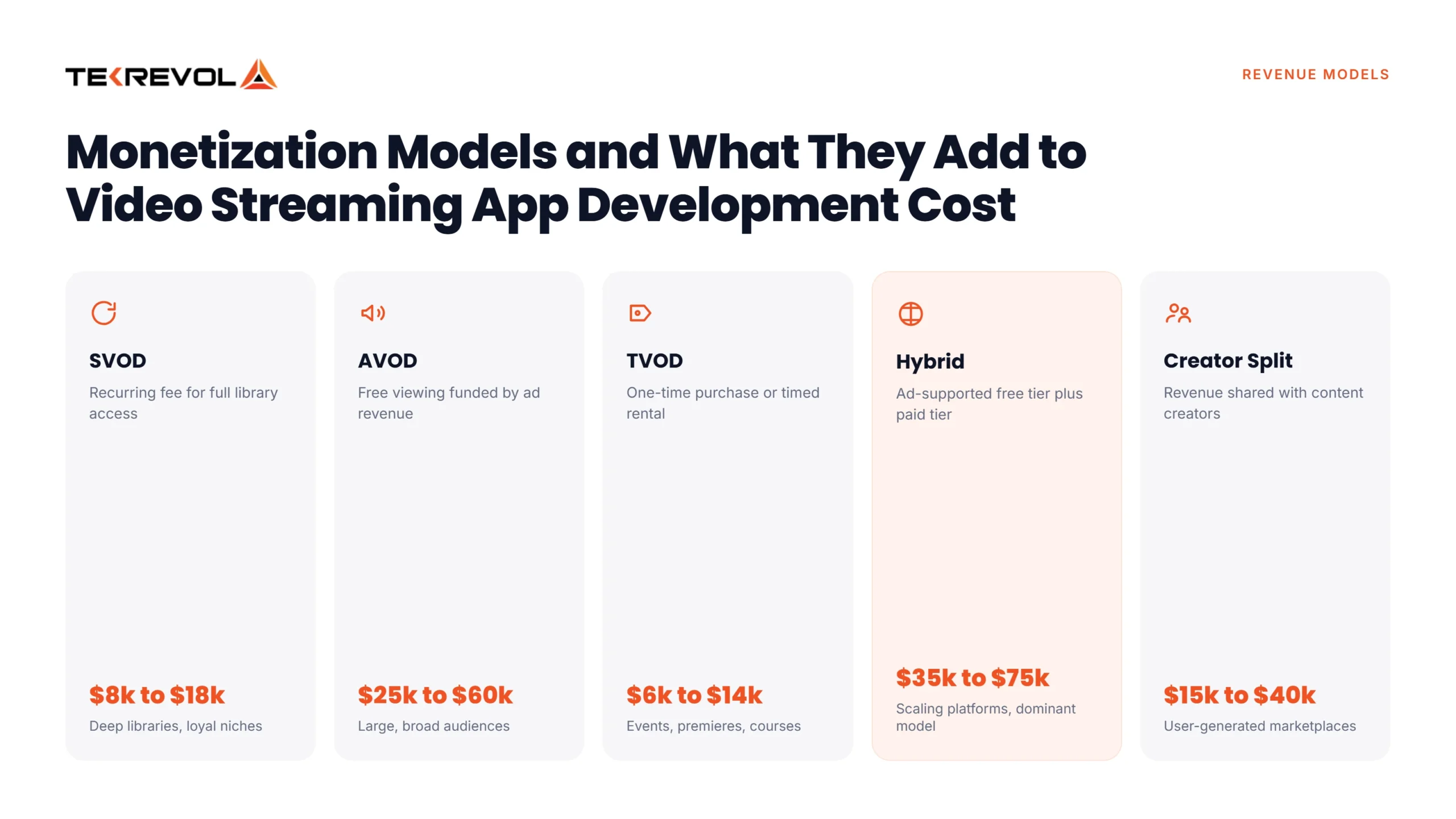
Your monetization choice isn’t just a revenue decision. It changes what you have to build.
| Model | How It Works | Build Cost Added | Best For |
| SVOD (subscription) | Recurring fee for full access | $8,000 – $18,000 | Deep libraries, loyal niches |
| AVOD (ad-supported) | Free viewing, ad revenue | $25,000 – $60,000 | Large audiences, broad content |
| TVOD (pay-per-view) | One-time purchase or rental | $6,000 – $14,000 | Events, premieres, courses |
| Hybrid | Free tier with ads, paid tier without | $35,000 – $75,000 | Scaling platforms |
| Creator split | Revenue shared with content creators | $15,000 – $40,000 | UGC and creator marketplaces |
Ad-supported models look free to the user and expensive to you. Server-side ad insertion, ad tracking, and fill-rate optimization are genuinely hard engineering, which is why AVOD carries the biggest build premium on that table.
Our advice for most first launches: start with a single subscription tier. It’s the cheapest to build, the easiest to forecast, and you can layer ads on later once you know your retention curve.
How Can You Reduce Video Streaming App Development Cost?
You can reduce video streaming app development cost by launching with a focused MVP, choosing the right streaming technology, and avoiding infrastructure expenses before they are necessary. The goal is to reduce scope without compromising the core viewing experience.
- Start with one platform: Launch where your target audience is most active, then expand based on real usage data.
- Choose HLS for standard streaming: If your use case does not require sub-second latency, HLS is often simpler and more scalable than WebRTC.
- Delay DRM when appropriate: If you are streaming your own content, basic authentication and encryption may be sufficient initially.
- Negotiate CDN pricing: Discuss volume-based or committed-use pricing as your viewing traffic grows.
- Use cross-platform development: Flutter or React Native can handle many app screens while native playback components manage video performance.
- Don’t cut critical infrastructure: Load testing, content management, and adaptive bitrate encoding are worth keeping from the start.
The smartest savings come from launching with only what you need today and adding complexity as your audience and business model grow.
Why Choose TekRevol for Video Streaming App Development?
TekRevol helps businesses build video streaming and on-demand platforms with the technology, infrastructure, and scalability needed to support real-world users. From video pipelines and content management to mobile, web, and connected TV experiences, our team handles the product journey from planning through launch.
- End-to-end development: From streaming architecture and encoding to app development and deployment.
- Cost-aware planning: We consider infrastructure, CDN, storage, and other ongoing expenses alongside development costs.
- Scalable architecture: Cloud-ready systems designed to support growth without unnecessary rebuilding.
- Cross-platform expertise: Support for mobile, web, and connected TV platforms based on your audience and business model.
- Flexible approach: We recommend the most practical solution for your needs, whether that means a custom platform or starting with an existing solution.
The goal is simple: build the right streaming product for your audience and budget without adding unnecessary complexity. With experienced product and engineering teams, TekRevol can help take your streaming idea from scope to launch and beyond.
Ready to Put a Real Number on Your Streaming App?
Bring us your idea and get a costed feature scope, 12-month infrastructure projection, and a phased plan built around your budget.
Schedule Your Free Streaming Consultation →


![How to Build an Image Recognition App: AI Features, Tech Stack & Cost [2026]](https://assets.tekrevol.com/images-tek/uploads/2025/05/Tek-Feature-18-400x160.jpg)


