



- Generative AI development costs $30,000 to $700,000+ in 2026, depending on approach, data readiness, and integration depth.
- Running costs matter more than build costs, because inference bills repeat every month forever after launch.
- Data preparation absorbs 30% to 50% of most budgets, making it the single biggest hidden cost driver.
- Hosted APIs and RAG cover most business needs; fine-tuning and self-hosting rarely justify their added cost and complexity.
- Compliance now belongs in architecture planning, not legal review, adding $20,000 to $155,000 depending on industry and state.
- Annual operating costs run 20% to 45% of the original build, driven mainly by inference, monitoring, and human review.
The real cost of a generative AI project rarely shows up in the initial quote. It shows up three weeks in, when token consumption spikes, data cleanup takes longer than planned, or an integration requires custom engineering nobody scoped upfront.
For business owners, this unpredictability turns AI adoption into a financial gamble rather than a calculated investment.
On average, generative AI development costs range from $30,000 for a focused pilot to $700,000+ for a governed enterprise platform. Most mid-sized businesses land in the 300,000 range, depending on the model approach, data readiness, and integration depth.
Providers experienced in delivering Generative AI solutions tend to price these variables in from the start, which is why their estimates hold up better than generic quotes.
In this blog, we’ll break down exactly what drives generative AI development costs, walk through realistic pricing tiers by project type, and show how to calculate ROI so you can budget with confidence.
Average Cost to Develop a Generative AI Solution in 2026
Generative AI development costs $30,000 to $700,000+ in 2026, depending on the project’s complexity, integrations, data, and governance needs. A hosted-model pilot starts near $30,000. A focused assistant with retrieval runs $70,000 to $150,000. Mid-size custom applications run $150,000 to $300,000.
Here’s how those tiers actually break down.
| Tier | Build cost | Timeline | What you get |
| Pilot or PoC | $30,000 to $70,000 | 4 to 8 weeks | One use case, hosted model, basic prompt layer, no production hardening |
| Focused assistant | $70,000 to $150,000 | 2 to 4 months | RAG over your documents, one or two integrations, simple admin view |
| Mid-size custom application | $150,000 to $300,000 | 4 to 8 months | Multi-step workflows, several integrations, evaluation harness, role-based access |
| Governed enterprise platform | $300,000 to $700,000+ | 8 to 14 months | Multi-model routing, audit trails, red-teaming, SSO, full LLMOps, regulatory review |
Before You Build, Know What You're Signing Up For.
We'll break down your development, infrastructure, model usage, and integration costs so you can plan your AI project with confidence.
Talk to Our AI Team!How Do Generative AI Applications Work and What Drives Their Cost?
Generative AI applications use AI models to create new content, including text, images, videos, audio, and code. They are widely used for chatbots, content creation, software development, marketing, and design.
Unlike traditional software, these applications generate content on demand, which changes the cost model. You don’t just pay for development; you also incur ongoing costs for each request the AI processes.
Under the hood, you’ll meet four families, and each carries different economics.
- Transformer models power almost every text product you’ll build. Cost is driven by tokens processed.
- Diffusion models generate images and video. Cost is driven by resolution, steps, and seconds of output.
- GANs still turn up in image synthesis and data augmentation. Training is expensive; inference is cheap.
- VAEs handle compression and anomaly detection. Rarely the headline in a product, often useful inside one.
Most business products you’d actually commission sit on transformers. Our breakdown of generative AI models and tools goes through the families in more depth if you’re still choosing.
If you’re comparing generative AI against classical machine learning, our broader guide to AI development cost covers the non-generative side, including predictive models and computer vision.
Generative AI Development: 5 Approaches and Their Costs
Generative AI can be built in five main ways: using a hosted API, adding retrieval, fine-tuning a model, self-hosting an open-source model, or training a custom model from scratch.
Each approach comes with different costs, complexity, and infrastructure needs. For most businesses, the first two options offer the best balance of cost and performance.
This is the single biggest fork in your budget, so let’s take it properly.
Route 1: Hosted API, straight out of the box
You call GPT, Claude, or Gemini and write good prompts. Build costs stay low because you use a hosted model instead of training or managing your own infrastructure.
- Build: $30,000 to $90,000
- Best for: content tools, drafting, summarization, classification, first pilots
- The catch: you’re exposed to vendor price changes and model deprecations. What works today might need re-prompting or re-testing after the next model update.
Route 2: Retrieval-augmented generation (RAG)
You keep the hosted model but feed it your own documents at query time through a vector database, so answers are grounded in your actual content instead of the model’s general training. This is how most genuinely useful business assistants work in practice.
- Build: $70,000 to $180,000
- Best for: internal knowledge, policy Q&A, support deflection, document search
- The catch: retrieval quality is now your product, and it drives your token bill too. A poorly tuned retrieval layer means irrelevant context gets sent with every query, and you pay for that noise.
Route 3: Fine-tuning
You adapt a model to your own examples so it matches your tone, format, or domain language. RAG gives the model better knowledge. Fine-tuning changes how it behaves. Many teams choose fine-tuning when better retrieval would solve the problem at a lower cost.
- Build: $90,000 to $250,000, including data preparation
- Best for: consistent structured output, specialized domain phrasing, narrow high-volume tasks
- The catch: you’ll redo it when the base model moves, and base models move often
For a deeper walkthrough of when to use each, including hybrid setups that layer both, see our guide on AI chatbot development: build vs buy vs customize.
Route 4: Self-hosted open-source
You run Llama, Mistral, Qwen, or similar models on your own GPUs. You get full control, but you’re also responsible for infrastructure, maintenance, scaling, and troubleshooting when something breaks.
- Build: $150,000 to $400,000, plus infrastructure from day one
- Best for: Strict data residency, extreme volume, or regulated environments that forbid third-party inference
- The catch: You’ve just hired an infrastructure problem, permanently.
Route 5: Custom-built from scratch
You train a foundation model on your own data instead of adapting someone else’s. Almost no business product actually needs this route, but it exists at the top of the ladder for teams with proprietary data at massive scale or those explicitly barred from touching third-party models.
- Build: $500,000 to $5,000,000+, before ongoing training compute
- Best for: Proprietary datasets with no comparable public equivalent, foundational research, or national/regulatory mandates that rule out every other route.
- The catch: You’re now an AI research lab, not a product company. Compute, talent, and retraining costs never stop, and a hosted frontier model will likely outperform what you build anyway.
None of these approaches is inherently better. The right fit depends on your data, compliance needs, and how much control you need over the model. You may not even need a new product. Adding generative AI features to software you already own can often be the most cost-effective option, as we explain in our guide to AI software integration without a rebuild.
Make that decision during discovery, before signing a contract, because it affects every cost that follows. Our AI development services team can help determine the right approach for your use case.
Main Factors Behind Generative AI Development Costs
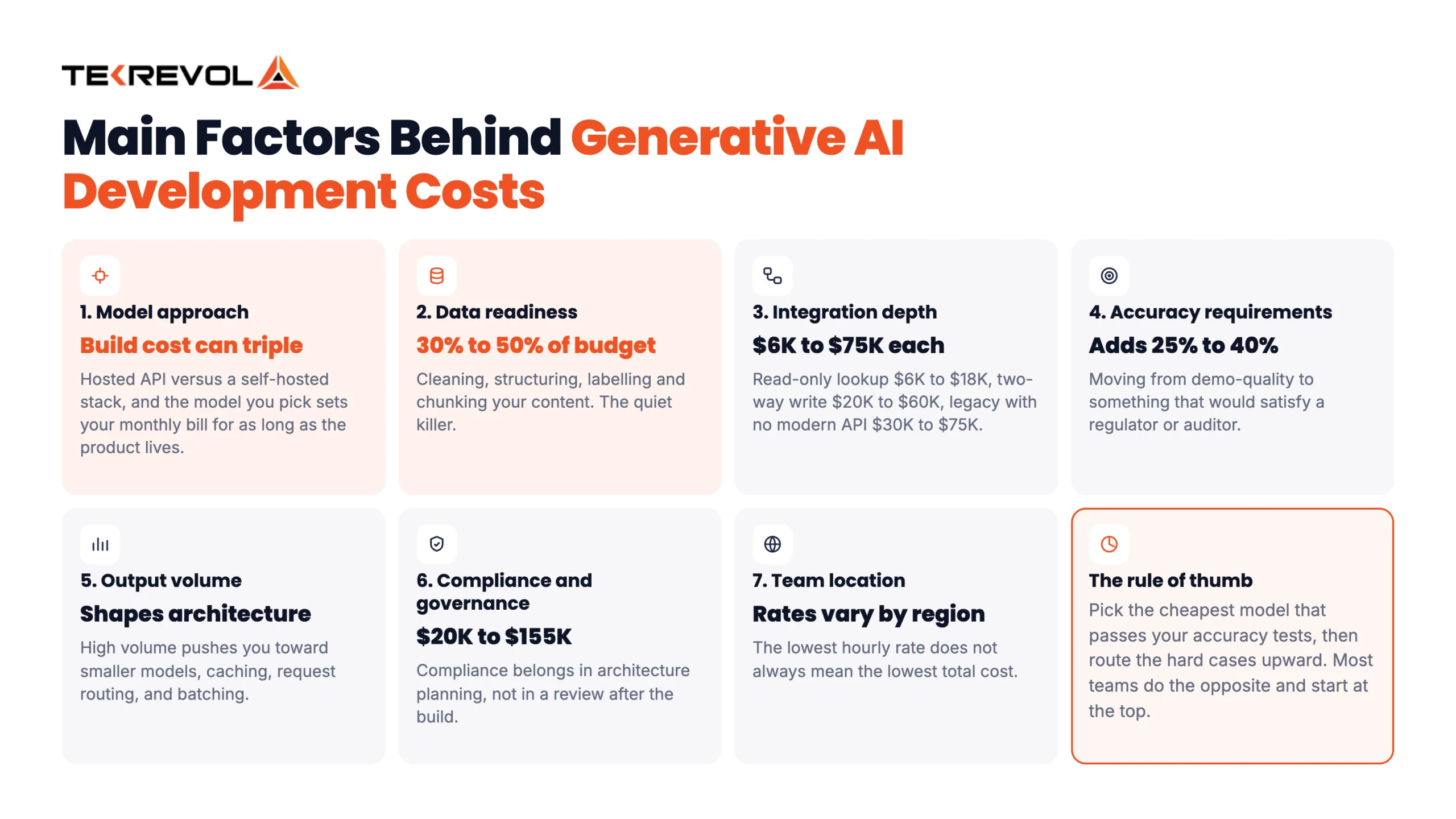
Generative AI cost factors are model approach, data readiness, integration depth, output volume, accuracy requirements, governance scope, and team location. Here’s the swing each one carries on a typical mid-size build.
1. Model approach
There are two model decisions to make: what you use and where you run it. A hosted API handles both for you. Self-hosting gives you control over both, but also makes you responsible for GPUs, infrastructure, maintenance, and scaling.
It’s the biggest single swing on the list, and it hits you twice. Build cost can triple between a hosted API and a self-hosted open-source stack. Then the model you pick sets your monthly bill for as long as the product lives.
We’ve priced the same workload across every tier: 500,000 interactions a month, 2,400 tokens each, split 70% input and 30% output.
| Model | Blended cost per 1M tokens | Estimated monthly bill | Best for |
| Gemini 3.7 Flash (batch) | $0.83 | $1,000 | Classification, tagging, bulk async work |
| Gemini 3.7 Flash (Standard) | $1.65 | $2,000 | High-volume chat, routing, simple extraction |
| Claude Sonnet 5 | $4.40 | $5,300 | Most production assistants and RAG products |
| GPT-5.6 Terra | $5.00 | $6,000 | Balanced reasoning, everyday agentic work |
| Claude Opus 5 | $11.00 | $13,200 | Hardest reasoning, high-stakes output |
| GPT-5.6 Sol | $12.50 | $15,000 | Frontier reasoning, long-context analysis |
| Llama or Mistral, self-hosted | Fixed cost, not per token | ~$23,700 (estimate) | Data residency and extreme volume only |
So pick the cheapest model that passes your accuracy tests, then route the hard cases upward. Most teams do the opposite and start at the top.
2. Data Readiness
This one is the quiet killer. Cleaning, structuring, labelling, and chunking your content commonly absorb 30% to 50% of a generative AI budget, and it happens before anyone writes a prompt. So rate your sources honestly before you commit to a launch date.
| State of your content | Cost to prepare | Typical timeline |
| Clean and structured, one system | $8,000 to $20,000 | 1 to 2 weeks |
| Mixed formats, some duplication | $20,000 to $45,000 | 3 to 5 weeks |
| Chaotic: scanned PDFs, a decade of wiki | $45,000 to $80,000+ | 6 to 12 weeks |
Notes: Figures reflect typical ranges we see across client engagements; actual cost depends on data volume, domain complexity, and compliance requirements.
3. Integration Depth
Reading from a CRM is cheap. Letting the model write back to it is not possible because now you need approvals, rollbacks, and an audit trail for every action.
- Read-only lookup: $6,000 to $18,000 each
- Two-way write access: $20,000 to $60,000 each
- Legacy system with no modern API: $30,000 to $75,000 each
4. Accuracy Requirements
Accuracy requirements can change the product and the price. An internal AI tool can usually tolerate a few wrong answers. A customer-facing system handling pricing or policies needs much stricter controls because mistakes can create legal, financial, or compliance risks.
Moving from demo-quality accuracy to something that would satisfy a regulator or auditor typically adds 25–40% to the budget.
| Accuracy Tier | Use Case | Tolerance for Error | Budget Impact |
| Low | Internal brainstorming, ideation tools | High; wrong answers are low-stakes | Baseline cost |
| Medium | Employee-facing support tools, drafting assistants | Moderate errors need review, not zero-risk | +10–20% |
| High | Customer-facing, regulated, or compliance-sensitive systems | Low errors carry legal/financial/reputational risk | +25–40% |
The added cost comes from retrieval, traceability, human review, testing, and monitoring needed for dependable results.
5. Output volume
This isn’t a build cost in itself, but it shapes the architecture, and that shapes everything else. High volume forces efficiency work into the build-up front. Low volume lets you skip most of it and simply pay a higher per-call rate.
High volume pushes you toward:
- Smaller, cheaper, or fine-tuned models instead of defaulting to the largest frontier model.
- Caching layers to avoid re-generating repeated or near-duplicate responses.
- Request routing (sending simple queries to cheap models, complex ones to expensive models).
- Batching and queueing infrastructure to manage throughput
6. Compliance and Governance
Compliance can add $20,000 to $155,000 to a generative AI project, depending on your industry, the data involved, and how much oversight you need. For US businesses, requirements vary by state and by sector, so compliance belongs in architecture planning rather than in a review after the build.
Common US compliance requirements
| Requirement | Applies to | What it typically adds |
| HIPAA | Healthcare and any system handling protected health information | Audit logging plus human review: $35,000 to $110,000 |
| FCRA | AI involved in consumer reporting or certain credit decisions | Adverse action explanations and override workflow: $26,000 to $80,000 |
| FTC Act | AI products making claims about performance or business outcomes | Substantiation and model documentation: $6,000 to $20,000 |
| State AI laws | Illinois and Texas since January 2026, California’s AI Transparency Act since August 2026, and Colorado’s ADMTA from January 2027 | Disclosure, labelling and consumer notice: $8,000 to $45,000 |
Colorado is worth watching as its AI rules change for 2027. Rather than building around today’s headlines, design for the strictest state requirements you may face. Retrofitting later can cost much more.
What governance adds to your build
- Disclosure, labelling and watermarking: $8,000 to $25,000
- Logging, retention, and audit trails: $15,000 to $50,000
- Human review workflow with override authority: $20,000 to $60,000
- Model documentation and training-data summaries: $6,000 to $20,000
- Annual review and reassessment: $10,000 to $30,000 a year
Budget governance is a running cost, not a launch task. The rules will keep moving, and the products that survive are the ones designed to be explained.
7. Team location
Where your development team is based can have a major impact on the overall project cost. As shown in the table below, hourly rates vary significantly by region and team structure, but the lowest rate does not always mean the lowest total cost.
| Region | Typical Hourly Rate | Best Fit When |
| United States | $150 – $250/hr | Regulatory complexity, real-time collaboration, sensitive data |
| Western Europe | $130 – $200/hr | EU data residency, GDPR-heavy builds |
| Eastern Europe | $40 – $90/hr | Strong technical depth needed at a lower blended rate |
| Latin America | $50 – $90/hr | US-based teams needing timezone overlap |
| South/Southeast Asia | $25 – $60/hr | Well-defined scope, cost is the primary constraint |
If you already have engineers but no AI specialists, IT staff augmentation usually beats a hiring round. Senior AI engineers currently take three to six months to hire, and that delay has a cost of its own.
Generative AI Development: Feature-by-Feature Cost Breakdown
Features can quickly change your AI development budget. Here’s a breakdown of the most common ones and their typical costs.
AI Chat Interface
Estimated Cost: $8,000–$20,000
The foundation most apps are built on. Straightforward if it’s connected to a hosted API, with cost rising alongside conversation memory and complexity.
Document Upload + Q&A
Estimated Cost: $12,000–$30,000
Requires embeddings and a retrieval layer to search your documents accurately. More document formats and volume push this toward the higher end.
Image Generation Module
Estimated Cost: $15,000–$40,000
Heavier on both processing and infrastructure than text-based features. Costs scale with resolution, generation speed, and model choice.
Voice Input + AI Replies
Estimated Cost: $18,000–$45,000
Adds real complexity: speech-to-text, real-time processing, and natural-sounding audio replies all have to work together smoothly.
Multi-language Support
Estimated Cost: $8,000–$25,000
Cost depends on how many languages you’re supporting and whether translation needs to hold up in specialized or technical contexts.
AI Personalization Memory
Estimated Cost: $20,000–$60,000
Usually the most expensive add-on. It needs persistent, user-specific context storage and a model that gets smarter about each user over time.
Admin Dashboard
Estimated Cost: $10,000–$35,000
Scales with how much control and visibility you need, basic usage stats versus full user management and analytics.
Payment + Subscription System
Estimated Cost: $8,000–$20,000
Fairly standard integration work, though compliance requirements can push costs up depending on your industry.
Generative AI Development Cost by Use Case
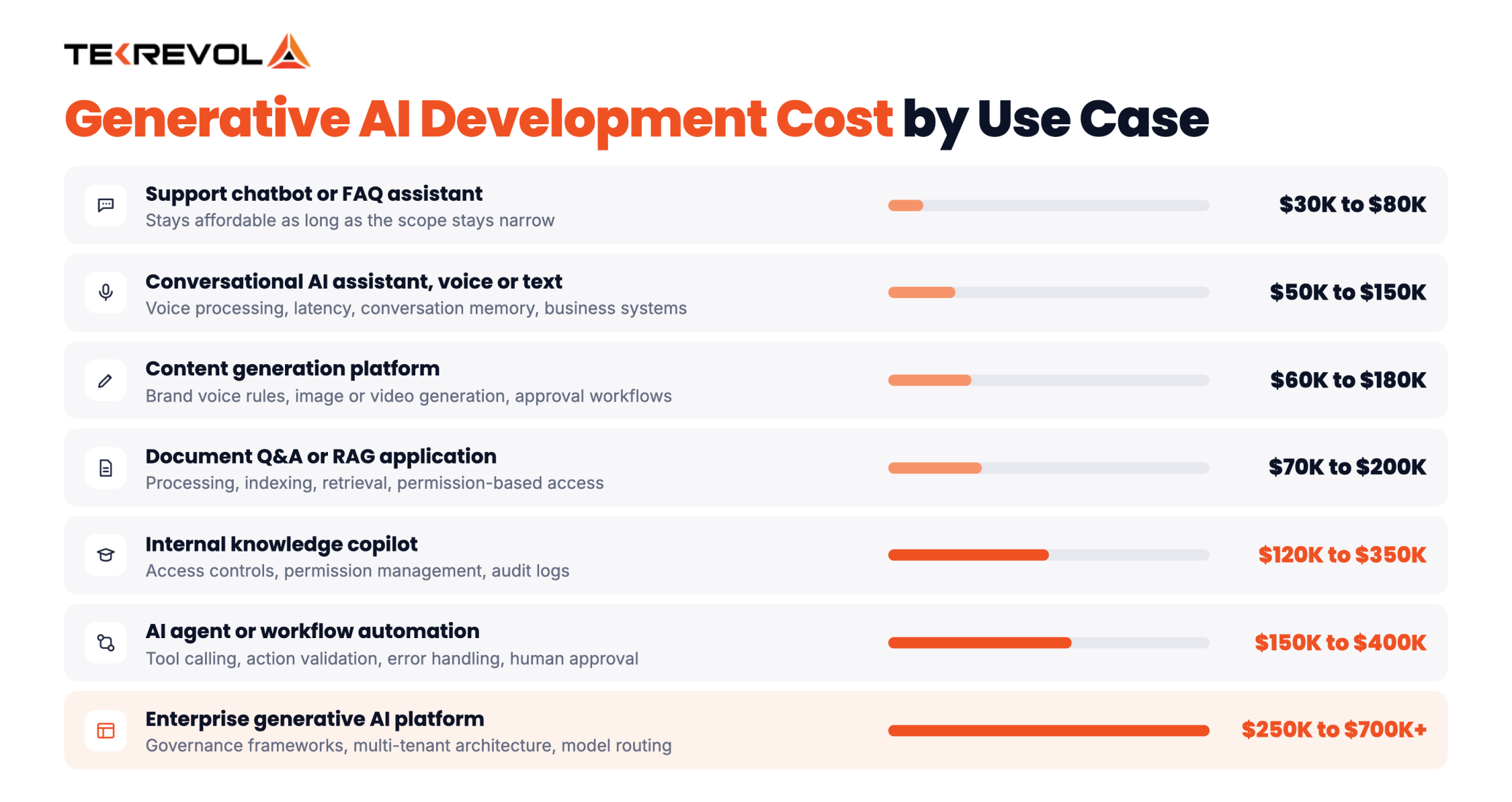
Generative AI development costs typically range from $30,000 for a focused FAQ chatbot to $700,000+ for an enterprise-grade AI platform. The use case often affects cost more than the number of features because it determines the level of data engineering, integrations, security, and governance required.
Support Chatbot or FAQ Assistant: $30,000 to $80,000
This is the entry point for most businesses experimenting with generative AI, and it stays affordable as long as the scope stays narrow. Costs increase when you add live system lookups, multilingual support, complex escalation logic, or integrations with CRM and support platforms.
Conversational AI Assistant (Voice or Text): $50,000 to $150,000
Conversational AI assistants require more than simple text responses, especially when they support voice. Voice processing, response latency, conversation memory, and integration with business systems can all increase development costs.
If your use case is a customer-facing assistant, our breakdown of conversational AI chatbot development cost goes deeper into that specific build than this page can.
Content Generation Platform: $60,000 to $180,000
Tools designed for marketing copy, product descriptions, and creative content generally fall within this range. Costs increase when businesses need tighter control over AI outputs, such as brand voice rules, image or video generation, and approval workflows before content is published.
Document Q&A / RAG Application: $70,000 to $200,000
RAG applications require a reliable pipeline for processing, indexing, retrieving, and securing documents. The volume of data, document complexity, retrieval strategy, and permission-based access can significantly affect the final cost.
Internal Knowledge Copilot: $120,000 to $350,000
Enterprise knowledge assistants are built to search across internal systems, including company wikis, shared drives, and support platforms. The more data sources they need to connect, the more complex the build becomes. Access controls, permission management, and audit logs add another layer of cost because accuracy and governance become critical requirements.
AI Agent or Workflow Automation: $150,000 to $400,000
AI agents cost more because they can take actions rather than simply generate responses. Integrations, tool calling, action validation, error handling, and human approval steps are major factors that drive the budget.
Enterprise Generative AI Platform: $250,000 to $700,000+
At the top end are full platforms meant to serve an entire organization rather than a single team or use case. Costs here are driven less by any single feature and more by cross-cutting concerns such as governance frameworks, multi-tenant architecture, and industry-specific compliance requirements. They also increase when routing logic is needed to direct requests across multiple underlying models.
Generative AI Development Cost Across Industries
Industry requirements can significantly affect generative AI development costs. Compliance, data sensitivity, accuracy requirements, and human oversight can make the same AI capability much more expensive in one industry than in another.
1. Retail and eCommerce
Estimated cost: $60,000 to $180,000
Retail AI applications often rely on constantly changing product and inventory data. Costs increase when the system needs to keep catalogs updated and prevent recommendations for discontinued or unavailable products.
2. Media and Marketing
Estimated cost: $50,000 to $160,000
Marketing and media platforms often generate large volumes of content. Rights management, brand consistency, content approvals, and controls for generated assets can add to development costs.
3. Logistics
Estimated cost: $90,000 to $240,000
Logistics applications need to handle situations where the AI is uncertain or cannot complete an action. Exception handling, human escalation, and integrations with logistics systems can increase the overall cost.
4. Education
Estimated cost: $70,000 to $200,000
Educational AI requires additional safeguards, especially when used by younger students. Age-appropriate filtering, content controls, monitoring, and user permissions can increase development effort.
5. Financial Services
Estimated cost: $150,000 to $450,000
Financial AI applications require strict controls over recommendations and decisions. Audit trails, advice boundaries, security, and detailed decision logging can significantly increase costs. These are key considerations when implementing generative AI in financial services.
6. Healthcare
Estimated cost: $180,000 to $550,000
Healthcare applications require strong safeguards because AI outputs can influence patient care. Clinical review workflows, consent tracking, secure data handling, compliance, and human oversight add to the development cost. Our guide on generative AI in healthcare explores where these added investments can create the most value.
7. Legal and Professional Services
Estimated cost: $130,000 to $380,000
Legal and professional AI tools need highly reliable and traceable outputs. Citation verification, document permissions, audit trails, and safeguards against fabricated references can make these applications more expensive to build.
Generative AI Development Cost Breakdown by Stage
Generative AI projects involve several stages, from initial discovery and design to data preparation, model engineering, testing, and deployment. Each stage requires a different level of effort, so understanding where the budget goes can help you spot potential cost gaps early.
1. Discovery and Use-Case Definition
Estimated cost: $5,000 to $25,000 (5% to 10% of budget)
Estimated timeline: 1 to 3 weeks
This stage defines the business problem, target users, core workflows, and technical requirements. It also determines which AI approach makes sense before development begins.
- Define use cases and success metrics
- Identify required integrations and data sources
- Select the initial AI architecture
2. Data Assessment, Cleaning, and Pipelines
Estimated cost: $15,000 to $90,000 (20% to 35% of budget)
Estimated timeline: 3 to 8 weeks
Data preparation is often the largest single cost category in generative AI development. The work can include cleaning, structuring, labeling, transforming, and connecting data sources so the system can use them reliably.
- Assess data quality and availability
- Build ingestion and processing pipelines
- Prepare data for RAG, fine-tuning, or other AI workflows
3. Experience Design and Guardrail Design
Estimated cost: $6,000 to $35,000 (8% to 12% of budget)
Estimated timeline: 2 to 5 weeks
This stage covers how users interact with the AI system and how its behavior is controlled. Guardrails are designed to reduce harmful, irrelevant, or unreliable outputs before the system reaches production.
- Design user flows and AI interactions
- Define response boundaries and escalation rules
- Establish content and behavior guardrails
4. Model Selection, Retrieval and Prompt Engineering
Estimated cost: $15,000 to $80,000 (15% to 25% of budget)
Estimated timeline: 3 to 8 weeks
The right model and retrieval strategy can have a major impact on both performance and operating costs. Teams test models, build prompts, configure retrieval, and optimize the system around the required use cases.
- Compare foundation models
- Build and optimize prompts
- Configure RAG and retrieval workflows
- Tune model performance for specific tasks
5. Application Build and System Integrations
Estimated cost: $25,000 to $150,000 (20% to 30% of budget)
Estimated timeline: 6 to 16 weeks
This is the largest time commitment in the build and often the highest cost as well. This is where the AI capabilities are turned into a working product and connected to the systems users already rely on. The cost depends heavily on the number and complexity of integrations.
- Build the application interface and backend
- Connect APIs, databases, CRMs, ERPs, or other systems
- Implement authentication, permissions, and business logic
6. Evaluation, Red-Teaming and Security Testing
Estimated cost: $10,000 to $70,000 (10% to 18% of budget)
Estimated timeline: 3 to 6 weeks
Generative AI systems need more than conventional software testing because outputs can vary and fail in unexpected ways. Evaluation and red-teaming help identify hallucinations, prompt injection risks, security gaps, and other failure modes before launch.
- Test accuracy and response quality
- Run adversarial and red-team testing
- Validate security, privacy, and compliance controls
7. Deployment, LLMOps and Pilot Rollout
Estimated cost: $8,000 to $50,000 (5% to 10% of budget)
Estimated timeline: 3 to 6 weeks
The final stage moves the system into a controlled production environment and establishes the monitoring needed to keep it reliable. A pilot rollout also gives the team real usage data before expanding to the full user base.
- Configure production infrastructure
- Set up monitoring, logging, and model evaluation
- Launch a controlled pilot and track performance
What Does It Cost to Run Generative AI After Launch?
Running costs vary by category and scale with usage. Here’s where the money goes.
Model Inference
Estimated cost: $300–$50,000+ per month
Inference is usually the largest ongoing expense. Internal tools with limited usage may cost a few hundred dollars monthly, while high-volume customer-facing products can reach $5,000–$50,000+ per month.
Vector Database and Re-Indexing
Estimated cost: $200–$3,000 per month
RAG applications need vector storage for embeddings and retrieval. Costs increase with data volume, query traffic, and re-indexing requirements when source content changes.
Monitoring and LLMOps
Estimated cost: $300–$2,000 per month for tooling
Monitoring covers logging, tracing, alerts, drift detection, and performance tracking. Engineering time for investigating failures and optimizing the system comes on top of these tooling costs.
Evaluation and Regression Testing
Estimated cost: 10%–20% of the original evaluation cost annually
Model, prompt, or retrieval changes can affect existing behavior. Recurring evaluations and regression tests help identify accuracy and reliability issues before they reach users.
Human Review
Estimated cost: $1,000–$20,000+ per month
High-stakes applications may require people to review AI outputs. The actual cost depends on output volume, review frequency, and the level of risk involved.
Retraining and Prompt Maintenance
Estimated cost: $15,000–$60,000 per year for a mid-sized system
Prompts, retrieval configurations, and fine-tuned models need updates as business data and requirements change. Systems using fine-tuning generally require more maintenance than prompt-based applications.
Model Migration
Estimated reserve: 5%–10% of annual operating costs
When a provider retires or changes a model, teams may need to retest prompts, update integrations, tune retrieval, and validate output quality. Setting aside a migration budget prevents these changes from becoming unexpected expenses.
Security, Compliance, and Legal Review
Estimated cost: $10,000–$40,000 per year
Regulated applications may require recurring security assessments, compliance reviews, access audits, penetration testing, and policy updates.
Cloud Infrastructure
Estimated cost: $1,000–$15,000+ per month
Cloud costs cover compute, databases, storage, networking, backups, and supporting services. Actual spending depends on traffic, architecture, data volume, and availability requirements.
For this reason, considering cloud consulting services during architecture planning can help control infrastructure costs before they start climbing.
Three-Year Total Cost of Ownership for Generative AI
The three-year total cost of ownership for a mid-sized generative AI product typically runs 1.9 to 2.7 times the original build price. A $150,000 build becomes $285,000 to $400,000 across 36 months. The run rate, not the build, is where most of the money goes after year one.
| Period | What’s included | Cost |
| Year 0 | Build, integrations, evaluation, launch | $150,000 |
| Year 1 | Inference, infra, monitoring, review, improvements | $45,000 to $80,000 |
| Year 2 | Run rate plus retraining and feature work | $40,000 to $75,000 |
| Year 3 | Run rate plus a model migration or major update | $50,000 to $95,000 |
| 3-year total | $285,000 to $400,000 |
Generative AI Development Costs by Team Model
The team structure you choose can have a major impact on your total generative AI development cost. Full in-house builds cost $400,000 to $1M+ annually once you include hiring and retention. Outsourced builds cost $60,000 to $400,000 per project. Hybrid teams land in the middle and retain knowledge better than pure outsourcing.
In-house
Best when generative AI is core to your product and you’ll be shipping continuously for years. Worst when it’s one project, because you’re hiring scarce, expensive people for a finite job, and you’ll carry them afterward.
Outsourced
Outsourcing is often the best option when speed matters and the project has a clearly defined scope. The main risk is losing critical knowledge when the external team hands over the project. Reduce that risk with documented architecture, a dedicated transition sprint, and shared repositories from day one. We covered the failure modes in detail in outsourcing AI development.
Hybrid
Your people own the product, data, and domain knowledge. A partner brings the ML engineering, LLMOps, and evaluation practice. In our experience, this is the model that most often survives contact with year two, because the institutional knowledge stays with you.
For generative AI specifically, we’d steer you away from a fixed price in the first phase. Nobody, including us, can fix-price a build before knowing what state your data is in. Fixed-price the phases after discovery instead.
Pricing Model
| Model | Best For | The real trade-off |
| Fixed price | Pilots and clearly scoped features | Vendors price in risk, so you pay a premium for certainty |
| Time and materials | Exploratory or research-heavy work | Flexible, but it needs active governance, or it drifts |
| Dedicated team | Programmes running for two quarters or longer | Best value at scale, needs real internal ownership |
| Outcome-based | Mature use cases with an agreed metric | Attractive on paper, hard to define fairly |
Hidden Generative AI Costs That Often Get Missed
Beyond the run-rate categories above, a few costs get missed because they don’t scale with usage or don’t show up until later.
Change Management and Adoption
Estimated cost: 10%–20% of the program budget
Employee training, internal communication, workflow changes, and adoption support can add a meaningful amount to the overall budget. Appinventiv’s 2026 analysis places change management within this range.
Shadow AI Cleanup
Estimated cost: Varies by organization size and number of tools
Larger organizations may already have employees using unapproved AI tools across departments. Identifying, consolidating, securing, and governing these tools can become an additional cost during enterprise AI adoption.
Cost of Not Shipping
Estimated impact: Potential loss of the entire development investment
Gartner reported that at least 50% of generative AI projects were abandoned after the proof-of-concept stage, citing issues including poor data quality, weak risk controls, rising costs, and unclear business value. Finding problems during discovery is considerably cheaper than finding them after a full build — treat that phase as budget, not overhead to minimize.
For a deeper look at the risks behind these costs, see our guide to AI adoption challenges and how to mitigate them.
Best Practices for Reducing Generative AI Development Costs
You can reduce generative AI development costs without cutting the features users actually need. The biggest savings usually come from using the right model for each task, controlling token usage, limiting the initial scope, and avoiding unnecessary fine-tuning.
Route Requests to the Right Model
Potential savings: 20%–40% on inference costs
Not every request needs your most capable model. Use smaller, lower-cost models for simple classification, extraction, formatting, and routine questions, while reserving larger models for complex reasoning. A model-routing layer can often deliver substantial savings without changing the user experience.
Use Caching Aggressively
Potential savings: 10%–30% on repeated requests
Caching prevents the system from paying to process the same context or similar questions repeatedly. Prompt caching can reduce repeated-context costs, while semantic caching can return stored answers for near-identical queries.
Batch Non-Real-Time Workloads
Potential savings: 20%–50% on eligible workloads
Jobs that do not require immediate responses can be processed in batches rather than through synchronous API calls. Document processing, content classification, summarization, and data enrichment are good candidates for batch processing.
Reduce the Context You Send
Potential savings: 10%–40% in token-related costs
Sending entire documents when only a few relevant sections are needed increases both cost and latency. Better chunking, retrieval, filtering, and reranking help the system send only the context required for each request.
Start With One High-Value Workflow
Potential savings: 20%–40% on initial development
A focused first release keeps the initial build smaller while creating reusable infrastructure for future use cases. Once the retrieval layer, evaluation framework, integrations, and guardrails are in place, additional workflows can be added without rebuilding the foundation.
Choose Retrieval Before Fine-Tuning
Potential savings: Varies by use case
Fine-tuning is not always necessary when the goal is to give a model access to company-specific or frequently changing information. RAG can often provide the required knowledge without the additional training, dataset preparation, and maintenance involved in fine-tuning.
Track Cost From Day One
Potential savings: Depends on usage patterns
Per-request cost tracking shows which models, workflows, and users are driving spending. Without this visibility, teams can end up optimizing the wrong part of the system or discover excessive usage only after receiving a large bill.
Avoid Paying for Unnecessary Speed
Potential saving: 30%–50%+ on infrastructure in some workloads
If users are comfortable waiting two seconds for a response, designing the system around sub-second latency may add unnecessary infrastructure costs. Set performance targets around actual user expectations rather than optimizing for speed that the product does not require.
What’s the ROI of Generative AI in 2026?
Most generative AI projects pay back in 9 to 24 months, though high-volume workflows land faster and lower-volume ones can take longer, as shown below. Returns typically come from lower labor costs, time savings, or added revenue. If you can’t name the source, the use case may not be strong enough yet.
A Simple Way to Calculate Payback
You can estimate the economics with three basic calculations:
- Monthly value = volume handled × savings per task × automation rate
- Monthly cost = monthly operating cost + monthly share of development cost
- Payback period = development cost ÷ monthly net savings
Example
Suppose an AI support assistant handles 3,350 conversations per month, saves $6 per resolved ticket, and resolves 55% of conversations. That creates around $132,000 in annual savings.
If the system costs $90,000 per year to run and requires a $150,000 build, labor savings alone would take roughly 3.5 years to recover the initial investment. Add faster resolution, fewer escalations, and improved retention, and the overall payback can become much stronger.
Our AI Strategy Advisor case study recorded a 30% average KPI improvement and 40% faster decision-making. These gains are harder to convert directly into dollars but can still create measurable business value.
For a stronger starting point, focus on AI agent use cases that can deliver ROI quickly rather than choosing the most ambitious AI project first.
What’s Driving Generative AI Costs in 2026 and Beyond
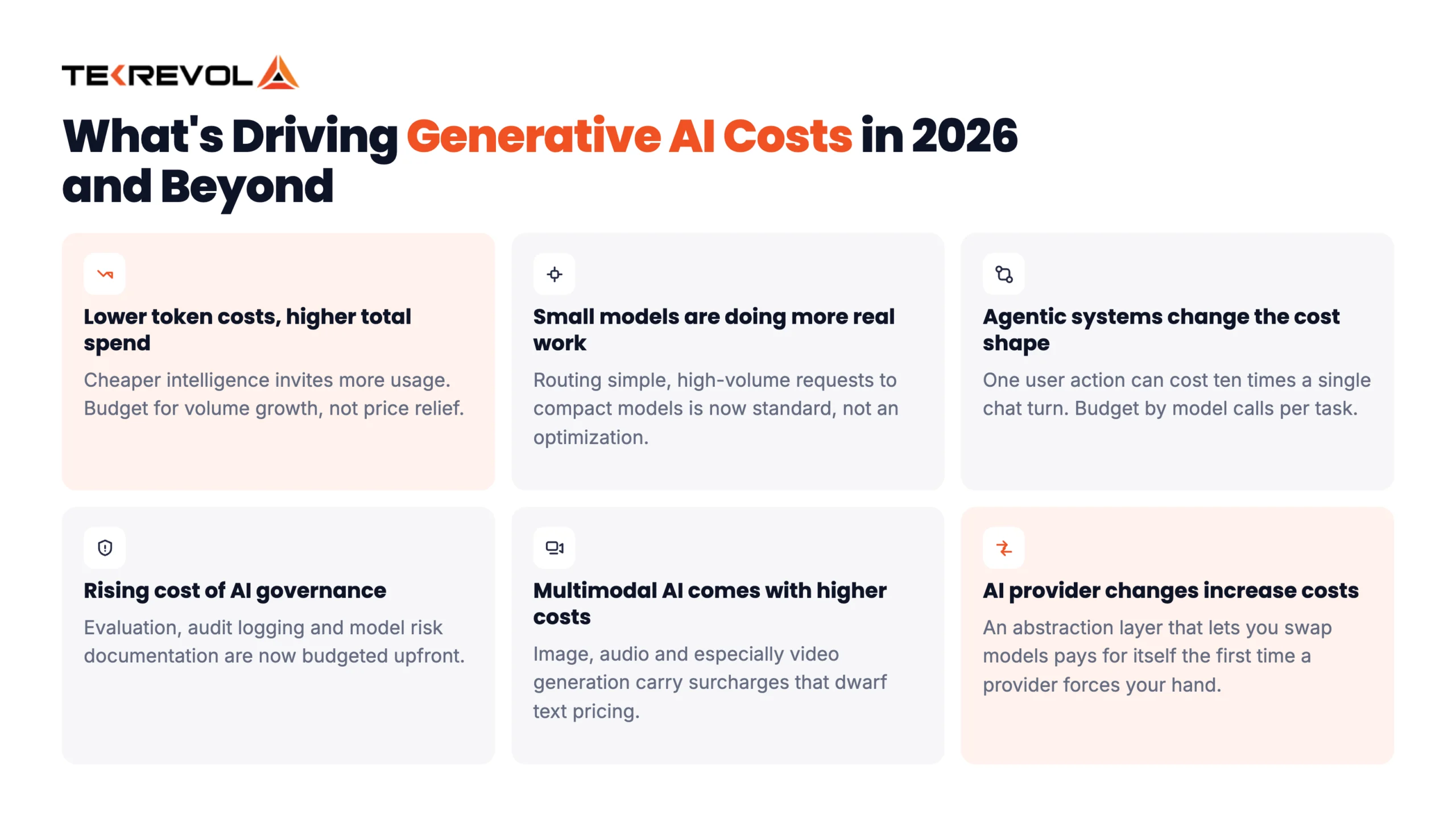
The cost of generative AI is changing as models become cheaper and businesses use them at greater scale. Lower token prices are being offset by growing spending on data, infrastructure, evaluation, and governance.
Lower Token Costs, Higher Total Spend
Cheaper intelligence invites more usage. As token prices drop, usage climbs, and total spend rises even as the unit price shrinks. Budget for volume growth, not price relief.
Small Models Are Doing More Real Work
Routing simple, high-volume requests to compact models is now standard, not an optimization. Not every task needs a frontier model; classification and routine responses run fine on smaller ones, at a fraction of the cost.
Agentic Systems Change the Cost Shape
Agents make multiple model calls per task, so one user action can cost ten times what a single chat turn does. If you’re pricing AI agent development, budget by model calls per task, not requests per day.
Rising Cost of AI Governance
Evaluation, audit logging, and model risk documentation are now budgeted upfront. Buyers want proof that a system behaves reliably before they trust it with real workflows.
Multimodal AI Comes With Higher Costs
Image, audio, and especially video generation carry surcharges that dwarf text pricing. Two projects can look identical in scope and land worlds apart in cost once the generation type enters the picture. Our multimodal AI overview breaks down where that extra cost is worth paying.
AI Provider Changes Increase Costs
Model deprecations happen often enough now to be a recurring cost, not a rare inconvenience. An abstraction layer that lets you swap models without a rebuild pays for itself the first time a provider forces your hand.
Partner with TekRevol for Generative AI Development
TekRevol helps businesses turn generative AI from a buzzword into a real competitive advantage. Our AI developers work closely with clients to design, build, and deploy custom AI solutions that fit specific business goals, from automating workflows to creating smarter customer experiences.
With deep expertise across machine learning, natural language processing, and large language models, TekRevol delivers scalable AI systems that are secure, reliable, and built for long-term growth. We start with one measurable use case and a cost model, not a capability demo. You get a build estimate and a monthly run-rate projection in the same document.
Our generative AI development team works across healthcare, fintech, eCommerce, education, and customer care, and we’ll tell you when an off-the-shelf tool beats a custom build. That answer costs us a project and saves you a year.
- Trusted & Top-Rated: Rated 5.0 on GoodFirms and 4.8 on Clutch and Rightfirms.
- Custom AI Solutions: Customized generative AI models built around your business objectives.
- End-to-End Development: From strategy and design to deployment and ongoing support.
- Proven Track Record: Real client success stories showing measurable AI-powered transformation.
Have an AI Idea but No Clear Budget Yet?
Let's turn your use case into a realistic development estimate covering infrastructure, integrations, and ongoing AI costs.
Get Your AI Cost Estimate!


