



Businesses commonly ask this question “how long does a POC take?” before initiating any new digital project. Startup or a corporation, it is good to know that timelines matter. They affect cost, planning, investor trust, and internal management.
Knowing the PoC timeline in software development enables the different teams to work without setting up unreasonable expectations and getting the results faster. Although a Proof of Concept is a short one by nature, its time can differ quite a lot because of its scope, technology, and the way it is carried out.
This post gives you the full story about the duration of the POC custom software development, tells you what impacts it, and helps you figure out a realistic schedule before you start.
Understanding Proof of Concept in Software Development
It is necessary to understand a PoC well before sharing the timeline. The time of a Proof of Concept in the software development field and its importance in playing the first role is the context that bothers us.
A proof of concept in software development is the smallest core of an idea, which subsequently seeks to prove if the idea, feature, or suggested technical approach is feasible. Without building a complete product, the team will develop a tiny one for testing assumptions, integrations, or performance constraints. It is usually the first step in the PoC development life cycle.
A PoC differs significantly from full-scale development. It does not aim for polish, scalability, or user readiness. Instead, it answers one core question: can this idea technically work? That is why PoC timelines are intentionally short and tightly scoped.
Why businesses rely on PoCs
PoCs become essential in scenarios such as:
- Testing new or emerging technologies
- Validating complex integrations or data pipelines
- Assessing technical risk before a major investment
- Aligning stakeholders on feasibility and direction
Industry data further reinforces this need. Studies show that 70% of software projects fail due to unclear requirements or unrealistic expectations. Early validation through PoCs helps reduce these risks and improves overall project success rates.
Looking to accelerate your product roadmap?
Tekrevol creates rapid PoCs to ensure your concept works before full development.
Start Your Free Consultation
Why PoC Timelines Matter More Than You Think
At first glance, a few weeks more or less may not seem critical. However, PoC duration has a direct impact on business outcomes.
A clearly defined average PoC completion time helps control development costs, align internal teams, and set expectations with investors and partners. When timelines are vague, projects often suffer from scope creep, delays, and budget overruns.
PoC timelines also influence go or no-go decisions. A focused and timely PoC allows leadership to quickly decide whether to move forward, pivot, or stop altogether. This ability to make informed decisions early is one of the biggest sources of business value of software PoC initiatives.
Key Factors That Determine How Long a PoC Takes
Every PoC is different, but certain variables consistently influence timelines. Understanding these factors affecting PoC timeline helps teams plan more accurately.
Project Scope and Objectives
A PoC with a clearly defined problem statement moves faster than one with vague or shifting goals.
- A narrow scope focused on one hypothesis shortens timelines
- Multiple features or unclear success criteria increase duration
Defining what you want to prove is the first step in answering how long to build a PoC.
Technology Stack and Architecture
Technology choices have a major impact on the software PoC process stages.
- Proven stacks reduce experimentation time
- AI, blockchain, IoT, or data-heavy use cases often extend timelines
- Infrastructure and hosting decisions also add complexity
New or experimental technologies naturally increase the proof of concept development duration.
Team Structure and Expertise
Who builds the PoC matters just as much as what is being built.
- Dedicated teams move faster than shared resources
- Experienced engineers anticipate challenges early
- Strong CRM solution architects reduce rework
A skilled team can significantly shorten the PoC project schedule.
Third Party Dependencies and Integrations
External systems often introduce delays.
- APIs, SDKs, hardware, or legacy platforms
Approval bottlenecks and access limitations - Poor data quality or missing datasets
These dependencies are among the most common reasons PoCs exceed the average PoC completion time.
Feedback, Testing, and Approval Cycles
Even a well-built PoC can stall without timely feedback.
- Delayed reviews slow progress
- Multiple approval layers add friction
- Involvement of stakeholders at the very beginning is highly missing; thus, rework is needed
- Efficient feedback loops are the main condition for predictable timelines.
PoC Timeline Breakdown: An Overview of Each Phase
It would definitely be more accurate to figure out how long does a POC take by looking at different phases separately. In general, the same structure is followed in most PoCs, even if there are some variations in the details.
It is very good to get everybody aligned with the phases and expectations before actually starting the work.
Phase 1: Idea Validation and Requirement Discovery
This point in the project is all about narrowing down the problem and figuring out what the results should be.
- Find out the main problem that the PoC is intended to solve
- Create success metrics and validation criteria
- Link business goals with technical feasibility
Usual time: from a few days to a week
This step establishes the base for the whole PoC.
Phase 2: Technical Feasibility and Solution Planning
After the goals are set, companies evaluate the potential risks and come up with a concise plan.
- Evaluate limitations and questions
- Select tools, frameworks, and platforms
- Design a minimal architecture
Typical duration: one to two weeks
Strong planning here reduces delays later.
Phase 3 PoC Design and Development
This is where ideas become tangible.
- Build minimum functionality to test feasibility
- Develop backend logic or integrations
- Create basic UI flows if required
- Conduct internal reviews and iterations
Typical duration: two to four weeks
This phase often defines the overall proof of concept development duration.
Phase 4 Testing, Validation, and Performance Evaluation
Now the PoC is evaluated against predefined success metrics.
- Functional testing
- Performance and scalability checks
- Identify limitations and improvement areas
Typical duration: one to two weeks
This phase determines whether the concept truly holds up.
Phase 5 Review, Documentation, and Go or No-Go Decision
Finally, results are shared with stakeholders.
- Present findings and risks
- Document learnings and recommendations
- Decide whether to proceed, pivot, or stop
Typical duration: a few days to one week
This marks the formal completion of the PoC.
Want faster insights for your digital product?
Tekrevol delivers PoCs that provide clarity and reduce technical risk.
Start Your Free Consultation
Average PoC Timelines Based on Project Complexity
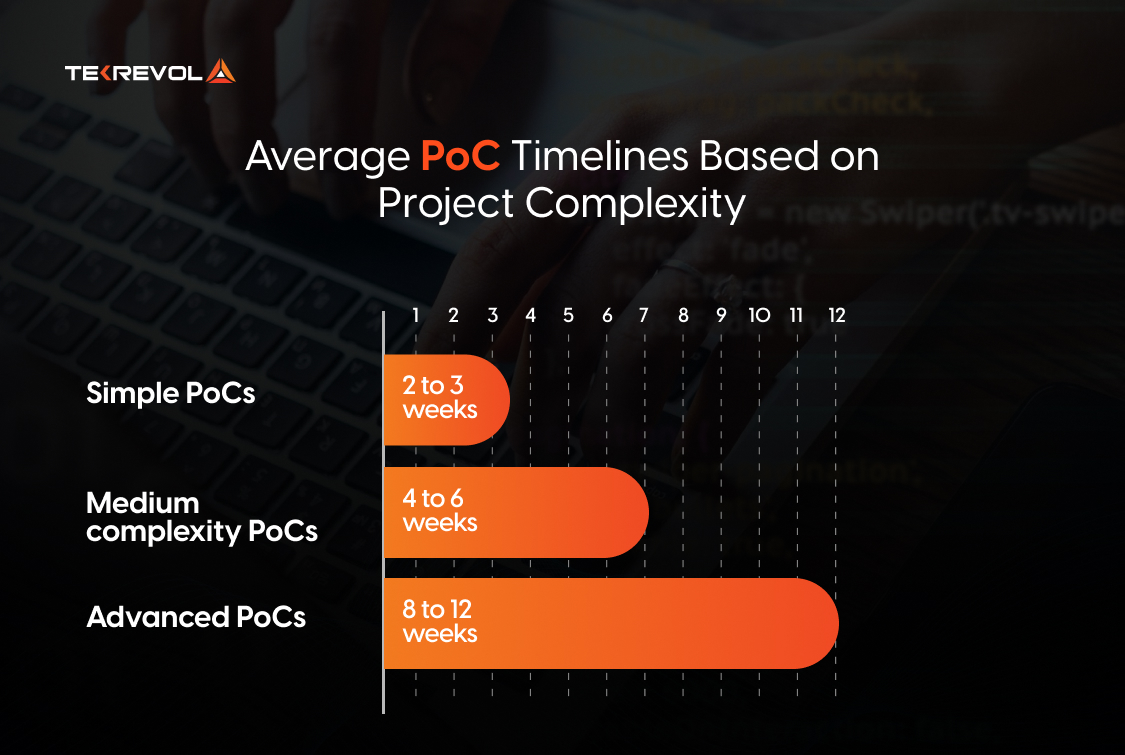
While timelines vary, patterns do exist. Understanding these ranges helps businesses plan realistic PoC project schedules and set accurate expectations for stakeholders. Here is the average PoC timeline based on project complexity.
- Simple PoCs with a single feature often take two to three weeks
- Medium complexity PoCs usually require four to six weeks
- Advanced PoCs involving AI, analytics, or enterprise systems may take eight to twelve weeks
These ranges provide a practical startup PoC timeline guide for planning and estimation.
PoC vs Prototype vs MVP: How Timelines Differ
Understanding the PoC vs MVP development timeline helps teams choose the right next step.
A PoC validates feasibility. A prototype focuses on design and user interaction. An MVP delivers core value to real users. Each stage serves a different purpose and therefore requires different timelines.
Many teams rush from PoC to MVP without addressing usability or scalability gaps. Recognizing these differences avoids costly mistakes and unrealistic expectations.
Common Reasons PoCs Take Longer Than Expected
Even with good planning, PoCs can slip. Delays often occur when teams underestimate integration challenges or fail to define clear success criteria upfront. Understanding these pitfalls in advance can help businesses plan a realistic PoC timeline in software development and avoid costly setbacks.
Common causes include:
- Expanding scope beyond feasibility testing
- Unclear or changing objectives
- Heavy reliance on third-party systems
- Limited stakeholder involvement early on
- Underestimating technical complexity
Addressing these risks early improves time estimation for software PoC initiatives.
How to Keep Your PoC Timeline Short and Efficient
Efficiency does not mean cutting corners. It means staying focused. By clearly defining the project scope and setting measurable success metrics early, teams can avoid unnecessary delays.
Maintaining rapid feedback loops and leveraging reusable components ensures your proof of concept development duration stays predictable and aligned with business goals. Here is what you can do:
- Define strict scope boundaries
- Set measurable success criteria early
- Use reusable components and open source tools
- Maintain fast feedback loops
- Partner with experienced development teams
These practices help teams answer how long does a POC take with confidence rather than guesswork.
When Is a PoC Considered Successfully Completed
A PoC is successful when it delivers clarity, not just code. Success is achieved when the core technical feasibility is validated, risks are documented, and stakeholders are aligned on the next steps.
A clear roadmap for moving from PoC to prototype or MVP ensures the project transitions smoothly while maximizing the business value of the software PoC.
Success indicators include:
- Core technical feasibility validated
- Risks and constraints are clearly documented
- Stakeholders aligned on next steps
- Clear roadmap for prototype or MVP development
This clarity is the true benefit of proof of concept in software projects.
How Tekrevol Helps You Build Faster and Smarter PoCs
Tekrevol is a company that specializes in the area of business where it is a necessity that the ideas be efficiently validated without the layer of excessive complexity. Their well-organized method of PoC creation is mainly focused on being feasible, quick, and strategically clear.
The various teams of Tekrevol are highly skilled and knowledgeable in a wide range of both cutting-edge and large-scale technologies, which makes them very efficient in risk identification and selection of the right technical path. The company employs agile and lean methodologies to carry out quick validation without any excessive engineering.
The point explaining what makes Tekrevol different from other similar companies is the strong emphasis they put on change. PoCs are considered not as separate trials but as a base for scalable products. The businesses that are funded through PoC get support in documentation, stakeholder alignment, and forward-looking architecture, which helps them in smoothly transitioning from PoC to prototype or MVP.
For those companies that are wondering how long a POC usually takes, Tekrevol offers you practical schedules, open planning, and a results-focused execution that eventually leads to your idea becoming a firm decision.
Want a faster, smarter route to product validation?
Tekrevol engineers PoCs that test assumptions and streamline decision-making.
Start Your Free Consultation



![20 Offline Music Apps To Try in 2026 [Free & Premium Options]](https://assets.tekrevol.com/images-tek/uploads/2024/07/Featured-Image-10-Offline-Music-App-400x226.jpg)
![Hire React Native Developers in Austin: Cost, Talent Pool & Where to Find Them [2026]](https://assets.tekrevol.com/images-tek/uploads/2026/07/Hire-React-Native-Developer-in-Austin-Featured-Image-400x225.webp)


