



In the past, businesses had to be willing to wait several months before they could put an application into production or make even small changes to it, while today, businesses have a growing demand for the ability to quickly create applications and to rapidly update or modify those applications as needed. This growing demand is largely to blame for the recent rise in interest in low-code versus no-code solutions.
While there is certainly a lot of discussion around low-code vs. no-code platforms, there remains a great deal of uncertainty in the industry. Many professionals are still unsure of what role low-code vs. no-code solutions will play in the future, especially when it comes to enterprise solutions.
This guide provides a clear, straightforward explanation of the terms of both solutions and includes insights into actual low-code vs. no-code solutions. It also helps businesses working with a mobile app development company in Austin understand how low-code vs. no-code platforms work, their benefits, and where these solutions can be effectively used within an organization.
What does Low-Code vs. No-Code Mean?
To the average person, there may be an assumption that there is a clear distinction between these two methods for creating applications. After all, you’ll find that low-code application development involves some coding, while no-code allows for the development of applications without any coding whatsoever. The definitions of low-code and no-code are not as clear as they appear.
When you go beyond the definitions and consider them practically rather than technically, however, you will also see that low-code and no-code are actually tools suited to address specific needs and problems. Each can be thought of as part of the same “toolbox” and is best used for the same types of things.
Although many low-code application development platforms are built with the developer in mind and are geared to help develop an application faster by automating many repetitive tasks via a visual development interface, they allow for the addition of custom-built logic and external integrations when a project becomes increasingly complex.
An example of how a low-code application development platform functions can be viewed in this video tutorial demonstrating the ability to build an application with the low-code interface and the integration of custom-built logic:
No-code, on the other hand, is about accessibility. These platforms are built so business users, marketers, and non-technical teams can create simple apps or workflows without needing to understand programming at all. A helpful way to think about no-code is through everyday analogies that explain how drag-and-drop tools replace traditional coding, like the one explained here:
IBM puts it well by explaining that the real distinction isn’t about which is better or worse, low-code or no-code, but about who’s building the app and how much flexibility they need. Low-code focuses on speed with control, while no-code focuses on speed with simplicity.
In the end, the choice between low-code and no-code isn’t about picking a winner. It’s about choosing the approach that fits your team, your timeline, and the kind of application you’re trying to build.
Need faster development without losing flexibility?
A strategic approach to low-code can help you ship smarter, not riskier.
Connect to Know How!What Is Low-Code App Development?
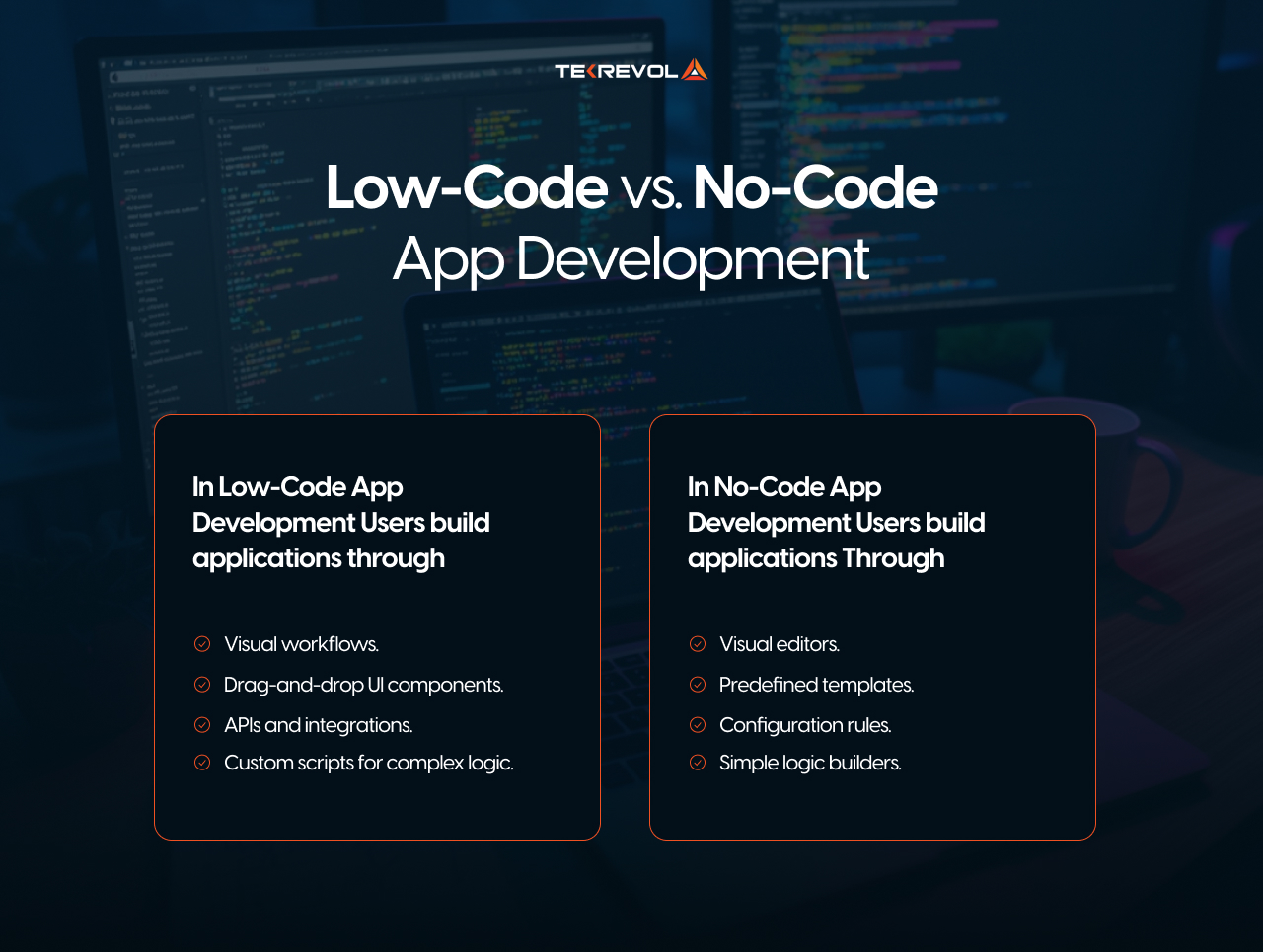
Low-code app development uses visual interfaces, pre-built components, and automation tools while still allowing developers to write custom code when needed.
Instead of building everything from scratch, teams assemble applications using:
- Visual workflows.
- Drag-and-drop UI components.
- APIs and integrations.
- Custom scripts for complex logic.
This approach dramatically reduces development time without sacrificing flexibility.
Who Uses Low-Code?
- Professional developers.
- IT teams.
- Technical product managers.
- Advanced “citizen developers”.
Where Low-Code Excels?
- Enterprise systems.
- Scalable mobile and web apps.
- Integrations with legacy software.
- Security-heavy environments.
This is why many teams at an iOS app development company or Android app development company adopt low-code to speed up delivery while keeping architectural control.
What Is No-Code App Development?
No-code app development removes programming entirely. Users build apps using predefined templates, drag-and-drop interfaces, and configuration rules, without writing a single line of code.
Users build applications using:
- Visual editors.
- Predefined templates.
- Configuration rules.
- Simple logic builders.
Everything happens inside a controlled environment, making it accessible to non-technical users.
Who Uses No-Code?
- Marketers.
- Operations teams.
- Founders.
- Business analysts.
Where No-Code Works Best?
- Internal tools.
- Simple workflows.
- MVPs and prototypes.
- Department-specific apps.
No-code tools are widely discussed in communities like Reddit, where users debate about when to choose no-code, low-code, or traditional app development through a top app development company in the USA. No-code shines when speed matters more than customization.
Difference between Low-Code vs. No-Code
Microsoft clearly outlines how low-code vs. no-code differs in customization and scalability.
1. Skill Level
No-code: Zero programming knowledge.
Low-code: Basic to intermediate coding skills.
2. Customization
No-code: Limited to platform features.
Low-code: Deep customization with code extensions.
3. Scalability
No-code: Best for small, contained apps.
Low-code: Designed for enterprise-scale growth.
4. Ownership
No-code: Owned by business teams.
Low-code: Shared ownership between IT and business.
This is why most enterprises don’t choose one but adopt a low-code and no-code strategy together.
Why Businesses Are Choosing a Hybrid Approach?
Modern organizations rarely ask, “Which is better?”
Instead, they ask, “Where does each fit?”
A hybrid strategy allows:
- No-code for fast internal tools.
- Low-code for customer-facing products.
- Traditional code for core systems.
This blended approach aligns perfectly with how digital teams actually work today. The developer community on Reddit actively discusses whether low-code and no-code will replace traditional coding.
The consensus? These tools change workflows, not the need for skilled developers.
How Low-Code vs. No-Code Impacts Mobile App Development?
For any iOS app development company or Android app development company, speed alone isn’t enough. Apps must be:
- Secure.
- Scalable.
- Performant.
- Customizable.
Low-code platforms allow mobile teams to:
- Reuse backend services.
- Accelerate UI development.
- Integrate analytics, payments, and APIs.
Meanwhile, no-code tools help validate ideas before committing engineering resources.
Thinking About Building Faster Without Sacrificing Quality?
Talk to experts who understand when to use low-code, no-code, or full-scale development.
Get a Free Strategic Call Now!Real Examples of Low-Code in Action
Some common low-code examples include:
- Workflow automation platforms.
- CRM customization tools.
- Internal dashboards.
- Enterprise mobile apps.
Microsoft Power Apps, Mendix, and OutSystems are widely cited examples by enterprise platforms like Microsoft and SAP.
Is No-Code Replacing Developers?
No, and that’s a misconception driven by hype.
No-code reduces developer dependency, but it doesn’t eliminate developers. In fact, it often increases demand for skilled engineers to:
- Govern platforms.
- Secure systems.
- Integrate APIs.
- Optimize performance.
Low-code vs. no-code shifts how developers work, not whether they’re needed.
Low-Code vs. No-Code for Startups vs. Enterprises
Startups
- Use no-code for MVPs.
- Validate ideas cheaply.
Switch to low-code, or custom builds later.
Enterprises
- Use low-code for core systems.
- Use no-code for internal tools.
- Maintain governance and security.
This layered approach reduces risk while maximizing speed. Not sure which approach fits your app idea? A seasoned mobile app development company can help you choose the right path without costly rework.
Security, Governance, and Compliance Considerations
Low-code platforms typically offer:
- Role-based access.
- Audit logs.
- API security.
- Enterprise compliance.
No-code tools may lack deep security controls, which is why enterprises rarely rely on them alone.
The Role of Location-Based Expertise
Working with a Mobile app development company in Austin offers an advantage for businesses targeting the U.S. market:
- Local compliance knowledge.
- Time-zone alignment.
- Enterprise experience.
Regional expertise combined with low-code strategies can dramatically speed delivery.
Future of Low-Code vs. No-Code
According to enterprise leaders like IBM, Microsoft, and Salesforce:
- Low-code adoption will continue to rise.
- No-code will remain essential for business agility.
- Hybrid development will dominate.
Quora discussions highlight that low-code and no-code platforms reduce costs, improve agility, and democratize development.
Looking ahead, experts on Quora also predict continued growth and deeper enterprise adoption.
If Vibe Coding Tools Fit In?
As development becomes more collaborative, newer approaches like vibe coding are emerging. These tools blend creativity, rapid experimentation, and developer efficiency.
This complete guide to vibe coding tools complements low-code vs. no-code by enabling teams to prototype, iterate, and innovate faster.
The future isn’t about choosing sides but choosing wisely.
How Tekrevol Helps You Build the Right Way?
Low-code and no-code platforms each have their own strengths; some excel in rapid delivery, others in scalability, flexibility, or creative problem-solving. As low-code vs. no-code continues to evolve, working with a team that understands when and how to apply each approach is more important than ever.
TekRevol, as a leading mobile app development company, provides end-to-end low-code, no-code, and custom app development services, including enterprise applications, SaaS platforms, workflow automation, and scalable mobile solutions for businesses of all sizes.
With a proven track record of delivering robust, scalable applications and a client-centric approach that prioritizes both technical excellence and measurable business outcomes, TekRevol stands out as a comprehensive partner capable of handling projects from initial concept through long-term maintenance and growth.
Ready to Build Smarter, Faster, and Future-Proof?
Partner with Tekrevol and turn your app idea into a scalable success.
Free Expert Advice!


