In today’s fast-moving digital world, not every software idea deserves full-scale development on day one. Some ideas look brilliant on paper but fall apart once technical realities step in. That’s exactly where POC in software development plays a critical role.
A Proof of Concept helps businesses answer one essential question before spending real money: Can this actually be built? Whether you’re a startup founder, a product manager, or an enterprise decision-maker, understanding POC in software development can save you months of wasted effort and thousands in development costs.
This guide breaks everything down, clearly, practically, and without jargon.
What Is POC in Software Development?
POC in software development stands for Proof of Concept. It is a small, focused project created to verify whether a specific software idea, feature, or technical approach is feasible in real life.
Simply put, POC in software development is a technical experiment built to confirm the possibility, not perfection.
A POC doesn’t aim to impress users or scale systems. Instead, it checks whether:
- The technology works as expected.
- The idea is technically viable.
- The risks are manageable.
A POC acts like a “pilot episode” for your product, testing viability before committing to full production.
This concept is also widely discussed by real developers and founders on Quora.
POC Meaning in Software Development (In Simple Words)
The POC’s meaning in software development is straightforward:
Prove that an idea can work before investing heavily.
In POC software development, teams focus only on the core functionality. There’s no polished UI, no performance tuning, and no scalability planning yet.
That’s why POC in software development is often confused with prototypes or MVPs, but they are not the same.
Not sure if your idea needs a POC or full development?
Get clarity before you invest time and money.
Book a Free POC Consultation!Why POC in Software Development Is So Important Today
Modern software projects are more complex than ever. AI, cloud computing, APIs, cybersecurity, and integrations all add layers of risk that can derail a project if not validated early.
According to Forbes experts, one of the biggest mistakes tech teams make is prioritizing full-blown development without checking feasibility first. Industry leaders increasingly emphasize validating ideas early to avoid expensive rework and misaligned product outcomes, a primary reason why early validation, like a POC in software development, is essential.
BCG Global has reported that tech projects frequently experience delays, exceed budgets, and fail to meet user expectations due to failure to validate a concept before expansion. Likewise, the global software market is expected to expand significantly due to research from Grand View Research, which estimates software industry revenues at $730 billion in 2024, with revenues nearing $1.5 trillion by 2030.
Greater growth opportunities as more businesses invest money into software products, making it increasingly necessary to validate a solution’s functionality and commerciality as early as possible, using tools such as POCs.
Top business publications, including Forbes, regularly note that testing and validating product ideas early is far more effective than building first and hoping it fits the market, a principle that further validates why a structured POC in software development should come before large investments.
Benefits of a POC in Software Development
The core uses/benefits of POC in software development include:
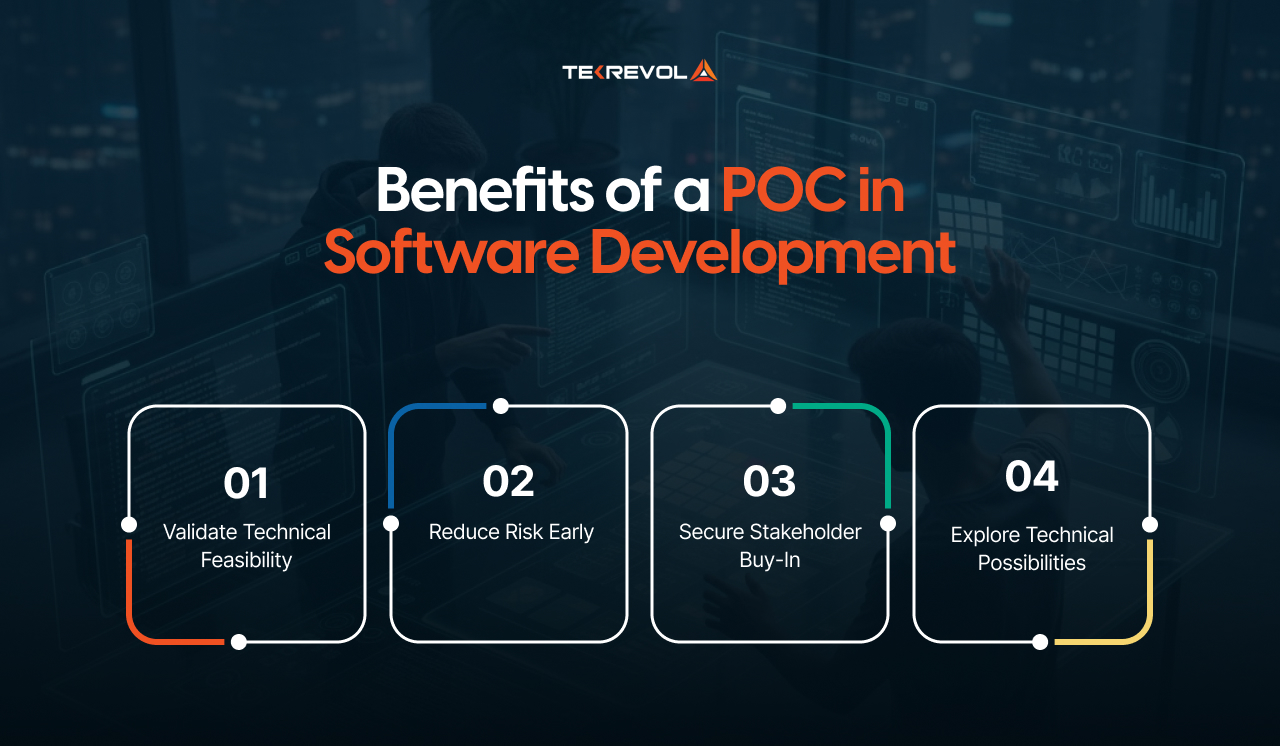
1. Validate Technical Feasibility
The primary goal of POC in software development is to determine whether the proposed technical approach actually works within real constraints like time, budget, and infrastructure.
2. Reduce Risk Early
By building a small POC, teams identify red flags before they become expensive problems. This makes POC software development a powerful risk-reduction strategy.
3. Secure Stakeholder Buy-In
Executives and investors don’t just want ideas; they want proof. A working POC in software development builds confidence and unlocks approvals.
4. Explore Technical Possibilities
POCs allow teams to experiment, fail safely, and learn. This exploratory phase is where smarter architectural decisions are made.
These benefits are consistently echoed across developer discussions like Reddit.
POC vs Prototype vs MVP
Three different terms used in the development of software are “Proof of Concept” (POC), “Prototype”, and “Minimum Viable Product” (MVP). These three terms all sound alike but serve different types of purposes. The best way to explain them is to look at the questions each term answers and when it is used. You can consider the three terms as three distinct steps, with a POC being step one, a prototype being step two, and an MVP being step three. Each step removes a different type of risk before you move forward.
- POC in software development answers: Can this be built at all?
- Prototype answers: How will users interact with it?
- MVP answers: Will users actually use it and pay for it?
A POC always comes first. It focuses purely on technical feasibility. Once the technology is proven, a prototype is created to test design and usability. Only after both are validated does an MVP enter the picture to test real market demand.
POC vs Prototype vs MVP: Easy Comparison Table
| Aspect | Proof of Concept (POC) | Prototype | Minimum Viable Product (MVP) |
| Primary Purpose | Validate technical feasibility | Validate design and user experience | Validate market demand |
| Core Question | Can this core function be built? | How will users use it? | Will users adopt and pay for it? |
| Focus Area | Technology and logic | Look, feel, and interaction | Business value and growth |
| Audience | Internal technical teams | Designers, stakeholders, test users | Real users and early adopters |
| Scope | Very limited, single-risk focused | Visual or clickable model | Small but complete user journey |
| Outcome | Go / No-go technical decision | Usability feedback and refinement | Real-world feedback and revenue |
How They Work Together in Real Projects
In real projects, POC work in software development often proves whether a specific integration, algorithm, or system architecture is possible. Once that’s confirmed, the prototype shows how users will experience the solution. Finally, the MVP brings everything together into a usable product that enters the market.
By understanding this sequence, teams avoid building too much too early. POC in software development protects you from technical failure, prototypes protect you from poor user experience, and MVPs protect you from launching something no one wants.
When used correctly, these three steps make product development clearer, smarter, and far less risky.
Step-by-Step Process: How POC Works in Software Development
To understand how to perform properly when utilizing POC in Software Development, there are specific steps that follow. POC should not be viewed as a finished product. The only question that should be asked while using POC is: Does this Idea Work in an Actual Scenario?
When done correctly, utilizing POC in Software Development should eliminate the Anxiety or Concern related to an Assumption being valid.
Step 1: Create a Clear Problem/Solution Statement
The successful POC will begin with a clear Problem/Solution Statement. Instead of saying “Can I create an app?” let’s say we have a specific problem to solve.
For Example, can we build a System that can handle “Real-time” Data? Or can we build a reliable System that supports a New Technology?
Step 2: Identify the Primary Assumptions
An Outline of Primary Assumptions allows POC to be developed in a structured manner as a component of software development and to be directed to an area of focus.
Step 3: Select the Appropriate Tool(s)
During this Phase, POC Development should be implemented using simple tools to ensure Testing and Validation Quickly. The objective here with POC is to ensure that it meets validation requirements, as opposed to Optimization or Scalability.
Step 4 – Create All You Need:
As you are creating your development process, build functionality on a minimal level in order to demonstrate the feasibility of your application. Focus on developing a solid proof of concept that does not include additional features, detailed design, or the like.
Step 5 – Honest Review of Results:
When evaluating the results of your proof of concept, do so objectively. Recognize that any limitations are valuable lessons to learn from. Essentially, if your proof of concept fails, you still gain an advantage by saving future costs.
Thinking about validating your software idea but unsure where to start?
Let experts handle the technical feasibility while you focus on the vision.
Talk to Our POC Specialists Today!When Should You Build a POC?
You should strongly consider POC in software development when:
- Using new or untested technology.
- Building complex integrations.
- Developing AI, blockchain, or IoT solutions.
- Entering a regulated or high-risk domain.
Many high-growth companies rely on POC software development services to validate ideas quickly without distracting their core teams.
POC Software Development Services: Who Needs Them?
Not every company has the internal expertise to run a clean POC.
POC software development services are ideal for:
- Startups validating investor ideas.
- Enterprises testing innovation pipelines.
- Non-technical founders.
- Companies exploring emerging tech.
Professional teams bring structure, speed, and objectivity to POC in software development, increasing the chances of accurate validation.
Common Mistakes to Avoid in POC in Software Development
Even though POC in software development is small, mistakes still happen.
Avoid:
- Treating POC like a full product.
- Adding unnecessary features.
- Skipping documentation.
- Ignoring negative results.
A POC is meant to answer questions, not confirm bias.
Real-World Insights and Learning Resources
Some of the most practical insights on POC in software development come from hands-on experts and educators.
If you’re a visual learner, watch:
Partner with Tekrevol for Expert POC Development and Execution
Building a successful POC in software development takes more than just writing code. It requires clear thinking, technical validation, business alignment, and the experience to spot risks early. That’s where Tekrevol stands out. As a trusted software development partner, Tekrevol helps businesses turn bold ideas into validated, workable solutions through well-structured POCs.
By working with Tekrevol, you gain:
Strategic POC Planning
Tekrevol works closely with you to define clear objectives, choose the right technologies, and set measurable success criteria, so your POC answers the right questions from day one.
Technical Feasibility Validation
From architecture decisions to performance checks, Tekrevol ensures your POC in software development is built to realistically test feasibility under real-world conditions.
End-to-End POC Execution
Tekrevol manages the complete POC lifecycle, from concept design and rapid development to testing and evaluation, delivering clear outcomes instead of assumptions.
Actionable Insights for Scaling
A Tekrevol POC doesn’t stop at validation. You receive practical recommendations that help transition smoothly from POC to MVP and full-scale product development.
With Tekrevol, POC in software development becomes a strategic step forward, not a trial-and-error exercise. The focus stays on clarity, confidence, and building software ideas that are truly ready to move ahead.
Ready to turn your idea into a proven concept?
Reduce risk, save costs, and move forward with confidence.
Schedule Your Free POC Strategy Call Now!