



In TekRevol’s judgment, Python frameworks for new web and API products mostly come down to Django, Flask, and FastAPI. Django includes the most, Flask is lightweight, and FastAPI is built for APIs. Survey data shows FastAPI leading usage, and some Django developers also use FastAPI or Flask.
This article compares the three on what they include, how developers use them, and which situations suit each. It ends with a table that matches your project to a framework.
We checked every figure in this article against its source on October 20, 2026.
What is a Python framework?
A Python framework is a reusable structure that handles common tasks such as routing requests and managing data, so you write only your application’s own logic. With a library, your code calls it. With a framework, the framework calls your code.
Web frameworks vary in size. Full-stack frameworks bundle many parts, and micro frameworks stay small. A third group, async or API frameworks, targets services.
Python 2 reached end of life on January 1, 2020, so current Python 3 frameworks are the only supported choice. For why Python suits web work at all, see our guide to Python for web development.
Which Python frameworks are most popular?
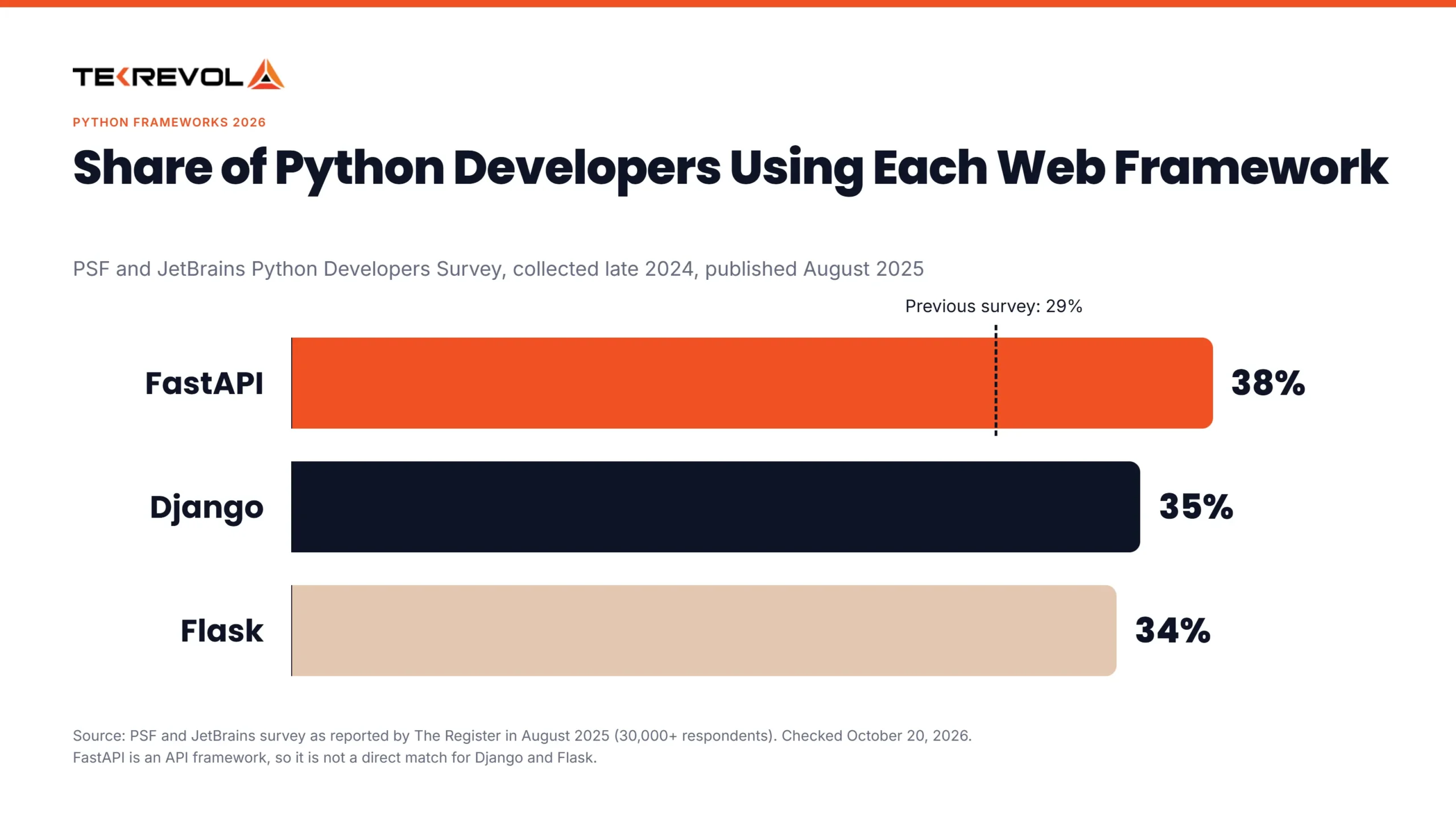
FastAPI leads both general surveys in the table, and Django and Flask sit close together in both. The table shows each framework’s share of respondents.
| Source | Audience | FastAPI | Django | Flask |
| PSF and JetBrains Python Developers Survey (collected late 2024) | Python developers | 38% | 35% | 34% |
| Stack Overflow Developer Survey 2026 | All developers | 18.5% (6th) | 11.3% (14th) | 12.5% (13th) |
Sources: the PSF and JetBrains surveys, as reported by The Register in August 2025, with more than 30,000 respondents. The Stack Overflow 2026 web frameworks data, with 10,281 respondents on this question.
The two surveys do not share an audience. The PSF survey asks Python developers, so its shares are higher.
Stack Overflow asks developers of every language, so each framework’s share is smaller. Compare the order of the frameworks.
FastAPI’s share in the PSF survey was 29% in the previous edition and 38% in the latest, and The Register calls Django and Flask near-equals in web frameworks (35% and 34%). The Register also notes that FastAPI is an API framework, so it is not a direct match for Django and Flask.
A popular Python framework is a sign of a large ecosystem. This is TekRevol’s judgment.
How do Django, Flask and FastAPI compare?
Django includes the most, Flask the least, and FastAPI is built around APIs. Python backend frameworks for web development differ most in what they bundle, as the table shows from each project’s own documentation.
| Framework | What it is | Built in or based on | Version checked |
| Django | A web framework aimed at building web apps quickly with less code | ORM, automatic admin interface, template system, internationalization | 6.1.2 is the latest release. 5.2 is the long-term support release |
| Flask | A lightweight WSGI web framework | Werkzeug toolkit, Jinja template engine, Click command-line toolkit | 3.1.x |
| FastAPI | An API framework based on standard Python type hints | Starlette for the web layer, Pydantic for data. Generates Swagger UI and ReDoc docs automatically | Not shown on its documentation page |
Support windows matter for planning. Django’s download page lists 6.1 with mainstream support to April 2027 and extended support to December 2027.
The 5.2 long-term support release ended mainstream support on December 3, 2025, and has extended support to April 2028. Check these dates before you pick a version for a long-lived product.
FastAPI’s documentation claims high performance and cites independent benchmarks without giving figures. This article runs no benchmarks and cites none.
Treat speed claims you see elsewhere with caution, and weigh your team’s skills first. That is our judgment.
What is the best Python backend framework?
No one framework is the best choice for every Python backend, and the right one depends on what you are building. In our judgment, Django suits a full application with an admin area and database models. FastAPI suits a product that is mainly an API.
Flask suits a small service where you want to choose each part yourself. Its dependency list is short, so database access and validation are your choices, which is our reading of its design.
Django REST framework adds a toolkit for building web APIs to Django. In the Django Developers Survey, collected between November 2024 and January 2025, 51% of respondents said they use Django for a REST API through it. That survey reached Django developers only, so it shows habits inside the Django community.
For a closer two-way comparison, see our guide to Flask vs Django.
Which Python framework is best for building APIs?
Among Python API frameworks, FastAPI is the one built around APIs, and Django REST framework is a common route for teams already on Django. FastAPI declares inputs with Python type hints and produces interactive API documentation automatically, according to its documentation.
FastAPI also ranks 6th in Stack Overflow’s 2026 web framework data, ahead of Flask at 13th and Django at 14th. Flask can serve a small API, but you choose the validation and documentation tools yourself, which is our reading of its lightweight design.
Django REST framework’s own site lists support for Django 5.2, 6.0 and 6.1 and for Python 3.10 through 3.15. It says it officially supports only the latest patch release of each series, so plan upgrades with that in mind.
Can you combine frameworks in one project?
Yes. In the Django Developers Survey, 28% of respondents also use FastAPI and 23% also use Flask. The audience is Django developers, so the figures show overlap among them.
In our view, one workable pattern is Django for the core application and admin, with FastAPI for a separate API service. Keep the split clear so two teams do not maintain the same logic twice.
Which frameworks exist beyond the web?
Testing and data work have their own frameworks, and you choose them for the task. pytest describes itself as a way to write small, readable tests. scikit-learn offers tools for predictive data analysis. PyTorch is an open-source deep learning framework.
Python frameworks for app development on mobile are a separate topic.
How should you choose a Python framework?
Match the framework to what you are building and to what your team already knows. The table maps common situations to a framework. This is TekRevol’s judgment.
| Situation | Lean toward |
| Full web application with an admin area and database models | Django |
| API-only service with typed requests | FastAPI |
| Small service or prototype where you choose the parts | Flask |
| Existing Django app that needs an API | Django REST framework |
| Team already skilled in one framework | That framework, unless requirements clash |
| Need long-term supported releases | Django’s long-term support release, supported to April 2028 |
When two rows point in different directions, start with the smaller scope and add a second framework later. TekRevol’s Python development team can scope the build with you. Start with a Free Consultation.
Pick the framework that fits what you are building today, and revisit it when the product changes.


