Building new software sometimes proves an upheaval. You might have a brilliant idea, but realize the underlying logic remains unproven. On the other hand, you might have command of the tech but no certainty that customers will actually pay for it. Here, the choice between PoC vs MVP software development becomes critical as the starting line determines success or failure.
About 35% of startups flop badly because they create products that nobody needs. Understanding the specific roles of proof of concept vs MVP allows you to manage risk and deploy capital responsibly. A PoC proves whether or not your idea is technically possible for internal teams, while an MVP validates market demand with real users.
Overall, these two approaches represent the fundamental stages of product development, moving from a technical test to market confirmation. In this article, therefore, we break down the difference between POC and MVP to help you better understand their roles and provide you with clear guidance for your next major project.
What Is a Proof of Concept (PoC) in Software Development?
A software Proof of Concept (PoC) is a small exercise to identify technical roadblocks of an idea or confirm that a specific algorithm works. It answers the question “can we build this?” before you invest heavy resources into full development.
Remember that PoC is not a product meant for the general public. It is not scalable and rarely survives the transition to production. Treat it as a “throwaway” build designed to provide internal validation for the technical team and architects.
Typical PoC Deliverables
When you invest in PoC software development, your output usually looks like one of the following:
- Code Spike: A rough piece of code meant to explore a specific technical hurdle.
- Algorithm Validation: Proving that a specific data model or AI logic can produce the desired result.
- API Integration Test: Confirming that two complex third-party systems can actually communicate.
Struggling with technical uncertainty?
TekRevol guides your PoC vs MVP software development choice.
Book Your Strategy CallWhat Is an MVP in Software Development?
In the PoC vs MVP software development services debate, the Minimum Viable Product is the simplest working version of a product built with just enough essential features to solve a core problem for early adopters. Unlike a PoC, which tests technical functions, the MVP tests market demand and viability.
A common mistake is treating an MVP as a cheap first version of the final product. It is a strategic tool central to the lean startup methodology. The MVP allows you to gather the maximum amount of validated learning from real users with the least amount of effort. This feedback loop then guides all future development.
Strategic Components of MVP
The major components of a successful MVP are:
- Achieve product-market fit through real-world usage.
- Engage early adopters to build a community.
- Establish a user feedback loop for rapid iteration.
- Build a scalable product foundation for future growth.
- Complete go-to-market validation with minimal risk.
PoC vs MVP Software Development: Side-by-Side Comparison
The core distinction between PoC vs MVP software development reveals that these two stages serve completely different masters and outcomes.
A PoC targets internal teams to prove technical possibility, while an MVP targets real users to prove market viability. One checks for feasibility vs viability, and the other builds a bridge to the actual customers.
The most effective way to see the PoC vs MVP comparison is by reviewing their key features side-by-side:
| Criteria | PoC (Proof of Concept) | MVP (Minimum Viable Product) |
| Primary Objective | To prove that a technical idea or feature is actually possible. | To prove that there is a market need and willingness to pay. |
| Audience | Internal teams and investors | Early adopters and potential investors. |
| Functional Depth | Narrow focus on one high-risk technical challenge. | Broad enough to solve a complete problem for the user. |
| User Interface | Often non-existent or very basic command-line output. | Functional, professional, and intuitive for end users. |
| Timeline | Typically, a few days to a couple of weeks. | Several months of design and development. |
| Scalability | Not built to scale; often discarded after the test. | Built with a scalable product foundation for future growth. |
| Typical Cost | Low investment, primarily developer hours. | Significant investment, including design and DevOps. |
| Success Metric | A “yes” or “no” on technical capability. | Retention, revenue, and feedback. |
The internal vs external validation split is the most important takeaway for a founder. A PoC gives your engineering team the confidence that the math and architecture are sound. An MVP gives your business team the evidence that customers find value in the solution.
Unsure which stage to pick?
Optimize your PoC vs MVP software development funding with TekRevol.
Get Expert ConsultationWhen Should You Build a PoC?
The need for PoC in software arises right after initial ideation when you face significant technical uncertainty. This is the best way to handle an early-stage software idea that relies on unproven methods. If you are unsure if a specific technology can handle your requirements, a PoC is the right tool.
These are some PoC vs MVP software development scenarios where a PoC is non-negotiable.
- Emerging Technologies: Your project requires using new technologies like AI solutions or Machine Learning. A PoC ensures the algorithms function as intended.
- Unique Functionality: You need an unconventional feature with no ready-made solution available.
- Integration Challenge: You must integrate multiple third-party services, like blockchain or legacy system modernization.
- Performance Risks: You have concerns about system performance or massive scalability.
A PoC is also essential for enterprise software validation and VC due diligence. Forbes highlights that at least 30% of generative AI projects will be abandoned after proof of concept by the end of 2025, which shows the value enterprises place on proper PoC evaluation before full commitment.
Besides, investors often want to see proof of feasibility before they write a check for a complex tech product. The business value of POC software helps you provide technical and financial viability to potential investors.
When Should You Build an MVP?
You should build a Minimum Viable Product when you have confirmed technical feasibility, but need to validate market demand through testing.
Let’s look at when MVP is the right choice in PoC vs MVP software development scenarios:
- B2B Pilot Program: You are testing a solution with a small group of partner companies.
- SaaS Product Launch: You want to introduce a new B2B or consumer SaaS product. An MVP provides the first real product foundation.
- Consumer App Validation: You need to gauge product acceptance and expectations from a broader public.
The Silicon Valley lean launch mindset favors the MVP because it gets you to market faster than a traditional “big bang” launch. It allows you to prove execution to investors by showing a user feedback loop in action.
When Do You Need Both PoC and MVP?
The symbiotic relationship of PoC vs MVP software development is often indispensable for complex projects. You need both when the product idea has high technical uncertainty and high market uncertainty. This combined approach is the ultimate product de-risking strategy.
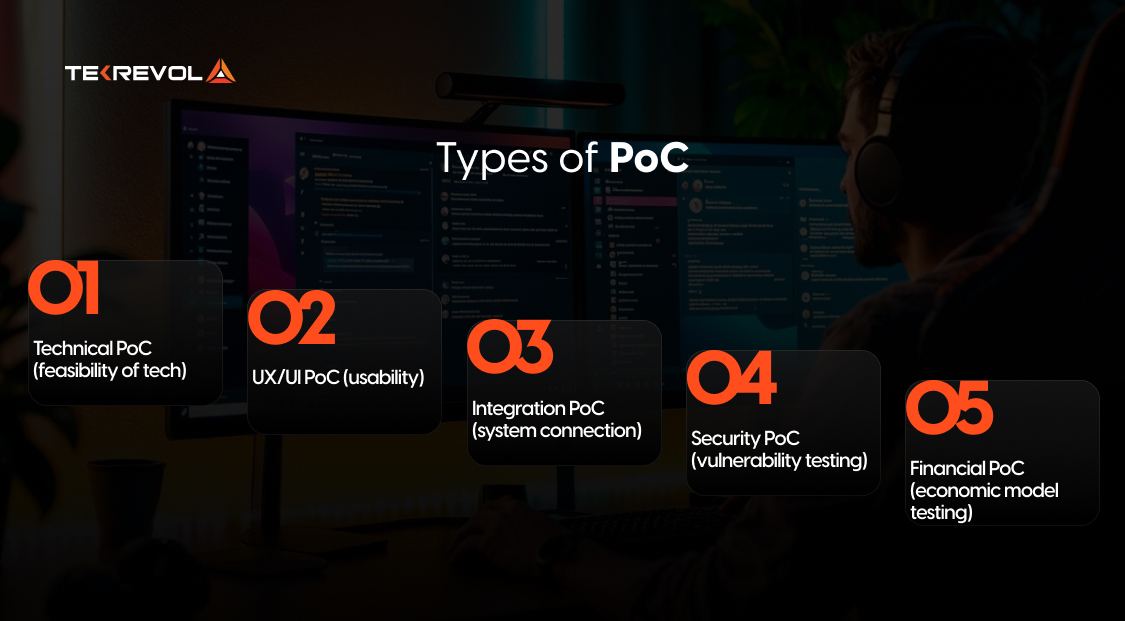
A clear decision tree helps determine the necessity of both :
- Low Technical Risk: If your idea uses established technology and standard integration, you can skip PoC and go straight to the MVP or a Prototype. An example is a basic CRUD SaaS application.
- High Technical Risk: You need a PoC first.
- High Market Risk: You need an MVP regardless of the technology.
The most common combined scenario is an AI startup. The team first implements a proof of concept process to prove that the core machine learning model works. Once the PoC is successful, build an MVP to see if users actually find value in the AI feature and are willing to pay for it. This combined evidence maximizes the chances of securing follow-on funding and achieving project success.
PoC Vs MVP Software Development Cost & Timeline Breakdown
The cost and timeline for PoC vs MVP software development differ significantly, reflecting their scope and function. The average cost of a software POC is relatively low because it is a tactical exercise carried out by a small team of engineers or architects to solve one specific problem.
In contrast, the MVP is a strategic market investment and significantly more resource-intensive. It requires a full squad, including product managers and UX designers. In the USA, the software development cost for an MVP can reach $1000-$10,000.
The PoC development timeline usually ranges from 10 to 30 hours. Meanwhile, the timeline for the MVP development process extends to weeks or months because you are building a functional product ready for external release.
| Metrics | PoC | MVP |
| Timeline | 10 to 30 hours (Very Short) | Weeks to months (Extended) |
| Team Size | Minimal (1 Software Engineer and 1 Business Analyst) | Comprehensive (PM, UX, QA, DevOps Engineers) |
| Budget | Low Investment | Medium-to-High Investment |
| Goal | Cost-efficient technical risk mitigation | Strategic market investment |
PoC vs MVP vs Prototype: Where Each Fits in Product Development
The product discovery phase often includes a third player: the Prototype. While the PoC checks the “engine” and the MVP checks the “market,” the Prototype checks the “experience.”
Understanding POC vs MVP vs Prototype roles allows you to move through the POC development life cycle without missing a beat.
| Feature | PoC | Prototype | MVP |
| What it tests | Technical Feasibility | User Experience (UX) | Market Viability |
| Core Question | Can we build it? | How will it work? | Should we build it? |
| Interactivity | Low to None | High (Clickable UI) | High (Fully Functional) |
| Backend | Mocked or minimal | Non-existent (UI only) | Full working backend |
| Market Ready | No | No | Yes |
While the Prototype is optional for simple apps, it is required for complex interfaces or for securing early funding by showcasing the product’s look. This three-stage process of PoC vs MVP vs Prototype ensures that technical viability, design quality, and market demand are all checked sequentially.
Common Mistakes Startups Make with PoC vs MVP Software Development
Even with a PoC and MVP comparison clarity, many founders stumble and make critical errors by mixing up their goals or skipping essential steps. Here are the most common startup product mistakes:
Building the MVP when a PoC was Needed
Founders sometimes jump straight to building an MVP only to find that a core technology or integration is impossible. They spend months and thousands of dollars on a product that cannot function. One of the major benefits of proof of concept is that it would have exposed this high technical risk early.
Overbuilding the PoC
The PoC must be narrowly focused. Some teams spend too much time polishing the UI or adding features. This wastes time and defeats the purpose of the quick internal validation. CIO points out that 88% of AI pilots never reach full deployment because the project loses its focus on core feasibility.
Treating MVP as the Final Product
Teams often launch the MVP and then stop development, thinking they are done. The MVP is merely the beginning of the user feedback loop. You must continuously measure user data and iterate to achieve true product-market fit.
Skipping User Feedback
The entire goal of the MVP is to gather feedback from real users. Launching an MVP without an effective way to collect and analyze user data is pointless. Gartner indicates that about 70% of companies using an MVP get better user insights.
Final Thoughts
The journey from a raw idea to a successful product requires a strategic approach to risk. Once you know the difference between POC and MVP, you can focus your energy where it matters most.
At TekRevol, we use the PoC vs MVP software development framework to protect your runway and validate your assumptions. By mastering these product development stages, we position your startup for long-term success.
Whether you are developing a complex AI model or launching a new SaaS tool, our expertise will save you time and money.
Stop guessing your development path
We simplify the POC vs MVP software development roadmap for long-term success
Claim Your Free Call


![How Much Would It Truly Cost to Develop a Food Ordering Website? [2026 Analysis]](https://d3r5yd0374231.cloudfront.net/images-tek/uploads/2026/03/Tek-Feature-7-1.jpg)