


The pressure on technology leaders has never been greater. Organizations are racing to embed intelligent automation into their core operations, and the window to gain a competitive advantage through AI is narrowing fast.
Yet despite the urgency, most engineering teams face a stark reality: AI agent development demands a rare convergence of skills in LLM orchestration, autonomous decision-making, and production deployment that takes years to build internally.
This is precisely where engaging the right AI agent development company becomes a strategic decision, not just a resourcing one. The right partner accelerates your timeline, brings battle-tested architecture experience, and scales with your ambitions, without the overhead of permanent hiring in one of tech’s most competitive talent markets.
But outsourcing AI agent work carries real risks. Misaligned expectations, vendor dependency, and systems your team can’t own or maintain can cost far more than they save.
This guide gives you the complete picture, the advantages, the pitfalls, and exactly what to scrutinize before you commit.
What Is an AI Agent, Actually? (And Why It Matters for Outsourcing Decisions)
Before diving into outsourcing decisions, you need to understand what you’re actually building. “AI agent” is one of the most overloaded terms in tech right now; vendors will call almost anything an agent. Properly defined, an AI agent perceives its environment, reasons over input, forms a plan, and takes autonomous action without a human guiding every step.
This distinction matters. A chatbot answers questions. An agent does things, updating CRM records, executing code, scheduling meetings, or coordinating other agents, all within a single task chain. According to Gartner, by 2028, 33% of enterprise software will include agentic AI, up from less than 1% in 2024.
That kind of growth is exactly why the choice of top AI agent development companies in USA is such a high-stakes decision. You’re not handing off a simple feature spec; you’re handing off architectural choices that determine whether your system holds up in production, keeps your data safe, and stays flexible as the technology evolves.
Build In-House vs Outsource: Which Is Right for Your Business?
Choosing between an internal AI team and outsourcing isn’t a question of preference; it’s a question of tradeoffs. The variables that matter most in AI development are fundamentally different from standard software decisions. Here’s how the two paths compare across every dimension that actually affects outcomes.
| Decision Factor | Outsourcing to AI Specialists | Building an Internal Team |
| Time to First Deployment | 4–12 weeks | 6–18 months |
| Day-One LLM Expertise | High — existing production experience | Low to Medium — significant ramp-up required |
| Prompt Engineering Standards | Establish if the vendor is mature | Must be built from the ground up |
| Model Drift Monitoring | Included when contracted explicitly | Fully your responsibility to the architect |
| Data & IP Control | Requires a strong contractual structure | Full control by default |
| Agent Architecture Experience | Varies significantly by vendor | Rare in most hiring markets |
| Annual Team Cost | $350K–$600K | $1.2M–$2M fully loaded |
| Ability to Scale Scope | High — add or reduce capacity quickly | Low hiring always lags demand |
| Knowledge Retention Risk | Medium — vendor dependency exists | Low — knowledge stays internal |
| Keeping Up With Stack Changes | Vendor absorbs R&D and evolution costs | The internal team must track and adapt continuously |
Note: Neither path is universally right. The right choice depends on your timeline, budget, and how central AI capability is to your long-term competitive advantage.
Ready to outsource AI agent development the right way?
We help you build AI agents that actually work in production
Book a Free ConsultationWhy Companies Outsource AI Agent Development: Real Advantages
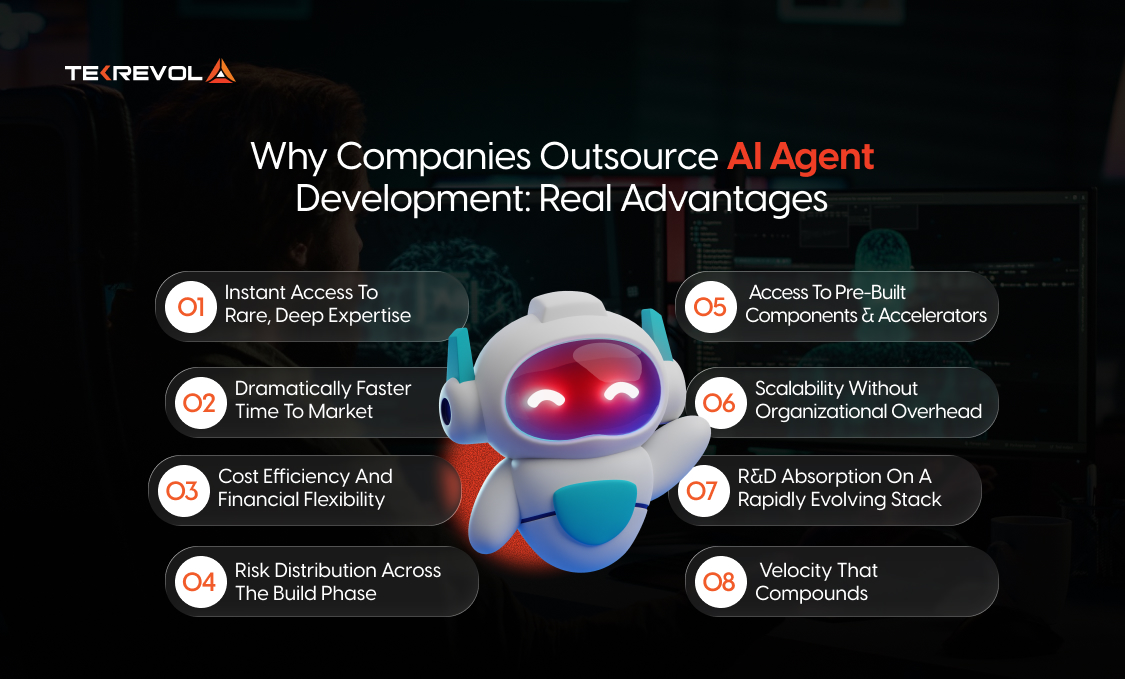
Outsourcing AI development isn’t just a cost decision; it’s a strategic one. Here are the benefits of outsourcing AI development:
1. Instant Access to Rare, Deep Expertise
The talent shortage in AI is real and not resolving quickly. Building AI agents well requires simultaneous expertise across LLM behavior, prompt engineering, orchestration frameworks, vector databases, RAG architecture, and MLOps, a combination that’s genuinely hard to hire for internally.
- The gap between “built with LangChain” and “maintained a production multi-agent pipeline for 18 months” is enormous
- The right AI agent development partner gives you that hard-won experience on day one
- Many vendors bring industry-specific knowledge on top of technical depth
2. Dramatically Faster Time to Market
Every week spent recruiting and onboarding is a week your competitor might be shipping. Outsourcing eliminates that ramp-up entirely.
- Partners come with tools, infrastructure, and workflows already in place
- No time lost building an internal AI department from scratch
- In competitive markets, deploying six months faster can shift market share meaningfully
3. Cost Efficiency and Financial Flexibility
Committing to three or four senior AI engineers at $130,000+ each, before product-market fit is proven, is a significant financial risk. Outsourcing removes that burden.
- Fixed costs like salaries, infrastructure, and benefits convert into flexible project-based expenses
- Companies can save up to 85% compared to equivalent in-house operations
- Financial flexibility is especially critical for startups and mid-market companies at the earliest stages
4. Risk Distribution Across the Build Phase
Wrong orchestration framework, wrong LLM for your latency profile, wrong RAG approach; these mistakes cost months of rework. Experienced vendors have already made them on other projects.
- You get the benefit of lessons learned without paying the price of learning them yourself.
- Outsourcing lets you align expenses with deliverables rather than carrying a fixed team cost.s
- Architectural risk shifts to a partner with the depth to manage it
5. Access to Pre-Built Components and Accelerators
The best vendors don’t start from scratch. They bring battle-tested building blocks that compress timelines significantly.
- Production-ready RAG pipelines, evaluation harnesses, and orchestration scaffolds cut weeks off delivery
- Pre-built GenAI components can be customized faster than building from zero
- According to Gartner, organizations using pre-built AI accelerators reduce average deployment time by up to 40%
6. Scalability Without Organizational Overhead
Once the foundation is proven, scaling should be seamless, not a hiring crisis.
- Move from one agent to a multi-agent system without managing a hiring surge internally
- A good partner scales both the team and the architecture in parallel
- You grow the capability without growing the organizational complexity
7. R&D Absorption on a Rapidly Evolving Stack
The AI tooling landscape is changing faster than any internal team can track while also shipping product. New frameworks, new model capabilities, new evaluation approaches, the pace is relentless.
- Specialized vendors absorb this R&D cost across their entire client base
- You benefit from their ongoing investment without carrying it yourself
- Your team stays focused on building, not keeping up
8. Velocity That Compounds
The right partner doesn’t just build faster; they build in a way that makes your own team faster over time.
- AI-native development practices embedded in how a team works, not bolted on as an afterthought, produce compounding gains.
- Scalability becomes seamless, moving from one agent to a multi-agent system without managing a hiring surge.
- You grow the capability without growing the organizational complexity
Top Challenges When You Outsource AI Agent Development
Most outsourcing guides bury these risks in a footnote. They shouldn’t. These are genuine, serious problems, and understanding them is what separates a successful engagement from an expensive disaster.
1. The Outsourcing Gap, The Risk Nobody Talks About
This is the one that quietly kills AI projects. Most vendors can build a working prototype; very few can architect something that holds up six months after they’ve left. And unlike traditional software, AI systems can degrade without anyone touching the code.
- 68% of AI failures happen because companies can’t maintain or iterate on results—not because the initial system was poorly built.
- The failure pattern is always the same: the vendor delivers, the model provider quietly updates their base model, outputs degrade, and there’s no version history to diagnose it; identifying the regression alone can take weeks
- 43% of production LLM applications experienced measurable quality degradation within 12 months without any change to the application code
- If there’s no monitoring, no regression testing, and no drift detection built in, you won’t catch the problem until it’s already costing you
2. Data Security and Proprietary Information Risk
AI outsourcing raises data questions that traditional software outsourcing simply doesn’t. The moment your proprietary data touches a third-party model API, the risk profile changes entirely, and a standard NDA doesn’t cover what actually needs to be covered.
- 54% of enterprises had no formal policy governing how third-party AI vendors could handle their proprietary data
- Many model API tiers are opted into training by default, but most companies don’t realize this until it’s too late.
- Always get it in writing: Is the API opt-out for training? Where’s your data stored? Who owns the vector embeddings?
3. LLM Expertise Gaps: The Hidden Budget Killer
Building with LLMs is not the same as integrating an API. Most general-purpose development shops don’t have the depth to make the right model choices, and that gap shows up directly in your costs and your production quality.
- A vendor who defaults to the most powerful model because it’s easier to prompt will cost you 4–8x more in inference costs than one who right-sizes the model to the task.
- Companies routinely report 200–400% higher than projected LLM API costs in year one.
- True LLM expertise involves knowing RAG architecture, embedding models, managing context windows, and deciding when fine-tuning is worth it versus optimizing prompts.
4. Intellectual Property and Ownership Ambiguity
Who owns what you build together? In AI, this question gets complicated fast, and most contracts aren’t written to handle it. Technology is advancing faster than most governance and contracting structures can accommodate.
- Model weights, prompt libraries, fine-tuned models, and evaluation datasets can each carry significant proprietary value.
- If contracts aren’t clear, it’s often uncertain who owns the AI work once the project ends.
- The more customized the solution, the more leverage you have, but only if the contract reflects that from the start
- If IP rules aren’t set up front, you might end the project with far less ownership than you assumed.
5. Hidden Costs That Erode the Financial Case
The initial quote rarely tells the full story. In AI development specifically, the costs that appear after go-live are the ones that catch companies off guard, and they add up fast.
- Ongoing model API costs are rarely included in the development quote
- Post-deployment monitoring and maintenance costs are consistently underestimated
- Re-engineering costs hit hard when the chosen approach turns out to be wrong for production
- Internal team retraining costs are rarely accounted for when the vendor eventually exits
6. Vendor Lock-In
Some vendors build on proprietary frameworks, proprietary models, or proprietary infrastructure, intentionally or not. Either way, the result is the same: you’re dependent on them for every future update.
- When the engagement ends, every change has to run through them
- Switching becomes expensive, disruptive, and sometimes technically impossible
- Good vendors build on open, portable frameworks and have a clear exit strategy from day one
- If a vendor can’t clearly explain how you’d move off their platform, treat that as a red flag
7. Accountability Gaps in Agentic Systems
When an AI agent makes an error, sends the wrong email, cancels the wrong order, or exposes sensitive data, someone in your organization is on the hook. That accountability chain needs to be clear before anything goes live.
- If the vendor built the agent and runs it on their infrastructure, the accountability chain becomes murky fast
- In regulated industries, murky accountability is a compliance disaster waiting to happen
- You need full transparency and traceability into every action the agent takes
- That requirement needs to be contractual, not assumed, and in place before deployment
8. Communication and Alignment Risk
AI development is highly iterative; requirements evolve as you learn what the model can and can’t do reliably. A vendor without a structured process for managing that iteration will cost you time and money.
- A vendor in a different timezone with a different development culture creates painful misalignment over time.
- What was specified at the start and what gets built can drift significantly without a tight feedback loop.s
- Successful AI projects require ongoing dialogue, not just a handoff at the start and a demo at the end.
- If the vendor doesn’t have a clear process for managing iteration, budget for rework from the beginning
Not ready to commit to a full engagement yet?
Let's validate your use case before we write a single line of code.
Request a Free Architecture Review!7 Red Flags to Watch For Before You Outsource AI Agent Development
Even experienced technology organizations get burned by these. They’re not obvious, but they’re consistent. Here’s what to watch for before you sign anything.
1. They Can’t Answer Prompt Engineering Questions
Prompt engineering isn’t configuration, it’s an engineering discipline. Vendors who don’t treat it that way will cost you quality down the line.
- Teams that version prompts and run regression testing see 3x higher output consistency over 12 months compared to those who treat prompts as ad-hoc.
- Ask directly: how do you version prompts, and what’s your process when a model update changes output behavior?
- If their answers feel vague, it’s a red flag; walk away.
2. Their Demos Don’t Reflect Production Reality
An AI agent can look impressive in a controlled demo and fall apart completely when it hits real-world edge cases, ambiguous inputs, or unexpected tool failures.
- Always ask to see production examples, not polished demos built for sales conversations
- Ask for references from clients with live systems, not pilot projects
- Understanding how a vendor handles exceptions tells you far more than watching a clean walkthrough
3. There’s No Plan for Post-Deployment Monitoring
AI agent failures are often subtle. Not “the system crashed”, more like “the agent started giving wrong answers 8% of the time.” Without the right monitoring, you won’t catch it until damage is done.
- Ask what metrics they track post-deployment and how they detect prompt drift
- Ask for their incident response process when an agent starts misbehaving
- If they can’t answer these in concrete detail, they’re building for the handoff, not for the long term
4. They Skip the Build vs. Buy Conversation
When evaluating how to hire AI agent developers, this conversation is non-negotiable. A vendor who jumps straight to “fully custom solution” without walking you through whether an existing provider might meet your needs is optimizing for their billing, not your outcome.
- Custom builds offer flexibility and long-term control but require more time and investment upfront
- Provider solutions deliver speed but limit adaptability over time
- The right vendor walks you through this tradeoff honestly before recommending anything
5. Their Data Governance Answers Are Vague
The benefits of outsourcing AI development disappear fast if your proprietary data isn’t properly protected. Get specific, written answers before handing over anything.
- Is the model API being used set to data training opt-out for your data?
- Where is your data stored during inference, and in which jurisdictions?
- Who owns the vector embeddings created from your documents, and what happens to them when the engagement ends?
6. They Want to Skip the Proof of Concept Phase
When you hire an AI agent development company, the first thing a credible one will recommend is a structured PoC, not a multi-month contract. If a vendor pushes straight to a multi-month contract, that’s a red flag.
- A PoC lets you test the approach before committing to full-scale implementation
- It reduces architectural risk significantly; wrong framework choices cost months of rework
- If a vendor skips this step, they’re either inexperienced or rushing past the stage that protects your investment
7. There’s No Knowledge Transfer Plan
This is where AI outsourcing vs in-house development decisions often go wrong. When the engagement ends, your team needs to be able to maintain, iterate, and extend what was built, without calling the vendor back every time something changes.
- Documentation, internal training, and architecture handoff should be contract deliverables, not afterthoughts.
- A good vendor plans for their own exit from day one
- If knowledge transfer isn’t explicitly in the contract, add it before you sign
Build In-House or Outsource? How to Actually Decide
Most companies approach this question the wrong way; they ask “what’s cheaper?” when they should be asking “what does this AI system mean to our business?” Start there, and the answer usually becomes clear.
Ask Yourself: Is This Your Product or Your Operations?
This is the single most important question in the decision.
- If the AI agent is your product, the thing customers pay for, the core of your competitive edge, build it in-house.
- If it’s an operational capability, automating support, processing data, managing internal workflows, and outsourcing almost always make more sense.
- Trying to protect a competitive moat with a vendor who’s building the same stack for your competitors is a strategic risk most companies underestimate
Then Consider Your Reality
Strategy aside, practical constraints matter. Be honest about where you actually stand.
- Do you have 6–12 months to recruit, hire, and onboard an internal AI team? Most companies don’t
- Do you have data so sensitive that any third-party architecture creates unacceptable risk?
- Do you need to iterate weekly based on live user feedback, something that requires deeply embedded internal expertise?
- Is building long-term internal AI capability a boardroom priority, or is shipping the outcome the priority?
For Most Companies, the Answer Is Both
A clean in-house vs. outsource decision is rarer than most frameworks suggest. The approach that works best in practice looks like this:
- Outsource the first build as a structured learning engagement, with your internal team actively involved, not just receiving a handoff
- Use the engagement to absorb expertise, not just a deliverable
- Take ownership of iteration and maintenance once the foundation is proven
- Keep the vendor on retainer for specialized work as the system evolves
What to Actually Look For When Hiring an AI Development Company
Most companies make their biggest mistake at the vendor selection stage, as they evaluate on pitch quality, not production capability. Here’s what actually matters.
Technical Depth Over a Long Technology List
Anyone can list every framework and model on their website. What you want is a vendor who knows AI agent development deeply, not broadly.
- Ask them to walk you through a real architecture decision: why they chose one orchestration framework over another, or why they opted for a hybrid RAG approach over pure vector search.
- The quality of their reasoning tells you far more than their technology stack page.e
- Depth in a few things beats surface-level familiarity with everything
Production References, Not Polished Case Studies
Demos and case studies are built to impress. Production references tell you what working with a vendor is actually like.
- Ask for specific live systems, not pilot projects, not demos
- Contact references and ask the hard questions: did the system degrade after three months, and how did they handle it?
- Ask what the client would do differently;y, that answer alone is worth the conversation.
A Clear Security and Compliance Posture
For AI specifically, standard security questions aren’t enough. You need to go deeper.
- Check their policies: How is data cached during inference, and does the model API allow opt-out?
- Verify certifications like ISO 9001 and GDPR compliance as a baseline
- Ask for their process when a security incident occurs in a live AI system, not just their prevention policies
A Real Evaluation Methodology
How does the vendor measure whether an agent is actually working? If the answer is vague, they’re building by feel, not by data.
- Look for structured evaluation frameworks with defined test sets
- They should track metrics like task completion rate, error rate, hallucination frequency, and latency under load
- A vendor without serious eval infrastructure has no reliable way to know when something breaks
A Stance on Governance and Ethics
This isn’t just a values question; it’s a business risk question.
- Ask how they address bias during model development and monitor for it post-deployment
- A vendor who won’t engage seriously on fairness and accountability may expose you to regulatory and reputational risk.
- Ethical AI agent practices should be part of their process, not a checkbox they pull out for an enterprise sales call.s
Roadmap Alignment Beyond the Current Build
AI capabilities are moving fast. A vendor locked into one architecture or one model provider may not be able to serve your needs 18 months from now.
- Ask whether they have a plan for multimodal capabilities, audio, images, and video, if that’s relevant to your use case.
- Ask about their approach to third-party tools and integration support as requirements evolve.
- The right partner grows with your needs, not just delivers against today’s spec.
What a High-Quality AI Outsourcing Engagement Actually Looks Like
Knowing what to look for in a vendor is one thing. Knowing what the actual engagement should look like, week by week, is another. Here’s what good looks like from start to finish.
Step 1: Deep Discovery Before Any Code Is Written (Week 1–2)
A capable AI development company doesn’t start building on day one. They start by understanding exactly what they’re building and why, and documenting every decision along the way.
- Model benchmarking against your specific data types to validate the right approach upfront.
- Data flow mapping to identify IP exposure, security requirements, and compliance obligations
- Infrastructure decisions made explicitly, what runs on your cloud, what runs on the vendor’s cloud
- Every architectural choice is documented in a decision record, so you’re never locked into something you don’t understand
Step 2: Building With Quality Gates at Every Sprint (Weeks 3–8)
Production AI development requires quality checks that standard software QA simply doesn’t cover. Each sprint should include more than feature delivery.
- Prompt performance benchmarking run alongside every build cycle
- Output distribution analysis to catch subtle quality shifts before they reach production
- Security review of data handling practices at every stage, not just at launch
- Regular updates on model performance metrics, not just feature completion status
Step 3: Monitoring Infrastructure Set Up Before Handoff (Week 8+)
This is where most engagements cut corners, and where most post-launch problems originate. The final phase should be treated as seriously as the build itself.
- Automated evaluation pipelines are configured and running before the engagement closes.
- Alerting thresholds established for model drift so problems surface before they cause damage
- Full prompt library documented with version history intact
- A system you can actually maintain, or a clearly defined ongoing support arrangement that covers AI-specific requirements
Step 4: Structured Knowledge Transfer, Not Just Documentation
Handing over a codebase and a README is not knowledge transfer. A serious partner makes sure your team can own what was built.
- Hands-on training for your internal team on the monitoring infrastructure and prompt management
- Architecture walkthroughs so your team understands why decisions were made, not just what was built.t
- Clear documentation on how to update models, manage prompt versions, and respond to drift
- The goal is a team that can iterate independently, not one that needs to call the vendor for every change.
Step 5: A Clear Ongoing Support Model for AI-Specific Maintenance
Even with great knowledge transfer, AI systems have maintenance requirements that traditional software doesn’t. A good partner plans for this upfront.
- Defined support coverage for model updates and output regression issues
- A process for handling silent model provider updates that affect your system’s behavior
- Ongoing access to specialized expertise for architecture changes as your use case evolves
- The distinction between what your team owns and what the vendor covers is written into the agreement from day one
The Cost Reality: What AI Agent Development Actually Costs
Before committing to any path, you need to understand what each option actually costs, not just the headline number, but the full picture. Here’s how each approach compares.
| Approach | What It Involves | Estimated Cost |
| In-House Team | Hiring 3–4 senior AI engineers, infrastructure, benefits, and management overhead | $1.2M – $2M+ per year |
| Freelance | Individual contractors for specific tasks, no continuity or architecture ownership | $150 – $350/hr, high coordination risk |
| Outsourcing — Simple Agent | Customer support agent, 3–5 tools, one system integration | $25,000 – $75,000 |
| Outsourcing — Multi-Agent System | Orchestrated pipeline, multiple agents, RAG, several integrations | $500,000+ |
| Ongoing Retainer | Post-launch monitoring, drift management, and iteration | 15–25% of the build cost annually |
Note: These are average pricing ranges you can expect when you outsource AI agent development. Actual costs vary based on vendor geography, project complexity, and engagement scope, but these numbers give you a realistic baseline before you start conversations with partners.
Outsource Your AI Agent Project to TekRevol: Here’s Proof It’s the Right Call
If you’ve spent any time researching AI agent development partners, you know the hardest part isn’t finding vendors; it’s finding vendors who have actually shipped production AI agent systems, not just prototypes. TekRevol sits in that rare category. Our portfolio includes dedicated AI agent case studies with real outcomes, real clients, and real numbers. Two stand out as the clearest proof of what you get when you choose us.
Case Study #1: The Iraqi EdTech Platform That Cut Tutor Response Time by 50%
An Iraqi education platform couldn’t scale fast enough to meet student demand, and hiring more tutors wasn’t the answer. So they came to us. We built a voice-powered AI tutor agent designed specifically for the Iraqi market, cutting tutor response time by 50%. The agent worked alongside human tutors, handling high-volume interactions so educators could focus on the deeper work only they can do. We design solutions for the real-world environments our clients operate in, and we apply this approach to every project.
Case Study #2: The US PropTech Firm That Accelerated Strategic Decision-Making by 40%
A US-based proptech firm was making major decisions on incomplete data, with planning cycles eating up 6 to 12 weeks at a time. We built them an AI Strategy Advisor agent that changed that entirely. It continuously monitors market trends, generates customized growth plans, predicts risk, and delivers strategic guidance on demand. The results: 500+ strategic plans generated, KPIs improved by 30%, and decision-making speed up by 40%. We mapped their real challenges first, trained the model on real business cases, tested with real clients, and shipped a product that keeps learning. That’s the standard we hold ourselves to.
Bring Your AI Agent Vision to Life With TekRevol
Drop us your project details, and our team will craft a custom AI agent plan built around your specific needs and industry.
Claim Your Free Consultation!

![How Much Does it Cost to Develop a Food Ordering Website? [2026 Analysis]](https://d3r5yd0374231.cloudfront.net/images-tek/uploads/2026/03/Tek-Feature-7-1.jpg)


