



- On-demand app outsourcing can cut costs by 40–60%, but the right engagement model is key for fast-moving products.
- Skipping discovery and signing a poorly scoped fixed-price contract is one of the biggest outsourcing risks.
- Nearshore and dedicated teams often outperform offshore-only models through faster communication and feedback cycles.
- API fees, payment processing costs, app store commissions, and maintenance should be budgeted upfront.
- TekRevol delivers discovery-first, IP-protected, milestone-based outsourcing with dedicated teams and post-launch support.
On-demand app development outsourcing involves hiring external experts to build and manage on-demand apps. These apps are among the most outsourced app categories in the world. They are also among the most commonly mismanaged. Founders see the cost savings, real, significant, and documented, and move fast.
Then they discover that an Uber-style platform is not a single app. It is three products (customer app, driver or provider app, and an admin dashboard) stitched together by real-time logistics, payment processing, and live tracking. That complexity changes everything about how outsourcing needs to be handled.
The problem is not outsourcing itself. The problem is treating on-demand app development outsourcing like a generic software contract. Wrong vendor. No discovery phase. Vague scope. Fixed-price deal. Six months later, the real-time tracking barely works, the payment integration is half-done, and the codebase belongs to someone else.
This guide exists to prevent that. Whether you are a startup founder building your first on-demand platform or a business owner trying to find the right on-demand app development company for a serious build, you will leave with a clear model for outsourcing decisions, real cost ranges, the right contract structure, and a framework for vetting vendors before you sign anything.
What Does It Mean to Outsource On-Demand App Development?
That external team takes ownership of your customer-facing app, your driver or provider app, and your admin dashboard. All three. Simultaneously.
This is where most founders lose the thread. On-demand apps are not single-product builds. They are three-sided systems:
- Customer app: product browsing, cart or booking, checkout, real-time order tracking, ratings
- Driver or provider app: job acceptance, navigation, status updates, earnings dashboard
- Admin dashboard: order management, user management, pricing controls, analytics, dispute resolution
All three products talk to each other in real time. That interdependency means a delay or quality problem in one component breaks the user experience in all three.
It also means your outsourcing vendor needs experience building this type of architecture, specifically, not just general mobile development experience.
This triple-app structure is the throughline for everything in this guide. This is why on-demand app development outsourcing carries higher stakes than a standard single-app outsourcing project, and why the vetting, contracting, and communication standards need to be proportionally higher.
Planning to Outsource Your On-Demand App Development?
TekRevol helps you evaluate your project scope, architecture requirements, and vendor fit so you can make the right development decision.
Book a Free ConsultationWhy Businesses Outsource On-Demand App Development in 2026
Businesses outsource on-demand app development primarily to reduce costs by 40–60% compared to in-house hiring, accelerate time to market, and access full-stack teams with real-time architecture experience that is difficult and expensive to hire directly.
The numbers behind this decision are consistent across research sources:
The talent shortage angle is real and often underestimated. Senior mobile engineers with real-time backend experience, WebSocket architecture, live GPS tracking, payment gateway integration, command $130–$190/hour in the US market.
For an on-demand MVP that needs a mobile developer, a backend engineer, a UI/UX designer, and a QA tester simultaneously, building that team in-house takes 3–5 months minimum and costs significantly more per month than an outsourced engagement covering all four roles.
Outsource vs. In-House: Which Model Fits Your On-Demand App?
For most on-demand startups and early-stage platforms, outsourcing beats in-house on time-to-market, cost, and access to relevant architecture experience; in-house makes sense only for companies with existing technical leadership and a clear 12+ month product roadmap.
| Factor | In-House Team | Outsourced Team |
| Upfront cost | High (salaries, benefits, equipment) | Lower — pay for output |
| Time to start | Slow hiring takes 2–4 months | Fast — teams ready in weeks |
| On-demand-specific expertise | Depends on who you hire | Often pre-built: agencies have shipped similar apps |
| Long-term cost post-launch | Higher fixed cost | Flexible — scale up or down |
| IP and knowledge retention | Full control | Requires contractual safeguards |
| Best for | Companies building large permanent product teams | Startups, MVPs, companies without in-house mobile expertise |
Most on-demand founders start with a fully outsourced build. As the platform matures and revenue comes in, they transition to a hybrid model, in-house product leadership, and outsourced engineering for ongoing development. That transition is normal and planned for. It is not a failure of the outsourcing model.
Offshore vs. Nearshore vs. Dedicated Team vs. Staff Augmentation: Which Outsourcing Model Works Best?
For on-demand app development outsourcing, nearshore outsourcing, or a dedicated team model typically outperforms pure offshore, because on-demand apps require frequent iteration and tight founder-developer communication that large time zone gaps make difficult.
Offshore On-Demand App Development
Offshore teams, typically based in South Asia or Eastern Europe, offer the lowest cost per hour. Rates range from $25–$50/hour in India and $35–$60/hour in Eastern Europe vs. $100–$150/hour for US-based developers.
The tradeoff is time zone alignment. A 10–12 hour gap between a US founder and a South Asian engineering team means a same-day bug fix becomes a 2-day cycle. For an on-demand MVP where requirements are still evolving daily, that delay compounds fast.
Best for: well-defined, tightly scoped builds where requirements are locked before development starts. Not ideal for first-time outsourcers.
Nearshore App Development Outsourcing
Nearshore means smaller time zone gaps. US companies working with Latin American teams (1–3 hours difference) or UK companies with Eastern European teams (1–2 hours) get overlapping work hours and real-time collaboration.
Communication overhead drops significantly. Sprint reviews, daily standups, and real-time feedback on live tracking bugs all happen in the same business day. That alone closes a meaningful portion of the quality gap between offshore and in-house development.
Nearshore typically costs 40–55% less than equivalent US onshore development, cheaper than pure offshore once you factor in revision cycles and communication overhead.
Dedicated Development Team Model
A dedicated team is assigned specifically to your project and functions as an extension of your company, not a vendor completing a scope document.
This is the best model for on-demand platforms that need continuous development post-launch. On-demand apps do not ship and sit. They need surge pricing logic, new service categories, provider tools, seasonal promotions, and constant UX refinement. A dedicated team handles this ongoing work without re-onboarding friction on every sprint.
Staff Augmentation
Staff augmentation fills specific technical gaps rather than replacing a full team. If you already have a mobile team but need a real-time backend specialist for your WebSocket architecture or a payments integration engineer for Stripe, staff augmentation drops that person into your existing team.
Best for: companies with in-house engineering leadership who need targeted expertise for specific on-demand features.
Outsourcing Model Comparison:
| Model | Time Zone Fit | Best For | Communication |
| Offshore | Often misaligned | Defined-scope builds | High overhead |
| Nearshore | Aligned or near | Iterative MVP development | Low overhead |
| Dedicated Team | Flexible | Long-term on-demand platforms | Low overhead |
| Staff Augmentation | Varies | Filling specific skill gaps | Medium overhead |
The Real Pros of Outsourcing On-Demand App Development
Outsourcing on-demand app development delivers cost savings of 40–60%, faster launch timelines, access to full-stack teams with pre-built architecture patterns, and post-MVP scalability, advantages that in-house hiring cannot match at early-stage budget and timeline constraints.
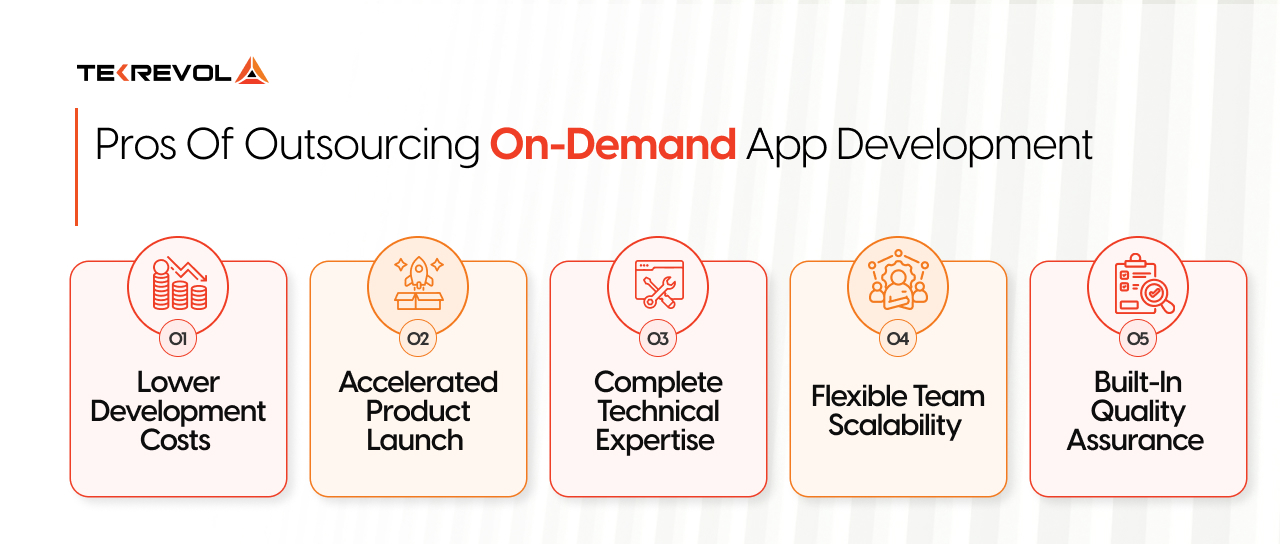
- Cost savings without sacrificing expertise: Agencies that have shipped on-demand apps before bring reusable code patterns for real-time tracking, payment flows, and push notification logic. You are not paying for them to learn those patterns; you are paying for the output.
- Faster time to market: Bypass the 2–4 month hiring cycle. An experienced outsourced team can start building in weeks. Outsourcing reduces time to market by up to 50% (SQ Magazine, 2025).
- Immediate full-stack coverage: On-demand apps need mobile devs (iOS/Android), backend engineers, DevOps, QA, and UI/UX simultaneously. Outsourcing gives you this structure on day one.
- Scalability without overhead: Add developers for a feature sprint, reduce them in a stabilization phase. The team scales with your product stage, not your payroll.
- Built-in QA processes: Established agencies bring dedicated QA engineers and testing protocols. Early-stage in-house teams almost always skip this; the cost shows up in post-launch bugs that users find first.
As a mobile app development company, TekRevol tailors its approach based on each project’s complexity, scope, and business requirements.
The Real Risks of Outsourcing On-Demand App Development
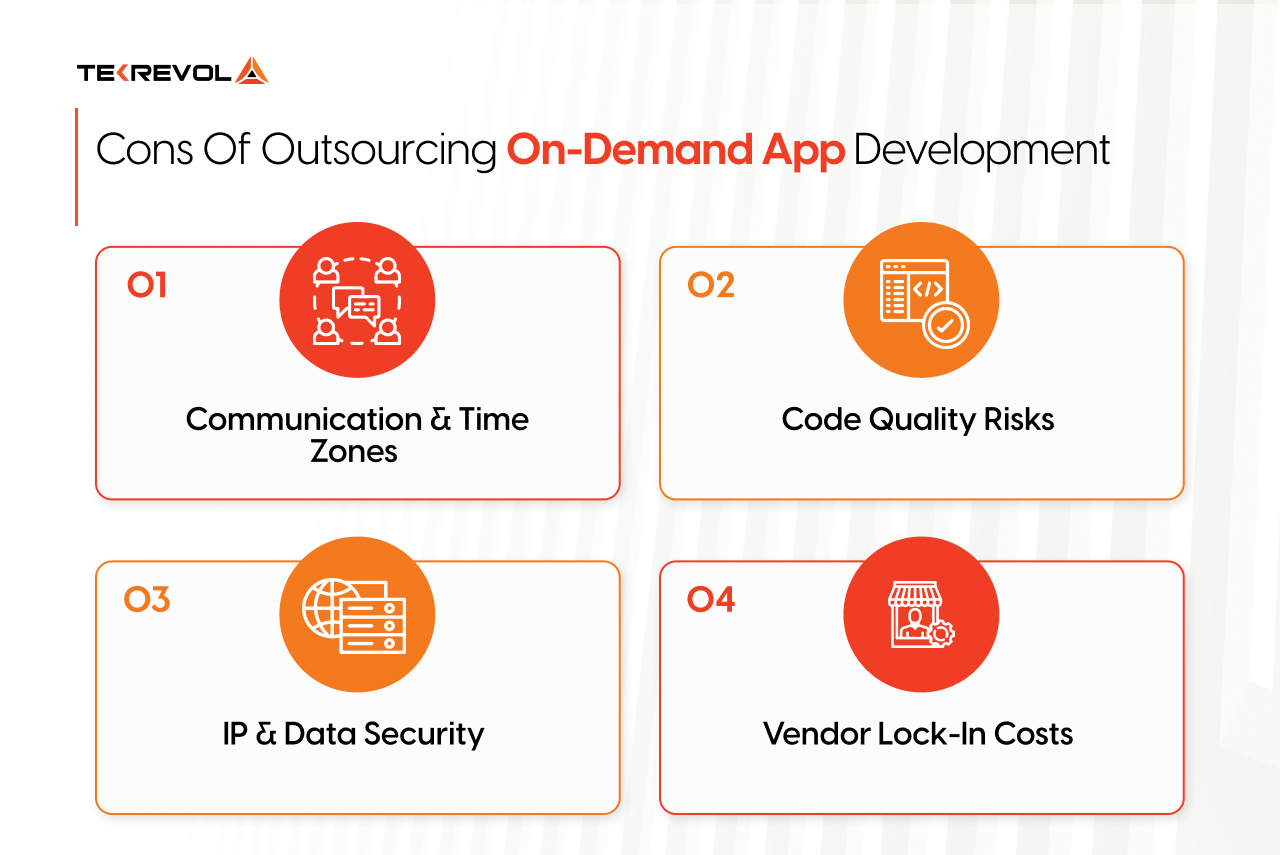
The biggest risks in on-demand app development outsourcing are scope mismanagement, IP exposure, code quality issues that surface post-launch, and vendor lock-in, all of which are preventable with the right contract structure and vetting process.
Communication Overhead and Time Zone Misalignment
On-demand apps require rapid feedback cycles. A live tracking bug in the driver app affects the customer experience in real time. A 10+ hour time zone gap turns that into a 2-day resolution cycle.
This compounds on iterative MVPs where requirements change from sprint to sprint. Communication overhead is cited as the top challenge by 42% of outsourcing clients. Choose your model accordingly.
Code Quality and Technical Debt
On-demand apps that scale fast inherit technical debt fast. Poorly architected real-time systems, WebSocket handling, push notification queues, and live GPS broadcasting become expensive to refactor once the user base grows.
What to ask before signing: Request to see how a vendor structured a previous on-demand app’s backend architecture. Any vendor with legitimate experience will walk you through this without violating client NDAs.
IP Protection and Data Security
On-demand apps handle sensitive data, user locations, payment credentials, drivers’ personal information, and provider banking details.
You need an NDA signed before sharing any product details. You need IP assignment clauses in the master service agreement before development begins. Waiting until post-launch to establish ownership is how founders lose their codebase.
Data residency matters too. If your platform operates in multiple states or regions, data handling compliance, even at a basic level, needs to be scoped before development starts. For more on building compliant AI-powered platforms, TekRevol’s AI app development services address these security layers in every engagement.
Vendor Lock-In
Vendor lock-in looks like: proprietary frameworks with no documentation, undocumented dependencies, or a vendor who controls your App Store accounts and hosting credentials.
Avoid it with contractual requirements for:
- Clean, commented source code delivered to your repository
- Architecture documentation and API docs
- A defined knowledge transfer process at handoff
- All third-party credentials and accounts in your name from day one
Hidden Costs Beyond the Initial Quote
The initial quote covers development. The following do not appear in most quotes and will appear in your bank account:
- Post-launch maintenance: 15–20% of build cost per year
- Google Maps API at scale: $3,000–$8,000/month at meaningful order volume
- Stripe and payment processing fees: 2.9% + $0.30 per transaction
- Push notification services (Firebase): Free at low volume, paid at enterprise scale
- App Store developer accounts: Apple $99/year, Google $25 one-time
- App Store commissions: 15–30% on in-app purchases
Budget for all of these before signing a development contract. They are not surprises; they are predictable operating costs that most first-time outsourcers discover after launch.
How Much Does It Cost to Outsource On-Demand App Development?
Outsourcing an on-demand app typically costs $40,000–$250,000+, depending on platform complexity, number of apps needed, and the outsourcing model chosen, with offshore teams running 30–50% cheaper than nearshore for equivalent scope.
| On-Demand App Type | Outsourced Cost Range | Timeline |
| Basic MVP (1 service type, single city) | $40,000–$80,000 | 3–5 months |
| Standard platform (customer + provider app + admin) | $80,000–$150,000 | 5–8 months |
| Multi-service / marketplace app | $150,000–$250,000+ | 8–14 months |
Offshore development can be 30–50% cheaper than nearshore for the same scope. But communication overhead and revision cycles in on-demand app development often close part of that gap in practice.
A nearshore team that resolves bugs the same day costs less in total than an offshore team that resolves them in 48 hours across three sprint cycles.
To better understand on-demand app development cost, TekRevol’s comprehensive guide breaks down pricing by features, platforms, and development requirements.
What Does Your On-Demand Platform Actually Cost to Outsource?
TekRevol scopes your complete three-app platform and provides an itemized cost estimate with a detailed breakdown of features, architecture, development phases, and timeline.
Get My Itemized Cost EstimateFixed Price vs. Time and Materials — Which Contract Model Should You Use?
For on-demand app development outsourcing, milestone-based payment structures, a hybrid of fixed price and time-and-materials, deliver the best balance of budget predictability and scope flexibility.
Fixed Price Contracts
Best for: tightly defined MVP scope where requirements are locked before development begins.
The risk: on-demand apps evolve. Real-time tracking logic changes when you test with actual drivers. Payment flows need adjustments after real checkout sessions. Fixed price makes mid-build scope changes expensive and creates adversarial dynamics with your vendor.
Time and Materials Contracts
Best for: on-demand apps where iteration is expected, which is most of them.
You pay for actual hours and materials. Budget is harder to predict. Requires active project management on your side. But it is the most honest contract model for a product category that inherently needs to evolve through development.
Milestone-Based Payments (Recommended)
The hybrid model most outsourcing experts recommend for on-demand builds.
Structure payments around deliverables:
- Discovery phase completion → first payment
- Design approval → second payment
- MVP feature completion → third payment
- QA sign-off → fourth payment
- App Store launch → final payment
This gives the vendor a predictable cash flow and gives you checkpoint reviews before releasing the next payment. If the real-time tracking is broken at sprint 4, you hold payment 4 until it is fixed. That is the only leverage that matters in an outsourcing relationship.
How to Outsource On-Demand App Development the Right Way
The right outsourcing process for an on-demand app starts with a paid discovery phase before any development contract is signed, and treats IP assignment, code ownership, and QA acceptance criteria as non-negotiable contract items from day one.
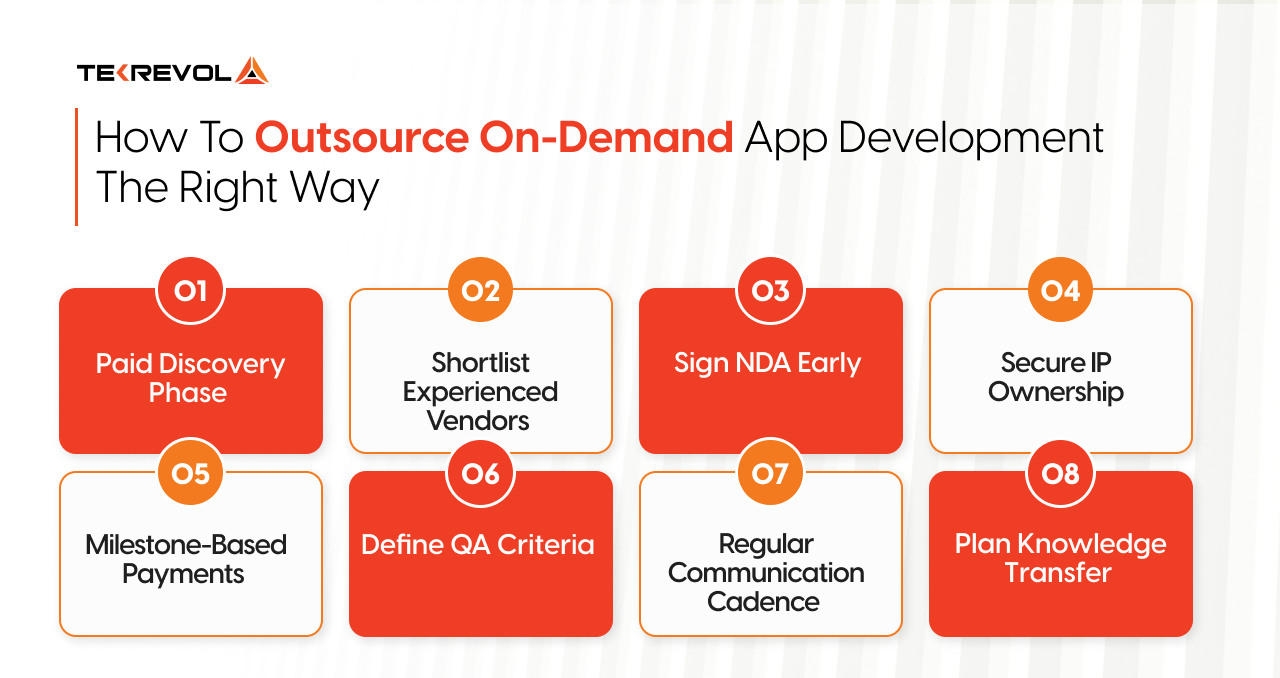
Here is the step-by-step process that works:
- Start with a Discovery Phase: Define features, user flows, and technical requirements before requesting quotes.
- Shortlist Experienced Vendors: Choose vendors with proven on-demand app experience and request live app demos.
- Sign an NDA Early: Protect your business idea before sharing detailed project information.
- Secure IP Ownership: Ensure all code, designs, and assets transfer to your company upon project completion.
- Use Milestone-Based Payments: Pay based on completed and tested deliverables, not timelines.
- Define QA Acceptance Criteria: Clearly specify what constitutes a successful feature before development begins.
- Maintain Regular Communication: Schedule daily updates, weekly demos, and sprint reviews for alignment.
- Plan Knowledge Transfer: Include documentation, code standards, architecture diagrams, and handover requirements in the contract.
Red Flags to Watch For When Vetting an Outsourcing Partner
The clearest red flag when vetting an on-demand app outsourcing partner is a vendor who quotes a price without first running a scoping call, because an accurate quote for a three-app on-demand platform requires a discovery conversation, not a template.
Watch for all of these:
- Cannot show a comparable on-demand app. A vendor with no live customer + driver + admin panel portfolio has no proven track record in this architecture.
- No discovery phase offered. If they quote you before understanding your scope, the quote is not reliable.
- Reluctance to sign NDA or discuss IP ownership. This is the single fastest filter. Professional vendors expect this conversation.
- Vague team composition. Cannot tell you who specifically will work on your project. “A team of senior developers” is not an answer.
- No post-launch plan. On-demand platforms need ongoing maintenance. A vendor with no post-launch offering is not thinking about your product’s lifecycle.
- Fixed-price quote for a poorly defined scope. This is how you end up with a technically complete app that does not match what you actually needed.
How TekRevol Approaches Outsourced On-Demand App Development
TekRevol operates as a dedicated outsourced team for on-demand app builds, running discovery-first engagements, milestone-based contracts, full IP assignment, and dedicated team continuity from sprint one to post-launch support.
Here is what that looks like in practice:
- Discovery-first approach: Every project begins with a paid discovery phase to define scope, user flows, and technical requirements before development starts.
- Dedicated team continuity: The same developers, designers, and QA engineers stay with your project from start to finish.
- Milestone-based payments: Payments are tied to completed, tested deliverables rather than hours worked or fixed dates.
- Full IP ownership: You retain ownership of all code, designs, assets, and accounts, with source code delivered throughout the project.
- Built-in post-launch support: Ongoing maintenance and support are available through structured retainers with dedicated contacts.
If you are evaluating options for an on-demand build, TekRevol’s team runs a free scoping call that results in a clear scope, timeline, and cost estimate, before any commitment.
Want the On-Demand App Outsourcing Roadmap That Actually Works?
TekRevol delivers discovery-first, milestone-based development with dedicated teams, full IP ownership, and ongoing post-launch support.
Get My On-Demand Outsourcing Roadmap


![Cost to Build an App Like Qiwa in Saudi Arabia [2026 Guide]](https://d3r5yd0374231.cloudfront.net/images-tek/uploads/2026/08/fimage-2-1-400x225.webp)


