



- Mobile app development in Australia costs AUD 25,000 to 600,000, depending on complexity, features, and compliance needs.
- A basic MVP app in Australia costs between AUD 50,000 and 95,000, taking two to four months.
- Most Australian app builds take four to eight months, with enterprise or regulated apps taking fifteen months.
- GST adds 10% to Australian agency invoices, though registered businesses can usually claim it back.
- Build iOS first for consumer or subscription apps; build Android first for field, trade, or logistics workforces.
- Annual app maintenance in Australia costs 15% to 20% of the build cost, covering updates and security fixes.
- Australian privacy and compliance requirements add 10% to 40% to app development costs, depending on data type.
- Australian agency rates run AUD 120 to 250 an hour, roughly three times the common offshore rates.
Many Australian business owners approach app development with a critical blind spot: they focus on the price tag before understanding the problem the app is meant to solve. This often leads to a costly outcome, either overinvesting in features that don’t drive business value or underinvesting and launching an app that fails to meet user expectations.
On average, a simple app in Australia costs AU$15,000–$40,000, a mid-complexity app ranges from AU$40,000–$100,000, while a fully featured, enterprise-grade platform can exceed AU$150,000–$250,000+. The final cost depends on factors such as app complexity, platform choice, features, integrations, design, security, and the development team’s location.
None of this is easy to judge from the inside. It’s worth bringing in a mobile app development company in Australia early enough so they shape the scope, not just execute whatever’s already been decided.
This guide breaks down what you can expect to pay in Australia, covering app type, features, development phases, team models, compliance, GST, and the R&D Tax Incentive.
How Much Does Mobile App Development Cost in Australia in 2026?Major Cost Factors That Affect
Mobile app development cost in Australia ranges from AUD 25,000 for a simple single-platform app to AUD 600,000 or more for an enterprise or regulated build. Most Australian projects land between AUD 60,000 and 250,000, depending on complexity and compliance load.
| Tier | Cost (AUD) | Timeline | What you actually get |
| Simple app | $25,000 to $50,000 | 4 to 8 weeks | One platform, 5 to 8 screens, no backend or a very light one, standard design |
| MVP | $50,000 to $95,000 | 2 to 4 months | Cross-platform, core feature set, basic backend, one or two integrations |
| Mid-complexity business app | $95,000 to $220,000 | 4 to 8 months | Custom design, admin dashboard, several integrations, payments, analytics |
| Complex or enterprise app | $220,000 to $600,000+ | 8 to 15 months | Multi-role access, deep integrations, compliance and audit readiness, AI features, SLA support |
Note: Australian agencies typically quote prices excluding GST. Add 10% GST when comparing these estimates with all-inclusive pricing. We’ll cover this in more detail below.
Planning an App for the Australian Market?
We'll scope your idea against real delivery data and give you a realistic AUD cost range in one free session.
Schedule a Consultation Now!Major Cost Factors That Affect Mobile App Development in Australia
The main factors affecting app development costs in Australia are team location, feature complexity, platform count, integrations, compliance requirements, design, and backend architecture. Team location and compliance account for most of the variance between two competing Australian quotes.
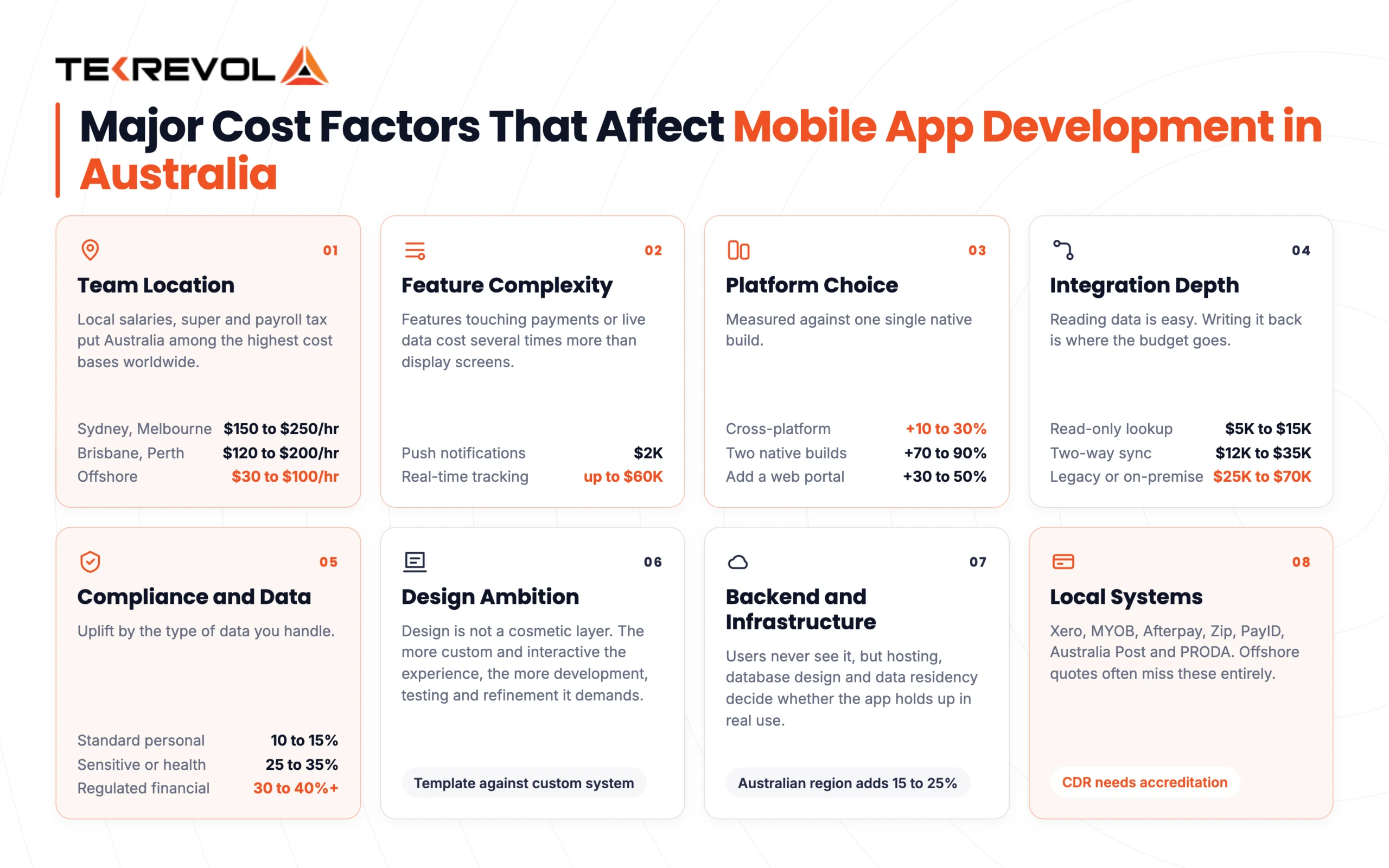
Vendors love listing these. Fewer explain which ones actually move money.
1. Team location and Engagement model
Australia has one of the highest development cost bases in the world. That isn’t the agencies being greedy. It comes down to local salaries, superannuation, payroll tax, and the fact that senior mobile engineers are hard to find here.
| Team location | Blended rate (AUD/hr) | What you’re really paying for |
| Australian agency (Sydney, Melbourne) | $150 to $250 | Local timezone, local accountability, in-person workshops, Australian contract law |
| Australian agency (Brisbane, Perth, Adelaide) | $120 to $200 | Same benefits, generally lower overheads |
| Australian freelancer | $100 to $180 | Lower cost, but no team redundancy if they get sick or take other work |
| Hybrid (Australian lead, offshore delivery) | $60 to $110 | Solid engineering, partial timezone overlap |
| Offshore (Eastern Europe, Latin America) | $45 to $100 | Widest quality spread, so vendor selection matters most here |
| Offshore (South Asia, Southeast Asia) | $30 to $70 | Local accountability at a lower blended rate |
Location alone can create a cost difference of more than AUD $300,000 for the same app and hours. Before comparing features, it’s worth understanding which team model fits your business best.
The hybrid row is where most Australian scale-ups end up, and it’s worth knowing why. You keep product, compliance, and client-facing work onshore. Then you rent engineering capacity at a rate that lets you actually ship. Our mobile app developers in Sydney work this way with most Australian clients.
2. Number and Complexity of Features
App features in Australia cost from AUD 2,000 for push notifications to AUD 60,000 for real-time tracking with live mapping. Features that touch payments, live data, or third-party systems cost several times more than screens that simply display information.
| Feature | Cost (AUD) | Why it costs what it does |
| User registration and login | $4,000 to $12,000 | Social sign-in and password recovery add up |
| User profiles | $5,000 to $14,000 | Editing, media upload, and privacy settings |
| Push notifications | $2,000 to $6,000 | Straightforward, until you need segmentation |
| In-app messaging or chat | $12,000 to $35,000 | Real-time infrastructure, not just an interface |
| Payments and checkout | $10,000 to $30,000 | Card, Afterpay, Zip, plus refunds and failure handling |
| Booking and scheduling | $10,000 to $28,000 | Availability logic, time zones, and cancellation rules |
| Maps and geolocation | $8,000 to $25,000 | Fine until you need live updates at scale |
| Real-time tracking | $25,000 to $60,000 | Live location, ETAs, and driver-side apps |
| Admin dashboard | $15,000 to $45,000 | A second product with its own permission model |
| Analytics and reporting | $8,000 to $25,000 | Event design matters more than charts |
| Offline mode and sync | $15,000 to $45,000 | Conflict resolution is the hard part |
| AI features | $20,000 to $80,000 | Plus running costs that never stop |
3. Platform Choice
Your platform decision sets the baseline that every other cost multiplies against. Here’s what the same mid-complexity app costs across the three main paths.
| Approach | Estimated cost (AUD) | Timeline | Best suited to |
| iOS only | $80,000 to $135,000 | 3 to 6 months | Australian consumer apps, since local users skew toward Apple |
| Android only | $85,000 to $145,000 | 3 to 6 months | Field teams, logistics, and audiences beyond Australia |
| Cross-platform (Flutter or React Native) | $90,000 to $180,000 | 4 to 7 months | Most Australian business apps need both platforms |
| Two native builds | $140,000 to $265,000 | 6 to 10 months | Device-heavy features, complex animation, or performance-critical apps |
A few things worth pulling out of that table.
- Android often costs slightly more than iOS, which surprises people. It isn’t the code. It’s testing across a far wider spread of devices, screen sizes, and OS versions.
- Cross-platform gets you both platforms for roughly 10% to 30% above a single build. That’s the value proposition, and for most business apps, it holds up.
- Two native builds cost 70% to 90% more, and you carry that premium forever because every future feature gets built twice.
- Adding a web portal on top of any of these adds another 30% to 50%.
There’s a rough test we use. If your app is mostly screens, forms, and API calls, cross-platform will serve you well. If it leans hard on the camera, Bluetooth, or background processing, budget for native and don’t fight it.
Either way, our cross-platform app development team scopes both paths side by side, so the decision gets made on evidence rather than preference.
4. Integration Depth
What the app is allowed to do inside each system matters more than how many systems it touches. Reading data is easy; writing it back is where the budget goes. Each integration carries its own discovery, authentication, error handling, and ongoing upkeep.
- Read-only lookup: AU$5,000–$15,000 each. Pulls and displays data, order status, stock, and balances. The safest starting point.
- Two-way sync: AU$12,000–$35,000 each. Creates or updates external records. Costs rise here because failed writes need a recovery plan.
- Payments: AU$10,000–$30,000. Stripe, Afterpay, Zip, PayID, or Tyro. The real cost is in refunds, failed transactions, and reconciliation, not the happy path.
- Real-time/event-driven sync: AU$20,000–$50,000 each. Live updates instead of batches are needed for tracking, bookings, or anything where stale data creates support tickets.
- Legacy/on-premise systems: AU$25,000–$70,000 each. No modern API means custom middleware and longer-than-expected discovery.
The Australian Systems That Come Up Most
Local integrations are worth naming because they’re often missed in offshore quotes:
- Accounting: Xero and MYOB
- Payments & BNPL: Afterpay and Zip
- Bank transfers: PayID and the New Payments Platform
- Shipping: Australia Post, Sendle, and Couriers Please
- Health: My Health Record and Medicare via PRODA
- Banking data: Consumer Data Right, which requires accreditation, not just an API key
Consumer Data Right deserves special attention. It involves an accreditation process with its own timeline and costs, not simply an API integration.
Integration costs increase with legacy systems, API limits, paid access, and workflows requiring manual cleanup after failed transactions. They can decrease if you launch read-only access first and add write capabilities later.
5. Compliance & Data obligations
Australian privacy requirements can shape your app’s architecture, data flows, and security from day one. Retrofitting compliance later can mean expensive rework, especially when sensitive or regulated data is involved.
The cost largely depends on the type of data your app handles:
- No personal information: Minimal privacy-related uplift.
- Standard personal information: Indicative 10%–15% uplift for consent, privacy controls, secure storage, and retention.
- Sensitive information: Indicative 25%–35% uplift for health data, certain biometric information, and stronger security controls.
- Regulated financial data: Potentially 30%–40%+ for products involving financial services, credit decisions, or CDR requirements.
One common mistake: founders often assume they don’t collect personal information, only to discover that analytics, device identifiers, location data, or crash logs may qualify as personal information when a user is reasonably identifiable.
6. Design ambition
Design isn’t just a cosmetic layer; it directly shapes how much development work goes into your app and how well users respond to it. The more custom and interactive the experience, the more time, testing, and refinement it demands from your team.
| Design Level | Cost Range (AUD) | What’s Included |
| Standard design | $8,000 – $20,000 | Pre-built UI kits, standard components, minimal customisation |
| Custom design system | $25,000 – $60,000 | Original UI/UX, brand-specific components, user testing, and iteration |
| Advanced (animation/3D) | $80,000+ | Custom motion design, 3D elements, highly interactive experiences |
7. Backend and Infrastructure
Users only see the interface, but it’s the backend development that determines whether your app actually holds up under real-world use. Cloud hosting, database architecture, and data residency requirements all carry distinct price points, and skipping proper planning here is one of the most common ways Australian app budgets blow out post-launch.
| Backend Requirement | Cost Impact | What It Covers |
| Simple managed backend | Low, minimal setup cost | Pre-built services (e.g., Firebase, Supabase) for basic apps |
| Real-time data sync | Moderate premium | Live updates for tracking, bookings, chat, or notifications |
| High-traffic / scalable architecture | Higher build and hosting cost | Load balancing, auto-scaling, and performance optimisation |
| Offline functionality | Moderate to high premium | Local data storage with sync-on-reconnect logic |
| Australian data residency (Sydney hosting) | Small ongoing premium | Compliance-driven local hosting, typically costlier than US-based servers |
App Development Cost Breakdown by Type in Australia
The cost of developing a mobile app in Australia varies significantly by app type because each product requires different features, integrations, security controls, and backend infrastructure. A simple booking app may start around AUD $50,000, while complex fintech or enterprise platforms can reach AUD $700,000+.
Below is a breakdown of the estimated mobile app development cost for the most common app types in Australia.
Booking or Appointment App: AUD $50,000–$130,000
Booking apps typically include user accounts, availability management, calendars, notifications, payments, and admin controls. Costs increase when you add two-way calendar syncing, complex rescheduling, multiple providers, or real-time availability.
eCommerce App: AUD $60,000–$180,000
An eCommerce app needs more than product listings and checkout. Inventory synchronisation, payment gateways, customer accounts, order tracking, push notifications, and integrations with systems such as Afterpay or Zip can significantly increase development costs. Our eCommerce app development team scopes the inventory and payments layer first, because that’s where these budgets usually move.
On-Demand or Delivery App: AUD $100,000–$280,000
On-demand platforms require customer and provider workflows, real-time tracking, payments, notifications, and location services. Delivery apps can cost more when they require driver-side functionality, route optimization, and reliable tracking across large geographic areas.
Marketplace App: AUD $110,000–$250,000
Marketplace apps are more complex because they serve multiple user groups. Features such as seller onboarding, product or service listings, payments, commissions, reviews, messaging, dispute management, and separate admin controls all add to the development effort.
Social or Community App: AUD $90,000–$250,000
Social apps require profiles, feeds, messaging, media uploads, notifications, search, and engagement features. Costs rise significantly when you need advanced moderation tools, recommendation algorithms, live features, or large-scale content management. If this is your category, our breakdown of social media app development cost goes feature by feature.
Fitness and Wellness App: AUD $45,000–$140,000
Fitness apps can include workout plans, progress tracking, subscriptions, video content, wearable integrations, and personalized recommendations. Supporting multiple wearable platforms and real-time health or activity data can push costs toward the higher end.
Education or eLearning App: AUD $70,000–$200,000
eLearning apps typically combine courses, video or audio content, quizzes, progress tracking, payments, certificates, and learner dashboards. The content management system and integrations often become more complex as the platform grows.
Logistics or Field Service App: AUD $110,000–$320,000
Logistics apps require location tracking, job management, route planning, notifications, and separate workflows for drivers or field workers. Offline functionality can add high cost, particularly when the app needs to keep working reliably in areas with inconsistent connectivity.
Healthcare or Telehealth App: AUD $150,000–$450,000
Healthcare apps require stronger privacy and security controls alongside features such as patient profiles, appointments, secure messaging, video consultations, and health-data integrations. Integrations with healthcare systems and compliance requirements can push costs considerably higher.
Fintech or Banking App: AUD $200,000–$700,000
Fintech apps typically require advanced security, identity verification, transaction processing, fraud controls, audit trails, and financial integrations. Requirements around Consumer Data Right, APRA standards, and other financial regulations can make these among the most expensive apps to develop.
Enterprise or Internal App: AUD $150,000–$400,000
Enterprise apps often connect with existing business systems rather than operating independently. SSO, role-based permissions, enterprise APIs, dashboards, audit logging, security testing, and internal IT reviews can substantially increase the overall development cost.
Know Your App Type but Still Unsure Where Your Budget Will Land?
We'll break down the features and integrations that will shape your final development cost.
Get a Custom Estimate!Breaking Down Mobile App Development Costs by Phase
Development takes under half of the total budget, which surprises most first-time buyers when they see the full breakdown.
1. Discovery and Scoping
Estimated Cost: AU$8,000 – $20,000 | Estimated Timeline: 2–4 weeks
This phase defines requirements, maps user needs, and locks in a technical architecture before any code is written. Skipping discovery saves money upfront but can cost far more later. Unclear requirements often turn into scope creep, rework, and budget overruns
- Stakeholder workshops and requirement gathering
- User and competitor research
- Technical feasibility assessment
- A costed, documented scope of work
2. UI/UX Design
Estimated Cost: AU$12,000 – $40,000 | Estimated Timeline: 3–6 weeks
Design translates the scope into something users can actually navigate. This includes wireframes, a reusable design system, accessibility considerations, and prototype testing with real users to catch friction points before development begins.
- Low-fidelity wireframes and user flow mapping
- High-fidelity mockups and interactive prototypes
- Accessibility and platform guideline compliance (Apple HIG, Material Design)
- Usability testing and iteration rounds
3. Development
Estimated Cost: AU$40,000 – $200,000 | Estimated Timeline: 3–8 months
This is where the bulk of the budget and timeline go. Frontend, backend, database architecture, and core business logic are all built out here, typically in iterative sprints so progress can be reviewed and adjusted along the way.
- Frontend build (native or cross-platform)
- Backend logic, database, and API architecture
- Core feature implementation per the agreed scope
- Sprint-based delivery with regular review checkpoints
4. Integrations
Estimated Cost: AU$10,000 – $60,000 | Estimated Timeline: Runs alongside development
Integrations link your app with external services like payment gateways, accounting software, and third-party APIs. Cost and complexity rise sharply with each system that requires two-way data sync rather than simple read access.
- Payment gateway integration (Stripe, Afterpay, Zip, PayID)
- Third-party API connections (accounting, CRM, logistics)
- Authentication and error-handling logic for each integration
5. Testing and QA
Estimated Cost: AU$12,000 – $45,000 | Estimated Timeline: 3–6 weeks
Testing is where many budgets get underestimated; it often costs more than the launch itself. Given Australia’s fragmented handset and OS mix, thorough device coverage is essential to avoid post-launch bug reports.
- Functional and regression testing
- Device and OS coverage across the Australian market
- Security and penetration testing
- User acceptance testing (UAT)
6. Launch and Deployment
Estimated Cost: AU$5,000 – $15,000 | Estimated Timeline: 1–2 weeks
The final phase covers app store submission, production environment setup, and handover. It’s the shortest and least expensive phase, but rushing it after cutting corners elsewhere is a common, costly mistake.
- App Store and Google Play submission
- Production environment and monitoring setup
- Documentation and team handover
7. First-Year Support
Estimated Cost: 15%–20% of total build cost | Estimated Timeline: Ongoing
Support isn’t optional overhead; it’s where real user behaviour surfaces bugs, OS compatibility issues, and small feature gaps that only appear after launch.
- Bug fixes and performance monitoring
- OS and device compatibility updates
- Minor feature refinements based on user feedback
iOS, Android, or Cross-Platform: Which Costs Less in Australia?
Cross-platform costs 10–30% more than a single native build. Two separate native apps cost 70–90% more. On paper, cross-platform wins every time, but which platform to build first is a strategic call most guides skip entirely.
Quick answer, by business type:
| Business Type | Build First | Why |
| Consumer subscription/paid app | iOS | Higher spend per user; Australia skews iOS |
| Field, trade, or logistics workforce | Android | Company-issued devices run almost entirely on Android |
| B2B or enterprise tool | Ask your first 10 customers | Beats any national stat |
| Expanding into Asia within 2 years | Cross-platform, now | Retrofitting later costs more than building both upfront |
Why Australia is different: As per Stat Counter, iOS holds roughly 63% of Australia’s mobile market to Android’s 37%. It’s a wider gap than in most Western markets, and the reverse of Android-dominant regions like India or Southeast Asia. That’s why most Australian consumer apps default to iOS-first.
Revenue skews further than users do: iOS users spend more per head on purchases and subscriptions. Subscription and paid-content apps do better launching iOS-first; ad-driven or transaction-volume apps benefit more from Android’s larger reach.
The real cost gap shows up in year two, not year one: A single native app may look cheaper upfront, but adding a second platform means maintaining two codebases. Cross-platform development can reduce both build and long-term maintenance costs.
Native still wins for heavy on-device processing, tight hardware integration, or complex animation. See our Android vs iOS usage breakdown for the market-share detail.
How Much Does Australian Compliance Add to Your App Budget?
Australian compliance adds 10% to 40% to app development cost, depending on the data you handle. Privacy Act penalties for serious interference reach AUD 50 million, and a new automated decision-making transparency requirement takes effect on 10 December 2026.
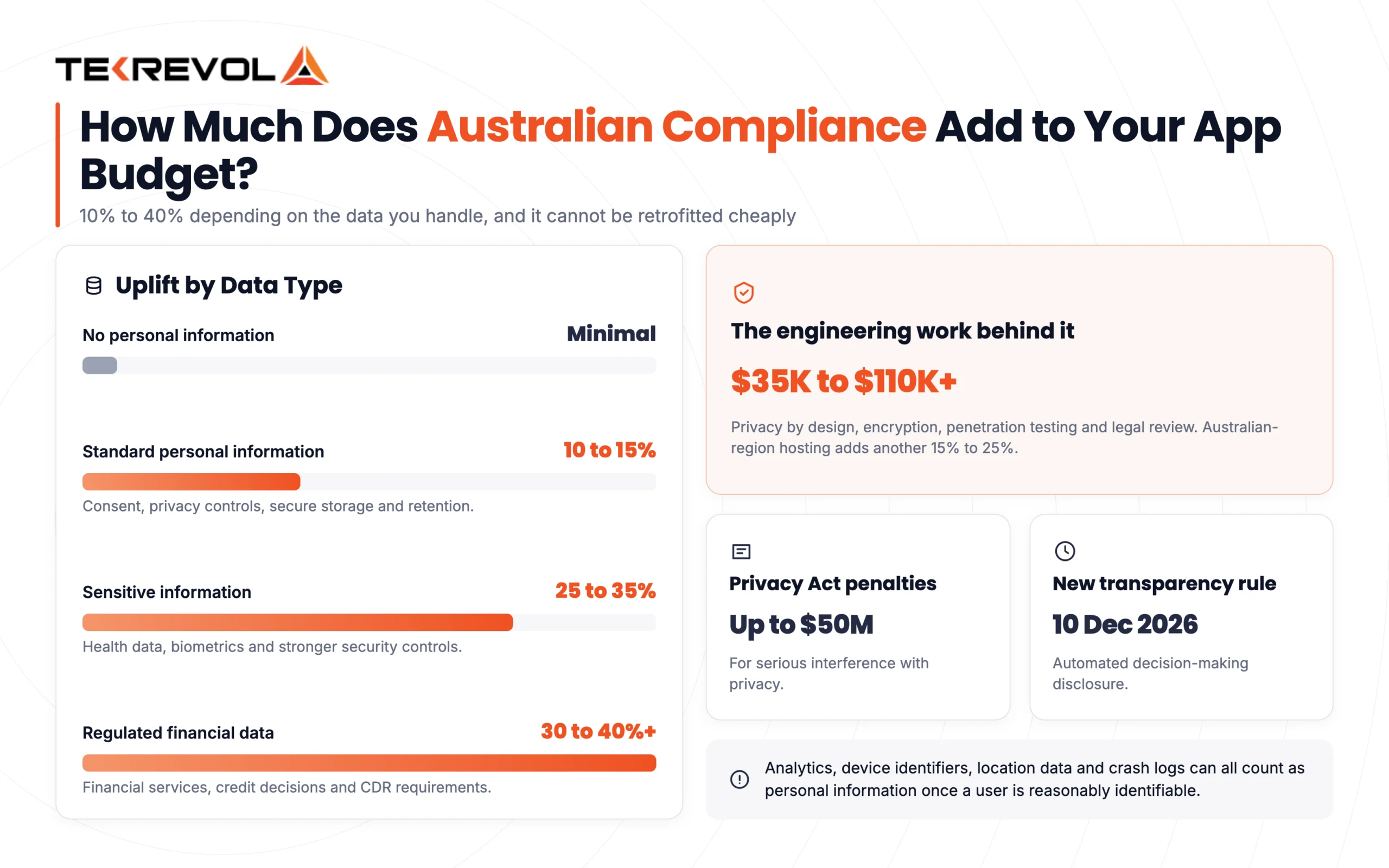
Most cost guides name the standards and stop. Here’s what each one actually does to your budget, and which ones you can’t avoid.
Which standards apply, and what each one costs
Two things drive this: what the law requires of you and what your customers require of you. The second catches people out more often because it usually arrives after you’ve signed the build.
| Standard | Status | Triggers when | Cost impact (AUD) |
| Australian Privacy Principles | Law | You hold personal information | Adds 10% to 15% of the build, plus $8,000 to $25,000 a year to review |
| Notifiable Data Breaches scheme | Law | Same trigger as the APPs | $3,000 to $10,000 for a response plan and tooling |
| Automated decision-making transparency | Law from 10 Dec 2026 | Algorithms make decisions affecting users | $5,000 to $15,000 |
| My Health Record and Healthcare Identifiers | Law | You connect to the national health infrastructure | $30,000 to $80,000 |
| Consumer Data Right | Law | You access banking or energy data for a consumer | Accreditation, not a build task. See below. |
| ISO/IEC 27001 | Contractual | Enterprise or government buyers ask | $15,000 to $40,000 first year, then $4,000 to $15,000 a year |
| PCI-DSS | Contractual | Your acquirer requires it if you touch card data | $5,000 to $40,000 by validation level |
| APRA CPS 234 | Regulatory | You serve APRA-regulated entities | Adds 25% to 40% to the build |
Consumer Data Right can extend timelines because it requires accreditation, not just a technical integration. The process involves multiple requirements, so confirm the timeline and costs before setting a launch date.
The engineering work behind compliance can add AUD $35,000–$110,000+, covering privacy-by-design, security and encryption, penetration testing, and legal reviews. Hosting data in Australian regions can add another 15%–25% to costs.
Building Something That Handles Regulated Australian Data?
We'll map your data flows against Privacy Act obligations and show you which controls are mandatory versus optional before you commit to a build.
Book a Free Compliance Scoping SessionCan the R&D Tax Incentive Reduce Your App Development Cost?
Yes, substantially. Australian companies with an aggregated turnover under AUD 20 million can claim a refundable tax offset of their company tax rate plus 18.5%, which reaches 43.5% for most small companies. On eligible spend, that can cut your effective app cost by nearly half.
This is the biggest cost factor in Australia, yet most guides don’t show the actual maths.
How the offset actually works
Per the Australian Taxation Office, the R&D Tax Incentive works in two tiers:
- Refundable offset: for entities with aggregated turnover under AUD 20 million, the offset is your company tax rate plus an 18.5% premium. For a company on the 25% base rate, that’s 43.5%, and it’s refundable, meaning you can receive it as cash even at a loss.
- Non-refundable offset: for larger entities, it’s your company tax rate plus 8.5% on R&D expenditure up to 2% intensity, and 16.5% above that threshold.
Not every app development project qualifies for Australia’s R&D Tax Incentive. It generally applies to genuine experimental work where the outcome cannot be known in advance, not routine development using established technology.
If you think your project may qualify, speak with an accountant or R&D tax specialist before development starts. Properly documenting your experiments and technical uncertainties is essential.
GST on App Development in Australia: What It Actually Costs You
GST applies at 10% on app development services from an Australian-registered supplier. GST-registered businesses can generally claim it back as an input tax credit, so it affects cash flow more than final cost. Offshore suppliers usually don’t charge it. None of the guides we reviewed cover this, and it catches people out when the first invoice lands.
What you need to know:
- Australian agencies quote excluding GST by default. “$150,000 + GST” means you’ll pay $165,000; always confirm the basis before comparing quotes.
- If you’re GST-registered, you claim it back via your BAS. Net cost is nil, but you carry the cash for a quarter.
- If you’re not registered, GST is a real 10% cost, meaningful for a pre-revenue startup under the AU$75,000 turnover threshold.
- Offshore suppliers typically don’t charge GST, though reverse-charge obligations can apply to imported services. Confirm your position with your accountant.
The practical takeaway: compare quotes on the same basis. A $150,000 + GST Australian quote against a $60,000 offshore quote is still a real gap, just narrower than it looks once the GST is reclaimed.
Should You Hire an Australian Agency, Offshore Team, or Freelancer?
Hire an Australian agency for regulated, complex, or stakeholder-heavy builds. Use offshore teams for well-defined scopes you can manage remotely. Most Australian scale-ups settle on a hybrid model, keeping product and compliance ownership local while renting offshore engineering capacity.
This is the decision that moves your budget the most, so let’s compare all four properly.
| Model | Total cost (AUD, mid-size app) | Best For | The real trade-off |
| Australian agency | $150,000 to $350,000 | Regulated data, complex stakeholders, tight timelines needing in-person work | You pay a premium for proximity and accountability |
| Offshore agency | $50,000 to $130,000 | Well-defined scope, experienced client, remote-friendly project | Timezone gaps and communication overhead are real costs |
| Hybrid | $80,000 to $200,000 | Most Australian scale-ups have passed their first build | Needs one strong technical owner onshore, or it becomes two problems |
| Freelancers | $30,000 to $90,000 | Isolated features, design work, prototypes | Nobody owns architecture, and continuity risk is high |
| In-house team | $600,000 to $900,000/year | Software is your permanent core business | You’re buying permanent capacity for a project with a finish line |
If you already have engineers but need mobile specialists, IT staff augmentation usually beats both a full outsourced build and an Australian hiring round, which currently runs three to six months for senior mobile roles.
Hidden and Ongoing Costs of Mobile App Development in Australia
The development invoice is only part of your app budget. Hosting, third-party services, security, compliance, and marketing can add significantly to your first-year costs.
App Store and Google Play Fees
Publishing your app comes with developer account fees, although these are relatively small compared with development costs.
Estimated cost: AUD $40–$150+ per year
Cloud Hosting
Hosting costs depend on users, traffic, storage, and backend requirements. Australian-region hosting may also carry a premium when data residency is required.
Estimated cost: AUD $100–$3,000+ per month
Third-Party Services
Maps, SMS, email, analytics, payment gateways, and other APIs create recurring usage-based costs that grow as your app scales.
Estimated cost: AUD $200–$2,000+ per month
Security Testing
Apps handling personal, health, or financial data may require penetration testing and recurring security assessments.
Estimated cost: AUD $8,000–$25,000+ per year
Privacy and Compliance
Privacy reviews, compliance updates, legal documentation, and security assessments can add ongoing costs, particularly for regulated apps.
Estimated cost: AUD $8,000–$25,000+ per year
App Marketing and ASO
Launch campaigns, app store optimisation, paid acquisition, and creative production can become significant post-launch expenses. Our guide to mobile app promotion strategies covers where that budget tends to work hardest.
Estimated cost: AUD $10,000–$60,000+
Cyber Liability Insurance
Insurance costs vary by industry, coverage, revenue, and the type of data your app handles. Health and financial apps typically require more coverage.
Estimated cost: AUD $2,000–$20,000+ per year
What Does App Maintenance Cost Each Year in Australia?
App maintenance in Australia costs 15% to 20% of your build cost annually, so AUD 22,500 to 30,000 on an AUD 150,000 app. That covers OS updates, bug fixes, security patches, third-party API changes, and small improvements.
Apple and Google both ship major OS updates every year, and each one can break something. That alone makes maintenance non-optional rather than a nice-to-have.
What the annual budget covers:
- OS compatibility updates: iOS and Android releases, plus new device sizes.
- Bug fixes and performance work: ongoing, based on real user behaviour.
- Security patches and dependency updates: libraries go out of date constantly.
- Third-party API changes: your payment or mapping provider changes things without asking you.
- Small feature improvements: the ones users actually request.
- Hosting and infrastructure scaling: as usage grows.
Skip maintenance for a year, and you don’t save 20%. You accumulate a rebuild. We’ve been handed several apps in exactly that state, and catching up almost always costs more than staying current would have. Our mobile app support and maintenance team picks up apps built elsewhere as well as our own.
How Much Does It Cost to Build an App Like Popular Australian Platforms?
Building an Uber-style app costs AUD 150,000 to 400,000. An Airtasker-style marketplace costs AUD 120,000 to 300,000. A CommBank-style banking app costs AUD 400,000 to 900,000. These estimate comparable to first-release functionality, not what those companies actually spent.
Their real development budgets aren’t public. The more useful comparison is what similar functionality would cost to build in Australia today.
| App | Comparable build cost (AUD) | The hardest part to replicate |
| Uber | $150,000 to $400,000 | Live dispatch and driver supply, not the map |
| Airtasker | $120,000 to $300,000 | Two-sided liquidity and trust, plus dispute handling |
| CommBank | $400,000 to $900,000 | Core banking integration and CDR compliance |
| Menulog | $130,000 to $350,000 | Three-sided logistics: customer, restaurant, courier |
| Afterpay | $300,000 to $700,000 | Credit decisioning and regulatory obligations |
| Seek | $150,000 to $400,000 | Search relevance and employer-side tooling |
| Strava-style fitness app | $80,000 to $200,000 | Wearable integrations and social graph at scale |
| HealthEngine-style booking | $100,000 to $250,000 | Practice management integrations across many vendors |
The expensive part usually isn’t the feature users see. It’s the licence, regulation, integration, or backend complexity behind it. Copying the screens doesn’t copy those costs.
How Is AI Changing Mobile App Development Costs?
Two separate AI conversations are happening in app budgets right now, and most people run them together.
One is AI as a tool: coding assistants that speed up your developers. The other is AI as a feature: something the app itself does. They move cost in opposite directions, and only one of them saves you money.
| Impact on cost | |
| AI as a dev tool (coding assistants) | Saves 20–40% on routine coding, doesn’t touch discovery, design, integration, testing |
| AI as a product feature (build) | Adds AUD 20,000–80,000, depending on scope |
| AI as a product feature (running cost) | AUD 500–5,000/month at 50,000 interactions, on top of hosting |
| Compliance | Dec 2026 automated decision-making rules apply if AI decides things about users |
Coding assistants speed up routine coding, not discovery, integration, compliance, or testing, so the savings on total project cost are modest, not the transformation the marketing promises.
AI as a feature works the other way: a chat assistant or recommendation engine adds AUD 20,000 to 80,000 to build. And it keeps costing; you pay per use, not once. Price the feature, then price running it a thousand times a day. That’s the number that breaks post-launch budgets, so put it in your operating costs from day one.
An app that’s affordable to build and unaffordable to run is a failed project with a nice launch. We model running costs before we quote, so talk to our AI development team early if AI is central to your product.
How Do Australian Apps Make Money?
Australian apps monetize through subscriptions, in-app purchases, transaction commissions, advertising, freemium upgrades, and B2B licensing. Subscriptions dominate the local market because Apple and Google both drop their commission to 15% after a subscriber’s first year, rather than 30%.
Cost only means something next to return, so here’s the other side of the ledger.
- Subscriptions: the most common model for Australian consumer apps. Predictable revenue and the reduced platform commission after year one help materially.
- In-app purchases: works for games, content, and feature unlocks.
- Transaction commission: marketplaces and on-demand apps take a percentage. Standard rates run 10% to 25% depending on the category.
- Advertising: needs real scale before it’s meaningful. Australian CPMs are healthy, but the audience is small.
- Freemium: widest funnel, and conversion rate makes or breaks it.
- B2B licensing: selling to businesses rather than consumers. Highest contract values, longest sales cycles.
The Australian market reality
Be realistic about market size. Australia has roughly 28 million people, based on the latest ABS estimate of 27.8 million at the end of 2025. A consumer app that reaches 1% of them has 270,000 users. That’s a solid business on subscriptions and a thin one on ads. Plenty of successful Australian apps plan for international expansion from the start for exactly this reason, and that decision affects your architecture and therefore your budget.
If you’re modelling revenue, our guide on how much money an app can make walks through the numbers in more detail.
How Can You Reduce Mobile App Development Costs in Australia?
You can reduce Australian app development costs by 30% to 50% through tight MVP scoping, cross-platform development, hybrid team models, and phased integrations. Claiming the R&D Tax Incentive where eligible is the largest single lever available to Australian companies.
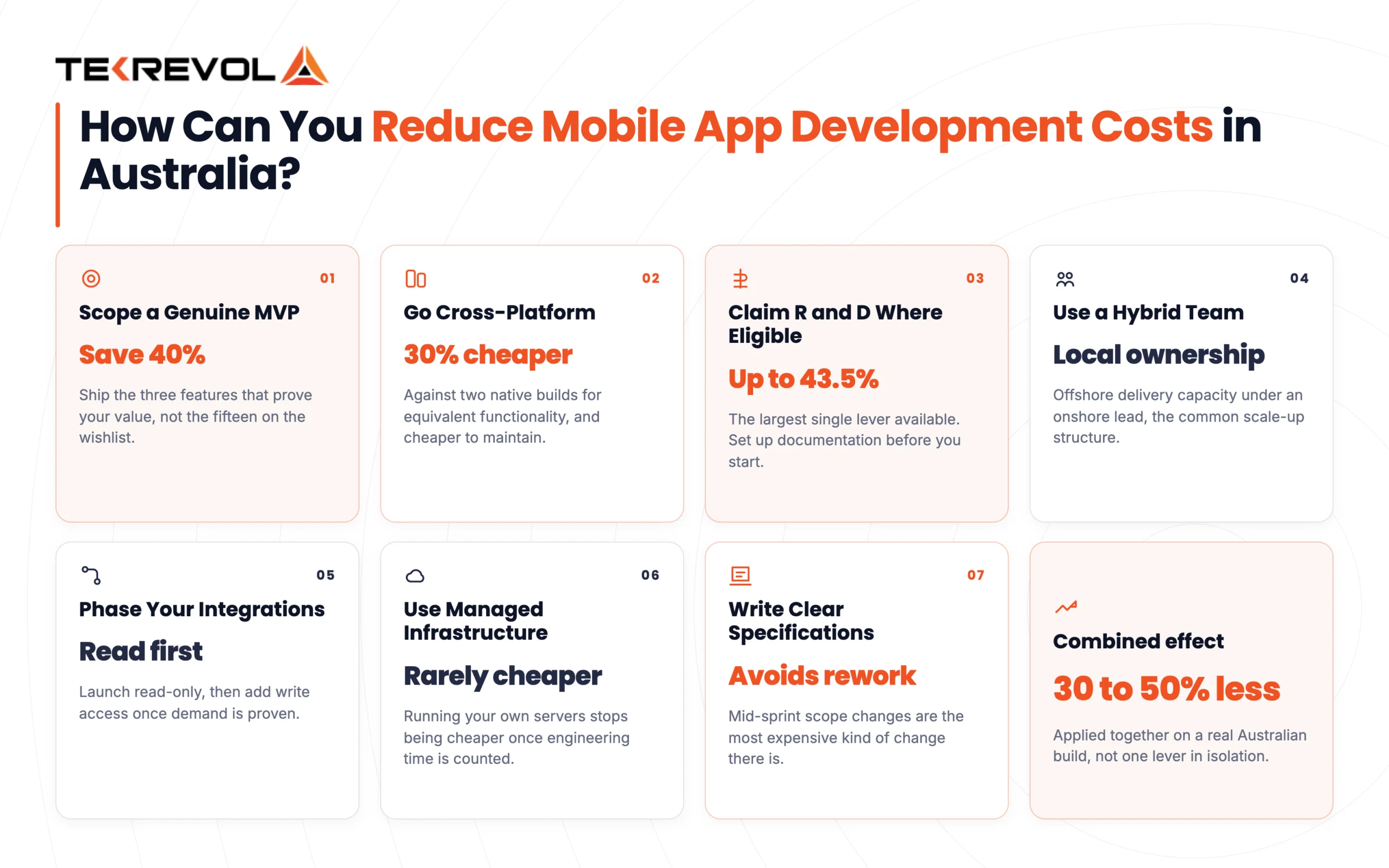
Here’s what genuinely works, based on Australian projects where we’ve hit the number.
- Scope a genuine MVP: Ship the three features that prove your value, not the fifteen on your wishlist. This alone typically saves 40% of first-release cost.
- Go cross-platform: Roughly 30% cheaper than two native builds for equivalent functionality.
- Use a hybrid team model: Local ownership with offshore delivery capacity is the most common structure among Australian scale-ups, and for good reason.
- Claim the R&D Tax Incentive if you’re eligible: Up to 43.5% back on qualifying spend. Set up your documentation before you start.
- Phase your integrations: Launch read-only, add write access once demand is proven.
- Use managed infrastructure: Running your own servers is rarely cheaper once engineering time is counted.
- Write clear specifications: Mid-sprint scope changes are the most expensive kind of change there is.
How Do You Choose a Mobile App Development Company in Australia?
Choose an Australian app development company based on shipped apps in your category, transparent AUD pricing by phase, named integration experience, and clear ownership terms. Ask who owns the code and the app store accounts, because the answer reveals a lot.
We’re obviously not neutral here. Even so, this is the checklist we’d hand a friend, including the parts that don’t favour us.
What to verify
- Shipped apps you can download: Not a portfolio of mockups. Actual apps in the Australian App Store and Google Play.
- Experience in your category: A team that’s built fintech understands CDR. A team that hasn’t will learn on your budget.
- A written breakdown by phase, in AUD, with GST clearly marked: One number on one page is a warning sign.
- Named integration experience: Which payment providers, which practice management systems, which CRMs.
- Code and account ownership in writing: You should own the repository, the app store accounts, and the cloud accounts. Some agencies keep these, and it’s a trap.
- Maintenance terms upfront: Rates, response times, and what counts as a bug versus a new feature.
- Willingness to say no: An agency that tells you a feature isn’t worth building beats one that agrees with everything.
Partner With TekRevol for Mobile App Development in Australia
TekRevol works with Australian businesses to plan, build, and scale iOS, Android, and cross-platform apps with clear scope and upfront pricing. We’ve delivered 800+ projects and maintain a 4.8 Clutch rating.
Here’s how we work with Australian clients:
We scope compliance, integrations, platforms, and key features before quoting, because these are the factors that can significantly change your budget. You’ll receive a clear breakdown by phase in Australian dollars, with GST shown separately, so you know exactly what you’re paying for.
We can also flag potential R&D Tax Incentive eligibility early, giving you time to discuss it with your accountant or R&D tax specialist before development begins. We’re not tax advisers, but the timing can matter.
Whether you’re in Sydney, Melbourne, Brisbane, or Perth, our Melbourne app development team can walk you through what your specific idea would cost, with a quote issued against your ABN and GST marked clearly. And if a custom app isn’t the right investment for your idea, we’ll tell you that too.
Ready to Find Out What Your App Will Actually Cost in Australia?
In 30 minutes, we'll review your idea, identify key cost drivers, and give you a realistic AUD estimate.
Schedule Your Free App Consultation!


