



- IoT app development cost in 2026 ranges from $40,000 for a pilot to $500,000+ for enterprise builds.
- Hardware, firmware, connectivity, and cloud together often cost more than the mobile app itself.
- Annual running cost per connected device ranges from roughly $31 to $96, depending on fleet size.
- Most IoT budgets break because teams fund the build and forget the recurring per-device run rate.
- Complexity, device count, connectivity choice, and compliance drive four out of five cost overruns.
- A staged pilot before full rollout cuts wasted spend more than any offshore rate arbitrage does.
What does it actually cost to build an IoT app? The answer is rarely as simple as an agency quote makes it sound. A connected toothbrush, smart home system, and industrial monitoring platform may all be called “IoT apps,” but the technology, infrastructure, and development effort behind each can be completely different.
In 2026, IoT app development cost ranges from $40,000 to $500,000, while large enterprise platforms can exceed $1.5 million. The final budget depends on factors such as the number of connected devices, hardware integration, communication protocols, cloud infrastructure, security requirements, and regulatory needs.
The real challenge is knowing where that budget goes and which costs continue after launch. From device integration and cloud infrastructure to security, maintenance, and scaling, this guide breaks down the major expenses so you can plan with realistic numbers. If you’re scoping an IoT project, TekRevol’s IoT development services team can also help you validate the scope and budget before development begins.
How Much Does IoT App Development Cost by Complexity?
IoT app development cost by complexity runs $40,000 to $95,000 for a pilot, $95,000 to $220,000 for a production build. Budget around $220,000 to $500,000 for a scaled multi-device platform, and $500,000 to $1.5 million-plus for regulated enterprise deployments with custom hardware.
Complexity in IoT isn’t about screens. It’s about how many things have to integrated with each other without failing. A single-device app with a Bluetooth connection and a dashboard is a different from a fleet platform that ingests telemetry from 20,000 sensors and pushes firmware updates over the air.
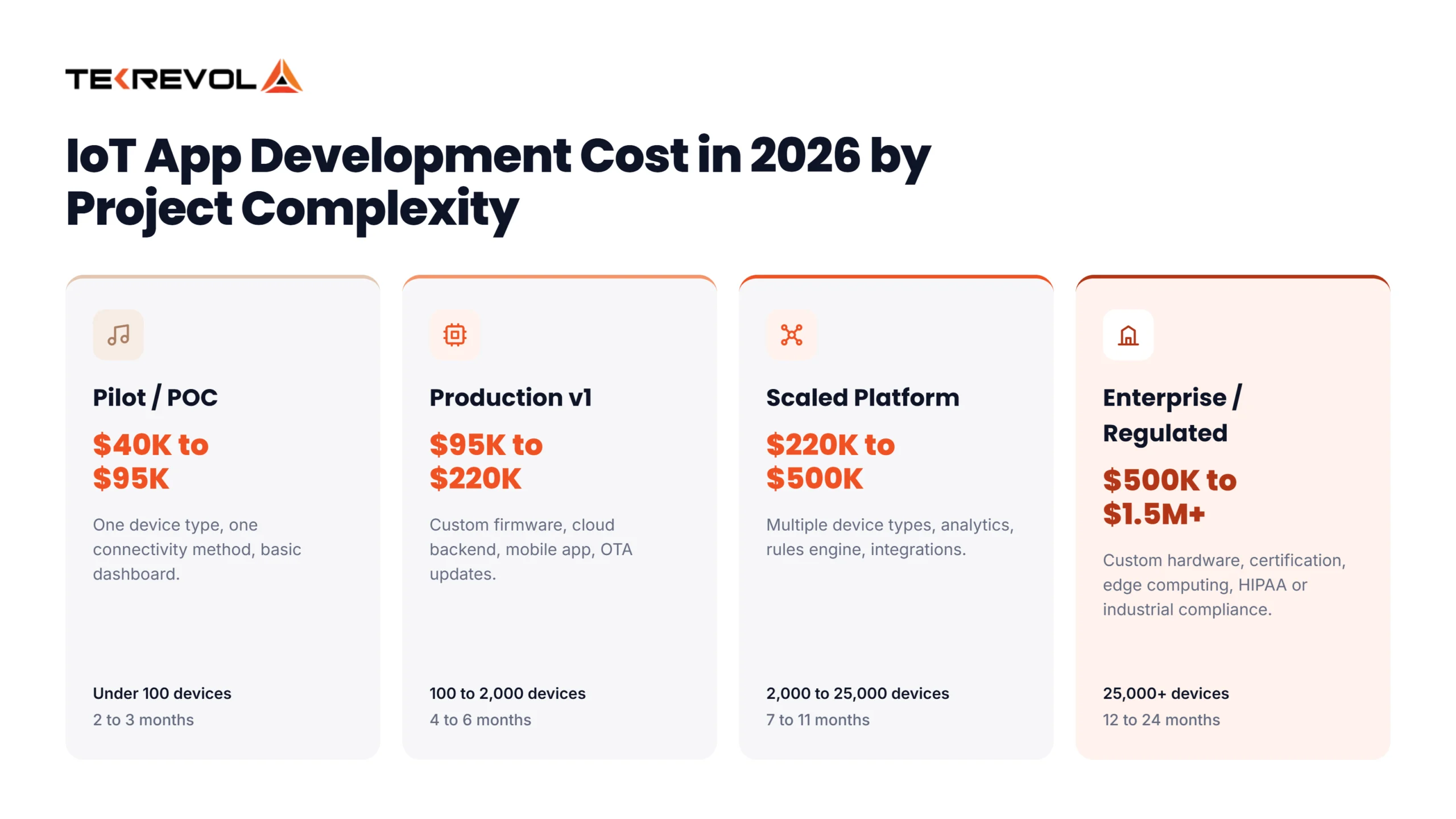
Here’s how the tiers actually break down:
| Complexity tier | What it covers | Device count | Timeline | Cost range |
| Pilot / POC | One device type, one connectivity method, basic dashboard, no scale requirements | Under 100 | 2–3 months | $40,000–$95,000 |
| Production v1 | Custom firmware, cloud backend, mobile app, OTA updates, user management | 100–2,000 | 4–6 months | $95,000–$220,000 |
| Scaled platform | Multiple device types, analytics, rules engine, role-based access, integrations | 2,000–25,000 | 7–11 months | $220,000–$500,000 |
| Enterprise / regulated | Custom hardware, certification, edge computing, ML, HIPAA or industrial compliance | 25,000+ | 12–24 months | $500,000–$1,500,000+ |
One thing worth flagging: the jump from pilot to production is the most underestimated line item in IoT. A proof of concept that works on ten devices often needs an architecture rewrite to survive 2,000 devices across three time zones. Budget for that transition as a real phase, not a tweak.
Not Sure Which Tier Your IoT Idea Falls Into?
Get a 30-minute technical review to map your device count, connectivity, and compliance needs to a realistic budget.
Get Your Free IoT Cost Assessment →What Do Statistics Say About the IoT App Development in 2026?
IoT app development statistics point to a rapidly expanding market, with demand for connected-device engineering continuing to rise. Key figures include:
- 21.1 billion connected IoT devices were in use worldwide at the end of 2025, up 14% year over year.
- The number of connected devices is projected to reach 39 billion by 2030, representing a 13.2% CAGR from 2025.
- The global IoT market is expected to generate $1.18 trillion in revenue in 2026, growing 11.6% year over year. Statista Market Insights
- IoT could generate $5.5 trillion to $12.6 trillion in economic value annually by 2030, depending on adoption and use cases.
- Nearly three-fourths of IoT projects were reported as unsuccessful in a 2017 Cisco survey. This figure is outdated, so it should be treated as historical context rather than a current failure rate.
These figures show why IoT development can cost more than a standard mobile app. Projects often require specialized expertise across embedded systems, firmware, connectivity, cloud infrastructure, security, and mobile development, increasing both development complexity and engineering costs.
The growing IoT market means higher demand for specialized embedded and IoT engineers, which can push development rates above standard mobile app projects.
When comparing quotes, make sure each estimate covers the same technical skill set. Learn more about how IoT is reshaping app development and where these added costs come from.
Types of IoT Apps and Their Estimated Cost
Types of IoT apps and their costs vary widely by vertical: smart home apps run $40,000 to $180,000, wearables and fitness $50,000 to $200,000, asset tracking and fleet $90,000 to $400,000, industrial IIoT $150,000 to $600,000, and connected healthcare $120,000 to $800,000.
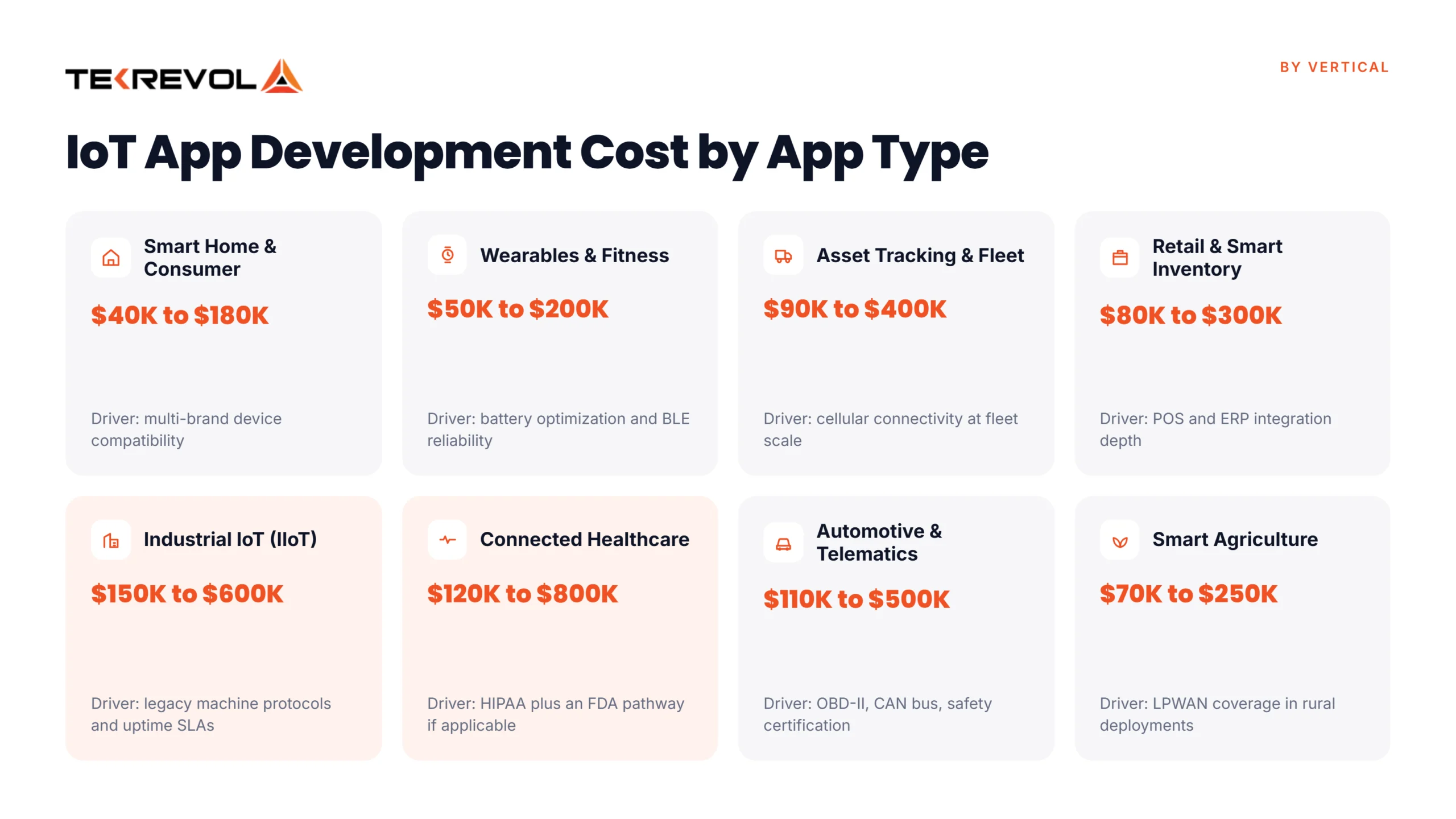
The spread comes from three things: how regulated the vertical is, how many devices are in a typical deployment, and whether the device already exists or has to be built.
| IoT app type | What it does | Typical cost range | Main cost driver |
| Smart home & consumer | Lighting, locks, thermostats, appliance control | $40,000–$180,000 | Multi-brand device compatibility |
| Wearables & fitness | Activity tracking, biometrics, coaching, sync | $50,000–$200,000 | Battery optimization and BLE reliability |
| Asset tracking & fleet | GPS, geofencing, condition monitoring, route data | $90,000–$400,000 | Cellular connectivity at fleet scale |
| Retail & smart inventory | Shelf sensors, RFID, stock automation | $80,000–$300,000 | POS and ERP integration depth |
| Industrial IoT (IIoT) | Predictive maintenance, SCADA integration, edge analytics | $150,000–$600,000 | Legacy machine protocols and uptime SLAs |
| Connected healthcare | Remote patient monitoring, medical device data | $120,000–$800,000 | HIPAA plus FDA pathway if applicable |
| Automotive & telematics | Vehicle diagnostics, driver behavior, roadside services | $110,000–$500,000 | OBD-II, CAN bus, and safety certification |
| Smart agriculture | Soil, irrigation, livestock monitoring | $70,000–$250,000 | LPWAN coverage in rural deployments |
If your project sits in the on-demand or service-dispatch space with connected hardware attached, our on-demand app development services cover the dispatch and real-time layer that usually sits alongside it.
How is IoT App Development Cost Broken Down by Stage?
An IoT app isn’t built all at once, and neither is the budget. Your investment is spread across several stages, from planning the product to connecting hardware, building the backend, and testing everything before launch.
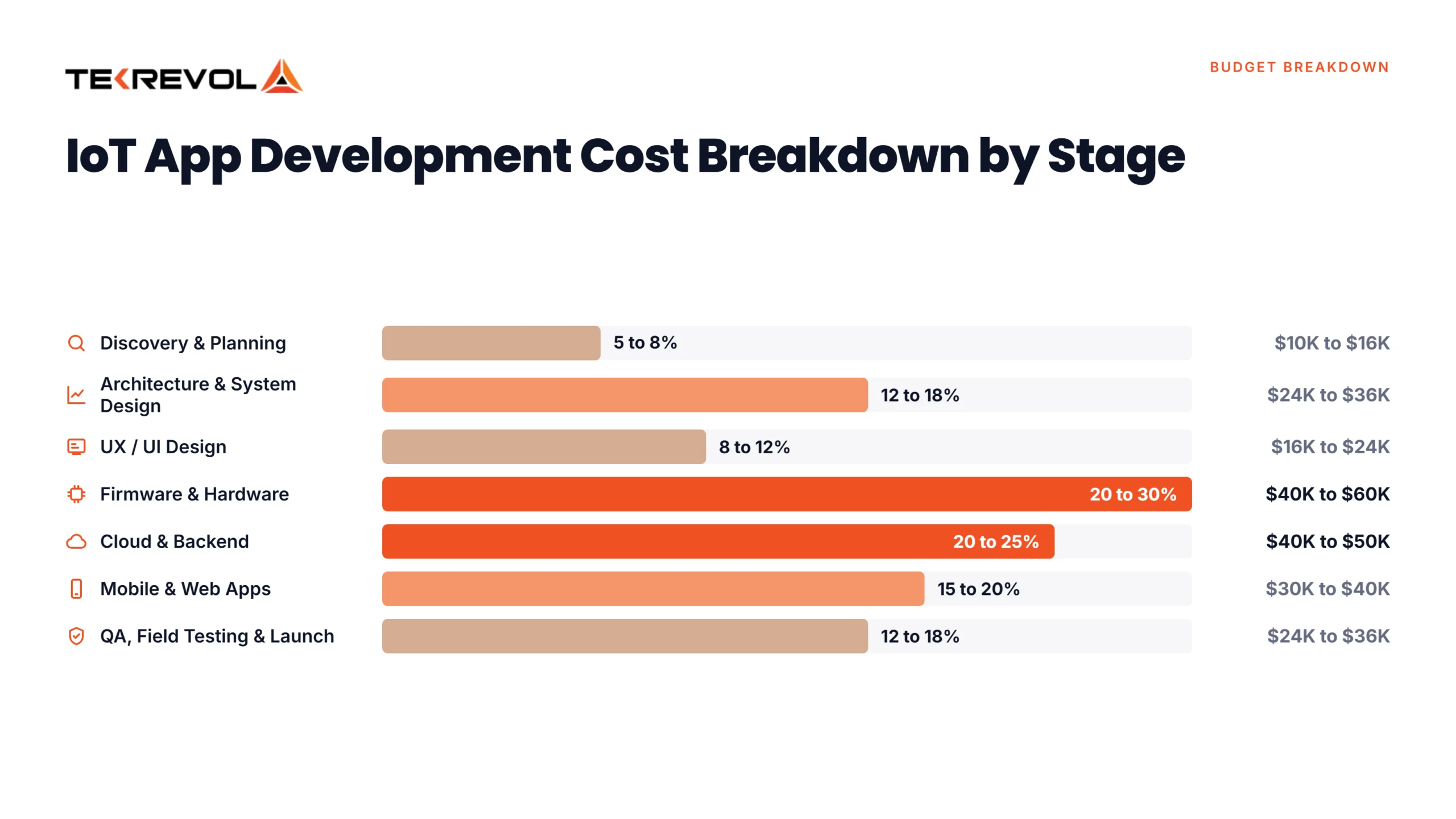
Stage percentages are more useful than raw dollar figures because they scale with your project. If a vendor’s proposal puts 60% into the mobile app and 8% into firmware, something is wrong with how they’ve scoped the connected side.
| Stage | What happens | Share of build |
| Discovery & technical planning | Use case definition, device selection, feasibility, risk mapping | 5–8% |
| IoT architecture & system design | Data flow, edge vs cloud split, protocol selection, security model | 12–18% |
| UX/UI design | App screens, dashboards, provisioning flows, alert design | 8–12% |
| Firmware & hardware integration | Embedded code, device drivers, protocol work, board bring-up | 20–30% |
| Cloud & backend development | Ingestion, storage, device registry, APIs, rules engine | 20–25% |
| Mobile & web app development | Native or cross-platform client, real-time sync, offline handling | 15–20% |
| QA, field testing & deployment | Device-in-the-loop testing, load testing, pilot rollout | 12–18% |
Notice the discovery line. Eight percent feels expensive until you’ve paid for a protocol decision that had to be reversed in month five. Discovery on IoT projects isn’t a workshop with sticky notes. It’s a technical exercise that includes device teardowns, RF range testing, and data volume modeling.
What are the Core IoT App Development Cost Components?
Core IoT app development cost components are hardware and sensors, firmware, connectivity, cloud infrastructure, the application layer, security and compliance, and ongoing maintenance. On most builds, the four non-app components combine to exceed the cost of the app itself.
This is the part that surprises teams coming from standard mobile projects. In a normal app build, the app is the product. In IoT, the app is the window into a system that costs more than the window.
Hardware and sensors
Off-the-shelf certified modules run $15 to $50 per unit. Industrial-grade sensors and ruggedized units run $200 to $1,500. If you need a custom board, add $15,000 to $40,000 per design iteration, and plan for two or three iterations before production.
Firmware and embedded development
Basic firmware on an existing reference design costs $10,000 to $30,000. Complex firmware with power management, edge processing, and secure boot runs $40,000 to $100,000-plus. This is where cheap vendors cut corners, and it’s where field failures come from.
Connectivity
The protocol you pick locks in five years of recurring cost. BLE and WiFi have no carrier fee. LPWAN runs $4 to $12 per device per year. LTE-M runs $12 to $60 per device per year. 5G runs $60 to $240. On a 10,000-device fleet, that choice is a seven-figure decision over five years.
Cloud infrastructure
Managed IoT services from AWS, Azure, and Google are priced by message volume and device count. Expect $1 to $8 per device per month at low volume, dropping sharply with scale and message batching. We cover the architecture tradeoffs in depth in the challenges of cloud application development.
Application layer
The mobile and web clients, dashboards, and admin tools that users interact with. A cross-platform build can typically save 25% to 35% compared with separate native apps, making cross-platform app development a cost-effective choice for many IoT companion applications.
Security and compliance
Budget 15% to 25% of the build. PKI setup for a mid-size fleet runs $15,000 to $30,000, penetration testing and compliance audits run $15,000 to $40,000, and certification like FCC or CE adds $3,000 to $40,000 depending on the market.
What Factors Influence the Cost of IoT App Development?
Factors that influence IoT app development cost are device count and diversity, hardware custom-build depth, connectivity protocol, data volume and processing, regulatory requirements, integration complexity, team location, and post-launch scale plans. Device count and compliance move the number more than anything else.
We rank these by how much they actually shift a quote, based on how our own estimates change when a client updates one variable:
| Factor | Cost impact | Why it moves the number |
| Regulatory environment | Very high | HIPAA, medical device, or industrial safety certification can add $80,000 to $250,000 and months of timeline |
| Custom hardware depth | Very high | Custom board design adds design cycles, tooling, and certification that off-the-shelf modules avoid entirely |
| Device count at launch | High | Architecture for 100 devices and architecture for 50,000 are different systems, not different settings |
| Connectivity protocol | High | Drives both module cost per unit and recurring carrier cost for the life of the fleet |
| Data volume & processing | High | Real-time analytics, ML inference, and digital twins multiply cloud spend and engineering time |
| Third-party integrations | Medium | ERP, CRM, payment, and voice assistant integrations each add $5,000 to $30,000 |
| Team location | Medium | North American blended rates run 2.5x to 4x offshore rates, though rework risk narrows the real gap |
| Number of device types | Medium | Each additional device model needs its own firmware, testing, and support lane |
The regulatory row deserves a second look. Teams building for healthcare or industrial settings frequently scope the software correctly and then discover certification requirements after development starts.
That’s not a cost overrun. That’s a scoping failure, and it’s avoidable in a two-week discovery phase.
What Does an IoT App Really Cost Per Device, Per Year?
An IoT app costs roughly $96 per device per year to operate at 1,000 devices, $56 at 10,000 devices, and $31 at 100,000 devices. Unit economics improve with scale, but total annual run rate grows fast enough to exceed your original build cost by year two or three.
This is the number that decides whether your IoT product is a business or a science project. Build cost is a one-time hit. Run rate is forever.
| Annual cost per device | 1,000 devices | 10,000 devices | 100,000 devices |
| Cellular connectivity | $24 | $18 | $12 |
| Cloud ingestion & storage | $36 | $22 | $12 |
| Device management & OTA | $6 | $4 | $2.50 |
| Security, certs & PKI | $8 | $3 | $1 |
| Support & monitoring | $22 | $9 | $3.50 |
| Total per device / year | ~$96 | ~$56 | ~$31 |
| Total fleet run rate/year | ~$96,000 | ~$560,000 | ~$3,100,000 |
Read the bottom row again. A 100,000-device fleet running on a $250,000 build costs $3.1 million a year to keep alive. That’s the math that kills IoT products, and it rarely appears in a development quote.
Two practical rules come out of this. First, model your run rate before you approve the build, not after. Second, treat connectivity protocol selection as a finance decision, not just an engineering one, because it’s the single biggest lever on that per-device number.
Do You Know Your Per-Device Annual Run Rate?
We'll model your five-year run rate across connectivity, cloud, and support so you can see the real total cost before you commit.
Book a Free IoT Cost Modeling Session →What Are The Challenges in Budgeting IoT App Development?
Challenges in budgeting IoT app development come from interdependent systems, hidden recurring costs, hardware iteration cycles, requirements that evolve after field testing, and compliance discovered late. Unlike standard software, one change in an IoT project cascades across four other layers.
We see the same five budget-breakers repeatedly:
Interdependencies you can’t isolate
Change the sensor, and you change firmware, power draw, data volume, cloud cost, and the app’s sync logic. In standard app development, a feature change is contained. In IoT, it isn’t.
Recurring costs nobody quoted
Connectivity, cloud, device management, certificate renewal, and support are rarely in the development proposal. They’re often larger than the build within three years.
Hardware iteration cycles
Custom hardware rarely works on the first spin. Each iteration costs $15,000 to $40,000 and adds four to eight weeks. Teams budget for one cycle and need three.
Requirements that change after field testing
IoT is the one category where real-world conditions routinely invalidate the spec. Signal drops in a metal warehouse. Battery life halves in cold storage. Those discoveries arrive after the budget is approved.
Compliance found late
Certification requirements surface during pre-launch review far more often than they should, and by then the architecture decisions that would have made compliance cheap are already shipped.
How Do You Overcome Obstacles When Budgeting IoT Development?
You overcome IoT budgeting obstacles by running a paid technical discovery, modeling five-year total cost of ownership, staging the rollout in fleet tiers, locking your connectivity decision early, and holding a contingency reserve sized to your complexity score.
Each of these maps directly to one of the challenges above.
Run a paid technical discovery before the build quote
Two to four weeks, $10,000 to $16,000, and it produces device selection, protocol decision, data volume model, and a compliance map. That spend removes most of the variance from the number that follows it.
Model five-year TCO, not build cost
Take the per-device annual figures from the table above, multiply by your projected fleet at years one, three, and five, and add that to your build. If the business case survives that math, it’s real.
Stage your rollout in fleet tiers
Ship to 100 devices, then 1,000, then full scale. Each tier surfaces problems while they’re still cheap to fix. This single practice does more for IoT budgets than any rate negotiation.
Lock connectivity early and deliberately
Involve finance in the protocol decision. The difference between LPWAN and 5G across a 10,000-device fleet over five years is often larger than the entire app development budget.
Size your contingency to complexity
We use 10% for scores of 5 to 12, 15% for 13 to 16, and 20% for 17 to 20. That isn’t padding. It’s the observed variance range on programs with that many moving parts.
How Can You Reduce IoT App Development Costs?
You can reduce IoT app development costs by starting with an MVP, using certified off-the-shelf hardware, building the client cross-platform, choosing managed cloud IoT services over custom infrastructure, and staging your fleet rollout. Combined, these typically cut first-year spend by 30% to 45%.
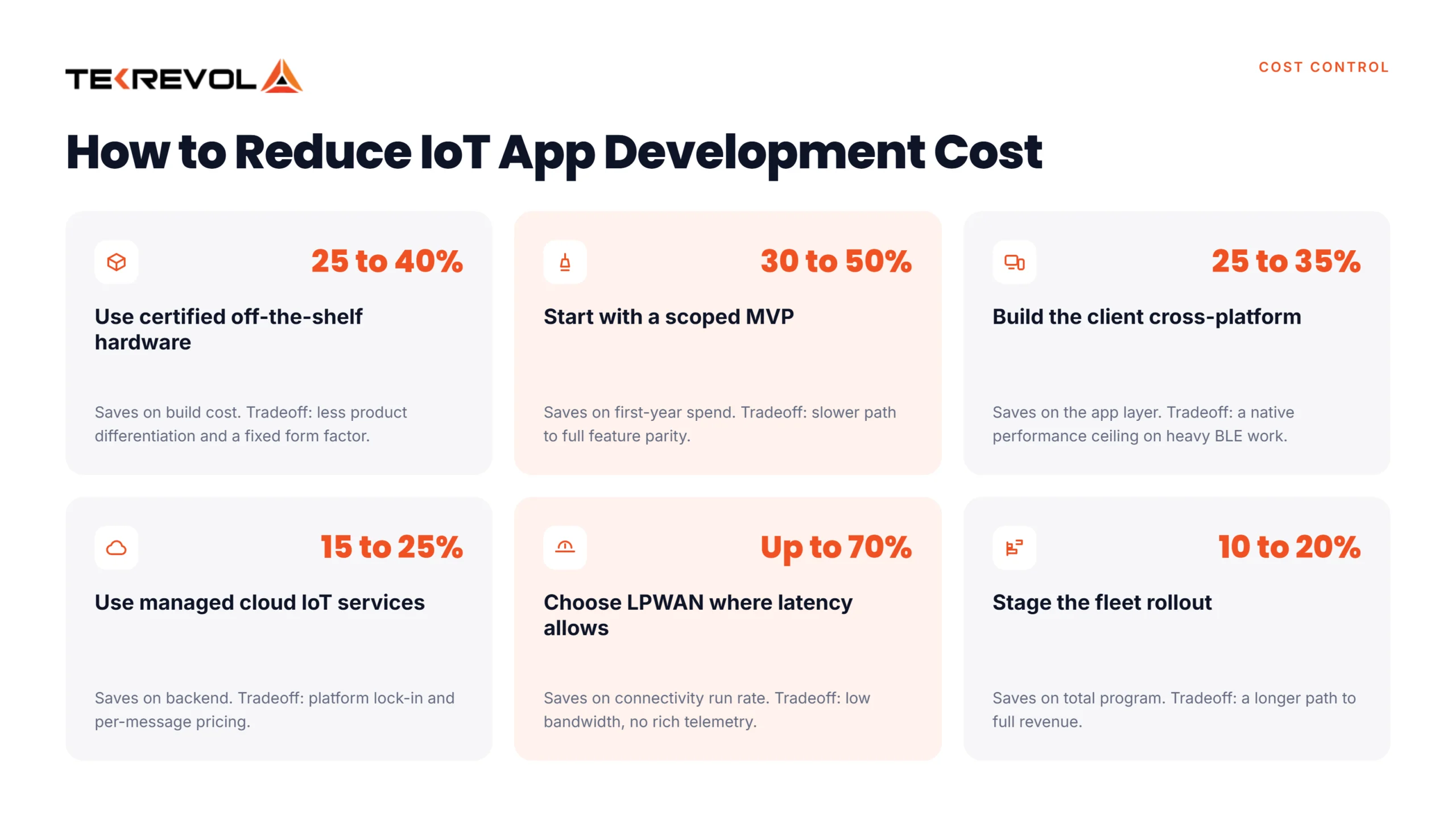
Ranked by how much they actually save, based on what we see across client engagements:
| Cost reduction tactic | Typical saving | Tradeoff |
| Use certified off-the-shelf hardware | 25–40% of build | Less product differentiation, fixed form factor |
| Start with a scoped MVP | 30–50% of first-year spend | Slower to full feature parity |
| Build the client cross-platform | 25–35% of app layer | Some native performance ceiling on heavy BLE work |
| Use managed cloud IoT services | 15–25% of backend | Platform lock-in and per-message pricing |
| Choose LPWAN where latency allows | Up to 70% of connectivity run rate | Low bandwidth, not suitable for rich telemetry |
| Blended onshore-offshore team | 20–35% of engineering | Requires strong technical oversight to avoid rework |
| Stage the fleet rollout | 10–20% of total program | Longer path to full revenue |
A word on the last two rows. Offshore rate arbitrage looks like the biggest lever on a spreadsheet and often isn’t, because IoT rework is expensive in a way that pure software rework isn’t. When firmware is wrong, you’re not redeploying a build. You may be recalling devices.
The tactic we’d push hardest is the MVP. Ship the smallest connected product that proves the business case, learn from real field data, then invest in scale with information instead of assumptions. Teams that want a broader view of app budgeting can also work through our mobile app cost guide.
Why Choose TekRevol for IoT App Development?
Choosing the right IoT development partner means looking beyond the app itself. TekRevol, as a digital transformative mobile app development company, approaches IoT as a complete connected ecosystem, covering hardware, firmware, connectivity, cloud infrastructure, security, and user-facing applications.
This end-to-end approach helps us identify technical risks, build more accurate estimates, and keep costs aligned as your product moves from prototype to production.
- End-to-end IoT expertise: We scope the complete system, including device selection, communication protocols, data flows, cloud architecture, compliance, and the application layer, rather than estimating the app in isolation.
- Budget visibility from day one: Our planning considers both development costs and ongoing infrastructure, connectivity, and maintenance expenses so you can evaluate the true cost of ownership.
- Cross-industry experience: With 800+ projects delivered across 11+ industries, TekRevol brings experience across healthcare, logistics, energy, automotive, and wellness. Our mobile app development and IoT teams collaborate within the same delivery process.
- Phased development: We validate the product through pilots and controlled rollouts before scaling the connected fleet. This reduces the risk of discovering costly hardware, connectivity, or performance issues after deployment.
- Proven track record: TekRevol maintains a 4.8/5 rating on Clutch across 83 verified reviews, supported by industry recognition including a Horizon Interactive gold award and Forbes recognition as one of America’s Best Startup Employers.
Whether you’re building a connected consumer product or an enterprise IoT platform, the goal is the same: validate the technology early, control costs, and build for reliable scale.
Ready to See What Your IoT Project Actually Costs?
We'll give you a scoped estimate covering hardware, firmware, cloud, and app, plus the five-year run rate most quotes leave out.
Talk to Our IoT Experts →


![Web3 Development Cost For Games Like Axie Infinity [Detailed Guide]](https://assets.tekrevol.com/images-tek/uploads/2025/10/web3-2-400x204.webp)


