



- The real cost of building a social networking app in 2026 ranges from $20,000 for a basic MVP to $500,000+ for an AI-powered platform.
- Niche social platforms retain users 3–5x better than broad platforms in their first 90 days.
- Every successful social app is built on five core mechanics: user identity, content feed, discovery engine, real-time messaging, and a moderation layer. Everything else is secondary.
- AI-powered features, personalized feeds, smart friend recommendation algorithms, and automated content moderation are no longer premium add-ons in 2026. They are the baseline. Social apps launching without them are already behind.
- Safety, compliance, and age verification are not optional features. They’re infrastructure.
- TekRevol has built and launched social platforms across 15+ markets. If you have the idea, feel free to reach out.
Building a social networking app in 2026 starts with three decisions that most founders get wrong: who you are building for, what keeps them coming back, and how the product makes money without pushing them away. Get those right, and everything else follows.
The social platforms winning right now look nothing like the ones that came before. They are smaller, more focused, and built around communities that actually have something in common.
The founders who choose to build a social media app in 2026 with a vertical focus will own communities that the big platforms can’t touch. Whatever the community, the challenge is the same: you need to learn how to build a social networking app that earns their trust, keeps them coming back, and grows without falling apart under the weight of its own success.
That’s the problem TekRevol solves. As a leading mobile app development company, TekRevol has shipped platforms across 15+ markets, and we’ve helped founders turn exactly these ideas into products people actually stay in. This guide is built from that ground-level experience: features, costs, compliance, and the cold-start strategies that turn an empty app into a living community.
The Social App Market: Why Now Is the Right Time to Build
Nobody is beating Facebook. Nobody needs to. The real opportunity in social app development isn’t horizontal anymore; it’s vertical, it’s niche, and it’s wide open. The founders who move now will own communities the big platforms can’t touch.
The numbers don’t lie:
- Social app development is accelerating, and the market is projected to grow from $117.19B in 2025 to $1,041.8 billion by 2035, at a CAGR of 24.42%
- Niche social platform development is growing at 20–30% annually, outpacing the broader market by a wide margin
- The average user is active on 6.8 social apps per month. They’re not loyal to platforms. They’re loyal to communities.
- Discord went from a gaming chat tool to 259M monthly active users and $725M ARR by the end of 2024, and by 2026, over 55% of its user base identifies as non-gamers, proving that a focused niche can become a category-defining platform.
- Niche social apps see 3–5x higher retention than broad platforms in their first 90 days.
- Gen Z spends more time on social discovery apps (Wizz, Yubo, Discord) than on Facebook or LinkedIn.
- The influencer economy has grown from $1.7 billion in 2016 to $32.55 billion in 2025, and platforms that support creator monetization are capturing the biggest slice.
The window is open. The founders who build now, with the right social networking app features and the right team, will be the case studies everyone references in five years.
Ready to Build the Next Big Social Platform?
Talk to TekRevol's experts and walk away with a clear roadmap, tech stack, features, timeline, and cost.
Get Your Free Consultation Worth $300!What Successful Niche Apps Actually Got Right
Before you build, study what’s already winning. These four apps aren’t just popular; they’re the clearest proof of concept for friend-matching app development done right. Each one identified a gap, built a single mechanic to fill it, and resisted every temptation to be everything to everyone.
Wizz
Wizz built its entire growth story on one mechanic: swipe, match, chat. It scaled to millions of downloads by being ruthlessly simple and laser-focused on a single audience.
The lesson: clarity of purpose beats complexity every time. This is friend-matching app development at its purest: one mechanic, one audience, zero noise.
Key Features:
- Swipe-to-connect discovery
- One-on-one messaging
- Age verification layer
- Profile interest tags
Yubo
Yubo proved that live video isn’t a dating feature, it’s a friend-discovery mechanic. By centering the entire experience around live group chatrooms rather than static profiles, Yubo created something closer to a virtual hangout than a traditional social app. Strict age segregation built the trust that made parents comfortable and users loyal.
Key Features:
- Live group video chatrooms
- Age-segregated matching
- Freemium subscription model
- Community interest tags
Discord
Started as a gaming tool, now a full-scale community platform with voice, video, text, and server-based communities. Discord’s growth story is the best argument for building a scalable architecture from day one. What starts as a niche tool can become a category.
Key Features:
- Public and private servers
- Voice, video, and text channels
- Role-based permissions
- Bot and API ecosystem
Bumble BFF
Bumble BFF is one of the strongest case studies in friend-matching app development, proof that social connection outside of romance is a market worth building for. Women were using Bumble to find friends, not matches, so Bumble built a mode specifically for that. The result was a feature that drove retention and revenue entirely outside of romance.
Key features:
- Verified profile system
- Female-first matching controls
- Swipe-to-connect interface
- In-app reporting and blocking
Each of these platforms identified a specific gap, built a specific mechanic to fill it, and resisted the temptation to be everything to everyone. That discipline is what a niche social app strategy requires.
View Full Case Study→
How to Build a Social Networking App: The Step-by-Step Process
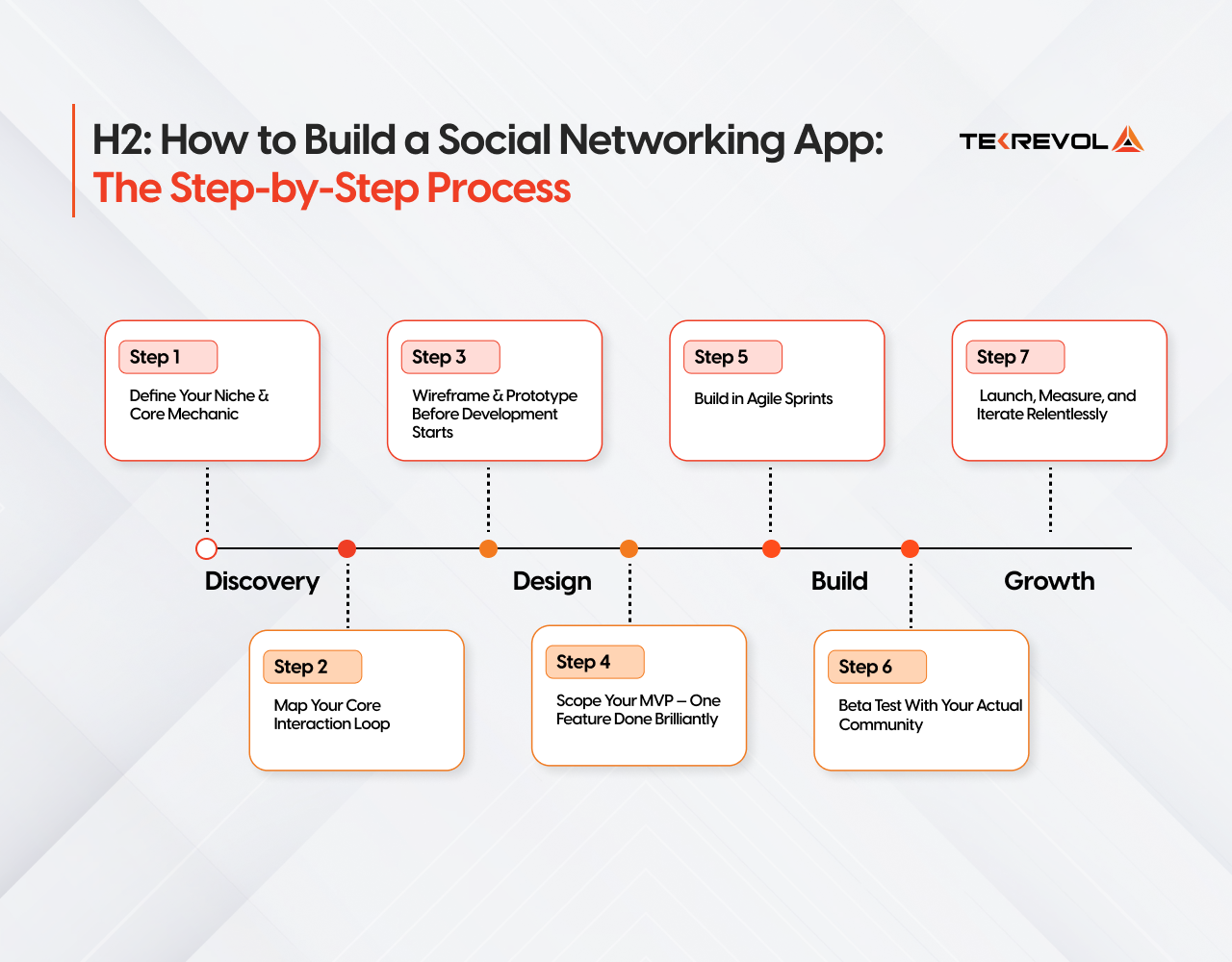
This is the actual process we run with every founder who comes to us with a social app idea. Not a generic framework, a proven methodology built from shipping real platforms across the US, MENA, and beyond. That’s the full process for how to build a social networking app that lasts.
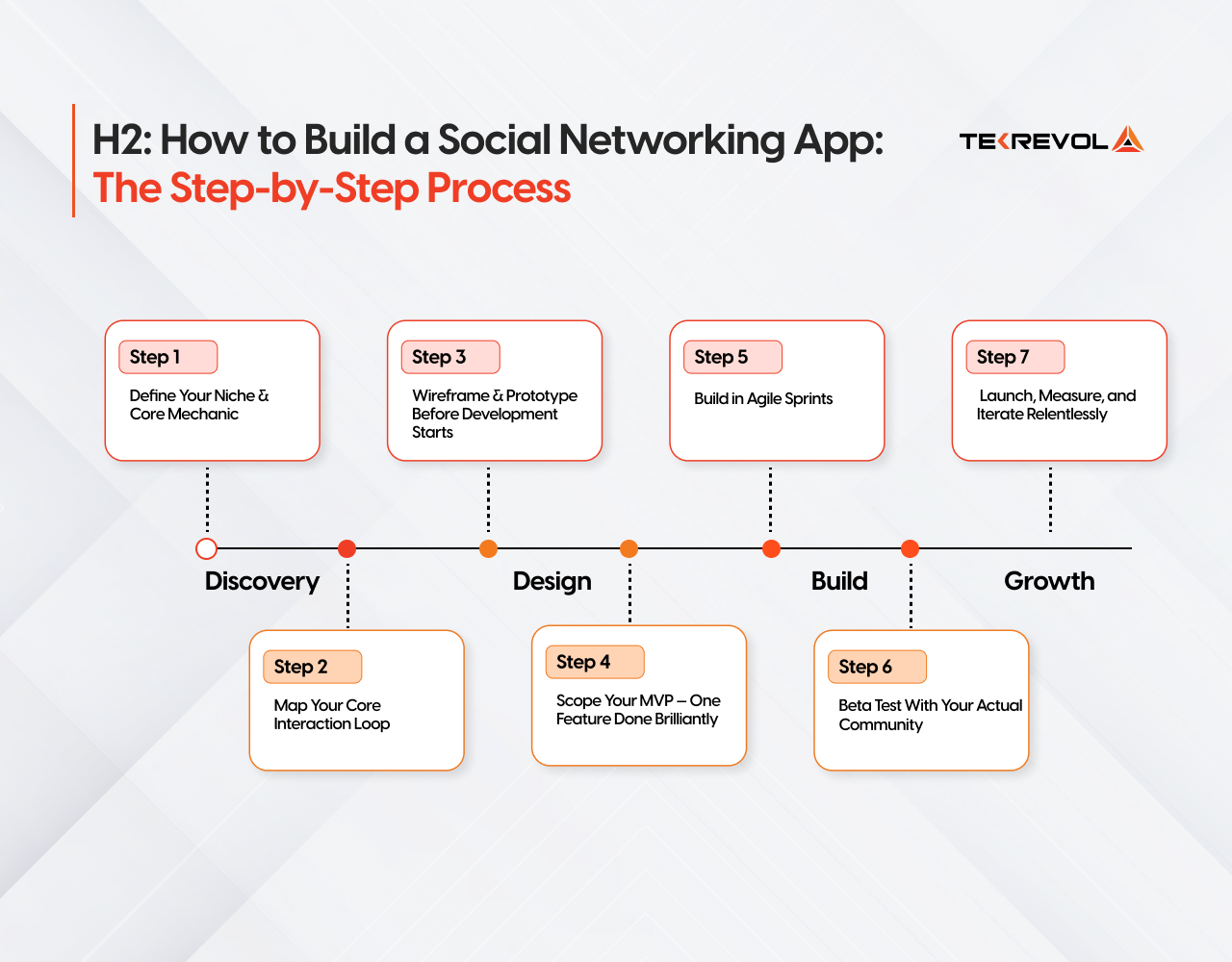
Step 1: Define Your Niche and Core Mechanic
Before we write a single line of code, we sit with every founder and pressure-test their niche. Not the demographic, the specific community, the specific gap, and the one mechanic that fills it. Most founders come in too broad. We narrow it down together until there’s a real product inside the idea.
- Identify the exact community and the gap they live with daily
- Define the one core social mechanic that solves it
- Validate that no existing platform genuinely serves this audience
- Map who the first 1,000 community members are and where they already gather
Step 2: Map Your Core Interaction Loop
Every social app runs on a loop: user actions create signals, signals drive discovery, and discovery fuels more engagement. We design this upfront.
- Define what your user creates, shares, or reacts to
- Identify the social signals that engagement generates
- Map how those signals power the discovery and friend recommendation engine
- Pressure-test the loop against real community behavior patterns
View the Qroll case study →
Step 3: Wireframe and Prototype Before Development Starts
We validate high-fidelity prototypes with real users before development begins. Fixing UX problems early saves time and cost. Strong onboarding is critical; if users don’t engage within five minutes, retention drops.
- Build interactive prototypes before any code is written
- Run validation sessions with real users from your target community
- Measure time-to-first-connection inside the prototype
- Identify and eliminate onboarding friction before it costs you, users
Step 4: Scope Your MVP — One Feature Done Brilliantly
We run a feature prioritization workshop with every client before development scoping starts. An MVP isn’t a stripped-down version of your full vision; it’s a liquidity problem. We solve the cold start problem before launch, not after it becomes a retention crisis.
- Seed the feed through founding member accounts before public launch
- Build single-player value so the app is useful before a user’s friends join
- Launch tight, one community, one interest group, one city first
- Cut every feature that doesn’t directly accelerate the first user connection
Step 5: Build in Agile Sprints
Social app development runs best in tight feedback loops, that’s why we use 2–4 week agile sprints on every project. Each sprint includes daily standups, ongoing QA, and tight feedback loops between design and development.
- Two to four weeks’ sprints with clearly defined deliverables
- Daily standups across design, development, and QA teams
- Continuous integration, so nothing breaks between releases
- Real user behavior data is reviewed and acted on at every sprint close
Step 6: Beta Test With Your Actual Community
Before public launch, we run a closed beta with 200 to 500 users pulled from the exact target community, not friends and family, not internal testers. We measure engagement depth, Day 1 and Day 7 retention, and whether users complete their first meaningful social interaction within 24 hours of joining. That single metric predicts long-term retention better than any other.
Step 7: Launch, Measure, and Iterate Relentlessly
Launch is not the finish line; it’s the starting gun on a continuous data collection process. Every feature decision after launch should be driven by real community behavior, not founder intuition. We instrument everything from day one, so you’re never flying blind.
- Track DAUs, MAUs, session length, and K-factor from day one
- Monitor churn rate weekly and act on early warning signals fast
- Run A/B tests on onboarding flows, discovery mechanics, and push notification timing
- Let retention data, not opinions, drive every post-launch feature decision
Core Features Every Social Networking App Needs
Social networking app features fall into six functional layers: identity and profiles, content and feed, discovery and matching, real-time messaging, safety and moderation, and monetization tools.
Every successful platform, from Discord to Bumble BFF, is built on these six layers. Everything else is differentiation.
Here’s what each layer looks like in practice:
| Features | What It Does |
| User Profiles & Identity System | Photo upload, bio, interest tags, verification badges, privacy controls |
| Activity Feed & Timeline | Posts, stories, shared content, likes, comments, social graph updates |
| Discovery & Matching Engine | Algorithm-based, tag-based, or proximity-based user recommendations |
| Real-Time Messaging | 1-on-1 DMs, group chats, media sharing, read receipts, message reporting |
| Push Notification System | Match alerts, message pings, likes, comments, activity updates |
| Content Moderation System | AI flagging, manual review queues, user reporting, auto-removal |
| Search & Hashtags | People search, content discovery, trending topics, hashtag filtering |
| Groups & Communities | Public and private groups, admin controls, member roles |
| Stories & Short-Form Content | Ephemeral photo/video posts, reactions, viewer counts |
| Live Streaming | Real-time video broadcast, viewer interaction, tipping/gifting |
| Reactions & Engagement Tools | Likes, emoji reactions, shares, saves, comment threads |
| User Verification & Trust System | Phone, email, ID, or badge-based verification |
| Privacy & Security Controls | Block, mute, restrict, report, two-factor authentication |
| Analytics Dashboard (User-Facing) | Post reach, profile views, follower growth, engagement rate |
| Monetization & Creator Tools | Tipping, paid subscriptions, exclusive content, brand partnerships |
AI-Powered Features That Separate Good Apps From Great Ones
AI is no longer a premium feature in social apps; it’s a baseline requirement in 2026.
Apps with AI-driven personalization see significantly higher user engagement and retention.
| Feature | What it does |
| Personalized Content Feed | Uses user behavior (likes, comments, watch time) to show more relevant content |
| AI Friend/Match Suggestions | Recommends users based on behavior, interests, and social overlap |
| Smart Content Moderation | Detects and filters harmful or inappropriate content using AI + human review |
| Intelligent Notifications | Sends alerts at the best time for each user to increase engagement |
| AI Content Suggestions | Helps users create posts with templates, prompts, and creative tools |
Expert Tip: Personalization without good data is just noise. TekRevol’s AI development services team doesn’t bolt AI onto your platform after launch — we architect it into the foundation, training models on your community’s specific behavior so your feed, matching engine, and moderation system work from the moment users arrive.
Tech Stack for a Social Networking App
In social app development, your tech decisions at day one determine your scalability ceiling. Here’s what a production-ready social app stack looks like:
| Layer | Technology/Tool | Purpose |
| Frontend (Mobile) | React Native / Flutter | Cross-platform iOS and Android development |
| Swift (iOS) / Kotlin (Android) | Performance-critical native builds | |
| Backend | Node.js / Go, Python (Django, FastAPI) | Real-time, high-concurrency API handling |
| GraphQL | Flexible querying across complex social graphs | |
| WebRTC / WebSockets via Socket.io | Real-time messaging and live notifications | |
| Database Layer | PostgreSQL | Structured user data, social graph relationships, transactions |
| Redis | Caching, session management, and real-time feed generation | |
| Elasticsearch | Discovery, search, and hashtag functionality | |
| Infrastructure | AWS / Google Cloud | Scalable, cloud-native hosting |
| Cloudflare / CloudFront CDN | Global media delivery | |
| Third-Party Services | Stream / Sendbird | Real-time chat infrastructure |
| Agora / Daily.co | Video and voice calling. | |
| Twilio | SMS and phone verification | |
| AWS Rekognition / Google Vision API | AI-powered content moderation |
Social Networking App Development Cost Breakdown
The cost to develop a social media app in 2026 typically ranges from $30,000 to $250,000+. A basic MVP (Minimum Viable Product) typically costs between $20,000 and $50,000, while more advanced, feature-heavy platforms can go beyond $300,000.
Here’s how that cost breaks down by feature category:
| Feature Category | Estimated Cost | Timeline | What’s Included |
| User Profiles & Auth System | $4,000 – $15,000 | 2–3 weeks | Registration, login, social auth (Google/Apple/Facebook), profile setup, privacy controls |
| Discovery & Matching Engine | $6,000 – $30,000 | 3–5 weeks | Friend recommendation algorithm, interest-based filters, location matching, search functionality |
| Real-Time Messaging | $8,000 – $25,000 | 3–4 weeks | Full in-app messaging infrastructure: 1:1 chat, group threads, media, and notifications.” |
| Activity Feed & Timeline | $5,000 – $18,000 | 2–4 weeks | Social graph-based feed, post creation, likes, comments, shares, algorithmic ranking |
| Stories & Short-Form Content | $4,000 – $18,000 | 2–3 weeks | 24hr stories, filters, stickers, video support, viewer tracking |
| Live Streaming | $10,000 – $40,000 | 4–6 weeks | Real-time video broadcasting, viewer chat, reactions, recording, and monetization hooks |
| Push Notification System | $2,000 – $8,000 | 1–2 weeks | In-app and device-level alerts, user preference controls, and engagement triggers |
| Content Moderation System | $4,000 – $18,000 | 2–3 weeks | AI-assisted flagging, manual review workflows, reporting tools, ban/suspend controls |
| Groups & Communities | $4,000 – $15,000 | 2–3 weeks | Public/private groups, admin roles, group feeds, member management |
| Admin Dashboard | $3,000 – $14,000 | 2–3 weeks | User management, analytics, moderation controls, revenue reporting |
| UI/UX Design | $6,000 – $25,000 | 3–5 weeks | Wireframes, full design system, interactive prototypes, mobile-first responsive design |
| QA & Testing | $4,000 – $15,000 | 2–3 weeks | Functional, performance, security, and device compatibility testing |
| Total Estimate | $45,000 – $200,000+ | 4–9 months | Full-cycle social networking app development, iOS & Android |
Post-launch costs are often overlooked. Expect 10–15% of your original development cost annually for updates, security, scaling, and compliance. Without this budget, apps quickly become outdated.
Find Out What Your Social App Will Cost — In Minutes!
Use TekRevol's free social app cost calculator to get an instant estimate based on your features, platform, and timeline
Calculate now!Safety & Compliance: The Infrastructure Most Founders Skip
This section matters more for social apps than almost any other app category, and it’s the section most founders skim. Don’t.
1. Age Verification
Estimated Cost: $5,000 – $20,000
Wizz got pulled from the App Store in 2024 because their age verification had gaps. They rebuilt it, got reinstated, and lost users they’ll never get back. A robust user profile system includes identity verification from onboarding — not as an afterthought.
- AI-powered age estimation at onboarding
- Document verification for sensitive feature access
- Strict content segregation between age groups
- App Store & Google Play compliance built in
Note: TekRevol provides complete App Store optimization services alongside every social app we build, so your platform is compliant, discoverable, and ready to scale from day one.
2. Content Moderation System
Estimated Cost: $8,000 – $30,000 + ongoing costs
Algorithms handle volume. Humans handle everything else. As your platform scales, moderation stops being a feature and becomes a core operational function; budget for both.
- Computer vision and NLP flagging for inappropriate content
- Human review workflows for edge cases and appeals
- User reporting and escalation flows
- Real-time moderation dashboard for your team
3. GDPR & COPPA Compliance
Estimated Cost: $6,000 – $25,000
Non-compliance doesn’t just generate fines, it generates the kind of press coverage that ends platforms. If you have EU users or users under 13, this is non-negotiable from day one.
- Consent management and cookie controls
- Verifiable parental consent for under-13 users
- Breach notification systems and audit logs
4. Reporting & Trust Systems
Estimated Cost: $4,000 – $15,000
Community trust is the product of niche platforms. Users who feel unsafe leave and don’t come back, and they tell people. Give them the tools to protect their own experience.
- One-tap block and report functionality
- Tiered escalation for serious violations
- Transparent moderation feedback to users
- Trust scoring and repeat offender tracking
5. Data Security & Encryption
Estimated Cost: $5,000 – $20,000
Social apps collect sensitive user data, messages, location, behavioral patterns, and payment info. A single breach doesn’t just cost money; it destroys the community trust you spent years building. Security isn’t a feature you add later.
- End-to-end encryption for all in-app messaging
- Secure data storage and transmission protocols
- Two-factor authentication and session management
- Regular penetration testing and vulnerability audits
6. Intellectual Property & DMCA Compliance
Estimated Cost: $3,000 – $12,000
The moment users start uploading content, videos, music, and images, you’re legally responsible for what lives on your platform. TikTok, YouTube, and Instagram all have entire legal teams managing this. You need infrastructure that handles it automatically.
- Automated content fingerprinting and IP detection
- DMCA takedown request management system
- User copyright dispute and appeals workflow
- Clear terms of service and content ownership policy
Monetization Strategies for Social Apps
Social apps have more monetization options than almost any other app category. Here’s how to think about the model.
| Monetization Model | How It Works | Best For | Revenue Potential |
| Freemium | Free core, paid premium features | Friend-matching, discovery apps | High, low barrier to acquire users |
| Subscriptions | Monthly/yearly plan for full access | Community platforms, professional networks | Predictable recurring revenue |
| In-App Purchases | Coins, boosts, stickers, profile upgrades | Teen apps, gaming-adjacent social | High engagement-driven revenue |
| Advertising | Display ads, sponsored content, native placements | High-volume, broad-reach platforms | Scales with MAU, lower per-user value |
| Brand Collaborations | Sponsored challenges, branded chatrooms | Youth-focused, lifestyle platforms | High upside but requires an established user base |
| Premium API / Data Insights | Anonymized behavioral data for research | B2B-facing social platforms | Niche but high-margin |
| Creator Revenue Sharing & Tipping | Fans support creators via tips or revenue splits | Creator economy platforms, media sharing apps | Aligns platform growth with creator success |
| Social Commerce & Brand Integrations | Selling products or promoting brands inside the app | Lifestyle, media, creator platforms | Converts engagement directly into purchases |
Partner With TekRevol to Build the Social Platform
TekRevol has shipped across every category of social app development, from AI-powered matching platforms to niche community networks for golfers, fitness enthusiasts, and real-time location-based users. The portfolio spans the US, GCC, and leading other markets.
At TekRevol, we engineer high-performance digital ecosystems backed by years of navigating the complex architecture of global social giants. Having launched numerous platforms that survived the transition from “startup” to “viral sensation.”
We specialize in preventing the technical debt and scaling bottlenecks that typically hold back early-stage social platforms.
- Elite Scalability Engineering Our architects build your backend to thrive under 10x launch-day traffic, ensuring your feed and real-time messaging remain lightning-fast during rapid user surges.
- Intelligent Discovery & Retention We deploy advanced matching algorithms that deliver immediate value to new users, creating the high-stickiness environment essential for long-term platform loyalty.
- Proactive Security & Governance By integrating AI-driven moderation and robust data privacy from day one, we protect your brand’s reputation and ensure seamless approval on major app stores.
- Strategic Revenue Architecture We embed sophisticated monetization layers, from subscription models to token economies, directly into the core code to maximize your ROI without costly future retrofits.
Build Real Connections with Your Own Social Networking App
Speak with TekRevol's social app development team and get a custom roadmap
Claim Your Free Consultation!


