



- Plant care app development needs core features like plant databases, care schedules, reminders, plant identification, disease detection, and journals.
- Plant care app development costs range from $25,000–$40,000 for an MVP and $80,000–$150,000+ for full AI-powered apps.
- AI-based plant identification is the top growth feature driving downloads and rankings in plant care apps.
- Freemium with premium subscriptions is the leading monetization model, used by apps like Planta.
- TekRevol develops AI-powered mobile apps with ML, subscriptions, and cross-platform integrations.
Plant ownership is now a lifestyle, and plant owners want digital help keeping their collections alive. The global indoor plant market was valued at over $20 billion in 2024 and is projected to reach $30+ billion by 2032.
That’s where plant care app development sits right now: a growing niche with strong user retention, subscription monetization potential, and a clear AI differentiator that separates market leaders from generic reminder apps.
But most founders entering this space don’t know where to start. What features actually matter? What does the AI really do under the hood? And what does it cost to build something that competes with Planta, without cloning it?
As a mobile app development company with hands-on experience building AI-powered lifestyle and utility apps, TekRevol breaks it all down here. Features, tech stack, ML architecture, and a realistic cost breakdown.
Why Plant Care Apps Are a Growing Business Opportunity
Plant care apps are a strong business opportunity because the indoor plant market is growing at roughly 5% annually. Plant owners have high engagement with daily care routine apps, and AI features create subscription justification that basic reminder apps cannot.
The numbers tell a clear story:
- The global indoor plant market was valued at $20.68 billion in 2024, with projections reaching $30.25 billion by 2032 at a CAGR of 4.87%
- Plant ownership surged during 2020–2021 and has stabilized at permanently higher levels. Search interest for “houseplants” remains well above pre-2020 baselines as of 2026
- Millennials and Gen Z are the core audience, 25% of both demographics engaged in indoor gardening as of 2018, a figure that has grown meaningfully since
Why Subscription Retention Works So Well in This Niche
Plant care is inherently habitual. Users check their apps to confirm watering schedules, log new plants, and diagnose problems over weeks and months, not just once after download. This daily interaction loop supports subscription retention far better than most utility app categories.
Apps like Planta charge $7.99/month or $35.99/year for premium access. Users stay subscribed because care schedules are personalized and built up over time — switching apps means losing that history.
Why AI Changes the Entire Value Proposition
A plant care app without AI is a glorified reminder app. Any developer can build one.
An AI development company changes what the app can actually do: identify a plant from a photo in seconds, detect early signs of disease from leaf discoloration, and recommend care routines tailored to a specific plant in a specific environment.
Those capabilities justify subscription pricing. They also drive word-of-mouth; users share screenshots of AI-identified mystery plants on social media more than any other plant app feature.
That combination, genuine utility, daily engagement, and subscription revenue, is why plant care app development is attracting serious founder attention in 2026.
Your Plant App Idea Has a $20 Billion Market Waiting for It.
TekRevol’s discovery process maps your plant app MVP in one call, defining features, subscription-justifying AI, and a cost-effective tech stack.
Book a Free Feature Scoping CallCore Features of a Plant Care App
A plant care app needs six core features: a searchable plant database, personalized care schedules, push notification reminders, camera-based plant identification, disease diagnosis, and a user collection journal, with premium features gated behind a subscription.
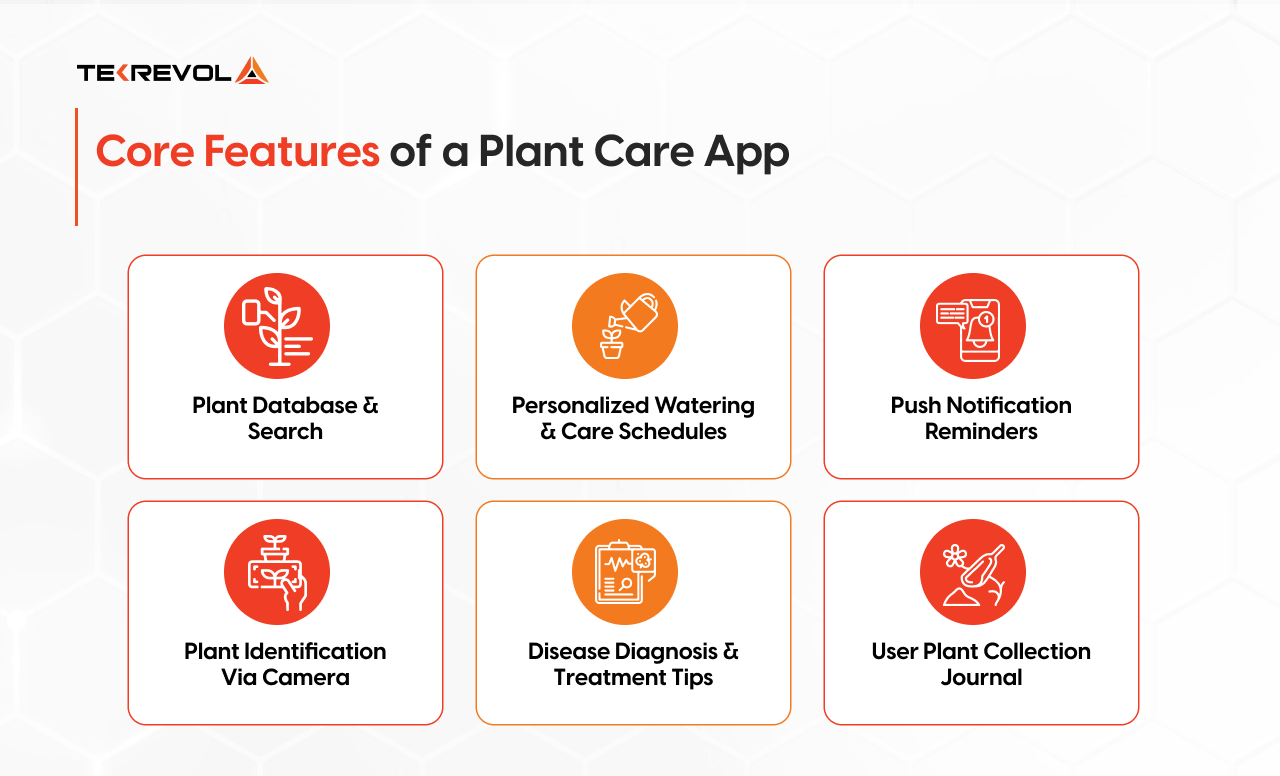
Here is the feature breakdown that separates functional apps from forgettable ones.
Feature Comparison: Basic vs Premium
| Feature | Free Tier | Premium Tier |
| Plant database & search | Basic search | Full database with advanced filters |
| Watering reminders | Fixed schedule | Personalized based on plant + environment |
| Push notifications | Basic | Smart reminders + weather integration |
| Plant ID via camera | limited | Unlimited AI identification |
| Disease diagnosis | N/A | Photo-based disease detection |
| Collection journal | Limited plants | Unlimited with growth tracking |
| Light meter | N/A | Environmental light assessment |
| Expert tips/care guides | Basic | Detailed, species-specific |
Plant Database and Search
This is the foundation. Your app needs a structured database covering thousands of plant species, scientific names, common names, care requirements, toxicity data (pets, children), growth patterns, and seasonal variations.
Most apps source this through a plant database API or build a proprietary dataset over time. The quality of the database directly affects how accurate your care recommendations are.
A solid MVP should cover at least 2,000–5,000 common houseplant species. A competitive full product covers 10,000+.
Personalized Watering and Care Schedules
Not all plants need the same care. And the same plant needs different care depending on pot size, soil type, sunlight levels, and local humidity.
Personalized schedules take inputs from the user at onboarding, plant species, location, pot size, current care routine, and generate care reminders calibrated to those specific conditions. This is what separates a plant care app from a generic calendar reminder.
The algorithm gets smarter when users log actual care events. Each “I watered today” tap refines the schedule.
Push Notification Reminders
Push notifications are the daily touchpoint. They drive engagement and reduce churn.
But notifications need to be smart, not spammy. The best implementations use Firebase Cloud Messaging (FCM) with conditional logic: don’t remind a user to water if rainfall data from a connected weather API suggests the plant has been naturally watered. Don’t send fertilizer reminders in winter for plants that go dormant.
Smart notifications = happy users who keep their subscription.
Plant Identification via Camera
This is the #1 reason users download plant apps. It is the feature that drives App Store discovery and organic sharing.
A user points their phone camera at an unknown plant and gets a species identification in seconds, along with care instructions, toxicity information, and a prompt to add it to their collection. That moment of “it actually works” is the hook that converts a first-time user into a subscriber.
Disease Diagnosis and Treatment Tips
Plants develop problems: yellowing leaves, brown tips, root rot, pest infestations. Users do not know what is wrong or what to do about it.
Disease diagnosis lets users photograph a sick plant and receive a diagnosis, “this looks like overwatering; try these steps”, with actionable treatment recommendations. This is the premium feature that most directly justifies the subscription price. Solving a plant problem creates a strong emotional attachment to the app.
User Plant Collection Journal
Users want to track their collection. Every plant gets its own profile: photo, species, purchase date, location in the home, care log, and growth photos over time.
This feature drives daily active use and creates switching cost — a user who has logged 50 plants with 6 months of care history is not leaving your app. The journal is the retention engine.
AI and Machine Learning Features That Set Top Apps Apart
AI features in plant care apps, plant identification, disease detection, and personalized care recommendations are built using computer vision models trained on large botanical image datasets, typically deployed via TensorFlow Lite for on-device inference or Google Cloud Vision API for server-side processing.
This is where AI app development becomes technically interesting in modern plant care applications.
AI Plant Identification
Plant identification via camera uses a machine learning model trained on millions of labeled plant images. The model learns to recognize species by visual patterns — leaf shape, color, texture, vein structure, flower type, and outputs a confidence-ranked list of likely matches.
How it works in practice:
- User opens the camera in the app and frames the plant
- The image is captured and sent to the ML model (on-device or via API)
- The model runs inference against a trained botanical dataset
- Results return in 1–3 seconds with species match and confidence score
- App displays the top match with care information and an “Add to My Collection” CTA
Technology options:
- TensorFlow Lite — Google’s framework for running ML models directly on mobile devices (on-device inference). No internet required after the model is downloaded. Faster response, better privacy. Requires more up-front model training.
- Google Cloud Vision API — sends the image to Google’s servers for processing. Easier to implement, no model training required, but costs scale with usage and require internet connectivity.
- Google AutoML Vision — lets you train a custom plant identification model on your own botanical dataset using Google’s infrastructure, without deep ML engineering expertise. Good middle ground for teams building their first plant ID feature.
- Custom-trained CNN model — the highest-accuracy option for serious plant ID apps. Requires a large labeled image dataset and ML engineering resource, but produces a proprietary model you own and can improve over time.
For an MVP, Google Cloud Vision API or AutoML Vision is the pragmatic starting point. For a competitive full product, a custom-trained model running on TensorFlow Lite is the better long-term investment.
TekRevol built TruthGPT, an AI chatbot delivering unbiased, real-time data using complex inference pipelines, blockchain transparency, Flutter animations, and 3D lip-syncing. The same production AI pipeline architecture TekRevol built for TruthGPT—model integration, real-time inference, and engagement-focused UX—directly applies to plant identification and disease detection features.
Disease Detection from Photos
Disease detection is a more specialized ML task than species identification. The model must recognize visual symptoms, leaf discoloration patterns, lesion types, pest markings, wilting patterns, and map them to specific conditions.
This requires a training dataset of diseased plant images labeled by condition. Public datasets exist (PlantVillage is the most widely used, containing 54,000+ images of healthy and diseased plants across 14 crop species), though consumer houseplant disease datasets are more limited and often require proprietary data collection.
The model then outputs:
- Probable condition (e.g., “powdery mildew,” “root rot,” “spider mite infestation”)
- Confidence score
- Recommended treatment steps
- When to seek additional help
Disease detection is computationally heavier than species ID. Most implementations process this server-side rather than on-device.
Personalized Care Recommendations
Beyond identification and diagnosis, ML can power smarter care recommendations over time. This uses a recommendation model trained on aggregate user behavior and plant outcomes.
The inputs: plant species, pot type, soil type, user’s location (climate zone), historical care logs, and light levels from the light meter feature.
The output: care schedule adjustments. “Users with similar setups water this plant every 9 days; your current 7-day schedule may be leading to overwatering.”
This kind of insight is only possible when the app has accumulated meaningful user data, which is why building the data collection architecture correctly from day one matters.
The AI Is the Product. Build It Right the First Time.
TekRevol integrates TensorFlow Lite, Google AutoML, and custom vision models to provide direct tech recommendations for your plant ID.
Get My AI Architecture ReviewSteps to Build a Plant Care App Like Planta
Building a plant care app that competes with Planta requires more than copying its feature list. To build an app that can survive and doesn’t stall in development, follow the sequence below.
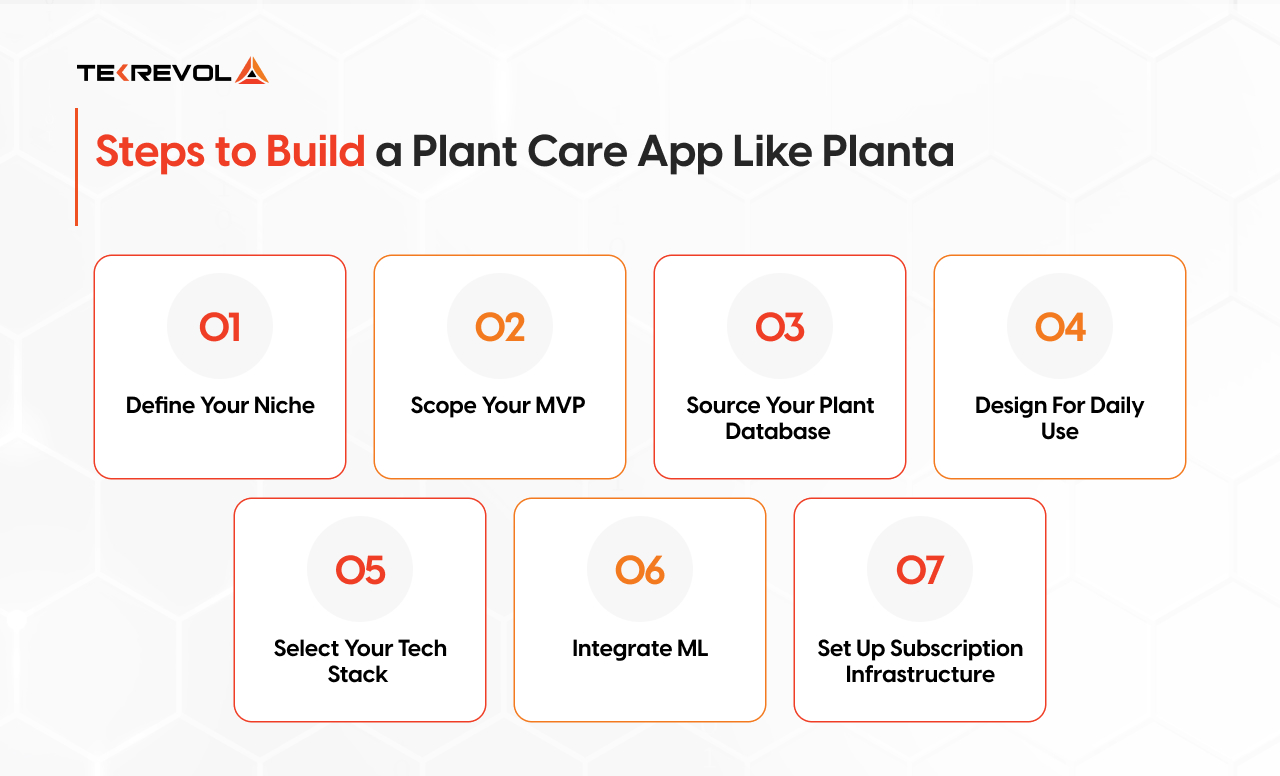
- Define your niche — Planta targets indoor houseplant owners. Your positioning could differ: outdoor gardens, succulents and cacti specialists, herb and vegetable growers, or agritech (commercial crop monitoring). Your niche shapes every feature decision.
- Scope your MVP — For a first version, focus on: plant database, camera ID, basic care schedules, and push notifications. Disease diagnosis and advanced ML features can follow in V2 once you have user data and revenue to fund the model training.
- Source your plant database — Options include licensing an existing botanical database API, scraping and cleaning public plant data (Trefle API, GBIF), or building a proprietary dataset. Quality and breadth directly affect user trust.
- Design for daily use — Plant care apps are opened daily. The home screen should show today’s care tasks at a glance. Onboarding should let users add their first plant in under 60 seconds. Friction kills retention.
- Select your tech stack — Platform choice and ML integration approach depend on your budget and timeline.
- Integrate ML — Start with an API-based approach (Google Cloud Vision, AutoML) for MVP. Plan the transition to a custom TensorFlow Lite model for V2 once you have training data from real user uploads.
- Set up subscription infrastructure — RevenueCat is the standard SDK for managing App Store and Google Play subscriptions in cross-platform apps. Set this up before launch — not after.
To make a successful app like Planta, you need more than just plant identification features. The key is combining a smooth user experience, accurate care recommendations, AI-powered functionality, and a scalable subscription model that keeps users engaged daily.
Tech Stack for a Plant Care App
The recommended tech stack for a plant care app in 2026 includes React Native for cross-platform frontend development and Node.js or Python for backend architecture. For advanced functionality, use TensorFlow Lite or Google AutoML for ML, Firebase or PostgreSQL for the database, and Firebase Cloud Messaging for push notifications.
| Layer | Technology | Why |
| Frontend | React Native | Single codebase for iOS and Android; strong gardening app ecosystem; good camera API support |
| Backend | Node.js or Python (FastAPI) | Node.js for real-time features; Python preferred when ML processing happens server-side |
| ML / Computer Vision | TensorFlow Lite (on-device) or Google AutoML Vision | TFLite for offline capability; AutoML for faster MVP delivery |
| Plant Database | Firebase Firestore or PostgreSQL | Firestore for real-time sync; PostgreSQL for complex relational plant data queries |
| Push Notifications | Firebase Cloud Messaging (FCM) | Free, reliable, cross-platform; supports conditional notification logic |
| Authentication | Firebase Auth | Fast to implement; supports social login (Google, Apple) |
| Subscription Management | RevenueCat | Industry standard for App Store + Google Play subscription management |
| Cloud Infrastructure | Google Cloud Platform or AWS | GCP aligns well with AutoML Vision and Firebase; AWS if the team has an existing preference |
| Image Storage | Firebase Storage or AWS S3 | For user-uploaded plant photos and disease diagnosis images |
Why React Native for a Gardening App
React Native development gives you iOS and Android from one codebase. For a plant care app where the core interactions, camera, notifications, and database are well-supported by React Native libraries, this is the right call. It cuts mobile app development cost by 30–40% versus building native iOS and Android separately.
The only exception: if your disease detection ML model has extreme on-device performance requirements, native iOS (Swift) or Android (Kotlin) may provide better hardware access. For most plant care app builds, React Native handles it without compromise.
TekRevol built Workplace Wellness, a cross-platform lifestyle app featuring personalized wellness plans, daily check-ins, and habit tracking. This architecture directly mirrors a plant care app’s need for automated reminders, logs, and habit-loop engagement, proving our ability to build high-retention utility platforms that users open daily.
Cost to Build a Plant Care App
The cost to build a plant care app ranges from $25,000–$40,000 for a basic MVP to $80,000–$150,000 for a full AI-powered app with disease detection. $150,000+ for an enterprise agritech product with a custom-trained ML model.
MVP vs. Full Product Cost Breakdown
| Build Type | Features Included | Cost Range | Timeline |
| Basic MVP | Plant DB (2K species), manual care schedule, basic push notifications | $15,000–$25,000 | 8–12 weeks |
| MVP with AI ID | Above + camera plant identification via Google AutoML | $25,000–$40,000 | 10–16 weeks |
| Full Product | All core features + disease diagnosis + subscription model + collection journal | $60,000–$100,000 | 20–28 weeks |
| Full Product + Custom ML | Above + custom-trained TFLite model + personalized recommendations | $100,000–$150,000+ | 28–40 weeks |
| Agritech / Enterprise | Commercial crop monitoring, IoT sensor integration, agronomy dashboards | $150,000–$300,000+ | 40+ weeks |
What Drives Cost in Plant Care App Development
- ML model approach — API-based (Google AutoML): lower upfront cost, per-call pricing at scale. Custom TFLite model: higher upfront ($15,000–$40,000 for training and integration), but no per-inference cost and better performance.
- Plant database size and sourcing — Licensing a large botanical database adds $3,000–$15,000, depending on species count and data quality. Building proprietary adds engineering time.
- Platform choice — React Native single codebase vs. native iOS + Android. Native adds 35–50% to development cost for equivalent features.
- Subscription infrastructure — RevenueCat integration adds approximately $3,000–$6,000 in development time but pays for itself in reliable subscription management.
- Design quality — Lifestyle apps like plant care tools live or die on UI/UX. Budget $8,000–$20,000 for proper UX research, wireframing, and polished visual design. This is not the place to cut corners.
Development Timeline
A plant care app MVP with AI plant identification takes 10–16 weeks. A full-featured product with disease detection and a subscription model takes 20–28 weeks. A custom ML model adds 8–12 weeks on top of the base development timeline.
| Phase | Activities | Duration |
| Discovery | Requirements, competitor research, feature scoping, tech stack decision | 1–2 weeks |
| UI/UX Design | Wireframes, user flow, visual design, prototype testing | 3–4 weeks |
| Backend Development | API architecture, plant database setup, user auth, notification system | 4–6 weeks |
| Frontend Development | React Native screens, camera integration, UI polish | 4–8 weeks |
| ML Integration | AutoML or TFLite setup, model testing, disease detection endpoint | 3–6 weeks |
| QA and Testing | Device testing, load testing, notification testing, ML accuracy QA | 2–3 weeks |
| App Store Submission | Apple and Google review, ASO setup, launch | 1–2 weeks |
A few things to plan for:
- Apple App Store review averages 1–3 days, but can take longer for apps with camera and ML features
- ML model accuracy QA is a separate, specialist task — budget time for iteration
- Plan a soft launch (TestFlight / Google Play internal testing) before full release to catch edge cases in the plant ID feature
Monetization: How Plant Apps Make Money
Plant care apps primarily monetize through freemium + premium subscription, with additional revenue from in-app purchases and plant shop affiliate partnerships. The subscription model is the most scalable because it aligns with the daily engagement habit the app creates.
Freemium + Premium Subscription (Primary Model)
This is the model Planta and most competitive plant apps use. Free users get enough to understand the value, basic plant logging, and fixed reminders, but hit a paywall on the features they actually need.
Planta’s pricing: $7.99/month or $35.99/year (as confirmed on the App Store and independently verified sources, including Mashable 2024 review and EcoCation).
For your app, a similar pricing structure works. The annual plan at roughly 37% discount (vs. monthly) improves LTV significantly — push annual plans in your onboarding and upgrade prompts.
Gates to put behind the paywall:
- Camera-based plant identification
- Disease diagnosis
- Personalized care schedules (vs. generic fixed reminders)
- Unlimited plant collection entries
- Light meter / environmental assessment
In-App Purchases
One-time purchases can supplement subscriptions:
- Individual plant care guides ($0.99–$2.99)
- “Lifetime access” option (popular with users who distrust recurring charges)
- Premium plant database packs (rare species, herbs, tropical plants)
Plant Shop Affiliate Partnerships
Partner with online plant retailers, The Sill, Bloomscape, and Rooted, to surface plant purchasing options when a user identifies a plant they want to add to their collection. Standard affiliate commissions in this category range from 5–15% per sale.
This revenue stream grows with the user base and requires minimal engineering, typically a deep link integration.
Subscription App Model: Key Metrics to Target
| Metric | Target Range for Healthy Plant App |
| Free → Paid Conversion | 3–8% |
| Monthly Churn | 2–5% |
| Annual Plan Uptake | 35–50% of paid users |
| Day 30 Retention | 25–40% |
| ARPU (monthly) | $3.50–$6.50 blended across free/paid |
TekRevol built Stop Vaping, a US lifestyle app driving daily habit change through streaks, motivation triggers, and community engagement. The subscription retention mechanics and daily check-in loop architecture are identical to what makes plant care apps sticky. Free-to-play conversion on habit apps follows the same behavioral pattern—users invest in the streak and are far less likely to abandon it once it has value.
Why Partner with TekRevol for Your Plant App
TekRevol builds AI-powered mobile apps with hands-on ML integration experience, including computer vision, push notification systems, subscription architectures, and cross-platform React Native development.
Here is what TekRevol brings to a plant care app development project:
- AI and ML integration: TekRevol has integrated Google AutoML Vision, TensorFlow Lite models, and custom computer vision pipelines into mobile apps. For plant care apps, this means reliable plant identification and disease detection, not just wired up, but tested for accuracy and edge cases.
- Cross-platform React Native delivery: TekRevol builds iOS and Android simultaneously from one codebase, cutting timelines and cost without sacrificing quality. The Tamreeni fitness app, one of the most downloaded wellness apps in the UAE with over 3 million downloads, was built by TekRevol using this same approach.
- Subscription app architecture: From RevenueCat integration to App Store subscription review compliance, TekRevol handles the subscription infrastructure that lifestyle apps depend on.
- Full-cycle delivery: Discovery → UX design → development → ML integration → QA → App Store submission: one team, one roadmap, no handoff gaps.
- Transparent fixed pricing: Milestone-structured proposals with clear deliverables at each phase. No surprise invoices halfway through development.
If you are building a plant care app, a gardening app, or an agritech product with AI features, TekRevol has the technical depth and the product experience to build it right.
Have a Plant Care or Agritech App Idea?
TekRevol builds AI-powered mobile apps with ML integrations like plant identification, disease detection, and cross-platform support.
Start My Plant App Project


