
70% of software projects fail, and the biggest reason for this widespread failure is a lack of early validation. Teams build full products without proving the business value of software PoC and waste millions.
Investing in a complex software project before proving the core idea is a huge gamble. A Proof of Concept (PoC) acts as the necessary bridge between that risky idea and a successful investment.
The strong business value of a software PoC lies in its ability to dramatically reduce uncertainty. It’s your earliest and most economical form of risk mitigation. It answers the fundamental question: Is this worth building?
An effective PoC is the first step toward software project success. Read on to learn how the business value of software PoC secures wins. No more guesses. Just facts.
What is Proof of Concept in Software Development?
A Proof of Concept (PoC) is your most effective tool for managing financial risk in software development. It serves as a comprehensive financial model validation for your entire project. You use the PoC to prevent significant losses and ensure every dollar you allocate is well spent.
For software business leaders, asking what is PoC in business. The measurable business value of software PoC lies directly in the money and time it saves you by providing definitive proof of viability. You measure outcomes like user uptake or cost savings. Without it, projects drift, and teams chase the wrong paths.
Don’t Build Software Blindly
Get certainty by validating the business value of the software PoC with TekRevol.
Contact us todayWhat is the Proof of Concept Value in Software Development?
The business value of software PoC centers on risk cuts to protect your budget and timeline from failure. It is far cheaper to scrap a $10,000 PoC than to abandon a multi-million dollar project halfway through.
The benefits of proof of concept in software development are the saving of resources via confirming viability quickly. Having early validation in hand, leadership gains the confidence needed to move forward with full-scale development. It is a critical foundation for true innovation.
7 Ways a Strong Business Value of Software PoC De-Risks Your Project
A strategic PoC doesn’t just prove if something can be built; it proves why it should be built. The 7 outcomes below form the core business value of software PoCs, ensuring every dollar spent is directed toward a measurable ROI.
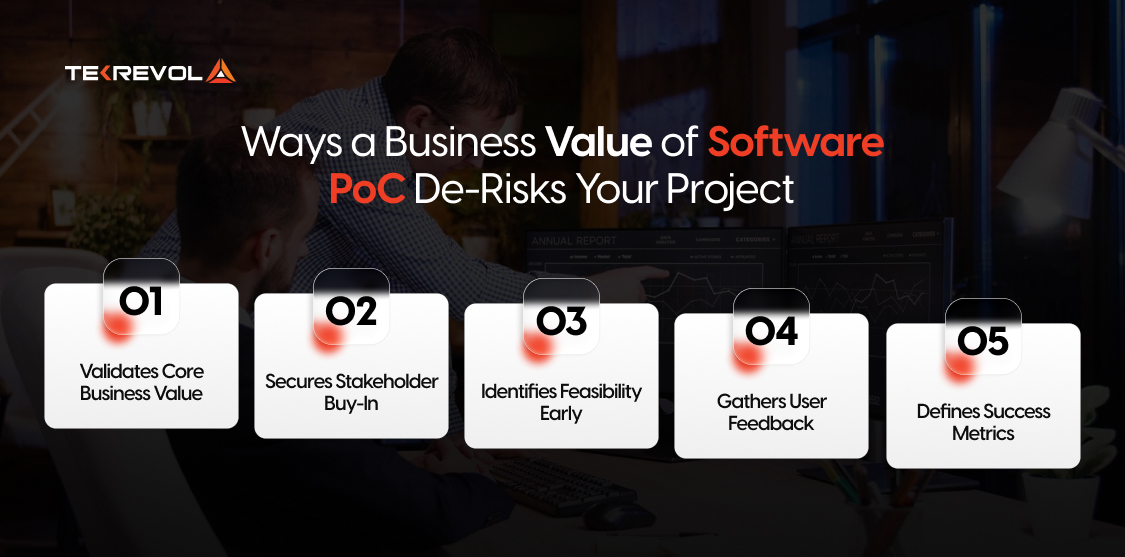
Validates Core Business Value & Market Demand
A key strategic business value of software PoC is testing actual market need before the final build. CB Insights highlighted that about 42 % of startups fail because there’s no real market need for their product.
A PoC allows you to validate whether your proposed solution actually solves a real, profitable customer pain point. The goal is to test if your proposed solution actually delivers value to the intended user. This product-market fit validation moves beyond technical function to confirm the potential for ROI. It uses lightweight testing to confirm your core assumptions are correct before committing significant resources. It is a critical component of a smart market entry strategy.
Secure Stakeholder Buy-In and Investment
A successful PoC acts as your most powerful business case for continued capital allocation. When you seek further venture capital pitching or executive approval, a working proof of concept demonstration is far more compelling than a slide deck.
The PoC provides tangible evidence that your concept is sound. This concrete proof eliminates doubts in the software development steps and builds confidence among executives and investors. You use it to demonstrate potential viability and secure necessary funding much earlier in the process.
Quantifiable Cost Avoidance
A PoC directly prevents the accumulation of expensive technical debt. Quantifiable cost avoidance metrics are a primary business value of software PoCs.
When technical flaws or integration challenges appear later, they require extensive rework. These fixes disrupt timelines and inflate budgets dramatically. According to IBM research, a software defect can cost up to 50×–100× more to fix in production than if it had been identified early.
By testing the riskiest component first in an isolated environment, the PoC identifies these problems when they are small and cheap to fix. This proactive approach saves the business substantial funds that would otherwise be wasted on features that needed complete overhauls.
Accurate Budgeting and Timeline Prediction
Other important benefits of proof of concept in software include improved project predictability. Conducting a PoC resulted in time estimates that were significantly more accurate. The PoC forces your team to confront the most complex technological requirements upfront. This process clarifies the scope and exposes hidden technical complexities that were previously only assumptions.
The data gathered allows for precise resource management and prevents delays in the PoC development timeline due to unforeseen issues. It provides the objective information needed for a realistic project feasibility study and budgeting.
Identifies Technical Feasibility & Challenges Early
Every software project has technical unknowns. The primary function of a PoC in project risk management is to tackle the high-risk technical capabilities of a concept.
A PoC often tests things like integrating a new payment gateway or the performance of a sophisticated machine learning algorithm with existing systems. By isolating and solving these problems in a small environment, you can decide whether to pivot or stop the project after the PoC process in software development.
Gathers Crucial User Feedback for Better Design
A PoC is a structured opportunity to conduct initial user acceptance testing (UAT) on the core idea. Instead of showing users a fully designed product that is expensive to change, the PoC presents the fundamental functionality. This early exposure provides crucial user feedback to ensure the final product is based on user-centered design principles.
You can validate the core workflow optimization and identify immediate barriers to adoption. This process is a quick, low-cost form of UX validation that prevents major redesigns later on. Studies from Forrester show that every $1 invested in UX can return $10–$100 in ROI. Iterating on the user experience early greatly improves the chances of proof-of-concept examples succeeding
Defines Clear Success Metrics & Scope
A successful PoC forces you to define what success actually looks like. If you cannot define it for the PoC, you certainly cannot for the final product. This ties directly into the project roadmap.
The PoC requires establishing clear, measurable objectives or KPIs for the trial. This exercise naturally introduces scope clarity and helps manage expectations. The metrics you establish here become the foundation for the entire project roadmap. It ensures everyone understands the desired business outcomes before full development is greenlit. This clarity is a key business value of software PoC.
Ready to Minimize Project Risk?
Plan Your PoC with TekRevol to realize the full business value of software.
Get Free ConsultationHow to Build a High-ROI PoC Proposal?
To build a high-ROI PoC proposal, focus should always be on business outcomes, not just technical specifications. Below, we detail the steps needed to create a software PoC proposal template that gets approved.
- Define the Scope: Clearly state the single business assumption the PoC is meant to prove or disprove. This should be narrow and highly focused.
- Establish Success Metrics: Use simple KPIs like “Must achieve 80% accuracy” or “Must process 100 transactions per second.”
- Outline Timeline: A PoC timeline should be short, typically 2 to 6 weeks, to prevent scope creep.
- Draft costs breakdown: Clearly outline the expected PoC development cost for 2025. Budgets often range from $5K to $50K on average in the USA, depending on the complexity.
- Identify Resources: List the necessary team members, skills, and tools.
- Detail the Test Scenario: Describe exactly how the PoC will be demonstrated and tested.
- Outline Next Steps: Clearly state the decision points after the PoC is complete. What happens if it passes, and what happens if it fails? This is a key part of the PoC development life cycle.
The Business Value Proposition of PoC vs Prototype vs MVP
Executives and product teams frequently confuse the Proof of Concept (PoC) with a prototype or a Minimum Viable Product (MVP). This confusion can undermine the true business value of software PoCs.
Addressing the difference among PoC vs MVP vs Prototype is vital as each one answers a different core question at a different stage in the product development lifecycle.
The PoC Focus: Concept Validation
The Proof of Concept answers “Can this fundamental idea actually work?” It is minimal code focused purely on one technical function. The output is a simple document that confirms feasibility. It has no user interface or design elements.
The Prototype Focus: Functional Mock-Up
A prototype comes after a successful PoC. It answers the question: “How will it look and feel for the user?” It is an interactive model focused entirely on design, flow, and user experience. It often looks like a finished product but lacks backend logic. Its goal is to refine the design before any expensive coding begins.
The MVP Focus: Market Entry Strategy
The Minimum Viable Product (MVP) is the first version that goes to real customers. It answers the question: “Does the market want it and will they pay for it?” It is a fully functional product with the absolute minimum features needed to start the customer feedback loop.
The MVP is where the actual revenue generation and market entry strategy begins. It follows lean software development principles. The difference between PoC vs MVP software development is the audience and the goal.
How to Measure the Business Value of Software PoCs?
Measuring the value of a Proof of Concept moves beyond simple technical checks. You must translate technical success into tangible business outcomes that stakeholders care about.
The primary metric is ROI. You calculate this using a basic cost-benefit analysis. Compare the average cost of a software PoC versus the cost of failure that the PoC helped you avoid. For example, a $20,000 PoC that prevents a $500,000 bad investment has a massive, immediate ROI. This makes it easy to communicate the business value of software PoCs.
Key KPIs for a PoC focus on performance, not features. These might include speed, processing capacity, or data accuracy. Stakeholder reporting should use clean dashboards and simple visuals.
Always focus the report on risk mitigation, time savings, and the path to achieving long-term success metrics. Effective performance tracking turns a successful PoC into a green light for full funding.
Common Pitfalls A Business-Focused PoC Helps Avoid
The most frustrating project failure is the one that could have been easily predicted. A well-executed, business-focused PoC helps avoid several common traps that plague software projects.
Scope Creep. Projects without a PoC often expand quickly because the initial vision was fuzzy. The clear boundaries and success metrics of a PoC prevent this expansion. The need for PoC in software projects is to define the boundaries.
Wasted Investment: Another pitfall is sinking a massive wasted investment into a technically unsound idea. A PoC acts as a cheap parachute, ensuring you only lose a small amount if the idea is fundamentally flawed.
Technical Debt: By testing complex parts early, you ensure the core architecture is sound, saving major rework later. The PoC is the best insurance against high-cost, high-profile failure and provides excellent risk mitigation.
How TekRevol Maximizes The Business Value of Software PoC
The quantifiable business value of software PoC is clear: it ensures you invest your initial capital expenditure in a concept that is not only technologically sound but also has a validated market need and a clear path to completion. It turns a blind organizational bet into a highly calculated, risk-adjusted investment.
You now possess the strategic framework to establish your own measurable PoC framework. At TekRevol, we turn vague ideas into high-ROI software PoCs. We focus on the business outcome first, ensuring your PoC doesn’t just work technically, but also makes perfect business sense.
Need a Sure Start for Your Project?
We guarantee the maximum business value of the software POC to achieve success.
Request a Proposal



![How Much Would It Truly Cost to Develop a Food Ordering Website? [2026 Analysis]](https://d3r5yd0374231.cloudfront.net/images-tek/uploads/2026/03/Tek-Feature-7-1.jpg)