
- Production-grade facial recognition apps require 4 core security layers to prevent breaches.
- Adding GDPR, BIPA, or HIPAA compliance late can increase costs by 30–50%.
- AI-powered KYC onboarding can reduce verification time to under 30 seconds.
- Encrypted biometric templates are safer than storing raw facial image data.
- AWS Rekognition, Azure Face API, and Apple Vision differ in GDPR and liveness support.
- Advanced 3D liveness detection can reduce false accepts to near-zero levels.
- Facial recognition app development costs range from $8K to $400K+ based on compliance needs.
In 2022, SingHealth began testing a facial recognition visitor system at Singapore’s Outram Community Hospital and SingHealth Tower. Instead of standing in long registration lines, visitors could pre-register online, scan their faces at the entrance, and enter automatically, even while wearing masks.
What made the rollout interesting wasn’t the futuristic factor, but how quickly the technology became practical infrastructure for managing patient flow, security, and contactless access in high-traffic healthcare environments.
That shift is happening across industries now. Facial recognition is no longer treated as an experimental feature reserved for airports or smartphones. Banks use it for identity verification, workplaces rely on it for secure access control, and healthcare providers increasingly see it as a way to reduce friction while improving operational efficiency.
Worth noting: Many teams trying to figure this out are also exploring broader AI-powered automation, which is why AI agent development services have seen such a surge in demand alongside biometric solutions. The underlying infrastructure often overlaps more than you’d expect.
This guide walks through what actually goes into facial recognition app development, the features that matter for enterprise use, the ethics you can’t afford to skip, and what the numbers look like when you start planning.
Where Facial Recognition Is Being Deployed in 2026
The global facial recognition market is projected to hit $14.5 billion by 2030, growing at a CAGR of around 14.6%, and the bulk of that growth isn’t coming from consumer gadgets. It’s coming from enterprises that needed a faster, more reliable way to verify who’s walking through the door, logging into an account, or showing up for work.
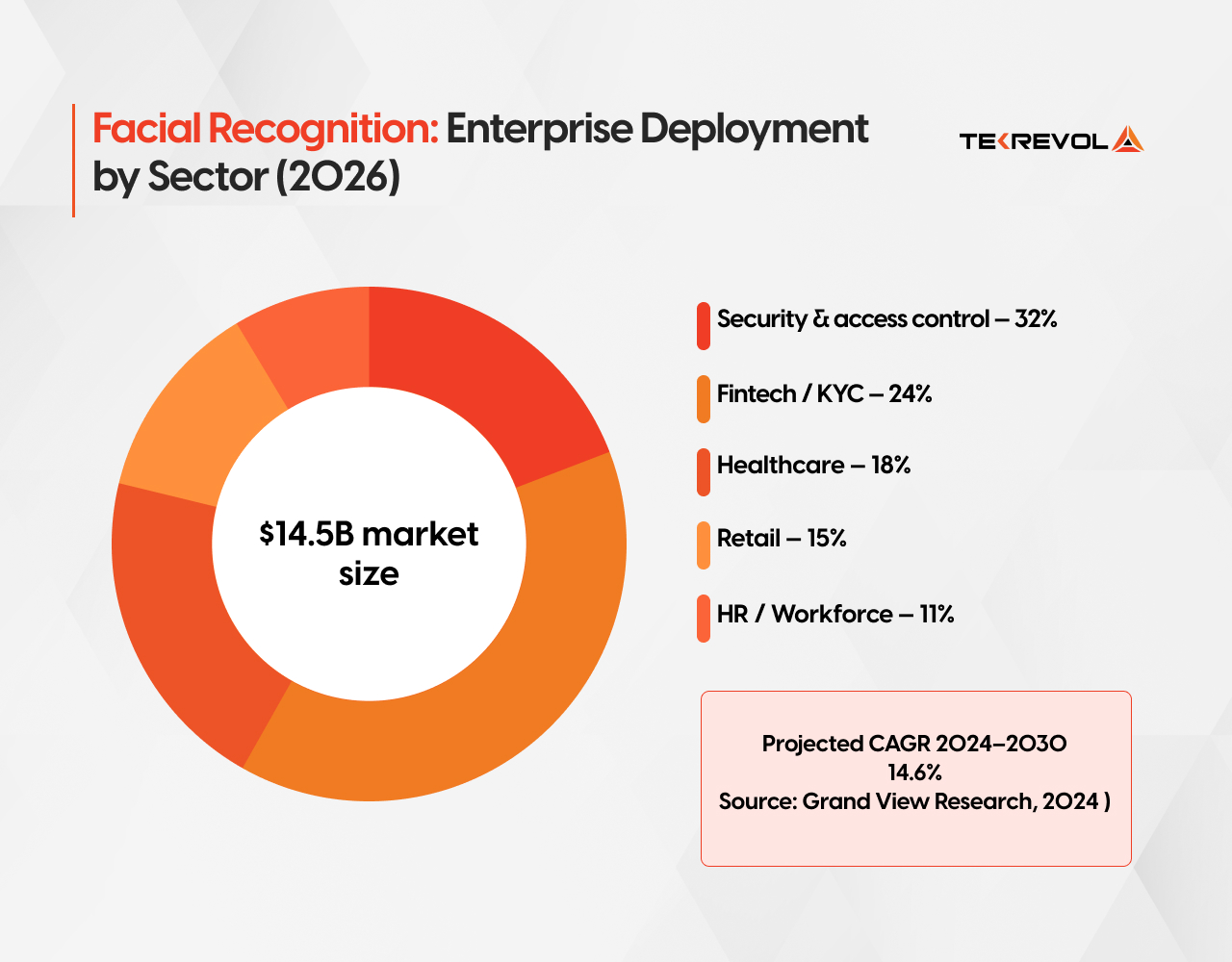
Here’s where actual deployments are happening, and what’s driving them.
Fintech
Regulatory pressure around Know Your Customer compliance has pushed fintech companies to look hard at biometric authentication. Traditional KYC:
- ID upload
- Selfie match
- Manual review
Converts poorly and frustrates users who abandon onboarding mid-flow.
Facial recognition app development for fintech typically combines liveness detection, document verification, and face matching in a single flow that takes under 30 seconds. The result is a verified user who never touched a branch or spoke to a rep.
Companies building in this space are also increasingly leaning on fintech software development partners who understand both the technical architecture and the regulatory landscape, because building a biometric KYC system that works in the US, EU, and GCC simultaneously requires more than a good SDK.
The regulatory angle matters here: FATF guidelines, PSD2 in Europe, and FinCEN requirements in the US all touch how identity verification is conducted and stored. Facial recognition implementations in fintech aren’t optional compliance add-ons. They’re core infrastructure.
Healthcare
The healthcare use case for face detection app development is straightforward: hospitals and clinics have been relying on patient-stated identity for decades, which creates both administrative friction and genuine safety risk.
A patient who walks in unconscious, or one who shares a name with another patient, or one whose records are split across two systems, these are all scenarios where fast, accurate identity verification matters.
Facial recognition in healthcare is being used for patient check-in, linking patients to their EHR records, verifying identity before medication dispensing, and controlling access to restricted areas.
When it’s integrated with a hospital’s existing patient management system, the gains are measurable: reduced wait times, fewer duplicate records, and improved medication safety.
Building this well requires deep familiarity with clinical workflows, not just the technology. Healthcare app development services that understand HL7 FHIR integration, HIPAA data handling, and the specific consent requirements around biometric data in medical settings are a different conversation from a general-purpose facial recognition API integration.
Security & Physical Access Control
This is where facial recognition has been deployed the longest, and where the technology is most mature. Enterprise campuses, data centers, government facilities, and multi-tenant office buildings are all replacing or supplementing traditional badge systems with facial recognition-based access control.
The advantages are practical: badges get lost, cloned, and lent out. A face doesn’t. And for high-security environments, combining facial recognition with other factors like proximity, PIN, or mobile device, creates multi-factor physical access that scales without adding friction at the gate.
Anti-spoofing technology (more on this in the technical architecture section) is critical in security deployments. A system that can be fooled by a photograph isn’t a security system.
Retail
Retail deployments tend to fall into two camps: loss prevention and customer experience. The loss prevention use case uses face matching to identify known shoplifters before an incident occurs. The customer experience use case is more aspirational, recognising a VIP customer the moment they walk in, surfacing their purchase history, and enabling frictionless checkout.
Retailers deploying facial recognition responsibly are building consent-first experiences with clear signage, opt-out mechanisms, and data retention limits. The ones that aren’t tend to end up in headlines for the wrong reasons.
Employee Management
HR tech companies have found strong product-market fit in facial recognition for workforce management. Time and attendance systems that use biometric authentication eliminate buddy punching, the practice of one employee clocking in for another, which costs US businesses an estimated $373 million annually in fraudulent time records.
Beyond attendance, facial recognition is being used for access control within offices (restricting certain areas to authorised personnel), visitor management, and, in some cases, factory floor safety verification, confirming that workers in hazardous areas have completed required safety training.
The HR tech implementation typically integrates with existing HRIS platforms, which means the custom software development work involves both the biometric layer and the API integrations with systems like Workday, SAP, or BambooHR.
| Sector | Primary Use Case | Key Integration | Compliance Priority |
| Fintech | KYC onboarding, transaction auth | Core banking, CRM | GDPR, FinCEN, PSD2 |
| Healthcare | Patient ID, EHR access | HL7 FHIR, HMS | HIPAA, DPDP |
| Security | Physical access control | VMS, PSIM | Site-specific, BIPA |
| Retail | Loss prevention, VIP recognition | POS, loyalty platforms | CCPA, GDPR |
| HR / Workforce | Attendance, access | HRIS, payroll | GDPR, local labour law |
Turn Facial Recognition Into a Real-World Product, Not Just a Concept
Get the exact technical roadmap used to deploy secure, scalable facial recognition systems across industries.
Consult With Our Experts For FreeConsumer Apps Using Facial Recognition — Technical Takeaways
Consumer apps have been quietly running large-scale experiments in facial recognition for years. The enterprise development community doesn’t need to reinvent what they’ve already figured out; it needs to understand the principles behind their choices and apply them in a compliance-first context.
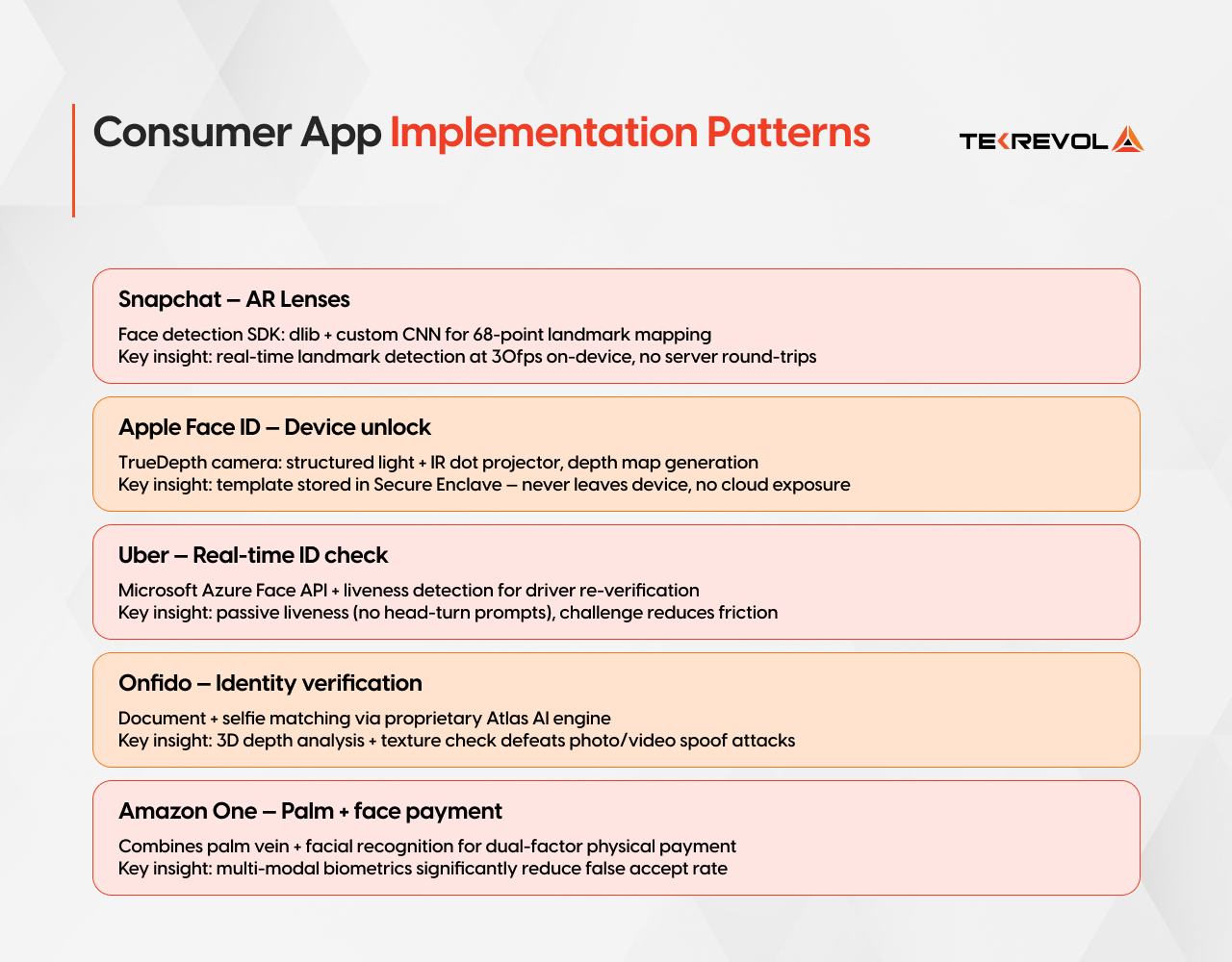
Snapchat: Real-Time Landmark Mapping at Scale
What made Snapchat’s AR lenses technically remarkable wasn’t the visual effects; it was running 68-point facial landmark detection at 30 frames per second on a mobile device without burning through the battery or adding noticeable latency. They did it by keeping everything on-device, using a lightweight CNN architecture optimised for mobile inference.
The enterprise takeaway: on-device processing for face detection isn’t just a performance optimisation. It’s also a data privacy decision. If detection and initial matching happen locally, you’re not sending raw biometric data across a network before you’ve verified anything.
Apple Face ID: The Secure Enclave Model
Face ID’s architecture is worth studying in detail for anyone building biometric authentication. Apple’s system generates a mathematical representation of the user’s face, not a photograph, and stores it in a dedicated hardware security module (the Secure Enclave) that no other software on the device can access, including iOS itself.
This is the gold standard model for biometric storage: the template never touches a server, can’t be extracted via software, and is destroyed if the device is wiped. For enterprise facial recognition deployments in regulated industries, this architecture is worth benchmarking against.
Uber: Passive Liveness Without Friction
Uber’s driver re-verification feature is a good case study in balancing security with usability. Early implementations of liveness detection required drivers to blink, turn their head, or perform other active actions, which frustrated users and increased drop-off. Uber (via Azure Face API) moved to passive liveness detection, which analyses texture, depth cues, and micro-movements without requiring explicit user action.
For fintech and HR tech implementations, this matters: every additional step in an authentication flow is a drop-off point. Passive anti-spoofing technology lets you maintain strong security without adding friction that kills adoption.
Onfido: Document-to-Face Matching
Onfido’s implementation is the closest consumer analogue to enterprise KYC. Their system extracts a facial template from a government-issued ID document, then compares it to a live selfie, with 3D depth analysis running in parallel to catch spoofing attempts using printed photos or video replay.
The technical challenge here is matching quality across different lighting conditions, document photo ages (a passport photo from five years ago), and selfie camera quality. This is where model selection and training data diversity matter significantly.
Amazon One: Multi-Modal Biometrics
Amazon’s retail payment system combines palm vein scanning with facial recognition, not because one alone is insufficient, but because combining two independent biometric signals dramatically reduces the false accept rate (the rate at which an unauthorised person is incorrectly granted access). For high-stakes applications like payments or secure facility access, multi-modal biometrics is worth the additional implementation complexity.
TekRevol’s work on AI development covers the broader architecture decisions behind biometric systems, including when to combine modalities and how to structure the matching pipeline.
Types of Facial Recognition Features to Build
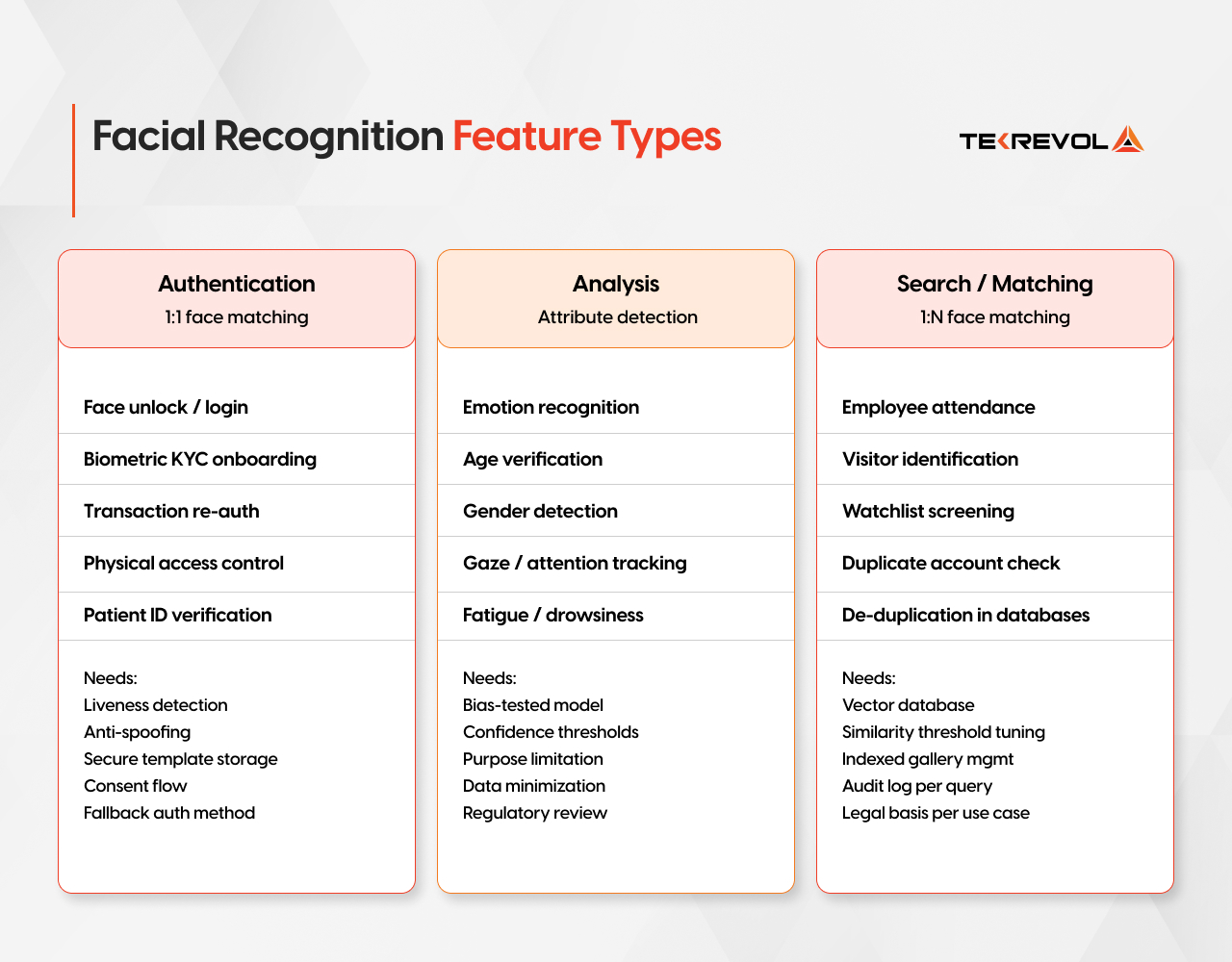
Before you write a line of code, the most important decision in any facial recognition app development project is which type of facial recognition you’re actually building. These are fundamentally different features with different architectures, different accuracy requirements, and crucially different legal and ethical footprints.
Authentication: 1-to-1 Face Matching
This is the most common enterprise use case and the most defensible one from a compliance standpoint. A user presents their face; the system compares it to a stored template for that specific person; it returns a yes or no.
Face unlock, biometric KYC onboarding, transaction re-authentication, and physical access control are all of these are 1:1 matching problems. The user is claiming to be a specific person, and you’re verifying that claim.
What makes 1:1 matching defensible is that the scope is narrow and the consent relationship is clear. The user actively enrolled their biometric data for a specific purpose, and you’re using it for exactly that purpose.
What you’re actually building:
- An enrollment flow (capturing and storing a facial template with appropriate consent)
- A verification flow (real-time capture → template generation → comparison → decision)
- Liveness detection layer (to prevent spoofing attacks)
- Fallback authentication (for cases where facial matching fails or isn’t available)
- Secure template storage with access controls and retention policies
For companies working on biometric authentication as part of a broader AI product suite, this often connects naturally to generative AI capabilities, particularly in onboarding flows where document extraction, OCR, and identity verification happen in sequence.
Emotion Detection: Useful Feature, High Scrutiny
Emotion recognition is technically fascinating and commercially unproven at scale. Systems trained on facial action units (following Paul Ekman’s foundational work on micro-expressions) can classify expressions like happy, neutral, surprised, angry, fearful, or disgusted.
The commercial applications get pitched in three main contexts: customer experience measurement (gauging how shoppers react to a product), remote proctoring (detecting stress or confusion during exams), and driver monitoring (detecting drowsiness or distraction).
Build emotion recognition for the applications where it adds clear value (UX research, driver safety) and avoid high-stakes decision-making applications until the science matures.
Age Verification: Increasingly Required by Law
Age verification via facial analysis is a fast-growing use case driven by regulatory requirements. Several jurisdictions, including the UK under the Online Safety Act, several US states, and the EU, are requiring platforms to verify the ages of users accessing adult content, gambling, or other age-restricted services.
Facial analysis-based age estimation is one approach, typically used as a soft gate (flagging users who appear to be below a threshold for further verification) rather than a hard gate (denying access based on facial analysis alone). Combining it with document-based verification creates a more robust system.
Face Search: 1-to-Many, Higher Stakes
1:N face matching, comparing an unknown face against a database of known individuals, is where the technology becomes most powerful and most sensitive. This is the architecture behind employee attendance systems, visitor management, watchlist screening, and duplicate account detection.
The key technical difference from authentication is scale. A 1:1 match is a direct comparison between two templates. A 1:N match is a similarity search across potentially millions of enrolled faces, returning the closest matches above a confidence threshold.
From a compliance standpoint, 1:N matching requires particularly careful scoping.
- Who is in the gallery?
- How did they get there?
- Is each person in the database aware that their face is enrolled?
- What happens when the system returns a false match?
| Feature Type | Technical Complexity | Compliance Complexity | Primary Enterprise Use |
| 1:1 Authentication | Medium | Medium | KYC, access control, attendance |
| Emotion detection | Medium | High | UX research, driver safety |
| Age verification | Low–Medium | High | Regulated content platforms |
| Liveness detection | High | Low | All authentication flows |
| 1:N face search | High | High | Attendance, visitor mgmt, security |
Core Technical Architecture of a Facial Recognition App
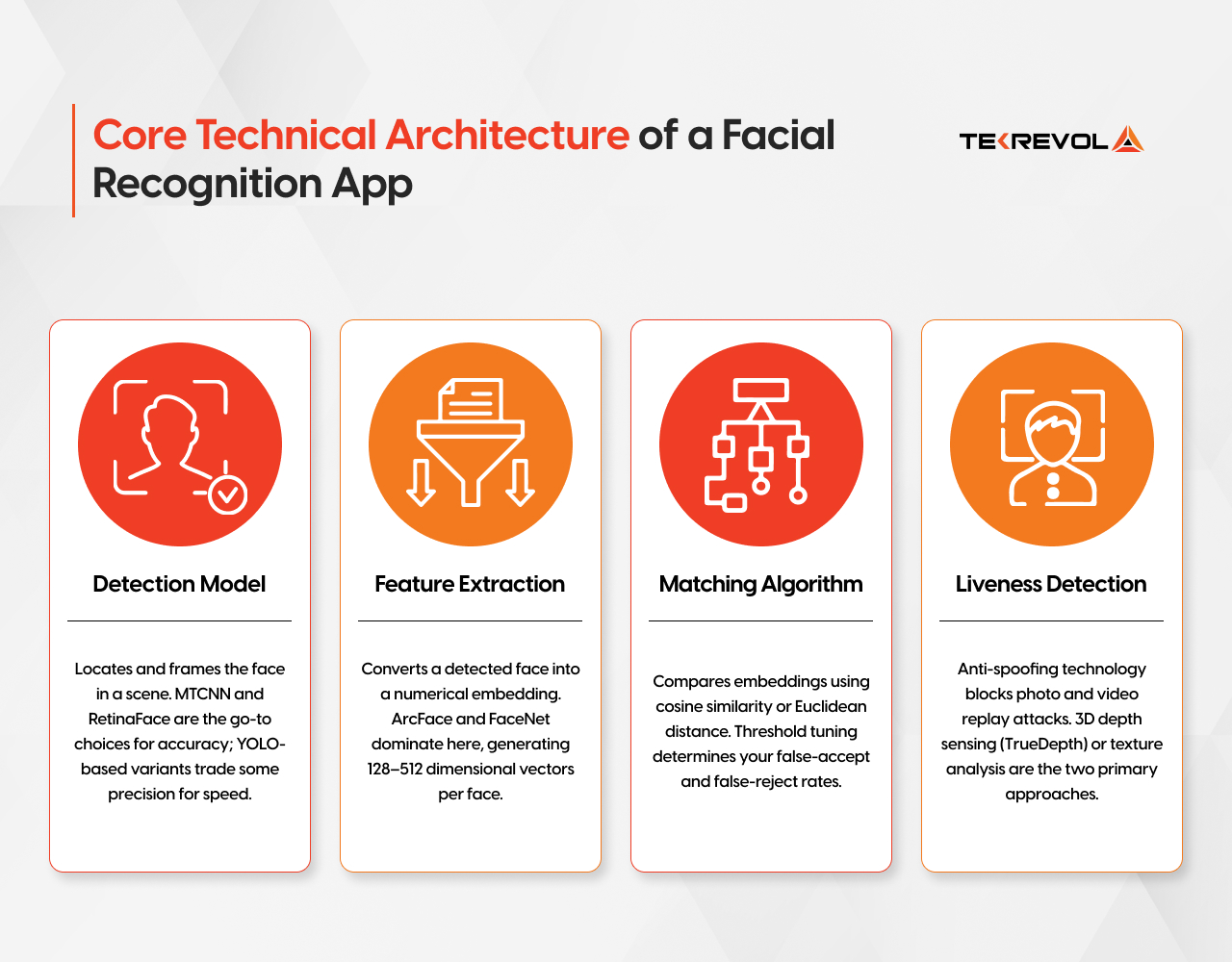
Understanding what’s happening under the hood is the difference between making a good vendor decision and a costly one. A production-ready facial recognition app development pipeline has four distinct layers, and each one carries real design tradeoffs.
The face matching algorithm layer deserves particular attention. A system optimised only for average accuracy often masks demographic performance gaps, something NIST’s Face Recognition Vendor Test (FRVT) has documented extensively across commercial models.
For fintech software development and KYC workflows, liveness detection is like its table stakes. Your biometric authentication app must distinguish a live user from a photograph before any identity claim is trusted.
Build It Right Before You Build It Big
Get a clear, production-ready blueprint for designing secure, high-performance facial recognition systems that actually hold up in real-world conditions.
Talk to Our Experts For FreeBest SDKs and APIs for Facial Recognition
You don’t need to build a face detection SDK from scratch. The real decision is which managed API fits your latency, cost, compliance, and accuracy requirements. Here’s an honest comparison.
| SDK / API | Best For | Liveness Detection | GDPR Ready | Pricing Model | Accuracy Highlight |
| AWS Rekognition | Scalable cloud verification, KYC | ✅ Face Liveness API | Partial (data residency controls) | Per-image / per-minute video | 99.7% on LFW benchmark |
| Azure Face API | Enterprise, Microsoft stack integration | ✅ Managed detection | ✅ Strong EU controls | Per 1,000 transactions | 99%+ on standard benchmarks |
| Face++ (Megvii) | High-volume, cost-sensitive apps | ✅ Active & passive modes | ⚠️ Data may route via China | Freemium + per-call | 99.5% on Megaface |
| Apple Vision (FaceID) | iOS face unlock feature development | ✅ Neural Engine depth map | ✅ On-device, no data leaves | Bundled with iOS SDK | 1 in 1,000,000 false accept rate |
| Google ML Kit | Mobile-first, offline face detection | ⚠️ Limited (no built-in) | ✅ On-device option | Free (on-device) | Solid detection; weaker matching |
Facial recognition API integration with Azure or AWS suits regulated industries well. FaceID integration is the gold standard for consumer mobile. Face++ works when cost is the primary driver and data sovereignty isn’t a constraint.
Legal & Ethical Compliance in Facial Recognition App Development
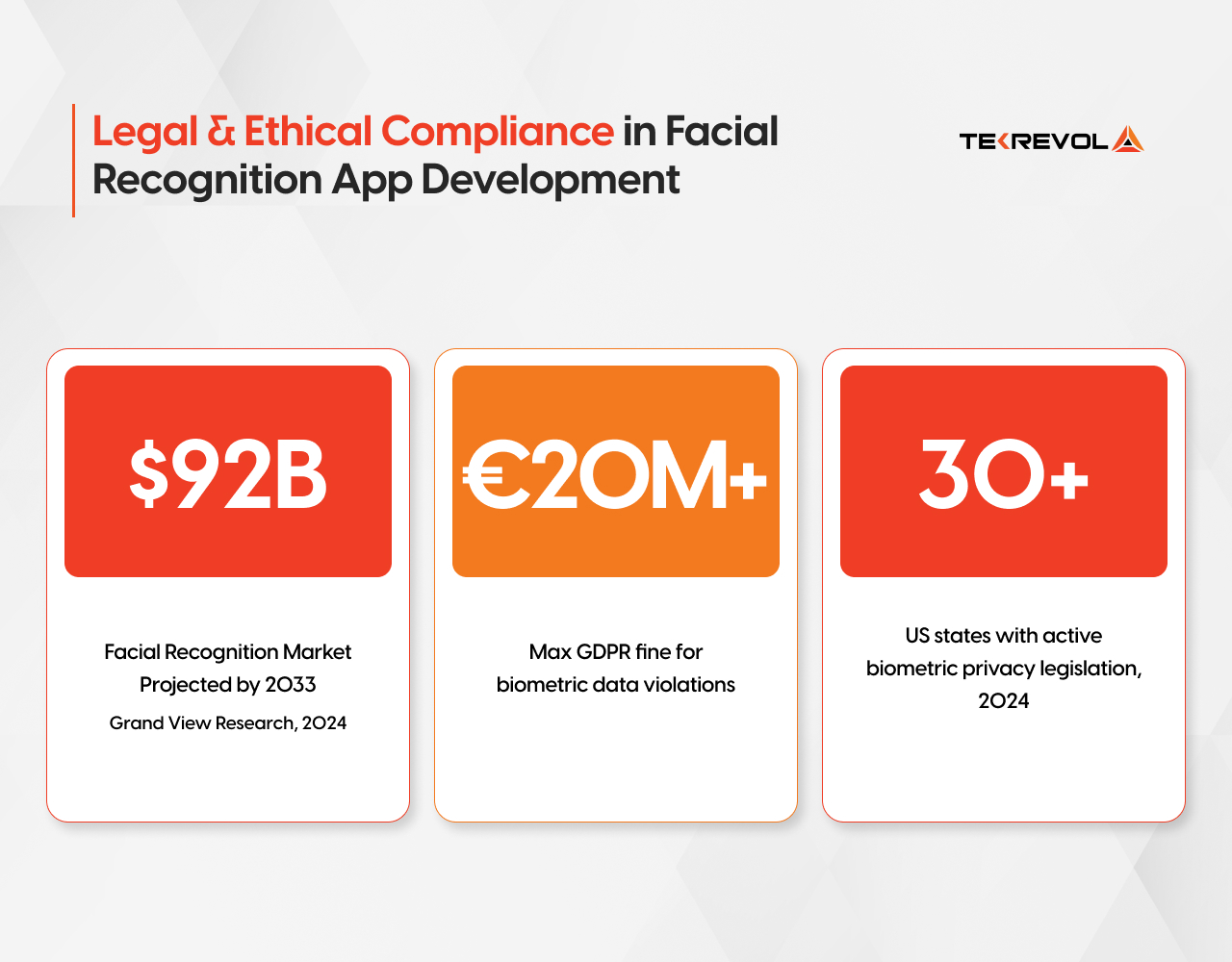
This is the section most teams skim. It’s also the section that determines whether your product survives its first legal audit.
Biometric data is a special category under most data protection frameworks worldwide. Unlike passwords, a face cannot be reissued. Once compromised, it’s compromised permanently. That changes the standard of care required.
Three principles need to be embedded in architecture, not bolted on at launch:
Purpose limitation: biometric data collected for authentication cannot be repurposed for advertising, emotion recognition, or behavioural profiling without fresh consent. Data minimisation, store templates, not raw images, and only for as long as the use case requires. Access control, role-based access, and immutable audit logs are non-negotiable for any regulated deployment.
Libido Health is a sexual wellness platform combining therapy, coaching, and AI-powered health guidance. TekRevol built a HIPAA-compliant platform with encrypted video sessions, GPT-powered support, and AWS scaling. The app achieved over 20,000 active users and increased user engagement by 150% within 3 months.
→ Explore the full Libido Health case study
Learn more about our healthcare app development capabilities
GDPR, CCPA, and Biometric Privacy Laws by State & Country
There is no universal biometric law. Where your users are located determines what your biometric security architecture must support. Here’s the current landscape.
| Region / Law | Key Requirement | Consent Standard | Penalty Exposure |
| EU – GDPR (Art. 9) | Data minimisation, DPA required, cross-border transfer controls | Explicit + documented | Up to €20M or 4% global turnover |
| Illinois – BIPA | Written policy, defined retention schedule, no sale of biometrics | Written consent required | $1,000–$5,000 per violation; class-action exposure |
| California – CCPA / CPRA | Right to delete, opt-out of sale, sensitive data disclosure | Opt-out (sale); opt-in (sensitive use) | Up to $7,500 per intentional violation |
| US Healthcare – HIPAA | Encrypted storage, access logs, BAAs with all vendors | Authorisation required | Up to $1.9M per category per year |
| Canada – PIPEDA / Bill C-27 | Proportionality, breach notification within 72 hrs | Meaningful consent | Up to CAD $25M under Bill C-27 |
| India – DPDP Act 2023 | Data fiduciary obligations, localisation rules | Informed, specific consent | Up to ₹250 Cr (~$30M) |
| UAE / GCC – PDPL | Data residency, cross-border transfer approvals | Explicit consent required | Criminal liability possible |
The GDPR biometric data rules are the strictest global benchmark. If your architecture is GDPR-compliant, adapting it for BIPA or CCPA is a configuration exercise, not a rebuild. Build to the highest bar from day one.
BOB was built to digitize and automate complex employee onboarding and HR workflows for enterprises. TekRevol developed a secure centralized platform with document verification, digital signatures, and workflow automation. The solution reduced manual admin work, improved data accuracy, and streamlined large-scale HR operations.
→ Explore the full BOB case study.
Cost to Build a Facial Recognition Feature
Cost varies enormously based on where the intelligence lives (on-device vs. cloud), whether you’re building a biometric authentication app from scratch or integrating an existing API, and what compliance requirements you need to meet.
| Build Type | Components Included | Typical Timeline | Estimated Cost Range |
| Simple Face Unlock | FaceID / on-device SDK, basic auth flow, no cloud processing | 3–6 weeks | $8,000 – $25,000 |
| Cloud-Based Verification | Third-party API (AWS / Azure), liveness detection, consent flows | 6–12 weeks | $25,000 – $75,000 |
| Full Biometric System | Custom model, feature extraction, encrypted template storage, audit logs, compliance layer, anti-spoofing | 4–8 months | $80,000 – $250,000+ |
| Regulated Industry (HIPAA / BIPA) | All above + legal architecture, DPA agreements, third-party security audit | 6–10 months | $120,000 – $400,000+ |
Estimates based on mid-senior engineering rates ($80–$150/hr), third-party API costs, and compliance overhead. Figures will vary by team location and complexity. See Statista’s biometric market data for broader industry context.
The largest hidden cost is compliance retrofitting. Teams that skip legal architecture at scoping routinely spend 30–50% more fixing it post-launch. Ongoing costs include API calls (typically $0.001–$0.01 per transaction), storage for encrypted templates, and annual bias auditing for liveness detection app and matching components.
How TekRevol Implements Facial Recognition Responsibly
Most teams treat compliance as a final checkbox. TekRevol treats it as the foundation.
Whether you’re exploring facial recognition app development for a fintech product, building a biometric authentication app for enterprise security, or just figuring out how to add a face unlock feature without cutting corners, the architecture decisions you make in week one determine what you’re defending in court two years later.
We’ve seen what happens when teams rush face detection app development without thinking through consent, storage, or bias. It’s expensive to fix and, in regulated industries, sometimes impossible to recover from.
That’s not the approach we take. Every system we build starts with the legal landscape, runs through ethical model selection, and ships with access controls and audit trails already in place. Not because it’s good marketing, but because our clients don’t have the option of getting it wrong.
If you’re ready to build something that holds up, technically, legally, and ethically, our AI development team is a good place to start the conversation.
Integrate Facial Recognition the Right Way
TekRevol builds compliant, accurate biometric systems for fintech, healthcare, and enterprise.
Get a Free Architecture Review!