Running an online store using a basic spreadsheet or manual tracking tool? You’re losing money on shoppers who visit once and never return. You need to build a custom CRM for ecommerce systems to fix this. The “answer” to better sales isn’t just getting more traffic; it’s using ecommerce customer relationship management. This helps you understand exactly who your customers are and what they want to buy next.
A custom ecommerce CRM solves your biggest pain points. You can finally trigger the right message at the right time to increase customer retention and drive repeat purchases. Partnering with a professional ecommerce app development company helps you capture these fleeting digital moments effectively.
This guide walks you through how to build the best CRM software for ecommerce that becomes the backbone of your retail growth strategy.
What is CRM for eCommerce?
An ecommerce customer relationship management system is a digital hub that gathers every interaction a shopper has with your brand into one clear profile. It tracks everything from the first time someone clicks an ad to their most recent refund request.
While a standard CRM might just store phone numbers, a CRM for ecommerce website focuses on buying habits. It tells you who your big spenders are. By visualizing customer lifecycle management, you can increase customer retention and drive personalized marketing efforts. Instead of sending the same email to everyone, you send the right message to the right person at the right time.
Integrating this level of insight is one of the many Shopify benefits for ecommerce, as it allows you to stop sending generic messages and start providing real value to every customer. Essentially, the best CRM for ecommerce business acts as a bridge between your raw data and your sales strategy, ensuring no customer feels like just another number in a database.
Types of eCommerce CRM
When choosing a CRM for ecommerce business, you generally have two paths:
Off-the-shelf CRMs are ready-made platforms like HubSpot or Zoho that you can start using today. They offer fast setup and standard features, but often charge per use,r which gets expensive as you scale.
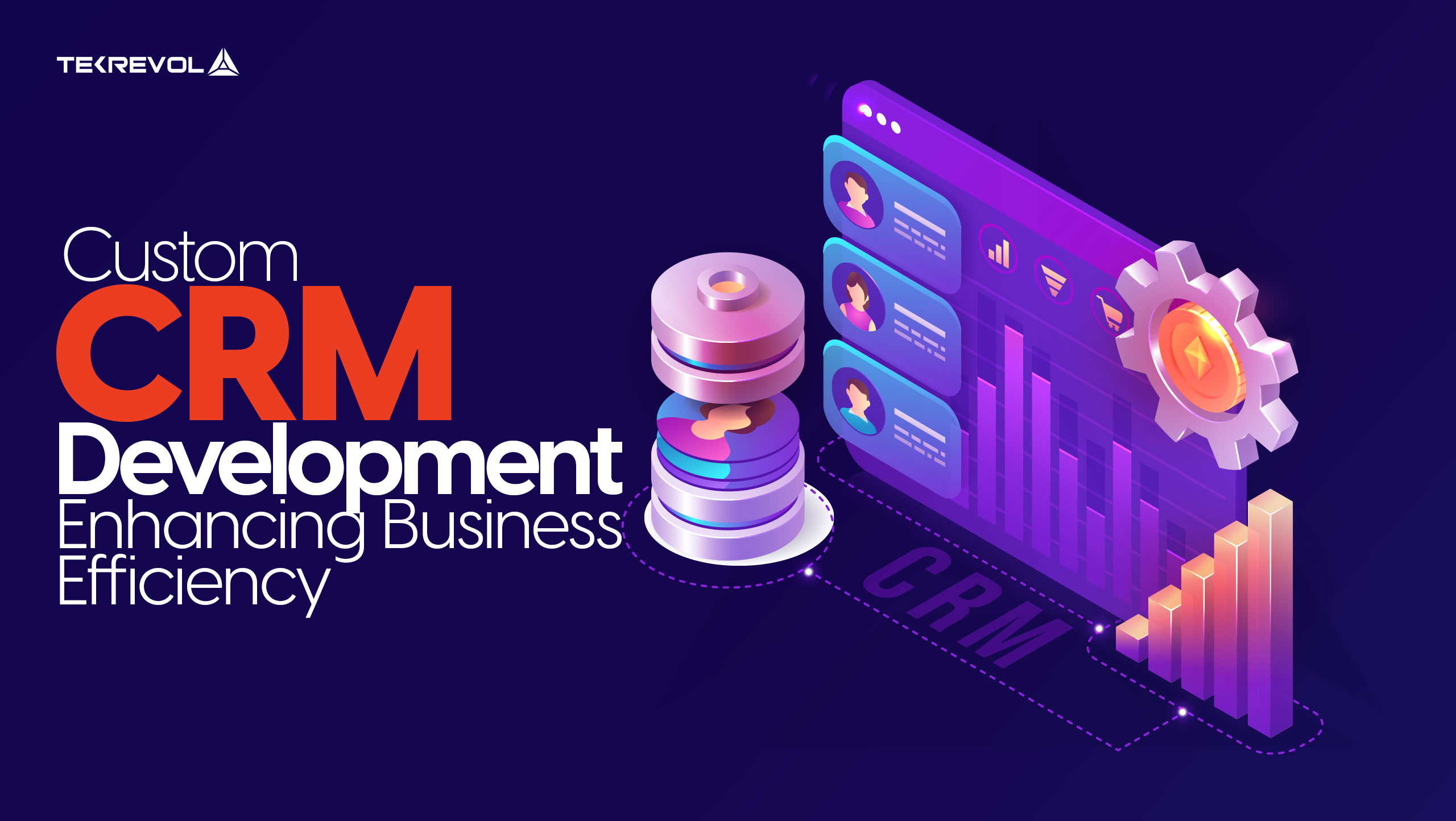
Custom CRMs, on the other hand, are built from the ground up to fit your exact workflow. While the initial setup takes more time, you own the software that matters to your niche. Many founders find that a custom CRM enhances business efficiency because it removes the clutter of unnecessary features.
Why Do You Need a CRM for eCommerce?
An online store can only grow as fast as its data allows. Without a central system, you are essentially flying blind, unable to see why some shoppers stay and others vanish. A CRM for ecommerce business provides the infrastructure needed to scale operations without losing the personal touch.
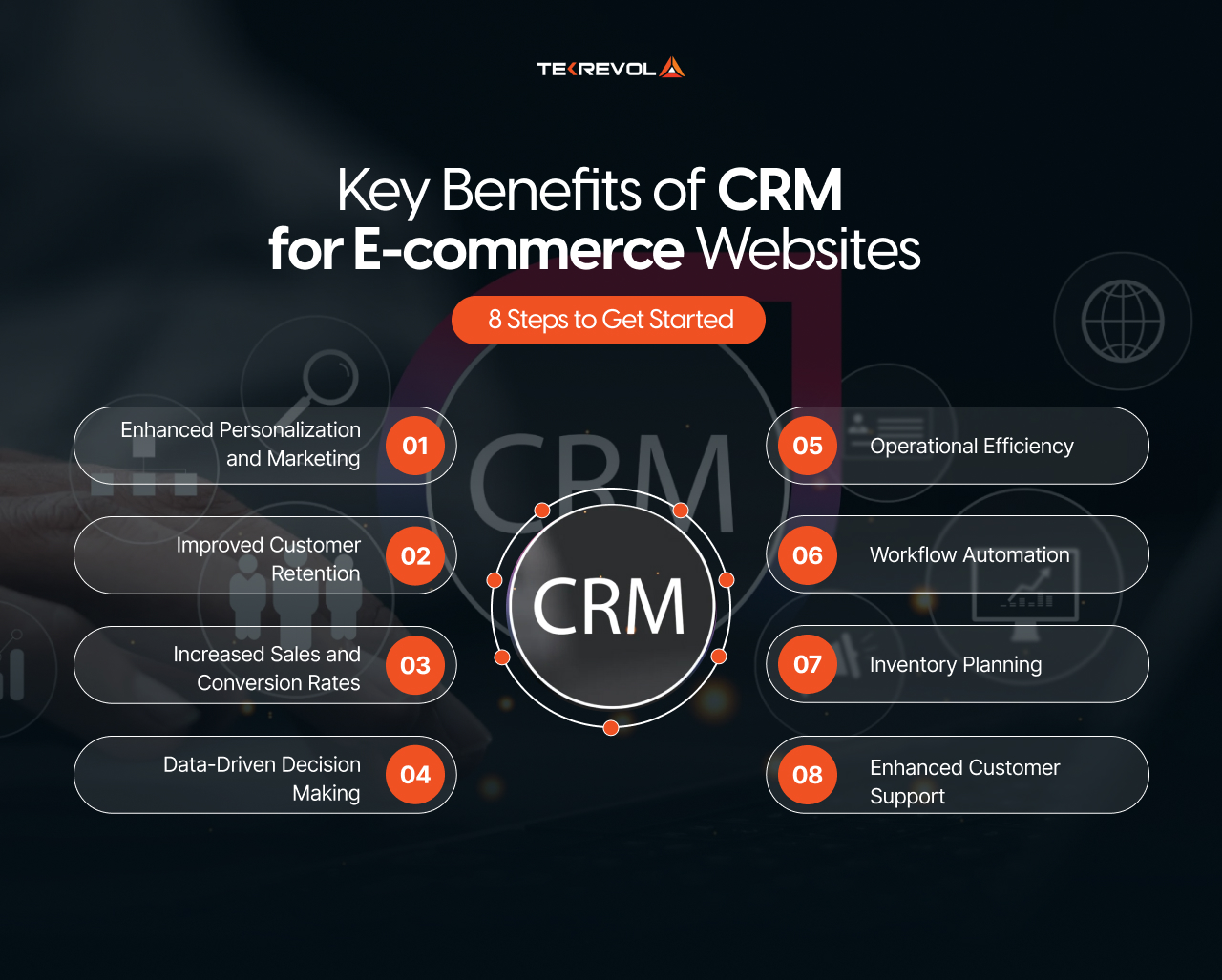
According to 2026 ecommerce statistics, businesses using a CRM see an average ROI of $8.71 for every $1 spent. Furthermore, personalized experiences driven by CRM data now make shoppers 60% more likely to become repeat buyers.
Here are five core functions a CRM performs for your store:
- Centralized Data Management: It gathers browsing history and past orders into one profile so your team always has the full story.
- Behavioral Segmentation: The system groups shoppers by their interests, allowing you to send deals that actually matter to them.
- Automated Marketing: It triggers “thank you” notes or win-back emails, which can increase lead conversions.
- Customer Support Tracking: Every help ticket is linked to a purchase history, helping your team solve issues faster.
- Predictive Analytics: By spotting trends, the CRM helps you forecast demand and restock products before they sell out.
If you want to start an ecommerce business that lasts, these tools are no longer optional. They are the engine that keeps your growth steady and predictable.
Why Traditional CRMs May Not Work for eCommerce
Many owners who use generic CRMs built for office-based sales often fall short. Traditional systems are made for long sales cycles involving manual meetings and phone calls. In contrast, online retail moves instantly and handles a much higher volume of transactions.
Standard CRMs cannot often track “live” digital events like abandoned carts. To compete in 2026, you need a specialized system for customer relationship management in ecommerce that understands SKU-level data and web behaviors rather than just phone calls and meeting notes.
Scale Your Sales Faster
We build high-performance CRM solutions that turn raw customer data into actionable insights—helping you streamline processes, boost conversions, and unlock new revenue streams.
Consult Our CRM ExpertsKey Features of a Powerful eCommerce CRM
Building a high-performing CRM requires more than just a place to store names and emails. It must act as an active participant in your sales process by identifying opportunities you might miss. The best CRM software for ecommerce focuses on turning raw data into actionable insights for your marketing team.
Customer Data Unification
The foundation of any successful system is customer data unification. In most stores, data is trapped in separate silos: one for email, one for the website, and another for the support desk. A powerful CRM pulls all these threads into a single “Golden Record” for every shopper. This gives your team a clear view of the entire customer journey, from their first social media click to their last support ticket.
Behavioral Tracking & Segmentation
Generic lists are no longer effective in modern retail. Real-time behavioral tracking monitors what products a user views or adds to their wishlist. The system then uses segmentation to group these users by their interests. This allows you to target “High-Value Shoe Lovers” differently from “One-Time Clearance Buyers.”
Personalization Engine
A robust personalization engine is what makes a shopper feel seen. Benefit from unified data and behavioral insights, the CRM can dynamically change the content a user sees. When you provide a relevant experience, you drastically increase the chances of a conversion because you are solving the customer’s specific needs at that exact moment.
Omnichannel Support
Customers expect a consistent experience whether they message you on Instagram or email your help desk. Omnichannel marketing features within the CRM keep the conversation history in one thread. This prevents customers from having to repeat their issues to different agents.
Detailed Analytics & Reporting
To understand what is actually working, you need more than just sales totals. You need to know exactly which efforts are making money. Detailed data analytics solutions show you the ROI of every email blast and discount code. This reporting helps you double down on what works and cut what fails.
Automation Workflows
Manual follow-ups are impossible to do at scale. Efficiency comes from business process automation that handles the heavy lifting of sending “We Miss You” notes or shipping updates. This keeps your brand top-of-the-mind without adding to your daily workload.
Predictive Analytics
The most advanced CRMs use predictive analytics to look into the future. Analyzing past behavior, the system can predict when a customer is likely to buy again or when they are at risk of leaving for a competitor. This foresight allows you to be proactive.
How to Build CRM for eCommerce (Easy Steps)
The process to create a custom CRM for ecommerce requires a clear roadmap to ensure your system actually helps your bottom line. You must balance technical stability with user experience for your internal team. Following these steps ensures your custom CRM development services result in a high-performing tool.
Define Goals & Requirements
The first step is identifying exactly what you want your data to achieve for your specific business model. You should focus on metrics like increasing customer lifetime value (CLV) and hitting specific business objectives.
Establishing your KPIs early on allows you to measure the success of the system once it goes live. Clear goals help you decide which ecommerce CRM features are essential and which are just “nice to have.”
Data Integration Across Platforms
A CRM is only as good as the data it pulls in. Your system needs to talk to your storefront, whether you require a Shopify integration or the services of a specialized WooCommerce development company.
Beyond the storefront, you must sync your website with payment gateways to track revenue and pull in social media data. This creates a 360-degree view, ensuring your omnichannel CRM remains updated in real-time.
Step 3: Develop Core Features
This step is the heart of your custom CRM for ecommerce. To build a truly effective tool, focus on these six pillars:`
- Customer Profiles: Store purchase history, browsing behavior, and contact preferences. This shows not just what a customer bought, but what they looked at multiple times before deciding.
- Segmentation: Use RFM (Recency, Frequency, Monetary) analysis to group your audience. Create loyalty tiers for high spenders or behavioral segments for those who only shop during sales.
- Automation Workflows: Build triggers for abandoned cart recovery, a welcome series for new sign-ups, and post-purchase follow-ups to ask for reviews.
- Omnichannel Support: Centralize communication across email, SMS, and push notifications so the customer gets a consistent message.
- Analytics & Reporting: Focus on churn prediction, campaign performance, and purchase trends to see which products are gaining heat.
- Personalization Engine: Use data for product recommendations and targeted marketing. If a customer regularly buys organic coffee, show them related items, not decaf tea.
Ensure Security & Compliance
Data protection is non-negotiable when you handle sensitive customer information. Your build must include GDPR compliance and CCPA compliance to avoid massive legal fines. Implement strong data encryption and secure authentication for everyone who accesses the backend. This builds trust with your audience and protects your brand reputation.
Testing & Launch
Before going live, put your system through rigorous QA testing to catch bugs. You should provide thorough user training for your staff to ensure they know how to use the new tools. A phased rollout is usually better than a “big bang” launch because it lets you fix small issues quietly. For those who want expert help, professional CRM development services can provide the technical oversight needed for a smooth transition.
Tech Stack For E-Commerce CRM Development
Building the best crm for ecommerce involves looking at how well the software plays with your existing tech. A modern stack ensures your system can grow as your ecommerce business takes off.
Frontend & Backend Technology Choices
For a modern user interface, the best frontend frameworks like React or Next.js are the industry standard in 2026. These allow your team to manage thousands of customer records in a fast, responsive “single-page” environment.
On the server side, backend app development typically uses Node.js for its speed in handling real-time data or Python (Django) for its deep libraries in AI and automation. This combination ensures the CRM feels snappy for the user while remaining powerful enough to handle complex sales logic.
Database Design & Management
Effective database design prevents your CRM from slowing down as you scale. For structured information like orders and contact details, PostgreSQL offers unmatched reliability and advanced query performance. However, to track unstructured behavioral tracking data like social media clicks or website heatmaps, a NoSQL database like MongoDB provides the flexibility you need. Most enterprise systems now use a hybrid approach to ensure that transaction records are secure while activity logs remain flexible and searchable.
API & Platform Integration
Your CRM needs a deep API integration with every tool you use. This involves connecting with storefronts like Shopify or BigCommerce to sync order data the moment a sale happens. To make these systems talk to each other perfectly, API integration developers can build custom “hooks” for payment gateways and marketing tools. A well-integrated frontend backend stack ensures that when a customer updates their profile on your site, that change is reflected in your CRM within milliseconds.
Cloud Hosting & Security Considerations
In 2026, cloud platforms like AWS or Google Cloud are essential for handling traffic spikes during major sales. Expert cloud migration services offer “autoscaling,” which adds server power automatically so your system never crashes.
Security is the final, non-negotiable piece; you must implement end-to-end data encryption and multi-factor authentication to keep shopper data safe. By hosting your CRM in a secure, compliant cloud environment, you protect your brand from data breaches and ensure you meet global privacy standards like GDPR.
Simplify Your Build Journey
We eliminate technical friction by developing scalable CRM solutions for eCommerce businesses—streamlining operations, centralizing data, and supporting long-term growth.
Get Your Custom QuoteTop Tools & Platforms for eCommerce CRM
The best tools to build a CRM for eCommerce bridge the gap between your store’s data and your marketing strategy by providing deep insights into shopper habits. Most top platforms offer built-in connectors for major storefronts, allowing you to sync order history and customer profiles automatically to drive repeat sales.
| Platform | Best For | Key Feature | Starting Price |
| HubSpot | Scaling SMBs | All-in-one Marketing & Sales | Free ($15+/user) |
| Zoho CRM | Budget Optimization | Modular AI (Zia) | $14/user |
| Salesforce | Global Enterprise | High-Volume Personalization | $25/user |
| Omnisend | Retail Automation | SMS/Email Sync | Free (Paid from $16) |
| Softr | Custom Internal Tools | No-Code Data Interfaces | Free (Paid from $49) |
HubSpot CRM
HubSpot is the best CRM for ecommerce for small to medium businesses. It offers a “freemium” model to track customer interactions without an upfront cost. However, as your database grows, the pricing can jump significantly. It is an excellent choice for those who want a “plug-and-play” experience with popular platform integrations like Shopify.
Zoho CRM
For brands looking for a balance between power and price, Zoho is a top-tier crm for ecommerce business. It is highly flexible, allowing you to customize modules and fields to fit your specific niche. It also includes “Zia,” an AI assistant that helps with sales forecasting and identifying anomalies in your data. It remains one of the most budget-friendly automation tools on the market today.
Salesforce Commerce Cloud
Salesforce is widely considered the best CRM software for ecommerce at the enterprise level. Its “Einstein AI” provides deep insights into shopper behavior, helping large brands scale their personalization engine across multiple regions. Because it is so complex, the cost to develop ecommerce website around Salesforce is higher, often requiring specialized consultants to manage the setup and ongoing maintenance.
Omnisend
Unlike general-purpose CRMs, Omnisend was built specifically for online retail. It excels as a crm for ecommerce website growth by focusing heavily on email and SMS marketing. While it may not have the deep “lead management” features of a B2B CRM, its ability to drive sales through targeted messaging makes it a favorite for stores focusing on fast-paced retail growth.
Softr
Softr allows you to build custom internal tools and portals on top of your existing data (like Airtable or Google Sheets). This is perfect for brands that need a specific interface for their support or warehouse teams to interact with customer data. It bridges the gap between a rigid best crm software for ecommerce and a fully custom build.
How to Decide Between Custom vs Off-the-Shelf CRM
The choice between building a custom CRM for eCommerce business or buying a license is one of the biggest strategic decisions. An off-the-shelf solution offers a quick start, but a custom build provides long-term ownership and precise control. The answer depends on whether you need a basic tool immediately or a scalable asset that grows with your specific brand identity.
Off-the-Shelf CRM
Ready-made platforms are designed for the “average” user. They provide a standardized set of tools that can be deployed almost instantly.
| Pros | Cons |
| Launch your system in just a few hours | Costs scale aggressively as your team grows |
| Small monthly fees are easier on startups. | You pay for tools that remain unused |
| The vendor handles all security and feature patches | Often difficult to sync with specialized software. |
Custom-Built CRM
A custom solution is designed around your specific business logic, allowing you to control every aspect of the user experience and data flow.
| Pros | Cons |
| Full control over customer information. | Requires a significant initial investment |
| No monthly subscriptions for adding new members | Building from scratch takes several months to complete. |
| Every feature is built for your processes. | You are responsible for future updates. |
Key Considerations for Your Business
To make the final call, look at your long-term roadmap. If your business relies on standard sales processes, a pre-built tool might be enough. However, if you have a unique product cycle or complex workflows, a custom build is the better path.
For growing stores, the cost to build custom CRM software is often seen as a one-time investment in scalability. A custom crm for ecommerce allows you to build only the integrations that move the needle for your bottom line.
Future Trends in eCommerce CRM
The latest CRM trends show that the industry is moving toward even more automation and smarter data use. Keeping up with AI CRM technology is going to be essential for staying ahead of the competition.
AI & Predictive Analytics
AI is now being used to write personalized emails and predict which products will be the next big hits. It can analyze your ecommerce website to find new opportunities. This makes your marketing feel less like a guess and more like a science.
Chatbots & Conversational CRM
Modern bots can now handle complex questions and even process returns without a human. They pull info from your CRM to provide instant help that feels surprisingly personal. This is a huge win for improving customer lifetime value (CLV).
Hyper-Personalization & Real-Time Segmentation
The future is all about showing the right thing to the right person at the exact right moment. This level of hyper-personalization is only possible if your CRM is fast and well-integrated. It turns every visit into a unique shopping experience.
Conclusion
To build a CRM for eCommerce website, you must focus on data unity and actionable automation. Whether you choose a ready-made tool or invest in custom software development services, the goal remains the same: understand customers better than your competitors do.
A well-implemented CRM turns a one-time buyer into a lifelong fan of your brand. It automates the boring stuff so you can focus on building products people love. This is how you move from being just another shop to being a beloved brand.
If you are looking for an expert to navigate this process, TekRevol is here for you. Our ecommerce website development services integrate your chosen CRM platform seamlessly with your storefront to avoid data silos. We help you find the best path forward for your unique goals.
Own Your Retail Future
Partner with TekRevol to build a powerful eCommerce CRM that centralizes customer insights, automates sales workflows, and strengthens your competitive edge in a fast-moving retail market.
Discuss Your Project