If you’re still running logistics the same way you did three years ago, you’re already behind.
Houston logistics faces mounting challenges: port delays, traffic congestion, and rising fuel costs. Reliable drivers are harder to find each year. And your competitors aren’t standing still; they’re actively improving.
That’s where agentic AI comes in, and no, this isn’t another overhyped tech trend that promises everything and delivers nothing. These intelligent systems do not merely follow what you are doing; they also solve problems themselves.
AI adoption in supply chain management is now becoming a necessity for Houston companies that need to remain competitive.
This is why more and more logistics companies are collaborating with mobile app developers in Houston to develop smart solutions with Agentic AI capabilities that fit their needs. These applications follow the patterns, evolve around the changes, and make decisions within a split-second that once required the whole team.
In this blog, we will take you through the reasons why logistics companies in Houston are considering agentic AI applications and how AI adoption in supply chains is transforming the industry.
What is Agentic AI in Logistics?
To understand the specific adoption of AI in supply chain operations in Houston, it is important to know what is unique about agentic AI in comparison to traditional automation and conventional AI systems.
The term agentic AI describes artificial intelligence systems that have autonomy, goal-directed behavior, and the ability to make independent decisions within specified limits.
Relative to the conventional software, which operates according to set rules or passive machine learning models that simply offer suggestions, agentic AI is active in taking action to achieve targeted objectives. This is what makes logistics apps revolutionize business more autonomously. That said, businesses must still address the challenges of AI adoption and focus on navigating and mitigating AI adoption risks before they can fully benefit from these capabilities.
Key characteristics of agentic AI systems include:
- Autonomy: The capability to act without human supervision, make decisions depending on the current data, and obtain information through established patterns.
- Goal-Oriented Behavior: These systems are not just processors of inputs but strive to meet a certain goal, such as minimizing delivery times or cost reduction.
- Flexibility: Agentic AI uses results and modifies its strategies with the evolving circumstances, be it traffic, weather, or demand changes.
- Proactivity: These systems do not just react in response to the emerging issues; they anticipate them and act in advance before the problems emerge.
- Multi-Agent Coordination: Multi AI agents may collaborate, exchange information, and coordinate their efforts to achieve optimal complex supply chain operations.
Traditional AI vs. Agentic AI in Logistics
The conventional AI in logistics is a support tool; it interprets data, provides forecasts, and suggestions, yet people must still act on these suggestions.
As an example, a traditional route optimization system may provide the most optimal delivery order, yet a human dispatcher must examine and confirm that.
In comparison, agentic AI is able to make autonomous decisions. A route optimization system is an agentic, it not only suggest route, but it also allocates drivers, releases schedules depending on traffic, informs the customers, and reroutes deliveries in case of an issue. The system is self-improving and learns with every delivery to do a better job in the future.
McKinsey suggests that business organizations that have adopted autonomous AI tools in their supply chain operations have saved logistics expenses by 10-15 percent and, at the same time, enhanced delivery performance.
Every Day Without AI Is a Day Your Competition Gets Ahead.
Partner with us to implement agentic AI solutions that solve real-world challenges!
Talk to Our Experts!The State of AI Adoption in the Supply Chain Industry
According to the recent industry surveys, the AI adoption in the supply chain landscape is interesting:
- By 2026, 50% of supply chain organizations will have invested in applications supporting autonomous decision-making capabilities, up from just 15% in 2023, according to Gartner research.
- Many businesses intend to test agentic AI systems shortly, particularly in fuel optimization, operational resilience, and better data quality.
- Generative AI in logistics is estimated to grow to 32 percent by 2034, up from the current $1.3 billion, due to the rampant adoption of AI by many enterprises.
What’s Driving AI Adoption in Supply Chain and Logistics?
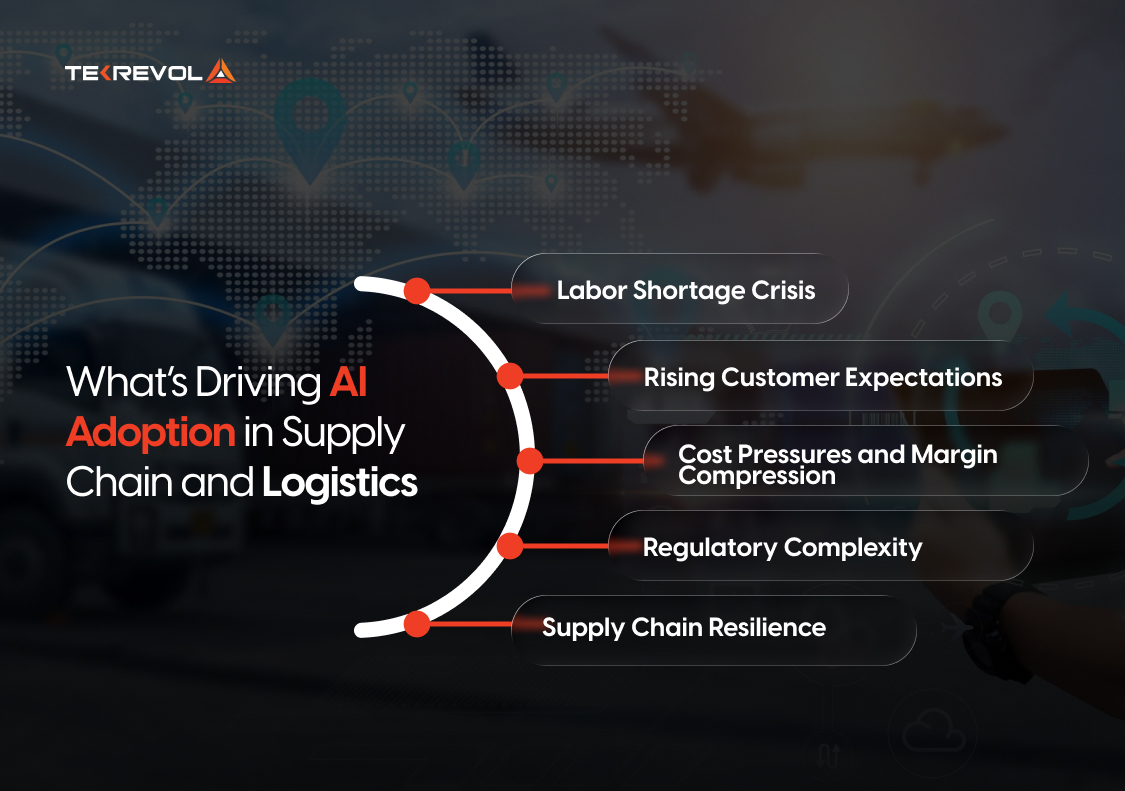
Houston logistics companies are adopting agentic AI technologies at an increasing rate because of several interrelated factors.
Labor Shortage Crisis
There is a serious and persistent shortage of labor in the logistics industry. According to the American Trucking Associations, there is a shortage of 80,000 drivers in the nation, and the situation in Houston is being aggravated by the growing economy.
Warehouse employees, dispatchers, and logistics coordinators are hard to recruit and retain. Agentic AI addresses this challenge, not by replacing workers, but by automating routine tasks and supporting existing staff. This allows companies to maintain service levels even with ongoing labor shortages.
Rising Customer Expectations
The Amazon effect has changed the expectations of customers in both B2B and B2C logistics. The contemporary customer needs real-time tracking, a delivery window that is really accurate, proactive updates, flexibility in delivering options, and immediate response.
At a large scale, it is almost impossible to fulfill these expectations manually. The agentic AI allows the logistics companies to rise above these demands, making customers more pleased and producing a strong competitive advantage.
Cost Pressures and Margin Compression
Logistics is a well-known low-margin business with the majority of companies having profit margins of between two and six percent. Profitability suffers when fuel, labor, or compliance costs go up, and such costs are very difficult to transfer to the customer when the competition is intense.
Agentic AI provides possible cost reductions in various aspects that contribute to making the logistics companies efficient and more profitable.
Regulatory Complexity
Logistics firms are forced to deal with increasing regulatory complexity. Federal hours-of-service regulations, hazardous material handling regulations, customs documentation, environmental compliance regulations, and safety measures all contribute to administrative labor and expense.
Failure to comply would lead to fines, service interruption, and loss of reputation. The agentic AI systems are used to assist logistics firms in handling challenges in an effective manner by maintaining compliance and reducing risk.
Supply Chain Resilience
The worldwide supply chain system has demonstrated its instability during the last two years because of pandemic-related disruptions, extreme weather events, port traffic blockages, and political unrest. Businesses now use supply chain resiliency as their main method for survival.
AI systems that operate autonomously achieve their ability to withstand interruptions because they identify risks, create backup plans, and respond swiftly to operational interruptions, which helps especially in hurricane-prone regions like Houston.
What Are the Advantages of AI in Logistics? Measurable Results Companies Are Seeing
Houston logistics companies achieve high operational efficiency and reduced expenses while satisfying customers through their implementation of agentic AI. Some of the most impactful benefits of AI in logistics include:
1. Intelligent Route Optimization
The AI agents identify the most efficient routes based on the real-time information that encompasses the traffic and the weather conditions, the availability of the drivers, the truck capacity, the fuel costs, and the time of delivery.
Each time it makes a delivery, the system collects operational data. This allows it to recognize patterns: certain warehouses that require extended unloading times, specific locations with predictable traffic delays. These learnings enable smarter route planning going forward.
2. Warehouse Automation & Management
AI systems control all warehouse operations by selecting storage locations for products while managing robotic systems, delivering operational predictions, creating delivery schedules, and training employees.
The system adapts continuously throughout the day based on demand levels and equipment performance, keeping operations flowing without constant manual oversight.
3. Predictive Maintenance
AI monitors information about your trucks to identify warning signs that a component is about to wear out. It takes time to plan the maintenance appropriately and even order the parts you are likely to need before the truck goes bad. The more it tracks each vehicle, the better it is at anticipating what will be required in the maintenance of that particular truck and when.
4. Demand Forecasting & Capacity Planning
AI forecasts the level of shipping demand that you will need in the future based on the past data, economic patterns, weather patterns, and customer trends. Then it automatically calculates your capacity, schedules, and prices to fit what is coming. This will allow you to plan wiser and bundle deliveries in a more efficient manner without wasting truck space or warehouse space.
5. Customer Service Automation
AI takes over warehouse tasks, determining where to locate inventory, working around robots, predicting what you require, organizing outbound deliveries, and training workers on how to do their tasks.
The system, using AI agents and workflow automation, will vary throughout the day depending on the busyness of things and whether the equipment is functioning correctly, keeping everything moving without an individual having to deal with every detail manually.
6. Load Matching & Network Optimization
AI matches shipments with trucks that have space, plans routes that cut down on driving empty, and finds ways to make more money from each truck. It operates as a self-driving marketplace, continuing to come up with more optimal combinations of loads and routes to ensure that your trucks are always loaded with paying freight rather than traversing empty roads.
Measurable Business Impact of Agentic AI in Logistics
AI adoption in the supply chain is not merely a technology upgrade; it brings real business outcomes. The Houston logistics companies are experiencing quantifiable changes in the cost, revenue, service, and workforce satisfaction.
1. Significant Cost Reductions
Agentic AI assists logistics companies in reducing costs in various fields. Dynamic routing reduces fuel expenditures, predictive maintenance eliminates costly repairs, and automation removes administrative overhead.
Further savings are obtained through reduced detention costs, reduced insurance claims through enhanced safety, and maximization of asset use. Early adopters have seen 15-30% reduced operating costs in the first year.
2. Revenue Expansion and Growth
AI in supply chain and logistics not only saves money, but it also opens new possibilities for increasing revenue. The companies increase their revenue by maximizing capacity, providing high-value services, and reacting to opportunities promptly, without necessarily augmenting resources in the same proportion.
3. Enhanced Service Levels
Reliability and responsiveness are the pillars of logistics. The agentic AI is instrumental in improving the accuracy of orders, on-time performance, and the overall customer experience with automated scheduling, predictive management of demand, and real-time modifications to operations. AI also enhances speed in responding to questions and automatically solves possible delays.
4. Improved Employee Experience
Instead of substituting employees, agentic AI can add to human abilities and minimize monotonous and stressful work. Staff members have improved decision-making processes, equal working hours, and reduced emergencies, which enhance morale and retention. This is particularly useful in Houston, where the shortages in drivers and warehouse workers are acute.
Roadmap to Successful Agentic AI Implementation for Houston Logistics Companies
For Houston logistics companies, custom logistics software development with agentic AI offers real transformation potential. However, to achieve this, a guided strategy is required. Here’s a practical roadmap for AI adoption in the supply chain:
Phase 1: Assessment and Strategy (Months 1–3)
Begin with the knowledge of what you are doing. Find the areas of pain, improvement, and where AI could impact the most. Measure the quality of your data and the preparedness of your system integration, and determine success metrics.
Research AI solutions and vendors, build a solid business case, and secure leadership support. Form a cross-functional team that has technical and operational knowledge to push the initiative. It is important to know what AI agents can do for your particular business needs at this point.
Phase 2: Pilot Implementation (Months 4–8)
Start with a small high-impact use case. Train and execute the required data and implement your AI solution in a test setting. Conduct training of the employees about the new processes and closely monitor the performance. Collect feedback, optimize processes, and capture lessons learned.
Phase 3: Expansion (Months 9–18)
Expand your successful pilot into wider operations. Add new applications of the system, increase training, and enhance governance frameworks. Enhance infrastructure to accommodate enterprise-wide implementation and remain in results tracking.
Phase 4: Optimization and Innovation (Months 18+)
Use of AI is a process that keeps going. Continue enhancing systems on the basis of the performance data and experiment with even more advanced advantages of AI. To enable growth, share best practices within your organization, stay up to date with industry practices and regulations, and maintain the infrastructure current.
Revolutionizing your operations with AI isn’t a one-time project; it’s a commitment to continuous improvement and adaptation as technology evolves.
Join the Logistics Leaders Who've Already Made the Switch
We help you navigate the hype and develop a practical strategy to implement agentic AI that delivers real results.
Get Your Free AI Roadmap!Challenges and Solutions for Implementing Agentic AI
The AI adoption in the supply chain is becoming more popular to promote efficiency, predictive analytics, and operational resilience. However, to make successful adoption, one has to overcome numerous complicated issues. This is how market leaders are beating them.
1. Data quality and system Integration
A successful agentic AI is based on high-quality and integrated data. The logistics operations of many organizations involve fragmented information in dispatch, accounting, and customer systems. The historical records are also incomplete or inconsistent, which makes AI accuracy more difficult.
Strategic Approach:
- Carry out comprehensive data audits to find gaps, inconsistencies, and redundancies.
- Pre-configure data cleansing, normalization, and enrichment before the deployment of the AI agents.
- Invest in API development to establish integrations to link siloed systems and real-time data flow.
- Implement data rules and ongoing quality control.
The mobile app development companies in the USA usually take 3-6 months to prepare and harmonize data, and the result was a drastically better AI performance and reliability in predictions.
2. Change Management and Employee Engagement
Recruiting employees is not easy. People fear AI will leave them jobless; they do not understand the way it operates, or they are just used to doing things the way they have always done them. Without your team’s support, your AI investment will fail to deliver results.
Strategic Approach:
- Position AI as a productivity enhancer, not a replacement, with clear messaging.
- Offer hands-on training and workshops to build technical confidence.
- Engage the employees during implementation planning to build ownership.
- Introduce pilot projects in departments with receptiveness, proving the positive changes practically.
3. Technology Selection and Vendor Strategy
The AI market is saturated, and the vendors have a tendency to over-stress agentic capabilities. The selection of an AI agent development company and technology requires stringent consideration.
Strategic Approach:
- Adapt AI solutions to particular operational use cases and scale.
- Evaluate the ability to integrate with existing systems to eliminate expensive customizations.
- Use proof-of-concept projects to validate claims before full-scale deployment.
- Maintain internal expertise to reduce dependency and allow flexibility for vendor changes.
4. Cost Management and ROI Realization
The level of upfront investment in agentic AI is high: the price of software licenses, hardware upgrades, consulting, training, and workflow redesign. The ROI timelines are not fixed and depend on the scope of implementation and the complexity of operation.
Strategic Approach:
- Demonstrate value in the short term by first concentrating on high-impact, high-ROI use cases.
- Implement phase to redistribute expenses and decrease operational interruption.
- Create precise performance indicators to measure the AI effect.
- View AI as a long-term competitive advantage rather than a short-term solution.
How Your Business Can Capitalize on AI Trends in Logistics
Logistics is a fast-paced digital transformation. It allows companies to reduce expenditure, enhance the quality of their products, enhance efficiency, guarantee compliance, and manage risk more efficiently, which eventually results in their increased overall performance. The following is how to shape the trends of AI into actual business outcomes:
1. Partner with Specialized Development Teams
Custom AI and digital solutions deliver the most value when customized to your operations. Partner with a mobile app development company that understands AI agents, agentic AI, and generative AI Solutions. You’ll get logistics-specific solutions instead of generic software that doesn’t fit your operations.
The right development partner has industry knowledge, technical skills, and continued assistance to change your operations positively. Consider:
- Proven logistics and supply chain experience.
- Firms that provide drivers and warehouse employees with a combination of AI agents and mobile apps.
- Partners who provide end-to-end support from strategy to deployment
- Developers capable of integrating AI with your existing systems and mobile workflows
2. Invest in Scalable AI Infrastructure
The power of AI in supply chain and logistics is limited to the systems that it supports. To maximize ROI:
- Create a centralized information repository that brings together data collected by trucks, warehouses, the ERP system, and customer portals.
- Use cloud computing to process large data volumes in real time and provide the necessary flexibility and scalability.
- Make sure that there are effective integration tools that allow AI to integrate with other enterprise systems to ensure smooth operations.
3. Start Small, Measure, and Scale
Do not spend too much in the initial stage. Start with pilot projects that focus on the high-impact areas, like:
- Optimization of routes: save money on fuel and shorten the delivery time.
- Automated customer support: simple questions are answered as the staff is freed to work on strategic issues.
4. Adopt a Continuous Improvement Mindset
The use of AI is not a project that can be completed once. Best practices from the most advanced logistics firms:
- Track the performance indicators and update the AI models.
- Educate workers on the changing AI technologies to achieve maximum use.
- Change strategies according to regulatory changes, market shift and customer expectations.
The Future of AI Adoption in Supply Chain and Logistics Operations
Agentic AI represents the future of AI in logistics, and it’s still evolving. These trends will shape how Houston logistics companies are adopting AI in supply chain and logistics to operate, compete, and grow in the coming years.
1. Gradual Adoption of Autonomous Vehicles
Autopilot trucks are not in full swing yet, but still, logistics firms are already planning for their occurrence. The initial application of AI will be to control mixed fleets, i.e., human cars and semi-autonomous cars will work alongside each other.
Why it matters:
- Better fleet coordination
- Lower labor pressure in controlled environments
- Safer and more predictable operations
2. Smarter Contracts and Payments
To automate logistics agreements, AI is more often integrated with blockchain technology. Automatic payments will be made after deliveries are verified, and the compliance regulations can be taken digitally.
Why it matters:
- Faster payments
- Fewer manual errors
- Greater transparency across partners
3. Digital Twins for Better Planning
Digital twin technology brings virtual copies of real-life logistics, which companies can experiment with changes, optimize, and forecast issues without interruptions to real operations.
The digital twin of your warehouse, of your fleets, or whole supply network runs in parallel with your real operation, and is fed by real-time data. Test the impact of new routes, warehouse redesigns, or demand surges virtually, before spending money on actual changes.
Why it matters:
- Lower operational risk
- Better long-term planning
- Faster decision-making
4. Real-Time Decisions with Edge AI and IoT
Edge AI brings intelligence directly to where decisions need to happen, in trucks, warehouses, and distribution centers, rather than sending data to the cloud and waiting for responses.
Internet of Things (IoT) sensors collect data from every part of your operation: truck locations and conditions, warehouse temperatures, package handling, and equipment performance. Edge AI processes this data instantly at the source, making split-second decisions without the delays of cloud communication.
Why it matters:
- Faster reaction to issues
- More reliable operations
- Better protection of sensitive data
5. Sustainability as a Business Advantage
Environmental responsibility is no longer optional. AI helps logistics companies reduce fuel usage, improve load efficiency, manage electric fleets, and track emissions accurately. In Houston, many logistics firms are now using AI-powered sustainability metrics as a selling point for enterprise customers.
Why it matters:
- Lower fuel and energy costs
- Easier compliance with environmental regulations
- Stronger brand reputation
Partner with TekRevol for Smooth Agentic AI Implementation in Logistics
TekRevol specializes in building AI solutions that actually work in the real world, not just in theory. With a proven track record in supply chain and logistics technology, we understand the unique challenges Houston companies face. We deliver solutions that integrate seamlessly with your existing systems and help your team work smarter from day one.
We’ve developed platforms like Stock n Ship, a comprehensive inventory and order management system that helps businesses handle their product supplies, orders, and customer refunds through unified portals.
As a leading logistics app development company, TekRevol supports every step of the AI journey. Our team assists with data integration, system selection, employee training, and pilot testing to reduce risk and accelerate ROI.
Ready to Transform Your Logistics with AI!
We help you turn complex AI technology into simple, practical solutions that save time and cut costs!
Schedule A FREE Consultation Now!