- A custom meditation app typically costs $40,000 to $300,000+, depending on content scope, AI, and compliance needs.
- A lean MVP needs onboarding, a guided audio library, a timer, progress streaks, reminders, and subscriptions.
- Flutter or React Native suits most meditation apps, while native code fits heavy wearable or audio work.
- Your marketing claims decide your regulatory lane, so “reduces stress” and “treats anxiety” carry different legal risk.
- Consumer wellness apps outside HIPAA can still fall under the FTC Health Breach Notification Rule for health data.
- Retention drives meditation app profit, since Apple’s standard subscription fee drops after a subscriber’s first paid year.
Stress has become a daily habit for many people. So has reaching for a phone. Meditation apps sit right where those two habits meet. That overlap now supports a multi-billion-dollar market, and it keeps growing each year.
Meditation app development is the process of planning, designing, building, and launching a mobile app that delivers guided meditation, breathing, and sleep content. In 2026, a custom build usually takes 3 to 9 months and costs roughly $40,000 to $300,000+, depending on features, content volume, and compliance scope.
Remember, when developing a meditation app, Scope, not code, drives the cost most. This guide walks you through every decision you’ll face, the same way an experienced mobile app development company plans a build. You’ll see app types, must-have features, tech stack choices, costs, monetization, and 2026 FDA and FTC rules. Plus, you’ll find hidden year-one costs and a claim-to-compliance matrix.
Why Should You Build a Meditation App in 2026?
In 2026, the demand for meditation and relaxation apps is climbing. Grand View Research values meditation management apps at $2.20 billion in 2025, reaching $6.99 billion by 2033.
That forecast reflects a compound annual growth rate of about 14.67% from 2026 to 2033, according to Grand View Research. North America held about 43% of revenue in 2025. Meanwhile, iOS led platform revenue with roughly a 49% share.
One detail matters more than the headline number. The same report found that free services held the largest segment share in 2025. In other words, users expect to try before they pay, so your app needs a strong free experience that earns the upgrade.
Why It Matters? A new app rarely wins by copying Headspace feature for feature. Instead, it wins by serving one audience better: night-shift nurses, new parents, teens with exam stress, Arabic speakers, or employees of one industry. Niche focus also shrinks your content budget, because you need fewer sessions to feel complete.
Have a meditation app idea but no clear feature list yet?
Our product team turns your concept into a scoped MVP, tech stack, and budget in one free session.
Book a Free Strategy SessionWhat Types of Meditation Apps Can You Build?
You can build guided meditation libraries, sleep apps, breathing and focus tools, yoga and movement apps, corporate wellness platforms, kids’ apps, and clinical therapy companions.
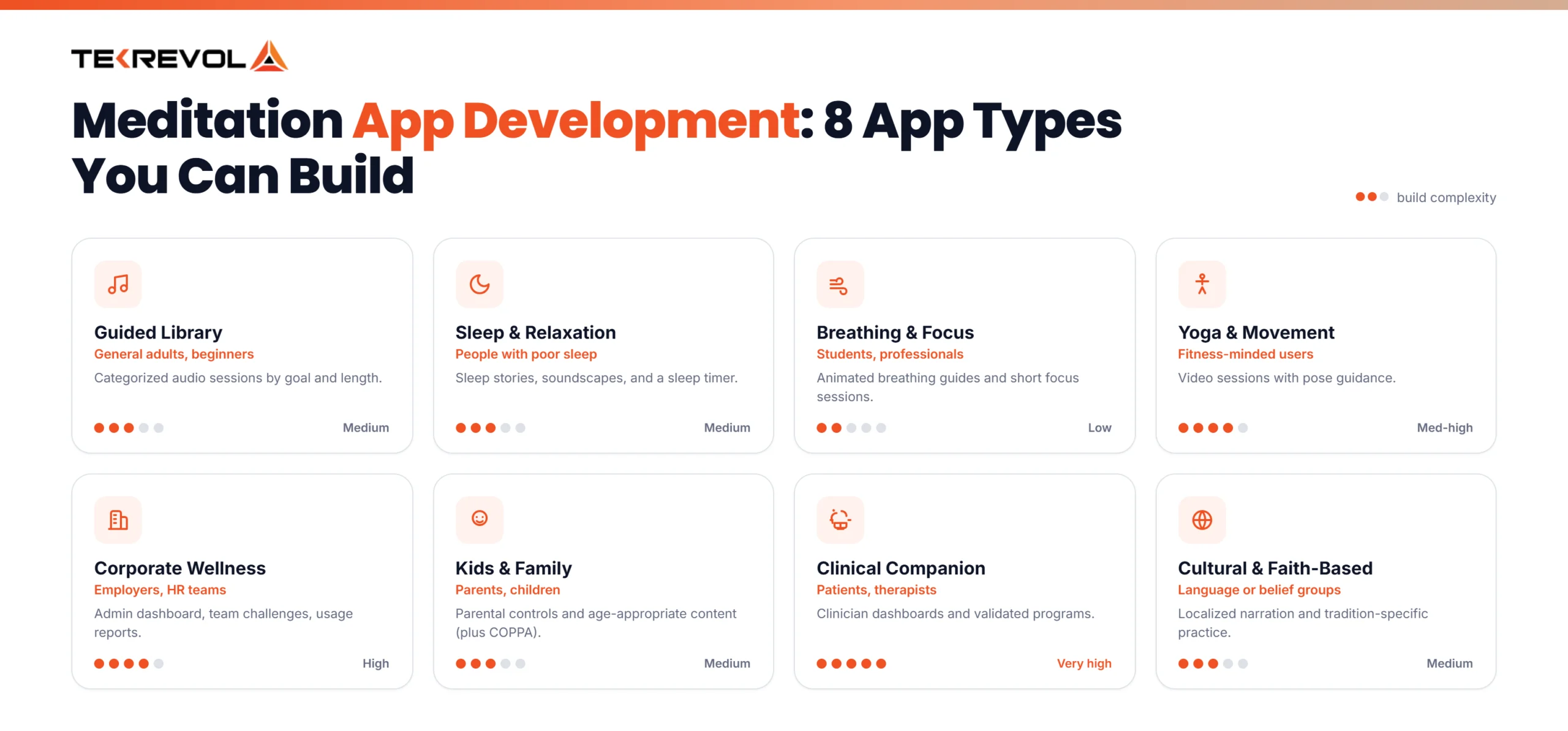
Each type changes your feature list, content needs, compliance exposure, and budget, so choose deliberately.
Here’s how the main categories compare:
| App type | Core audience | Signature feature | Relative complexity |
| Guided meditation library | General adults, beginners | Categorized audio sessions by goal and length | Medium |
| Sleep and relaxation | People with poor sleep | Sleep stories, soundscapes, sleep timer | Medium |
| Breathing and focus | Students, professionals | Animated breathing guides, short focus sessions | Low |
| Yoga and movement meditation | Fitness-minded users | Video sessions, pose guidance | Medium to high |
| Corporate wellness (B2B) | Employers and HR teams | Admin dashboard, team challenges, usage reports | High |
| Kids and family | Parents, children | Parental controls, age-appropriate content | Medium (plus COPPA) |
| Clinical or therapy companion | Patients, therapists | Clinician dashboards, validated programs | Very high |
| Cultural or faith-based | Specific language or belief groups | Localized narration, tradition-specific practice | Medium |
Movement-based apps overlap heavily with fitness products. So if a yoga and meditation app is your plan, our breakdown of the cost to build a yoga app covers video delivery and pose features in more depth.
Clinical apps need a word of warning. Once an app claims to treat a condition, it can move from “wellness product” to “medical device.” We cover that line in the compliance section below.
What Features Does a Meditation App Need in 2026?
A meditation app MVP needs quick onboarding, a guided audio library, a meditation timer, progress tracking with streaks, reminders, offline downloads, subscriptions, and an admin CMS. Then, phase two adds AI personalization, wearable sync, community features, and richer sleep content.
Must-have MVP features
These features form the core experience, and users expect all of them on day one:
- Fast onboarding: Ask one or two goal questions (sleep, stress, focus), then start a session. Skip long forms, since social sign-in and Sign in with Apple cut friction.
- Guided meditation library: Organize sessions by goal, length (3, 5, 10, 20 minutes), and experience level. Also, clear categories matter more than a huge catalog.
- Audio player: Play, pause, a scrubber, background playback, and lock-screen controls. For example, a 3-to-5-second delay before audio starts gives users time to close their eyes.
- Meditation timer: Unguided sessions with interval bells and ambient sound choices.
- Progress tracking: Total minutes, sessions completed, and streaks.
- Reminders and push notifications: Let users pick their own time, because a reminder at the wrong hour feels like noise.
- Offline downloads: People meditate on planes, trains, and in bedrooms with weak Wi-Fi.
- Subscriptions and paywall: Free trial, monthly and annual plans, and restore purchases.
- Admin CMS: Upload audio, tag sessions, schedule new content, and edit copy without a developer.
Phase two and advanced features
Once your MVP proves people come back, layer in features that deepen engagement:
- AI personalization: Recommend sessions based on mood check-ins, time of day, and listening history.
- Mood journaling: Short check-ins before and after sessions.
- Wearable sync: Pull heart rate variability and sleep data from Apple Health or Android Health Connect.
- Sleep content: Sleep stories, soundscape mixing, and fade-out timers.
- Community: Group sessions, live classes, and friend challenges.
- Access for everyone: Add transcripts, captions, and screen reader support. Record sessions in your users’ own language.
- Immersive modes: VR or spatial audio sessions for headsets.
For more ideas on the therapeutic end of the spectrum, see our list of advanced mental health app features.
How Do You Build a Meditation App? Step-by-Step Process
To build a meditation app, pick a niche, set your regulatory lane, scope an MVP, design a calm interface, plan your content pipeline, develop and integrate, test audio on real devices, and launch with app store optimization before iterating.
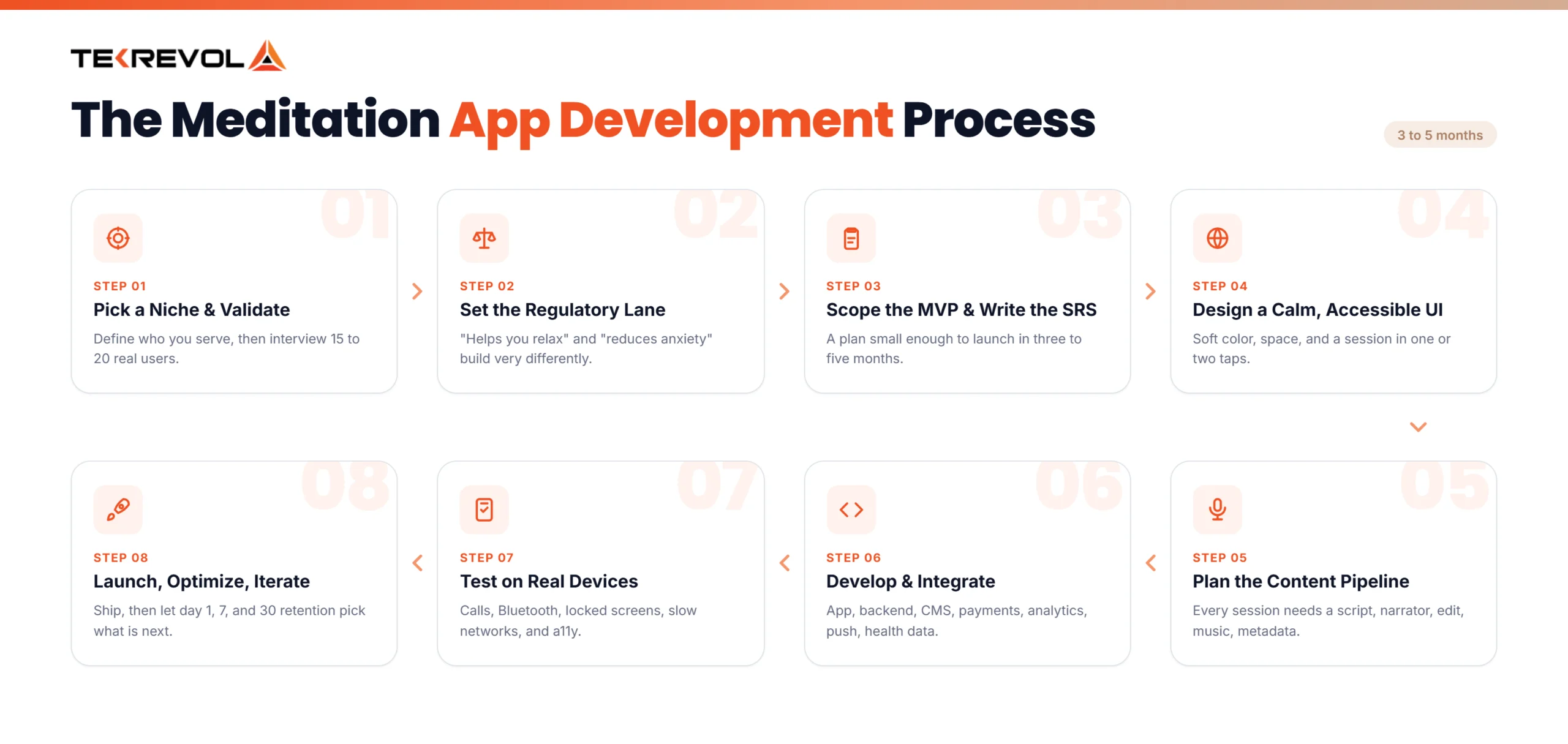
Step 1: Pick a niche and validate demand
First, define exactly who the app serves and which problem it solves. Interview 15 to 20 people from that audience. Then study the top five apps they already use and note what frustrates them in reviews.
Step 2: Decide your regulatory lane early
Next, write down the claims you plan to make in your app store listing. A “helps you relax” claim and a “reduces anxiety symptoms” claim lead to very different build requirements. So settle this before design starts, not after launch.
Step 3: Scope the MVP and write requirements
Turn the feature list into a written plan of what the app must do (an SRS). Keep the MVP small enough to launch in three to five months. As a result, you’ll learn from real users sooner and spend less on features nobody uses.
Step 4: Design a calm, accessible interface
Meditation app design follows its own rules. Use soft colors, lots of space, and slow motion between screens. Also, users should reach a session in one or two taps. Support dark mode, dynamic text sizes, and high contrast, because many people meditate at night. Culture matters too. Images, symbols, and voices should fit your users.
Step 5: Plan your content pipeline
This step gets skipped most often. Every session needs a script, a narrator, a recording, an edit, music, and metadata. Decide whether you’ll hire teachers, license content, or produce in-house. In fact, content is usually the longest lead-time item in the whole project.
Step 6: Develop and integrate
Now your team builds the app, the backend, the CMS, and the integrations: payments, analytics, push notifications, and health data if needed. A seasoned mobile app development team will run this in two-week sprints with a working build at the end of each one.
Step 7: Test on real devices
Test audio playback during phone calls, with Bluetooth headphones, on locked screens, and on slow networks. Additionally, run accessibility checks and a closed beta with 50 to 100 target users.
Step 8: Launch, optimize, and iterate
Finally, prepare store screenshots, a clear description with the right keywords, and a short preview video. After launch, track day-1, day-7, and day-30 retention. Then let that data decide your next features.
Which Tech Stack Works Best for a Meditation App?
Most meditation apps work best with Flutter or React Native, a Node.js or Python back end, cloud storage with a CDN for audio, and native store billing. Heavy wearable or audio features, however, may justify native Swift and Kotlin.
| Layer | Recommended options | Why it fits |
| Mobile front end | Flutter, React Native, or native Swift and Kotlin | One codebase for iOS and Android cuts cost; native gives deepest audio and sensor control |
| Back end | Node.js, Python (Django or FastAPI) | Fast to build, strong libraries for APIs and AI |
| Database | PostgreSQL, Firebase Firestore | Reliable user, progress, and content data |
| Audio delivery | AWS S3 or Google Cloud Storage with a CDN, HLS streaming | Fast, low-cost streaming worldwide |
| Authentication | Firebase Auth, Auth0, Sign in with Apple | Secure sign-in with little custom code |
| Payments | StoreKit 2, Google Play Billing, RevenueCat | Handles trials, renewals, and receipts |
| Health data | Apple HealthKit, Android Health Connect | Sleep, heart rate, and mindful-minutes sync |
| Analytics | Mixpanel, Amplitude, Firebase Analytics | Tracks funnels, retention, and session completion |
| Push notifications | Firebase Cloud Messaging, Apple Push Notification Service | Reminders and content alerts |
Cross-platform or native?
For most founders, cross-platform wins. One team ships to both stores, and updates land everywhere at once. That’s why cross-platform app development services are a go-to pick for a first release.
That said, native development still earns its place. If your app depends on precise background audio, Apple Watch haptics for breathing, or real-time heart rate variability, native Swift and Kotlin give you tighter control.
Microservices or a modular monolith?
For an MVP, though, a well-structured modular monolith is cheaper to build and easier to maintain. You can split out services like recommendations or media processing later, once traffic justifies it.
How Much Does It Cost to Build a Meditation App in 2026?
In 2026, meditation app development costs range from $10,000 for a no-code prototype to $300,000+ for an AI-powered, wearable-connected platform. Most custom cross-platform MVPs land between $40,000 and $90,000, depending on your features, content volume, and compliance needs.
The estimates vary widely because “a meditation app” can mean anything from a timer to a clinical platform. Here are the ranges we see for typical builds in 2026:
| Build tier | What you get | Estimated cost | Typical timeline |
| No-code or white-label | Template app, your branding, basic library | $10,000 to $35,000 | 1 to 3 months |
| Custom MVP (cross-platform) | Core features, CMS, subscriptions, analytics | $40,000 to $90,000 | 3 to 5 months |
| Mid-tier product | MVP plus mood tracking, AI recommendations, wearable sync | $90,000 to $180,000 | 5 to 8 months |
| Advanced platform | AI coaching, B2B dashboards, VR, HIPAA-ready architecture | $180,000 to $300,000+ | 8 to 12+ months |
Where the money goes
In a typical custom build, budget splits roughly like this:
- Discovery and planning: 5% to 10%
- UI/UX design: 10% to 15%
- Development (app, backend, CMS): 45% to 55%
- QA and testing: 15% to 20%
- Project management: 8% to 12%
What pushes the price up
Several factors move your quote more than anything else:
- Platforms: Two native apps cost more than one cross-platform codebase.
- Content volume: Hundreds of sessions need a stronger CMS and more QA.
- AI features: Smart picks and chat check-ins add data, model, and safety work.
- Wearables: Each health platform integration adds development and testing.
- Compliance: HIPAA-ready infrastructure, audit logging, and legal review raise both build and hosting costs.
Not sure which cost tier fits your meditation app?
Get a line-by-line estimate built around your features, platforms, and content plan, free of charge.
Get Your Free App EstimateHow Do Meditation Apps Make Money?
Meditation apps make money mainly through freemium subscriptions, free trials that convert to annual plans, lifetime purchases, corporate wellness licenses, and content partnerships. In-app ads work poorly because interruptions clash with the calm, focused experience that users pay for.
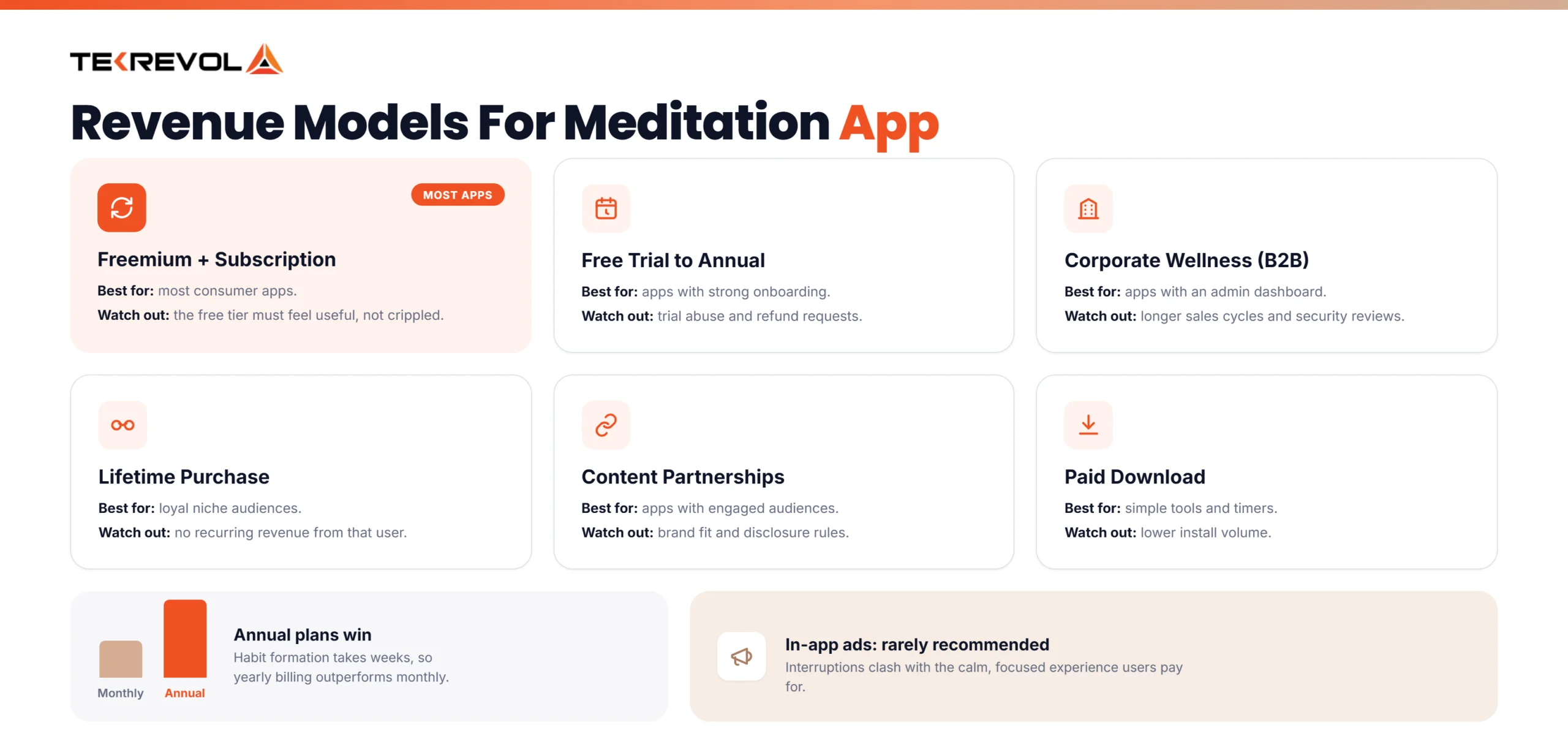
| Model | How it works | Best for | Watch out for |
| Freemium plus subscription | Free sessions, premium library behind a paywall | Most consumer apps | Free tier must feel useful, not crippled |
| Free trial to annual plan | 7 or 14-day trial, then billed | Apps with strong onboarding | Trial abuse, refund requests |
| Lifetime purchase | One-time payment for permanent access | Loyal niche audiences | No recurring revenue from that user |
| Paid download | Pay once to install | Simple tools, timers | Lower install volume |
| Corporate wellness (B2B) | Employers buy seats for staff | Apps with admin dashboards | Longer sales cycles, security reviews |
| Content partnerships | Brands or teachers sponsor programs | Apps with engaged audiences | Brand fit and disclosure rules |
| In-app ads | Ads shown to free users | Rarely recommended | Breaks the meditative experience |
Annual plans usually outperform monthly ones for meditation apps, since habit formation takes weeks. For a deeper look at pricing models across the wellness space, see our guide on mental health app monetization models.
TekRevol Project Insight
B2B wellness is one of the steadiest revenue paths in this category. Corporate employees were falling behind on physical and mental wellness under deadline pressure. So TekRevol built the AMJ Workplace Wellness app. We keep the design simple, so healthy habits feel easy. As a result, the platform delivered 40% more engagement through fitness tracking and daily activity.
Compliance and Rules Apply to a Meditation App in 2026
Your app’s claims and data decide which rules apply. General relaxation apps usually fall under FDA wellness policy and FTC oversight. Apps that treat conditions may become medical devices, while apps handling data for healthcare providers need HIPAA compliance.
- The FDA finalized a revised General Wellness: Policy for Low Risk Devices guidance on January 6, 2026. It keeps the core test: a product must be intended only for general wellness and present low risk. However, it widens the path for noninvasive wearables that estimate measures like pulse or sleep quality, as long as claims avoid diagnosis and treatment.
- The FTC’s amended Health Breach Notification Rule took effect on July 29, 2024. According to the Federal Trade Commission, the update clarifies that the rule covers many health apps not governed by HIPAA. A breach now includes unauthorized disclosures, such as sharing health data with advertising platforms without consent.
The claim-to-compliance matrix
Use this table to find your lane before you design a single screen:
| What your app does | Example claim | Likely regulatory lane | What to build in |
| Promotes relaxation and healthy habits | “Unwind and sleep better” | FDA general wellness (low risk); FTC truth-in-advertising | Evidence for any benefit claims, honest marketing |
| Collects mood logs, sleep, or heart data directly from consumers | “Track your stress trends” | FTC Health Breach Notification Rule | Consent flows, no silent ad-pixel sharing, breach response plan |
| Syncs noninvasive wearable data for wellness insights | “See how your HRV changes after meditating” | FDA 2026 general wellness policy, if claims stay non-clinical | Avoid disease language; validate displayed values |
| Claims to treat or reduce a condition | “Clinically reduces anxiety symptoms” | Possible FDA medical device (software as a medical device) | Regulatory strategy, clinical evidence, quality system |
| Serves clinics, therapists, or health plans with patient data | “Share progress with your therapist” | HIPAA (as a business associate) | Business associate agreements, encryption, audit logs, access controls |
| Serves users in the EU or UK | Any | GDPR (health data is a special category) | Explicit consent, data minimization, deletion tools |
| Targets children under 13 | “Mindfulness for kids” | COPPA | Verifiable parental consent, limited data collection |
| Collects consumer health data from Washington residents | Any health-related tracking | Washington My Health My Data Act | Separate health data consent and privacy policy |
This matrix is general guidance, not legal advice. Always check your own case with a health law attorney.
Why do HIPAA-compliant wellness app quotes come back so high?
Founders often ask why every quote for a HIPAA-compliant wellness app comes back double what they expected. The answer is scope. These builds need encrypted storage, audit logs, access rules, special hosting, and security tests. Our breakdown of the cost of adding HIPAA compliance to a mobile app explains each line item.
The good news? Many consumer meditation apps don’t need HIPAA at all. If you sell directly to consumers and don’t handle data for a covered healthcare entity, the FTC rules above usually apply instead. For apps that do cross into clinical territory, a dedicated healthcare app development company can plan compliance from sprint one.
How Can AI, Wearables, and VR Improve a Meditation App?
AI personalizes session recommendations and adapts content to mood and time of day. Wearables add heart rate and sleep data for real feedback. VR and spatial audio create immersive calm. Each feature raises engagement, but also adds cost, privacy, and safety work.
AI personalization
AI works best when it removes decisions. For instance, a recommendation engine can suggest a five-minute breathing session at 3 p.m. on a busy weekday, then a sleep story at night. Teams building these features often partner with an AI app development company to design the data model and privacy controls together.
Generative AI can also draft scripts or run chat-style check-ins. But people still need to check the work. A trained teacher should edit every AI-written script. And if you clone a voice, get the narrator’s written consent first.
Wearables and biofeedback
Apple HealthKit and Android Health Connect let your app read heart rate, heart rate variability, and sleep data. As a result, you can show users how their body reacts to a session. Keep claims within wellness language, as the FDA’s 2026 guidance requires, and validate any numbers you display.
VR and spatial audio
Immersive sessions on headsets like Apple Vision Pro and Meta Quest are a strong differentiator. Still, the audience is smaller than mobile. So treat VR as a phase-three feature unless your niche lives on those devices.
Should You Use No-Code, White-Label, or Custom Development?
Choose no-code to validate an idea cheaply, white-label to launch a branded app fast, and custom development to own your features, data, and long-term growth. Many founders validate with no-code, then rebuild custom once retention data proves demand.
| Approach | Speed | Flexibility | Cost | Best for |
| No-code builders | Fastest | Low | Lowest | Testing an idea with a small audience |
| White-label platforms | Fast | Low to medium | Low to medium | Coaches and studios who want a branded app quickly |
| Custom development | Slower | Full | Highest upfront | Startups building a scalable, differentiated product |
No-code tools help non-technical founders test demand in weeks. But they limit audio control, offline use, and add-ons. White-label apps look polished, but every competitor on the same platform ships nearly the same product. Custom development costs more at first. Yet it’s the only way to own your features and your data.
How Do You Choose the Right Meditation App Development Company?
Pick a partner that has shipped wellness apps, knows audio and compliance, and builds easy content tools. Look for clear estimates and support after launch, too. Also, ask to see their live apps in the stores, not just mockups.
Before you sign, ask each partner these questions:
- Which wellness or health apps have you shipped, and can I download them today?
- How do you handle audio interruptions, offline playback, and background audio?
- Who decides whether my app needs HIPAA, and how do you document it?
- Will I get an admin CMS my team can use without developers?
- Which roles will work on my project: product manager, designers, mobile and backend engineers, QA?
- What does post-launch support include, and what does it cost?
Partner with TekRevol to Build Your Meditation App
Meditation app development in 2026 rewards focus. The market keeps growing, yet the generic end is crowded, so your edge comes from a clear niche, reliable audio, honest claims, and a plan that keeps users returning.
Choosing a meditation app development company is a big decision. So here’s exactly what you get when you build with us:
- A wellness experience you can download. We’ve shipped live wellness apps, including AMJ Workplace Wellness, Tamreeni, and Libido Health.
- Audio that doesn’t break. Our engineers test calls, headphone changes, lock screens, and offline play on real devices before every release.
- Compliance planned from sprint one. We map your claims and data flows first, then build for FDA, FTC, HIPAA, or GDPR only where they apply.
- One codebase, two stores. Cross-platform builds reach iOS and Android together, which saves budget for content and marketing.
- A CMS your team can run. Upload sessions, tag content, and schedule releases without calling a developer.
- Support after launch. We handle OS updates, bug fixes, and new features as your retention data grows.
TekRevol has delivered 800+ projects across mobile, AI, and healthcare. You can browse more of that work in our project portfolio.
Ready to build a meditation app people actually return to?
Secure a free 30-minute session with our senior product developer to map your MVP, budget, and compliance scope before you build.
Schedule Your Free App Consultation