Monolithic vs microservices architecture is a choice between shipping one application as a single unit and splitting it into many services that deploy on their own. The right answer depends on your team and your system, not on fashion.
Choosing wrong costs you later, either in a slow rewrite or in a team buried in operations work, and that risk grows with the size of a custom software development project, which is our judgment. This guide compares the two side by side and weighs the pros and cons of each, then gives you a five-question test for your own case.
What is the difference between monolithic and microservices architecture?
A monolithic application is built and deployed as one unit, while microservices split the application into small services that deploy independently. The Azure Architecture Center describes each microservice as a self-contained service that owns one business capability and its own data. Monolithic architecture keeps all of an application’s functions in one codebase.
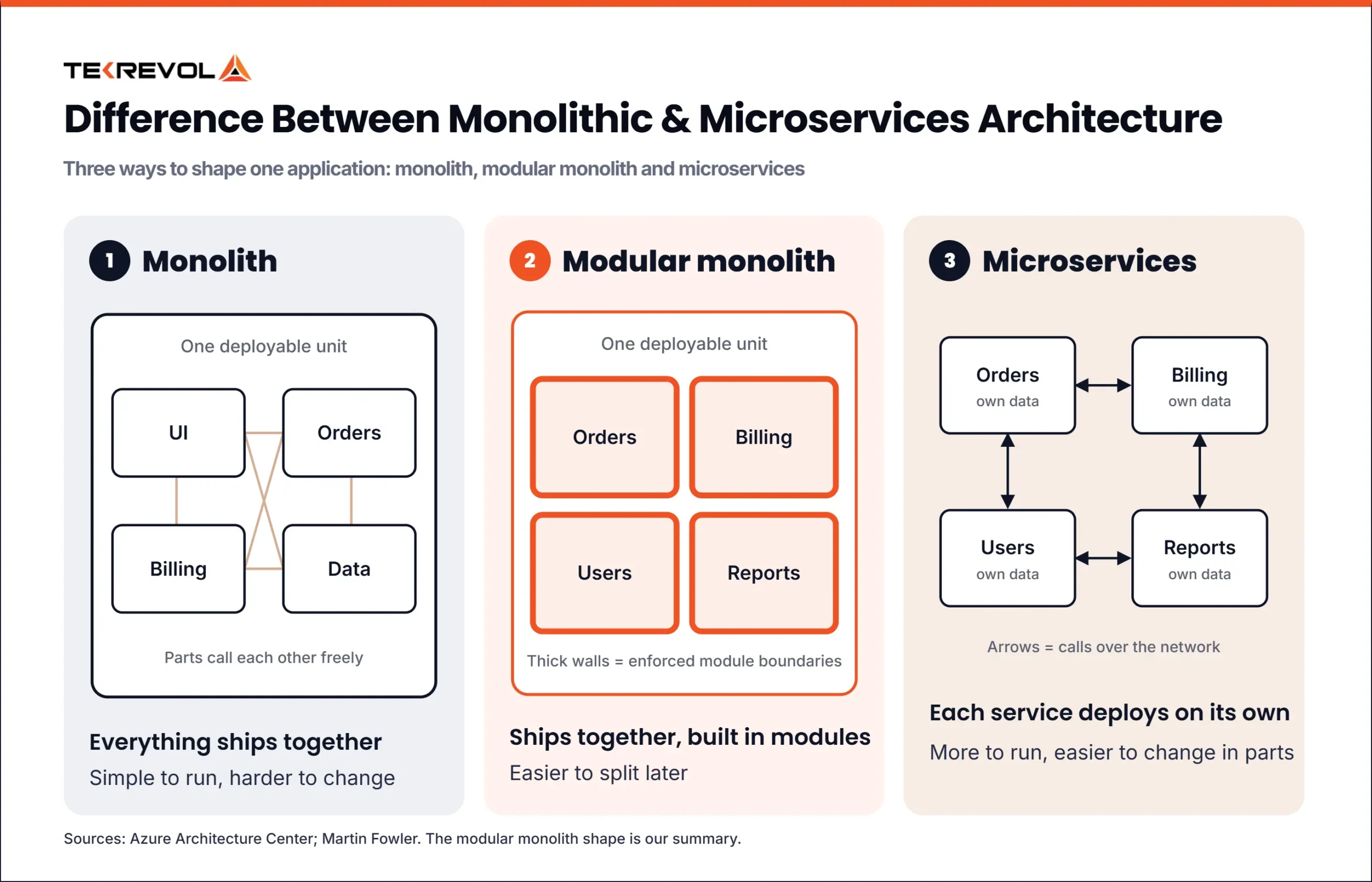
A modular monolith is one deployable application split into modules with enforced boundaries, and it is the option people skip in microservices vs monolith debates. The table shows all three, which our software architecture guide covers.
| Question | Monolith | Modular monolith | Microservices |
| How it ships | One deployable unit | One deployable unit | Each service deploys on its own |
| How it scales | The whole application scales together | The whole application scales together | Only the services under load scale |
| How the parts talk | Direct calls inside one process | Direct calls through module interfaces | Calls over the network, through APIs or messages |
| Where the data lives | One shared database | One database, ideally split by module | Each service owns its data |
| When one part fails | A fault can affect the whole application | A fault can affect the whole application | A failing service need not take down the rest, if designed for it |
| How you test it | Test one application end to end | Test one application and check the module boundaries | Test each service and the calls between them |
| What the team looks like | One or more teams sharing one codebase | One or more teams sharing one codebase, bound by module rules | Small teams that each own a service |
The microservices column follows the Azure Architecture Center and Martin Fowler. The monolith and modular monolith columns are our summary.
What are the pros and cons of a monolithic architecture?
A monolithic architecture trades long-term flexibility for early simplicity: it is quick to build and run, and it gets harder to change as it grows. The table pairs each benefit with the cost that comes with it, and it is our summary of common usage.
| Benefit | Cost that comes with it |
| One codebase is simple to build and debug | Every change means retesting and redeploying the whole application |
| One deployment is simple to run | The whole application scales together, loaded or not |
| Calls stay inside one process, so requests are easy to trace | A fault can spread through the shared application |
| A small team can start fast | Boundaries between parts erode as the code grows |
Martin Fowler notes that a monolith can have clear module boundaries, but they take discipline to keep. In our reading, that erosion is the main reason a monolith that suits a small team can become expensive to change at scale.
What are the pros and cons of microservices?
Microservices trade operational simplicity for independence: teams can release and scale in parts, but they pay for it with more automation and more distributed-systems skill. Fowler calls that cost the microservice premium. The table follows the Azure Architecture Center and Fowler, and it pairs each benefit with its cost.
| Benefit | Cost that comes with it |
| Services release and roll back independently | The team needs mature automation and a DevOps culture |
| Only the services under load scale | Calls between services cross the network and add latency |
| A failing service need not take down the rest | Testing and log correlation span many services |
| Each service has a small codebase and one owning team | Each team may choose different tools, so shared standards are needed |
| A schema change affects only the owning service | Data is spread across services, so it is eventually consistent |
The failure mode is the distributed monolith, which is TekRevol’s term, not Fowler’s: services that still have to be released together, so the system pays these costs without the benefits. Fowler’s test is direct: services that need coordinated releases are not really microservices. In our reading, services that share one database are a second sign, because the Azure Architecture Center describes each service owning its data.
When to use microservices and when to stay with a monolith
Use microservices when the system is too complex to manage as one codebase, and your team can run distributed systems; start with a monolith when it is not. Fowler argued in 2015 that microservices pay off only when complexity is high enough to offset their extra cost. In Monolith First, he advised building most new systems as a monolith, though he called his evidence anecdotal.
We call the next step the TekRevol Split Test. Answer five yes-or-no questions and count the yeses. Four of the five questions draw on Fowler’s conditions, and the second is TekRevol’s judgment based on Microsoft’s Azure guidance.
| Question | Why it matters |
| 1. Is the system too large or complex to change and deploy safely as one unit? | Fowler’s main sign that a monolith is no longer enough |
| 2. Do separate teams need to release on their own schedules? | Microsoft lists agility among the benefits of microservices and ties it to independent deployment. |
| 3. Is the domain well understood, so service boundaries will not keep moving? | Moving functionality between services is harder than refactoring inside one application |
| 4. Does the team already run automated deployment and monitoring? | Many frequently redeployed services need mature automation |
| 5. Can each service deploy without coordinating with the others? | Services that need coordinated releases are not really microservices |
Four or five yes answers point to microservices, and none or one points to a monolith. Two or three point to a modular monolith, which is one deployable application with enforced module boundaries. We score that way; four of the five questions draw on Fowler’s conditions, and the second reflects TekRevol’s judgment based on Microsoft’s Azure guidance.
Modular monolith
A modular monolith is one deployable application split into modules with enforced boundaries, so it can be split into services later. It keeps the simple deployment of a monolith and gives each module a clear owner. Fowler suggests this route in Monolith First, though he admits that few real cases confirm the later split goes smoothly.
In our judgment, a modular monolith with its boundaries written as automated tests is the safest default for most new products. If you are unsure which route fits, a proof of concept can test the riskiest assumption first, and our guide to what a proof of concept is in software development explains how.
Distributed monolith
A distributed monolith is a system split into services that still have to be released together, so it pays the costs of microservices without the benefits. Fowler makes the point directly: services that need coordinated releases are not really microservices. In our reading, the pattern is common when a team splits services before it understands the domain, because Fowler notes that good service boundaries are hard to find at the start.
Two examples, both our illustrations: a startup with one team and no deployment automation answers yes to perhaps one question and lands on a monolith, while a company with six teams releasing weekly and mature automation answers yes to all five and lands on microservices. For a startup weighing this choice, our guide to startup architecture covers how the setup changes as the company grows. For the wider menu of styles, see our guide to software architecture patterns.
How do you move from a monolith to microservices?
Move from a monolith to microservices by peeling services off the edges one at a time while the core stays stable, and only where the Split Test says to. Fowler describes this gradual extraction, and the option to start with a few coarse services and split them finer as boundaries settle. The strangler fig pattern in the Azure Architecture Center replaces a legacy system’s functionality piece by piece.
In our judgment, pick the first service for low coupling and clear business value, and automate its deployment and monitoring before starting the second, because skipping that groundwork recreates the monolith’s problems across a network. If the monolith is an aging legacy system, our guide to legacy system modernization covers the wider options.
How can TekRevol help you decide between a monolith and microservices?
If your Split Test score lands in the middle, or you cannot answer a question with confidence, get a second opinion before you commit. TekRevol is a software development company, and its custom software development team plans the architecture in the design stage, before the build starts.
Bring your Split Test answers and your team structure, and talk them through in a free consultation. Ask for the recommendation in writing, with the trade-off you are accepting, because a modular monolith or a plain monolith is a valid answer.
Start with a Free Consultation.