

Software architecture best practices are the actions a team takes to keep a system fit for its goals: setting quality goals, reviewing a design before building it, recording decisions, testing the structure, and revisiting it on a schedule. This guide groups nine of them into three sets, each with a source, and ends with a ten-minute health check for teams that plan custom software development.
What are software architecture best practices?
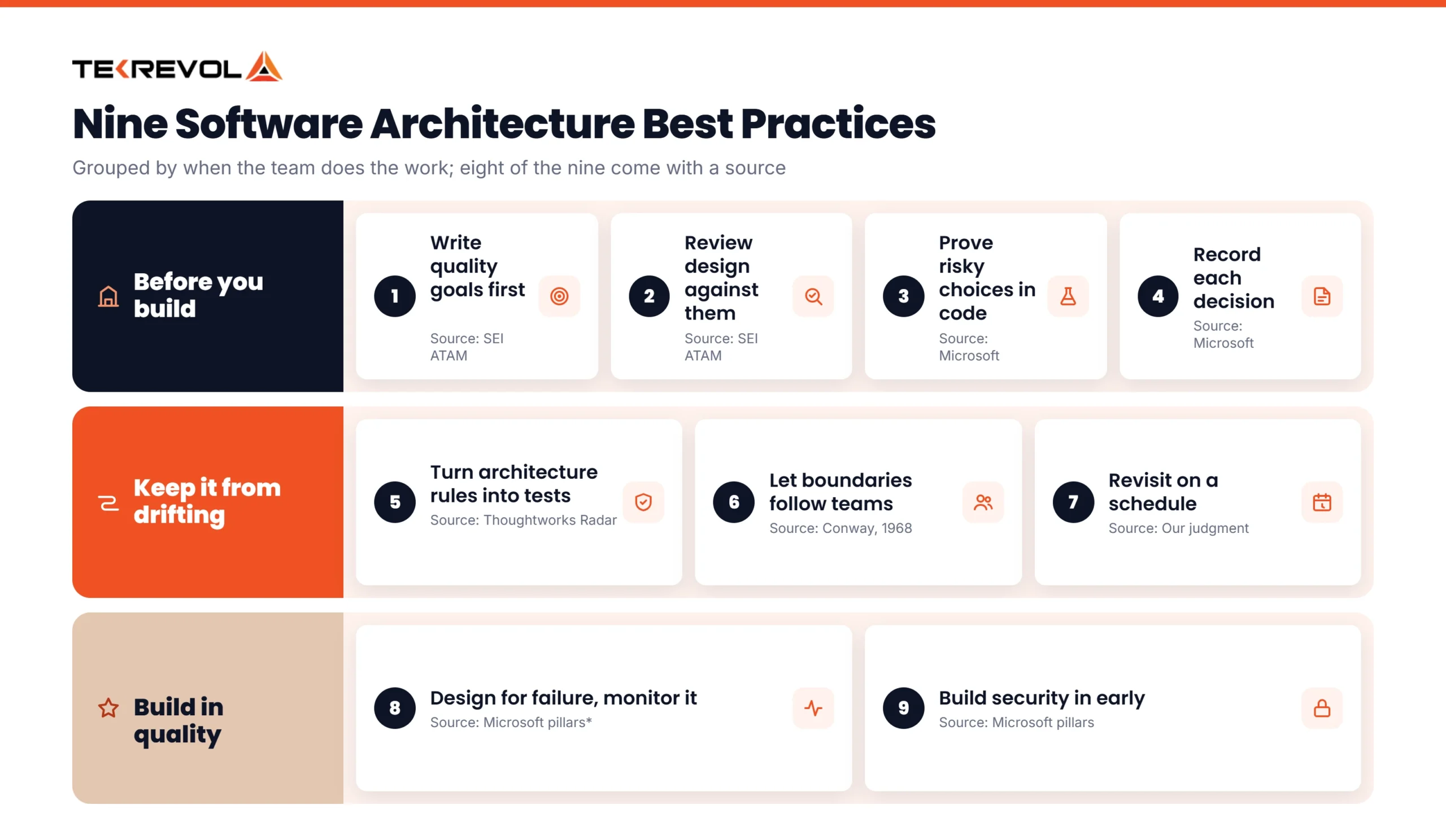
Best practices for software architecture are repeatable team actions that keep a system meeting its quality goals as it changes. This guide sorts nine of them into three sets, shown below, and eight of the nine come with a source while practice 7 is TekRevol’s judgment.
What is the difference between software architecture principles and best practices?
Principles are rules a team reasons from, while best practices are actions a team performs. Separation of concerns is one of the principles of software architecture, and reviewing a design against quality goals before building is a best practice. That example is our reading, not a published definition.
In our reading, principles change slowly, so a team agrees on them once and applies them to every decision. Architecture best practices are the routines that make those principles real.
Which architecture best practices come before you build?
The first software architecture design best practices are settled before the design is final: write quality goals, review the design against them, prove risky choices in working code, and record each significant decision. Microsoft advises validating high-risk or novel components with working code before finalizing a design.
The table gives the action for each practice, with its source and its limit. For practice 3, our guide to what a proof of concept is in software development shows how a proof of concept works.
| Practice | What to do | Source and limit |
| 1. Write quality goals first | Name the two qualities that matter most as measurable goals, for example “search answers within one second at peak load,” which is our illustration | The SEI’s ATAM report (1998) says quality attributes such as modifiability, security, performance, and availability interact, so improving one can weaken another. Limit: goals need an owner. |
| 2. Review the design against the goals | Walk the design against each quality goal before building, and list the risks and trade-offs it exposes | ATAM works as a spiral in which candidate architectures are proposed, then analyzed and risk-mitigated. Limit: small teams can run a lighter review, which is our judgment. |
| 3. Prove risky choices in working code | Build a prototype of any novel or high-risk component before the design is final | Microsoft’s architect guidance (Well-Architected Framework, updated December 9, 2025) favors experiments and proofs of concept over theory. Limit: prototype only the risky part. |
| 4. Record each significant decision | Write a short record with context, justification, trade-offs and status | Microsoft’s decision-record guidance says an undocumented decision is likely to be forgotten, so teams repeat debates. Limit: record only architecturally significant choices. |
Microsoft’s guidance adds that an accepted record is not edited. A changed decision gets a new record that supersedes the old one.
A short decision record might look like this, and the example is our illustration.
| Field | Example |
| Decision | Put a message queue between ordering and billing |
| Context | Billing slowdowns were blocking checkout |
| Trade-off | Orders and invoices become eventually consistent |
| Status | Accepted |
In our judgment, the simplest structure that meets the goals is the right default.
How do you stop a software architecture from drifting?
Architecture drift is caught by automated checks and by teams that revisit the design on a schedule. An architecture rule is a structural limit written as a test, for example, “billing code may not import from reporting code,” which is our illustration.
The Thoughtworks Technology Radar (2017 entry) describes architectural fitness functions as objective checks that a system still has certain architectural characteristics, and says they may encompass existing checks such as unit tests, metrics and monitors. The entry is not on the current Radar edition.
Module boundaries that follow team boundaries reduce coordination cost. Melvin Conway observed that organizations produce designs that copy their own communication structure, so in our judgment the boundaries should be drawn on purpose. Conway’s idea dates to 1967, and Wikipedia cites his paper as published in Datamation in April 1968.
Revisit the architecture on a fixed date, such as every quarter, and ask whether the recorded decisions still hold. A decision that no longer holds gets a new record that supersedes the old one.
The quarterly cadence is our judgment, and so is skipping automated rules on a throwaway prototype, where writing them costs more than they return. For where review and maintenance fall in a project, see our guide to the phases of the software development life cycle.
How do you keep a software architecture reliable and secure?
Check the design against the five pillars of the Azure Well-Architected Framework: reliability, security, cost optimization, operational excellence, and performance efficiency. Microsoft’s pillars page (updated January 22, 2025) describes reliability as staying available and recovering from failures, and security as protecting data and systems from threats. It describes operational excellence as running workloads smoothly through monitoring and safe deployment, which is why the health check below asks about monitoring.
In our judgment, design for failure by asking what happens when each dependency is slow or down, and make sure the team can see the failure through monitoring. Treat security as a design input from the first review, not a final check, which is our judgment.
The pillars pull against each other, so Microsoft’s architect guidance asks which pillars matter most for a given design and why. In our judgment, name the top two before the first review, which links back to the first practice in this guide.
How healthy is your software architecture?
Answer ten yes or no questions, covering all nine practices, and let each no point to the practice to apply next. This is the TekRevol Architecture Health Check, and it is our judgment, built on the sources above.
| Question | If the answer is no |
| 1. Can the team name its top two quality goals? | Write quality goals first |
| 2. Was the design reviewed against those goals before building? | Run a structured review |
| 3. Have the riskiest choices been tried in working code? | Build a prototype of the risky part |
| 4. Is every significant decision recorded with its trade-offs? | Start decision records |
| 5. Does a test fail when a structural rule is broken? | Write architecture rules as tests |
| 6. Does module ownership match team ownership? | Redraw boundaries around teams |
| 7. Is there a date set to revisit the architecture? | Schedule the revisit |
| 8. Can the system survive the loss of one dependency? | Design for failure |
| 9. Does the team see a dependency failure when it happens? | Add monitoring |
| 10. Was security reviewed at design time? | Add a security review to the first design review |
Start with the first no, because earlier practices support later ones. Who answers each question depends on the team.
How can TekRevol help with architecture best practices?
TekRevol is a software development company, and its custom software development team can help you apply these practices to a new build or an existing system. Our custom software development work includes architecture planning in the design stage, so quality goals and key decisions are settled before the code is written.
Start with a Free Consultation.