



The difference between C# and Java is smaller than most people expect. Both are C-family, object-oriented languages that run on managed runtimes, and they differ mainly in language features and in how widely each is used. Java leads C# on every current usage and hiring signal we checked, though the gap in developer usage is slim.
This article compares the two on language features, speed, current versions and demand. It ends with a table that helps you choose.
We checked every figure in this article against its source on October 21, 2026.
Is C# similar to Java?
Yes, C# and Java are similar languages. Microsoft’s guide for Java developers lists the shared ground: both use C-family syntax, both are object-oriented and strongly typed, and both run on multiple platforms. Both also manage memory with garbage collection and handle errors with try, catch and finally.
Is Java similar to C# in package tooling? Largely, yes.
The same guide says C#’s NuGet package manager is analogous to Maven. In our reading, that overlap is why developers move between the two with little retraining.
What are the main differences between C# and Java?
The main differences between C# and Java sit in language features. The table lists six, using Microsoft’s guide and Java’s release documentation.
| Area | C# | Java | Source |
| Properties | Language support for properties and indexers | Naming conventions for get and set methods | Microsoft Learn |
| Value types | Can define value types as structs | Not listed in Microsoft’s comparison | Microsoft Learn |
| Checked exceptions | None | Yes | Microsoft Learn |
| Asynchronous code | async and await keywords | Virtual threads, final in JDK 21 | Microsoft Learn, InfoQ |
| Pattern matching | Yes | Pattern matching for switch, final in JDK 21 | Microsoft Learn, OpenJDK JEP 441 |
| Collection queries | LINQ | Streams | Microsoft Learn shows both code examples side by side. The LINQ and Streams pairing is TekRevol’s reading. |
Microsoft’s guide lists pattern matching among the features Java lacks. Java finalized pattern matching for switch in JDK 21, so check any older comparison against current releases.
The asynchronous row compares two designs. This is our reading. For another Java comparison, see our guide to Java vs Kotlin.
How different is the syntax of C# and Java?
The syntax is close, and the differences show up in a few everyday tasks. Java vs C# syntax looks alike in classes, loops and access modifiers, so the table shows only where the two diverge.
| Task | Java | C# |
| Declare a constant | final int count = 5; | const int count = 5; |
| Filter a list | list.stream().filter(x -> x > 5).collect(Collectors.toList()) | list.Where(x => x > 5).ToList() |
| Format a string | Concatenate with + | Interpolation: $”Hello, {name}! Count: {count}” |
| Default for null | optional.orElse(“default”) | input ?? “default” |
Examples from Microsoft Learn’s guide for Java developers.
C# vs Java speed: is one faster?
Microsoft’s documentation says Native AOT, which compiles a .NET app ahead of time to native code, gives faster startup and a smaller memory footprint. That page also lists limits, such as no dynamic loading and no runtime code generation.
It is Microsoft’s own claim. This article cites no equivalent Java statement to set beside it. In our judgment, speed rarely decides between the two, because team skill and architecture usually matter more.
What are the current versions of C# and Java?
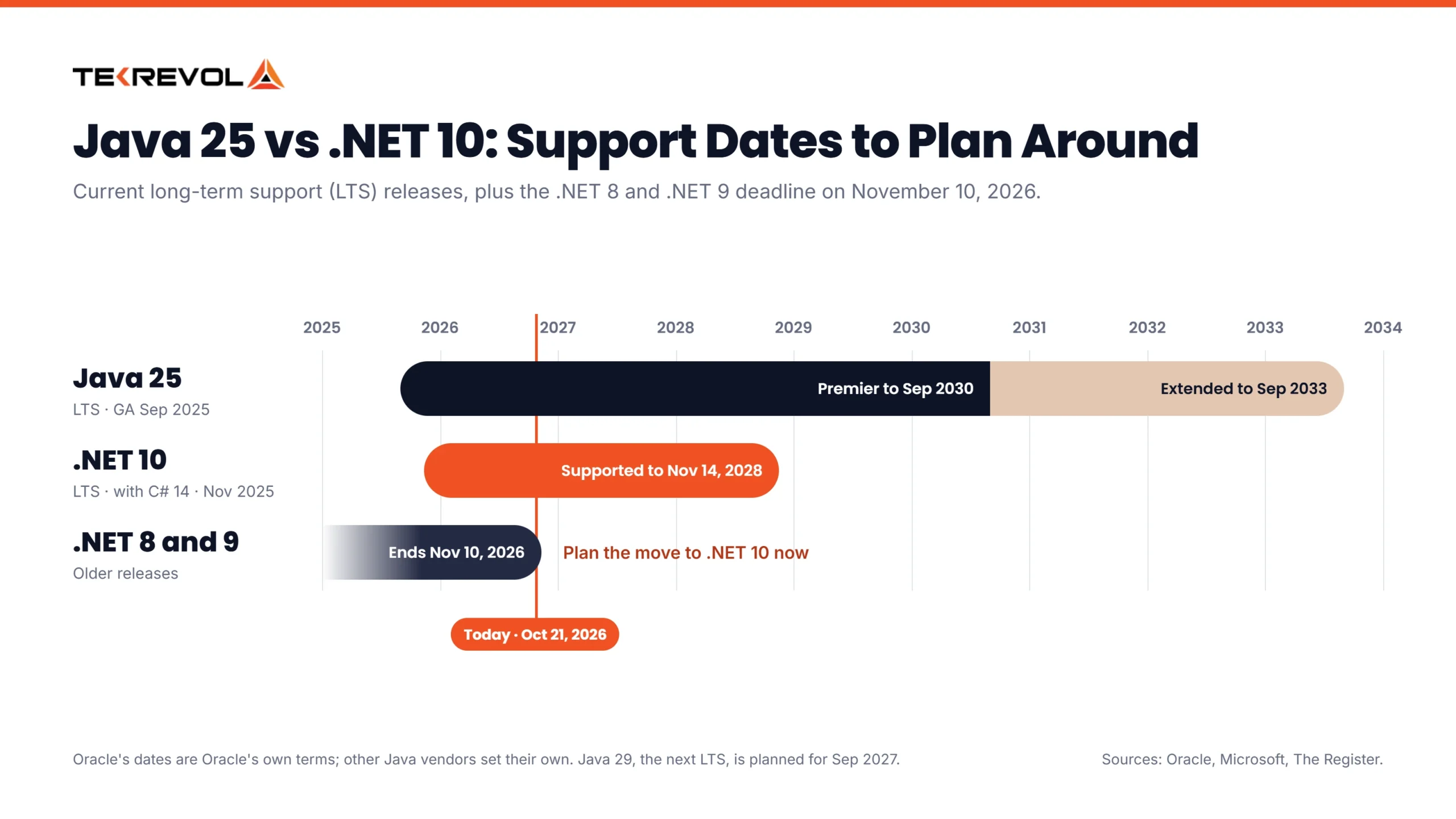
Java 25 and .NET 10 are the current long-term support (LTS) releases as of October 21, 2026. The table shows the dates, which matter as much as features when you compare Java vs C sharp for a long-lived custom software product.
| Platform | Current LTS | Support dates | Also note |
| Java | Java 25, GA September 2025 | Premier support to September 2030, extended support to September 2033 | Java 27 is the latest feature release (September 2026). The next LTS is Java 29, planned for September 2027. |
| .NET | .NET 10, released November 11, 2025, with C# 14 | Supported to November 14, 2028 | .NET 8 and .NET 9 reach end of support on November 10, 2026. .NET 11 is not yet listed on Microsoft’s support page. |
Sources: Oracle’s Java SE support roadmap, Microsoft’s .NET support policy page (updated October 13, 2026) and The Register’s coverage of .NET 10.
Oracle’s dates are Oracle’s own support terms, and other Java vendors set their own. If you run .NET 8 or .NET 9, plan the move to .NET 10 before November 10, 2026. That is our reading of the dates.
Which is more widely used, C# or Java?
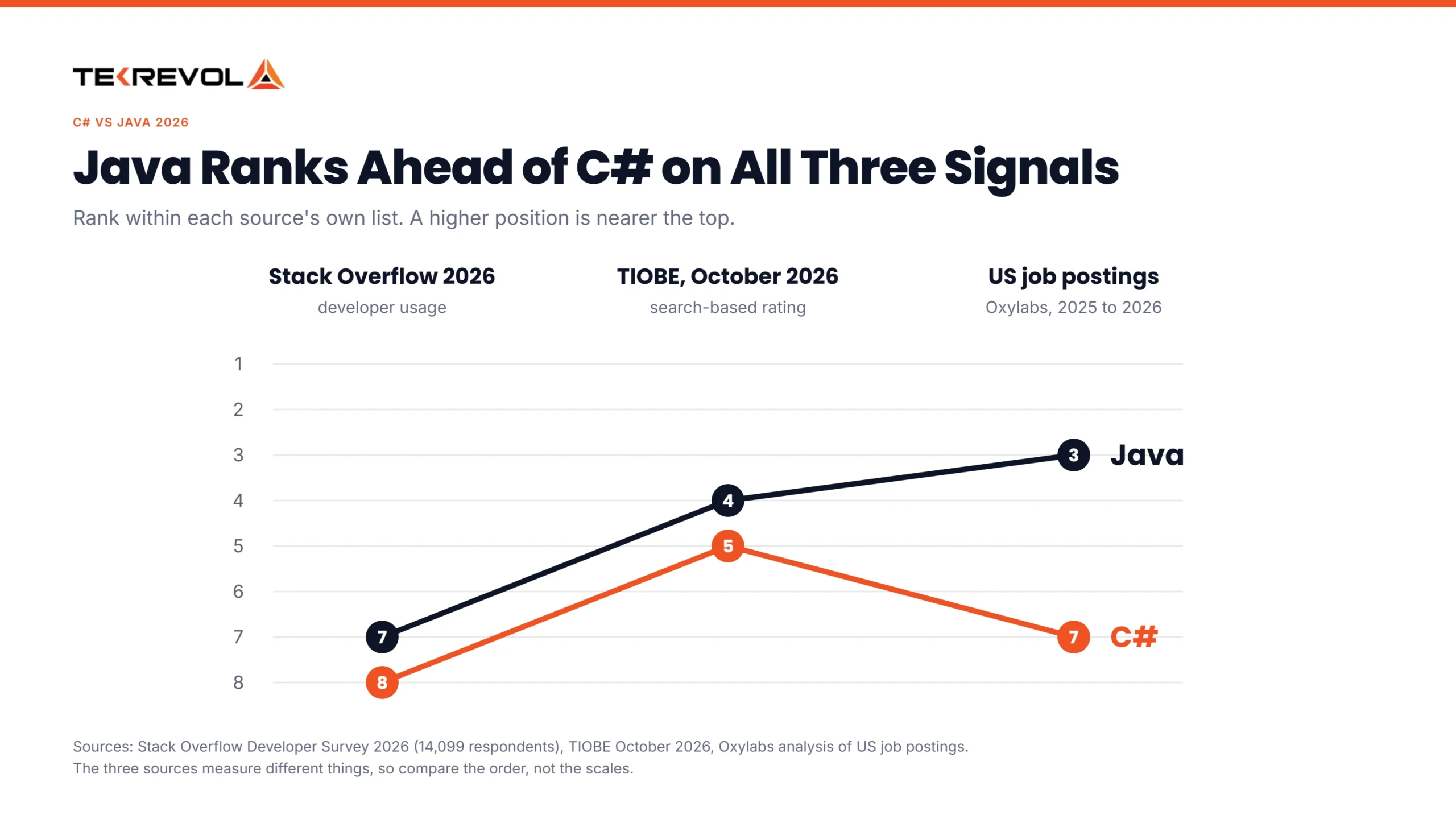
Java leads C# on all three current signals, and the gap is widest in job postings. The table shows each signal.
| Signal | Java | C# |
| Stack Overflow 2026, extensive development work in the past year (14,099 respondents) | 27.6% (7th) | 27.1% (8th) |
| TIOBE index, October 2026 | 8.41% (4th) | 3.79% (5th) |
| Share of US job postings requiring a language, Oxylabs, January 2025 to March 2026 | 21% (3rd) | 9% (7th) |
The three measure different things. Stack Overflow counts developers’ own work, TIOBE rates languages using search engine queries, and Oxylabs counts employer postings. Oxylabs’ sample covers US postings that require at least one programming language, so it shows what employers ask for, not how many developers use each language.
Developer usage is nearly tied, yet employers ask for Java more than twice as often as C#. That reading is our judgment. For a wider view of hiring demand, see our guide to most in demand programming languages.
What are the pros and cons of C# compared with Java?
The pros of C# are rich language features and a cross-platform runtime, and the main con is a smaller hiring pool. The table sets each factor against Java.
| Factor | C# | Java |
| Language features | Properties, LINQ, async and await, nullable reference types | Pattern matching for switch and virtual threads, both final in JDK 21 |
| Platform reach | Both are cross-platform, per Microsoft. | Cross-platform, per Microsoft’s own comparison |
| Hiring signal | 9% of US postings | 21% of US postings |
| Release support | LTS releases supported three years, standard-term releases two | Java 25 has premier support to September 2030 |
The Register’s coverage of the .NET 10 release described Visual Studio 2026 as a Windows-only IDE, which matters if your developers work on other systems. Check that against your own tooling.
Should I learn C# or Java?
Either is a sound first language, and learning one makes the other easier because they share so much. Microsoft’s guide lists the common syntax, typing, and runtime ideas.
If your goal is a US job, Java appears in 21% of postings that require a language, against 9% for C#, in Oxylabs’ data. Pick the language that the employers or products you care about use most, then add the second. That advice is our judgment.
How should you choose between C# and Java?
Match the language to your team, your existing systems and your hiring plans. The table maps common situations to a language. This is TekRevol’s judgment.
| Situation | Lean toward |
| Team already skilled in one language | That language |
| Existing systems built in one of them | The language of those systems |
| Hiring pool is the main concern in the US | Java, by posting share |
| Stack built around Microsoft’s cloud and tools | C# and .NET |
| Learning a first language | Either, then add the second |
When two rows point in different directions, start with the language your team already ships in. TekRevol’s Java development and .NET development teams can scope either path. Start with a Free Consultation.
Choose the language your team can maintain best, and let the support dates guide when to upgrade.


