



In-house vs outsourcing software development comes down to how stable your product is and how fast you need to start. In-house suits a stable, long-term core product. Outsourcing suits a fast start or a specialized skill.
This article compares the two models on cost, speed, control, and risk. It ends with a table that matches your situation to a model.
We checked every figure in this article against its source on October 20, 2026.
What is the difference between in-house and outsourced software development?
In-house software development means your own employees build, run and own the software. Outsourced development means an outside custom software development firm builds it under a contract, either as a whole project or as an added team. A hybrid model keeps a core team in-house and adds outside engineers for specific work.
Code developed in house sits in your repositories and under your management from day one. The vendor’s engineers are on another company’s payroll, so you manage the result through the contract. Outsourcing also varies by location: onshore teams share your country, while nearshore and offshore teams do not.
How much does each model cost?
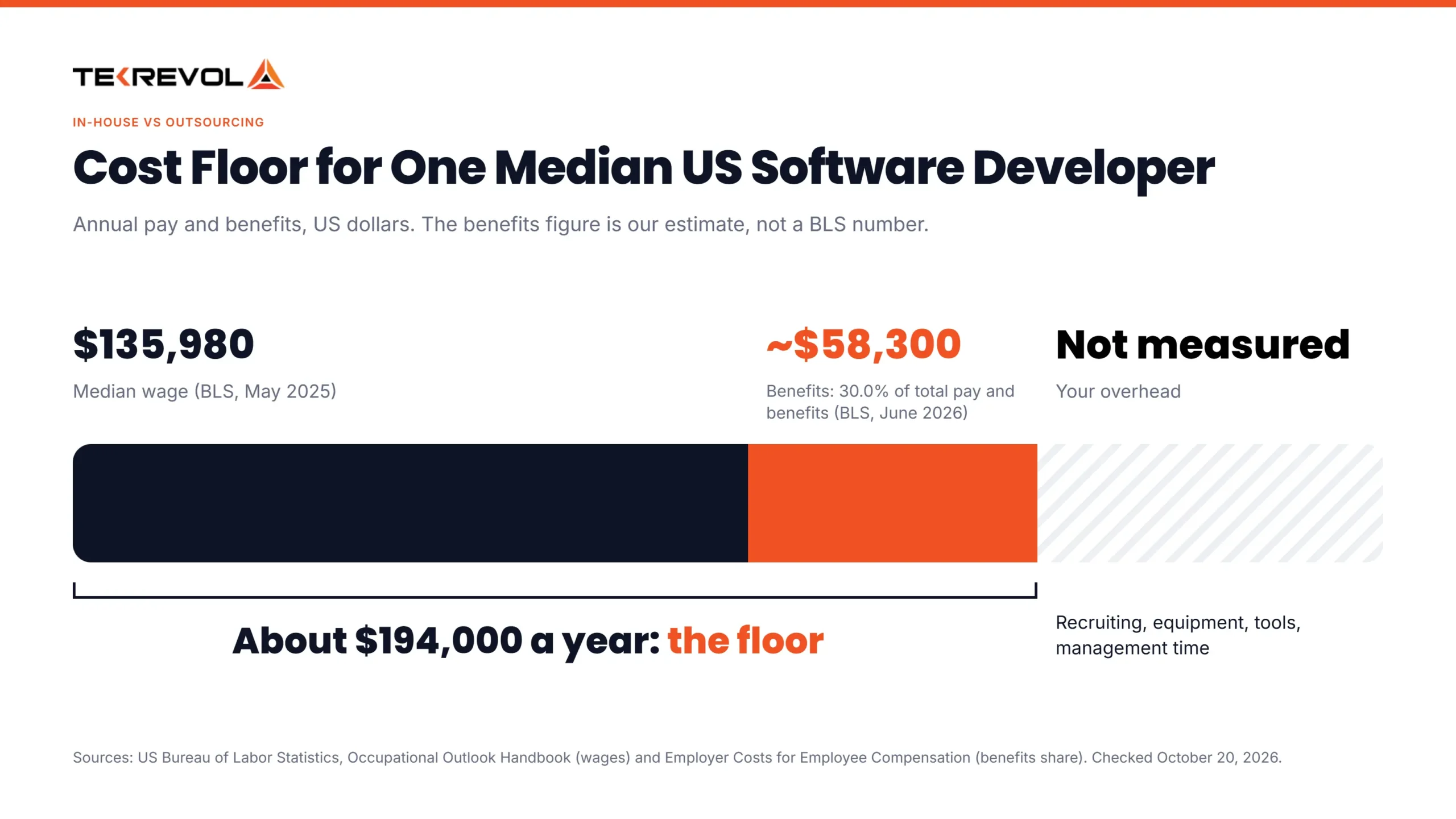
The one sourced cost figure is a floor of about $194,000 a year for the pay and benefits of one median US software developer. The US Bureau of Labor Statistics (BLS) reports a median wage of $135,980 for software developers in May 2025.
BLS’s June 2026 employer cost release shows benefits at 30.0% of total compensation for private industry workers, so wages are about 70%. Dividing the wage by 0.70 gives roughly $194,000.
That estimate is ours. It applies a private-industry average to developer pay, and the wage is a national median, so your location will move it. It also leaves out recruiting, equipment, tools and management time, so treat it as a floor.
The table shows what to price on each side. Only the first row has a source.
| Cost item | In-house | Outsourced | Source found? |
| Pay and benefits | About $194,000 a year per median US developer | Vendor fees, quoted per project or per month | In-house: BLS data plus our calculation. Outsourced: no independent benchmark |
| Recruiting | Job ads and recruiter time | Time spent choosing a vendor | No. Enter your own |
| Equipment and tools | Laptops and software licenses | Usually inside the vendor’s fee | No. Enter your own |
| Management | Engineering lead time | Your oversight time | No. Enter your own |
| Change and exit | Severance, lost knowledge | Transition, handover | No. Enter your own |
For outsourced work, the main cost is vendor fees, and we found no independent benchmark for them. Ask two or three firms for written quotes before you compare.
Add up the in-house side as wage plus benefits plus recruiting plus equipment plus management time. Then set it against vendor fees plus your own oversight time over the full length of your roadmap.
When you outsource, the right comparison is total cost over the roadmap. For a build budget, see our guide to custom software development costs.
How fast can each model start?
In-house hiring takes weeks, and no source we found times developer hires separately. SHRM’s 2026 recruiting benchmarking page reports a median of 39 calendar days to fill a nonexecutive position, using data from over 4,600 organizations.
Employ, a recruiting software company, reported an average of 63.5 days to fill a position in 2025 across five sectors (software and technology, business services, retail, hospitality and manufacturing), as covered by HR Dive in January 2026. A developer search may run shorter or longer.
An outsourcing vendor may start faster because it already employs engineers. We found no independent source for vendor start times. Ask each firm for a start date in writing, and ask for references on how long past projects took to begin.
Who controls the code, the roadmap and the data?
In TekRevol’s judgment, in-house development gives the most direct control, and outsourcing can match it only through contract terms. With your own team, product decisions, code access and data handling follow your own policies. With a vendor, the contract has to state who owns the code, who can see the data and what happens when the work ends.
Five terms matter most: IP assignment to your company, a non-disclosure agreement, data handling rules, access rights to repositories and a handover plan on exit. This is TekRevol’s judgment. Have counsel review the contract.
Control does not remove knowledge loss. BLS reports median tenure of 4.1 years for wage and salary workers as of January 2026, and that figure covers all workers. An in-house team can lose its knowledge over time as well, so documentation matters under either model.
What are the advantages of outsourcing software development?
The main advantages of outsourcing are speed to start and flexibility in capacity. Both depend on the vendor you choose, and we found no independent dataset that compares project outcomes between the two models.
A vendor can staff a project without a recruiting cycle. A specialized skill, such as a one-time integration, can be rented for the length of the work instead of hired for good. When you are meeting fluctuating demand, a vendor team can grow before a launch and shrink afterward, while an in-house team carries its salary cost in quiet months.
This is TekRevol’s judgment. For the steps of running an outsourced project, see our guide to how to outsource software development successfully.
When does in-house developed software make sense?
An in-house team makes sense when the software is the core of your business and your roadmap is stable for years. Tightly regulated data is a second reason to keep the work close.
The advantage of in-house developed software is that the people who build it stay close to the business and keep what they learn. A team that owns a product for years builds deep knowledge of its customers and its code.
If the product defines your competitive edge, that knowledge is worth keeping inside the company. That reasoning is our judgment.
Hiring competition is the cost of this choice. BLS projects 10% employment growth for software developers between 2025 and 2035, so demand for the same talent should continue. That is context for planning.
What are the risks of each model?
The main in-house risks are slow hiring, key-person loss and fixed cost when demand falls, and the main outsourcing risks are uneven quality, communication gaps and lock-in. Each risk has a practical fix, and the table pairs them. All of it is TekRevol’s judgment.
| Risk | Model | What reduces it |
| Slow hiring | In-house | Start with a contract team while you recruit |
| Key-person loss | In-house | Documentation and shared ownership of the code |
| Fixed cost when demand falls | In-house | Keep the core team small and rent the rest |
| Uneven quality | Outsourced | A paid trial sprint and regular code reviews |
| Communication gaps | Outsourced | Fixed overlap hours and one named lead |
| Lock-in and hard exit | Outsourced | Own the repositories and require handover terms |
Is a hybrid model better?
In TekRevol’s judgment, a hybrid model is often the better fit when you want control of the product and flexibility in capacity. In a hybrid model, an in-house core team keeps architecture, data and roadmap decisions, while outside engineers take work that is bounded or specialized.
That split rule is our judgment, and we found no independent dataset showing that hybrid teams outperform the alternatives. Test it on one project first. IT staff augmentation adds outside engineers to your own team, and our guide to staff augmentation benefits, use cases and limitations covers when it fits.
How to decide between in-house and outsourced software
Match the model to how long the product will live and how soon you need it. The table maps common situations to a model.
| Situation | Lean toward |
| Core product with a stable roadmap for years | In-house |
| Launch needed within a few months | Outsourced, or hybrid |
| One-time specialized skill | Outsourced |
| Demand rises and falls | Outsourced or hybrid |
| Tightly regulated data | In-house, or a tightly governed hybrid |
| No engineering lead yet | Outsourced with strong oversight, then hybrid |
The table is TekRevol’s judgment. When two rows point in different directions, a hybrid model is usually the safer start.
TekRevol’s custom software development team can scope either path. Start with a Free Consultation.
Pick the model that fits how long the product will live, and revisit the choice when that changes.


