



The most in demand programming languages in US hiring are Python and SQL (the language for querying databases), which appear in 46% and 45% of job postings that require at least one programming language. Those figures come from Oxylabs, a web intelligence company that analyzed about 800,000 US postings between January 2025 and March 2026. The ranking changes when you measure something else: developers report using JavaScript most, and search activity favors Python and C.
If you hire engineers for custom software development or choose a technology stack, the signal you trust decides which skills you chase. This article puts three current signals side by side and shows where they disagree.
We checked every figure in this article against its source on October 19, 2026.
Which programming languages are most in demand?
Python (46% of postings) and SQL (45%) lead US job ads, followed by Java (21%) and JavaScript (19%), based on the Oxylabs analysis. The data counts job ads and does not count hires, and it covers postings that require at least one programming language.
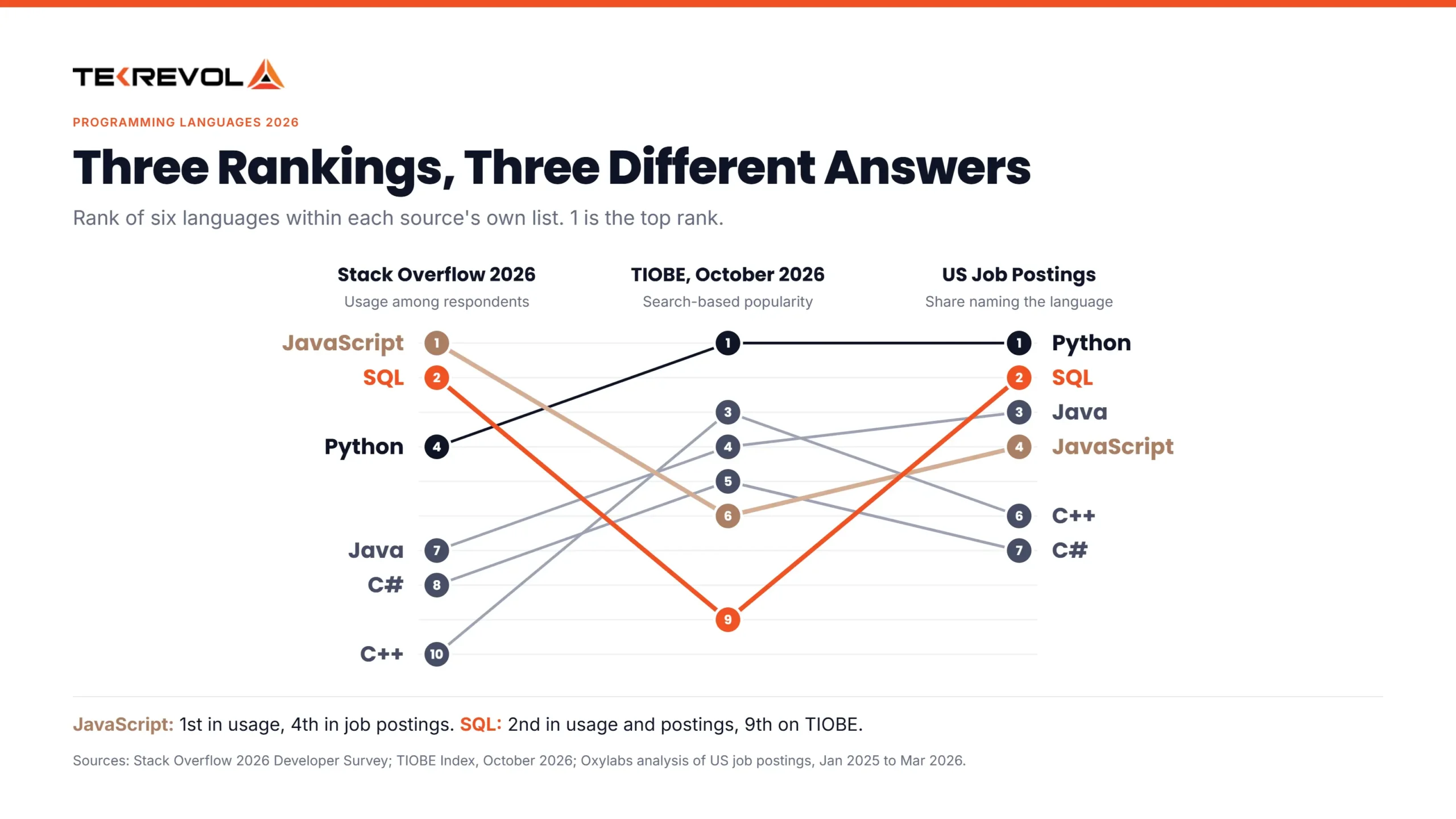
The table compares the top programming languages in demand with two other signals: what developers use, and what people search for. Each source ranks languages within its own list.
| Language | Stack Overflow 2026 usage | TIOBE, October 2026 | US job postings |
| Python | 58.0% (4th) | 19.23% (1st) | 46% (1st) |
| SQL | 58.4% (2nd) | 1.97% (9th) | 45% (2nd) |
| Java | 27.6% (7th) | 8.41% (4th) | 21% (3rd) |
| JavaScript | 62.0% (1st) | 2.77% (6th) | 19% (4th) |
| C++ | 24.3% (10th) | 8.87% (3rd) | 11% (6th) |
| C# | 27.1% (8th) | 3.79% (5th) | 9% (7th) |
| TypeScript | 43.8% (6th) | Outside the top 10 | 8% (8th) |
Sources: Stack Overflow 2026 Developer Survey, percentage of respondents who selected each language (a self-selected group). TIOBE Index, October 2026, a monthly rating based on search engine queries. Oxylabs analysis of US job postings, January 2025 to March 2026, share of postings that mention each language. Bash, tied with C++ at 11% of US postings, is not shown.
Among the most sought-after programming languages, Python and SQL form the strongest pair. Python and SQL appear together in about 21% of postings, according to Oxylabs. In our reading, Python leads because it serves data work and general software engineering at once, so Python skills fit many types of software development.
Why do three rankings of the same languages disagree?
The rankings disagree because usage, search popularity, and hiring demand measure different things. Stack Overflow’s survey and the TIOBE index capture what developers do and what people search for. Oxylabs’ analysis of US job postings captures what employers ask for.
JavaScript is first in usage at 62.0% but fourth in job postings at 19%. SQL is second in both usage and postings but ninth on TIOBE. On the TIOBE index, the most popular programming languages in October 2026 are Python, C and C++.
Popularity signals also carry noise. TIOBE’s own page says the index now includes Mandarin Chinese search terms, weighted at 44.2% of the English terms, so some movement reflects wider coverage. IEEE Spectrum’s 2025 ranking reported that Stack Exchange questions across the languages it tracks fell to about 22% of 2024 levels, which it attributes to programmers asking AI assistants instead.
In our view, job postings are the closest signal to demand for talent. Surveys of the most used programming languages show what developers already know, and programming language popularity on TIOBE shows what draws interest.
What programming languages are in demand in your industry?
SQL leads job postings in six of ten industry groups and Python leads in the other four, according to Oxylabs’ analysis of US postings that require a programming language. The table shows the leading language in each group.
| Industry group | Top language | Share of postings |
| Finance, insurance and real estate | SQL | 62% |
| Consumer, retail and agriculture | SQL | 62% |
| Healthcare, pharma and wellness | SQL | 62% |
| Professional, legal and business services | SQL | 48% |
| Education, government and non-profit | SQL | 47% |
| Logistics, travel and construction | SQL | 43% |
| Tech, data and telecom | Python | 50% |
| Media, entertainment and arts | Python | 49% |
| Energy, utilities and environment | Python | 41% |
| Manufacturing, industrial and defense | Python | 38% |
Source: Oxylabs analysis of US job postings that require at least one programming language, January 2025 to March 2026.
Tech, data and telecom account for 43% of these postings, so more than half come from other industries. A developer-survey ranking therefore misses much of the demand. SQL is the leading choice among programming languages for business outside tech, leading in six of the nine non-tech groups.
Java ranks third in finance, insurance and real estate at 25%. A team planning Java development in that sector is hiring into a skill that one in four postings there name.
Which programming languages are growing, and which are slipping?
Rust and R are climbing the TIOBE index while Go is falling, so no single language is rising everywhere. TIOBE’s October 2026 index places R eighth at 2.06% and Rust tenth at 1.44%. Go ranks eleventh at 1.39%, down from eighth a year earlier.
TechRepublic’s coverage of the October index reports that Rust rose from 16th place a year ago and R from 13th. Rust is not among the ten most used languages in Stack Overflow’s 2026 survey.
TypeScript, a typed version of JavaScript, shows a different pattern. Of Stack Overflow respondents, 43.8% use it, yet it appears in 8% of US postings.
No source here measures the fastest growing programming languages by job postings over time. Treat these moves among the trending programming languages as signs of rising interest. They do not prove faster hiring.
Which programming languages pay the most?
No primary dataset we reviewed ranks pay by programming language, so any list of the highest-paying programming languages rests on weaker evidence. Stack Overflow’s 2025 survey reports pay by developer role and by country, and its technology section has no pay data by language.
Pay follows the role and the market more than the language. A language used mostly in senior or specialist roles can look well paid in a list even when the language adds little. That is our judgment, and no survey tested it.
To budget a hire, benchmark the role and the location first. Then check job-posting demand for that language to judge how hard it is to find.
Which programming language is best to learn for a Job?
The best programming language to learn for a job depends on the target role, and Python plus SQL is the strongest pair in the data. Oxylabs found that 60% of postings name at least two languages. For software engineering roles, SQL appears in 42% of postings, Python in 41% and Java in 38%.
For jobs outside tech, SQL leads postings in six of the nine non-tech industry groups in the Oxylabs data, which makes it a likely second language to add (our judgment).
Our advice is to pick the language your target employers list most, then add the partner language they list with it. That judgment comes from the pairing data, and no study measured the outcome.
How to turn language demand into a hiring decision?
Start with what your product needs, then use demand data to judge how hard each skill will be to hire. The steps below are TekRevol’s judgment, built on the Oxylabs, Stack Overflow and TIOBE data.
Four checks turn the numbers into a decision:
- Product need. List the languages your product and existing code require, before you look at demand.
- Sector row. Find your industry in the Oxylabs analysis of US job postings (January 2025 to March 2026), which splits postings into ten industry groups, and note whether SQL or Python leads there, because competing employers post for that language.
- Language pairs. Check which second language each role needs, since Oxylabs found that 60% of postings name at least two.
- Time to fill. Ask recruiters how long past searches for each language took, because the sources here do not measure supply.
A team that already ships well in one language should not switch only because another ranks higher, and a proof of concept can test the switch before the team commits. Demand data tells you how competitive a search will be, and it leaves the question of what to build to your product plan.
If your own hiring search shows that a language is hard to fill, IT staff augmentation adds TekRevol developers to your team. Start with a free consultation.
Hire for your product first, and let the demand data tell you how hard that search will be.


