



- Super app development costs $15,000 to $5 million, depending entirely on which tier you’re actually building.
- A mini-app runtime and SDK cost $60,000 to $150,000 and define a genuine super app.
- Most quotes below $60,000 are pricing a multi-service app rather than a genuine super app platform.
- Advertising revenue needs roughly 500,000 monthly active users before it contributes anything meaningful to revenue.
- Cross-platform mobile development saves 30 to 40 percent against native, compounding across every future feature shipped.
- Support and running costs together can hit 3–5x a single-service app’s cost, arriving before monetization does.
Super apps have changed how people use their phones. Instead of juggling separate apps for chatting, shopping, paying bills, booking rides, and managing money, everything lives under one roof. That’s why businesses across industries are investing in the model in 2026. It keeps users coming back, opens multiple revenue streams, and removes the friction of switching apps for everyday tasks.
Building a super app is far more complex than developing a standard mobile application. In 2026, super app development costs $15,000 to $5 million, and the biggest variable isn’t your feature list or your platforms. It’s which tier you’re actually building: a white-label clone, a multi-service app, or a genuine platform where outside businesses build inside yours.
With this level of complexity, businesses often work with a mobile app development company to handle modular architecture, payment security, and phased launches while keeping costs under control.
This blog prices all four tiers, breaks down must-have features, walks through the build with timelines, and shows what each monetization model needs before it earns you anything.
How Much Does Super App Development Cost in 2026?
Super app development costs $15,000 to $5 million in 2026. A white-label clone runs $15,000 to $60,000, a multi-service app $60,000 to $300,000, a true super app platform $250,000 to $1.5 million, and an open ecosystem $1.5 million and up.
| Tier | Cost Estimate | Timeline | What you actually get |
| White-label / clone | $15,000–$60,000 | 2–3 months | Someone else’s architecture, lightly rebranded |
| Multi-service app | $60,000–$300,000 | 6–12 months | Your own services, one login, one wallet, no third parties |
| Super app platform | $250,000–$1,500,000 | 12–18 months | Mini-app runtime and SDK, outside businesses build inside your app |
| Open ecosystem | $1,500,000–$5,000,000+ | 18–36 months | Regulated financial layer, multiple markets, developer community |
Most companies asking about app development cost need the second tier and get quoted for the first or the third. Getting that decision right before you request quotes will save you more money than every other cost lever in this article combined.
Planning a Super App?
Get a clear estimate based on your features, integrations, and business goals.
Talk to Our ExpertsWhat Counts as a Super App, and Why Does It Change the Price?
A super app is a single mobile or web application that brings multiple services together in one place. Users can access messaging, shopping, banking, travel, and other services through one platform and a unified account.
But multiple services alone don’t make an app a super app. A true super app also acts as a platform and ecosystem where third parties can build and publish mini-apps. Gartner also predicts that more than 50% of the global population will be daily active users of multiple superapps by 2027.
This distinction directly affects development cost. A multi-service app offering your own services requires less infrastructure than a super app with third-party mini-apps, developer tools, APIs, merchant onboarding, security, and partner management. For businesses focused on their own services, on-demand app development can be a more practical option.
Before estimating your budget, decide which model fits your needs. An on-demand app works well for your own services, while a true super app makes sense when you plan to build a broader partner ecosystem.
What Are the Different Types of Super Apps?
Super apps split three ways: by who they serve (consumer, business, or government), by the service they started from (payments, messaging, transport, or commerce), and by industry vertical. Each combination carries a different cost profile.
Classifying your product before pricing it saves you from comparing quotes for fundamentally different things.
By audience
| Type | Who it serves | Cost profile | Why |
| Consumer super app | The general public | $250,000–$1,500,000 | Large-scale demands, heavy UX investment, consumer-grade fraud risk |
| B2B super app | Merchants, suppliers, field teams | $150,000–$800,000 | Fewer users, but complex permissions, reporting, and integrations |
| Enterprise or internal | One organization’s workforce | $120,000–$600,000 | No acquisition cost, but deep legacy system integration |
| Government or civic | Citizens accessing public services | $500,000–$3,000,000+ | Accessibility mandates, identity assurance, procurement, audit |
B2B super apps are often overlooked, yet they can be highly viable. You already have an established user base, lower acquisition costs, and less pressure to reach massive consumer scale.
By origin service
The service you start with shapes both your cost and your odds.
| Origin Strategy | Typical First Service | Key Advantage | Main Risk |
| Payments-first | Wallet or money transfers | Builds strong trust and enables easy cross-selling | Higher regulatory and licensing costs upfront |
| Messaging-first | Chat or communication | High usage frequency and strong organic distribution | Difficult to monetize directly |
| Transport-first | Ride-hailing or delivery | Generates transactions and revenue from the start | Thin margins and high operating costs |
| Commerce-first | Marketplace or retail | Builds on existing merchant relationships | Lower usage frequency than other models |
Industry often determines your compliance costs more than your feature list. Fintech and healthcare can require licensing, audits, and security measures before development even begins, while retail, travel, and logistics typically have fewer compliance requirements. We break down how this affects your total development cost in the factors section below.
Business Model Behind Super Apps
The super app business model is a platform, not just a collection of services. An aggregator connects users with other businesses and earns a margin, while a platform provides the infrastructure that other businesses use to offer their services.
This difference affects what you build, how you make money, and how your business grows.
| Factor | Service aggregator | Platform business |
| What you own | Customer relationships and a storefront | Identity, payments, and core infrastructure |
| How you earn | Margin on services you resell | A share of transactions across the platform |
| Who adds services | You add each service yourself | Partners add services through your platform |
| Adding new services | Requires another integration | Partners can add services with less work from you |
| Defensibility | Easier for competitors to replicate | Stronger as more partners join |
| Build cost | $60,000–$300,000 | $250,000–$1,500,000 |
The Core Layers of a Super App
Successful super apps stack revenue in a specific order, and each layer is only available once the one below it exists.
| layer | What It Includes | purpose |
| Core Infrastructure | Identity, payments, APIs, security | Connects the entire platform |
| Your Services | Delivery, transport, commerce, etc. | Drives initial user activity |
| Partner Services | Third-party services and mini-apps | Expands the ecosystem |
| Financial Services | Credit, insurance, payments | Creates additional business opportunities |
The more layers you build, the more complex and expensive the super app becomes. If you only need your own services, a multi-service or on-demand app may be enough. If you want third parties to build within your platform, you’re moving toward a true super app.
8 Factors That Drive Super App Development Cost
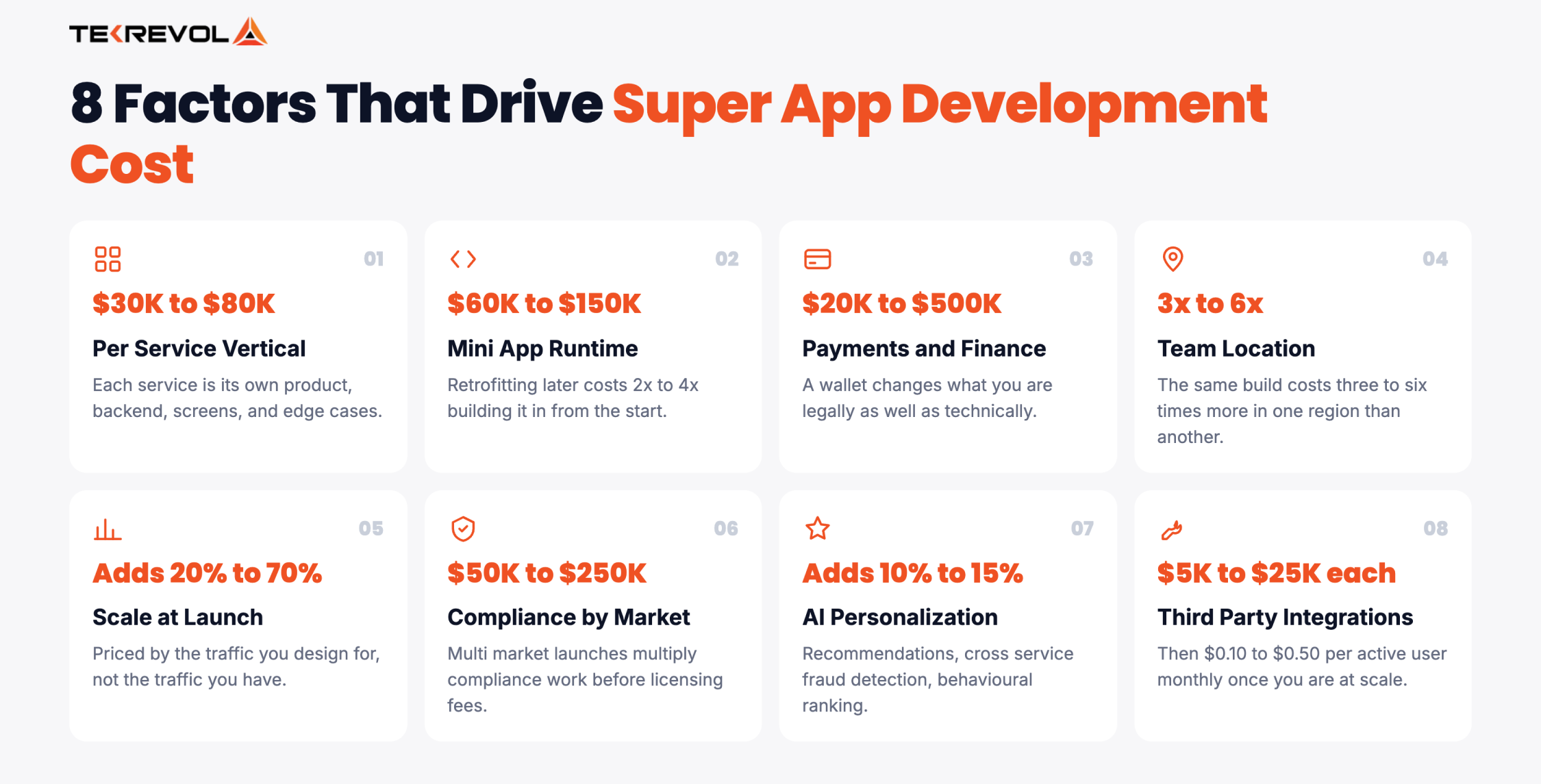
The factors affecting super app development cost most are the number of service verticals, whether you need a mini-app platform, regulatory scope, team location, and expected scale. Each service vertical adds $30,000 to $80,000 on its own.
Here’s each one, ordered by how much it moves your budget.
1. Number of service verticals
Every service you add is effectively its own product with its own backend, its own screens, and its own edge cases. This is the biggest scope lever you control.
| Services at launch | Added build cost | Added timeline |
| 1 core service | Baseline | Baseline |
| 2 services | +$30,000–$80,000 | +2–3 months |
| 3–4 services | +$90,000–$240,000 | +4–7 months |
| 5+ services | +$150,000–$400,000 | +8–14 months |
Launching with one strong service and adding the second after you have retention data is almost always cheaper than launching with four mediocre ones.
2. Mini-App Platform vs. Closed App
A mini-app platform costs more because it lets third-party businesses build and operate inside your app. Budget $60,000–$150,000 for the runtime and SDK, $20,000–$50,000 for merchant onboarding tools, and $15,000–$50,000 for multi-tenant data isolation to keep each partner’s customers, orders, and pricing separate.
If you’ll only ever offer your own services, skip this; a closed app avoids the added cost. But if partners are even a possibility down the line, build the platform layer now.
Retrofitting it later means reworking identity, data isolation, and API boundaries across every service you’ve already shipped, each one re-scoped, re-tested, re-released. Our working estimate: 2–4x the cost of building it in from the start. We give a range, not a single number, because no reliable study pins this down, but the direction isn’t in question. You pay once to build it right, or twice to unbuild what you shipped without it.
3. Payments and financial services
A wallet changes what you are legally as well as technically.
| Financial capability | Build cost | Regulatory note |
| Payment gateway integration only | $20,000–$40,000 | Usually no licence needed |
| Stored-value wallet | $40,000–$100,000 | Money transmitter rules may apply |
| Peer-to-peer transfers | $60,000–$150,000 | Licensing likely in most markets |
| Lending or BNPL | $150,000–$400,000 | Licence required, plus underwriting |
| Insurance or investments | $200,000–$500,000+ | Heavily regulated, market by market |
If your roadmap includes fintech capability, fintech software development and licensing costs should be priced before engineering. Regulatory fees alone can run from $50,000 to $500,000, depending on the market and product.
4. Team location
The same build costs three to six times more in one region than in another.
| Region | Hourly rate | Multi-service app | Super app platform |
| United States | $150–$250 | $250,000–$600,000 | $1,000,000–$3,000,000+ |
| United Kingdom | $120–$200 | $200,000–$500,000 | $800,000–$2,500,000 |
| Western Europe | $80–$150 | $150,000–$400,000 | $600,000–$1,800,000 |
| Middle East | $60–$150 | $120,000–$350,000 | $500,000–$1,500,000 |
| Eastern Europe | $50–$100 | $90,000–$250,000 | $400,000–$1,200,000 |
| Latin America | $30–$70 | $70,000–$180,000 | $300,000–$900,000 |
| South and Southeast Asia | $25–$70 | $60,000–$170,000 | $250,000–$800,000 |
5. Expected Scale at Launch
Architecture decisions are priced by the traffic you design for, not the traffic you have. Building for 10,000 users and building for 10 million users are different systems.
- Under 50,000 users, a well-built monolith is fine. Cheapest to build and run.
- 50,000 to 1 million: microservices for the busy paths, event-driven messaging. Add 20% to 35%.
- Over 1 million: full service mesh, multi-region, autoscaling. Add 40% to 70%.
Over-engineering for scale you don’t have is one of the most expensive mistakes in this category. So is the reverse, since rebuilding under load costs more than building right.
6. Compliance and data residency
Operating across markets multiplies compliance work rather than adding to it. Each regime carries its own design, engineering, and audit costs.
| Regime | Applies when | What it costs you in build terms |
| GDPR | You serve EU users | Consent capture, data export, right to erasure across every service |
| CCPA and CPRA | You serve California users | A “Do Not Sell or Share My Personal Information” control, deletion request handling, opt-out preference signal support |
| PCI DSS | You touch card data | Scoped environments, encryption, annual assessment |
| KYC and AML | You offer wallets or transfers | Identity verification flows, screening, transaction monitoring |
| Data residency | Markets requiring local storage | Regional infrastructure, which multiplies hosting cost |
A multi-market launch can require $50,000–$250,000 before licensing fees. CCPA adds extra engineering work, including opt-out requests, browser privacy signals, and data deletion across your services and partners. The more services your super app has, the more complex this becomes.
7. AI & Personalization
Personalization is what makes a super app feel coherent rather than like a folder of apps. Recommendation engines, cross-service fraud detection, and behavioural ranking add roughly 10% to 15% to the core build cost across the first eighteen months.
If AI capability is central rather than decorative, an AI development company can help you budget for the data pipeline, model integration, and evaluation loop, not just the model itself.
8. Third-party integrations
Maps, messaging, identity verification, payment providers, and logistics partners all carry integration costs and ongoing usage fees. Budget $5,000 to $25,000 per integration to build, then $0.10 to $0.50 per active user monthly once you’re at scale.
What Are the Must-Have Super App Features and What Do They Cost?
Must-have super app features are unified identity, a digital wallet, a mini-app runtime, cross-service search, unified notifications, and a merchant dashboard. Together, these run $150,000 to $400,000 before you build a single service vertical.
The mistake here is budgeting for services and forgetting the platform underneath them. These are the components every service depends on.
Core platform features
| Feature | Cost | Why It’s Non-negotiable |
| Unified identity and SSO | $15,000–$35,000 | One login across every service, or you don’t have a super app |
| Digital wallet and payments | $20,000–$60,000 | The connective tissue between services |
| Mini-app runtime and SDK | $60,000–$150,000 | Required for a true platform, skip only if closed |
| Multi-tenant data isolation | $15,000–$50,000 | Keeps one partner’s data invisible to every other partner |
| API gateway and service mesh | $25,000–$60,000 | Routing, rate limiting, and versioning across services |
| Unified notification service | $10,000–$25,000 | One notification voice, not five competing ones |
| Cross-service search and discovery | $15,000–$40,000 | Users must find services they didn’t know existed |
| Event pipeline and analytics | $20,000–$50,000 | You cannot optimize what you cannot see across services |
User-facing features
| Feature | Cost | Notes |
| User profiles and onboarding | $10,000–$25,000 | Progressive onboarding beats a wall of forms |
| In-app messaging and chat | $15,000–$40,000 | Higher if you need voice or video |
| Real-time tracking | $15,000–$35,000 | Mapping and location fees are ongoing |
| Loyalty and rewards engine | $15,000–$40,000 | The main tool for pushing users between services |
| Personalization and recommendations | $25,000–$70,000 | Needs data volume before it earns its cost |
| Ratings and reviews | $8,000–$20,000 | Plus moderation tooling |
| Multi-language support | $10,000–$30,000 per language | Right-to-left layouts cost more |
Trust and Operations Features
| Feature | Cost | Notes |
| KYC and identity verification | $20,000–$60,000 | Required for most financial features |
| Merchant and partner dashboard | $20,000–$50,000 | Partners need self-service, or your ops team becomes the bottleneck |
| Admin and moderation console | $20,000–$50,000 | Underestimated, then urgently needed at launch |
| Fraud detection | $30,000–$90,000 | Cross-service fraud is a different problem from single-service fraud |
| Role-based access control | $15,000–$40,000 | Multi-tenant permissions get complicated fast |
Super App Features by User Role
Some teams scope by category, as above. Others scope by who uses what, which is a better fit if your super app serves distinct groups. Here’s the same build seen that way.
| User role | Features they need | Typical share of build |
| Customer | Onboarding, wallet, service discovery, ordering, tracking, support, reviews | 40%–50% |
| Merchant or partner | Self-service dashboard, catalogue tools, order management, payouts, analytics | 20%–25% |
| Field operator (driver, courier, technician) | Job acceptance, navigation, status updates, earnings view, offline mode | 15%–20% |
| Internal admin | Moderation, dispute handling, pricing controls, partner approval, fraud review | 15%–20% |
The admin and field-operator apps are the ones that get cut from early estimates and then urgently built anyway. If your model involves anyone doing physical work or approving anything, those are separate products with their own screens, and they belong in your budget from the start.
Super App Development: Key Steps From Idea to Launch
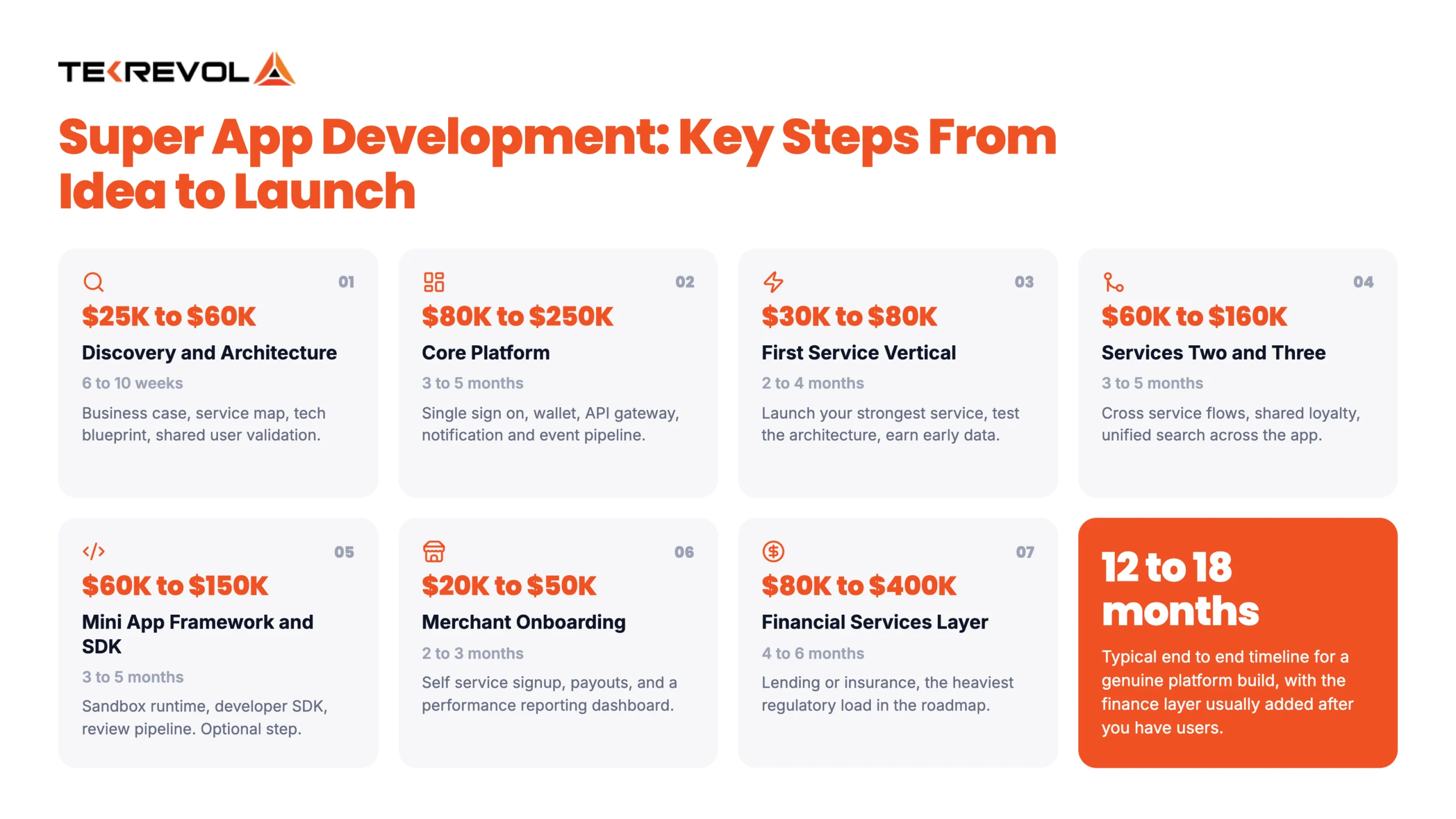
Building a super app isn’t a single build; it’s a sequence of seven distinct stages, typically spread across 12 to 18 months. Each stage adds a new layer of capability, and each comes with its own budget and timeline. Here’s how the full journey breaks down.
Step 1: Discovery and Architecture
Timeline: 6–10 weeks | Cost: $25,000–$60,000
This phase validates whether your super app idea actually holds together before you spend a dollar on development. On a single-service app, weak discovery just means some rework later; on a super app, it can make or break your entire business case.
- Business case and unit economics
- Service map showing how features connect
- Complete tech blueprint
- Validation that your services genuinely share users
Step 2: Core Platform
Timeline: 3–5 months | Cost: $80,000–$250,000
This is the foundation everything else sits on, and it typically eats up the largest single chunk of your budget. A weak foundation makes every service you add later more complex and expensive to integrate.
- Single sign-on (SSO)
- Wallet infrastructure
- API gateway connecting all services
- Notification service and event pipeline
Step 3: First Service Vertical
Timeline: 2–4 months | Cost: $30,000–$80,000
Instead of building everything at once, you launch with your strongest, most proven service fully integrated into the core platform. This lets you test the architecture in a real-world setting before committing further budget.
- Tests the architecture in a real-world setting
- Generates early revenue and user data
- Validates demand before further expansion
Step 4: Services Two and Three
Timeline: 3–5 months | Cost: $60,000–$160,000
With one service live, you now bring in two more to start building out the ecosystem. This phase is less about new features and more about making the services feel genuinely connected.
- Cross-service flows between all three verticals
- Shared loyalty program across services
- Unified search across the whole app
Step 5: Mini-App Framework and SDK
Timeline: 3–5 months | Cost: $60,000–$150,000
This step turns your super app into a true platform by letting third-party developers build mini-apps within it. It’s a significant investment, so it only makes sense if third-party extensibility is core to your model.
- Sandbox runtime for mini-apps
- Developer SDK
- Review pipeline for published mini-apps
- Optional step—skipping it saves $80,000–$200,000
Step 6: Merchant Onboarding and Dashboard
Timeline: 2–3 months | Cost: $20,000–$50,000
If your super app involves merchants or partners, this phase gives them the tools to manage themselves instead of relying on your team. It’s a smaller investment but an important one for any marketplace-style model.
- Self-service onboarding
- Payout systems
- Performance reporting dashboard
Step 7: Financial Services Layer
Timeline: 4–6 months | Cost: $80,000–$400,000
The final and most demanding phase upgrades your wallet into a full financial product with lending, insurance, or advanced payment options. It carries the heaviest regulatory and compliance load of any step in this roadmap.
- Lending, insurance, or advanced payment features
- Heaviest regulatory and compliance burden
- Longest timeline of the entire build
- Usually added after you’ve built a user base, not before
Turn Your Super App Idea Into a Buildable Scope
Get the architecture and technology decisions right early so your super app can scale without costly rework.
Build With TekRevolWhat Architecture Does a Super App Need?
A super app needs scalable architecture to support multiple services and future growth. This typically includes microservices, an API gateway, an event-driven data layer, and a mini-app framework for third-party services. The right architecture makes adding new services faster, easier, and more cost-effective.
| Architectural component | Cost to build | What it does | When you need it |
| Microservices with service boundaries | $50,000–$150,000 | Each service ships, scales, and fails independently | Above 2 services or 2 teams |
| API gateway | $25,000–$60,000 | Single entry point, routing, rate limiting, versioning | From service two onward |
| Event-driven data layer | $40,000–$100,000 | Services react to each other without direct coupling | When services must share user state |
| Mini-app framework and runtime | $60,000–$150,000 | Sandboxed environment plus SDK for third parties | Only for a genuine platform |
| Multi-tenant data isolation | $15,000–$50,000 | Hard walls between partner data | The moment outsiders are on the platform |
| Unified identity service | $15,000–$35,000 | One account across every service | Always, from day one |
Why the Event Layer Matters More Than It Sounds
The event-driven layer is the piece most likely to get cut and most likely to be regretted.
Here’s what it buys you. A user completes a ride. That single event needs to update their loyalty balance, feed the recommendation engine, trigger a receipt, adjust their credit profile, and notify the driver. Without an event layer, each of those is a direct call from the ride service to five other services, and every new service multiplies those connections.
With an event layer, the ride service publishes one event; everything else just listens. Service six is cheaper to add than service five, not more expensive.
The monolith question
You don’t need all of this on day one, and building it early is a real way to waste money.
- Under two services, a well-structured monolith is genuinely fine and considerably cheaper to run.
- Two to four services: split the busy paths into services, add the API gateway and event layer.
- Above four services or a mini-app platform: full separation, and you’ll want it before you need it.
Moving from a monolith to services is far cheaper than untangling a badly-split set of services. Design the boundaries early, split them late.
What Tech Stack Does a Super App Need?
A super app needs the best cross-platform frameworks, a microservices backend, an API gateway, event streaming, and a sandboxed mini-app runtime. Stack choice affects cost by 20% to 40%, mostly through hiring availability rather than licensing.
| Layer | Common choices | Cost impact |
| Mobile frontend | React Native, Flutter, native | Cross-platform saves 30%–40% against dual native |
| Backend services | Node.js, Go, Python | Go costs more to hire for, scales cheaper to run |
| API gateway | Managed cloud gateway, self-hosted | Managed costs more monthly, far less to operate |
| Event streaming | Kafka, managed queues | Needed above roughly 100,000 users |
| Mini-app runtime | Custom sandbox plus JS SDK | $60,000–$150,000, almost always custom |
| Databases | Relational plus NoSQL plus cache | Multi-store is standard at this scale |
| Cloud infrastructure | Major cloud provider | 15%–25% of build cost annually |
Cross-Platform vs. Native: Which Is Better for a Super App?
This is the tech stack decision founders ask about most, so here it is directly.
| Cross-platform (Flutter, React Native) | Native (Swift and Kotlin) | |
| Mobile build cost | $60,000–$180,000 | $100,000–$300,000 |
| Cost difference | Baseline | 30% to 40% more |
| Timeline | Baseline | 2–4 months longer |
| Teams needed | One | Two, plus coordination between them |
| Every future feature | Built once | Built twice, forever |
| Performance | Fine for the vast majority of super app use | Better for heavy camera, AR, background processing |
| Mini-app runtime support | Fully workable | Fully workable |
| Best for | Almost every super app | Products where device capability is the product |
The recurring cost is what tips this. The 30% to 40% gap applies not just to your build but to every feature you ship afterwards, for the life of the product. On a super app adding services for years, that compounds into far more than the initial difference.
For most super apps, cross-platform development is the right call on the mobile layer. You’re already carrying enormous backend complexity, and doubling your client codebase adds cost without adding capability that users notice.
The backend is where you shouldn’t economize. A super app’s defining characteristic is that services share identity, payments, and data, and that sharing lives in the backend. Getting it wrong means every new service costs more than the last one instead of less.
Cloud infrastructure deserves its own line in your model rather than a footnote. Our cloud services work consistently show infrastructure as the cost founders underestimate most, because it scales with usage rather than sitting fixed.
How Is AI Used in Super Apps, and What Does It Cost?
AI in super apps handles service recommendation, cross-service fraud detection, mini-app discovery, and embedded credit scoring. Together, these add 10% to 15% to the core build cost over the first eighteen months, and they need data volume before they earn it.
| AI capability | Build cost | What it does | Data needed first |
| Personalized service surfacing | $25,000–$70,000 | Ranks which services appear on the home screen per user | 3–6 months of behavioural data |
| Cross-service fraud detection | $40,000–$120,000 | Spots patterns invisible inside any single service | Transaction history across services |
| Mini-app discovery and ranking | $20,000–$60,000 | Surfaces relevant third-party mini-apps | An active mini-app catalogue |
| Conversational and agentic interfaces | $40,000–$150,000 | Users state an intent, the app completes the task | Reliable service APIs plus fallback design |
| Embedded credit scoring | $60,000–$200,000 | Underwrites using in-app behaviour, not just bureau data | 12+ months of transaction history, plus a licence |
How Do You Secure a Super App?
Super apps need layered security: device fingerprinting, biometric authentication, machine-learning fraud models, and hardened APIs. Budget $80,000 to $250,000 for the security layer, plus $30,000 to $80,000 per audit cycle afterwards.
| Security layer | Cost | What it defends against |
| Device fingerprinting | $15,000–$40,000 | Account takeover from unrecognized devices |
| Biometric and step-up authentication | $15,000–$40,000 | Unauthorized high-value actions |
| ML-based fraud scoring | $40,000–$120,000 | Coordinated fraud across multiple services |
| API hardening and rate limiting | $15,000–$40,000 | Scraping, credential stuffing, abuse at the gateway |
| Mini-app sandboxing and review | $20,000–$60,000 | A malicious or careless third-party mini-app |
| Penetration testing and audit | $30,000–$80,000 per cycle | Everything you didn’t think of |
Note: The more services and partners your super app supports, the more important and expensive, its security layer becomes.
How Much Does Super App Maintenance Cost?
Super app maintenance costs 15% to 25% of your build budget annually, plus support costs running three to five times higher than a single-service app. On a $400,000 build, expect $60,000 to $100,000 yearly before support staffing.
| Ongoing cost | Annual figure |
| Platform maintenance and updates | 15%–25% of build cost |
| Cloud infrastructure | $30,000–$300,000, scaling with usage |
| Third-party API usage | $0.10–$0.50 per active user monthly |
| Security audits and penetration testing | $30,000–$80,000 per cycle |
| Compliance reviews | $20,000–$100,000 per market |
| Customer support | 3–5x a single-service app |
Support costs grow as you add more services. Each service brings its own issues, refunds, and customer complaints, but users still contact your platform when something goes wrong. Budget for customer support from the start. It can have a major impact on your overall operating costs and profitability.
How Do Super Apps Make Money?
Super apps make money through transaction fees, merchant commissions, advertising, subscriptions, financial services margin, and mini-app revenue share. Most of these need substantial scale before they earn, which is the part rarely mentioned.
Every article lists these models. Almost none tell you when each one actually switches on, which is the only thing that matters when you’re modelling a business case.
| Monetization model | Typical margin | Scale needed before it works | Time to activate |
| Transaction fees | 15%–40% net | 50,000+ monthly transacting users | At launch |
| Merchant commission | 10%–30% of GMV | 5,000+ active merchants | 3–6 months |
| Subscription or premium tier | 60%–80% | 100,000+ monthly active users | 6–12 months |
| In-app advertising | 40%–70% | 500,000+ monthly active users | 12–18 months |
| Mini-app developer fees | 15%–30% revenue share | An active developer community | 12–24 months |
| Financial services margin | 20%–40% | 1,000,000+ users plus a licence | 18–36 months |
| Data and insight products | 70%–90% | 5,000,000+ monthly active users | 24–36 months |
Read that “scale needed” column carefully, because it’s the honest version of the super app business case.
The lifetime value maths, done honestly
You’ll see claims that super app users are worth three to ten times more than single-service users. We can’t find a traceable study behind that range, so we won’t repeat it as fact. The underlying logic is sound, and you can check it yourself with your own numbers.
Say acquiring a customer costs you $20, and your first service earns $40 in gross profit over their lifetime. Your return is 2x.
Now sell that same customer a second service. Acquisition cost stays at $20 because you already have them. If service two earns another $30, your return on the same $20 is now 3.5x. Add a third at $25, and you’re at 4.75x.
The multiplier isn’t magic; it’s just acquisition cost spread across more revenue. Which is exactly why the model collapses when your services don’t share an audience: you pay the $20 again for each one, and you’ve built an expensive portfolio instead.
Run this with your real numbers before you commit to a budget. If your second service can’t be sold to your first service’s users, the arithmetic never works, no matter how well you build it.
What Are the Best Super App Examples to Learn From?
The best super app examples are WeChat, Alipay, Grab, Gojek, Paytm, and Careem. Each started with one dominant service and expanded outward, which is the pattern worth copying rather than the feature list.
| Super App | Started as | Now includes | The lesson |
| Messaging | Payments, mini-programs, government services, commerce | Mini-programs made it a platform, not the feature count | |
| Alipay | Payment escrow for a marketplace | Wealth management, insurance, credit, lifestyle services | Financial trust first, then everything else |
| Grab | Ride hailing | Delivery, payments, lending, insurance | Regional focus beat trying to be global early |
| Gojek | Motorbike ride booking | 20+ services including payments and logistics | Solved a local problem no global player understood |
| Paytm | Mobile recharge | Wallet, banking, commerce, ticketing | A tiny, high-frequency habit became the wedge |
| Careem | Ride hailing | Delivery, payments, mobility across the Middle East | Built for one region’s payment and language realities |
Most successful super apps started with one high-frequency service. Once they had users coming back regularly, they added more services.
What Are the Biggest Super App Development Challenges?
The biggest super app development challenges are architecture debt from moving too fast, bootstrapping a mini-app ecosystem with no developers, payment regulation varying by market, and navigation breaking down as services multiply. Each has a known fix.
These are the execution problems you’ll hit during the build. The section after this one covers a different question: why the business model itself fails. Both are worth reading, and they’re not the same list.
Challenge 1: Architecture debt from shipping fast
The problem: you launch service one quickly with everything in a monolith, which is correct. Then service two goes in the same place, and service three, and by service four, every deployment risks all of them.
The fix: design service boundaries in the first sprint, even if you don’t split them yet. Keep identity, payments, and the event layer separate from day one. Splitting later is manageable; untangling shared database tables across four services is not.
Challenge 2: A mini-app platform with no mini-apps
The problem: you spend $60,000 to $150,000 building a runtime and SDK, then discover that no developer wants to build for a platform with 40,000 users.
The fix: get written partner commitments before you build the runtime. Then seed it yourself by rebuilding two of your own services as mini-apps, which proves the SDK works and gives arriving partners something to copy. Never build the platform in anticipation of demand.
Challenge 3: Payment regulation changes by market
The problem: your wallet works in market one and is illegal in market two. Licensing timelines run months, sometimes years, and they’re outside your control entirely.
The fix: treat payments as a pluggable layer rather than a fixed integration, so a market’s local rail can be swapped in without touching your service code. Sequence market entry by regulatory difficulty, not by market size.
Challenge 4: Navigation collapses as services multiply
The problem: this one is badly underrated. Every service you add competes for the same screen. At three services, your home screen is clear. At eight, users cannot find anything, and your newest service gets no traffic at all.
The fix: cap primary navigation at three to five items and move everything else into a searchable directory with personalized surfacing. Rank what appears by that user’s actual behaviour rather than showing everyone the same grid.
Budget $25,000 to $70,000 for personalized surfacing, and treat it as a growth investment rather than a nice-to-have. A service nobody can find generates nothing, whatever it costs to build.
Challenge 5: Bootstrapping a multi-sided marketplace
The problem: merchants join when there are users, users join when there are merchants, and at launch you have neither.
The fix: pick the side that’s cheaper to acquire and subsidize it openly. Most super apps subsidize supply first, because a merchant with no customers still shows up if onboarding is free and instant. Budget the subsidy as a line item rather than treating it as a marketing overspend.
Hit One of These Already?
We'll review your architecture and roadmap against all five and tell you which ones are fixable now versus which need addressing before your next service ships.
Consult Our Strategy TeamWhy Do Super App Projects Fail?
Super app projects fail on unit economics rather than engineering. The common causes are services that don’t share users, monetization that needs to scale the product never reaches, and support costs that grow faster than revenue.
We’d rather say this plainly than sell around it.
Services Don’t Overlap
The entire premise is that acquiring a user for service one makes service two cheaper to sell. If your food delivery users have no interest in your insurance product, you’ve paid platform prices for a portfolio of unrelated apps.
Scale Threshold Never Arrives
Look again at the monetization table. If your realistic ceiling is 80,000 users, advertising, financial services, and data products are all permanently unavailable to you. Model your revenue against your realistic user base, not your ambitious one.
Feature Bloat Kills Retention
A super app with fifteen services and no clear entry point performs worse than a focused app with three. More services increase the number of things a user must ignore.
Support and operations outgrow revenue
The three-to-five-times support multiplier is real, and it arrives before the monetization thresholds do. As you add more services, support teams must handle more transactions, issues, refunds, and partner requests, increasing operating costs faster than revenue.
Regulation moves faster than the roadmap
Payment and lending rules vary by market and change. A financial layer scoped eighteen months ago may need rework before it launches.
Why it matters: none of these are engineering failures, which is why hiring a better development team doesn’t prevent them. They’re business model failures, and the only place to catch them is discovery.
Should You Build Custom or Use a White-Label Super App?
Choose white-label to validate demand cheaply at $15,000 to $60,000 in 2 to 3 months. Choose custom when the product is your business, since white-label platforms cap your services, data ownership, and ability to add a mini-app layer.
| White-label | Custom build | |
| Cost | $15,000–$60,000 | $60,000–$1,500,000+ |
| Time to launch | 2–3 months | 6–18 months |
| Services supported | Fixed by the vendor | Whatever you need |
| Mini-app platform | Rarely possible | Yes |
| Data ownership | Often shared or limited | Fully yours |
| Scaling ceiling | Real and arrives fast | Set by your architecture |
| Best for | Testing whether demand exists | Building the actual business |
White-label gets unfairly dismissed. If you genuinely don’t know whether your users want a second service from you, spending $30,000 to find out beats spending $400,000 to find out.
What white-label can’t do is become the real thing later. There’s no upgrade path from a licensed platform to your own architecture, so treat it as a research expense rather than version one. If you already know you’re building the business, custom software development is the cheaper route in total, even though it isn’t cheaper upfront.
7 Ways to Reduce Super App Development Cost
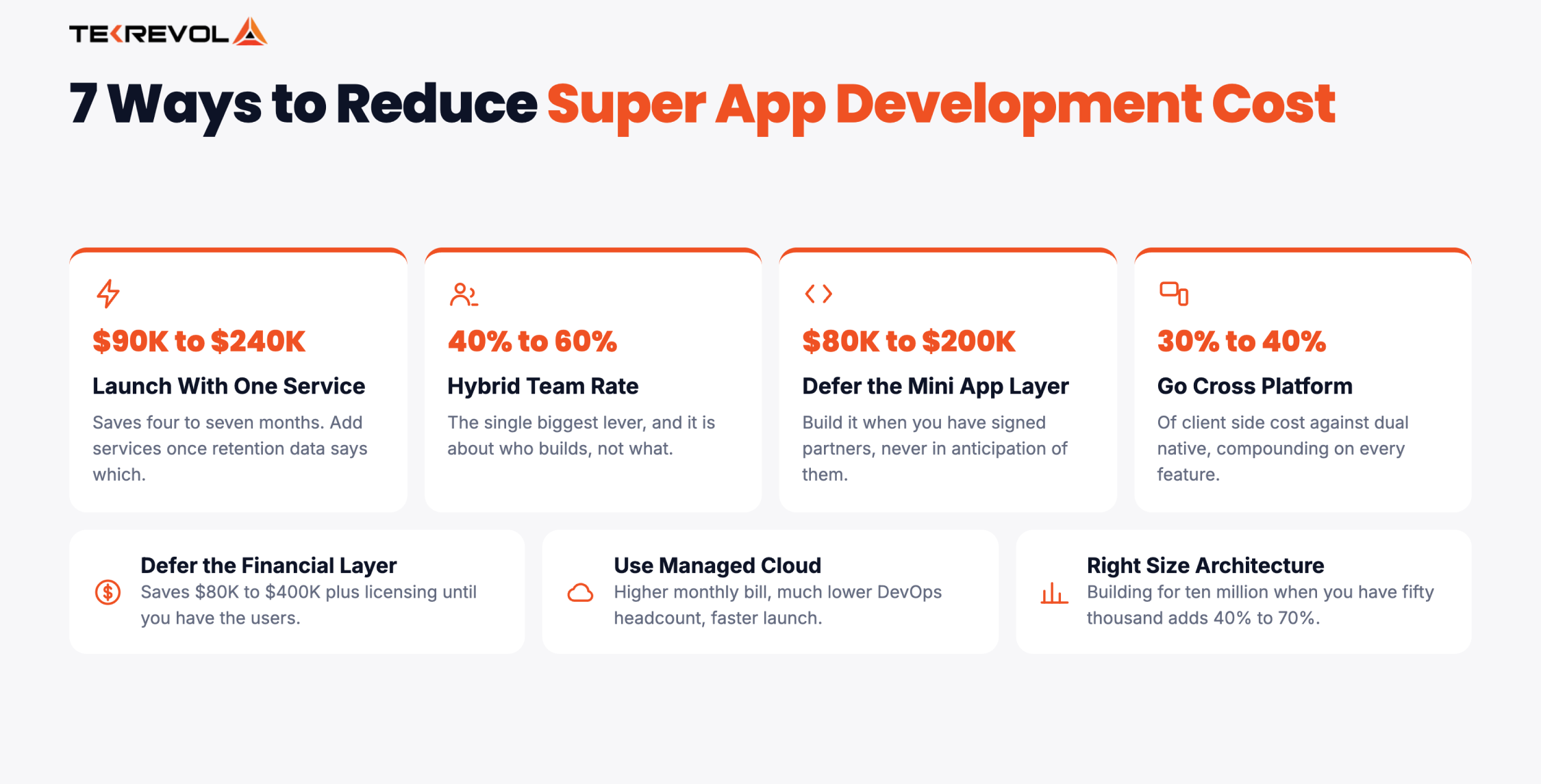
Reduce super app development cost by launching with one service instead of four, deferring the mini-app platform until partners exist, using cross-platform mobile development, and choosing a hybrid team rate. Together, these save 40% to 70%.
Ranked by what each is genuinely worth:
- Launch with one service: Saves $90,000 to $240,000 and four to seven months. Add services once you have retention data telling you which one to add.
- Move to a hybrid team rate: Saves 40% to 60% of the total. The single biggest lever, and it’s about who builds rather than what you build.
- Defer the mini-app platform: Saves $80,000 to $200,000. Build it when you have signed partners, not in anticipation of them.
- Go cross-platform on mobile: Saves 30% to 40% of client-side cost compared to dual native.
- Defer the financial layer: Saves $80,000 to $400,000 plus licensing. Add finance once you have the users it needs.
- Use managed cloud services: Higher monthly cost, considerably lower DevOps headcount, and faster to launch.
- Right-size your architecture: Building for ten million users when you’ll have fifty thousand adds 40% to 70% to capacity you won’t use for years.
If you’re validating rather than committing, our MVP development services scope to the smallest version that proves whether your services genuinely share an audience.
Why Choose TekRevol for Super App Development?
TekRevol has built and shipped a live super app, so our estimates come from delivery rather than theory. We scope by service vertical with auditable hours, and we’ll tell you when a multi-service app serves you better than a platform.
We’re not the cheapest option, and we’re not going to tell you every business needs a super app. Most don’t.
How we approach super app builds:
- We check service overlap first: We make sure your services target the same audience before development begins.
- We build the core platform first: Identity, payments, and shared infrastructure come before individual services.
- We plan costs by service: You get a clear cost for each service, making it easier to phase your roadmap around your budget.
- We delay the mini-app layer when possible: We only recommend it when you have real partners ready to join the platform.
Ready to Find Out Which Tier Your Business Case Supports?
You'll get a service-by-service cost breakdown, a phased timeline, and an honest answer on whether you need a super app at all.
Get Your Super App Assessment


