



- Most failed software projects fail on process, not on technology.
- Poor software quality costs US organizations roughly $2.41 trillion a year, according to CISQ research.
- Technical debt accounts for about $1.52 trillion of that. It also consumes a third of developer time.
- Most software problems begin at the requirements stage, long before anyone writes code.
- Regulated industries like healthcare and fintech carry compliance rules that generic development advice never covers.
- An experienced delivery partner brings structured QA, predictable budgets, and dates that hold.
Starting a custom software project is an exciting milestone. Then an unexpected technical roadblock stalls your momentum.
Over 65% of enterprise software initiatives run over budget or miss their deadline. The usual causes are misaligned expectations, shifting requirements, and hidden architectural complexity.
Clearing those hurdles starts with knowing them before you write a line of code.
Software development challenges are the recurring problems that push projects past deadline and over budget. Shifting requirements. Unrealistic timelines. Technical debt, thin testing, security gaps, and talent shortages.
They’re predictable, which is the good news. Predictable problems have known fixes.
This guide covers all twelve, with a practical fix for each. Every fix comes from what we see running real projects. We’ll also map where each problem starts, where AI genuinely helps, and the order to fix them in.
Project Slipping and Nobody's Sure Why?
Book a free 30-minute review session. We'll flag the bottlenecks that usually cause overruns before you commit budget.
Schedule Your Free ConsultationWhat Are the Biggest Software Development Challenges?
The biggest software development challenges are scope creep, unclear requirements, unrealistic timelines, technical debt, security vulnerabilities, legacy integrations, resource constraints, and poor communication.
On real projects, technical hurdles rarely show up alone. Most of them trace back to a structural gap set during planning.
| Planning & Governance Issues | Technical & Architecture Issues |
| Scope creep & shifting goals | Accumulating technical debt |
| Unrealistic budget & deadlines | Legacy system compatibility |
| Unclear software requirements | Security vulnerabilities |
| Poor stakeholder communication | Inadequate testing practices |
Teams that rush into coding without a blueprint pay for it later. Small misunderstandings snowball, and the fixes get harder the further downstream you find them. Setting clear principles of software development upfront protects the investment.
Facing complex architectural decisions? Our custom software development team builds on a resilient, scalable foundation from day one.
12 Most Common Software Development Challenges and How to Solve Them
The 12 most common software development challenges cover requirements, timelines, cost, and communication. They also cover technical debt, testing, security, legacy systems, talent, documentation, scalability, and constant change.
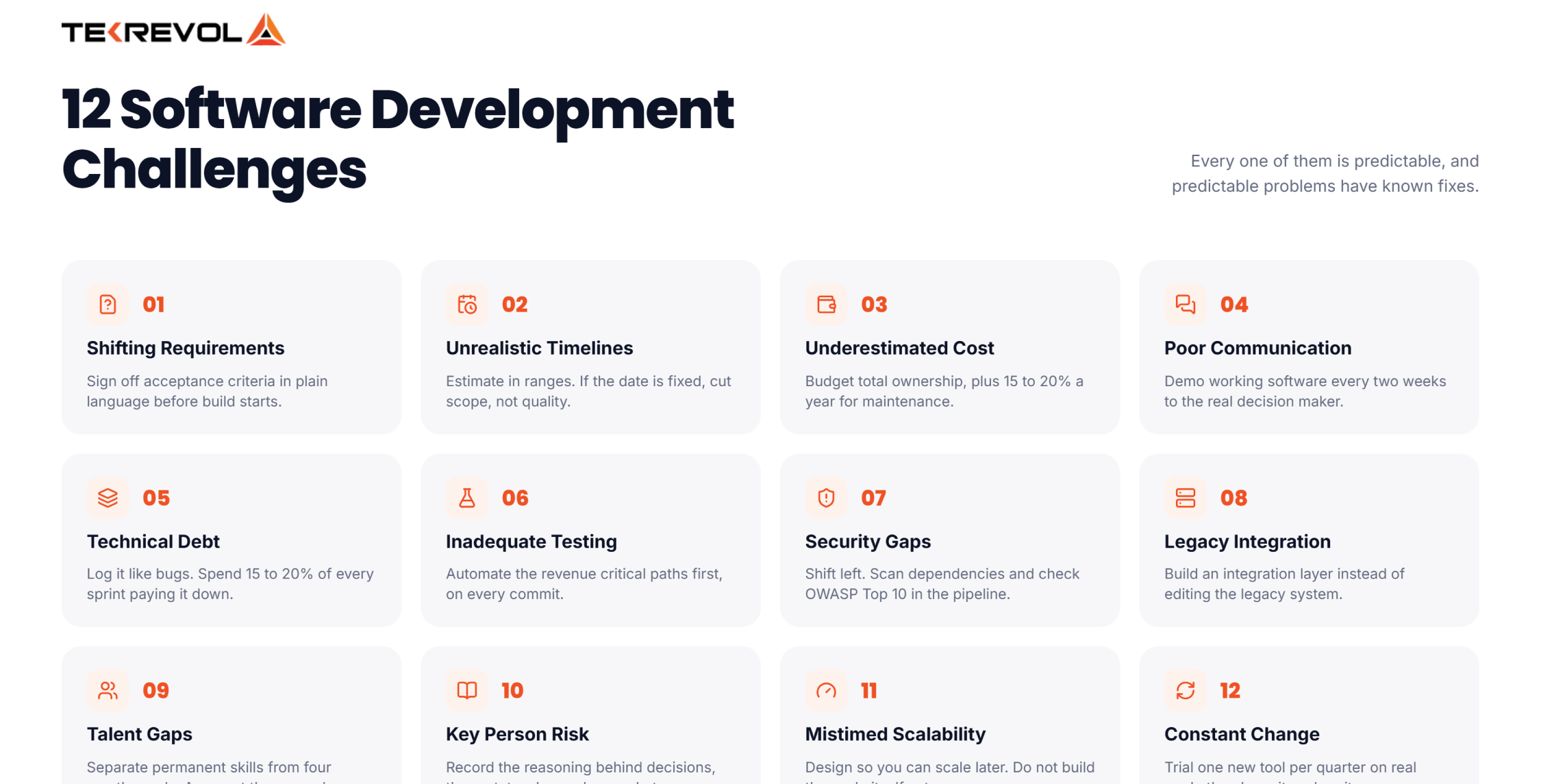
Each one has a practical fix that works at most team sizes. Here’s what each looks like when it’s happening to you.
1. Unclear or Shifting Requirements
Unclear requirements create a gap between what the client expects and what developers build. Without documentation, teams build the wrong features. That means rework, missed milestones, and a bigger budget.
Vague requirements stall more builds than any other single cause. When goals live in verbal promises, developers have to guess at the business logic, which is exactly what a software requirements specification exists to prevent.
The fix: Write acceptance criteria before development starts. Keep them in plain language, and get them signed off by whoever owns the budget. Then require a written change request for anything new, with its cost and timeline impact attached. The point isn’t to block changes. It’s to make their price visible at the moment someone asks.
2. Unrealistic Timelines
Unrealistic timelines happen when schedules follow marketing dates instead of technical complexity. Developer capacity gets treated as a variable it isn’t.
Aggressive release dates cause a cascade. Rushed teams skip discovery, write unoptimized code, and defer testing to hit an artificial milestone, and how much room you have to absorb that pressure depends on the software delivery model you chose.
The fix: Estimate in ranges, never single numbers, and state your assumptions out loud. If the date is genuinely fixed, cut scope rather than quality. A smaller product that works beats a full one that doesn’t.
3. Underestimated Cost
Underestimated costs come from incomplete requirements and uncounted third-party API licensing. Cloud scaling, legacy migration, and post-launch maintenance add the rest.
Initial quotes look manageable on paper. Then unbudgeted operational expenses surface during execution. Misjudged resource allocation and forgotten dependencies drive most serious overruns.
The fix: Budget for total cost of ownership from the start. Assume ongoing costs of roughly 15–20% of the build annually for maintenance. Our software development cost guide breaks the components down properly.
4. Poor Communication
Poor stakeholder communication misaligns feature expectations. It also delays approvals, scrambles priorities, and wastes development cycles.
Business leaders and developers speak different languages. Executives think in launch dates and revenue. Developers think in system architecture and database schemas. Intent gets lost between the two.
The fix: Demo working software every two weeks to the actual decision-maker, not a proxy. Working software surfaces misunderstandings that documents hide. It’s the cheapest correction mechanism there is.
5. Technical Debt
Technical debt is the accumulated cost of quick-fix trade-offs. Codebases turn fragile, bugs multiply, feature velocity drops, and maintenance costs climb.
Shortcuts taken to hit a release date work like a high-interest loan. The feature ships today. Paying the debt down later takes double the engineering effort.
The fix: Log debt like you log bugs, with an owner and a size estimate. Allocate a fixed share of every sprint, commonly 15–20%, to paying it down, and keep the disciplined engineering practices that stop new debt forming in the first place. Debt you never measure is debt that compounds silently.”
6. Inadequate Testing
Inadequate testing lets critical bugs, performance bottlenecks, and security flaws reach production. The result is system crashes, poor user experience, and expensive emergency hotfixes.
Rushing to market without thorough testing makes a terrible first impression. Real traffic finds what unverified code hides. A subtle concurrency bug or database bottleneck can take the whole platform down.
The fix: Automate the tests that protect revenue-critical paths first, and run them on every commit, adding visual regression testing for the interfaces customers actually see. Don’t chase a coverage percentage. Cover the flows where failure actually costs you money.
7. Security Vulnerabilities
Security vulnerabilities are flaws in code logic, system design, or third-party dependencies. They let attackers reach sensitive data, inject malicious scripts, or disrupt critical services.
Cybersecurity risks grow more sophisticated every year. Treat security as an afterthought, and you invite breaches, compliance fines, and lost customer trust.
The fix: Shift security left. Scan dependencies automatically and check against the OWASP Top 10 in your pipeline. Keep secrets in a secret manager. Have a second person review authentication logic before it ships.
8. Legacy System Integration
Legacy integration challenges appear when modern applications meet aging monolithic databases. Those systems often lack documented APIs, process transactions slowly, and run deprecated security protocols.
Enterprises still depend on platforms that have carried core business logic for decades. Making them talk to modern web applications without breaking existing workflows is a genuine technical hurdle.
The fix: Build an integration layer instead of modifying the legacy system directly. Document what you learn as you go. That knowledge is currently one resignation away from disappearing.
9. Talent Gaps and Slow Hiring
Talent gaps appear when a team lacks specialized engineering expertise. The effects are resource bottlenecks, developer burnout, slipped schedules, and rising recruitment costs.
Finding, hiring, and onboarding skilled developers takes months. Projects that need advanced machine learning or high-throughput cloud engineering stall without that expertise in place.
The fix: Separate “we need this skill permanently” from “we need it for four months.” For the second, IT staff augmentation fills the gap in weeks while you hire in parallel.
10. Weak Documentation and Key-Person Risk
Key-person risk shows up when critical system knowledge lives in one developer’s head. Nothing is written down, so the project is exposed the day that person leaves.
Undocumented code logic turns routine maintenance into high-risk work. When a lead developer exits without recording system dependencies, the remaining team struggles to maintain or upgrade the application.
The fix: Require a written architecture decision record for every significant choice. Record the reasoning, not the syntax. Then rotate who works on what, deliberately, so knowledge spreads before it walks out.
11. Scalability Planned at the Wrong Time
Scalability planned at the wrong time produces one of two failures. Premature optimization burns budget on infrastructure before demand is proven. Delayed scaling leaves the application crashing under a traffic spike.
Building a massive auto-scaling system for an unproven product wastes funding that core features need. Building a fragile prototype with no growth path fails the moment traffic arrives.
The fix: Design so you can scale. Don’t build the scale itself. Stateless services, a database that can be read-replicated, and no hard-coded limits keep the door open cheaply. Our cloud services team handles the rest when traffic actually arrives.
12. Keeping Up With Constant Change
Frameworks, tooling, and AI assistants now move faster than teams can evaluate them. Chasing every release costs more than ignoring most of them would.
The fix: Adopt on evidence, not novelty. Trial one new tool per quarter on a real project. Measure whether it helped, then standardize it or drop it. Our guide on AI adoption challenges covers the evaluation side in depth.
Recognize More Than Three of These?
Get a free project assessment and an honest evaluation of the challenges affecting your delivery, even if the answers are uncomfortable.
Consult Our ExpertsWhere in the Software Development Life Cycle Do Problems Start?
Most software problems start in requirements and planning, not in coding. A requirement misunderstood on day one survives every later stage of the SDLC. It also gets more expensive to remove at each one.
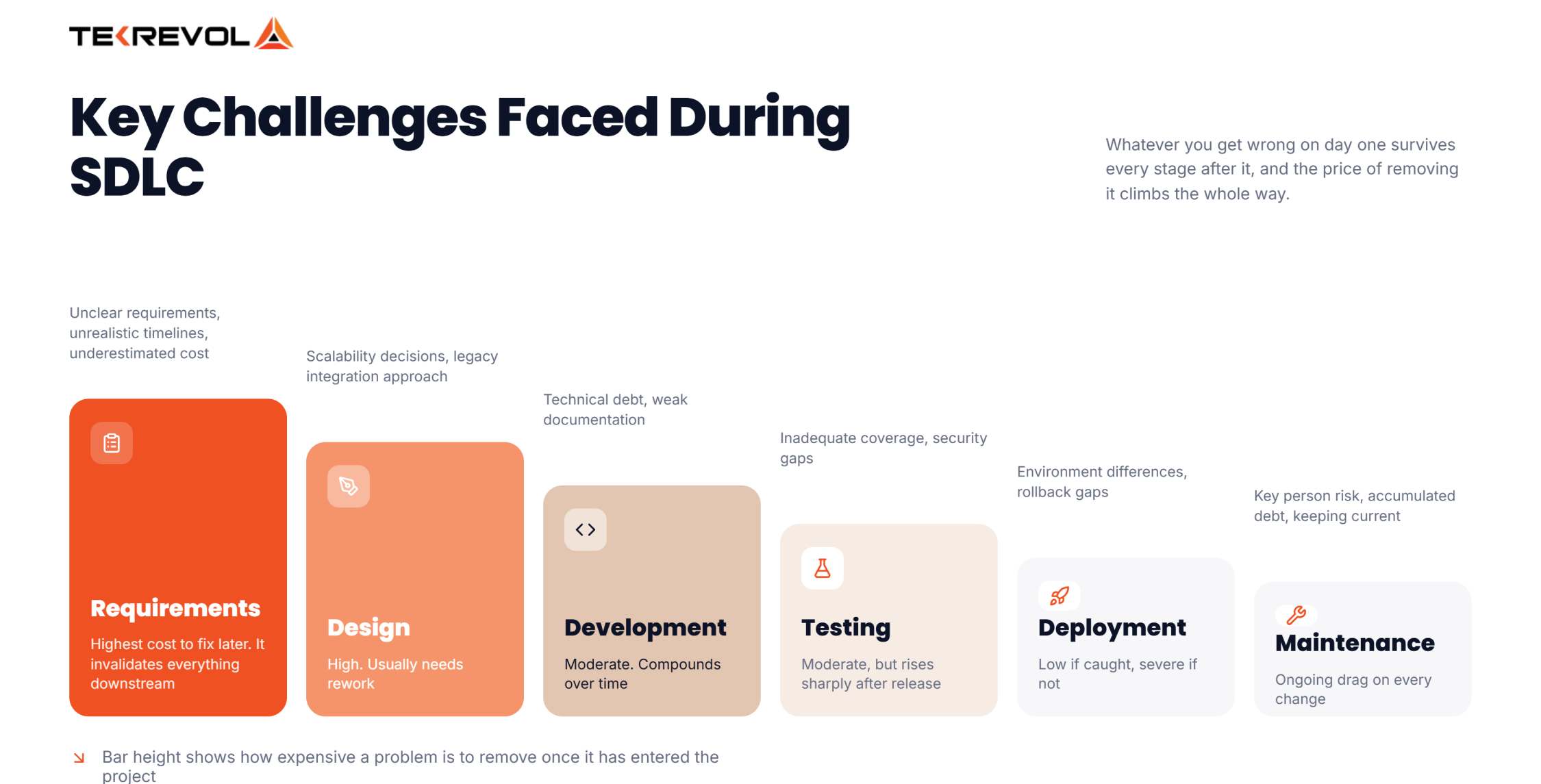
This is the most useful single idea on the whole topic.
| SDLC stage | Challenges that start here | Cost to fix later |
| Requirements | Unclear requirements, unrealistic timelines, underestimated cost | Highest; it invalidates everything downstream |
| Design | Scalability decisions, legacy integration approach | High, usually needs rework |
| Development | Technical debt, weak documentation | Moderate, compounds over time |
| Testing | Inadequate coverage, security gaps | Moderate, but rises sharply after release |
| Deployment | Environment differences, rollback gaps | Low if caught, severe if not |
| Maintenance | Key-person risk, accumulated debt, keeping current | Ongoing drag on every future change |
Read the right-hand column top to bottom. The earlier a problem enters, the more it costs to remove. A wrong assumption in requirements gets baked into the design, the code, the tests, and the docs.
So the highest-leverage improvement available to most teams isn’t a better framework. It’s two more days spent on requirements.
Software Development Challenges Unique to Specific Industries
Regulated industries add compliance, audit trails, and data residency on top of the usual twelve. Healthcare, fintech, and education carry legal requirements that change architecture decisions, not just paperwork.
| Industry | The added challenge | What it changes |
| Healthcare | HIPAA compliance, patient data handling, clinical workflow accuracy | Encryption, access logging, and audit trails become architecture, not features |
| Fintech | PCI DSS, KYC and AML rules, transaction integrity | No eventual consistency on balances. Every action needs an immutable audit record |
| eCommerce | Traffic spikes, payment reliability, inventory accuracy | Must survive 10x load on one predictable day a year |
| Education | Student data privacy, accessibility law, low-bandwidth users | Accessibility is a legal requirement, not a nice-to-have |
| Logistics | Real-time tracking, offline operation, hardware integration | Devices lose signal. The system has to keep working anyway |
| Automotive and IoT | Safety standards, firmware updates in the field | You cannot patch a car the way you patch a web app |
Two patterns run through all of these.
First, compliance shapes architecture. Find a rule late, and you’re facing rework, not just a new policy document. That’s why healthcare software development starts with encryption and audit design rather than features.
Second, the cost of failure is lopsided. A broken feature in a game annoys people. A broken feature in a payments app lands in a regulator’s inbox.
Building in financial services? Our breakdown of fintech development challenges goes considerably deeper on the compliance side.
The rule is simple. Pin down your legal constraints during requirements, not during testing. Teams that treat compliance as a launch checklist pay for it twice.
How Does AI Help Solve Software Development Challenges?
AI helps most with repetitive work: boilerplate, test drafting, documentation, and explaining unfamiliar legacy code. It doesn’t solve requirements or communication problems. It shifts effort toward review rather than removing it.
Here’s where AI genuinely earns its place, matched to the twelve challenges above.
| Challenge | How AI helps | What it can’t do |
| Technical debt | Explains legacy code and suggests refactors | Decide which debt is worth paying down |
| Inadequate testing | Drafts unit tests and edge cases quickly | Knows which paths actually matter to revenue |
| Weak documentation | Generates first-draft docs and code summaries | Captures why a decision was made |
| Legacy integration | Reads undocumented code and explains behavior | Replaces testing against the real system |
| Talent gaps | Raises output per developer on routine work | Substitute for senior architectural judgment |
| Unclear requirements | Very little | This is a people problem, not a tooling one |
The adoption data is settled. The trust data isn’t.
Stack Overflow’s 2025 Developer Survey found that 84% of developers use or plan to use AI tools. That’s up from 76% the year before. Among professionals, 51% use them daily.
Yet favorable sentiment fell to 60%, down from over 70% in 2023 and 2024. Only 3.1% highly trust the accuracy of AI output, and 46% actively distrust it. Three-quarters said they’d still ask a person when they don’t trust an AI answer.
That gap is the real story. Teams that added AI without adding review capacity got faster at writing and no faster at shipping. The bottleneck moved. It didn’t go away. Our artificial intelligence development team builds the review step in from the start.
Which Software Development Challenges Should You Fix First?
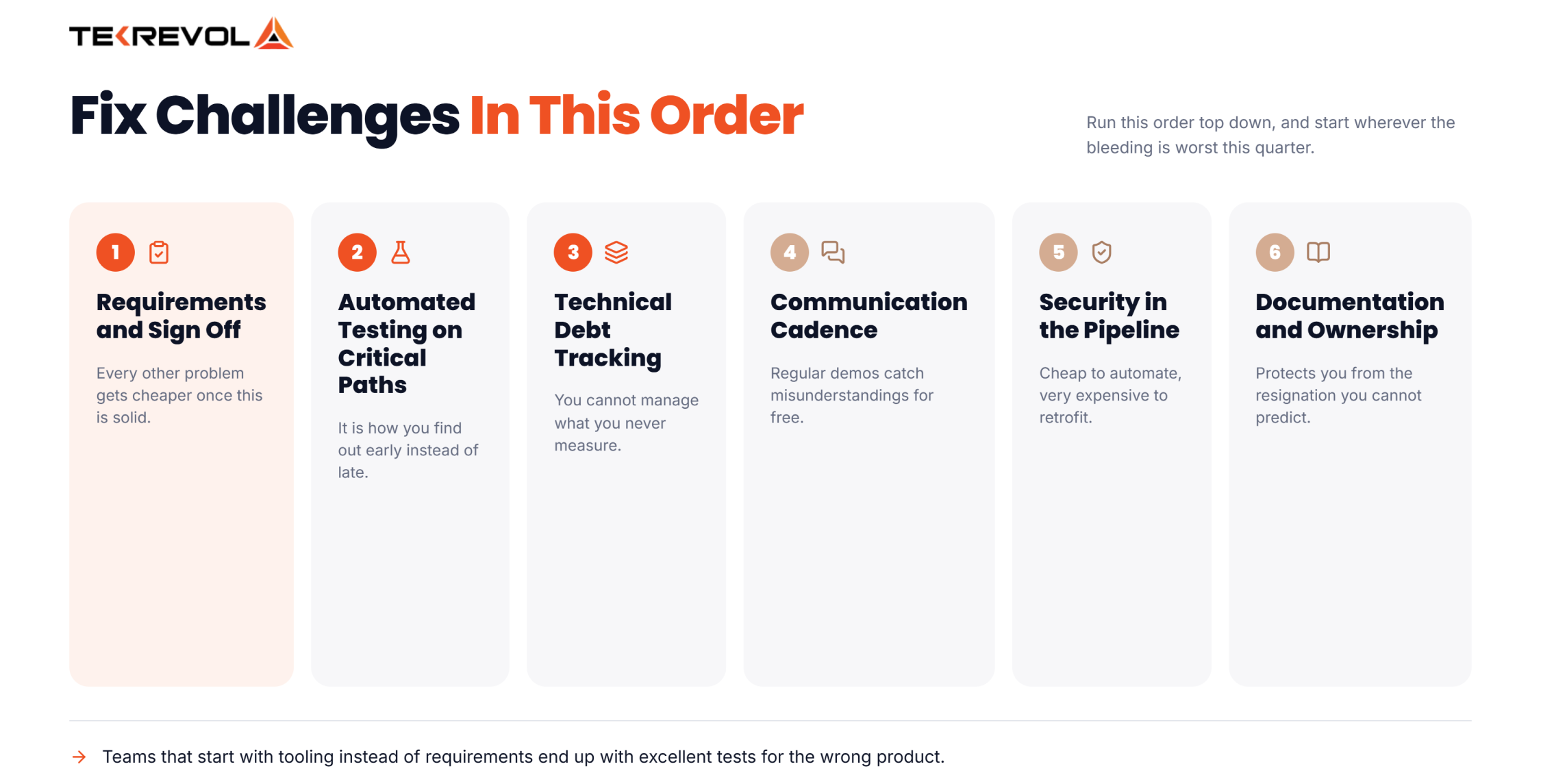
Fix requirements first, then testing, then technical debt. Requirements problems cause the most downstream damage. Testing catches what requirements missed. Debt sets how fast you can move afterwards. Everything else builds on those three.
| Priority | Fix this | Because |
| 1 | Requirements and sign-off | Every other problem gets cheaper once this is solid |
| 2 | Automated testing on critical paths | It’s how you find out early instead of late |
| 3 | Technical debt tracking | You can’t manage what you never measure |
| 4 | Communication cadence | Regular demos catch misunderstandings for free |
| 5 | Security in the pipeline | Cheap to automate, very expensive to retrofit |
| 6 | Documentation and ownership | Protects you from the resignation you can’t predict |
Sequence matters here. Teams that start with tooling instead of requirements end up with excellent automated tests for the wrong product.
One caution. Don’t attempt all six at once. Pick whichever is costing you most this quarter, fix it properly, then move down the list. Six half-fixed processes are worse than one that works.
Why Choose TekRevol for Software Development?
Across 800+ projects in 11 industries, we’ve hit every challenge on this list repeatedly. That includes the regulated ones: healthcare, fintech, logistics, and education, where compliance shapes architecture from day one. That pattern recognition is the real product.
TekRevol follows the best software development practices on every project we deliver. Here’s how we handle the ones that cause the most damage.
| Challenge | What we do about it |
| Unclear requirements | Written acceptance criteria signed off before development starts. No verbal scope |
| Unrealistic timelines | We say so at proposal stage. If the date is fixed, we cut scope with you, not quality |
| Underestimated cost | Estimates include hosting, integrations, and maintenance, not just build hours |
| Technical debt | Every shortcut we take is logged and sized, so paying it down stays your call |
| Weak documentation | Architecture decisions and reasoning delivered with the code, not after it |
| Talent gaps | Augment for short-term needs, build permanently for long-term ones |
Two things we’d rather be judged on than a list of awards.
We push back before you sign, not after. If a timeline needs scope cut to be realistic, that conversation happens at proposal stage. It costs us some deals. It costs our clients far less than month four does.
You can leave. Documented decisions, a working README, no undocumented scripts, and no single person holding the whole picture. Take the project in-house later and you can, which is exactly the key-person risk this article warns about.
Building Something Where Mistakes Get Expensive?
Send us your scope. Get a delivery plan and a price, free.
Consult Our Strategy Team


