



- Software development practices are habits your team repeats, while standards are documented rules your team agrees to follow.
- Version control, automated testing, and code review deliver more value than other software development best practices combined.
- ISO/IEC/IEEE 12207:2026 replaced the older 2017 software life cycle standard back in April this year.
- DORA now tracks five delivery metrics, not the four that most articles still quote today.
- SOLID, DRY, KISS, and YAGNI are the coding principles that prevent most long-term maintenance pain.
- Adopting every practice at once fails, so fix your biggest bottleneck first and measure it.
Every team says they follow best practices. Then you open the repo and find a branch called final-fix-v2-REAL, tests nobody has run since March, and one developer who’s the only person alive who understands billing. We’ve taken over enough codebases to know this is normal, not shameful.
Software development best practices are the repeated habits that keep code easy to ship as a team grows: version control, testing, code review, small releases, and clear docs. They aren’t rules for their own sake. Software gets harder to change over time, and these habits slow down.
This guide covers the same set we run as a software development company on client work. We’ll split practices from standards, cover the coding rules worth knowing, and compare the main methods. We’ll flag the formal standards nobody else mentions, including one quietly replaced this April. Then you get a checklist, the metrics that prove it’s working, and a straight answer on what to fix first.
What Are Software Development Best Practices?
Software development best practices are proven, repeatable methods teams use to build software that stays reliable and easy to change. They cover how you write code, review it, test it, release it, and document it, from the first commit through to maintenance.
The word “best” oversells it a bit. These are habits that have worked across enough teams and enough years that starting anywhere else is usually a mistake. They’re a default, not a law.
Here’s what they share: each one trades a little speed now for a lot of speed later. Writing tests slows down today’s feature. It speeds up every change you make for the next three years.
That trade is the whole argument. Teams that skip these habits ship fast for about six months, then slow down for good, because every change risks breaking something nobody can see.
Inherited a Codebase You Don't Trust?
We'll audit your codebase against the checklist and identify what's urgent, what can wait, and where the biggest risks are, free of charge.
Schedule Your Free ConsultationDifference Between Software Development Standards and Best Practices
The difference between software development standards and best practices is that standards are written rules your team agrees to enforce. Best practices are widely accepted habits. Standards are specific and checkable. Best practices are general and adaptable.
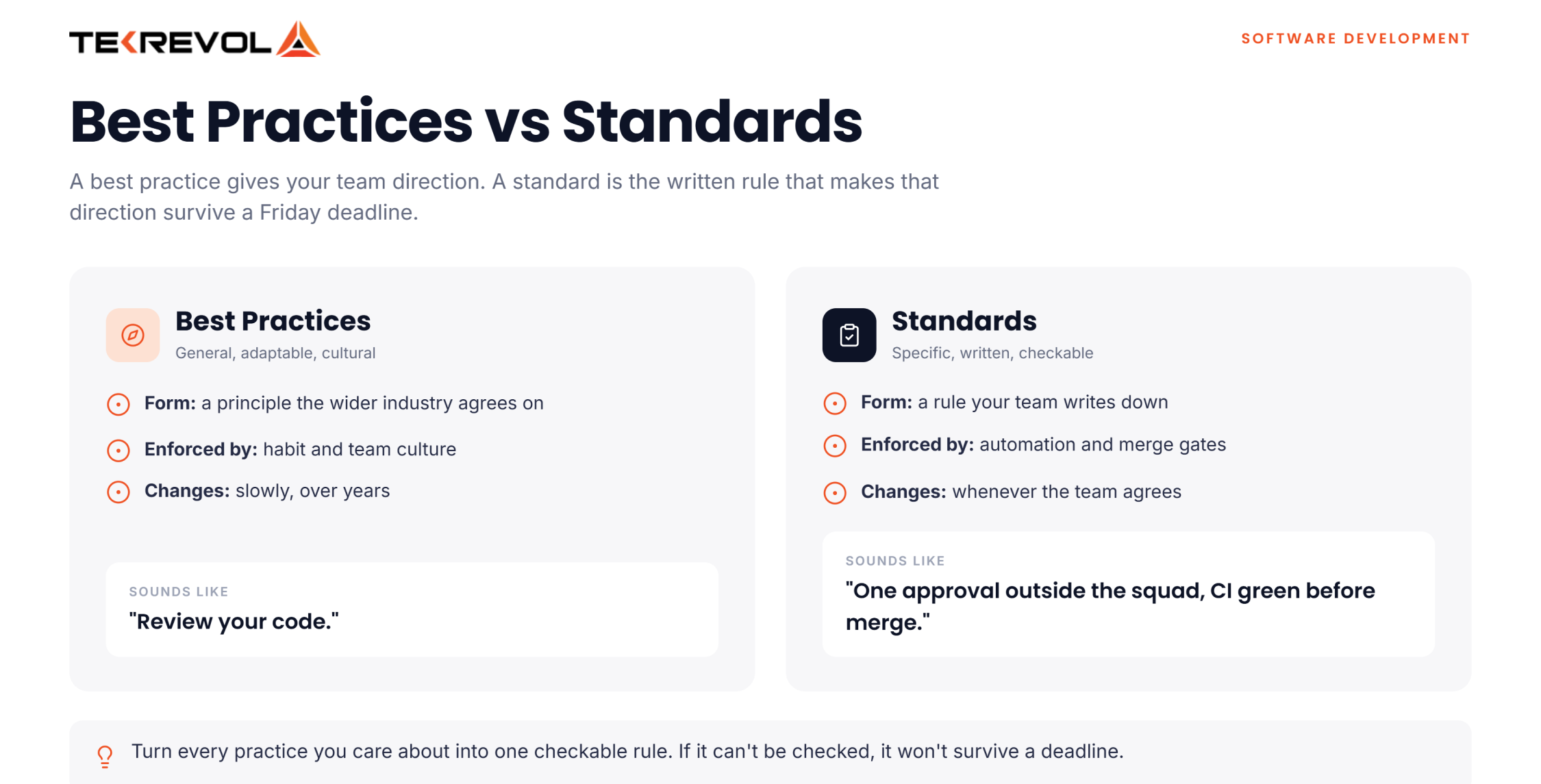
Put simply, a best practice says “review your code.” A standard says “every pull request needs one approval from someone outside the author’s squad, and CI must pass before merge.”
| Aspect | Best practice | Standard |
| Form | General principle | Written, specific rule |
| Enforcement | Cultural, by habit | Automated or gated |
| Example | “Write readable code” | “Max cyclomatic complexity of 10, enforced by linter” |
| Who sets it | The wider industry | Your team, company, or a standards body |
| Changes | Slowly, over years | Whenever your team agrees to change it |
Most teams need both. Practices give you direction, and standards make that direction stick at 4 pm on a Friday when someone wants to merge fast. The move here is to turn each practice you care about into one checkable rule. If it can’t be checked, it won’t survive a deadline.
Software Development Standards You Should Know
The software development standards worth knowing are ISO/IEC/IEEE 12207 for life cycle processes, ISO/IEC 25010 for product quality, and industry standards like OWASP for security. Regulated sectors add their own on top.
Most articles on this topic skip formal standards. That’s a gap, because if you work in health, finance, cars, or government, someone will ask which standard you build to.
ISO/IEC/IEEE 12207: Software Life Cycle Processes
This is the umbrella standard for how software gets built, from idea through to retirement. It sets out the steps and the shared words, so two firms can agree on what “verification” or “maintenance” really means.
Worth flagging, since almost nobody has caught it yet: the current version is 12207:2026, published on April 15, 2026, replacing the 2017 edition. If your compliance docs cite the 2017 version, they’re now out of date.
ISO/IEC 25010: the Product Quality Model
ISO/IEC 25010:2023 defines what “good software” means in measurable terms. The current version sets out nine quality characteristics: functional suitability, performance efficiency, compatibility, interaction capability, reliability, security, maintainability, flexibility, and safety.
That list is more useful than it looks. It’s a ready-made checklist for sign-off criteria, and it stops “quality” being an argument about taste.
Practical Standards Most Teams Actually Use
Formal ISO standards matter for audits. Day-to-day, most teams run on lighter ones:
- OWASP Top 10 for web application security risks
- Semantic versioning for release numbering
- Conventional Commits for commit message format
- Language style guides, such as PEP 8 for Python or the Google Java Style Guide
- WCAG for accessibility
Pick a few, write them down, and automate the checks. A standard nobody enforces is just a document.
What Are the 5 Principles of Software Development?
The five principles most teams follow are SOLID, DRY, KISS, YAGNI, and separation of concerns. Together they push you toward simple code, having one clear purpose per component, and not repeating yourself unnecessarily.
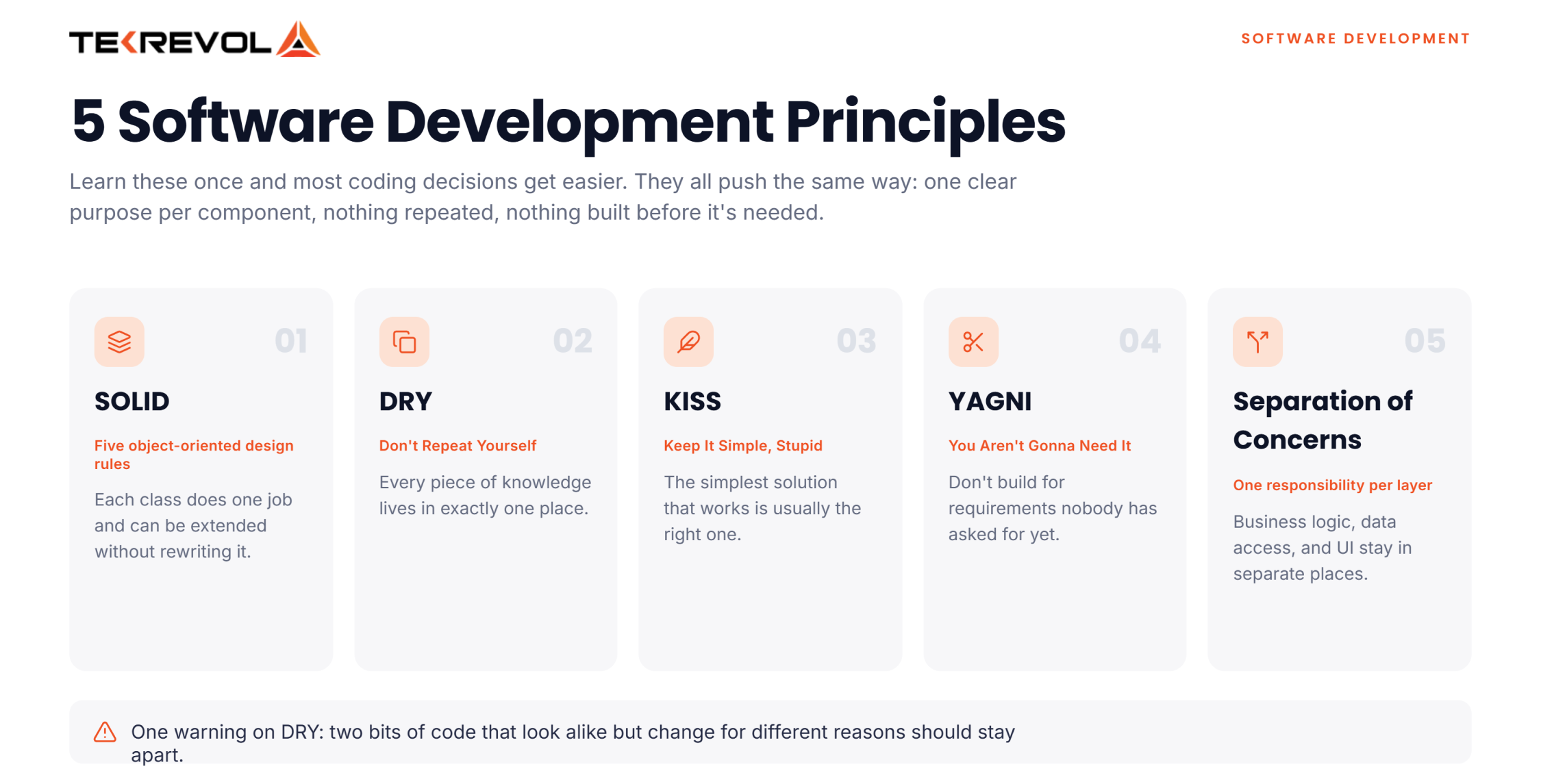
These are the ideas behind the software development best practices. Learn them once, and most coding decisions get easier.
| Principle | What it stands for | What it means in practice |
| SOLID | Five object-oriented design rules | Each class does one job and can be extended without rewriting it |
| DRY | Don’t Repeat Yourself | Every piece of knowledge lives in exactly one place |
| KISS | Keep It Simple, Stupid | The simplest solution that works is usually the right one |
| YAGNI | You Aren’t Gonna Need It | Don’t build for requirements nobody has asked for yet |
| Separation of concerns | One responsibility per layer | Business logic, data access, and UI stay in separate places |
One warning on DRY, since it’s the rule teams most often push too far. Two bits of code that look alike but change for different reasons should stay apart. Forcing them together links two things that were never related.
10 Core Software Development Best Practices
The core software development best practices are version control, code review, automated testing, continuous integration, small releases, secure coding, documentation, and clear ownership. Most teams get real results from the first four alone.
Here’s each one, and what “doing it properly” actually looks like.
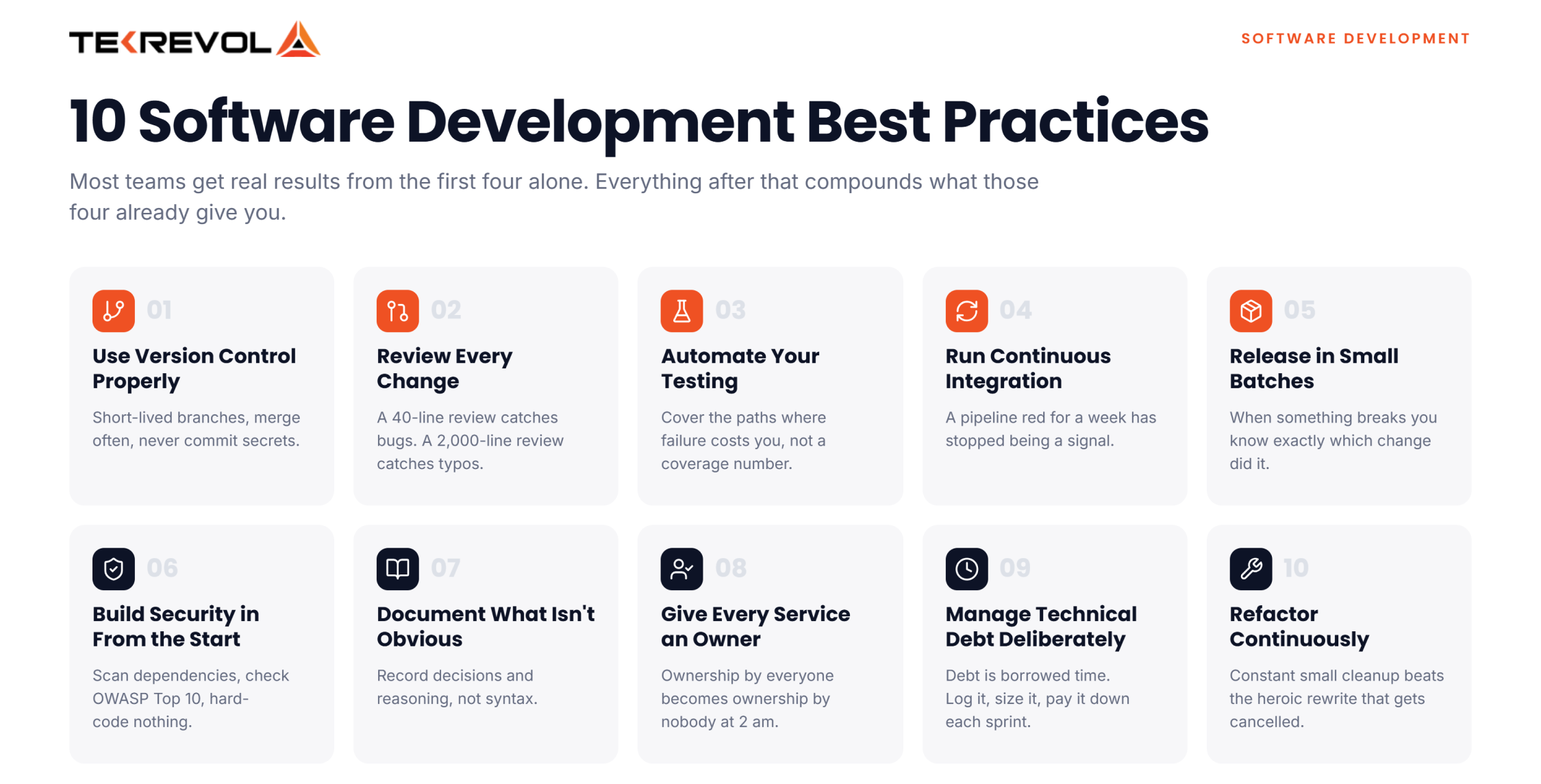
1. Use Version Control Properly
Everything goes in Git, including infrastructure config and documentation. Use short-lived branches, merge often, and never commit secrets. Long-lived feature branches are where merge conflicts go to breed.
2. Review Every Change
Every pull request gets at least one reviewer. Keep them small, because a 40-line review catches bugs and a 2,000-line review catches typos. Review for correctness and clarity, not personal style, since the linter should handle style.
3. Automate Your Testing
Aim for a test pyramid: many fast unit tests, fewer integration tests, a small number of end-to-end tests, plus visual regression checks on UI-heavy products. Chasing a coverage percentage is a trap. Cover the paths where failure actually costs you something.
4. Run Continuous Integration
Every commit triggers a build and the test suite. If the build breaks, fixing it is the team’s top priority. A CI pipeline that’s been red for a week has stopped being a signal.
5. Release in Small Batches
Small, frequent releases are safer than big ones, because when something breaks, you know exactly which change did it. Feature flags let you merge code before the feature is ready to switch on.
6. Build Security in From the Start
Shift security left: scan dependencies automatically, check for the OWASP Top 10, never hard-code credentials, and review authentication logic carefully. Retrofitting security after launch costs far more than building it in. Our guide to mobile app security best practices goes deeper on the application side.
7. Document What Isn’t Obvious
Document decisions and reasoning, not syntax, and keep them next to the requirements specification the build started from. A short architecture decision record explaining why you chose PostgreSQL over MongoDB is worth more than fifty comments explaining what a loop does.
8. Give Every Service an Owner
Every service, repo, and pipeline needs a named owner, which is far easier when team structure and role definition are explicit. Shared ownership across everyone reliably becomes ownership by nobody, which you discover at 2 am during an incident.
9. Manage Technical Debt Deliberately
Technical debt isn’t inherently bad; it’s borrowed time. The failure is borrowing without tracking it. Log it, size it, and allocate a fixed share of each sprint to paying it down.
10. Refactor Continuously
Improve code as you touch it rather than scheduling a big rewrite that never gets approved. Small, constant cleanup beats the heroic refactor that gets cancelled in month three.
Knows What to Do but Never Gets Time to Do It?
Our developers plug into your existing process and help clear your backlog with the skills your team needs. Your first consultation is free.
Consult Your Staffing NeedsWhat Are Good Coding Practices in Software Engineering?
Good coding practices in software engineering are descriptive naming, small functions, low complexity, consistent formatting, meaningful error handling, and no hard-coded values. They make code readable by the next person, who is often you in six months.
The practices that pay off most at the code level:
- Name things clearly. calculateMonthlyInvoiceTotal() beats calc(). Length is not the problem; ambiguity is.
- Keep functions short. If a function needs a comment to explain its sections, those sections want to be functions.
- Reduce nesting. Return early instead of wrapping everything in nested conditionals.
- Handle errors on purpose. Catch specific exceptions and do something useful. Never swallow errors silently.
- Avoid hard-coded values. Configuration, credentials, and limits belong outside your code.
- Format automatically. Prettier, Black, or gofmt end style arguments permanently.
- Write tests alongside code. Tests written later test what the code does, not what it should do.
- Delete dead code. Git remembers it. Your codebase doesn’t need to.
Which Software Development Methodologies Should You Use?
The software development methodologies most teams use are Scrum, Kanban, and DevOps, with Waterfall still common in regulated or fixed-scope work. Methodology is how you organise the work. Practices are how you do it. You need both, and they’re often confused.
| Methodology | How it works | Best for | Watch out for |
| Scrum | Fixed sprints, defined roles, regular ceremonies | Teams needing predictable planning cycles | Ceremony overhead swallowing delivery time |
| Kanban | Continuous flow, work-in-progress limits | Support, maintenance, unpredictable priorities | No natural deadline pressure |
| DevOps | Dev and ops share responsibility for delivery | Any team deploying frequently | Treating it as tooling rather than culture |
| Waterfall | Sequential phases, each completed before the next | Fixed-scope, regulated, contract-driven work | Late discovery of requirement mistakes |
| Rapid application development | Fast prototyping with heavy user feedback | Projects where requirements are still forming | Prototypes quietly becoming production |
Most teams we work with end up with a hybrid, usually Scrum ceremonies over a Kanban board, with DevOps practices underneath. That’s fine. Purity in methodology has never shipped anything. If you want the detail on one of these, our rapid application development guide breaks that model down properly.
How Do You Measure Whether Your Practices Are Working?
You measure whether your practices are working with DORA metrics, which track delivery speed and stability together. DORA, a research program run by Google Cloud, now publishes five metrics rather than the four most articles still cite.
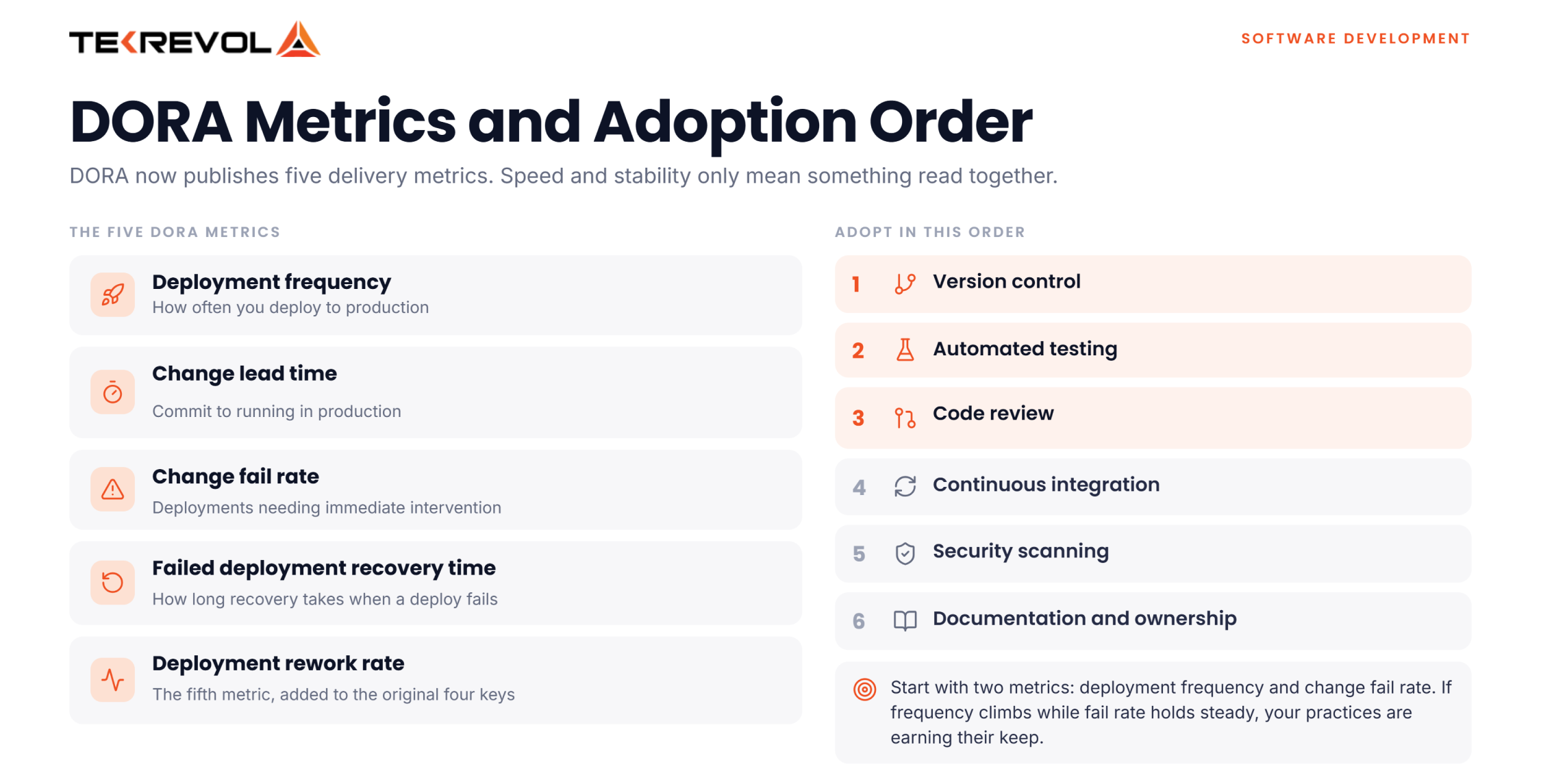
This matters because “we follow software development best practices” means nothing until you attach numbers to it.
| Metric | What it measures |
| Deployment frequency | How often you deploy to production |
| Change lead time | Time from commit in version control to running in production |
| Change fail rate | Share of deployments needing immediate intervention |
| Failed deployment recovery time | How long recovery takes when a deployment fails |
| Deployment rework rate | Share of unplanned deployments caused by a production incident |
Source: DORA, a program run by Google Cloud. Deployment rework rate is the fifth metric, added to the original four keys.
The pairing is what makes these work. Speed metrics alone reward reckless shipping, and stability metrics alone reward shipping nothing. Read together, they show whether your habits are helping or just slowing you down.
What Should Be on Your Software Development Best Practices Checklist?
Your software development best practices checklist should cover source control, code review, testing, CI/CD, security, documentation, and ownership. Work through it once per project, then re-check it quarterly as the team and codebase change.
Copy this, adapt it, and make it part of your project kickoff.
Source control
- [ ] All code, config, and infrastructure in version control
- [ ] Branching strategy documented and agreed
- [ ] No secrets committed, with automated scanning to confirm
- [ ] Commit message format agreed
Code review
- [ ] Every change reviewed by at least one other person
- [ ] Pull requests kept small (under a few hundred lines)
- [ ] Review turnaround expectation agreed, usually within one day
- [ ] Style handled by a linter, not by reviewers
Testing
- [ ] Unit tests on core business logic
- [ ] Integration tests on critical paths
- [ ] Tests run automatically on every commit
- [ ] Failing build treated as a stop-work event
CI/CD
- [ ] Automated build on every commit
- [ ] Automated deployment to staging
- [ ] Rollback procedure documented and tested
- [ ] Feature flags available for risky changes
Security
- [ ] Dependency vulnerability scanning enabled
- [ ] Secrets in a secret manager, never in code
- [ ] Authentication and authorisation reviewed by a second person
- [ ] OWASP Top 10 checked before release
Documentation and ownership
- [ ] README that gets a new developer running locally
- [ ] Architecture decisions recorded with reasoning
- [ ] Named owner for every service and repository
- [ ] On-call and escalation path documented
Measurement
- [ ] Deployment frequency tracked
- [ ] Change fail rate tracked
- [ ] Technical debt logged and sized
- [ ] Checklist reviewed quarterly
Which Software Development Practices Should You Adopt First?
Adopt version control, automated testing, and code review first, in that order. These three deliver most of the benefit, and everything else builds on them. Add CI once tests exist, then security scanning, then formal documentation and ownership.
Nobody adopts eleven practices at once. Teams that try end up with eleven half-implemented practices and no improvement to show for it.
| Team stage | Adopt these | Skip for now |
| Solo or 2 developers | Version control, basic tests, a README | Formal review process, DORA metrics |
| 3 to 8 developers | Code review, CI, dependency scanning | Feature flags, formal standards documents |
| 8 to 25 developers | Small-batch releases, service ownership, DORA metrics | Heavy compliance frameworks |
| 25+ or regulated | Formal standards, audit trails, security gates | Nothing; at this size you need it all |
The order is simple. Tests are no use without version control. CI is no use without tests. Metrics are no use until you ship often enough to have data.
So pick your single biggest bottleneck, fix that, then measure. If releases scare everyone, that’s a testing and CI problem. If bugs keep coming back, that’s a review problem. And if nobody knows who owns a broken service, that’s an ownership problem.
Mistakes Teams Make With Best Practices
The most common mistakes are adopting practices as rituals without understanding the common software development challenges they exist to solve, chasing test coverage percentages, treating documentation as a one-off task, and copying the process of companies far larger than yours.
Five we see repeatedly:
- Cargo-culting the ceremony. Running daily standups that are status reports to a manager isn’t agile; it’s a meeting. If a practice’s purpose can’t be explained, it’s decoration.
- Chasing coverage numbers. A team hitting 90% coverage by testing getters and setters has worse protection than one at 60% covering payment logic. Coverage measures lines run, not risk covered.
- Writing documentation once. Documentation written at launch and never touched becomes actively harmful, because people trust it and it’s wrong.
- Copying enterprise processes at startup scale. A six-person team does not need a change advisory board. Practices should match your size, not your ambitions.
- Adding practices without removing anything. Process accumulates. Every quarter, ask which ceremony or gate has stopped earning its place, and drop it.
The error behind all five is treating software development best practices as a box to tick rather than problems to solve. Every practice exists because of a specific failure. If you don’t have that failure, you may not need that practice yet.
Why Choose TekRevol for Software Development?
As a custom software development company, TekRevol follows all the practices we’ve discussed on every project we deliver. Version control, code review, automated testing, CI/CD, and security scanning aren’t optional extras on our engagements; they’re how we work by default.
What that means for you in practice:
- You get the code and the standards with it: Documented architecture decisions, a README that works, and named ownership. If you take the project in-house later, you can.
- We size technical debt honestly: If we take a shortcut to hit your date, it gets logged and quantified rather than quietly buried for you to discover.
- We match the process to your stage: A startup MVP and a regulated enterprise build get genuinely different levels of process. We won’t sell you a change advisory board you don’t need.
- Breadth across the stack: Custom software, mobile app development, web, cloud, and AI, with the same delivery standards applied across all of them.
We’ve also been recognised by Forbes as one of America’s Best Startup Employers.
Want These Practices Running on Your Project?
Send us your scope, and we'll come back with a practical delivery plan and realistic cost range at no charge.
Consult Our Strategy Team


