



- Software development focuses on building application features, writing code, and solving targeted functional problems.
- Software engineering applies systematic mathematical and architectural principles to construct large-scale, complex software systems.
- Developers typically specialize in application layers, while engineers design overarching system infrastructure and frameworks.
- Software engineering demands strict quality assurance, scalability modeling, and continuous systemic fault tolerance protocols.
- Development projects emphasize rapid feature iterations, whereas engineering projects prioritize long-term system stability.
- Combining robust software engineering with agile development creates scalable, market-ready custom digital platforms.
Over 65% of business leaders use the terms “software developer” and “software engineer” interchangeably when hiring or scoping tech projects.
Software development vs software engineering is a real split between two disciplines and a nearly empty one between two job titles. Conflating these two disciplines can lead to misplaced hiring budgets, misaligned project scopes, and brittle digital products that struggle to scale.
While both fields center on creating digital solutions, software development focuses on building specific applications, features, and user interfaces. Software engineering, on the other hand, applies rigorous engineering principles to design, test, and maintain large-scale system architectures. Choosing the right approach determines whether your project needs rapid application building or scalable infrastructure.
In this comparison guide, we break down definitions, core operational differences, skill sets, and project scope so you can make informed decisions for your investments.
What Is the Difference Between Software Development and Software Engineering?
Software development is the full process of building software: designing, coding, testing, and maintaining standalone computer programs or application features. Software engineering is the discipline of building it under real constraints: reliability, scale, safety, cost, and years of upkeep.
The answer to software development vs software engineering as disciplines is not the honest answer to it as job titles. Every engineer develops. Not every developer works under that discipline. As job titles, the two get swapped freely.
- Is developing software a different thing from engineering software? Yes, and the difference is about which constraints you are held to.
- Is a software developer a different person from a software engineer? Almost never, and the evidence for that is stronger than anything in the first question.
Want to Know Which Category Yours Falls Into?
Describe what it does and who it affects, and we'll help you identify the right category and where your project fits.
Consult Our Strategy TeamWhat Is Software Development?
Software development is the full process of building software: designing, coding, testing, and maintaining standalone computer programs or application features. It focuses on translating user requirements into functional software through programming languages, frameworks, and agile development cycles.
When we talk about software development at TekRevol, we are referring to the creative and technical craftsmanship that is defined by its output. Something works, users can use it, and it does what it was supposed to do. That is the bar.
It is also a wide-open category. A solo founder building a landing page is doing software development. So is a 200-person team shipping a payments system. There is no required credential and no governing body, and outside regulated industries, there is no minimum standard either. That’s a feature when you build something that handles money or health records. We covered the process end to end in our guide to software development.
The word also carries no seniority signal. “Developer” describes what someone does, not how good they are at it, which is exactly why the title debate exists at all.
What Is Software Engineering?
Software engineering is the systematic discipline of applying formal engineering principles and established software development standards to the lifecycle of complex software systems. It emphasizes system architecture, scalability, hardware integration, reliability, security protocols, and long-term maintainability across entire digital infrastructure platforms.
Software engineering takes a broad, systemic view of technology. At TekRevol, we treat software engineers as the digital architects who ensure entire tech ecosystems run smoothly without crashing under heavy traffic.
Instead of focusing solely on single features, software engineers evaluate how different systems interact. They design cloud infrastructure, establish DevOps pipelines, build microservice frameworks, and enforce strict security standards.
Software engineers use engineering methodologies to ensure systems handle high concurrency, data security, and hardware compatibility across enterprise environments.
Software Development vs Software Engineering: How Do They Compare?
The core difference lies in scale and approach: software development focuses on constructing functional applications and user features, while software engineering applies mathematical and structural principles to design, scale, and secure enterprise-wide system architectures.
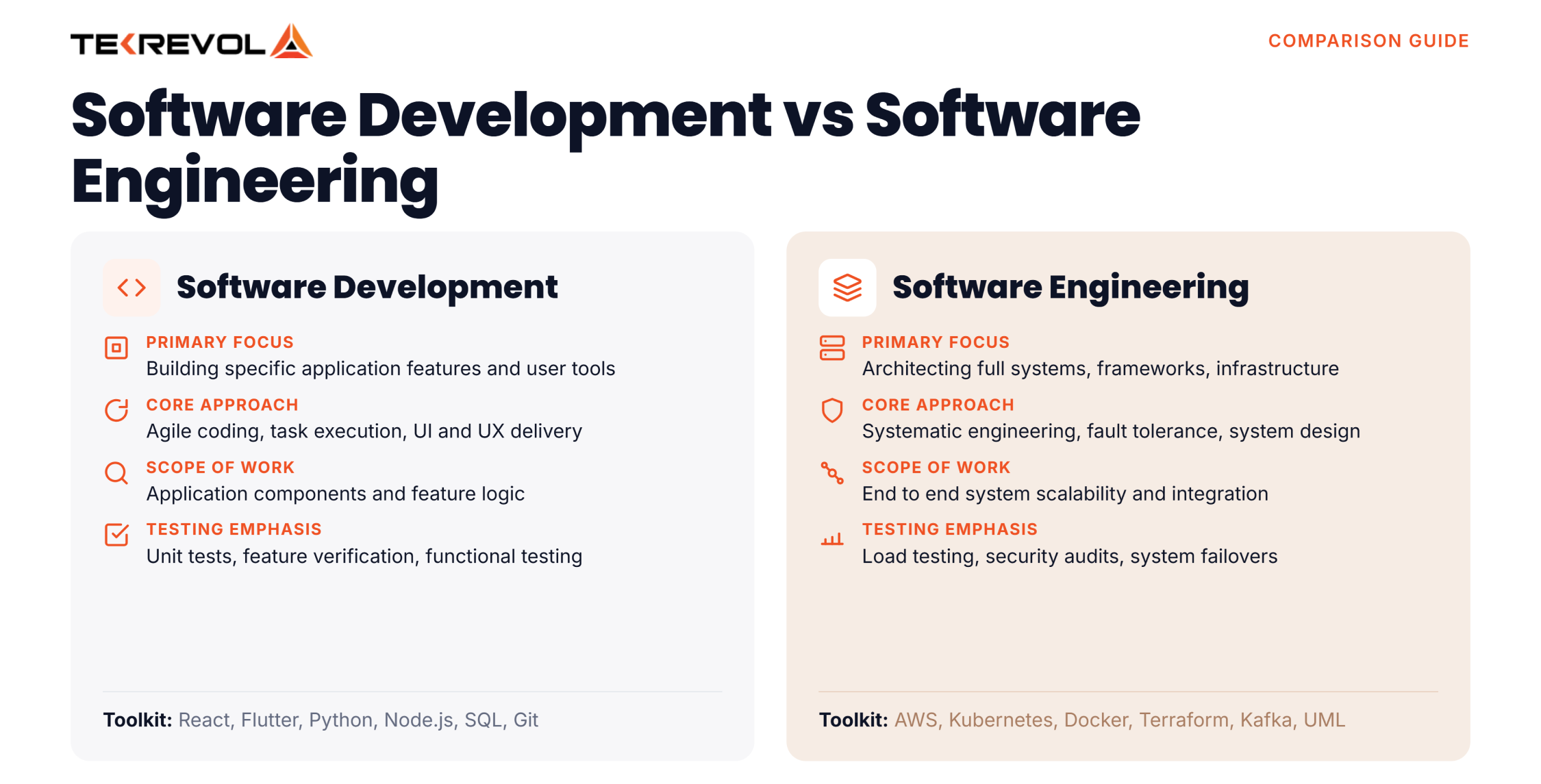
To help visualize how these two disciplines complement each other in real-world projects, consider the comparison table below:
| Metric | Software Development | Software Engineering |
| Primary Focus | Building specific application features and user tools | Architecting full systems, frameworks, and infrastructure |
| Core Approach | Agile coding, task execution, and UI/UX delivery | Systematic engineering, fault tolerance, and system design |
| Scope of Work | Focused on application components and feature logic | Oversees end-to-end system scalability and integration |
| Common Tools | IDEs, React, Flutter, Python, Node.js, Git | AWS, Kubernetes, Docker, System Modeling, Microservices |
| Testing Emphasis | Unit testing, feature verification, functional testing | Load testing, structural security audits, system failovers |
| Educational Background | Bootcamps, computer science, or self-taught paths | Computer science or software engineering degrees |
Writing a Job Req and Stuck on the Title?
Tell us what the role needs to own, and we'll help you scope the position clearly before you post.
Schedule Your Free ConsultationIs a Software Developer the Same as a Software Engineer?
In practice, yes. The US Bureau of Labor Statistics tracks both under one occupation, 15-1252 Software Developers. Its own title file maps “Software Engineer” straight to that code, and O*NET lists it as a sample reported title. Employers pick whichever word they like.
This is where software development vs software engineering stops being a philosophical question and starts having receipts. Four independent sources describe the same people, and none of them agree on what to call them.
| Source | What it calls the role |
| BLS and O*NET (code 15-1252) | “Software Developer.” Software Engineer appears only as a sample reported title |
| Stack Overflow 2025 Developer Survey | The most-picked roles are all “Developer, something.” No plain “software engineer” option exists |
| Levels.fyi 2025 pay report | The canonical ladder is Software Engineer. There is no software developer track on it |
| A typical US job board | Both, interchangeably, decided by whoever wrote the posting |
The BLS handbook does draw one line, and it’s worth quoting.
“Software engineers take a broad view of a project’s system and software requirements, planning its scope and order of work.”
If a candidate’s last title was Software Engineer and yours says Software Developer, that tells you where they worked. It does not tell you what they can build.
Roles and Responsibilities: Software Development vs Software Engineering
Software developers focus on writing code, debugging applications, creating user interfaces, and implementing features, which is one slice of the wider set of developers roles inside a delivery team. Whereas software engineers manage system architecture, build CI/CD pipelines, optimize database scaling, enforce security protocols, and oversee platform integrity.
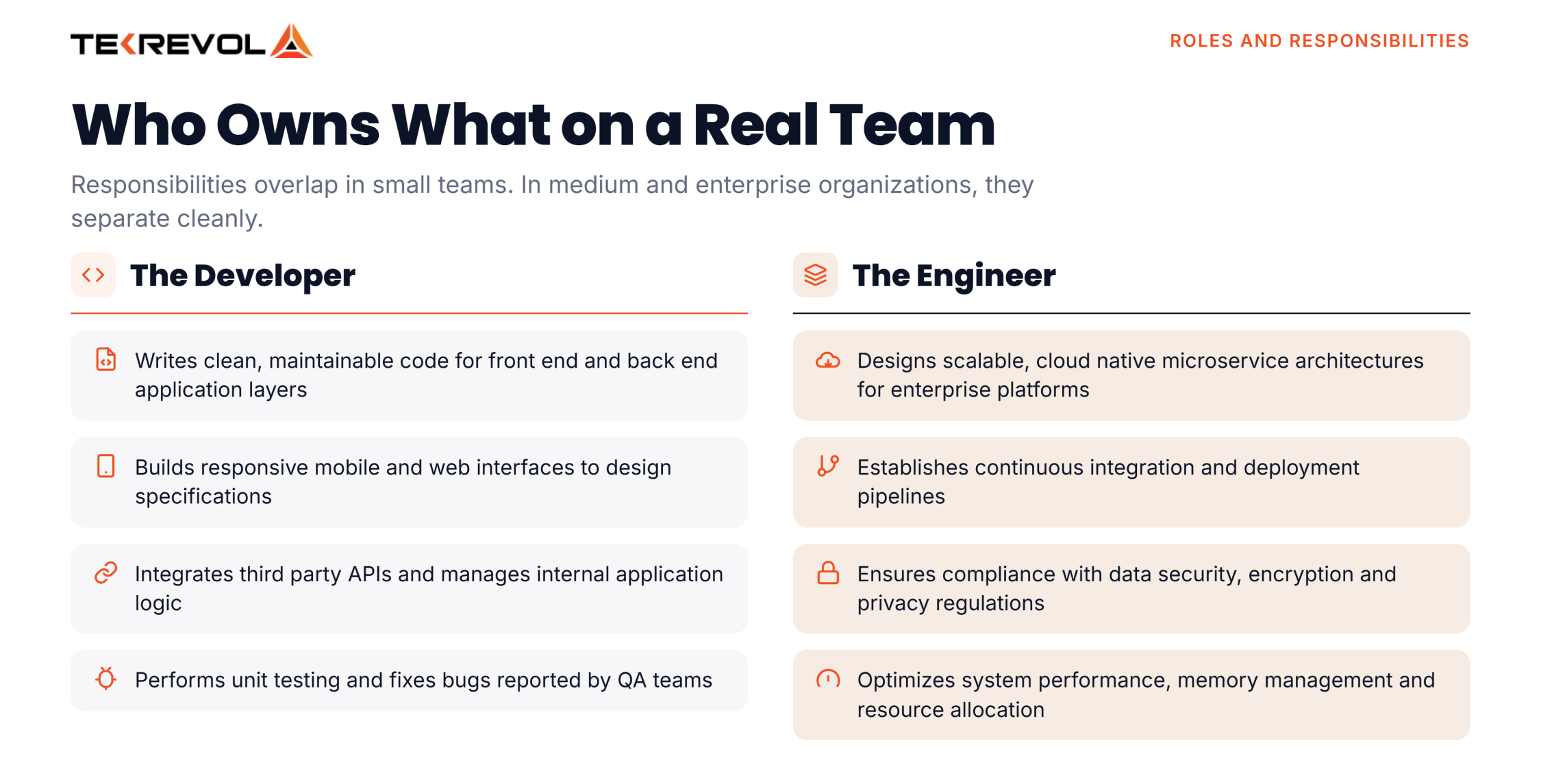
While responsibilities often overlap in smaller teams, medium and enterprise organizations clearly separate these roles:
Software Developer Responsibilities:
- Writing clean, maintainable code for front-end or back-end application layers.
- Building responsive mobile and web interfaces according to design specifications.
- Integrating third-party APIs and managing internal application logic.
- Performing unit testing and fixing software bugs reported by QA teams.
Software Engineer Responsibilities:
- Designing scalable, cloud-native microservice architectures for enterprise platforms.
- Establishing continuous integration and deployment (CI/CD) automated pipelines.
- Ensuring compliance with strict data security, encryption, and privacy regulations.
- Optimizing system performance, memory management, and hardware resource allocation.
When building complex multi-platform products, our enterprise app development engineers guarantee your system scales without architectural bottlenecks.
Which One Should You Hire: Software Developer or Software Engineer?
Hire for the problem, not the title. If you need a feature built to a spec, you need development capacity, and a software developer staff augmentation model is usually the fastest way to add it. If you need someone to own architecture and what happens in year three, you need engineering discipline, whatever the job ad calls it.
What does change the outcome is the scope of ownership.
- A team hired to build what you specified will build what you specified.
- A team asked to own the system will push back on the spec, name the constraints you didn’t mention, and tell you which of your requirements are going to cost you later.
That is the actual difference, and it shows up in the statement of work long before it shows up in anyone’s title. So screen for it.
- Ask what they’d do if requirements changed halfway.
- Ask what they’d measure to know the thing is healthy.
- Ask about something they built that failed and what it cost to fix.
Those three answers separate the two far better than a resume header does. If you’d rather add capacity than replace judgment, staff augmentation is the honest name for that.
Comparing Agencies and Getting the Same Pitch?
Send us your scope, and we'll tell you what's genuine engineering work and what can be handled as standard implementation.
Consult Our ExpertsSkill Sets and Tools Required for Software Development vs Software Engineering
Software developers master programming languages, UI frameworks, and application databases, and the modern software development tech stack. Software engineers require deep knowledge of system architecture patterns, cloud infrastructure, containerization, network security, and low-level computer science fundamentals.
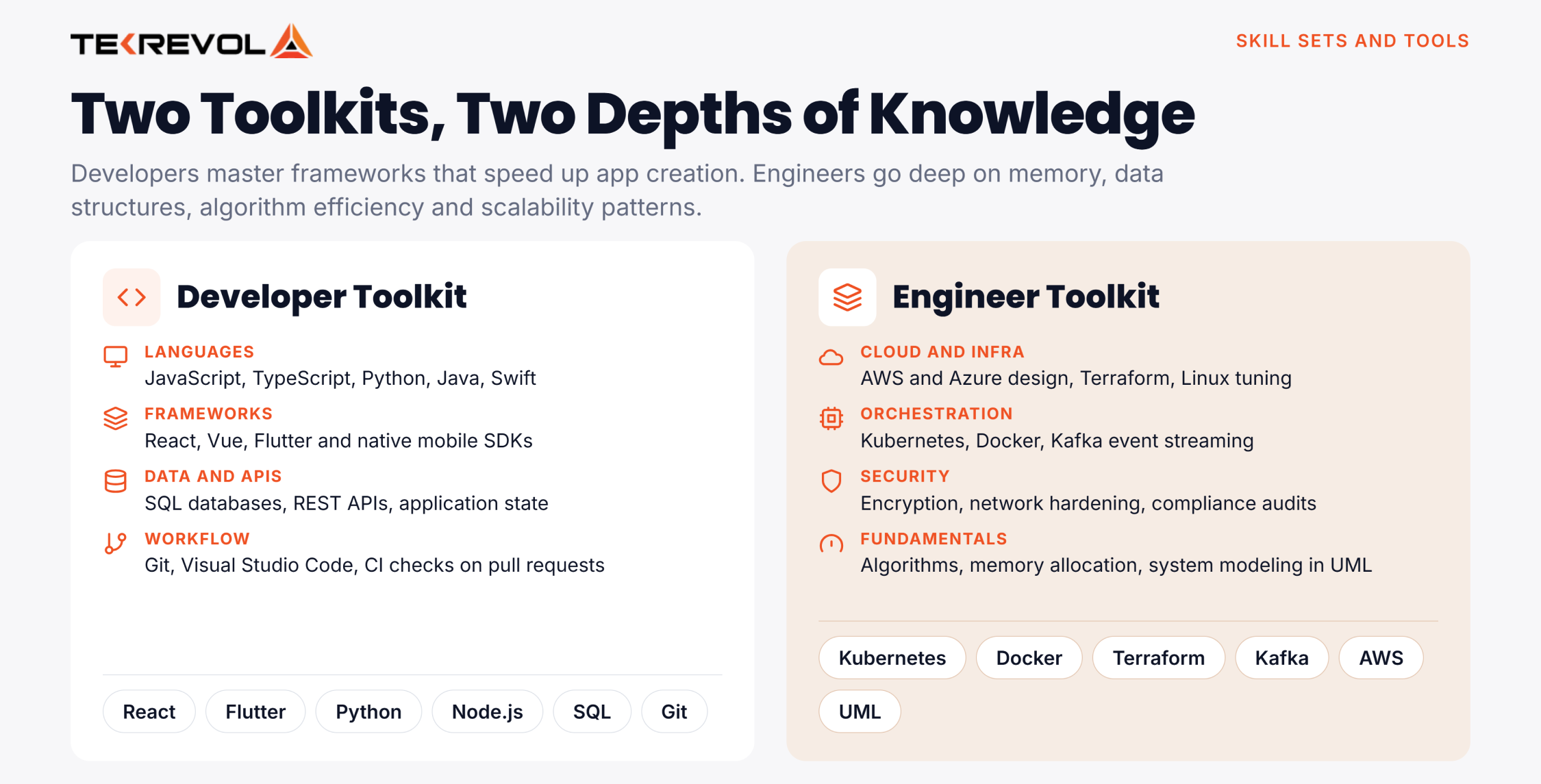
Both roles demand strong technical skills, but their toolkits reflect their different scopes:
- Developer Toolkit: JavaScript, TypeScript, Python, Java, Swift, React, Vue, Flutter, SQL, REST APIs, Git, and Visual Studio Code.
- Engineer Toolkit: Kubernetes, Docker, AWS/Azure cloud design, Terraform, Linux kernel optimization, System Modeling (UML), Kafka, and CI/CD tools.
Developers focus on mastering frameworks that speed up app creation. Engineers dive deep into memory allocation, data structures, algorithm efficiency, and system scalability patterns.
How Do Methodologies Differ Across Software Development vs Software Engineering
Software development relies heavily on iterative Agile frameworks to rapidly push user features.” While software engineering uses structured system engineering lifecycles (SDLC) to model risk, ensure hardware compatibility, and guarantee fault-tolerant high availability.
The way teams approach project execution highlights the contrast between development and engineering. Software developers thrive in fast-paced Agile or Scrum sprints. They ship updates quickly, gather user feedback, and refine features over short iteration cycles.
Software engineers, by contrast, must plan for worst-case system scenarios before writing code. They evaluate network latency, database sharding, container orchestration, and failover redundancies. If a system handles millions of concurrent requests, engineering methodologies prevent server crashes and data corruption during usage spikes.
Why Choose TekRevol for Software Development and Software Engineering?
Because we will tell you which side of software development vs software engineering your project actually sits on.
Some builds are development work: the requirements are settled, the scope is clear, and what you need is capable people executing well. Others are engineering work: the constraints conflict, the system has to survive change, and someone has to own the tradeoffs. Charging engineering rates for the first kind is how agencies pad invoices, and we’d rather not.
We’ve been doing this for the last 10 years, across more than 800 projects for clients. One pattern repeats. Projects go wrong when nobody owns the system-level decisions. So we scope those decisions as real work with a named owner instead of hoping someone picks them up.
Need Custom Software Engineered to Scale With Your Growth?
TekRevol delivers complete engineering and development services tailored to your business needs, technical requirements, and long-term growth.
Book a Strategy Consultation Today


