



- Only 6% of Austin venture capital went to rounds under $15 million in the past year, so early-stage founders compete for a narrow slice of a large market.
- Investors fund evidence rather than ideas, and your codebase, analytics, and ownership paperwork decide whether a term sheet survives diligence.
- You cannot report retention you never tracked, which makes analytics instrumentation a build-scope decision rather than a post-launch task.
- Texas SB 2420 became enforceable in June 2026 and places age-verification obligations on app developers, not just on Apple and Google.
- Investors no longer penalize AI-written code, but they do penalize founders who cannot explain their own architecture under questioning.
- A well-scoped MVP from a US agency runs roughly $30,000 to $100,000 and ships in three to four months.
Do you have an app, a deck, and a meeting on the calendar with an Austin investor?
Then here’s the uncomfortable part. Your deck will get you into the room, but your codebase decides whether you leave with a term sheet.
Austin raised $8.1 billion in venture capital during 2025 and another $5.0 billion in the first half of 2026, according to Dealroom.co. Yet only 6% of that money reached rounds under $15 million. Early-stage capital is the scarcest thing in a market drowning in capital.
Investors respond to that scarcity by filtering harder and earlier. Instead of taking product claims on trust, they started checking the product itself.
This article walks through exactly what Austin investors examine in 2026: the things your app has to prove, how technical due diligence works, and what a fundable build cost looks like. You’ll also get a pre-pitch checklist you can run before your first meeting.
Let’s start with what investors are actually looking for.
What Do Austin Investors Want To See In Your App?
Investors want four proofs: the product works with real users, you can measure what those users do, your company owns every line of code, and the architecture survives growth. Everything else in your pitch is packaging around those four claims.
Notice that none of those four are features. Founders consistently over-invest in what the app does and under-invest in what the app can prove.
Let’s break each proof down.
Proof 1: The product works with real users
A demo on your laptop does not count. Investors want a live product functioning as it claims. The bar has risen here. AI-assisted development made shipping cheaper and faster, so a working app now reads as table stakes rather than as a milestone.
Proof 2: You can measure what users do
This is where most founders lose ground. Investors ask for retention cohorts, activation rates, and funnel drop-off. You can only answer those questions if you instrumented the app before launch.
Proof 3: Your company owns every line
Ownership problems kill more deals than bad code does. Investors check whether every contributor signed an IP assignment, whether your repositories sit in company accounts, and whether any open-source dependency carries a licence that contaminates your product.
Proof 4: The architecture survives growth
Nobody expects a perfect system at pre-seed. But investors do want evidence that you thought about scale rather than ignoring it, and that evidence usually takes the form of documented decisions rather than elegant code.
If you’re weighing a partner for that first build, our Austin app development team scopes all four proofs into the engagement rather than treating them as extras.
Now let’s look at why Austin specifically raises the bar on all of this.
Why Is Early-Stage Money So Hard To Raise In Austin?
Austin capital is booming and concentrating at the same time. Only 6% reaches rounds under $15 million, which covers every pre-seed, seed, and small Series A deal in the city.
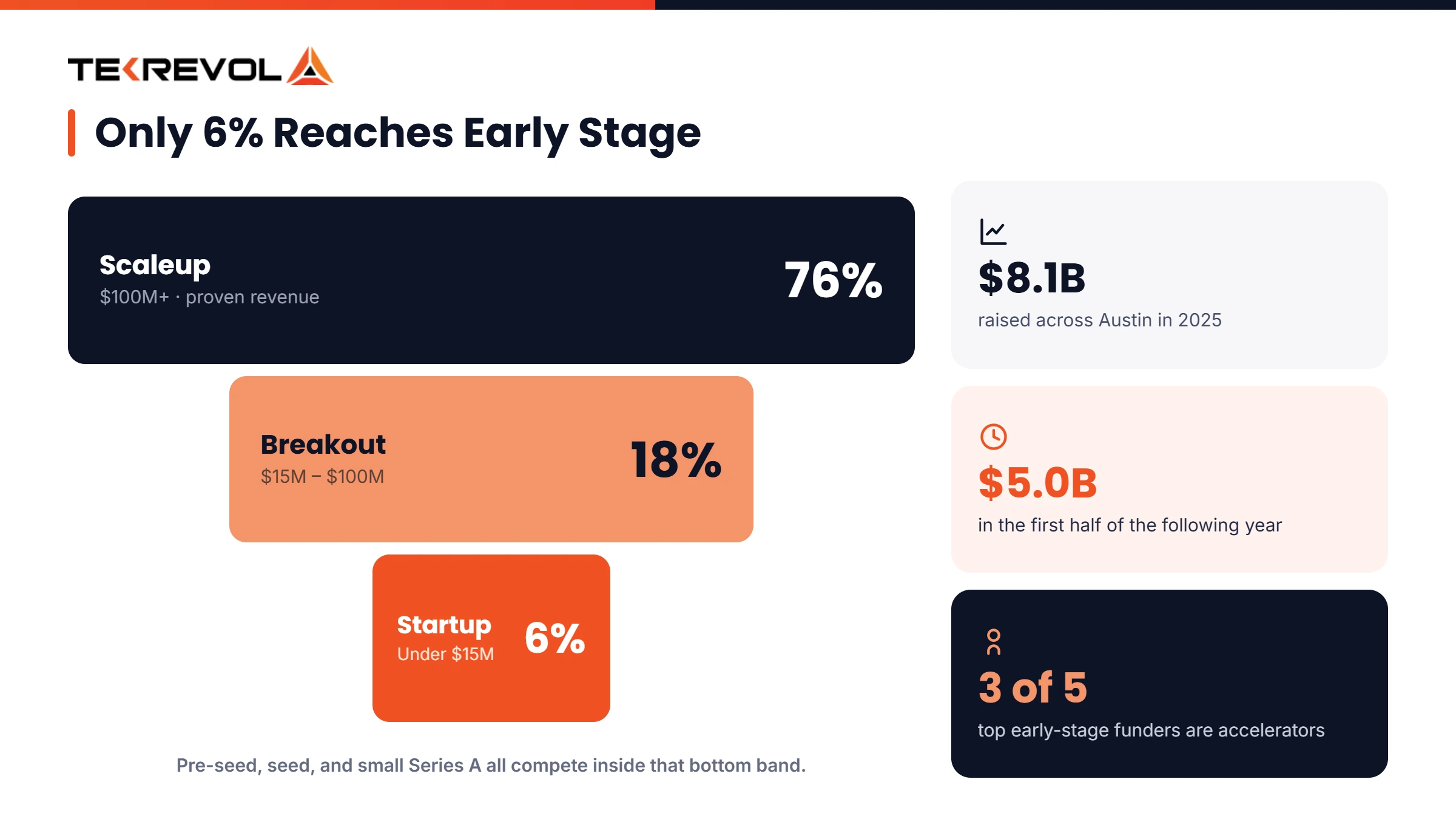
Dealroom splits Austin’s venture capital into three bands. Here’s how the trailing four quarters break down.
| Round band | Size | Share of Austin capital | Who it reaches |
| Scaleup | $100M+ | 76% | Late-stage, proven revenue |
| Breakout | $15M–$100M | 18% | Series B and large Series A |
| Startup | Under $15M | 6% | Pre-seed, seed, small Series A |
Source: Dealroom.co Austin ecosystem data, updated 18 June 2026.
The headline and your reality point in opposite directions. Austin looks thriving, and the door you’re knocking on stays narrow. Investors respond to that gap by cutting earlier, and by cutting on whatever signal costs least to check. That signal is almost always your product.
What Is Technical Due Diligence, And When Does It Start?
Technical due diligence is a structured review of your codebase, architecture, security posture, and IP ownership. It usually begins after an investor shows real interest and before the money moves, which makes it the stage where deals get repriced, delayed, or dropped.
Most founders prepare exhaustively for the pitch and get blindsided by this second evaluation. So let’s demystify it.
What reviewers open first
They rarely start with code, because ownership problems are faster to find:
- Ownership documents – contributor agreements, IP assignments, account access
- Repository history – commits, contributors, release cadence
- Architecture materials – diagrams and decision records
- Analytics – whatever product data you can actually produce
- The code – usually last, and usually sampled
Which Build Decisions Create The Evidence Investors Ask For?
Ten specific build decisions produce the artifacts investors request during diligence. Six of them get examined at seed or earlier, which means you make most of these calls long before you think diligence applies to you.
| # | Build decision | Question it answers | What it produces | Stage checked |
| 1 | Wire analytics before launch | Do people come back? | Retention cohorts, funnel data | Seed |
| 2 | Sign IP assignment with every contributor | Do you own this? | Clean ownership chain | Pre-seed |
| 3 | Write architecture notes during the build | Did you think or guess? | Dated decision log | Seed |
| 4 | Keep modular service boundaries | Will this survive 10x? | Architecture map | Series A |
| 5 | Automate tests on core flows | Can you ship safely? | CI pipeline, deploy history | Seed |
| 6 | Model infra cost per active user | What happens to margins? | Unit economics with real inputs | Series A |
| 7 | Set a security baseline on day one | Are we buying a breach? | Security posture doc | Series A |
| 8 | Inventory dependencies and licences | Any legal landmines? | Package list with licences | Seed |
| 9 | Log release history | How fast does this team move? | Commit and release cadence | Pre-seed |
| 10 | Document and review AI code usage | Can your team explain this? | Review process, test coverage | Seed |
Original TekRevol framework, built from diligence criteria described by Sphere (2026) and Softjourn (2026) plus Dealroom’s Austin stage data. The decision-to-artifact mapping is ours.
Three of these deserve extra attention, because founders skip them most often.
Decision 1: Analytics before launch
Every investor conversation past pre-seed turns into a data conversation. Wire your events first, and you answer those questions in an afternoon. Skip it, and you wait months for history to accumulate.
Decision 2: IP assignment with every contributor
Every contributor means every contributor. That includes the freelancer who built your first landing page, the co-founder who left in year one, and the agency that shipped v1.
Decision 3: Architecture notes during the build
A decision record answers three things: what you chose, what you rejected, and why. Ten lines per decision is plenty.
What Do Austin Investors Expect At Each Funding Stage?
Expectations scale with the cheque size. Pre-seed investors bet on your team and your speed, seed investors bet on early product-market fit, and Series A investors bet on whether the system survives growth. The proof changes at each stage, not the feature count.
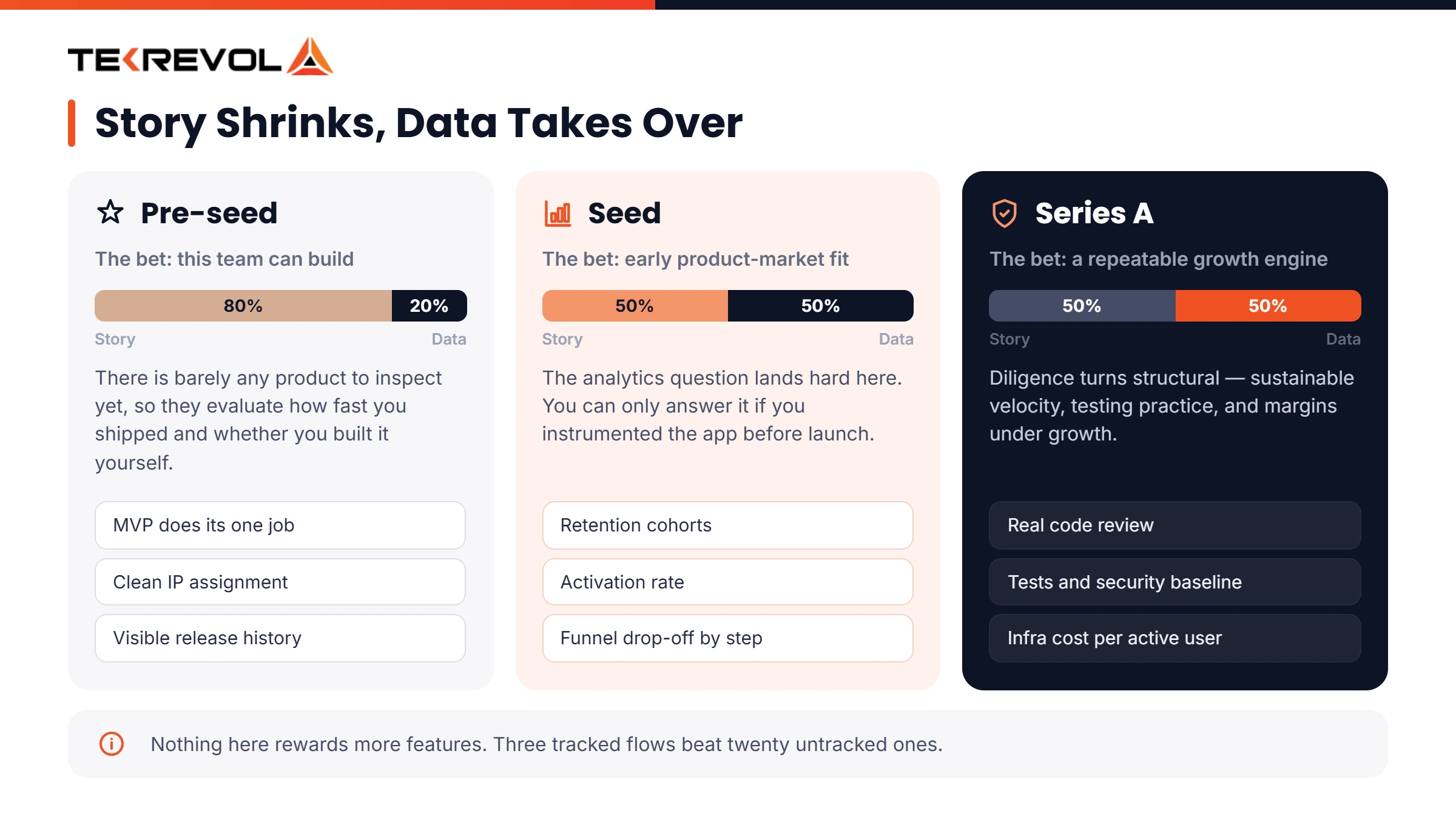
Here’s the shape of it before we go stage by stage.
| Stage | The bet | What they check in the product | Story vs data |
| Pre-seed | This team can build | MVP does its one job, founder explains it, IP is clean | 80% story |
| Seed | Early product-market fit | Live users, real engagement, tested go-to-market | Roughly even |
| Series A | A repeatable growth engine | Code review, tests, security, infra cost, tech debt | 50% data |
Pre-seed: Can this team actually build?
At pre-seed, there often isn’t much product to inspect. So investors evaluate you instead.
They look at how fast you shipped, whether you built it yourself or described it to someone else, and whether ownership is clean. Perfect documentation is not the expectation here. Organized code and a sane foundation are.
Seed: Is anyone actually using it?
Seed is where the analytics question lands, and it lands hard.
Investors at this stage want a live MVP with real users, measurable engagement, and a go-to-market hypothesis you tested rather than assumed. They will ask for numbers you can only produce if you planned for them.
Series A: Does it survive scale?
Series A diligence gets structural. Expect genuine code review, questions about whether your development velocity is sustainable, and scrutiny of testing practice, security measures, and infrastructure cost per user.
If you’re still deciding what belongs in version one, our guide on how to build an MVP covers what to cut and what to keep.
How Do Investors Treat AI-Generated Code In 2026?
Investors no longer penalize AI-generated code. They penalize teams that cannot explain their own system. Y Combinator reports that 95% of its latest batch ships AI-generated code, and Gartner projects 60% of all new code will be AI-written by the end of 2026.
The four questions you should expect
Prepare answers to these before your first meeting:
- How much of this codebase came from AI tools? Give a real estimate, not a deflection.
- What review process do you run? Describe who reviews what, and when.
- Which parts are proprietary versus assembled? This shapes your defensibility argument.
- Can your team explain the architecture? Someone will test this in the room.
What Does An Investor-Ready App Build Cost In Austin?
A well-scoped MVP runs roughly $30,000 to $100,000 and ships in three to four months. Lean single-feature builds start near $15,000, while complex or AI-heavy products push past $150,000.
That timeline is also why an SXSW-ready MVP in Austin has to start in autumn rather than January; the demo date isn’t negotiable, and the build window is.
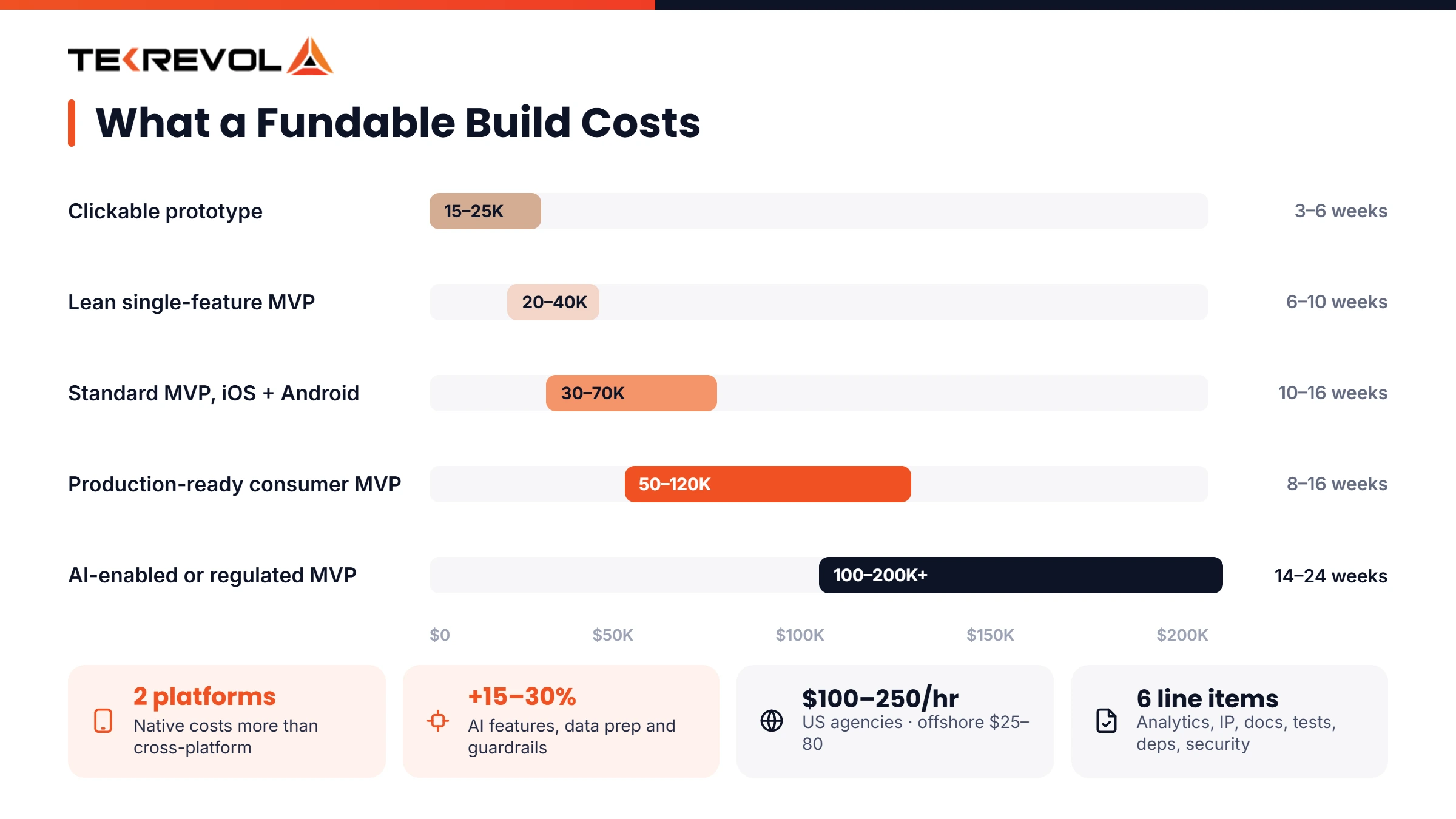
Use the table to plan, then price your actual scope.
| Build type | Typical range | Timeline |
| Clickable prototype | $15,000–$25,000 | 3–6 weeks |
| Lean single-feature MVP | $20,000–$40,000 | 6–10 weeks |
| Standard MVP, iOS and Android | $30,000–$70,000 | 10–16 weeks |
| Production-ready consumer MVP | $50,000–$120,000 | 8–16 weeks |
| AI-enabled or regulated MVP | $100,000–$200,000+ | 14–24 weeks |
What drives the number
Four variables move the price more than anything else:
- Platform count. Native iOS plus native Android costs meaningfully more than a cross-platform build.
- AI features. These add roughly 15–30% because of data preparation, evaluation, and guardrails.
- Team location. US agencies charge $100–$250 an hour. Offshore teams charge $25–$80.
- Compliance load. Regulated verticals carry certification runways that stretch timelines as well as budgets.
For reference, TekRevol’s own project work most commonly lands between $10,000 and $199,999. That’s a useful sanity check when you’re weighing a proposal.
What “investor-ready” adds to the scope
Functional and fundable aren’t the same thing. Beyond features, a fundable scope includes analytics instrumentation, a written architecture rationale, clean IP assignment, tests on core flows, a dependency inventory, and a security baseline.
Ask for those six as named line items. A proposal listing only features tells you exactly what you’d receive.
What Technical Red Flags Stall Austin Raises?
Four issues stall raises more than anything else: missing analytics history, IP assignment gaps, documentation written during the raise, and a demo that only runs on someone’s laptop. None of them are exotic, and all of them cost less to prevent than to explain.
Ownership red flags
- Unsigned contributors. One unassigned freelancer can hold up a close for weeks.
- Personal accounts. Repositories, domains, or store listings held by an individual rather than the company.
- Unreviewed licences. Copyleft dependencies buried in proprietary code.
Evidence red flags
- No analytics history. The most common problem by a wide margin.
- Docs written for the raise. Reviewers spot these, and they undercut every other claim.
- Twenty features, engagement in three. This raises focus questions you don’t want.
Engineering red flags
- A demo that isn’t production. If the impressive version only runs locally, that surfaces fast.
- Unmodeled infrastructure cost. Linear cost scaling becomes a margin conversation mid-diligence.
- One person who understands everything. Reviewers read this as a continuity risk, and they’re right.
- AI code nobody reviewed. New to this list in 2026, and climbing quickly.
- Security deferred indefinitely. Acceptable at pre-seed. Not at Series A.
Who Funds Early-Stage Startups In Austin?
Accelerators play a bigger role than most founders expect. Dealroom ranks Austin Ventures first by disclosed round count, but Techstars, Y Combinator, and Antler occupy three of the next four positions.
That mix should shape both your target list and your preparation.
| Rank | Investor | Type | Austin rounds | HQ |
| 1 | Austin Ventures | VC | 162 | Austin |
| 2 | Techstars | Accelerator | 98 | New York |
| 3 | Y Combinator | Accelerator | 91 | Mountain View |
| 4 | Antler | Accelerator | 46 | Singapore |
| 5 | Right Side Capital | VC | 39 | San Francisco |
| 6 | Alumni Ventures | VC | 36 | Manchester, NH |
| 7 | Floodgate | VC | 36 | Palo Alto |
| 8 | Andreessen Horowitz | VC | 32 | Menlo Park |
| 9 | NEA | VC | 31 | Menlo Park |
| 10 | Battery Ventures | VC | 30 | Boston |
Source: Dealroom.co Austin data, updated 18 June 2026.
Why the accelerator skew matters
Accelerator-heavy ecosystems are demo-day ecosystems. That format rewards products you can show working, briefly, with a number attached.
Which brings us right back to where this article started. Build one thing properly, track it, and be ready to prove it.
How Do You Prepare Before Your First Investor Meeting?
Run a four-part audit covering ownership, evidence, architecture, and engineering practice. If you can tick every box below, technical diligence becomes a conversation rather than an interrogation.
Work through it a month before you start pitching, not the week of.
Ownership
- [ ] Every contributor signed an IP assignment, including former co-founders
- [ ] Repositories, cloud accounts, domains, and store listings sit with the company
- [ ] You inventoried dependencies and reviewed their licences
Evidence
- [ ] Analytics run live, with at least one full retention cycle recorded
- [ ] You defined and measured an activation event
- [ ] Onboarding drop-off is visible by step
- [ ] Metrics are queryable, so follow-ups take days rather than weeks
Architecture
- [ ] You documented platform and stack reasoning during the build
- [ ] A diagram matches the current codebase
- [ ] Service boundaries surround the parts most likely to scale
- [ ] You modeled infrastructure cost per active user
Practice and compliance
- [ ] Tests cover your core flows
- [ ] Release history is visible
- [ ] More than one person understands the system
- [ ] You documented AI code usage and can describe your review process
- [ ] You assessed SB 2420 obligations if any users are under 18
- [ ] You reviewed authentication, encryption, access control, and logging
Why Build Your App With the TekRevol Austin Team?
Austin startups choose TekRevol as app development partner because we scope diligence artifacts into the build itself, so your app arrives fundable rather than merely functional. Analytics, ownership paperwork, and architecture documentation ship as line items rather than as afterthoughts.
Operating for the last 10 years, we’ve delivered 800+ projects across 11+ industries with a team of 500+ professionals. Clients rate us 4.8/5 on Clutch across 83 verified reviews, 5.0 on GoodFirms, and 4.8 on RightFirms.
What working with us looks like
- Full product builds across mobile, web, custom software, and AI
- Team extension when you have technical leadership but need capacity
- Clean handover with signed IP assignment and documentation a reviewer can read
Most of our project work falls between $10,000 and $199,999, which provides a realistic benchmark when comparing quotes.
Ready to Scope a Build Investors Can't Poke Holes In?
Get an itemized project estimate from TekRevol's product team within 48 hours.
Start with a Free Consultation


