



- React Native developers in Austin post about $113,425 a year, or roughly $55 an hour.
- Benefits push that higher, so a senior React Native hire really costs about $200,000 yearly.
- Austin holds roughly 11,100 React developers against only 2,370 React Native specialists, a considerable gap.
- That React crossover makes React Native the easiest mobile stack to staff in Austin.
- Ask when a candidate last upgraded, because React Native’s old architecture is now gone.
- One React Native hire covers both app stores, while native development means funding two engineers.
Here’s the problem most Austin founders run into. You need an app on both app stores, so you price out an iOS engineer alongside an Android engineer, and the payroll math stops the project before it ever starts.
React Native exists to solve exactly that, and Austin happens to be an unusually good city to hire for it. A React Native developer here posts an average of $113,425 a year, which works out to around $200,000 fully loaded for a senior. But the real advantage isn’t price. It’s that Austin has roughly 11,100 React developers, versus only about 2,370 React Native specialists, so your candidate pool is far deeper than the job titles suggest.
This guide covers what React Native developers cost in Austin, why that crossover pool matters, where to find people, what to ask in the interview, and when an Austin app development company beats a full-time hire.
Weighing a React Native Build for Your Austin Business?
Our React Native experts help define the right project scope, timeline, and budget for your app.
Get a Free App Consultation →How Much Does It Cost to Hire React Native Developers in Austin?
React Native roles in Austin post an average of $113,425 a year, or $54.53 an hour, per ZipRecruiter’s July 2026 data. Once you add benefits, a mid-level hire really costs about $165,600, and a senior one runs close to $200,000.
That figure sits neatly between the other mobile stacks, landing below iOS, above Flutter, and well under what Austin pays general software engineers.
| Data source | What it measures | Austin figure |
| ZipRecruiter (July 2026) | Average posted pay, React Native roles in Austin | $113,425 ($54.53/hour) |
| ZipRecruiter (July 2026) | Average posted pay, iOS developer roles in Austin | $122,904 |
| Built In Austin | Average base salary, general software engineers | $144,034 |
| BLS Occupational Employment and Wage Statistics | Mean wage, all Austin software developers | $139,390 |
Sources: ZipRecruiter, July 2026; Built In Austin; US Bureau of Labor Statistics OEWS, May 2024.
What Will a React Native Hire Really Cost Me?
Salary isn’t your real cost, because benefits add roughly a third on top. BLS puts them at 31.5% of total compensation for professional roles, which lifts a $136,800 senior salary to nearly $200,000 annually.
Here’s what each band actually costs once benefits are counted.
| Who you’re hiring | Advertised salary | What it really costs | Per hour |
| Junior | $85,200 | $124,380 | ~$60 |
| Mid-level | $113,425 | $165,584 | ~$80 |
| Senior | $136,800 | $199,708 | ~$96 |
| Lead | $155,619 | $227,181 | ~$109 |
TekRevol calculation. Salary bands from ZipRecruiter Austin, July 2026. Benefits ratio from BLS Employer Costs for Employee Compensation, March 2026, professional occupations.
Then add the costs nobody plans for: a laptop, both an iPhone and an Android device for testing, two app store accounts, and roughly three months before a new hire ships production code.
Our React Native app development cost guide breaks down how those pieces land across a whole build.
Is React Native Cheaper Than Hiring iOS and Android Separately?
Almost always, yes. One React Native engineer costs about $165,600 loaded and covers both app stores. The native route means funding two specialists, and an Austin iOS hire alone already costs more than a React Native one.
That’s the entire commercial argument, and it holds up in Austin. An iOS developer here posts $122,904 against React Native’s $113,425, and going native still leaves your Android side unstaffed.
The trade-off is real, though. Native gives you same-day access to brand-new phone features, and it’s still the better call for graphics-heavy apps. For most business apps, cross-platform app development reaches both stores for meaningfully less money.
Why Is Austin’s React Native Talent Pool Bigger Than It Looks?
Because React Native runs on React. Stack Overflow’s 2024 survey puts React usage at 39.5% developers against React Native’s 8.4%, so Austin holds roughly 11,100 React developers versus about 2,370 React Native specialists.
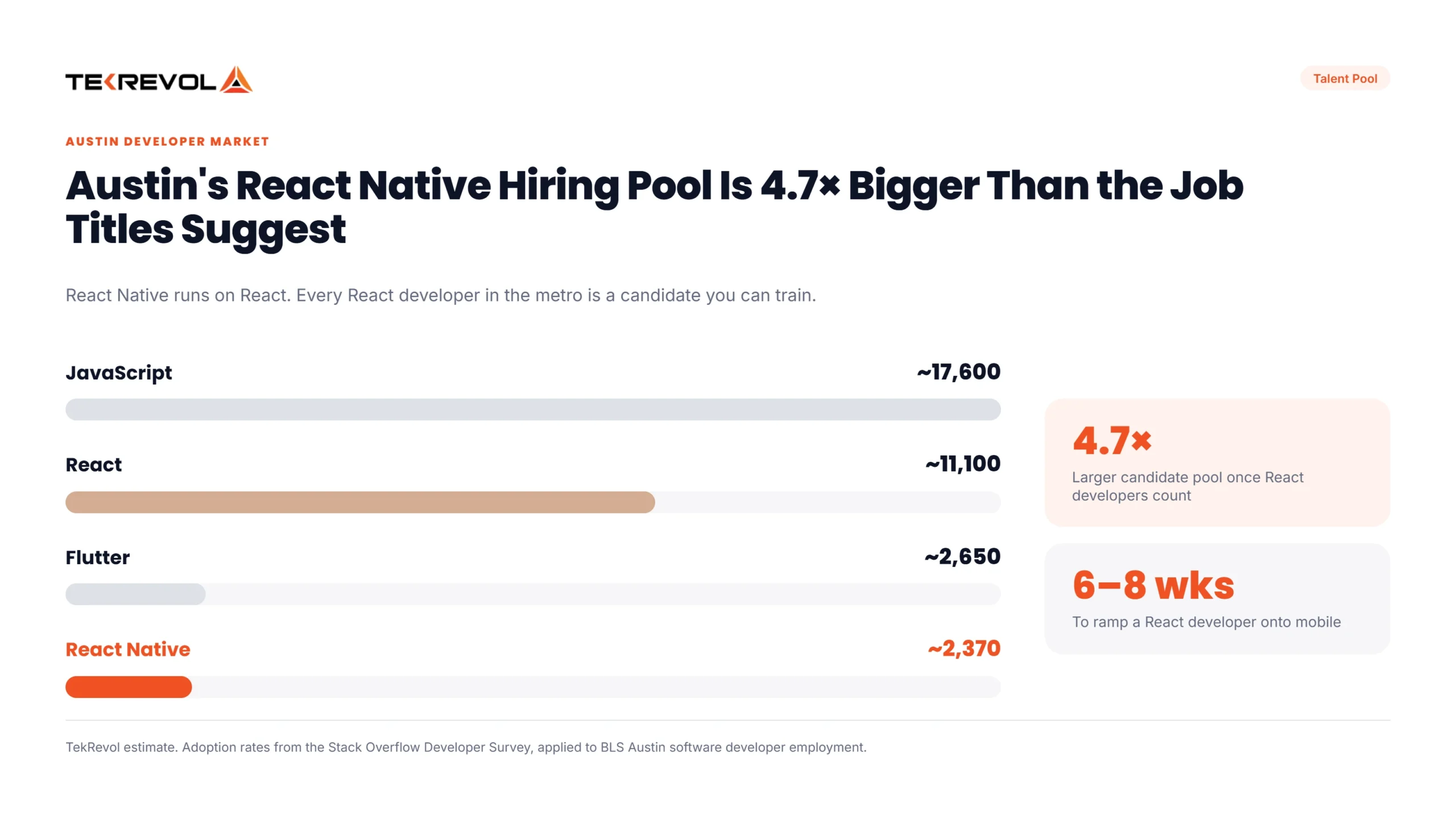
This is the part nobody writing about Austin hiring seems to mention, and it changes your search. Here’s the arithmetic, applied to the 28,210 software developers that BLS counts across this metro.
| Skill | Share of developers (Stack Overflow 2024) | Estimated Austin developers |
| JavaScript | 62.3% | ~17,600 |
| React | 39.5% | ~11,100 |
| Flutter | 9.4% | ~2,650 |
| React Native | 8.4% | ~2,370 |
So the pool of people who could work in React Native is roughly 4.7 times larger than the pool who already list it. That gap is your genuine hiring advantage, and it simply doesn’t exist for any other mobile stack.
How Do You Actually Use That Crossover?
A strong React developer with no mobile experience is a legitimate candidate, provided you plan for the gap. We’ve watched Austin teams do this well by being honest about exactly what transfers and what doesn’t.
- What transfers immediately: components, hooks, state management, TypeScript, and the whole JavaScript toolchain, which covers most of the day-to-day work.
- What doesn’t transfer: app store submissions, native modules, device permissions, push notifications, and testing on physical hardware. Budget six to eight weeks for someone to get comfortable there.
The practical move is to hire one experienced React Native engineer, then grow the rest of the team from your React bench. That’s much cheaper than competing for the 2,370.
Where Do You Actually Find React Native Developers in Austin?
Start with your own React and JavaScript network, then LinkedIn filtered for React plus mobile experience, and Austin app development firms with React Native teams already sitting on the bench.
Because of that crossover, your best sourcing channels here are web channels rather than mobile ones, which is the opposite of how you’d run an iOS search.
| Where to look | Who you’ll meet | How long it takes | Best for |
| Austin React and JavaScript meetups | Web developers curious about mobile | 3–6 weeks | Mid-level, with ramp-up time |
| LinkedIn, React plus mobile filters | People who’ve shipped both web and app work | 3–5 weeks | Mid to senior hires |
| Your existing web team | Developers who already know your product | Immediate | Growing a team internally |
| UT Austin, Texas State, ACC | Juniors with strong JavaScript fundamentals | 6–12 weeks | Roles you’ll train |
| Austin app agencies | Vetted React Native teams, ready now | 1–3 weeks | Full product builds |
| Staff augmentation partners | Developers who join your sprints | 1–2 weeks | Adding capacity fast |
That third row is the one Austin companies overlook most often. If you already run a React web team, your next mobile developer may already be sitting on your payroll.
If you’d rather see how the wider market prices this work, our roundup of React Native app development companies in the USA lays out the national field.
Should You Hire In-House, Freelance, an Agency, or Staff Augmentation?
Hire in-house when your app needs constant work for years. Use an agency when you need a whole app shipped. Use IT staff augmentation when you have a team but no mobile capacity. Use freelancers only for small jobs.
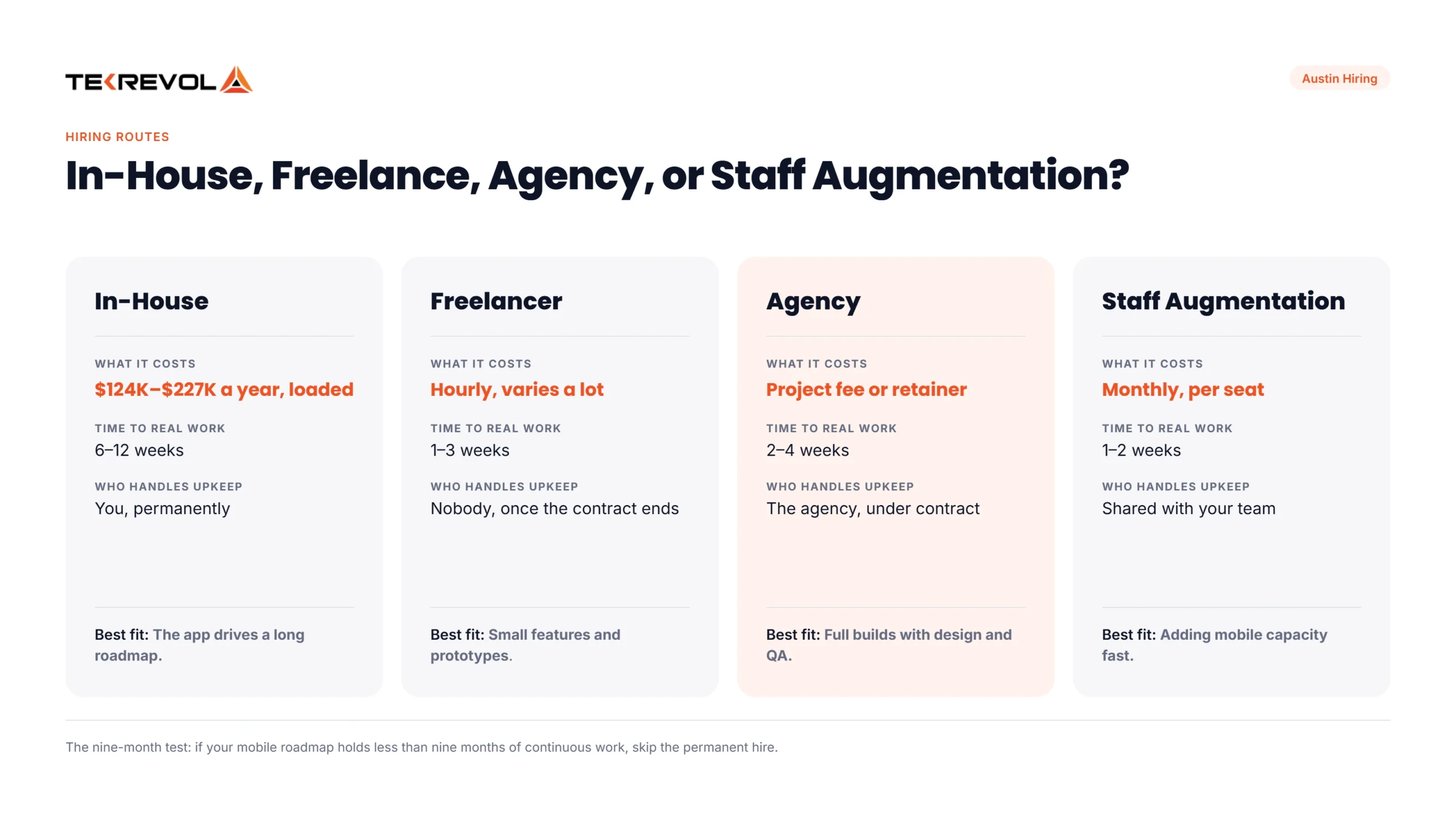
Most guides turn this into a rate comparison, but it isn’t one. The better question is who keeps your app shipping after launch, because React Native moves quickly and an app left alone falls behind fast.
| Route | What it costs | Time to real work | Who handles upkeep | Best fit |
| In-house | $124K–$227K a year, loaded | 6–12 weeks | You, permanently | The app drives a long roadmap |
| Freelancer | Hourly, varies a lot | 1–3 weeks | Nobody, once the contract ends | Small features, prototypes |
| Agency | Project fee or retainer | 2–4 weeks | The agency, under contract | Full builds with design and QA |
| Staff augmentation | Monthly, per seat | 1–2 weeks | Shared with your team | Adding mobile capacity |
Cost range comes from the loaded model above. We’re deliberately not quoting freelance or agency rates, because published averages for those routes are all over the map.
When Should You Not Hire Full-Time?
Use a nine-month test. If your mobile roadmap holds less than nine months of continuous work, skip the permanent hire entirely. You’d be carrying a six-figure annual cost for a seat that eventually goes quiet.
React Native has its own version of this problem. Both Apple and Google ship OS updates every year, and React Native itself releases every few months, so somebody has to keep pace with all three.
Plenty of Austin companies ship with a partner, then keep a small retainer for upgrades. It costs less than a headcount and beats hoping a freelancer answers.
Need a React Native Team Without a Twelve-Week Search?
Our Austin-based React Native experts are ready to join your project and accelerate development with proven cross-platform expertise.
Contact Our React Native Experts →What Should You Ask a React Native Developer in the Interview?
Ask when they last upgraded a React Native version, whether they’ve shipped to both stores, and who handled their releases. Those three answers separate real experience from résumé keywords, and you don’t need to be technical to hear it.
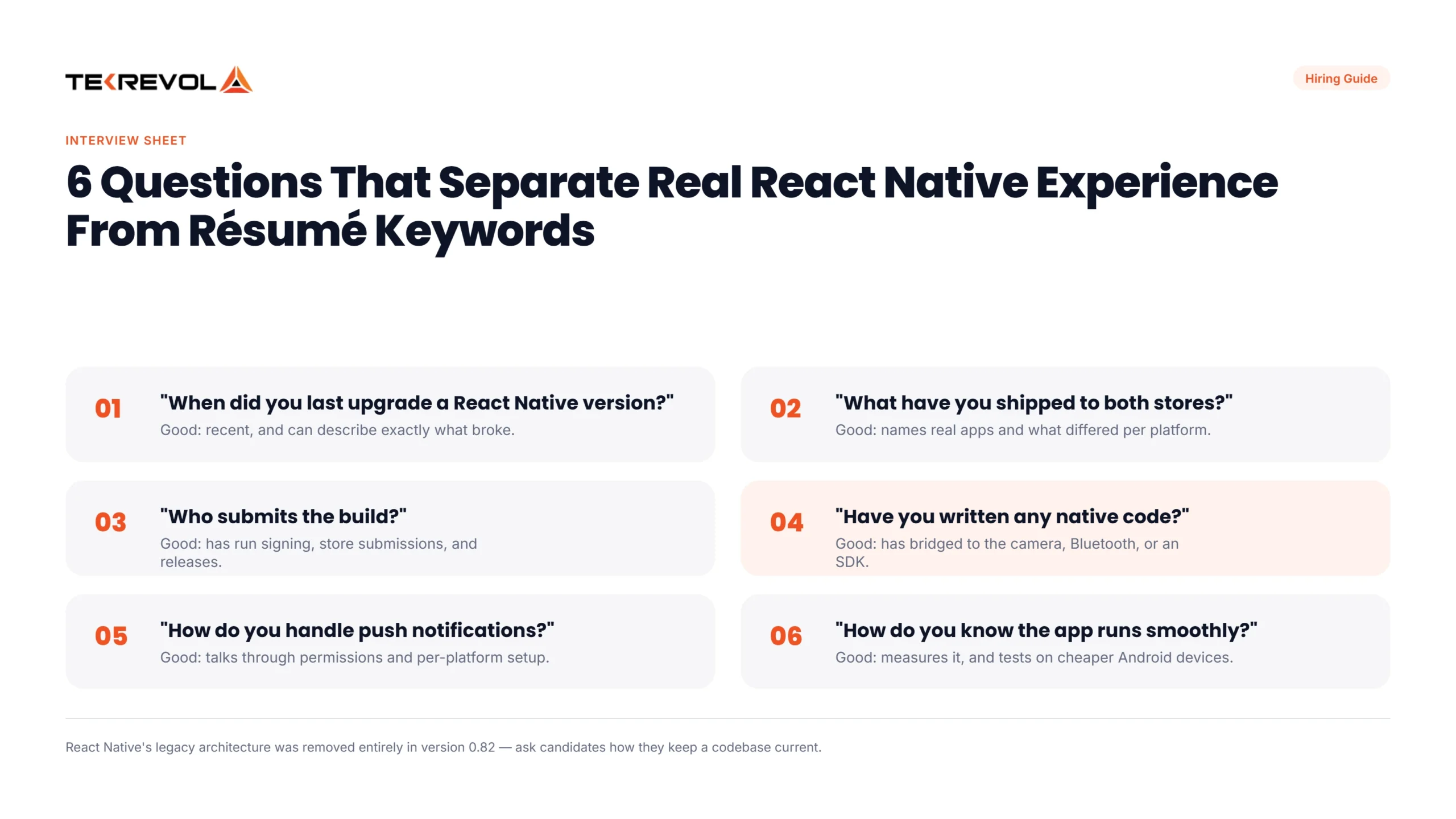
There’s a timely reason the upgrade question matters right now. React Native’s old architecture was removed entirely in version 0.82, released in October 2025, and the current release is 0.86 from June 2026. A candidate whose experience stopped before that shift has been building on something that no longer exists.
| Ask this | Worrying answer | What good sounds like |
| “When did you last upgrade a React Native version?” | “The team kept us on an old one.” | Recent, and can describe what broke |
| “What have you shipped to both stores?” | Only one store, or only test builds | Names real apps and what differed per platform |
| “Who submits the build?” | “Someone else handles that.” | Has run signing, store submissions, and releases |
| “Have you written any native code?” | Never touched it | Has bridged to the camera, Bluetooth, or an SDK |
| “How do you handle push notifications?” | Vague | Talks through permissions and per-platform setup |
| “How do you know the app runs smoothly?” | “It’s fine on my phone.” | Measures it, and tests on cheaper Android devices |
Original TekRevol interview sheet. Copy it straight into your hiring notes.
That last row matters more than people expect. React Native apps often feel fine on a new iPhone yet struggle badly on a mid-range Android, which is where plenty of your Austin users actually are.
For a deeper technical screen, our React Native app development guide covers what a panel should listen for.
What Are the Most Common React Native Hiring Mistakes?
The costliest mistakes are hiring a React developer without budgeting ramp-up time, ignoring React Native version upgrades until they turn into emergencies, and letting a contractor keep hold of your Apple and Google store credentials.
We see the same four repeatedly, and every one of them is entirely avoidable.
- Assuming React experience equals React Native experience. The crossover is real, but it isn’t instant. Budget six to eight weeks, and pair the person with somebody who has shipped mobile before.
- Treating upgrades as optional. Skip enough React Native versions and the eventual upgrade becomes a rewrite. Ask candidates how they’d keep you current, not merely how they’d build version one.
- Letting someone else hold your store credentials. Apple and Google accounts, signing keys, and store logins belong to your company from day one.
- Skipping a paid trial. Two weeks of real, paid work tells you considerably more than four interviews, so give the candidate a small, scoped task and see what comes back.
How Long Does It Take to Hire a React Native Developer in Austin?
Plan on 5 to 10 weeks for a full-time hire, which is faster than iOS or Flutter here because the crossover pool is deeper. An agency or staff-augmentation partner gets you working in 1 to 3 weeks instead.
Here’s where the weeks actually go:
- Sourcing: 2–4 weeks. Quicker than other stacks, since you can approach React developers too.
- Interviewing: 2–3 weeks. Screen, technical round, a small exercise, references.
- Offer: 1 week. Usually smoother, because you’re rarely bidding against Apple or Meta.
- Notice: 2 weeks minimum. Sometimes four, for senior people at larger employers.
Add ramp-up time if you hire from the React side rather than the React Native side. Six to eight weeks is realistic, and it’s still often faster overall than waiting for a true specialist.
What Does a Full React Native App Cost Versus Hiring One Person?
A senior React Native developer costs about $199,700 a year, fully loaded. But a shipped app also requires design, QA, backend work, and store submissions, so a single salary doesn’t remotely cover an entire product.
This is where budgets go wrong. A founder puts an agency quote next to a single salary and calls the agency expensive, but a functioning app team is rarely one person.
| What a shipped app needs | Does one React Native hire cover it? |
| React Native development | Yes |
| UI/UX design for both platforms | No |
| Testing across iOS and Android devices | No |
| Backend and APIs | Rarely |
| App Store and Play Store submissions | Sometimes |
| React Native version upgrades | Yes, while they’re on payroll |
Price those missing rows honestly, either as additional hires or contractors, and the real in-house total sits well above a single salary.
Why Do Austin Companies Work with TekRevol for React Native Development?
We work out of downtown Austin at 701 Brazos Street, with 80+ app development experts and 500+ apps delivered across 11 industries. A typical React Native build ships within two to three months, not two to three quarters.
Austin clients usually call us after one of two things happens: a React Native search stalls out, or an application built two years ago can’t be upgraded without a rewrite.
- A React Native bench that’s already assembled, so you skip the sourcing phase entirely
- A 4.8 out of 5 rating on Clutch across 83 verified reviews
- Results we can point to, including Reck’N at 65% ROI growth and 50% conversion growth
- An Austin office you can walk into, so reviews happen face to face
Clutch has also named us among the top React Native developers, which reflects how the same team is rated outside Texas.
Ready to Put a Vetted React Native Developer on Your Project?
Start faster with proven React Native expertise matched to your project requirements, timeline, and business goals.
Talk to Our Austin App Team


